

Table of Contents
No Easy Answers
by
Terri Beckett & Chris Power
An Adult S/H Novel
No Easy Answers is the third novel in the “Red Light Trilogy” by Beckett and Power. The first novel in the series, One More Mountain, is gen, and is available on this archive. The second novel, One More River, is slash, and is also available on this archive, as is the Epilogue, The Last Full Measure.
No Easy Answers, the zine, was published in 1988. As we do with most zines, we will post the novel as it appeared, including introductory material originally in the printed version, and the zine’s art.
No Easy Answers was originally produced on a typewriter, and had to be scanned to produce a digital format, then proofed. Special thanks and a bouquet of roses to SHaron for all her work bringing classic SH fiction to the online community.
NO EASY ANSWERS
by
Terri Beckett & Chris Power
© 10-13 Enterprises & Cat & Dragon Press, 1988. All rights revert to the authors and artists. NO EASY ANSWERS is an amateur publication intended solely for the entertainment of the readers. No attempt is made to infringe on copyrights held by Spelling-Goldberg, BBC, or any other organization or individual holding copyrights on STARSKY & HUTCH.
* * * * * * * * * * * *
Acknowledgements
Our grateful thanks are due to:
- Kathy, who typed every draft with unflagging willingness. Oh, the joys of a word-processor!
- Paula, for yet another fine job of editing, turning a mediocre first attempt into the result you hold now.
- Jody, for encouragement, devotion, and infinite patience. Without her, this wouldn’t have been ready for another year!
- Suzan, for producing a stunning portfolio with just an outline to work from.
- Dargelos, for permission to use her “Starsky” portrait as our frontispiece.
- All the ranks of fandom. Your continued interest made this happen!
* * * * * * * * * * * *
Credits
Typing, 1st, 2nd, 3rd and final drafts: Kathy H.
Proofing: Whoever we could blackmail.
Editing: Paula S.
Distribution: Cat & Dragon Press — Jody
Illustration:
frontispiece — Dargelos
All others: Suzan Lovett
* * * * * * * * * * * *
APOLOGIA
Before you turn to page 1 and dive right in, a few words to you, dear reader. When we first conceived the idea of the RED LIGHT trilogy, some years ago, we didn’t think it’d take this long. And, frankly, the whole mood of the piece has changed somewhat from our original outline. But we think it’s still valid for the Starsky and Hutch we saw on the screen, and who we developed through ONE MORE MOUNTAIN and ONE MORE RIVER.
People change with the passage of time. We have, and it seems logical that if we are following the ‘real’ lives of ‘real’ people, then they too will undergo changes. Some for the good—some less so. Change is a fact of life. Without it, we stagnate—and so would they. That’s reality. There are other kinds of reality, and some of them are in this story. We make no apology for any of this.
But we do apologise for keeping you waiting. You’ve been very patient. So now, read on. And, if you can, enjoy.
Wild weep and wail, and mourning-torn clothes;
Let me sing Kaddish for my dead—for us,
For all the high lake-gold and water-cold skin!
He was bright enough to burn the sun!
To burn the heart from me,
The long-limbed, sunbrown, wind- and water-blessed
Swift-pleasured smiling fire.
Where has it gone?
Sun mocks, flicks paradoxes acid in my eyes.
Beautiful blue-skied, gilded, light-aired world;
Even at noon the poisons seep into the gutters and the drains,
Heart’s ashes sift through gratings,
Feed the shit-rich rats and copse-fat worms;
A pinch of seasoning at an unclean feast.
I have been portioned out and shared around
Those yellow teeth and knives,
All the long worms feasted on my blood
And all the yellow eyes fed on my screams.
My futile screams.
My heart’s ashes silt my veins,
Sometimes shaving the blade is poised to cut,
Expecting all the rank and blackshit poison
To exhale and vapour from the open wound.
Dead men don’t bleed. It wouldn’t work.
And if I’m dead
Am I not wise
Protecting him from necrophilia?
Sing Kaddish for my dead:
For all the bright-skied, honey-mouthed, wind-brisk laughing love
For all our certainties.
* * * * * * * * * * * *
Pamela Freeman
16.1.1984
FRONTISPIECE

Starsky by Dargelos
PART 1
CHAPTER ONE
At three o’clock in the morning, the mocking birds in the lemon tree in the yard began to sing. They always did. The man looking blindly out into the darkness wondered vaguely how the birds knew what time it was. Or if they cared. Whatever, they had started their morning serenade with the usual liquid trilling, heralding the coming of sunrise and the beginning of a new day.
A new day. And it didn’t feel as if he’d finished with the old one yet. Hadn’t slept. He ran one hand wearily through his tousled hair, glancing over his shoulder at the figure in the bed, lying quiet as always, fair hair catching what little light there was and gleaming like a halo on the pillow. The sight gave him comfort, as it always did. Times like these, it was good to have a partner. But Hutch seemed to have other ideas on that.
“Davie?” His bedmate wasn’t asleep after all. “What is it, love?”
“Nothing,” he said quickly. “I woke up early is all. Go back to sleep, babe.”
“Horsepuckey,” said his wife brusquely, sitting up in the bed, the sheet falling into her lap. “You haven’t slept all night. I should know. You going to tell me what the problem is? Or do I guess?”
“Sal — ” Dave Duplessis began, but she patted the bed at her side.
“Come on, darlin’. Come and tell momma all about it, huh?”
The feel of her, warm under the satin and lace of her nightgown, made him aware of how chilled he’d gotten standing at the window. She smelled of sleep and the Chanel No. 5 that he’d bought her last birthday, which she’d said was too expensive to wear anywhere but in bed. He rubbed his cheek against her shoulder, closed his eyes, and sighed.
“Problem?” she prompted.
“Oh, just cop stuff. You know.”
“I should. I married one.” She was stroking the back of his neck, fingertip light, inviting confidences. “Davie—it’s not just cop-stuff. Can’t you tell me? I want to help, you know that.”
“S’not me who needs the help, honey. It’s Hutch.”
She was quiet for a minute. “It was Starsky who got hurt, wasn’t it?”
Duplessis nodded. Sally didn’t know exactly what had happened to Starsky. She didn’t know that he’d been the victim of a brutal rape while undercover on the same case her husband had been investigating. She didn’t need to know, and he wasn’t telling her. The fewer people who did know, the better. But she did know that he’d been ‘injured on duty’ a few weeks ago. And she’d seen Hutch in the days following.
“Yeah. But he’s okay. Seems to be okay,” he amended. “There’s another Review Board next week. Hutch — well, Hutch is kinda edgy.”
“He was like that last time,” Sally reminded him.
“Don’t I know it. But this—this is different.”
It sounded lame to his own ears. How to explain what he could see happening to Hutch—the fraying nerves, mood swings, the ragged edge of breakdown—the classic signs of stress? How to explain it without revealing what else he knew—that Starsky and Hutch were not only partners, but lovers, and that Hutch was almost certainly still blaming himself for not having somehow prevented his lover’s rape.
“Guilt-trip?” Sally suggested, startling him. “He’s just the type, Davie. Starsky got hurt, and he’s convinced himself that it’s his fault.”
“Something like that,” Duplessis hedged. “Maybe.”
Gently, Sally pulled him down to lie beside her. “Well, as much as I like Hutch—and Starsky—there’s not a lot you or I can do for them. They just have to work it out for themselves, darlin’.”
“Yeah. I know. Don’t get involved. Right?”
She kissed him. “You wouldn’t be Dave Duplessis if you didn’t get involved. You care, lover, and that’s one of the things that makes you special. Hutch is your partner until Starsky gets back on duty—of course you worry about him. But you shouldn’t be losing sleep over it.”
Good sense. Sally always talked sense. He put his arms around her, held her tight, and tried to banish the niggle of worry to the back of his mind.
Outside, the mocking birds launched into Opus #2.
* * * * * *
Damn you, David Starsky. Jaqi pulled her velvet wrap more securely around her, tucking her feet up on the satin cushion of her peacock chair, and looked again at the man lying insensible in her bed. Face half-buried in the pillow, jaw shadowed with blond stubble, hair tangled into ungroomed elf-locks, he was snoring slightly, too dead asleep to know it. Damn you for doing this to him.
She’d lost count of the number of times Hutch had come to her in this state during the long months of his partner’s convalescence after being shot last year. Alcohol had been his only way off the treadmill of stress, overwork, incipient burnout, and the added continual worry over Starsky’s recovery. But Starsky had recovered. And Hutch had become again the man she had first met and grown to love, no longer needing the crutch of alcohol to steady him.
She had met David Starsky. Liked him, so far as she could on one acquaintance. Still did, even knowing now the relationship he had with her lover. But she had recognized, even then, that it wouldn’t work. ‘ . . . you’re going to end up with more pain than you thought possible.’ She hadn’t wanted to be proved right.
The change hadn’t been sudden—over a period of a few weeks, beginning with the undercover assignment that had culminated in Starsky’s undefined injury, she had seen the tension building in Hutch again. And then, after a period of not seeing or hearing from him for maybe ten days, he had turned up, last night, unannounced on her doorstep.
She had not known what had happened to put him in that state once again—hopelessly drunk, incoherent, maudlin — but she could hazard a guess. The idyll was over, and Hutch couldn’t handle it. When he sobered up, would he be miserable, apologetic and uncommunicative. She shrugged to herself. She didn’t know why it had happened. But the old pattern was plainly reasserting itself.
She could do nothing. He wouldn’t—couldn’t—confide in her. All she could do was take him in, put him to bed, help him sober up, be a shoulder to cry on when eventually he needed it. But nothing else. The helplessness of watching someone she loved hurting, and being unable to ease the pain—that was hard.
Damn you to hell, David Starsky.
* * * * * *
The files on the Escort Agencies murders were growing ever thicker, and although Hutch was no longer directly involved with the case, there were plenty of people to keep him up-to-date. What had seemed a complicated web of a case had simplified itself down to a consortium specializing in supplying vice and home comforts to VIPs on both sides of the law, guaranteeing at all times 100% security and discretion. Pinning down those specifically involved with the murders of Chris Villiers, Drew Connery, and Richie Sandovall was not so easily done. But it was on these crimes the police investigation concentrated. The drugging and “assault” of one David Starsky, an undercover officer, figured low down on the list of priorities, except where it might lead on to the murderers.
Babcock was Hutch’s main source of information, and it was he who passed on the latest information joining them in the cafeteria where they were putting away coffee and sandwiches.
“We got a break,” he said quietly, leaning between Hutch and Duplessis, a hand on each man’s shoulder. “Munro, the barman who slipped the mickey into Starsk’s drink? he wants a deal. He’ll retract his retraction if we give him a new face, cash, and a passport with a one way ticket out of America. The D.A. is talking it over, right now.”
“That’s good news,” Duplessis said. He had a damned good idea why Babcock was keeping them—or rather, Hutch—in touch with the progress, and it was more than cops sticking together. Babcock had walked the blood-soaked track left by Richie Sandoval. Drugged and mutilated, the young man had dragged himself a long way from where he had been left to die. Babcock did not have much imagination, but it didn’t take much to put Starsky in Sandoval’s place.
“Once we got the go-ahead on that, we can question Felix Corey over again, and a few others. We’ll get the bastards, sooner or later.”
“Yeah,” said Hutch. “Thanks.”
“No sweat,” and the detective left them with bitter, uncomfortable thoughts.
* * * * * *
“Intruder,” said the radio. “Hotel Malibu, West 5th Street, Room 351. Possible robbery. Units in the vicinity, please respond.”
“We’re just down the block,” Duplessis said.
“Go for it,” Hutch answered, reaching for the mike.
As hotels went in that part of the city, the Malibu was pretty good, catering mainly to tourists. They were met in the foyer by the manager, a man more irritated than alarmed.
“That was fast,” he said. “But even so, they’ll be long gone. Of course, no one’s gone into the room, so I don’t know what’s been taken. Or damaged,” he added. “We don’t get many break-ins, but when we do, they usually seem to create as much mess as possible.”
“Yeah,” said Hutch. “We know the pattern. Who reported it?”
“The Hansons. They heard movements as they were about to go in. They came straight to me.”
“Did they make any noise? Put the key in the lock, bang the door?”
“Uh, yes. Both of those, and a yell of ‘who’s there!'”
“Okay. Does the room overlook an alley?”
“Yes. Right at the back, between the hotel and the shoe store on the next street.”
“Check it out, Dave. Okay, Mr. — ?”
“Ledbury.”
“Mr. Ledbury, let’s take a look at the apartment.”
A porter showed Duplessis the way out and round to the back. The alley matched the hotel; better than some in the city. It was dark, but relatively uncluttered with garbage cans and heaped rubbish. Maybe because of this, it did not seem to have any resident winos. But it was occupied. There was a neat pile of empty cardboard boxes stacked outside of the kitchen entrance of the hotel, a couple of yards away from where they stood. There was a narrow gap between it and the wall, and in the shadow-blackness, Duplessis thought he saw movement. A small, furtive, and silent movement. It might have been anything from a rat to a hobo, but if it was human, it might tell what—if anything—it had seen.
Not being one to take foolish chances, Duplessis took out his gun and edged closer. “I’m an armed police officer,” he said quietly. “Come out with your hands away from your sides.”
“Can’t,” said a small gruff voice. “Hurt my leg.”
“When? How?”
“This guy jumped on me. He was on the fire escape.”
“When?”
“Just now. Don’t shoot, huh?”
“What’re you doing in there?”
“I was scared. So I hid.”
“So come out. If you got in there, you can get out again.”
There were scuffles, a few grunts, and a boy of about fourteen shuffled out on his backside. By the look of the dark hair raggedly cut across forehead and collar, he was of Latin American stock. He didn’t try to get up, just sat there huddled over in a denim jacket several sizes too big over a plain red tee-shirt and blue jeans.
“What’s your name?” Duplessis said crisply.
“Don Amuergo.”
“You with a street gang, Don?”
There was a slight pause. “No.”
“Sure?”
“Said so, didn’t I?”
“Okay. So tell me about this guy who jumped you.”
“Jumped on me. From up there. Like, I was in the way and he wasn’t stopping.”
“Describe him.”
“Uh, twenty—twenty-five, about six foot, dark hair. White.”
“Wearing?”
“Green shirt. Blue jeans.”
“Carrying anything?”
“Don’t think so.”
“Okay, Don. I’ll tell you what I think. I think it was you who came down off that fire escape, only you didn’t make a good landing, and you damaged your leg.”
“Bullshit!” the boy snapped. “You pigs are all alike.”
“Then it’s okay if I search you.”
“I want a lawyer.”
“Don’t need one if you’re telling the truth. Stand up.”
He did more than stand. He came to his feet like a released spring, but an obviously painful ankle slowed him enough for Duplessis’ first grab to hook onto the collar of the jacket and the shirt beneath.
“That was dumb,” the detective said grimly. “Hutch!” he yelled. “Hear me up there?”
“Yeah. Loud and clear.”
Duplessis glanced up, one fist twisted firmly in fabric. Hutch was leaning out of a third floor window, six feet away from the fire escape ladder. Not an impossible jump for a young, fit cat-burglar. “Could be we’ve struck lucky. There’s rings, necklaces, and a fancy gold watch missing.”
“Let’s see what Don’s got in his pockets,” Duplessis grinned, “C’mon, punk. I’ll bet even money you know the procedure from here on in. Hands on the wall.”
“You can’t do this! I’m a juvie—” the boy yelled, voice no longer gruff. It was clear as a struck bell, and an octave higher. The pulled-open jacket revealed the swell of breasts under the tee-shirt, and there was a certain maturity to the bones of the dirty face. And in the first pocket Duplessis emptied was a tangle of gold and jewels, including a beautiful wristwatch with a chased gold bracelet-band.
“Jackpot,” he called, “We got us a female Raffles.”
“Read her her rights, and we’ll take her in. Is she hurt for real?”
“Dumb pigs!” she yelled. “My fuckin’ ankle’s swollen like a balloon!”
“Yeah,” said Duplessis. “Looks like she might be.”
“We’ll go via the hospital.”
* * * * * *
Her name was Donna Amuergo, she was nineteen, and had a record of petty theft that started when she was nine. Shoplifting, mostly, and the occasional purse snatch. But she had kept out of trouble for four years before launching a new career in burglary. Even with a cigarette in her mouth, she still looked like a fourteen-year-old boy. The effect was obviously deliberate. The search that Minnie and another woman officer had conducted revealed that her breasts had been bound flatter with wide strips of rag, and padding had been sewn into the shoulders of the jacket to make them seem wider.
She wore no make-up, and though there were holes in her earlobes, she wore no earrings.
The latest photograph in her file showed a pretty girl with long dark hair and a confident, challenging stare. That was at fifteen. Her brother ran with the Diabolos, and was a close friend of Damio, one of Moynihan’s suppliers.
“Anyone set you up to rip off that hotel room?” Duplessis said quietly.
“No,” Donna answered stubbornly.
“How much was Tip Moynihan paying you?” Hutch snapped. “Couldn’t you make enough on the street?”
“I’m no hooker!” the girl flared, “an’ I don’t work for Moynihan nor anyone else!”
“What’ve you been doing for the last four years?”
Duplessis cut in, voice sympathetic. “This is the first time you’ve been picked up for quite a while, and it isn’t for the sort of things you used to do.”
“Natural progression,” Hutch sneered. Good-cop, bad-cop routines were something they had down to a fine art now.
“Fuck you!” Donna yelled. “I got a job!”
“In a massage parlor?” from Hutch.
“No way! I work for old Mendiz in his grocery store, and I go to night classes!”
“Then why risk all that by breaking into that hotel room?” Duplessis said over Hutch’s snort of disbelief.
She hesitated for a split second. “I needed the money,” she said sullenly.
“For the night classes? What are you studying?”
Her face suddenly twisted, but she forced back the tears. “Want to be a nurse,” she whispered. Then: “None of your fuckin’ business! You gonna charge me? So do it!”
“I want to know why you did it,” Duplessis leaned forward, expression earnest. “I think it wasn’t your choice. Was it your brother? Damio? Moynihan?”
Donna’s body became rigid, hands clutching the table edge like talons, the knuckles showing bone-white. Her face was starkly pale, eyes wide and staring, mouth a rictus of what looked like terror. “No,” she said in a monotone. “No no no no — ”
“Christ,” Duplessis muttered. “That hit a nerve. Take it easy, honey. Tell me what’s goin’ down, huh?”
“Don’t touch me!” she screamed, although he had not moved. “It was me, no one else! Don’t call me honey, you motherfucker!”
“Donna — ”
“It’s Don. I’m a dyke. Want to make somethin’ of it, pig?”
Hutch sat frozen in his chair, unable to speak for the moment. Minnie had also found severe and recent bruising all over the girl’s body, as if she had been beaten up. But her reactions were all too familiar, and suggested a more serious assault.
“We want to help you,” he heard Duplessis say, and knew exactly what her response would be.
“I don’t need help! Not from you, or anyone! You’re all the fuckin’ same!”
“Everyone needs help, girl,” Hutch said gently, “especially when the world’s kicked us in the guts. Who did it to you? Who raped you? Tell us who did it, and we’ll make sure they pay for it. Help us to get them.”
She stared at him in confused horror and Duplessis got quickly to his feet. “That’s about it, Don. Me and my partner are going to have a talk outside. Officer Kaplan will stay with you. Hutch,” he continued, and indicated the door with a jerk of his head. “Out here.” Mouth and jaw were set in controlled anger and Hutch, caught up in the overlap of Starsky’s and Donna’s turmoil, was taken entirely by surprise when that anger was directed at him. A stiff armed shove slammed him back against the wall, and Duplessis closed in.
“Don’t you ever pull a stunt like that again!” he hissed. “We are cops, not problem counselors, and you keep your own personal crises out of our jobs, understand?”
“But — ”
“No buts! You could have blown the whole thing, and we might lose a good lead on Moynihan. Just pray Minnie can salvage something out of this.”
Hutch spun around defensively. “Yeah, okay, okay. But she was just so like — ” He stopped, held up his index finger in a warning gesture. “Don’t push me.”
Duplessis paused. “Let’s go get a cup of coffee, give Minnie a chance to work.” Morosely Hutch followed him to the cafeteria. Duplessis was right, and the knowledge was bitter.
By the time they returned to the interview room Minnie had done more than salvage work and was waiting for them outside.
“You guys have got the luck of the devil,” she said. “The poor little girl was attacked by her brother and some of his friends. They told her to work the hotel rooms or they’d do it again. Seems like they were getting ambitious, wanted more gold for Moynihan and more stuff for themselves. Like watches, credit cards, wallets, anything they could fence or spend. She won’t testify against them, of course. Scared they’ll do it for revenge, but she’ll tell us all she knows about the gang’s link with Moynihan. As long as we keep her name out of it. She can convince them she escaped without being seen, and can use her ankle to keep out of shit. Does she have a deal?”
“Well, she hasn’t been charged with anything,” Hutch said. “I think we could get Dobey to see it our way.”
“If her information is worth it,” Duplessis added dryly.
“Oh, I think you’ll find it useful, Davie-boy,” she smiled. “Take it very carefully with her. She just plain hates men for what was done to her, and who can blame her for that? I’m giving her names, phone-numbers to contact for help and counseling.”
“Thanks, Minnie,” Hutch said quietly. “I owe you.”
“Yeah,” she agreed.
Hutch let Duplessis take the statement. He went to the cafeteria and sat at a corner table with his head in his hands. He was cracking up. Couldn’t take much more of this.
“Oh, Christ,” he sighed. But he had to pull himself together. Starsky needed him. Didn’t he?
* * * * * *
“Here y’go, Starsk.” Minnie put a fresh cup of coffee down at his elbow.
“Thanks, Minnie. You’re an angel,” Starsky said around the pencil between his teeth, not pausing in his typing.
“You’re doin’ real good, now. Gonna miss you when you go back on the street.” She looked with approval at the stack of completed reports—fruit of his day’s labors.
“You’re just sayin’ that,” he gave her a smile, which managed to look positively piratical, “’cause you don’t want to lose my pretty face around here.”
“Trashy boy,” she scolded, swatting him lightly with a file-folder.
“That’s me,” he agreed, finishing a page and ripping it clear with a flourish.
He was doing real good, she acknowledged silently But Hutchinson needed his ass kicked. The way he’d been acting . . . . She gave a small shake of the head. If he were the one facing a Review Board, he’d be off the force so fast his ass would blister. Which was a shame. It was a cute ass.
Right on cue the squadroom door opened and Hutch came in. He was snapping a reply over his shoulder at Duplessis as he entered, but his gaze immediately swung to Starsky, checking him out with a tense anxiety that made Minnie swear under her breath.
“Okay?” he asked, an odd note of caution in his voice. But Starsky looked up with a smile.
“Yeah, I’m fine. Aside from typing my fingers to the bone.” The expression on his face was warm with tolerance and understanding, and Minnie wanted to hug him. “You and the kid look like you could use some coffee.”
“Don’t call me kid,” Duplessis said, in automatic response.
“Haven’t got time. Just checked in to pick up that file.” Hutch rummaged through the clutter on his desk. “It’s not here.” He looked up, scowl fixing on Minnie. “Did someone take it?”
“Take what, Blondie?”
“The file on Moynihan. I put in a request for it yesterday morning. A written request.”
“He did,” Starsky confirmed. “I typed it.”
“Well, bully for the both of you,” Minnie cooed. “Then I guess it’s in the system and R&I’ll send it right along when they get around to it.”
“It’s about time someone woke them up!” Hutch shoved papers out of the way and grabbed his phone. “What the hell do they think they’re playing at? I need that information now, not next year!”
“Ease up, sweetie,” Minnie counseled. “Yours isn’t the only case they have to deal with, y’know. What are you trying to do? Give yourself—and us—ulcers?”
“How the hell can I conduct an investigation without help?” Hutch growled, plainly ready to mount a one-man war against bureaucracy. “And this isn’t the first time!” He warmed to his subject.
“Hutch,” said Duplessis.
“They conveniently lost the Horowitz papers for five days—five days—”
“Hutch — ”
“And they’re not gonna pull the same stunt now! What?” he barked, rounding on Duplessis, whose grin would not be smothered, and looked as if he couldn’t decide whether to be placating, ingratiating, or just plain amused. Duplessis was holding up a buff folder.
“It was on my desk.”
“Your desk?” Offered a new target, Hutch forgot R&I. “Since when were you promoted, huh? Who put you in charge of this fuckin’ case? Well, come on. We’ve lost enough time as it is.” He snatched up the file and stalked out.
Duplessis followed with a shrug and a wry wink for Minnie.
“One of those days, I guess.” Minnie picked up the papers Hutch’s impatience had scattered on the floor. “Give me one good reason I shouldn’t bang his head against the wall,” she asked the room in general.
“I guess,” said Starsky, voice neutral, “he’s got a lot on his mind.”
Minnie’s snort was expressive. “And you haven’t, I suppose.”
“I get by,” he said, and went back to his typing.
* * * * * *
When Hutch returned to the squadroom at end of shift, he paused long enough to pour himself a cup of coffee, made no attempt to tidy his desk, and placed the Moynihan file pointedly and with precision atop the jumble. By the time the coffee was half finished, the room was almost empty, in the strange limbo between one shift logging off and the next taking over. Hutch abandoned the mug and the bitter dregs, and headed slowly for the locker-room. It was deserted by the time he got there, except for the solitary figure astride the bench.
“Want a ride?” Hutch asked superfluously.
“How else am I getting home?” Starsky wanted to know. “Yeah, I want a ride. You’re late. Do you feel as lousy as you look?”
“Lousier.” Hutch waited for Starsky to volunteer to do the driving, but the offer didn’t come. He sighed. “Okay, partner. Let’s go.” He nearly said ‘home,’ but somehow the word stuck.
The traffic was its usual rush-hour pattern, fast and homicidal, with every man for himself. Waiting at a red light Hutch glanced at his partner. Starsky hadn’t said word one since they got into the car. He looked tired, but there was no tension there. His hands rested in his lap, long fingers relaxed. But the weariness was more than physical—reason enough for not wanting to take the wheel? He never did, now.
The Torino sat at the roadside, accumulating a layer of dust and grime, inscribed with finger-drawn graffiti from neighborhood kids.
“If you’re still antsy about driving — ” Hutch began.
“I’m not.” Flat statement.
” — why don’t you mention it at your next counseling session?”
“Nothing to mention. The light’s green.”
Hutch pulled in behind the Torino outside Starsky’s apartment and Starsky got out, shutting the door carefully behind himself. Hutch took a deep breath.
“Do you want me to come up?” he asked tentatively. Starsky paused, but didn’t look at him.
“Do what you like,” he said. Nothing could be read from the expressionless voice or the set of shoulders and spine. Nothing at all. For a moment Hutch’s hands clenched on the steering wheel. Nothing changes . . . but you keep right on trying.
Got no choice.
“Okay,” he said, and climbed out of the car.
Since Starsky walked straight past the mailbox, Hutch checked it and removed the contents, following him into the apartment.
“Bill . . . bill . . . advertising . . . this looks like a letter from your Mom,” he said, taking off his jacket and dropping it over a chair, then handing over the bundle of envelopes. Starsky tossed the mail unlooked-at onto the coffee table. Then he switched on the television and sprawled on the couch.
“Looks like we may be getting somewhere with the Moynihan case,” Hutch said over the gabble of prime-time. “We’ve found a link with a couple of kids from the Diabolos on Eighth. All we need now is the next fence in the chain . . . ”
“Hutchinson,” Starsky cut in, contempt frosty in his tone, “you’re talkin’ with your mouth again. You want to be here, so do something useful.”
Hutch’s hope and false buoyancy dissolved under the acerbity. It was part of an increasingly familiar pattern — the mood-switch would cut in somewhere along the road home. Hutch had not yet managed to isolate the exact moment, nor did he know why it happened. “So what do you want to eat?” he asked, ignoring the hostility.
“Suit yourself.”
No, dammit, you ‘re going to make a decision!
“We can send out for pizza, I guess. What do you want on yours?”
He got no direct answer, Starsky merely turned up the sound on the T.V.
Sure, Hutch, pizza’ll be fine: pepperoni, mushrooms, heavy on the anchovies. Okay, Starsk, consider it done. Thanks, partner. No sweat, for a partner.
What he said was: “I’ll fix some scrambled eggs.”
* * * * * *
The meal took its predictable course, and Hutch retreated to the kitchen to wash the dishes. As usual, Starsky had pushed his food around the plate, spent more time finding fault than eating. At the same time, Hutch knew that if the meal hadn’t been prepared for him, Starsky wouldn’t have eaten. He was needed here, in spite of appearances. The psychiatrist had warned him of the power plays that would almost certainly develop, and sure enough they were appearing with increasing regularity.
“A need to exert control,” Jerry Greenroom had said. “Go along with it.”
So he had. It was not always easy. Part of the time, though, Starsky was maneuvering him so that choices, decisions, should be his, perhaps needing to be convinced over and again that nothing had changed. Except that everything had. Or at least, that Hutch’s commitment had not changed. Or maybe that was wishful thinking on Hutch’s part.
Everything changes; nothing stays the same. We accepted that, when we first became lovers: the inevitable changes in attitude, in lifestyle, in the way we think, act, relate. Life itself is change. We coped with it. People do, or go crazy. And I can cope with this—I know you got problems, goddammit, I know you’re hurt and scared and screwed up inside, but you’re not alone. I’m here. If you could just acknowledge that —
But I can cope. I just need one constant to hang on to.
We used to have that. Right from the beginning, long before we became lovers, we had that because we had each other. Someone to trust, someone to rely on, whatever came down. And after that, the love.
‘He was my north, my south, my east, my west;
My working week, my Sunday rest,
My noon, my midnight, my talk, my song
I thought that love would last forever.’
I was wrong.
When are you going to grow up, Hutchinson? Quit seeing the world through a rosy glow of everything-is-beautiful?
You did that to me, Starsk. I used to see things clear, all the crud and shit in crystal clear microscopic detail. Then you loved me, and turned my head around, and I couldn’t see anything but you.
I still can’t. Even now, when you’re hanging on with one hand and pushing me away with the other, when you act like you hate me but can’t live without me. I still love you, David Michael Starsky.
Guess that’s my constant.
Guess I hang in there.
Guess I got no choice.
* * * * * *
Starsky was sprawled on the couch again when Hutch came back to the living room. For a moment that relaxed, untidy slouch revived a flicker of hope.
“Get me a beer.” Hope took it on the chin, and Hutch gritted his teeth, obeying without comment. When he got back, Starsky had moved to the chair.
So Hutch took over the couch, consciously trying to unravel the tension that ached through every muscle. Okay, Starsky needed his care, needed a target, needed proof of his love. A pity the target was starting to get punchy, a little frayed around the edges. But what the hell. No limits, babe.
Has to be even more a truth now. Has to be.
But relaxation was impossible. Starsky was watching him, a basilisk stare that was intense and unreadable.
Suddenly Starsky was on his feet. “We’re going out,” he said.
“What? But — ”
“To the Pits. You’re driving.”
“Starsky — ”
“We’re going to socialize.” The smile was false.
“Is that wise? Jerry put you on Adapin, and he said don’t mix it with alcohol. You’ve already had one beer.”
“We are going out. Now.” Starsky was poised on the balls of his feet, tense as a cat waiting to spring.
Something feral was glittering in his eyes, and Hutch resisted the urge to respond with anger. That would get neither of them anywhere. Another one of those fucking power games, and Dr. Greenbaum, who ought to know what he was talking about, had said go along with it.
“Okay,” he said neutrally. “But go easy on the beer, okay?”
“Sure.” The smile was one of triumph. “No sweat.” He started for the door, then stopped and shrugged. “Maybe not, though. Ain’t no fun socializin’ on orange juice.” The challenge was back, demanding a response that would feed it. “Let’s hit the sack. Lover. That’s what you’re here for, isn’t it?”
The dark blue eyes fixed him briefly, then Starsky walked into the bedroom.
Hutch stood up, knowing he was going to follow, knowing what it would be like. He was right. Tenderness had become a memory, non-existent now—this was a conflict, unspoken battle in the struggle between them. Worse, it was a struggle that could never be resolved. No one could win.
There was no enjoyment in the act for Hutch, no gentleness, nothing of the together-discovered ecstasy that had been so much a part of their loving. This was animal rut. The initial penetration hurt, because he was tensed and unreceptive—all he could do was try to relax as much as he could and hope it wouldn’t take too long. If it hadn’t been so tragic, it might even have been grimly laughable—the sex-act, something that should be cherished and joyous reduced to the equivalent of a trip to the proctologist.
It never did take too long, now, he had that to be thankful for. The mere genital friction achieved a result.
Starsky’s fingers bit into his hips, pulling at him, and he flinched in spite of himself.
“Ride, you son of a bitch,” Starsky moaned through clenched teeth, and Hutch felt the spasming of his climax and let out a silent breath of relief.
Nothing had changed. But one day—Please God, soon!—healing would change the pattern.

CHAPTER TWO
It hadn’t made the front page, of course, nor even a banner headline. It had a box of its own on the fourth page, headed in black boldface: ‘LAS VEGAS BUSINESSMAN SLAIN IN MYSTERY SHOOTING.’
Alexander Lazero was dead. A single high-velocity bullet through the back of the skull. Nobody was sure why.
There wasn’t much detail in the two-inch column story, but Starsky read it again at breakfast alone next morning, trying to sort out his own tangled feelings. On the one hand, relief—the bugbear, the boogieman of the nightmares, the man who had raped him, was vanquished forever. But another part of him raged at being denied a personal revenge, the primeval demand of blood for blood, regardless of the veneer of civilization that denied him that right, and the overlay of police discipline that reinforced the denial with an iron-clad ‘Thou Shalt Not.’
The half-full yellow legal pad that had recorded his notes for his Literature course had found a new use. The lucidity he had discovered in himself no longer had the outlet of dissertations on Homer or Eliot or J.D. Salinger, but once discovered it refused to be dammed up. It flowed from pen to paper, a stream of consciousness carrying with it thoughts and emotions, things that could not yet be spoken.
Weird that the news should break today. Like finishing one chapter, and the Review board starts a new one. Please God, let it start a new one. I’m going crazy typing reports every day. If I wanted to fly a desk, I wouldn’t have busted a gut to get back on the street. They’ll see that. I made it back after the shooting. Massive damage. This is just a formality. S.O.P. I’m fine. No scars. Not where they show, anyway.
Hutch never said anything this morning before he left. Not even ‘good luck.’ It’s been tough on him. I’ve been tough on him. Can’t seem to help it. I don’t want to say those things—it just happens. I can hear my own voice talking like it belonged to somebody else. I don’t want to hurt him, either. Maybe I’m schizoid. I’m not telling the board that. And if the shrink hasn’t managed to dig it out after three weeks of ‘counseling’ sessions, I’m not gonna tell ’em.
I’ll make it. Lazero’s dead. Everything’s going to be all right again.
The pad was slipped back inside its file. He never reread what he had written, any more than he would retrace the course of his thoughts.
* * * * * *
“Did you see the papers?” Duplessis said, shutting the car door and settling into the passenger seat. “Lazero’s dead.”
“What?”
“Someone shot him through his office window. Can’t say I’m sorry.” He pulled a wad of newsprint out of his pocket. “Page four. No leads so far, they say. Wanna bet what the obituary will call him? ‘Pillar of Society’; ‘Public Benefactor’; ‘Will be deeply mourned.’ Makes me want to puke. I’d like to know who did it, though. Don’t know if I’d arrest him or shake his hand. He was the public benefactor.”
“It’s kind of out of our territory,” Hutch pointed out with a mildness he was far from feeling.
“True enough. Maybe someone’ll do the same for those other bastards who got away with what they did to Starsk. Times like this I can almost understand vigilante cops.”
Hutch didn’t answer. Couldn’t. He read the brief article again, then tossed the paper onto the back seat and put the car into gear.
“Sorry,” Duplessis muttered as they eased into traffic.
“What for?”
“Dunno. Everything. The whole stinking mess. Corey, Hart, Forenzi, and Wright on three counts of Murder One. The rest of their snuff-party pals set to walk. No charges of kidnapping, drug abuse, sexual assault—the D.A. could have thrown the book at ’em. But they’re either ‘not guilty’ or plea-bargained an easier sentence, and the only good thing is that the D.A. won’t put Starsky on the stand. Will he have seen that article?”
“By now, yes.”
“Shit.”
“Right.”
“What time’s the Board?”
“Ten-thirty.”
“Shit,” Duplessis said again. “He’ll make it okay, Hutch. Just like last time.”
“Last time was different,” Hutch said bitterly. “He’s got to make it. For his own sake.” And mine.
But what a time for the news to break. He’d been half expecting it ever since he’d phoned Henderson to have Lazero ‘taken care of,’ favor for favor, but as the weeks had passed, he’d lost touch with it, as if it had been a fantasy, a wish-fulfillment divorced from the real world. But the nausea now was real enough. Vengeance is not sweet. It is gall and wormwood, bitter and unclean. He had murdered Lazero as surely as if he had pulled the trigger himself, which made him no better than the one hired for the hit. He had no doubt that Lazero’s death had been Henderson’s doing, and thereby his. But if he had that time over again, would he still have made that phone call? He knew the answer was yes.
Yet now Starsky would be paying the price. What would it do to him, reading the death notice and the glowing obituary?
And would he be able to handle his reaction before he had to face the Review Board? Dear God, please let him be okay. Maybe this is the shock he needs to set him back on the road to recovery. Maybe it’ll work out for the best after all. Maybe I should have told Starsky what I did . . .
The morning dragged. Twinges of soreness that were the legacy of the previous night made Hutch even more restless. Every five minutes he looked at his watch, to discover it was only five minutes after from the last check. Luke Moynahan, secure in his packrat store of assorted secondhand junk, was not at all co-operative, though on the face of it he was doing his best to be helpful.
“Jose and Damio? Sure I know them. Doesn’t the whole street know them and their doings? I just thank God they’re not my kids,” he said piously. “Not that any child of mine would run with a pack like that. But as to the other question . . . ?”
“Gold,” Duplessis said patiently, “have they ever offered you any items in gold? Chains, watches, jewelry?”
“Ah, you’ll be jokin’ with me, won’t you now, Officer.” The brogue was getting thicker by the minute. Hutch decided that if Moynahan referred to himself as a ‘son of t’ould sod’ he’d run him in for abuse of clichés. “We don’t see much of that stuff down here, more’s the pity.”
“I’m sure,” Hutch agreed. “But you’re not exactly a model citizen, are you, Tip?”
“Sure and wasn’t that five years ago, Sergeant Hutchinson? I’m clean as a maiden’s thoughts now.”
Duplessis stifled a snort of amusement. “Right. I really hope so, Mr. Moynahan.”
The ex-fence spread his hands in a gesture that was more Gallic than Gaelic. “I swear to God — ”
“Don’t perjure yourself, Tip,” Hutch said shortly. He had dealt with Tip before, and was not taken in. “And keep thinking about it. We’ll be back, with a warrant to search this little Aladdin’s Cave of yours if necessary. Oh, and tell Jose and Damio that they don’t qualify for Juvie any more.”
“And we tend to come down hard on street scum like them,” Duplessis chimed in with his half of the warning.
“I’ll be sure to do that. If I see them.” Moynahan almost bowed them out of his shop, and watched them out of sight.
“Do you think he’ll tip them off?” Duplessis asked on the way back to the car.
“Nope. He’s the kind who thinks he’s so much smarter than us dumb cops.” He glanced at his watch again. Eleven twenty-eight.
“How about an early lunch?” Duplessis suggested. “I could really use something. And you could call in, see if there’s any news.”
Which seemed like a good idea, but when they reached the car, the radio was already paging them, quietly persistent. Hutch snatched up the mike and snapped out his name. Dobey’s voice came over, heavy.
“We got the results of the Review Board.” He sounded dispirited, angry, and Hutch’s stomach gave a lurch. “You better get back here, Hutch.”
Deja Vu. But this time it was worse. Death of a hope, of a career. Because he knew—had known right from the start, but would not admit even to himself—that Starsky wouldn’t get through this Board. His partner was a sick man, and right now had just received a gut-kick of a setback.
* * * * * *
He heard the edge on the raised voice as he walked into the squadroom and did not need the watchful, embarrassed faces to tell him what was coming down. Very rarely had he heard Starsky sound like that, with Dobey or anyone else. It backed up the certainty of bad news.
Dave Duplessis, on his heels, caught at his arm as he headed for the captain’s door. “Hutch — ”
“Later,” he said shortly, and pushed into the office. The two occupants broke off, Starsky swinging to face him, anger and hurt naked in his eyes.
“I’m out,” he said before Hutch could speak. “Did you know? They don’t want me any more. Kiss off.” His voice was shaking, verging on the edge of total loss of control. Hutch winced, and laid a hand on his shoulder, gripping hard in lieu of the embrace he wanted to give.
“Easy, babe. Take it easy. Captain? There’s a mistake here, isn’t there?” There has to be.
Dobey heaved a sigh, obviously distressed about the situation but unable to alleviate it. “I’m sorry, Hutch. The report — ”
“Stuff the report!” Starsky yelled, wrenching free of Hutch’s restraining hand, slamming his fist onto Dobey’s desk. “That’s an excuse and you know it! Dammit, they passed me fit just a coupla months ago! There’s nothin’ wrong with me!”
“Dave,” Dobey said helplessly, “I told you, there’s nothing I can do right now, but we can put in an appeal — ”
“And stuff that too!” Starsky spat, wrenching his badge from his ID wallet, throwing it onto the desk and slamming out of the office. Hutch spared the captain one glance and followed, catching Starsky just outside the squadroom and steering him to the nearest place he could think of for comparative privacy, the washroom. It was empty.
“Calm down, lover — ”
“Oh, sure! I’m out on my ass and you tell me to calm down!”
Hutch threw caution to the winds and grabbed hold, pulling Starsky into his arms, holding him tight—and after an initial resistance that lasted no more than a heartbeat, Starsky got a double handful of leather jacket and leaned against him, face hidden on Hutch’s shoulder. He was shaking, and Hutch hesitated, then began to massage the taut muscles of shoulders and back in slow circles.
“It got out, Hutch.” Voice dulled to a monotone. “God knows how, but it got out.”
“What did?” Hutch queried stupidly.
“The business with Lazero. The rape. Tough macho cop Dave Starsky gangbanged by a bunch of perverts. They all know. The whole friggin’ department.” Of course. The grapevine would have spread the word. There didn’t seem anything Hutch could say, so he kept silent. “And the Board—they dress it up in fancy language, but that’s what it’s all about. Stress disability. Means I can’t be trusted. Gonna go to pieces too easy. God, Hutch . . . ” His voice failed him.
Wordless, Hutch laid his cheek against the disordered curls. It shouldn’t have been like this. I could have broken it to you better. Should have been there.
“No big deal, Starsk,” he said at last, softly. “I hear Bolivia’s a real nice place at this time of year.”
After one disbelieving instant, Starsky went rigid. “Are you crazy?” His voice cracked up a full octave as he pushed away, eyes glossed with tears of sheer fury. “It’s me who’s out, dammit! Me. Not you. You’re not — ”
“Starsk. Take it easy.” Hutch reached for him again, but Starsky backed off, evading his grasp. “David—please — ”
But Starsky shook his head like a tormented animal. “No, Hutch!”
It was warning and entreaty in one.
Hutch let his hand drop. “Okay,” he said. “Whatever you want to do, lover.”
“I want — ” Starsky sucked in a deep breath, visibly reaching for control. “I gotta get out of here.”
“Okay,” Hutch said again. Waiting. When he’s ready . . . “You want me to drive you home?”
“You got work to do.” There was the slightest extra emphasis on the first word. “I’ll be all right.” He tried for a smile, didn’t make it, and the attempt was worse than the lack. “I’ll be all right,” he said again.
“Yeah. You sure I can’t . . . .”
“Sure. I’ll see you later.”
Hutch let him get to the door, then —
“I love you.”
Starsky’s eyes were unreadable—then he nodded once, and the door closed quietly, leaving Hutch alone in the empty washroom.
* * * * * *
“I tried, Hutch. God knows I tried.” Dobey dug fingers into the kinked thatch of black hair shot with grey. “I told them. One of the best men I got. Half of the best team. We got him back from the edge of the grave after Gunther’s hit, and that was okay, that they could deal with. This—they don’t want to take the risk.” He faced the arctic chill in the Hutchinson gaze. “Hutch. I’m relying on you now. His reaction—dammit, that’s understandable, he’s been through hell and back. Maybe you can help him over the worst. Don’t let him go off the rails. Give it time . . . maybe we can work something out.”
“You mean about the appeal?” Hutch said stonily. “What are the odds on that, Captain? For real?”
“Off the record—pretty slim. Oh, they’ll give him a desk job, transfer him to another department, wash their hands of him. But they won’t put him back on the street. He’s through in Homicide. And that’s the bottom line.” The captain heaved another sigh. He looked tired, Hutch realized suddenly. Tired and old. “I’m sorry, Hutch. More than you know.”
“Yeah,” Hutch said absently. So that’s it. All over. It wasn’t Butch and Sundance after all, Starsk.
“He went home?”
“I guess so.” It occurred to Hutch that Starsky hadn’t said where he was going. Hutch had assumed that he would go back to his apartment. But he wasn’t certain.
“You got any business can’t wait? Anything Duplessis can’t handle?” Hutch thought of the legwork and questioning and minutiae of policework still to be done. But suddenly they weren’t important any more. He shook his head. “Okay. You better go see him through it. It’s gonna be tough.”
Duplessis was on his feet the moment Hutch came out of the office, half a stride behind him as he went into the corridor. “We going back on the streets?” he wanted to know.
“Starsky’s walked out,” Hutch snapped, not pausing. Duplessis caught up.
“Don’t worry, we’ll find him.”
Unexpectedly, Hutch halted in mid-stride, and the glare he turned on Duplessis stopped the younger man in his tracks.
“Get off my case. He’s my partner.”
Duplessis did not flinch or back down. “Yes,” he said grimly. “So am I. Like it or not, you’re stuck with me. So get off my case, Hutchinson,” he echoed, eyes like polished granite. “I don’t like being a convenient target for your beef against the world, and I’m not going to take it. Okay, go look for him. On your own. When you want help from this partner, you can ask for it.”
“That’ll be a cold day in hell,” Hutch snapped, and stalked away.
Duplessis’ first impulse was to grab him by the shoulder and swing him round for a right hook to the jaw. But he squashed it, giving himself the childish satisfaction of going back into the squadroom and slamming the door behind him.
* * * * * *
Starsky wasn’t home. The apartment was empty. Maybe it was his own over-stressed imagination, but the emptiness was more than the lack of a physical presence. In some ways, Starsky had not been home for a month or more.
Okay, so where was he? Huggy’s was the obvious place, and that was his first phone call. Starsky was not there. And Hutch had no idea where to begin looking for him. When a man doesn’t want to be found, Los Angeles is a good place to get lost in, and Hutch knew perfectly well that even if he’d had unlimited time and manpower at his disposal he wouldn’t have been able to track down a determinedly evasive Starsky. It didn’t stop him from trying—a fruitless round of calls that left him drained and frustrated.
” . . . No,” Huggy said wearily, “he still ain’t here, Hutch. An’ I still ain’t had no word on him, from anyone or anywhere. I told you, I’ll get back to you soon’s anything turns. Man, it’s one-thirty in the morning — get some rest, willya? He’ll be okay.”
“Yeah, sure. Thanks, Hug . . . ” Hutch put the phone down, slumping in the chair. Outside the circle of light from the table-lamp beside him, Starsky’s apartment was dark and still. The pressure of an incipient headache pulsed warningly behind his eyes; he ground the heels of his hands against his eye sockets, conjuring violent green and purple ghost patterns under his closed eyelids. He should get some rest. Right. Short of knocking himself cold, he couldn’t think of a way off the treadmill of anxiety.
Starsky could look after himself. Sure he could. He’d managed okay so far, hadn’t he? Why the panic because he’d taken it into his head to cut loose? He wasn’t dumb. And you’re not his keeper, Hutchinson.
No. But I’m his partner. And his lover. Or I was both, until a few hours ago. Now I don’t know what I am.
* * * * * *
The snick of the lock disengaging jerked him out of his doze, disoriented, blinking in the light of the lamp. The dark figure beyond the edge of the golden light could only be Starsky, and the relief flooded through him.
“Where have you been?” As if it mattered. “Are you okay?”
“Sure,” said the voice out of the darkness. “I’m fine.”
But he didn’t sound fine. The brittleness that even the slurring of alcohol couldn’t dull lurked under the words, and Hutch levered himself to his feet. “Why shouldn’t I be okay — ” Starsky went on. “I’ve just been kicked out of the job I’m good at, the only job I know. I’ve been stigmatized for something that happened to me, something I never asked for. Sure, I’m terrific.”
Pure vitriol, unslaked rage, and the monstrous pain underneath. Hutch took a step forward, and another, reached out and laid his hands on the taut shoulders, close enough now to see the twin reflections of light glinting in Starsky’s eyes. It’ll be all right, he wanted to say, even opened his mouth to say it, but before the words could form in his throat, Starsky’s hands came up, brusquely disengaged his grip, and he stepped back from it.
“I can’t shake you, can I?” he said, wonderingly.
“You’re my partner,” Hutch said. The rejection had thrown him, and he groped for a truth to hang on to. “We’re a team, Starsk.”
“Uh-uh.” A mocking negative. “Not any more, buddy-boy. I’m out, remember? As of eleven-thirty this morning. Yeah, you still got a partner. But it ain’t me.”
“We’re partners,” Hutch said stubbornly, “nothing changes that. We’re partners, in the force or out of it. There are other things we can do — ”
“We?” The emphasis should have warned him. “There’s no ‘we’ any more.”
“Of course we, what else?” The half-formed embryo plans took shape even as he voiced them. “I’m not staying on the force without you. Dobey’ll have my resignation in the morning. We can — ”
Laughter cut in on the speech, hard-edged as broken glass, no humor in it.
” — do what? Be football players? Star in porno movies?” Starsky’s voice was ice. “Congratulations, Hutchinson. You’ve been looking for an out ever since they talked you into taking your badge back. And now you think you’ve found it.” Hutch stared blankly at the shadowed face, at the chips of freezing indigo, like the crevasses of a glacier that were his lover’s eyes. “Wrong. Dead wrong. You’re not gonna use me as a scapegoat, partner. No way.”
“David — ” Hutch knew now that this wasn’t real, couldn’t be happening. Surely soon he would be able to wake out of the nightmare.
“Listen up,” said the stranger behind Starsky’s eyes. “You quit, and I walk. You hear me? Right out of your life. You’ll never see me again.” Give me a reason, whispered a ghost voice in Hutch’s ears. Let me go, turn me loose. And a bitter hiss of accusation—I can’t shake you, can I?
Someone had scooped out his guts and replaced the empty hell with ice mush, which was odd because he hadn’t felt it happen. His legs felt rubbery, not entirely willing to support him, and there was a cold knife driving slowly up under his ribs.
The changeling in front of him gave a short nod, as if Hutch had spoken—but he didn’t think he had—and the room was suddenly still. Hutch knew he was dreaming. He couldn’t even hear his own heartbeat, or his own breathing. Stasis. Limbo. Why doesn’t it hurt?
“Come on,” said Starsky’s voice, except it didn’t sound like Starsky. And “Let’s fuck,” the changeling said.
* * * * * *
Cold trickles ran from the wet hair on his nape down over naked shoulders and spine, but the unpleasant sensations were nothing. He didn’t feel numb any more. He wished he did.
The silence and darkness of the pre-dawn at least allowed him a kind of anonymity. A degree of non-being. Here in limbo he didn’t have to be supportive friend, loyal partner, devoted lover. All of which were pretty farcical under the circumstances. He didn’t even have to be Kenneth Richard Hutchinson.
But solid flesh doesn’t melt for sheer wishing, however much Hamlet desired it. Scott Fitzgerald had it right when he talked about ‘the dark night of the soul, when it’s always three o’clock in the morning’. Human kind cannot bear very much reality.
The shower had washed away the surface grime. It couldn’t touch the memories, burned into him like the marks of Starsky’s fingers on his flesh. The smell and taste of stale liquor on Starsky’s mouth. Too much liquor, obviously, for all the urgent fumbling and desperation, hurting them both because he couldn’t achieve enough of an erection to make penetration possible.
Hutch winced. Even the usual catharsis of sexual release had been out of reach, though by that time Starsky had been beyond realizing it.
Memory hurt worse than the bruises. Sweat-slicked skin, fingers gripping like talons, hips thrusting in a vain attempt to batter co-operation from insensate flesh. But worst of all, the voice—not mocking or demanding as so often before, but pleading.
“Please . . . ” a gritty whisper forced out in a gasp of exertion. “Please — ” against his shoulder, shuddering with effort. “Please!” a groan of despair . . .
Hutch leaned his brow against the windowpane.
I can’t help you. I don’t know what you want from me. I can’t help you, Starsk. I don’t know how.
CHAPTER THREE
For a moment before he got out of the car at Starsky’s apartment, Hutch leaned on the steering wheel, closed eyes laid against his wrists. He felt punchy, slightly sick with lack of sleep. In the week since the Review Board’s verdict, he couldn’t recall getting a full night’s sleep at Starsky’s place. Come to think of it, he hadn’t had much sleep before, either. When had he last awakened warm and comfortable, drowsily content to meet the new day?
Inevitably the two weeks in the cabin just before the first Review Board earlier in the year came into his mind. A bright jewel of memory, precious, unsullied—a heartbreaking contrast to the present. He drew in a shuddering breath, unable yet to get out of the car and go into the apartment. It shouldn’t be like this. He had tried every way he knew to help, support, strengthen Starsky, even when his concern was thrown back in his face, ripped apart and mocked.
Starsky was sick, and getting sicker. Hutch no longer knew how to help or guess what was needed, but he couldn’t give up. That was unthinkable, wasn’t it? You don’t give up on a partner.
No, he shook his head wearily. Cancel that. Why wasn’t Starsky’s therapist helping him to readjust? Think of that instead. Surely the man must know the state his patient was in? Oh, Starsky could bluff with the best of them, but Jerry Greenbaum was a shrink, for godssakes. Tomorrow he’d phone, tell the man to get the lead out and start practicing his trade a whole lot more effectively. Because he, Ken Hutchinson, was reaching the end of his tether.
Abruptly he felt sick, because that was no more than the truth. Only a month ago, Starsky had pleaded for time. As long as it takes, he’d said, and meant it. But now? He was hollow, drained empty and aching, with no reserves left. Dear God, ‘time’ wasn’t always measured in hours and days.
The mailbox hadn’t been emptied. He took the handful it contained up to the apartment. The place smelled stale—he wrinkled his nose in unconscious distaste as he closed the door behind him. The television in the living room was on at full volume, and Starsky was sprawled on the couch. One glance told Hutch the worst: Starsky was barefoot, unshaven, wearing a stained tee-shirt that should have been torn up for rags long ago, and jeans that Goodwill would have refused.
“I thought you had that interview this afternoon,” Hutch said. One of Dobey’s contacts had a job opening in his security firm—it seemed like an ideal opportunity.
“I didn’t go,” Starsky said curtly.
“For godsake, why not? You’re not gonna get many offers like that.” Hutch’s temper got the better of him. Starsky shot him a look of intense irritation and turned the sound up on the T.V.
“I don’t need a job,” he said with finality.
“Really. You’re gonna live here for free, huh? Or are you hoping it’ll rain manna on the back porch? I got news for you—you don’t qualify.” Hutch threw the mail onto the coffee table. “There’s another letter there from your mother. You’d better start answering some of them or she is gonna turn up on the doorstep. Has she called today?”
Starsky shrugged. “Dunno.” His eyes were riveted on the screen.
“Didn’t the phone ring?” Starsky didn’t answer him.
Hutch swore and strode into the kitchen, yanking open the fridge and reaching for the milk carton. There was perhaps a quarter-cup of milk in it, sour clots floating in the rancid dregs. Hutch poured it down the sink. There were no eggs. An open can of beans had begun to grow a fur coat. Further investigation revealed that aside from a slice of cold pizza in its box on the kitchen table, and a half-eaten packet of Oreos, there was nothing edible in the place. “Dammit, Starsky! I thought you were going to shop today!”
“I didn’t feel like it.” Starsky’s tone dared him to make something of it, and Hutch bit back the retort that sprang to mind. Tight-lipped, he left the apartment without another word, drove the few blocks to the local Safeway, spent half an hour and thirty dollars buying necessary foodstuffs, and drove back. The double armful of paper sacks hampered him somewhat in climbing the steps, and even more so as he fumbled for his key, since he knew there was no hope of Starsky stirring himself to let him in. A phone was ringing—he didn’t realize it was Starsky’s phone until he got inside. Starsky was still sitting on the couch, feet on the littered coffee table. The T.V. was now yelping inanely through ‘Family Fortunes.’
Hutch dumped the groceries precariously on the drainboard and grabbed for the phone. “Yeah. Talk to me.”
“Oh—Hutch? This is Jerry Greenbaum. Is Starsky there?”
“Jerry—uh—yeah.” Hutch glanced at the heedless figure on the couch. “What’s the problem?”
“The problem is that Starsky hasn’t kept any of his appointments for the past two weeks,” the department psychiatrist said. “What’s happening, Hutch? He’s not out of the woods yet. He still needs help — ”
“Tell me something I don’t know,” Hutch snapped. “I’ll get back to you, okay?”
He hung up, closed his eyes for a moment. Then strode into the living room, switched off the television and turned to face Starsky’s glower.
“Okay. Gonna tell me why you haven’t been keeping your appointments with Jerry?”
Starsky gave him an unreadable look, then tilted his head back against the rainbow-serape-draped couch, avoiding Hutch’s angry eyes. “You think I need a shrink?” His voice was toneless, dangerously soft.
“Are you telling me you don’t?” Holding rigidly to his self-control, Hutch forced his voice to stay even. In spite of an urge to knock Starsky’s head against the nearest wall, he was well aware that he couldn’t afford to lose even an inch of ground in this battle.
“I’m telling you,” Starsky said silkily, “that shrinks talk a load of bullshit. They don’t know diddly-squat about what counts. An’ that I’m teed-off with having Greenbaum grubbing around in my head. Okay?”
No. It’s not okay, dammit.
“Jerry says you need help.”
“Jerry says,” Starsky sneered. “Sure! ‘Jerry says’ and everyone listens. Like the fuckin’ Board. He said I wasn’t fit, the bastard! He ditched me, and you say go and see him. What help can that jerk give me?”
“Help with picking up the pieces and getting on with the rest of your life,” Hutch shot back. “Because this sure as hell isn’t it. Take a look around you—this place is a mess, and so are you.”
“And going to a shrink is going to sort that out, huh?”
“It’ll help you to accept what happened — ”
” — what happened?” Starsky threw his head back with a bark of angry laughter. “Say what you mean, Hutchinson. Accept the rape? Do I have a choice? It happened. I should know, I was there!”
“That’s why you need a shrink.”
Starsky swung himself to his feet and marched to the bathroom. “You know me so well,” he flung over his shoulder,”you go.” And the door slammed shut.
Hutch stood there, eyes screwed shut, and took a long, calming breath. “Yeah,” he said to the silence. “Maybe I will.” For a few seconds he hesitated, then let himself out and drove home to Venice Place. He needed a respite.
Starsky came out of the bathroom as the front door shut. Hutch had gone. He stared at the sacks of groceries, rummaged through them for something immediately edible. He found cookies, and a carton of milk, took them both to the couch and settled down in front of the television again. Hutch would be back. He could put the stuff away. He awoke to the strident clarion of a morning news bulletin that gave way to the weather jingle as he stared at it. Morning? Gone eight o’clock in the morning. Hutch had let him sleep on the couch, damn him. Bleary-eyed, he got to his feet and headed for the kitchen. At least there would be hot coffee left from Hutch’s breakfast. The coffee pot was cold. The groceries lay where he had spilled them, the few once frozen items now defrosted, spreading sogginess through the rest.
Hutch had not come back last night.
Gradually Starsky became aware of the emptiness of the place. The sound from the television seemed to echo, the way voices do in empty places. It emphasized rather than negated the feeling of isolation. Gradually too, he became aware of the smell. Of squalor, degradation, like his life. Himself. Christ, he stank. No wonder Hutch didn’t come back. Dimly, from trauma-lectures in the past, he remembered some of the phases that victims go through. That he was going through. Jerry Greenbaum had said so too. This was A Phase, and it was time he snapped out of it. Had to get cleaned up. The sooner the better.
* * * * * *
Jerry Greenbaum’s office was a place Hutch had come to know well, even before Gunther’s hit—ever since department regulations had required that officers involved in shootings or stress-inducing incidents should have professional counseling. He and Starsky had come in for their share.
“Hutch,” Jerry said, smiling. He was a small man, slight in build, with tightly curled hair and a dapper little moustache. He looked as if he’d blow away in a strong wind. In reality, as Starsky had once had occasion to remark, he was as tough as Texas steak. He always reminded Hutch of a terrier—one of the kind sent down holes to flush out prey. “Good to see you.”
“Thanks for seeing me on such short notice.” Hutch shook the offered hand.
“No sweat. Sit down. So, how’s Starsky doing?”
Hutch took a chair. “Not good,” he said warily.
“I gathered that much. Last time I saw him was — ” he checked a desk calendar, ” — more than two weeks ago. He seemed to be coping okay then.”
“He was. We both were. But you heard about the Review Board?”
“Hutch,” Jerry said quietly, “I had to give them a report.”
“Then you know what happened. And you can make a damn good guess about how he took it,” Hutch said shortly.
“Tell me about it.” Jerry leaned back in his chair.
“I know you can’t give me time limits, but,” Hutch broke off and glanced away, “it seems like he’s getting worse.”
“Since he failed the Board?”
“Yes.”
“In what way?”
“The place is a mess. So is he. He won’t do a thing about it. And the power games are tough to take. Oh sure, you warned me, told me to go along with it, but for how much longer?” Desperation, fear, put an edge to his voice. Fear for his own sanity as well as Starsky’s. “He’s off the force, but he’s still my partner. But I don’t know how much longer I can take it without hitting back. I don’t know how to help him any more.”
Jerry got up, wandered to the window, looked out. “Hutch, there are four stages in trauma crisis recovery—denial, depression, anger, and acceptance. That’s what the books tell us, and experience shows that to be a standard — ”
“I know all that, for godssake,” Hutch snapped. “I’ve had the lectures often enough. But what’s going on with Starsky doesn’t fit the pattern. He’s getting worse, not better — ”
” — a standard, at least, for Joe Public,” Jerry went on as if Hutch hadn’t interrupted. “Cops are different. Cops are a special case. What I’d expect from Starsk is what you’re describing—anger, rage, often self-directed, which can account for the neglect you’ve mentioned. Cops tend to think they’re invulnerable—that all the shit they see hitting everyone else can’t happen to them. When it does, they can’t handle it. He resents being shown that he’s as vulnerable as anyone else. And there’s a need for vengeance. He can’t direct it at the persons responsible, so he hasn’t got a target. Except the people closest to him.”
“In other words, me.” Bitterly.
“In other words, you,” Jerry agreed, turning and leaning back on the window ledge. “It’s hard to be sure without seeing him, but this could be the kind of classic progression I expected. Controlling you, yes. Soon he’ll be controlling his environment, but what he’s really trying to control is his sexuality. With no wife or current girlfriend, that’ll cause problems. The anger—well, how long this phase is likely to last—I can’t say. Every case is different. As to what you can do to help him through it — ” He paused. “He isn’t the only one who’s not been showing up. But in your case, you haven’t even been making the appointments. This isn’t something you can do on your own, Hutch, and if you’d come to me sooner, I could have told you this.”
“What?” a bark of growing anger. “I was doing as you said—go along with it. Humoring him for Chrissake!”
Would a wife or girlfriend be able to handle the kind of shit he’s handing out? Hutch wondered grimly.
“Don’t jump on me, Hutch. Listen. Partners develop an interdependency over the years, and you two are no exception. Which is why you’ve taken my advice a stage too far. You’ve been over-protective, and that is counter-productive. It’s slowed down his recovery to an extent, maybe done more harm than good. Protection was good, initially, but now you’ve got to give him space. Time to face the world on his own.”
“Now wait a minute.” Hutch was on his feet, white faced and furious. “Are you telling me you gave me bad advice?”
“No. I’m telling you you went too far with the good advice. Give him that space, Hutch.”
“That’s crazy! He can’t cope on his own! Won’t cope. Like yesterday. He wants for me to make his decisions.”
“Sure. Because you’re there, and he can control you. But only because you let him. He won’t starve, I promise you, because you’re not there to cut up his meat for him. I’ve told you both before that a trauma victim has to find his own way to acceptance and recovery. All we can do is provide back up. What’s more,” he went on, leaning forward to emphasize the point, “you need space. You’re as much a victim in this as he is, but you are not Siamese Twins. Take some time for yourself. I’ll put it on prescription if you like. Also, make appointments and keep them. Like next week. Okay?”
“Oh, sure,” Hutch snapped and walked out.
* * * * * *
Give him space. Over protective. Counter-productive. More harm than good . . . If you’d come to me sooner, I’d’ve told you this . . .
The words haunted Hutch, overlaying Duplessis occasional street commentary and the bursts of relayed messages from the radio. Damn it, was he being accused of worsening Starsky’s condition? After all he’d done, tried to do, for his partner? All the abuse and emotional blackmail, all the mute and confused apologies, to be told now he’d been wrong all along the line? While he’d been worrying himself sick thinking he wasn’t doing enough, for chrissake! What the shit did Greenbaum know anyway, especially about their bond of friendship. Okay, he didn’t know they were lovers, but the bond of partnership was over and above everything else, and this so called psychiatrist didn’t have the first idea about —
“Shit!” Duplessis yelled, gleefully. “Damio, a purse snatch in broad daylight! Take a left, now!” Automatically Hutch obeyed, skidding the car into the next street. Ahead of him, and running like a stag, was Damio, a bright shoulderstrap purse clutched in one hand. The street punk glanced round once, black hair tossing, teeth a white grin in the tanned face. Then he flipped a finger at them and jinked down an alley too narrow for a car. Hutch slammed on the brakes. “It takes a sharp left bend,” he snapped as Duplessis piled out. “I’ll cut him off round the next block.” But the younger man was already sprinting down the alley.
Hutch pulled up close to the alley mouth and started down it, gun drawn. Damio was a well-known user of knives. That young man was flattened against a wall, hands empty, still grinning, as the two cops approached from each side.
“Hey, I’m clean,” he called, “no sweat.” And tried to dodge past Hutch. Sprinting speed may have gone, but Hutch’s reactions were pretty fast. He grabbed the man by his yellow shirt and slammed him back against the wall.
“Sure, no sweat,” he said coldly. “You’re booked, Damio.” Too-bright eyes squinted in laughter, and the febrile energy in the lean body was warning enough, but even so, Hutch could not entirely avoid the knee to his groin. He took it on his hip, and at the same time Damio chopped at his wrist, twisting free from numbing fingers.
“Hey, viejo!” the kid hooted. “Hey, old man, can you still run?” and took off like a 100 meter champion.
“Leave him for me!” Duplessis yelled from behind him. “I’ll run the bastard into the ground!”
Which was very nearly the last straw for Hutch. From somewhere he found the reserves, and pounded after the yellow shirt, goaded on by insult and bullring cries. Once he almost caught up, but Damio spurted away with a derisive: “Ai, toro!” Then Damio’s sneakers skidded on garbage and he staggered, giving Hutch enough chance to lunge forward and grab a handful of collar and hair.
“Marico!” Damio yelled, lashing out with fists and feet, and Hutch, pushed past endurance, raised the heavy Python to bring it down across the boy’s skull with all the strength he possessed.
Hard fingers closed on his wrist, checking momentum, wrenching his arm up and back.
“For Christ’s sake, Hutch!” Duplessis bellowed. “What the hell are you doing?”
Damio took his chance and disappeared at a run, and neither man spared him more than a passing glance.
“First Donna Amuergo, now this. What the shit are you trying for? A swift kick in the ass out of the L.A.P.D?” He let Hutch go, stepped back, a mixture of compassion and anger on his face. “Damn it, Hutch, you’re too good a cop for this!”
The words echoed strangely in Hutch’s mind like a heavy door slammed shut on an empty room. Duplessis was right. Again. Self-disgust battled with fury, and neither won, because something else was reborn. There were other doors, other rooms, and a granite determination grew beneath the rawness of emotion. There were other ways to help Starsky, and to help himself.
“You’re right,” he said distantly. “It won’t happen again.”
“I hope not. We better cruise around for a while; see if we can spot our fast friend. At least I got the purse,” holding it up. “The zipper’s still shut, so she could be lucky.”
“It’s about time someone was,” Hutch grunted.
* * * * * *
Line on line of the lefthander’s backhand scrawl covered the legal pad. He’s right. He’s absolutely right. This place stinks. So did I. Dirtball. Damned-near scrubbed my skin raw in the shower. But at least now I can stand downwind of myself without getting grossed out. I’ll clean this place up next. And I’ll call Dobey’s buddy, see if the job’s still open. Maybe I should call Jerry, too. The pen faltered, the words becoming an ever decreasing spiral. Then it jerked into motion again. But he’s too good at his job. Too clever. All the father-confessor act, that ‘good listener’ pose, everything steers me down the one path, and I can’t tell him about Hutch and me. I can’t. It doesn’t matter for me, now, but if I.A. got one smell of it, Hutch would be in the shit. Another pause. He didn’t come back last night. I need help. Jerry’s probably the only other person who can give it. I’ve started. I’m out of the rut. All I need —
Slowly, Starsky put down the pen, and reached for the phone.
* * * * * *
Going out, leaving the haven of his apartment, took more nerve than Starsky had guessed. The Torino was a surrogate shelter, enclosing him in its familiar shell, but he still had to get out, walk up to Jerry’s office. His spine felt naked, the hairs on the back of his neck prickling. It was a sensation he knew well. Had felt it in a hundred back alleys, a hundred dark streets. Fear of the unknown, lurking danger.
Except that no danger threatened here. No PCP-crazed junkie, no cold-blooded rip-off artist with a loaded gun; only Jerry Greenbaum.
Nonetheless, Starsky felt better when the door closed behind him.
Jerry saw the nervousness and uncertainty in Starsky’s stance—it backed up the phone-call. He stayed behind his desk to put the man at ease.
“How y’doin’, Dave?” He used the standard friendly opening. “Glad you could make it.”
Starsky gave a short nod, and cleared his throat. “Guess it was about time,” he conceded.
“Yes, well, I didn’t want to twist your arm. Okay, suppose we pick up where we left off . . . ?”
“Sorry.” A shrug as Starsky sat down. “Where exactly was that?”
Reading body language was a skill Greenbaum had cultivated, of necessity, down to a fine art. Starsky might appear relaxed, at least superficially, but his movements were constrained, lacking their usual fluidity. He was clearly unsure, unwilling to betray himself in any fashion. Jerry, who worked on gut instinct much of the time, recognized this to be one of those times.
“You got me,” he said with a grin. “Look, suppose we forget all that, play it by ear?”
“Sure. Whatever.”
It didn’t take as long as Jerry had expected. Starsky didn’t say much in response to Jerry’s inconsequential conversation. “Jerry,” he said abruptly. “I haven’t been straight with you. I couldn’t. It isn’t just my secret.”
“Seal of the confessional,” Jerry said quietly. “Or professional confidentiality, if you prefer. Whatever you say goes no further than these four walls.”
“I know that. That wasn’t what I meant.” He took a deep breath. “Hutch and me . . . It started a few months back. Just before the Review Board. The first one. One night we got smashed—well, high, anyway—on a couple of bottles of wine, and one thing led to another . . . and we made love.”
He was avoiding eye contact, stumbling over the words as if he was having trouble vocalizing his thoughts. No surprise, Jerry reflected. He probably hadn’t said any of this to anyone before.
“I couldn’t handle it at first. But it was so right, so inevitable. It had to happen. It was like we fit, you know? Like no one else before. We were so right together.”
It was the last piece in the puzzle, the piece that pulls all the others into a coherent shape. Jerry waited, but Starsky didn’t seem to have anything more to say.
“Why are you telling me all this now?” Jerry said.
The man looked at him for the first time. “It doesn’t matter any more,” he said simply. “I’m off the force. The department doesn’t care what I do with my life. And Hutch—Hutch makes his own choice. I got nothing to hide anymore.”
“You felt you had to hide what you and Hutch felt for each other?”
Blue eyes fixed him. “Hutch and me—we never hid how we felt about each other.” It had a kind of pride. “When—when it changed, then it was . . . different. It’s okay to be buddies, but if all the world loves a lover, someone forgot to tell the L.A.P.D. IA would have thought it was their birthday.”
“You’re probably right there.”
“Probably? Remember the dog-and-pony-show over John Blaine? That man all but raised me. Still the best damned cop in the business. But that didn’t count for shit when the scandal broke.”
“I remember,” Jerry agreed.
“Yeah, well, I didn’t want that for us.” Starsky’s voice had dropped. “We weren’t freaks, perverts. Just two people who loved each other.” Past tense, Jerry noticed. An obituary.
“Your relationship with Hutch—you want to tell me about it?”
“What relationship?” Starsky said bitterly. “What’s to tell?”
“Take it easy, Dave.”
“Well, okay, but what do you want to know? Who does what to who, for God’s sake?” There was a fine, almost imperceptible tremor in his voice.
“I think you know me better than that, Dave,” Jerry said gently. “All right. Let me make a guess. You say it started just before the first Review Board? Hutch made the first move, didn’t he?”
“Christ.” Starsky stared at him. “You read minds as well?”
“Nothing so simple. I’d counseled you both up until then—right up to your Review Board. And you weren’t in the closet then. As to the other—fifty per cent chance of being right. What’s more, I don’t think you adapted as easily to being gay — ”
“I’m. Not. Gay.” Starsky bit the words out.
“All right. It’s a label. You’ve had a sexual relationship with another man. What do you want to call it?”
“I don’t know.” The flash of anger was gone, but the unease was a strong undercurrent. “It’s a label, like you said. Maybe I just don’t like labels. Especially that one. Gay. Jesus H., that has to be the worst choice of words in the history of the language.” He locked his fingers together. “What’s ‘gay’ about being regarded as some kind of social leper? Having to hide and lie or be branded unclean? That wasn’t us, Jerry. Not me and Hutch.”
“Dave, what do you think when you think ‘gay’? Is that it? Men like John Blaine? Or the kids who work the streets? There are as many kinds of ‘gay’ as there are straight. Yours wasn’t a unique situation, you know.”
“Maybe not. But it felt that way.”
The age-old conviction of lovers, that no one else can ever have experienced this ecstasy, the power that remakes all creation anew because the beloved breathes and moves and speaks, and because for a little time, there is no loneliness . . . The tragedy is that it is transient, false coinage, and vanishes like words written on water.
There had been a breakthrough. But Jerry could foresee that there was still a long way to go.
“Okay, Dave,” he said quietly. “We’ll take it from there next time I see you.”
PART 2
CHAPTER FOUR
The early Code 7 was Duplessis’ idea, and Hutch wasn’t about to argue. He needed to think, to check out the way forward that had suddenly presented itself to him. A swift kick in the ass out of the L.A.P.D.! Or a more leisured departure? It wasn’t a new thing by any means. Over a year ago he had thrown his badge into the sea. Then his reasons had been anger and disgust as well, but directed mainly at the system and the futility of what he was trying to do. But such a decision should not be made by emotion.
They were sitting in a snack bar, Hutch in the corner seat, Duplessis between him and the rest of the world. Neither spoke. Hutch recognized that this other partner was deliberately giving him space, isolation, to work things out. He raised his coffee cup in silent thanks, then leaned back in his seat and sought for logical thought. It wasn’t so difficult. Clear-eyed assessment of himself showed him just how far downhill he’d gone, and that if he didn’t take positive steps, he was going to get someone hurt or killed. Probably Duplessis.
‘You’re too good a cop,’ Dave had said. Should have put it in the past tense. He was getting too old, too slow, and was too screwed up to function at his best. To go on like that would invite tragedy. And since he was being honest with himself he simply did not want to be a cop any longer. Bottom line. Out of the force, he and Starsky would have a better chance of making a new start. Together. Their own problems were enough to carry, without the added burden of other people’s trauma and distress that he inevitably found in police work. Time to quit, before someone he cared about was injured or worse. Time to quit while he could still rebuild.
Running away? Maybe.
Recognizing limitations and accepting them? Or was that another name for running?
Time to quit for his own sake, his own survival. And after that, Starsky’s.
Because there was something he could do, and he wasn’t at the end of his rope. Be positive, Hutchinson. The power games and the abuse are symptoms, the real man is still there, needing help. Give him a stronger anchor, and he can ride out the storms.
“I got to make a phone call,” he said quietly. “Won’t be a minute.” But there was no reply from Starsky’s phone.
Hutch said nothing about his plans to Duplessis. Starsky had to know first. Then Dobey. But Starsky still wasn’t answering the phone when he rang again from the squadroom. So it had to be Dobey first.
It wasn’t going to be easy, of course, though nowhere near as hard as telling Starsky would be. His partner had already made himself pretty clear on the issue. Well he, Hutchinson, had some clear opinions on it as well, and it was time Starsky did some listening.
“Cap,” he said, poking his head round the door, “can you spare me some time?”
“Sure,” Dobey sat back, pushing paperwork away from him. “What’s the problem?”
“I’m resigning,” Hutch said, his voice confident and determined. “I’m going to work out my notice, less whatever leave I’m due, and that’s it.”
“Can’t say I wasn’t expecting this,” Dobey said quietly. “How’s Starsky?”
“I haven’t told him yet. He’s still bitter over the Board rejection. But once he’s over the worst of that, he’ll need a new direction. We both will.”
“Anything I can do, I will. You know that. I know some people who want to hire ex-cops for security work, stuff like that. I’ll phone around and see what I can turn up.”
“Thanks, I appreciate that.”
“I won’t waste our time by trying to talk you out of it,” Dobey said, “but Jesus, I am so sorry.”
Hutch shrugged. “We’re still alive,” he said. “Some cops don’t get a chance to resign.”
“Hutch,” Dobey leaned forward, elbows on the desk. “I’m not blind, and I’m not stupid, and I’m not asking questions out of line, but in some ways I know you two a lot better than the department shrink. Jerry’s a good man, and good at his job, but I don’t think either of you have been open with him. He can’t help unless he knows all the facts. All of ’em, Hutch. Trust him, huh?”
“Starsky isn’t in the department any more. And as of two weeks, neither am I. We’ll work it out.”
“He still needs counseling. So do you. Let Jerry help.”
“We’ll see. I better get back to work. I’ll have my resignation typed out and on your desk before the end of the day. And thanks for everything, Cap.”
“Forget it,” Dobey said gruffly. “But don’t forget who your friends are.”
“No way.” Hutch’s smile was stiff, but genuine.
* * * * * *
It was done. Typed out, neat, official and irrevocable. An opening door into a future leading who knows where, and he was walking it with renewed confidence and hope. He’d made the right decision. Hutch was deeply, instinctively certain of it. He’d tell Starsky tonight since he wasn’t answering his phone, and then start job hunting. With the leave due to him, he had only a couple of working days to put in before the new start. And he remembered there were some loose ends to tie up, apologies to make. Especially to Jaqi.
Hutch signed his resignation; took it in to Dobey. It was accepted with regret, but Dobey had some sheets of paper for him in exchange.
“I’ve been doing some phoning. Names and addresses—the top one is Hal Nash of Carter-Goldstock in San Francisco. He’ll see you any time you can get up there. The others are mostly in L.A. or San Diego.”
“Thanks. I don’t know what else to say.”
“Don’t have to say anything. Have you told Starsky yet? Or Duplessis?”
“No. There’s no answer from his place. I guess he’s out. I’ll tell Dave tomorrow.”
“Yeah, well, good luck.”
Hutch smiled, sketched a quick salute and went back to his desk. Once more he rang Starsky’s number. Still no answer. Regardless of what he’d said to Dobey, it was more likely that Starsky was ignoring the phone. No matter. He’d tell him after work. There’d be a fight, almost certainly. Hopefully, Starsky would eventually calm down enough to see the advantages. Jerry had said give him space. And while Hutch wasn’t altogether sure he trusted the man’s advice, he had little else to go on right now. So he’d give him space, and time to think about the future. He himself had some debts to pay.
Jaqi’s phone rang, and she picked it up. “Hi, honey.” The voice was familiar, cheerful, and Jaqi blinked at the phone in her hand.
“Hi, Hotshot,” she drawled, putting down her pen. “Long time no hear. Phone company cut you off?”
“Uh, sorry. Guess I called at the wrong time — ”
Jaqi could have bitten her tongue. “No, Ken, I’m just having a bad day, and I can’t switch the bitch off. You’re just the antidote I need. How’re you doing, darling?”
“Fine. You?” His voice softened. “And Emma?”
“Angelic as ever.” The secretary popped her head around the door, and Jaqi mimed ‘busy.’ “The neighbors finally fenced their yard, so she can’t get to the pond, and she’s given up trying to catch the cat. How’s Starsk?”
The pause was infinitesimal, but her attuned ear caught it. “Doing okay.” This was where he usually sent his love to Emma and rang off, and this time Jaqi was determined to prevent it. This time she was ready to pin him down.
But before she could voice her plan, he forestalled her. “I was wondering,” he said, “I know it’s kinda short notice, but how about dinner tonight? There’s some things I’ve got to tell you.”
No depression, no hesitation, but a confidence that was almost cheerful.
“Sounds good to me,” she said, intrigued, “Eight o’clock?”
“Yeah. That’ll be great. I’ll pick you up.”
“See you then, Hotshot,” she smiled, and rang off.
* * * * * *
It was six-thirty before Hutch and Duplessis were able to log off. Duplessis had been ignoring his partner’s distracted mood. When Hutch was ready, no doubt he’d talk.
They headed for the car park in silence, but just before they parted for their cars, Duplessis said what he’d been thinking for more than a week now. “Hutch. I may not be the partner you want, but remember I’m your friend. If there’s anything I can do — ”
Hutch paused and gazed at him. “Thanks, Dave.” It was the first genuine smile he’d seen from Hutch since before the Review Board. “‘preciate it.”
“Yeah, well, get some rest, willya?” Duplessis gave him an answering grin. “It’s getting to me, y’know? Riding with a zombie.”
“Point taken.” Hutch tipped two fingers to his brow as a salute, and turned away.
* * * * * *
Hutch showered, shaved and changed in record time, and headed for Starsky’s apartment. At the first gas station flower vendor he bought roses, laying them carefully on the back seat, then drove on to Starsky’s.
The absence of the Torino was totally unexpected. He parked in his usual place, ran up the steps and let himself into the apartment. No one was there. The television was blank and silent. The stale air hung heavy, but from the open door of the bathroom came the damp scent of soap. Piles of towels and dirty clothes confirmed its recent use. Starsky had obviously changed and gone out. Good sign or bad? Had to be good. He’d started to tidy up the kitchen and some of the groceries were put away. But the rest, Hutch discovered, were in the garbage pail. Spoiled, defrosted—he’d gone to the store to restock?
“Ah, babe,” Hutch said softly, “we’ll make it,” and settled on the couch to wait for Starsky’s return.
And waited.
Hutch glanced at his watch. He’d be late for the date with Jaqi, maybe he should phone her, take a rain check. If Starsky was stuck in a line at the supermarket checkout he could be a while yet.
‘Over-protection. Counter-productive,’ Jerry had said. ‘Give him space. Take time for yourself.’
Hutch scowled. Instinct did not help. One part of him said stay, the other said go; don’t trust the so-called experts; trust Jerry, he’s okay. And the signs did seem to be good. Go, and let Starsk continue to work it out, or stay and—what? Give him space, give him time. Hutch found paper and a pen, wrote a quick note: ‘Hi, partner. I’ve got something very important to tell you. I’ll catch you tomorrow. Take care. Love you.’ He put the note on top of the television and left.
* * * * * *
The supermarket was on his way home—on impulse Starsky pulled in to the parking lot. If he was going to clean his act up, he might as well start here. It felt a little like the first time after being let out of the hospital. Everything was too bright, too loud, too much. Shining vistas of aisles, lined with shelves full of brilliant colors, lit by unforgiving fluorescent glare. No Hutch at his side now to lend support if he needed it. He had to cope with this alone, in a skin that somehow felt wrong on him, as if he were out of synch with the reality outside him, and someone else was looking at the world out of his eyes.
His spine was still prickling, but he made himself go ahead. The place was full of women—housewives with kids, little old ladies, a couple of flashily-dressed girls obviously on a coffee-break picking over the avocados—they were all staring at him, he could feel their eyes on the back of his head like lasers.
What was wrong in a guy shopping alone? He’d done it before, dozens of times, so what was different now? He’d hardly filled half the basket with the cleaning materials he needed before he started feeling antsy. A couple of office clerks were giggling beside the detergents. They stopped when he reached between them for a box of Tide, started again as he moved away.
By the time he reached the checkout, he felt like he had two heads or something. An exhibit in a freakshow. Roll up, roll up, see the faggot ex-cop go out of his freakin’ mind.
He didn’t linger. Within the hour he was back in the safe confines of the apartment, heartbeat slowing, the sweat of panic clammy and cold. He resolutely ignored it. He had things to do.
He started in the bathroom, because it seemed logical. Had to have a routine about these things. Do things in orderly fashion. The bath gleamed from its Dow scrubbing, chrome faucets shining like silver. The toilet bowl was pristine from the application of Vanish. He frowned at the droplets of water on the floor, wiped at them, then picked up the bottle of Mr. Clean and did the job right.
Nowhere showed the effects of L.A.s air pollution more readily than panes of glass. He polished every inch, inside and out until he ran out of Windex.
The paintwork needed wiping when he finished the windows. He swabbed it thoroughly with Fantastik.
The film of dust on teak was Pledged away, leaving only the lemony clean scent of polish. It made him realize how grimy he felt, the dust and sweat of his exertions filming his skin. Sluiced away under a scalding shower, it left him clean, smelling antiseptically of Gold Dial and Prell. He bundled up the wet towels for the laundry—straightening, caught sight of himself in the bathroom mirror.
Hair a damp dark tangle. Skin scoured by soap. Jaw shadowed by stubble. Eyes . . . He looked away from their gaze after one glimpse of the indigo emptiness.
This was what they’d seen, in the supermarket.
No wonder they stared, he acknowledged wryly. How often do you see a zombie in the Safeway?
No more. He was going to get his act together, show the world he could make it through. He owed it to Hutch.
* * * * * *
At five minutes past eight, the doorbell rang, and Jaqi opened the door with a flourish. “Come on in, I won’t be a minute — ” she started, then froze, clutching the bunch of yellow roses he put into her hand. “Ken, what the hell have you been doing to yourself?” The over-long hair had been combed, the face freshly shaven, blue shirt, yellow tie and sports jacket were neat and tidy. And he was sober. Unfortunately, shirt and jacket hung on him, and the gauntness of his features emphasized the weight he’d lost even in the short while since she’d last seen him. He was poised and confident and she didn’t trust the front.
She tossed the flowers in the general direction of the hall table and dragged him inside. He looked startled, then smiled.
“I’m okay,” he said. “And you look good enough to eat. Is that dress new?”
“Yes, but don’t change the subject. The way you look, the cat wouldn’t touch you. When did you last get a night’s sleep?”
“Hey, I’ve been busy. No rest for the wicked — ”
“Terrific. Stand there and let me look at you.”
“Jaqi — ”
“Hush up!”
“All ready to go?” he asked brightly.
“No,” she said, making a snap decision. “I have a sudden craving for a night at home with my favorite cop. How about it?”
“But — ”
“Have you been eating properly?” she cut in on his lame objection. He hesitated, and she read his pause clearly enough. Junk food snatched on the fly, too much black coffee gulped down too fast, too many hours in a working day.
“Of course I have,” he said defensively.
She didn’t believe it. “Glad to hear it. Come and sit down while I fix something to eat.” She smiled up at him. “Hey, indulge me?”
“Well, if you put it like that . . . ”
“I do.”
“Okay by me. Listen, there’s something — ”
“It can wait.” She steered him to the couch, took his jacket and tie, unbuttoned his shirt collar. “Just relax while I fix a meal. Then we can talk.”
She paused at the record deck, put on an album of guitar music and turned the volume low. Then she retired to the kitchen, sticking the flowers into a vase full of water. Luckily, tomorrow’s dinner was already in its casserole in the fridge—while it heated, she could throw together a simple salad. Chocolate mousse would do for dessert—Emma’s favorite, but it was in a good cause.
She left the chicken paprikash to take care of itself, poured two glasses of wine, kicked off her shoes and joined him on the couch.
“Here y’go,” she said. “One of the finer Sebastiani Californians. A vintage year. Gift from a grateful client. Treat it with respect.”
“Nice,” he said after the first sip. “It’s great to be spoiled, but really, I’m fine.”
“You don’t look it,” she said, leaning against him. “So tell me what’s wrong?”
“Nothing.”
“But — ”
“Okay. I know it seems like you only see me when I’ve got a load of trouble, but this time it’s different.”
“Hey, what’re friends for?”
Hutch laughed and gave her a swift hug. “You’re special, Jaqi. One of the most special people I know.”
Jaqi sat back and studied him. It wasn’t a front. He really was as confident and optimistic as he looked.
“Hutch,” she said, “what’s happened?”
“I’ve resigned. Only a few more working days — ”
“You what?” Incredulously.
“Resigned. Quit.”
“Dear God in Heaven!” Shock and delight widened her eyes. “Why now?”
“Lots of reasons.” Abruptly his face grew somber. “One of them being I had it proved to me a couple of times that I just can’t cut it out on the street anymore. Another, well, Starsk failed the Review Board. Stress disability.”
“So you’ve quit because of him.” There was an edge to her voice that she could not keep out.
“No.” Hutch stared into his glass. “I’ve got to be totally honest. I quit for me. Ain’t gonna study war no more,” he added with a grin.
“Starsky failed the Board. He would have taken that badly.”
“Yes. It’s been rough.” He took another drink of the wine. “Ever since that Escort Agencies case it’s been — ” He broke off, eyes dark with pain. “But I’m hoping we’re through the worst now, and we can start to build.”
“You and Starsky.” Jaqi toyed with her own drink. “I’ve got to be honest too, lover. I can’t see it, somehow. There’s been so much pain and grief between you—it isn’t going to go away overnight.”
“I know that,” he said with some impatience.
“And it isn’t going to stay away, either.”
“Jaqi, I know what I’m doing.”
“I know,” she sighed. “I don’t like to see you hurting, is all, love. Don’t mind me. What are your plans?”
“Dobey’s given me a list of contacts. I’m going to take the leave due, and we’re going job hunting. Thought we’d try this one first. It’s up state and the break away from L.A. might do Starsky some good.”
“You’ll move away from here?”
“No, not unless we find work somewhere else. This company has its headquarters in Oakdale, but it’s got branches in L.A.”
The plans for a hopeful future continued through the meal, and by the time she served dessert, Jaqi was heartily sick of the ‘we’ as in Hutch and Starsky. He wasn’t being deliberately thoughtless. When Hutch had first told her about his feelings for Starsky she’d told him right out that he was making a mistake. But she had also said: “I’m your friend, I’ll be around if you need someone to listen, or to pick up the pieces.” Not entirely his fault that was how he was treating her; as a trusted, loved, friend. But something was changing—had changed?—within her, and if he said that particular kind of ‘we’ one more time, she would break a plate over his head. Since she wanted to keep the dinner service intact, she used Emma as a diversion, and their conversation turned to safe ground.
The evening drew on to midnight, and instinct told Jaqi that he would soon smile and kiss her and leave. And she did not want that. She’d study her own motives later, but right now she wanted him to stay. She knew he would if she asked, because she was his friend and he loved her, and sex between them was good—healthy and natural—she added to herself. Jaqi smiled, held out her hand and said “Come to bed, lover.”
* * * * * *
Hutch slept and Jaqi drowsed, warm and content as a sated cat, but his increasing restlessness put an end to her catnap. She craned up on one elbow to switch on the bedside lamp, and he flinched away from the flood of light without waking. On his face was a rerun of the distress she had seen on earlier visits, and one hand flung out in an unconscious gesture of entreaty. “David . . . ” The ache of grief and loneliness in the single whispered name choked the words of reassurance in her throat — she caught the hand, held it between her own, gathering him into her embrace. He sighed, relaxing against her, sliding into deeper sleep.
Damn you to hell, David Starsky! I thought that confidence was too much. He just isn’t sure of you, is he? Jaqi scowled up at the ceiling. It was time to do some reassessing. Hutch was as involved with his partner as ever, but did Starsky still feel the same way? He’d failed a Board, and was probably out of a job, but even before that he’d been making Hutch’s life hell. The simple truth was that he didn’t deserve the kind of love and loyalty he was being offered. Whereas she—and there Jaqi stopped. No strings. That had been part of her relationship with Hutch right from the very start. She had imposed it, just as she had the other ground rules later on. No strings, just friends, who enjoyed each other’s company and bodies. And now? Hutch wasn’t a cop. No more weird hours, thirty-hour days, nine-day weeks. No more danger, no more corpses. He loved her. He thought he was in love with David Starsky. That could change. If she wanted, she would make it change. Jaqi contemplated the ceiling and knew she wanted it. Love—in love—a fine distinction, but a vital one, and surely within her influence.
David Starsky. A rival now, as perhaps he had not been before, and she had three powerful weapons to fight with: her love, her woman’s body, and her daughter. But the contest had to be fair and open. Starsky should know who and why, then make his own choice to fight or concede. Perhaps he would concede and be glad to. It could be he was backing away from the sexual side of their relationship, and their problems stemmed from that as much as his beating-up and the failed Board. Time would tell. Tomorrow, as soon as she had free time, she’d pay him a visit.
That decided, Jaqi settled to sleep, curled around the man like a tigress around her one cub.
* * * * * *
Hutch didn’t have a chance to call from Jaqi’s. As soon as he got to the squadroom, he rang again. There was no answer. In disbelief he cleared the line and re-dialed. Still no answer. Either Starsky wasn’t back since last night, or he was refusing to pick up the phone.
“Trouble?” said Duplessis gently.
“Uh, no. Starsk’s out, I guess.”
He hadn’t told Dave yet that he had quit, Starsky had to know first. Should have been the first to know, but he was being oddly evasive. “I’ll drop you somewhere at lunch break, pick you up later. I’ve got to make sure he’s okay.” And to hell with Jerry Greenbaum’s ‘space.’
“Sure,” Duplessis said cheerfully. “Let’s hit the street, compadre.”
Hutch did not find it easy to concentrate the rest of the morning. The empty parking space outside the apartment, the unanswered phone-calls, raised too many questions. Some of them, at least, were answered when he turned onto the road. The Torino was in its accustomed place. He breathed a sigh of relief, parked behind it, and loped up the steps. No television sound could be heard as he rang the bell, and let himself into the apartment.
“Star — ” he began, but the call was cut off by amazement. The place was transformed. It gleamed. The scent of lemon polish hung heavy in the air, tickling his sinuses. Everything was in immaculate symmetry, as if a team of window-dressers had gone through it, creating a glossy and unlikely image of the perfect bachelor pad. He caught himself wondering briefly if he’d walked into the wrong place, and almost checked the number on the door, but there was his partner in the kitchen, about to pour coffee. Wearing a clean blue chambray shirt and pressed—pressed!—Levi’s, shaved, combed and squeaky-clean. In fact the only sign Hutch could see of his previous state was the shadowed gauntness in his face.
“Hey,” Hutch gasped, a grin of delight widening. “You’ve been busy.”
Starsky’s answering smile was uncertain at first. “It needed doing,” he admitted. “You were right. So I did something about it.”
“That’s great,” Hutch said quietly. “Ah, David, we’re going to pull through this.”
“Sure as hell gonna try.”
Slowly, Starsky came to meet him, and they moved into each other’s arms with cautious care, relaxing with sighs of relief in the mutual embrace.
For a long time they stayed silent, drawing strength from it, and the beginning of healing.
“I missed this, y’know,” Hutch whispered, eyes closed, face turned into Starsky’s hair.
“I know. Me too, Hutch. I’m sorry.”
“S’okay. Listen, I’ve got something to tell you,” and he didn’t try to keep the enthusiasm out of his voice.
“Yeah, I got your note. But I got somethin’ to tell you, too. Can I go first?”
“Sure.”
“I guess we don’t have much time. This is your lunch break, right? Sit down, babe. I’ll fix you some coffee.”
Reluctantly, Hutch let him go, and sat on the couch.
“I’ve been trying to call you,” he said tentatively. “And you were out when I came round last night.”
“Yeah. Want some cookies?”
“No, thanks, just the coffee.”
“Coming up.” He brought the mugs through, went back for the sugar bowl and put it in the center of the gleaming coffee-table “Let me say it, Hutch. You can tell me your bit later. I’ve been treating you like a bastard. No, let me finish,” he said as Hutch started to speak. “I know all the excuses, the reasons, the stages of trauma reaction and all the rest of it. Okay, it wasn’t entirely my fault, but I should have tried harder. I didn’t. It was easier to put you through hell.” He loaded the sugar spoon, held it poised over the bowl, frowning. “That was wrong. So was not seeing Jerry. It wasn’t his fault I flunked the Board. The way I was, he didn’t have any choice.”
“David — ”
“Was, lover. I’m getting better. Slowly. I went to see Jerry last night. I’m seeing him again this afternoon.”
“That’s fantastic!” Hutch laughed and stretched out a hand. “Davie — ”
“Oh, sure, there’s a long way to go,” Starsky didn’t see the gesture, he was concentrating on the sugar in the spoon. “But I’m trying, Hutch. I’m over all that anger, the self-punishment, then taking it out on you. Power games. They were the sickest. But it’s in the past now, and I’m gonna make it up to you.” Absently he emptied the spoon back into the bowl, and refilled it. “I cleaned myself up, and this place, kind of like part of the apology. I am getting better, Hutch.”
But it was as if Starsky was on automatic, his attention was elsewhere. Puzzled for a moment, Hutch watched him load the sugar spoon yet again, hold it over the bowl. Watched as it was weighed, measured, almost checked grain by grain before Starsky emptied it back into the bowl and refilled it. And again. But this was no childish game. The process continued, totally engrossing, totally meaningless, and Hutch sat and watched with Jerry’s warning crystallizing in his brain. Any kind of compulsive or obsessive behavior . . . The apartment hadn’t just been cleaned up. It had been scoured, polished and arranged to perfect symmetry.
Starsky never even noticed his silence, absorbed in his private ritual, until Hutch couldn’t stand it any longer and reached out and took hold of Starsky’s wrist, arresting him in mid-refill. But he couldn’t find the right words to say to the mildly surprised eyes.
“Your coffee’s getting cold,” he said helplessly. And Starsky looked at him as if he’d spoken in Sanskrit.
“After I’ve seen Jerry,” Starsky went on, ignoring the pause and interruption, “I’m going to start looking for jobs. Really looking, not just playing at it. But I’ll be here when you come back tonight.”
“That’s great,” Hutch found the words with difficulty. He was stupid to expect a fast miracle cure, but at least Starsky was beginning to walk the long road, and of his own volition.
“Davie, I’ve got to tell you — ”
“Tonight,” Starsky smiled. “G’wan, you’ll be late back otherwise ”
Hutch opened his mouth to object, but suddenly it was easier to agree. There was no time left now, not for all he wanted to say. And since he wasn’t sure how Starsky was going to react, he wanted time to break the news the right way.
If there was a right way
“Tonight,” he promised. “I love you.”
CHAPTER FIVE
Having made her decision, Jaqi was not one to postpone the confrontation. It wasn’t going to be the easiest thing she’d ever done, and it surely wouldn’t be something she was going to enjoy doing, but like a dose of ipecac, it was necessary.
Traffic was worse than usual, and by the time she pulled up behind the Torino on the quiet street, the afternoon sun was casting long shadows across the sidewalk. Jaqi straightened the skirt of her cream linen suit, tugged the jacket over her hips, and squared her shoulders. She looked how she wanted to look—poised, confident, and feminine. Okay, girl. Here goes nothin’.
Her heels clicked briskly as she climbed the steps.
From the occasional hint Hutch had let slip in conversation, she knew that Starsky had let things slide. She was braced, therefore, to expect Slob of the Year, and when she had to ring the doorbell a second time, that expectation was strengthened. She was not prepared for the sight she got when the door did open. If this was ‘letting things slide’ . . . ? Starsky was almost too neat, and somehow it didn’t sit right on him. She had a fleeting urge to ruffle his hair out of its brushed perfection. He stared at her, wary, startled, not-quite-hostile. Well, not yet.
“Hi,” she said casually. “Remember me? Jaqi?” For a moment, no reaction, then she wondered if he was just going to close the door in her face. “I’d like to talk to you,” she went on. “Can I come in?”
There was a pause. Then, neutral: “Sure.”
He stepped back and she walked inside. It was cool, pleasant after the sticky heat, and the mess she’d been led to expect was non-existent. Plainly he was making an effort. But that was irrelevant. The door closed behind her, and she turned to face him, wondering if she had made a mistake by confronting him on his own ground. Neutral territory would have been better. Too late now, though.
“Coffee?” he said finally, as if he’d just remembered a lesson in etiquette.
“No, thank you. This isn’t a social call. I’ve come to talk about Ken. Specifically about Ken, you, and me.”
That did, at least, get him to look at her, but there was a shuttered look behind the blue eyes. No trespassers? she wondered. Too late for that, baby blue.
“What about us?” he demanded, and his tone was a warning to back off.
She curled her fingernails into her palms. “There’s an old saying that ‘three’s a crowd.’ You know it?”
“If I wanted Twenty Questions, I’d call my mother,” he said shortly. “What are you getting at?”
“Things have changed,” she said. “We’ve changed, all of us. Ken and I—we’ve been friends, and lovers, for a long time. I didn’t want our relationship to be any more than that, particularly when he told me about you. But it’s different now. He’s got a chance to lead a normal life now he’s resigned from the L.A.P.D.”
Starsky didn’t speak, but his basilisk stare raised the hairs on her neck.
“A normal life,” she repeated, consciously cruel, “with all the love and caring a normal family can give him. He’s got so much to give, and he’s just throwing it away in a relationship that’s going nowhere. He loves me, and he loves Emma. And he needs us. I’m going to see he gets what he deserves to have — ”
“I think you better go,” he said softly.
Jaqi nodded, and gathered her courage about her like a cloak. “In case you hadn’t noticed,” she said evenly, “that was a declaration of intent. Just so you know where you stand. I love him, and I’m going to have him. If I have to fight you for him, I will. Fang and talon.”
And with that, she turned and walked out of there, not hurrying. It wasn’t until she was sitting in her car that she started to shake.
* * * * * *
Starsky stared at the closed door for a long time, unmoving. Hutch had quit. Hutch had quit, and not told him. Told her, but not him.
Normal life? What the hell did that mean? She knew they were lovers. Hutch had told her that. And told her, too, about the rape. Nothing ‘normal’ about him now.
Hutch had quit, and hadn’t told him. Told her, instead. The words became a taunting jingle that rattled around inside his head.
Jerry had betrayed him to the Review Board.
Judas.
Now Hutch, partner, lover, had betrayed him to her.
Judas.
Starsky doubled over, arms wrapped around himself, as if the pain he felt was physical.
Her perfume hung in the air, an echo of the challenge thrown down. Had to do something about that, before he did anything else. Had to clean the place up. Clean her out of it.
Hutch.
“Why?” he demanded aloud. “Fuck you, Hutchinson! Why’d you do that? What the hell do you want from me?”
* * * * * *
It was an overdue end to another day, and Hutch greeted it with unalloyed relief. One more shift, and that was it. Finis. End of Chapter.
Did he regret it? Hutch thought about that as he waited at a red light. They’d made some good friends, he and Starsky, people who would stay friends. Huggy, the Dobeys, Duplessis and Sal, Minnie and quite a few others. Oh, not many, but better quality than quantity, and these were solid gold.
When it came down to it, his regrets were for the unfinished business, and he wasn’t about to lose sleep over that. No, it was time to let others take over. He and Starsk had paid their dues and then some. Now it was time to get on with their lives. Once Starsk was okay—and he would be, in time. No question about that.
The light turned green and he was on the move again, heading for Starsky’s apartment.
He bounded up the steps, calling “Hi!” as he walked through the door, and broke immediately into a fit of coughing. The place reeked of air-freshener, enough to choke a healthy horse. “Christ, Starsk, what — ?”
Starsky stalked from the kitchen like something predatory. “You told her, you bastard. You told her and not me.” His voice was hard, flat, and brittle with rage.
“What?” Hutch blinked. “What are you talking about?”
“You quit,” Starsky said. “After all I said, you quit. And then you tell her!”
“I was going to tell you today, but you said leave it until now,” Hutch snapped, irritated by this unreasoning attack. “What’s got into you?”
“Big deal. When did you talk all this over with her? What else did you spill? The lousy way you’re getting treated? The way I got raped?”
“You’re crazy — ”
“Oh yeah, that too — ”
“Don’t be dumb! I never told her any — ” Hutch got hold of his own temper. “Wait a minute. Jaqi’s been here?”
“She knew!” Starsky yelled. “She knew and she’s taking you away from me because I’m not worth shit!”
Astonished, Hutch reached for him, to have his hands punched away. “That’s not true — ”
“You quit and you didn’t tell me! That’s true. Had it all arranged with her, sewn up nice and tight. Gonna cut out on me, partner?”
“You listen to me!” Hutch bellowed, closing the gap between them and getting a handful of shirtfront. “Dammit, you’re going to listen! Yes, I quit. And I’ve been trying to tell you that since yesterday!”
“You told her. Not me. When? Last night!”
“We need a new start. I’m going to find us one.” Hutch bit the words out over Starsky’s fury.
“You didn’t tell me!” Starsky seemed stuck in a groove, even if he wasn’t making sense.
“Will you shut up and listen? You better get your act together because we’re starting over whether you like it or not. Are you hearing me?”
“You didn’t tell me!” There was a hard glitter, midwinter midnight, burning cold in Starsky’s eyes.
And something in Hutch snapped.
“For Christ’s sake, I’m telling you now! Jesus, they told me to expect personality problems, but in the past few weeks you’ve gone through enough changes to confuse a fucking chameleon! What more do you want from me? Blood? I already gave you that when I killed Lazero. Anyone else you want wasted? I’ve taken all the power trips and abuse you could throw at me, but this is the end of the line. You’re gonna get your head back into gear and do it fast! Because I’ve had it!”
Starsky wrenched away, fabric tearing. His eyes were feral, almost black. “You told her. Judas.” The words burned like acid on hot metal. “Well, tell her something else, from me. You tell that dumb-bitch interfering cu–”
Hutch’s fist smashed the incomplete obscenity against his teeth, snapping his head back. Starsky collapsed in a loose uncoordinated sprawl against the night table.
Hutch didn’t even look back as he walked out.
Starsky quite literally did not know what had hit him. “Hutch –” It was no more than a croak, and it didn’t carry, but anger and hurt rose in him, blazing through him like a flame and he was on his feet, lurching, a loose-kneed stagger into the living room. “Hutch –”
The door slammed.
Too late. Too late.
“No—!” Grief and rage found voice in a howl that was barely human. The flame leapt up, swamping everything, blanking out thought and reason. “Judas!” It was a scream of uncontrolled fury, and he hit out blindly, fists connecting with fragile things that leapt and spun and fell and shattered and the anguish and bitterness were too great to be contained any more, breaking out of him, leaving him strengthless in their wake in the midst of devastation.
He slumped to his knees, but even they couldn’t hold him upright any more. He slipped down to lie full-length, fingers clenched in the rough pile of the carpet as the fibers grew steadily sodden under his cheek.
* * * * * *
No limits. I really thought there were no limits. Hutch drove by instinct out through the fast-darkening streets to Venice. Well, it’s not the first time I’ve been dead wrong. Reached my limits a long time ago, but I was too stubborn to admit it. What the hell kind of game is Jaqi playing? He didn’t believe the half of Starsky’s hysterical accusation, but certainly she must have said enough to set him on a short fuse. Hutch needed answers. He’d go straight over, get to the root of the matter, take it from there.
He parked outside Jaqi’s house and hit the doorbell. She opened the door, startled but equally delighted when she saw him—until she read his expression. Emma, in a white nightgown, charged past her mother with a screech of happiness, and he scooped the child up for a hug before untangling her arms and handing her back to her mother. “Bedtime, Emma,” he said. “Jaqi, you and I have to talk.”
She nodded, and maybe the child sensed something of his mood, because she didn’t try her usual wheedle for extra time. “C’mon, sweetheart,” her mother said. “You can see Uncle Ken later. Ken, fix yourself a drink. I won’t be a moment.”
She put on a bright smile before rejoining him. Something was wrong, and he was angry. With Starsky? With her? “So, Hotshot,” she said, pouring herself a drink, since he hadn’t even sat down. “What’s the problem?” She couldn’t remember ever seeing that expression in his eyes before.
“Why did you go to see Starsk?” he demanded. “And what did you tell him?”
“Is this an interrogation, Officer?” she said lightly. “Should I call my lawyer? Take the Fifth?”
“Don’t play games with me!” he snapped, and she met his anger with a curt brusqueness of her own.
“All right,” she said crisply. “I went to tell him that I love you, that Emma and I need you and you need us. Or words to that effect.”
He let out a muffled expletive. “What in God’s name gave you that right?” he demanded, and there was more than anger in his voice and eyes.
“All the times you came to me, dammit!” she shot back. “When you were drunk, and hurting, and you needed someone who could love you and care for you. All the things we’ve shared gave me that right. You’re not gay, Ken. You need far more than Starsky could ever give you, even if he wanted to and was capable of it!”
“You don’t know what you’ve done . . . ” He shook his head. “You’ve made a mistake, Jaqi. How much of one I don’t know, yet. Right from the beginning you made the rules and set the boundaries on our relationship. It’s too late to change them now, just because you’ve changed your mind.”
“That’s not what changed, Ken. Before, you were a cop, and I couldn’t make any commitment. Things are different now.”
“Because I’ve quit? I’m the same person, Jaqi. Maybe you should have remembered that before you interfered. I’m sorry. We had some good times.”
He started to leave, and Jaqi panicked slightly. She still didn’t know what had gone wrong.
“If you walk out that door now, there’s no coming back,” she said, staking everything on one more toss of the dice. “Sit down, let’s talk this over — ”
It came up snake-eyes. “Goodbye, Jaqi,” he said, and shut the door behind him.
In the bedroom, Emma started to cry.
* * * * * *
Another door closed to him, and this time with more regret. Jaqi had been special, and in other circumstances he might have found with her what he and Van had sought in vain. But whatever they had had together, he and Starsky had more, and could do again. He’d miss Jaqi, and Emma, but too much hung in the balance for half measures and backward glances.
Circumstances meant a change in plan. Hutch drove back to Venice, fixed some coffee, then sprawled on the couch and hooked the phone towards him, dialing Greenbaum’s number. “Jerry,” he said, after the answering machine’s tone, “this is Hutch. Starsky and I had a fight and I decked him. I know you don’t make house calls, this is just so you know the score. I’ve quit the force and I’m going up state for a while. I’ll be back in a few days, hopefully with jobs for us. No way am I quitting on him.” He gave a variation of the same brief message to Dobey’s home answering machine. Then phoned the Pits and gave Huggy a more detailed run-down.
“Hug, it’s Hutch,” he said, rubbing a hand over his eyes. “I’m asking a favor, pal.”
“Speak, o faded bro, an’ I will deliver. Anything within reason,” he added with an evil chuckle.
“Starsky’s sick, you know that,” Hutch said without preamble. “He won’t ask for help yet, and the shrink says he has to make that decision himself, no outside help. Like from me or anyone else.”
“Yeah, I know that, man, but — ” All humor had gone from the Bear’s voice now.
“No buts. It’s gotta be his choice. Huggy, I can’t help him. Not any more.” Briefly he faltered. “We had a fight . . . .”
“So what else is new? Hutch — ”
“I decked him. I walked out. I’ve handed in my resignation and I’m leaving town — ”
“Hutch — ”
“Dammit, listen to me! I’m coming back. Keep an eye on him. But don’t interfere, and don’t let him know you’re there unless he asks for you. Got that?”
“Since what you’re askin’s what I do anyway, I guess I c’n see my way clear. Oh, man, what can I say? You got it, babe. Keep in touch, huh?”
“Yeah. Thanks, Hug.”
There was one more person to contact, and he couldn’t be dealt with by a phone call.
* * * * * *
Taste of blood, metallic salt, filled Starsky’s mouth. His tongue explored clumsily, flinching away from the throbbing soreness of a split lip. His jaw ached solidly. The back of his head and left shoulder, where he’d struck the unyielding wood of the night table, pulsed nauseatingly when he moved. So for some considerable time he didn’t, and when at last he did it was only to curl himself awkwardly, jerkily, into a fetal huddle on the floor, knees drawn up, face buried in arms, retreating into oblivion.
No thought, no feeling, no emotions. Wasted. Empty. Like the prospect of life without Hutch.
Around him, in the silent apartment, night closed in.
CHAPTER SIX
Hutch parked in front of Duplessis’ house and glanced at his watch. By now they should have had dinner, the dishes would be done, and the kid put to bed. He would be interrupting their evening, but only briefly, and it couldn’t be helped. What he had to say wouldn’t take long, and he owed the kid—he corrected himself with a wry smile—owed the man an explanation. Duplessis was pushing thirty, for godssake, and a good cop. And a damn good partner in his own right. It wasn’t his fault that for Hutch he was and always would be the wrong partner.
Taking the small package from the seat beside him, Hutch walked up the short paved path. The dog heard him; its adolescent barking rattled the windows, and Duplessis’ bellow failed to shut it up. The front door opened before Hutch reached the porch, and Duplessis grinned, a welcome, a frantically squirming Labrador pup under one arm.
“Worse than the Hound of the Baskervilles,” he said cheerfully. “Come on in. You’ve missed dinner, but there’s coffee. Or beer?”
“Thanks, but I can’t stop. You got a minute?”
“Sure.” Duplessis sounded puzzled. “We’ll go through to the back yard.” He led the way, snagging a six-pack from the fridge en route. “Make yourself at home,” he said expansively, dropping into one of the redwood patio chairs and gesturing at another. Hutch carefully put the packet on the slatted table.
“That’s my badge,” he stated quietly. “Can you give it to Dobey tomorrow? He’s already got my resignation.”
“Your — ?” Duplessis sat bolt upright. “But—Hutch—Why?”
“It’s something I’ve wanted to do for a long time. Okay?”
“No it’s not okay!” Duplessis leaned forward, concern clear on his face. “Hutch, can’t you tell me why?”
Hutch shrugged. “You know a few of the reasons. You’ve had to cope with them. Usual cop burnout is one. I’m tired, Dave. How tired you won’t know until you get there, and I’ll pray God you never do.”
“Shit,” Duplessis muttered, looking dazed. “Shit, shit, shit . . . . I’ll be back in a minute. Have a beer.”
It was the work of a moment to liberate a couple of shot glasses and a bottle of Johnnie Walker Black Label, then he rejoined the man on the patio. “I guess,” he said, sitting back down and pouring out the Scotch, “all this means you won’t be working out your two week’s notice.”
“Leave. Actually I should work tomorrow, but I won’t.”
Duplessis handed him the glass without comment. After a minute or two: “What does Starsk think of this?” he asked quietly. “A while back, you said he didn’t want you to quit.”
Hutch studied the inch of liquid in his glass. “I told him. But I’m not sure he understood. He was pretty mad about—something else at the time.”
“Oh,” Duplessis said blankly.
“I decked him.” Hutch gave a bleak, humorless smile. “Not the first time I’ve slammed a door on his head, metaphoric or actual. Ask Huggy. Nor the last time, probably.”
“Yeah, but . . . ” and he hesitated.
“Yeah, but perhaps not the best time to do it, all things considered.” Hutch finished the sentence for him. “I know, but I wasn’t thinking straight myself at the time. What’s done is done. I’m going upstate for a few days to see a man about a job or two. I could be gone a week—maybe more.”
Duplessis refilled his glass, and Hutch’s. It was growing dark, the swift twilight of a tropic night. Duplessis could hardly see the expression on the shadowed face opposite him.
“But I’m coming back. I’m not giving up on Starsk. It’s him and me, Dave. All the way along the line.” He gave a snort of laughter. “Could be it’s as well I’m gonna be out of the way for a while. He’s gonna be sore as hell.”
He drained the glass again as if it were no more than water, and topped it up himself.
“Anything I can do?” Duplessis asked. “When are you leaving?”
“Tomorrow morning. I was gonna fly up tomorrow night, but the more I think about it, I’d go stir-crazy sitting on a plane. I’ll drive up, stop over with my sister in Visalia.” He stood up, blinked, and sat down again. “What the hell did you put in that drink?”
“Pure unadulterated Johnnie Walker. Finest kind,” Duplessis assured him. “Maybe you better have some coffee.”
“I gotta go,” Hutch said, as if registering the lateness of the hour. “I didn’t pack yet. Oh, hell. Can you keep an eye on my plants?”
“No sweat,” Duplessis grinned. “I’ll see they’re okay and Sally can talk to ’em for you, so they don’t pine.”
“Donna Summer,” Hutch said incomprehensibly. Then: “They like Donna Summer. Gets ’em off.”
“Oh. Right. Anything else I can do?”
“Don’t think so.” Hutch considered. “You could drop in on Starsk, I guess. Just to make sure he’s okay. Could be I’ve given him more of a set-back than just the headache, in which case watch your step.” He shook his head. “Damn. I wish — ” But he didn’t complete the sentence. “This’ll give him space, give him a chance to get himself together before I come back. That’s what Jerry’d say. Wish I could believe it.”
“Hey,” Duplessis said quietly. “He’ll be okay, Hutch.”
“Yeah. Thanks for the drink, Dave.” And he groaned. “Shit, I forgot. Called everyone but Kathy. My sister.”
“Use our phone,’ Duplessis suggested. “And I’ll fix you some coffee.”
“Thanks. For everything, Dave.”
“Anytime. You know that. And don’t fret about your greenery.”
“Least of my worries.” Hutch got carefully to his feet. “Dave, if you do see that crazy partner of mine, remind him I am coming back?”
“Consider it done,” Duplessis said gently.
* * * * * *
Driving north had definitely been a good idea. Even the vagaries of other drivers made no difference. He was doing something, not sitting in a damned plane being taken somewhere. “Like Starsky,” he smiled ruefully to himself. “I need to be in control.” That reminded him of Jaqi, and he sighed. God, he would miss her. She’d been a friend. He owed her a hell of a lot. But not enough.
Don’t look back too much. Concentrate on the future.
The freeway slipped steadily behind him, the brown velvet of the hills fold on fold on either side. It was difficult not to think, not to remember. Best to concentrate on the future. Like, for instance, what the hell he was going to tell his sister—knowing Kathy, she would expect an explanation for his sudden visit, and would work on him until she got it.
“Of course you can come,” she’d said. And then: “What’s wrong? What’s happened?” with concern and not a little suspicion in her voice.
He seemed to recall saying that he’d tell her when he got there, which brought him back to the original problem. The bare facts; that he’d quit the force after so long, but before he’d put in his twenty years, would not be enough. All the whys and wherefores would be dug out, held up to the light and inspected like so much household linen, as if she could shake them out and fold them neatly away in the proper place. At least, that would be her aim. But it had been many years since he had taken his troubles to his elder sister; not since he’d left home; and he had no intention of telling her the whole of it now.
Maybe a stopover in Visalia wasn’t such a good idea. However much Kathy might care for him, Hutch was pretty certain she wouldn’t understand, and he didn’t want the well-meant conventional advice she was sure to hand out. Nor did he want the wounds laid bare and searched out by her brisk efficiency.
He’d stay overnight, as arranged, just long enough for a brief hello-how-are-you-and-Mac-and-the-kids, then he’d be on his way. Even Kathy wouldn’t set much mileage out of so short a stay.
But there was at least two hours of freeway between him and Visalia, and there was a limit to the amount of forward planning he could do. It was inevitable that the last scene between him and Starsky would get a lot of replays.
* * * * * *
It was going to be another scorching day, Duplessis realized as he climbed the steps to Starsky’s door — his shirt was sticking to his shoulder blades, and the sun was bouncing glaringly off every reflecting surface. Adjusting his sunglasses, Duplessis hit the doorbell.
He didn’t know, had no idea, what to expect, but it seemed that he’d been leaning on the doorbell for an hour at least, and he was wondering if maybe Hutch had broken Starsky’s neck, or worse. The scenarios got rapidly more gruesome as the seconds ticked away, and he was within an ace of getting out his gun and blasting the lock off when he heard movement from inside, and the door opened four inches on its chain.
“Christ,” said Duplessis, “did you get — ” he bit off ‘the number of the truck that hit you,’ and changed in mid-sentence to “Are you okay?” Which was also pretty dumb, because he plainly wasn’t.
He hadn’t seen Starsky in more than two weeks, and the man hadn’t looked exactly one hundred per cent then. Now he looked terrible. His face was all planes and angles, pared down to basic bone structure, eyes sunken and shadowed. There was blood caked in a crusted dark trickle on his mouth, and the lower lip was a puffed and swollen travesty. One side of his jaw was discolored by a darkening bruise only partly hidden by heavy morning stubble. He blinked at Duplessis like a man waking from a bad dream, or maybe unable to wake from one. He made two attempts to form words before finally managing a gravelly croak. “I’ve had better days.”
“Looks like it.” Behind his shoulder, Duplessis could see a litter of wreckage. “Anything I can do?”
Slowly and with obvious effort, Starsky shook his head. “Nothin’ anyone can do,” he said, almost as if talking to himself. Then: “Thanks, anyway.” And began to close the door.
Duplessis got a foot in it. “Hey,” he said quickly, “I gotta go, but I’ll be around tonight. If there’s anything you want.” And, lamely: “Take care, you hear?”
There was a pause, then Starsky nodded, and Duplessis took his foot out of the door. It snicked shut with a kind of finality.
Duplessis drew a breath, shook his head, and started back towards the street. He was halfway there when he almost collided with Huggy, heading in the opposite direction.
“Two minds with but one single thought,” Duplessis quoted, giving him a grin.
“You got a call from Blondie, too?” Huggy asked, glancing up at the silent house.
“Yeah, kind of,” Duplessis said. “He took off north this morning. I thought I’d better check Starsky out.”
“Yeah, man. Me, too ” Huggy jerked his head at the closed door. “How is he?”
“He’s had better days,” Duplessis echoed what Starsky had said. “I don’t know, Hug. He looked—tuned out. Like maybe he didn’t hear anything I said.”
“Figured it’d be like that.”
“Yeah?” Duplessis cocked an eyebrow. “I better get to work, I guess.”
Huggy nodded, eyes still on Starsky’s door. “Listen, man, you come on down to the Pits soon as you can, an’ we’ll have a council of war, bounce some ideas around.”
“You got a date,” Duplessis promised.
* * * * * *
It had been the insistent ringing of the doorbell that had finally penetrated the shell surrounding him. The effort involved in just getting to his feet was almost beyond him. He was cold, chilled to the bone, and as stiff as if every joint had set solid, immovable.
Duplessis’ anxious face swam and the concerned enquiries were so much gibberish until finally the sense of what he was saying got through, and Starsky managed to frame a coherent reply. But at last he was left alone, with reality lurking to face him from every corner.
Alone.
He didn’t want to think, because thinking meant realization of what had happened, and he knew he couldn’t cope with that yet. He got himself to the bathroom, ran the tub full and soaked, the moist heat first aggravating and then easing the aches. His skin was crinkled and soggy by the time he got out. He didn’t dress. There was orange juice in the fridge, which slaked his thirst, and then he went back into the bedroom and crept under the quilt. Mechanical actions, without any background thought. He was functioning on the most basic of levels, the hurt animal in the safety of the den, licking the wounds, resting up.
* * * * * *
Duplessis’ hope that Dobey would be calmed down, having got over the initial shock, was justified. When the captain called him in the dark face was heavy with depression, not anger.
“Can’t say I couldn’t see it happening—but damn it’s hard. Losing the both of them . . . I guess I was thinking it’d have happened sooner if it was gonna happen at all. I was expecting it right after the Board—I suppose I was hoping that they’d get things straightened out, as the time passed, and something’d turn … ” He shrugged. “Damn.”
Duplessis made a sympathetic noise, but there was nothing he could say. The explanations were not for him to give. If indeed Dobey needed any.
“Well? Do you think he’ll change his mind? I can sit on this — ” Dobey indicated the letter ” — for a week, maybe. He had leave coming . . . ”
Duplessis coughed. ”I think he meant it this time, Captain,” he said, and found himself fixed by the dark eyes.
“In other words, you know something I don’t?” Dobey commented shrewdly. “Okay, son. I get the picture. If I ask no questions, I get told no lies. Anyone ever tell you you’ve picked up a habit or two from Hutchinson?”
Duplessis gave a small smile, deciding to take that as a compliment.
“All right. You’ve got a couple of weeks paperwork to catch up on, at the least. Should keep you busy until I can get you fixed up with a new partner.” He paused. “Dave—off the record—have you got any idea what they’re gonna do? Are they staying in the city?”
“Uh—I’m not sure.” Duplessis backpedaled quickly. Well, how should Dobey know that they weren’t together? If he hadn’t been told himself by Hutch, he wouldn’t have believed it either.
“Too soon to know, huh? Okay. Well, if you see ’em before I do, tell ’em to stay in touch.”
“Will do,” Duplessis said obediently, and wondered wryly if he’d ever get the chance.
He logged off early, and made straight for the Pits. The place was very nearly deserted, and Huggy signed for him to join him at the bar, setting up a cold beer in readiness.
It tasted good after the dusty heat outside, ice lotion to a parched throat. Duplessis drained half of it, then settled himself on the barstool. “So,” he said quietly. “What’re we gonna do?”
Huggy gave the polished surface in front of him a cursory wipe-over. “Guess we could start by comparing notes. What did Hutch tell you?”
“They’d had a fight, he’d lost his temper, decked Starsk, and walked out. When he came over to my place, he told me he’d resigned. Don’t know how long he’d been planning it. He headed out for Visalia this morning.”
“Yeah. He’s got a sister there.” Huggy buffed up the brass bar fittings absently. “He said Starsk was sick. Needed help, but had to realize it himself. And I wasn’t to interfere unless he asked for help.” He gave a self-mocking smile. “Don’t know if he really thought I’d sit back and wait.”
“Don’t think it matters that much,” Duplessis said. “I never made any promises, Hug. Anyway, how serious do you think this fight was?”
“Well, it wasn’t no lover’s tiff, if you get my drift,” Huggy snorted, then realized what he’d said.
“The paths of true love never do run smooth, and like that,” Duplessis said easily, registering Huggy’s embarrassment but ignoring it. “Hey, man, I know the score, okay?”
The dark velvet eyes regarded him steadily for a moment. “Yeah, okay. Well, like I say, this had to be for real.”
“You’ve known them for years. They’ve had bust-ups before, surely?” Knowing Hutch, Duplessis couldn’t see even a saint putting up with the man’s mood without the occasional objection. And whatever else he might be, Starsky was no saint.
“You better believe it. I even refereed a couple. But nothin’ like this.”
“And it’s not the first time Hutch has dumped his badge, either — ”
“That, too.” But the unspoken coda made Duplessis nod.
“But not like this. Okay, I can dig it. So let’s take a worst-case scenario. Hutch said he was coming back, but if he doesn’t — ” He paused as a thought struck him. “Christ. Hug—what if Hutch doesn’t come back? What’s Starsky gonna do?”
He didn’t need to say more. Huggy shook his head. “Uhuh,” he said with certainty. “Don’t got no worries on that score, Dave. Sure, I know it happens. But I know the type, and Starsky and Hutch ain’t it. They’re tough, those two—inside and out. When the chips are down, they got what it takes to come through. Like you say, I’ve known ’em for years.”
“I hope you’re right,” Duplessis murmured. Suicide was one of the endemic diseases of the profession, and merely because Starsky was no longer a cop, he wasn’t disqualified or granted immunity. More like the reverse. Then again, if the man really was bent on self-destruction, would they be doing him any favors by getting in his way? But if anything did happen that he might have prevented, he’d never be able to face Hutch again.
“Give me a six-pack of Coors and a pizza to go, Hug,” he said, pulling bills from his pocket. “I’ve kept the wake with one—I may as well go sit shivah with the other.”
CHAPTER SEVEN
Habits ingrained during childhood can sometimes be hard to break in adult life. Katherine McKinley sometimes felt she had spent her formative years looking after her kid brother. Their mother had had a difficult pregnancy with her second child, when Kathy was six, and it was weeks before the small infant had been released from the hospital. Even then it took months for their mother to recover her full strength, and in the meantime Kathy had appointed herself as surrogate nurse to her new brother.
In all fairness, once he was out of babyhood, the boy had given little cause for concern other than the usual childhood ailments, but Kathy, out of habit, love, and because hers was a managing nature, continued to ‘take care of’ her brother. They had been close as children, and she had dealt with the infant problems he’d brought to her with efficiency, dispatch, and the wisdom of her extra six years. Ken grew into his teens, and in the natural course of events they began to drift apart, though it had taken her a while to realize it. Arguments became more frequent as the adolescent showed his resentment of her bossiness. When he finally left home after a fight of epic proportions with their father, Kathy had been bitterly hurt and upset—not just over the fight, or his leaving, but because he had not confided in her all his anger and frustrations, as he would once have done.
As time passed, and she was married with a family of her own, Kathy was able to understand and come to terms with some of her brother’s rebellion. But Ken no longer confided in her. Nor did she expect him to. Though over the years they had regained a lot of their earlier closeness.
The kids worshipped Starsky, as they did their uncle. In—what was it? Eight years?—he’d become family. Between them, they never forgot birthdays, or Christmas. In that time she’d had some weird phone calls from them, some more sober than others. But last night’s was different. He wasn’t drunk, that much was obvious, but the tone of his voice was something else. Tired, determined, and lonely. Katherine McKinley glanced at the kitchen clock. Nearly two. She realized she’d been half-expecting an apologetic cancellation, and didn’t know whether to be relieved or worried that it hadn’t come.
She glanced at the clock again. Three minutes after two. She smiled to herself in self-mockery. He hadn’t given her a precise time, so she could just quit sitting around as if she was waiting for the Second Coming, and get on with her own life. The phone rang right then, making her jump like a goosed antelope, but it was a friend calling about the next P.T.A. committee meeting, wanting a plan of campaign.
Halfway through, Kathy heard a car pull into her driveway.
“Dee,” she cut in on the flow, “I have to go, my brother’s just arrived from L.A. Yes, the cop. No, he can’t give us a talk on crime prevention. I’ll call you back tonight. Yes, I promise,” and put the phone down quickly as the doorbell rang. A single chime, not the fanfare he normally used when he visited.
She opened the door, took in her brother’s near exhaustion at a glance, and didn’t miss a beat. “Ken, honey,” she kissed his cheek, accepting his hug, “and on time for once. It’s so good to see you.”
“You, too, Sis.”
“Come on in, Ken.” She led the way through to the kitchen. “I was about to fix coffee. You look like you could use some. Or would you rather have tea?”
“Whichever. How is everyone?”
“Same as always. Mac’s out of town, he’ll be back tomorrow; JJ’s at college, and the kids are still in school. They’ll be home at the usual time, so you’ve got an hour or so to rest up until the horde hits. If you can face it—you look ready to drop.”
“I’m okay. It’s a long drive.”
And then some, she thought grimly. “Well, Vicky and Martin are really looking forward to seeing you,” she said cheerfully. “They’ll be sorry that Dave didn’t come along, though. They scored a whole bunch of Brownie points with their classmates, having your pictures all over the papers with the Gunther case.” She had the feeling she’d missed something, a reaction that should have been there but wasn’t. He took the coffee she put in front of him.
“Vicky’s still determined to study medicine?” he said casually, as if it wasn’t an attempt to change the subject.
“My daughter the brain surgeon.” Smiling, Kathy went along with the switch of topic. “Martin hasn’t made up his mind yet.”
“He’s given up wanting to be a cop, then.” He smiled, but it was a fraction too late, too obviously forced. Kathy put a plate of cookies in front of him. When in doubt, offer food.
“Months ago, thank heaven. We did have a phase when he was going to become a lawyer and reform the whole system, but right now it’s a toss-up between the Air Force, astrophysics, or the life of a movie stuntman.”
“Kid’s got brains,” he said wryly. The tension of tiredness was beginning to ease, but in Kathy’s astute eyes the barriers were still up. And that wasn’t like Ken at all. More, he was far too thin, and the gauntness gave him the look of a sick man, old before his time. Right now, a stranger would put him at the same age as Mac, or even older, and Mac was ten years his senior. Her kid brother had no business looking like that.
“Ken,” she said quietly. “What’s wrong?”
“Nothing.” He yawned and stretched until his joints cracked. “I’m wired, that’s all.”
“Don’t snow me, Ken. I’m not blind. Something’s on your mind, and its worrying you.”
“Look, Sis, don’t make mountains out of molehills. Just give me a while to unwind, and I’ll put you in the picture, okay?”
“Something is wrong,” she said, convinced.
Hutch laughed, genuine, gentle amusement in the sound. “Never change, do you?” he sighed. “We’ve had some really rough times. Starsk isn’t too fit right now, and I’ve got business in San Francisco which could be promising for both of us. Will that hold you until I get my second wind?”
“What kind of business?” she said stubbornly. “I thought this was a vacation.”
“No. We are both off the force. No longer cops. You want a reason, call it burn-out, the endemic cop’s disease. Now can I rest?” There was a set to the wide mouth that she recognized.
“Okay,” Kathy agreed. “Well, if I can’t give you the third degree, at least I can feed you better than any fast-food joint. Deal?”
Their eyes met, identical shades of blue. Identical expressions of stubbornness as well. But: “Deal,” Hutch smiled. “Kath, I’m too beat to fight with you.”
“Good,” she said, and got to her feet. “So why don’t you get some sleep? You can have JJ’s room.”
* * * * * *
Once more unto the breach, and like that. Duplessis played a cheerful fanfare on the doorbell and was relieved when the door opened, this time without the unnerving hiatus.
Starsky blinked at him. He didn’t actually say: ‘what are you doing here?’ but the question was clear in his face.
“Thought you could maybe use some company,” Duplessis said before the door could be shut in his face, and strolled past to unload six-pack and box on the counter top in the kitchen. “Iron rations. Don’t know about you, but I’m starving.”
“You don’t got a home to go to?” The voice was still, husky, hoarse, but on the whole the man did look better. The apartment had been cleaned up as well.
“Sure,” he changed the subject easily. “You need to see a doctor?” The bruising, and swellings, could conceal more serious injury.
“No.” Starsky shook his head.
Duplessis didn’t feel inclined to press the point. While he didn’t think the man was about to evict him, neither was he being made to feel exactly welcome. He certainly wasn’t going to start an inquisition into Starsky’s health or state of mind. If it came to that, he realized, he didn’t know the man well enough to know what was normal for him. He could count on the fingers of one hand the number of occasions he’d spent time with Starsky, with or without Hutch. And the casual friendliness extended to him on those occasions had been only that, no more than a surface thing. Oh, he’d never really had the chance, or the inclination to look deeper, but then from what he’d heard there weren’t too many who had got past the façade Starsky showed to the world. Even in the department.
“In that case, Doc Duplessis prescribes a pizza and beer.” He set the oven on low and slid the box onto the top shelf. “Plates?”
“In the cabinet.” Starsky sounded slightly bemused.
“Right.”
Duplessis found the plates, and dished out the pizza, popped a couple of cans. “Here,” he said, “enjoy.” And raising a can, “Skol.”
“L’chaim,” said Starsky, automatically and drank.
“Food’s not bad.” He was looking more relaxed. One slice of the pizza was gone, and he was reaching for another.
“Yeah,” Duplessis annexed a second piece, licking the cheese strings from his fingers.
Starsky grunted something. He was looking past Duplessis’ shoulder, and it dawned on Duplessis that he was watching the door. Almost as if he were waiting for someone else to arrive. A chunk of pepperoni stuck in Duplessis’ throat for a moment, or something did, because it was suddenly difficult to swallow. There was only one person he was waiting for.
“Hey, Starsk,” he said, and watched the man’s eyes slowly focus on him. “Hutch asked me to remind you he’ll be back in a couple of days.”
“Oh,” Starsky blinked. “Yeah.” Then something like resentment sparked in his eyes. “He told you he quit?”
“Yeah, last night.”
“Terrific!” The can slammed down on the coffee table with enough force to bring beer foaming from the ring pull opening. “How come I’m the last one that motherfucker told? Who else knows? Did he put it out on the radio for Chrissake?”
“If he did, I didn’t hear it,” Duplessis snapped. “Told me last night, after he was here. Which is why I’m here. Because he asked me.”
“I don’t need a fuckin’ nursemaid!”
“You haven’t got one. What you have got is a bust in the chops to remind you you can push some people too far.”
Starsky sat silent, then slumped back with a mutter of something that might be an apology. Then: “Where’s he gone, d’you know?”
“San Francisco. To see a man at Carter-Goldstock.”
“San Francisco,” Starsky gave a derisive cackle of laughter. “Where else?”
“I’m beginning to see what he meant,” Duplessis remarked caustically, “about slamming doors on your head. Have some more pizza and shut up.”
“Smartass.”
By the time the food was gone it was full dark outside, and Duplessis knew it was time he left. But he paused on the threshold. “Are you going to be okay?” he said to the silent figure on the couch. “Can I get you anything?”
“I’ll be fine,” Starsky said. “Hutch’ll pick up anything I need when he gets back.” There was a pause. “Thanks for stopping by.”
“De nada,” he said quietly. “See you around, Starsk.” And got out of there.
* * * * * *
Who really could claim to know Starsky, Duplessis wondered, besides Hutch? Or who could claim an inside knowledge of either one? They had acquaintances, sure—brother officers, casual friends. Everyone knew them, or at least, knew about them. They were part of department legend, after all. But how many friends? Real friends who would go to the wall for them, cover for them when things got tough, laugh with them, cry with them?
Damn few. The overall impression he’d received when he’d first transferred and got partnered with Hutch had been one of resentment. He hadn’t known why. Now he thought he did. ‘Me and thee’ . . . That had been their watchword, with its coda, ‘against the world.’ And the implication had been clear—they neither wanted nor needed anyone else. The benison of that close knit bond carried with it an inevitable bane—the exclusivity shut out everyone else, people who would care, given the chance. And in the nature of things, those same people came to resent this exclusion.
Within the department, perhaps only Captain Dobey could be called their friend—and he, by virtue of superior rank, excluded himself. Which left—Dave Duplessis. And how far was he prepared to go?
As far as I can, he promised silently. No one should be in that situation, not of their own will. But maybe they hadn’t realized it was even happening until it was too late. They’d developed an interdependence, a symbiosis, like oak and ivy, growing into and through each other. The roots went deep and if, as now, they were torn only partway out, the bleeding went on and on. And there is no styptic in the whole of nature for those wounds.
It has to be a mistake to get that close to anyone. He would not make it.
* * * * * *
Starsky sat in the darkened apartment frowning at the vague shape of the pizza box. Something wasn’t quite right. He tried to isolate it. That took effort, and concentration wasn’t easy, but he did get it pinned down eventually. Hutch. Or rather, something he’d said. Couldn’t narrow it down any finer than that, and the next logical step was to ask Hutch. So where was he? San Francisco covered too wide an area, he needed address, zip code, and phone number. Duplessis obviously didn’t know or wouldn’t tell, but he knew someone who would. He reached for the phone, punched out the number.
“Ain’t this just the Pits,” caroled the familiar voice, to a background cacophony. “Whaddya say, can I make your day?”
“Hug, it’s Starsky.”
“Hey, how y’doin’, man?”
“Need your help, Hug,” he said. “Can you come over? It’s not something I can talk about over the phone.”
“Sorry, Starsk, I can’t,” Huggy said. “Man, this place is jumpin’.”
“Okay. So talk to me. Where is Hutch? I’ve got to talk to him.”
“He’s gone up-state. He’ll be back in a couple or three days. No sweat m’man. He’ll be back.”
“I know that!” Starsky snapped. At least, I think I do. “But—never mind. Did he drive or fly? Where’s he staying?”
“Hey, I don’t know, Starsk. He didn’t say.”
“He must have.”
“He didn’t, man! Listen, I gotta go, they’re comin’ out of the woodwork with their hands full of money. Quit worrying, Starsk, he’ll be back.”
“But — ”
“Gotta go. Take care, y’hear?” and the line was cleared.
Slowly Starsky replaced the phone. Huggy didn’t know or wasn’t telling? The sense of isolation grew up like walls of ice, chilling him in the darkness. But Hutch was coming back, wasn’t he? What more did he want —
The phrase triggered the memory of Hutch’s angry voice. “What more do you want from me? Blood? I already gave it to you. I killed Lazero.”
“Hutch?” Starsky whispered into the silence. Then he moved for the phone. Huggy could find out the facts he needed—use his Vegas contacts, Primrose McGregor among them. But before he could dial, he put the instrument down. He didn’t need to bother Huggy. All it would take would be a call to Henderson.
And he didn’t want to make that call.
The darkness was oppressive, and hid too much. Starsky switched on all the lights and prowled through the rooms without properly seeing them.
Hutch, what have you done?
That was dumb. He knew. His partner didn’t need to pull the trigger himself, all it would have taken was a phone call. Justice, of a kind, but not their kind. How the hell could Hutch of all people . . . .
Starsky pulled up short, found himself staring at the bed with its dark blue cover. A new thought came to him, fighting its way through the barriers of repression and control. How would he be feeling, reacting, if it had been Hutch who’d been raped?
He rejected the thought immediately, but it wouldn’t go away. So in the end, he braced himself and faced it. He’d be there. All the time. Just like Hutch had been for him. He’d take all the shit because all that monstrous pain and anger had to have an outlet and what are partners for anyhow? As for Lazero—fuck justice. He wouldn’t have made a phone call. He’d’ve been on the next flight out with his gun and Lazero would have got the full clip blasted right through his filthy crotch. Except for the last bullet between the eyes.
Would he have loved Hutch any less? Found him unclean?
No.
Starsky looked around the room, at the rest of the apartment, so scoured and polished and ordered it was a travesty of itself. “Crazy,” Starsky said, “as a bedbug.” Hutch was right. He had to get his head back in gear, and soon. Hutch would be coming home in a day or so. No question of that, no matter what Jaqi might say or do. Maybe she was a lovely woman, but what he and Hutch had was rare. And when it came down to it, unbreakable. He looked at his watch. Too late, now, of course. But first thing in the morning, he’d phone Jerry for an appointment and they’d get down to some serious work on his brain.
* * * * * *
Hutch blinked the heaviness from his eyes and found himself gazing across an unfamiliar room at an equally unfamiliar trophy-laden bookcase lit by diffused sunlight from the Venetian blinds. The wall was decorated by several USC pennants and a poster of Cheryl Ladd.
JJ’s room. Kathy’s house. Right. Having established his surroundings, Hutch hauled one arm from beneath the covers and groped for the night-table, fingers groping blindly for his pocket-watch. 12:35? He held it to his ear to find out if it was still ticking. It was. He’d almost slept the clock round. It felt strange, uncanny, to be so rested. There was still a residue of tiredness deep in his bones, though, and he wasn’t sure he’d ever shake that. Legacy of the job.
Except that he didn’t have a job. Yet, he reminded himself. A little time and a little luck could change all that.
“A new start,” he said aloud to drive back the surge of doubts. How was Starsky doing? Better? Worse? How much harm had he done walking out the way he had? How much more harm if he had stayed? Trust Jerry, that’s all he could do, and trust Starsky’s innate strength.
Hutch sat up, drew in a deep breath. They were going to make it.
Basic physical needs provided a distraction. He needed the bathroom. Then coffee. Then maybe even food.
The house was quiet, he discovered, and empty. In Kathy’s neat pine plant-littered kitchen the table was set for a solitary meal, and a note was propped against the bowl of fruit. “Gone to the store. Back soon. Make yourself at home. Love, Kath.”
Suddenly Hutch felt hungry. While fresh coffee was perking he took a shower, dressed, and returned to find it ready to pour. Drinking it black and strong, he found it honed a fine edge to his appetite—he found eggs and bacon and a half-empty bag of frozen hash browns, and while they were cooking he buttered a few thick slices of rye bread.
He made a leisurely meal, enjoying the food and the lack of pressure. He’d stay for another couple of hours, then carry on to San Francisco, check in somewhere for the night, then tackle Carter-Goldstock.
Sounds of car engine, banging doors, and cheerful voice heralded Kathy’s return. She came into the kitchen like a fresh sea breeze, and he smiled a welcome.
“Well, good morning,” she said. “Or is it afternoon? Yes, it is. I thought you’d gone into hibernation, Ken. Any coffee left?”
“Sure, or I can make fresh.”
“What’s there’ll be fine. Can you give me a hand with the groceries?”
He helped carry the heaped brown paper sacks into the kitchen, and helped put things away under Kathy’s supervision. He was aware, all the time, of her eyes on him, assessing him, and knew it was only a matter of time before she started in with the inquisition.
He was right.
She sat watching him until their coffees were finished, and then he sighed and said: “Okay, Sis. Spill it.”
“I’m not going to pry,” said his sister, which he knew from experience meant exactly the opposite. “But can’t we talk about what’s troubling you? I want to help, that’s all.”
“I know. But there’s nothing you can do, Sis.”
“I can listen,” she said stubbornly. “Ken, things seemed to be going so well for you at the beginning of the year. What’s happened? Something’s gone badly wrong, hasn’t it?”
“Yes.” He considered how much he could tell her. “Everything was fine,” he said, “then we went undercover on a homicide investigation. Things turned sour, and Starsky—he got beaten up. Had to face another Review Board, and didn’t make it through. They call it a Stress Disability Discharge, but what it means is he’s been kicked out.”
Kathy put a hand over his. “Oh, Ken. I’m so sorry. You must both be devastated. Was he badly hurt?”
“Not physically, but he wasn’t able to handle it. Both of us burned out. I did what I could to help him, but between one thing and another I was under too much pressure to help as I should, I guess. So I quit. Dobey gave me some names and addresses, and I’m checking them out for openings. Carter-Goldstock have got some factories in L.A. so I’m going up to see their security head, see if he can get us jobs. It’ll be a new start, a new direction for both of us. Starsky needs it, and God knows I do.”
“Oh, Ken, I’m so sorry,” she whispered. “All those years as cops . . . ”
“Don’t be sorry. I’m not,” he smiled. “We did the best we know how, and I got no regrets on that score. As for the future, well, it isn’t going to be easy for a while. Starsk still isn’t fit, but he’s getting there slowly. Once one or both of us have jobs, that’d help.”
“Yes, of course it would.” She was caught by his confidence, although she could sense the doubts beneath the surface. “Carter-Goldstock. I know that name. Electronics, right?”
“T.V.s, stereos, stuff like that.”
“Thought so. They’re one of the companies Mac is always bitching about. He should be able to tell you quite a bit about them. You’ll need to know what you’re being interviewed for.”
“Yeah, well, I was planning on driving up in a couple of hours time.”
“Then unplan. You can leave first thing in the morning and get there in plenty of time for the afternoon. Talk to Mac first, you don’t go into these things blind.”
Which made sense.
“Okay, Sis,” he agreed. “What’s for dinner?”
“Pot roast. Kenny, don’t take this wrong, but have you seen a doctor?” He stared at her blankly. “Well, you’re much too thin, your color’s bad, you look sick.”
“Too many working hours, not enough sleep—that’s a combination that’ll fuck you any time,” he said without thinking, then saw her face. “Sorry, Sis. I’ll be okay, that’s behind me now. Believe me.”
She snorted. “Well, at least you’ll get food and rest while you’re here.”
* * * * * *
Kathy’s kids had grown up some since Hutch had last seen them, and though he knew what a difference even a few months can make in the swift-changing years of puberty, he was still illogically surprised.
Victoria McKinley had the best of both worlds, inheriting as she did her father’s build and her mother’s fairness—she had a dancing grace, and all the bubbling vivacity of a bright and happy girl on the threshold of womanhood. Martin was all Hutchinson, and it was easy for Hutch to see himself at that age in the blond boy not yet grown into the big-boned frame.
But Martin had no more than the usual occasional spat with paternal authority, there was no real conflict between them at all. Martin and Mac were friends in a way he had never been with his father. Both of them were overjoyed to see him, and of course wanted to know where Starsky was. He told them Starsky was sick, as if he had a head cold for Godsake! but they accepted it without question. It was distraction enough to compliment Vicky on her scholastic achievements, to congratulate Martin for yet another sports trophy to add to the collection on his bookshelf, to listen to their cheerful and excited chatter.
Jim ‘Mac’ McKinley wasn’t an unusually big man, maybe a couple of inches taller than Hutch himself, but slimmer in build and dark haired. Another good friend. There was a genuine warmth and friendliness in the clasp of his hand.
“Man, it’s good to see you!” And he pulled Hutch into a rib-bending bearhug. “How the hell are you, Ken-boy?”
“The worse for wear,” Kathy said shortly. “As is obvious. Dinner in half an hour, okay?”
“Sure, doll. Give Ken’n’me time for some catching-up. C’mon into the den—we got time for a drink before we eat.”
Once they were alone, the bonhomie became more serious concern. “Kath told me you quit the force, Ken, and the trouble you and Dave have had. Can’t tell you how sorry I am to hear it. She also said something about you trying for work with Carter and Goldstock.”
“Yeah, that’s right. They’re on the list Dobey gave me.”
“Ken, you don’t want to work for them,” Mac said earnestly. “Have a beer. Believe me, you wouldn’t stick out a month. They cut corners, penny-pinch, and go through employees like a scythe through corn.”
“Don’t tell me,” Hutch lounged back in the comfortable wing-chair. “They’re competitors of yours, right?”
“How did you guess?” Mac groaned. “Yeah, they are, and they fight dirty. They’ve poached some of our best brains and ideas over the last couple of years.”
“So what is your unbiased opinion?” Hutch asked. Mac didn’t answer at once, sat frowning at the far wall, obviously thinking hard. Hutch could almost hear the cogs grinding.
“Have you got an interview all set up?” he asked abruptly.
“No. Just that this friend of Dobeys will see me when I show up.”
“The Security head, right? Nash?”
“Yes.”
“Ah-huh. I’ve got to make a phone call and it might take a while. Will you tell Kath not to wait dinner for me if I’m not there on time? You’n’me can talk about Carter-Goldstock and your job afterwards. Okay?”
“Fine by me,” Hutch shrugged, and left him to it, finding an equally comfortable chair in the living room.
Mac came out of the den as Kathy was filling up plates. His expression gave nothing away, and Hutch wondered what he’d found out about the company.
Then Mac caught his eye. “Got a proposition for you, Ken,” his brother-in-law said. “How about a fishing trip? Me and Martin are going up to Three Rivers tomorrow. Why don’t you come along? We can loan you the tackle.”
“Well — ” Hutch began doubtfully, but Martin cut in on him.
“Hey, yeah! That’d be great! I got this new carbon fiber rod last birthday, and Dad taught me some new flies. I caught a trout this big — ” an improbable size was indicated ” — last time, and I’ll let you try it out if you like!”
“The trout or the rod?” His mother smiled. “Sounds like an offer you can’t refuse, Ken.”
“What about Carter-Goldstock?” Hutch demanded, fixing his brother-in-law with a steady stare.
“We’ll talk about them later. And a company called Westray Electronics. Heard of it?”
“Of course. You work for them.”
“Right. How about that fishing? With no interview set you can spare a couple of days, and Starsk isn’t expecting you back yet, so — ?”
Which sounded as if Westray had a job prospect for him as well. Nepotism it might be, but he didn’t care, if there was a chance of a job.
“Guess you don’t have to twist my arm, at that,” Hutch conceded. When was the last time he’d been fishing? “Sounds like a good idea. I can’t remember when I last went to Three Rivers.”
“That’s settled then. Jim, you can call and fix accommodation,” Kathy said briskly. “Vicky, we’ll go on that shopping spree we’ve been promising ourselves, once these three are out of our hair.”
Vicky would have bounced in her seat if she’d been younger. As it was, she just glowed. “I really need something new for the winter,” she wheedled. “And maybe some new jeans. Oh, and I. Magnin has these terrific new sweaters. All the girls are wearing them — ”
“Just remember the impoverished state of your poor father’s bank balance,” Mac instructed, mock-sternly. “Ken, we’ll make an early start, if that’s okay with you.”
Hutch nodded. The more he thought about it, the better it sounded. It would be good to get out into the clean open air and the peace of the riverside. He did wonder, briefly, if maybe Kathy had set him up for this trip — she abhorred untidy edges and loose ends. Especially when it came to people. Well, he didn’t mind being shepherded along with the rest of the flock as long as he didn’t lose much time. He wanted to be back in Los Angeles before too long. He wanted to be back with Starsky.
CHAPTER EIGHT
Starsky looked abstracted, as if his mind was on something else entirely. Jerry idly set the polished spheres of his desktop Newton’s Cradle swinging, enjoying the rhythmic click-click-click.
“Dave,” he said quietly over the mesmeric sound, “do you blame Hutch?”
That got Starsky’s attention. “Blame him for what?”
“Anything.” Jerry shrugged. “Tell me how you feel about him quitting, for starters.”
“I didn’t want him to,” Starsky said. “Not because of me, anyhow. I tried to tell him that after the Review Board. I guess I didn’t want to be the reason for any action he took. Which is dumb, but I didn’t see that at the time. Being a cop—it’s not just a job, it gets to be part of you. The White Knight. If he quits—if it ever lets go of him—it has to be because he wants to for him, not out of some dumb feeling of loyalty for me. I tried explaining that. It didn’t come out right. Nothing did between us.
“Jerry, I watched what was happening to Hutch, and I couldn’t prevent it. We were both on a downhill slide. Take it right back, and I guess Gunther started it. Hadn’t been for that, and the changes it meant for both of us, and . . . maybe . . . we wouldn’t have become lovers. Stayed the way we were—loving each other like brothers, best friends, that final step never taken. Did we have a choice? I’m not sure. Walked into it eyes closed, riding high on the euphoria. Never guessed what kind of shit we’d be wading in . . .
“Maybe that’s not fair. We weren’t kids; we knew the score. We should have been able to handle it.”
He fell silent. Jerry watched the kinetic energy of his desk toy diminish into immobility, and waited.
“Tell me about it,” he said finally. “Tell me why you think you couldn’t handle it.”
Starsky shook his head. “If I knew the answer to that . . . ”
“Think it through, Dave. What changed? What happened?”
He got a disbelieving stare. “‘What happened’ is why I’m here. I was raped, dammit.”
“Yes,” Jerry said calmly. “Tell me about it.”
The disbelief transmuted into anger. “About being raped? What the hell do you want? The clinical details? How it feels to have — ” He choked, breaking off, recovering. “It hurts,” he said savagely. “It hurts is what. It hurts like nothing else, and it’s not all physical. Christ. I don’t know the words, Jerry. I thought I knew about rape. Seen enough cases, interviewed victims. But when it’s happening to YOU . . . ”
Jerry could hear a barely perceptible tremor in the words, see the tension in Starsky’s body. “Go on,” he prompted.
“I thought I knew all about it,” Starsky went on, more quietly now, plainly fighting for control. “But I didn’t. It isn’t just the pain. I’ve had worse. It’s being completely helpless. Not being able to do a damn thing about what was being done to me. It’s not just the physical thing—that’s bad, but so’s stopping a bullet. It’s inside the head. It’s mind fuck, Jerry. Being used. That’s the violation. That’s what rape is. Having no control over what’s happening to you.” His breath caught raggedly in his throat. “That’s what I was doing to Hutch, wasn’t it? Power-games. Christ, no wonder he decked me. If I’d been him, I’d have broken my friggin’ neck.”
“Are you asking me or telling me?” Jerry said softly. He could hear Starsky’s grief and anguish clearer than speech as it changed the timbre of his voice and the pattern of his breathing.
“What gets me—what really gets me—is that he let me do it. He just let me do that to him. I never thought he was a masochist.”
“I don’t think he is,” Jerry assured.
“But I’m not the same Dave Starsky who walked out onto the police parking lot nearly two years ago. Or the same man who went undercover in Benedic’s. So who was it Hutch loved?” There were no barriers left for Jerry’s expertise to breach.
“I don’t know, Dave. Can any of us know why anyone loves us?”
“I wish you wouldn’t answer a question with a question.” Starsky blinked a couple of times and sniffed surreptitiously and Jerry pushed a box of tissues across the desk. “What we had—I don’t think we can ever have that again.”
“He’s coming back, Dave. That has to mean something,”
“Yeah. He’s coming back. But I still don’t know what is going to happen to us.”
“Do any of us know that?”
Starsky shook his head. “All I can hope is that there’ll be something left for us when we get through with this mess.”
“In a way,” Jerry said thoughtfully, “that’s in your hands, Dave.”
Starsky’s eyes were steady and suspiciously bright.
“I know,” he said.
* * * * * *
“Kath,” Mac said, as the kids began to clear the table, “you’ll excuse me from dishwashing tonight. Me’n’Ken need a conference.”
“Sure. Why?”
“Tell you later.” Mac gave her a kiss. “Also we’d like coffee in the den.”
“Ten minutes,” she said, and Mac ushered Hutch along the hall.
“So what’s the story?” Hutch shut the door behind him and settled into the armchair. “And what have Westray got to do with it?”
“Okay. For a start, Carter-Goldstock does have vacancies in Security at their Long Beach plant. But it’s about equal to a Desk Sergeant’s job. Now, we at Westray don’t have a Security Department as such. We contract local security companies to handle that. With me so far? Compared to Carter-Goldstock and the giants, Westray is small. But we’re damn good. Like I said, they’ve poached people and ideas from us, and they’re not alone. Electronics is a growth industry, Ken, and we aim to grow right along with it. We got our own think-tank, and we’ve known for a while we were going to have to rethink our policy on security. A buddy of mine is heading the committee that’s looking into it.” Mac looked annoyingly smug. “That call I made was to Rafe Tucker, our head of Personnel. How does a consultant’s job suit you?”
“Huh?” Hutch said lamely. He’d been expecting some form of offer, but nothing as high powered as that sounded.
“Check out the plants, tell ’em what’s needed, help set it up, be part of the running of it.”
“Mac, that’s — ” Words failed him. “Dammit, Mac, if you’re doing this because you feel sorry for your poor, out-of-work brother-in-law . . . ”
” . . . You’d tell me where to stick the offer, and rightly too. Nepotism be damned, Ken, you’re the right man for the job.”
It sounded good. It’d be a challenge, something completely new, but that was what he needed now. He could meet that challenge, he knew, and make a good job of it. And so could Starsky, given time.
“Hell, Mac—I don’t know. I like the idea, I’d be lying if I pretended I didn’t. But I’m half of a team. I can’t give you any answer until Starsk and I have talked it through.”
“That’s okay. Take a break fishing for a couple of days, think it over.”
* * * * * *
The drive to Three Rivers took a couple of hours, and Mac was in no hurry. The weather was good, the traffic light, and although the scenery fell short of spectacular through the endless dark green of the citrus groves, Hutch could remember the prospect of the beautiful valley ahead.
By midday he was settled at the riverside, perched on a vantage point on water-smoothed boulders, his shoulders wedged comfortably against the warm rock. He had one of Mac’s old straw Stetsons pulled down over his eyes, Martin’s second-best rod in his hand, and a six-pack cooling in the stream below his perch. Water sound and birdsong crossed the t’s and dotted the i’s, and Hutch drew in a deep lungful of the pure perfumed air. That was one of the things he had always relished about vacations away from the city—breathing clean air. But this wasn’t a vacation, just a hiatus.
He was going back—but not for long. He and Starsky would be able to shake the L.A. dust from their shoes, and get out. The more he thought about it, the more the idea appealed. L.A. really was the Pits. When he added all the faults together, he couldn’t understand why anyone would want to live there.
It wasn’t even as if he was a native Angeleno, after all. The only reason he’d come to L.A. had been the job, and Van. The only reason he’d survived there had been his partner. Who was still trapped there. But who was also better equipped to survive in it. For a little while longer, at least.
“Hutch!” a young voice yelled. “You got a bite! Wake up, you’re gonna lose it!”
“No way!” And he gave his attention to the business in hand—or at least, at the end of the taut line. The trout was a sizeable one, and put up a good fight before he got it to the net and landed it. But then, to Martin’s amazement and thinly veiled disgust, he carefully removed the hook and slid the fish back into the river. “The next one may be a keeper,” he said. “But that one gets another chance.”
Like Starsk and me. Off the hook.
* * * * * *
By ten that evening, Martin was sprawled in front of the television in his room and by common consent the two men left him to it and ambled slowly down to the riverbank and sat on the rocks. The night sky was an unforgettable shade of blue-black, and in the crystal air the stars were a profligate spill across the darkness. The lights of the motel behind them were a gentle glow, dotted by dancing fireflies.
“The whole family’s crazy about this place,” Mac said quietly. “King’s Canyon too. Once or twice a year, we book a cabin up there for a couple of weeks. Recharge the batteries.”
“Sounds great.”
“It is great. My idea of heaven. Just hope the hereafter takes the hint.”
Hutch shrugged. “Heaven or hell, they’re what you make ’em, I guess,” he said noncommittally. “In this life or the next. But it’s kinda difficult to be that negative out here.”
“Ain’t that the truth,” Mac smiled. “Here’s to the positive,” he went on, raising his beer can in salute. “Which brings me around to you. Kath told me what you’d told her about Dave, and quitting the force. He must have been beaten up bad. What did they say? Stress disability?”
“Yes,” Hutch said.
“That figures. Saw a lot of it in ‘Nam. The trouble is, guys like Dave can handle the trauma better than the label. Give ’em time and they can come to terms—but if you stick the jargon on them, throw them on the garbage heap, that can be the last straw.”
“Yes.”
“Okay, I know you’re not ready to talk about it. Let’s change the subject.”
“It’s not that,” Hutch said quickly. “Well, not entirely. It didn’t happen to me, Mac, so it’s not my . . . if I’d gotten there sooner, maybe it wouldn’t have happened. I guess he blames me for it to that extent. Maybe he’s right.”
“Was there any way you could have been there sooner?”
Hutch had asked himself that question too many times. “No.”
“Then it’s not your fault. You told me once, years ago, that all the shit goes with the badge. Well, now that’s behind you. You’re out of the combat zone, more or less intact, so quit feeling guilty about it because your buddy is walking-wounded.”
Hutch shook his head. “Mac, you don’t know the half of it. And you don’t want to. Listen, I’m going back to L.A. tomorrow. When I’ve talked to Starsk, I’ll call you about the job.”
“You just say the word, Ken. I’ll be waiting.”
* * * * * *
The next morning Hutch found it impossible to concentrate on the fishing. The air was clear and fresh, the sun bright and warm—but something vital was missing. Starsky was in L.A. and Hutch need to speak to him suddenly, needed to hear in his partner’s voice—what? That he was better; worse; missing him; hating him. Just to hear his voice.
“Mac,” he called up-river, reeling in his line. “I’m taking five. See you in a while.” He didn’t wait for a reply, left the rod safely wedged between rocks, and headed back towards the motel and the payphone.
He punched out the number and waited. And waited, while a chill weight grew in his gut. Answer the phone, Starsk. Come on, lover, pick it up. Talk to me, huh?
“Yeah?” said a breathless voice, and Hutch lost words for a moment. “Who is this?” Guarded, suspicious.
“Me,” Hutch said stupidly.
“Hutch.” The single word said on a sigh, and Hutch could read nothing from the tone.
“How are things?” he asked after a moment. There was a pause.
“Okay, I guess. You?”
“Okay.” Stilted, stupid conversation, saying nothing. Hutch took a deep breath. “I’m coming back,” he said. “Tonight.”
“Tonight?” Was there really a note of hope in the word, or was he imagining it? “When? What time?”
“If I leave here about five—sometime after nine, I guess.”
Another hesitation. “If you want to risk my cooking? I could fix something — ”
“No, meet me at Venice Place.” Then, because he couldn’t help himself: “Ah, babe, I’ve missed you.”
There was the sound of a caught breath. “Goes double for me. Hutch — ” He heard the yearning in the whispered name.
“Listen,” he said quickly, past the lump in his throat, “I’ve got things to tell you. Good things. We’ve got a lot to talk out. David — ” He caught a glimpse of Mac and Martin heading for the car. “I got to go. Looks like we got an early lunch break. I love you — ” That was when his money ran out and the line went dead.
“Ken,” Mac greeted him amiably, as he joined them. “Martin wants to go photograph bears—want a drive up into the Park?”
“No,” Hutch said, unable to smother his grin. “No, I’m going home early, Mac.” And he knew he couldn’t wait until evening. “Like right now, in fact.”
“Awshit, Uncle Ken — ” Martin began, but his father gave him a stern look.
“There’ll be other times, Martin. Ken’s got things to do. Ken-boy—call me soon, huh?”
His parting handclasp was warm and reassuring, and the sense of that was with Hutch on the journey home.
It didn’t seem to take to long to drive back as it had to drive out—maybe that was due to his changed mood. The sun gave the haze of pollution over the city a deceptively golden glow—after the clean air of the north it tasted metallic, stale, and burned unpleasantly in his sinuses. He finished the journey in air-conditioned claustrophobia, and was glad to find his usual parking place clear. He glanced at the lights of the restaurant across the sidewalk. Business at Chez Helene was good tonight.
He walked upstairs, groped for the spare key automatically—it wasn’t in its place above the door. Of course, Duplessis had it. So he hunted through his pockets until he found his own, and let himself in.
The apartment had a musty closed-in smell about it—he turned on the air-conditioning, stripped and showered, hardly needing to towel himself dry—the temperature was probably in the eighties still. After pulling on clean clothes he-checked his watch. Six. He’d told Stark nine—he’d better call and tell him he was on his way right now.
That was when the doubts set in. He was presuming too much, and he knew it. Starsky’s illness wasn’t going to be cured in the space of a few days, especially since he, Hutchinson, had walked out on his partner after hanging a fist on his jaw. Did he really expect Starsky to welcome him back with the fatted calf? Regardless of the provocation, violence was the worst possible response he could have made, even if it felt good at the time. And it had, he acknowledged bitterly.
Nor had it been merely on Jaqi’s behalf that he’d struck out, either. But that excused nothing. Since then, their one contact had been a single phone call. Sure, Starsky had said the right things, but — Starsky had shown a Jekyll and Hyde act to the world before, and for all he knew, this could be another part of it. Another phone call would be no help. Hutch needed to see him, to find out if the changeling was still there behind his lover’s eyes. To discover the extent of the damage he had done.
Because if the changeling was still there, then all of his tunnel-visioned, over-confident plans for them both would be flushed straight down the toilet.
A car backfired outside, the sharp gunshot of the sound jolting him.
Okay. He gave himself a shake. First things first. Check out the plants, see what’s in the cupboard, then go see Starsk. Pick up any groceries en route. Or we can send out for pizza.
The optimist says the bottle’s half-full.
* * * * * *
He walked out into the kitchen—and was thrown off his feet by a massive concussion. The floor heaved underneath him. His one coherent thought was “Earthquake!” then the sound hit in an ear shattering blast that tumbled furniture and windows and cracked walls and the floor sagged and the front wall groaned and screamed and fell away to be rebuilt in flame.
PART 3
CHAPTER NINE
There was a routine to Starsky’s evenings, almost a return to the old pattern of his working life, as he marked time waiting for Hutch to come back. Now the waiting was almost over. He wasn’t sure how he felt about it, and all his sessions with Jerry hadn’t crystallized that. A lot of things had got straightened out, but not that. He wasn’t sure if he was ready yet.
Oh, he had something to show for his efforts. He was making progress, Jerry assured him, en route for a complete discharge and a clean bill of health. And if the job agencies hadn’t been too helpful as yet, at least he was on file with them. There was time. He wasn’t hurting for cash, but he couldn’t just sit around doing nothing. He’d go out of his skull for real.
He unloaded the two sacks of groceries from the supermarket, replenishing the deleted stock of his food cupboard, then hacked a couple of slices from a loaf to construct a sandwich. With a glass of cold milk, it would hold him until he had time for a proper meal. Taking a healthy bite, he switched on T.V., kicked off his shoes, and sprawled on the couch to watch M*A*S*H*.
He could never remember afterwards what the episode had been about. As the credits rolled, he hit the remote channel button—and caught the last few minutes of a news-flash.
” . . . At a few minutes before eight o’clock tonight, an unexplained blast ripped through a popular Venice restaurant. Chez Helene was packed with diners at the time of the explosion, and it is not yet known how many dead — ”
The screen showed devastation. Starsky had often enough heard of someone’s blood running cold, but what he felt was worse—ice flooded his veins and froze there, numbing sense and thought, and only one word crystallized out of the chill.
Hutch.
He didn’t stop to think. He didn’t even remember that Hutch wasn’t even home yet, still on his way from Visalia. He simply acted, going with the instinct, as he had—how long ago?—when Soldier’s bomb had wrecked Hutch’s car.
Hutch.
* * * * *
It was a waking nightmare, a holocaust of devastation. Bomb, quake, whatever had caused it didn’t matter. Once the instinct for survival had got Hutch out of the ruined apartment, and discovering that he was miraculously intact, the instinct for help took over. The rescue teams needed all the help they could get. Part-deafened by the initial blast, shocked and bruised, he could still function. He helped shift timbers, dug at shattered brick and plaster, to get at trapped victims—helped carry body bags and stretchers, fought to cheat death again and again.
Sooner or later, his own exhaustion was going to catch up with him, but until then he was going to do all he could.
* * * * *
By the time he reached Venice Place, there was nowhere to park in a three-block radius. Starsky slewed the Torino into the mouth of an alleyway and sprinted for the scene of the disaster, surreal now in the swift onset of night, floodlit by the emergency services. They had the fires under control now—crews of men were working in the wreckage, burrowing into the heap. All that was left of Hutch’s apartment was a crazily-tilted floor and two walls—front and side had disappeared into the pile of rubble that was all that remained of the restaurant.
Ducking under the warning barriers of yellow plastic tape that cordoned off the area, he crossed the gleaming wet road and was headed off by a uniformed patrolman. “Sorry, pal, back behind the tape, okay?”
“I’m a cop,” Starsky said automatically, not even remembering that he wasn’t any more. “My partner’s in there.”
In the confusion, he wasn’t asked for any I.D—the officer hesitated, and Starsky was past him, making for the devastated building, not knowing where to begin to look—until suddenly a man moved through a beam of light, and the shock of overlong gilt blond shone out like a beacon.
Hutch.
The ice melted. The constriction in his chest eased. He’s okay. Thank God, he ‘s okay. He drew in a deep breath to call out, then didn’t. This was hardly the time or the place for a romantic reunion scene. There was work to be done and he’d better get on and do it. Hutch hadn’t seen him, was helping carry a casualty to one of the fleet of ambulances, and plainly wasn’t hurt, so Starsky followed his lead and started doing what he’d been trained to do. But inside him, something was singing.
There wasn’t time for discussion, for light conversation with the dazed man working at his side. It wasn’t necessary. They were a team again. Hadn’t ever been anything else. They were working together, side by side, as if one will directed them, a still center in the midst of chaos.
But even the energy of adrenaline bottoms out eventually. Hutch faltered, grabbed for support, but the slick panels of the ambulance failed him, and Starsky got to him as his knees folded, steadying him, taking his weight.
“I got you, partner.” Reassurance to unheeding ears. “I got you.”
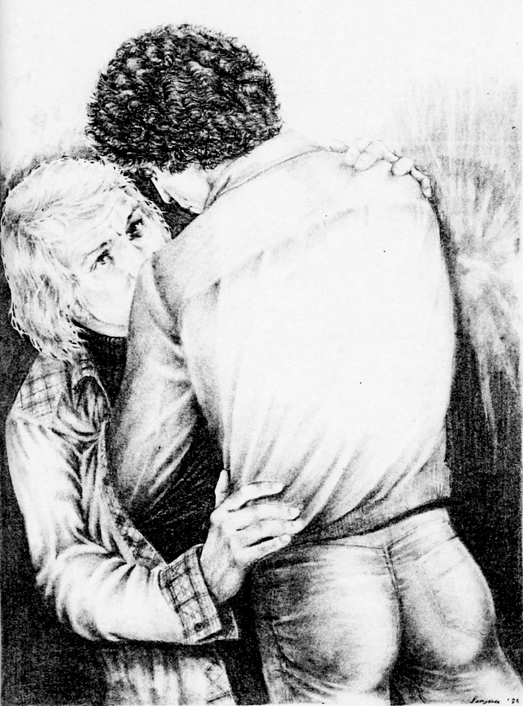
* * * * *
Hutch had lost all control over his world. Images left fleeting impressions—arms strong around him, hands gentle on his face—cold white light of a hospital corridor, the strange sensation of being carried along by that light, flat on his back, like a leaf on a river. The whiteness was too bright. It misted into grey, deepening into black, and he drifted into it, wearily grateful for the gift of oblivion.
Voices.
” . . . Letting him go. He’ll be fine. Bring him back in a couple of days, we’ll check the burns on his hands . . . ”
“C’mon, babe. I’m takin’ you home.”
Cruel mockery. He didn’t have a home any more. And which bastard was using Starsky’s voice? Dirty pool. Had to be against the Geneva Convention. He couldn’t focus at all. They’d washed his eyes out with some kind of medication, and he peered through his personal fog, got a vague impression of dark hair . . . . He wanted desperately to sleep. But he had to know.
“Starsk?” God, it wasn’t even a croak.
“Who else? C’mon, lover, let’s get out of here.” Voice harshly husky, as if the throat was raw, but still unmistakably Starsky’s.
Hutch still didn’t believe it. “What are you doing here?” he wanted to know.
“Tryin’ to take you home. Will you come on?”
“Can’t.” Home was a crazily-tilted floor with no street wall. Home was shattered glass and splintered furniture. Nothing made sense. Home was the lover he had left bleeding by a betrayal worse than any inflicted by Alex Lazero and his pals. Besides, he’d quit the force, and Starsky had said he’d leave him if he quit. “Can’t.”
“Sure you can. Want to park your ass in this chair?”
His next clear impression was of cushioned softness beneath him, comfort he could relax into. Should probably get a shower. He could smell himself, stink of smoke and sweat and dust. Too tired. Later.
Everything hurt. Some things more than others. Best idea seemed to be to go back to sleep, figure out answers when he woke up. If there were any answers. Right now, nothing was . . .
Something cool and wet moved over his face and neck, stinging in cuts and grazes he’d managed to forget about. It jerked him the last little distance into full consciousness and he blinked his eyes open to gaze up at the face bent close over his, frowning slightly with concentration. Reflex snapped his eyes shut, and a tide of confused emotions rose in his throat and threatened to choke him. Grief, guilt, shame.
Love.
“Starsk . . . ”
“Hush up. You should be sleeping.” Still husky, but the harshness muted to a velvet murmur. “Take it easy, Hutch.” Fingertips traced gently over his eyelids, spilled the liquid that pooled under his lashes. “It’s all right, babe. Everything’s gonna be okay now.”
“Starsk. I quit.” It was vitally important that he get this understood. “I—tried to tell you. But — ”
“It’s okay. We’ll talk it out later. Just let me take care of you for now, huh?” There was a world of tenderness aching in the quiet words, all the love he thought he had forfeited, and right then Hutch couldn’t handle it. He groped blindly for contact, discovered his hands were mittened with bandaging, but it didn’t matter because Starsky was lifting him into an embrace, holding him close, fingers of one hand twisted in his hair. For an instant he tensed, waiting for the gentleness to become the thoughtless hunger that he’d experienced too often, but the hand that circled over his back and shoulders eased the fear. They would talk later. In the meantime, this was Starsky, who had called him lover, and something within him that he had hardly allowed to hope began to breathe and grow, feeding on the caring that enfolded him.
Let it be real. Please God, don’t let me be dreaming this. Let it be real . . .
* * * * *
The tune played on the doorbell had become familiar of late, and it jolted Starsky out of the doze he’d fallen into. Morning. Hutch. If that maniac at the door woke him up . . . But nothing short of Gabriel’s Horn seemed likely to disturb the sleeper right then, so Starsky dived for the door and cut the cheerful jangle off mid-note, glaring at Dave Duplessis, seeing a pale and soot-streaked face bisected by a wide white grin.
“Hi,” said the apparition. “Did you see the news? I got over there soon as I could log off duty, and—damn, I’m saying this all wrong. Listen, I’ve salvaged some of Hutch’s stuff. Some clothes he’d left in suitcases, a few of the plants. They’re in the car. Sally’ll take care of them for him until he gets back in town. It’s gonna come as a helluva shock for him, though. Are you okay?” he asked belatedly.
“Yes,” said Starsky.
“The place is a wreck, and what isn’t busted is smoke damaged. Apart from the stuff in the cases. But I think the plants should make it. If they haven’t been too badly traumatized. At least, the ones I got in the car — ”
“Dave,” Starsky cut in, “you got diarrhea of the jawbone? Did you catch that off Hutch?” Sudden laughter welled up in him. He wanted to hug Duplessis, shout halleluiahs to the uncaring sky. “Leave the clothes with me, he’s gonna need them. And one of the plants — that philo-whatsis if it survived.”
A guarded expression crossed the young face, as if his sanity was being seriously doubted.
“Starsky — ”
The laughter bubbled up again. “It’s okay, I freaked out completely. Hutch is here, Dave. With me.”
“What? But—How? When? Shit! Was he—is he — ?”
“Yes, but he’s okay. Shook up, singed around the edges, but somebody up there likes him. Do me a favor, Dave. Give us some space, huh?”
“Huh?” Duplessis looked understandably dazed. “Oh, uh, yeah, sure. Plant. I’ll get the plant. And the cases.”
“I’ll give you a hand.”
After he had finally shut the door on Duplessis’ departure, Starsky thought he heard a half-smothered and exultant yell. But it wasn’t important. Bearing the philo-whatsis as if it was a work of art on a golden platter, he carried it carefully into the bedroom and set it carefully on the night table, where Hutch would see it as soon as he woke up, living proof that not everything he held dear had been destroyed.
The day crept past on silent cat feet, and Starsky hardly moved from the bedside, self-indulgent in his scrutiny of the man lying unconscious in his bed. Grime-dulled fair hair spilling onto his pillow, closed eyes sunk in shadowy hollows. How come I never noticed you losing weight? Hands slack on the covers, the stark white of the bandaging contrasting with the tan of wrists and forearms. I’ll never disbelieve in miracles again. To have come alive out of that . . . It’s about as big a miracle as you coming back to me. Because until now I wasn’t sure you would.
Afternoon sun was streaming through the window when Hutch began to stir—Starsky pulled the blinds half-down so that the brightness dimmed to a golden twilight, and resumed his vigil, rewarded at last by the flutter of eyelids, and a vague blue gaze fixing on him, squinting slightly.
“How’re you feeling?” Starsky touched the matted blond hair gently.
“Great,” Hutch mumbled. “Fantastic.”
That was hilarious, but the laughter that rose in his throat stung his eyes as well. “Oh, sure,” he said, “you come through Armageddon in Venice Place, and everything’s fine?”
“You’re here.” Two words, but the look in Hutch’s eyes said more than the words could.
“I’m here,” Starsky agreed, past the lump in his throat. “Hutch—we have to talk. Maybe it should be left until you’re more with it, but—the way I look at it, the sooner we clear the air, the better it’ll be. For both of us.”
Something that had been reborn behind the weary, smoke-scoured eyes began to die again, and he couldn’t endure it.
“Don’t, Hutch. Don’t look at me like that. This is why we have to talk, so we both know where we stand. Truth or consequences, huh?” He tried for a smile, but Hutch did not relax. Starsky recognized the grim tension that had been so much a part of the man in their last weeks together—the feeling of a man bracing himself to face the unacceptable again. It hadn’t been there during the case, before the rape, or even immediately after—it had grown like an invisible cancer that had fed on his own bitterness and violence.
“Truth or Consequences,” he said again, more firmly this time. “Maybe we’ve come through more than one kind of fire. We ought to find out what we got left.”
Hutch nodded, silent, and Starsky took a deep breath. Okay, so Hutch wasn’t going to help on this.
“I’ve been talking to Jerry. He said walking out the way you did was the best thing you could have done for me. Shock therapy.” His fingers found a tangled strand in the blond hair and he started teasing it gently out.
“I wasn’t thinking of that. Of anything.” Hutch turned his head on the pillow, jerking free of the stroking fingers. “I just snapped.”
“I know.” Starsky waited, but Hutch said nothing more, and the silence stretched until he couldn’t bear it any longer. He had to ask. “And now?”
Silence.
“I—don’t know.” A week ago, even a day ago, he would have been certain. But a week ago, yesterday, he hadn’t had Starsky sitting there looking at him, eyes wide and clear.
“I love you, Hutch.” Emotion held under tight control. “I love you, and I know that you love me. That doesn’t change. It’s about the only thing in all that’s happened that hasn’t. I don’t think it ever will, no matter what we do with the rest of our lives.”
“I walked out on you — ” Hutch started.
“And I pushed you to it. I was sick, I know that. Guess I’m not completely out of the woods yet, but I’m better than I was. I’m getting my head back into gear, straightening it out.” There was no irony or bitterness now. “You were under pressure as well. So you cracked up. But we’re both going pick up the pieces. Because we’re both survivors.” There was nothing Hutch could disagree with in that clear statement of facts. “Hutch—where do we go from here?” And he stopped, plainly unable to voice his greatest need. “Do we start over, build something new?”
“Dobey’s got my resignation,” Hutch said. “I’m not going back to being a cop.”
” Duplessis told me. And I wouldn’t want you out on the street without me to cover your back. Not that Duplessis wasn’t a good partner, but — ” And he stopped again, as if unsure of his ground or unwilling to presume too much. The silence grew, and Hutch watched the muscles in Starsky’s jaw tighten with strain. But he said nothing, and Hutch knew the next move had to be his.
Build something new, Starsky had said. And—I love you.
He let himself look at the familiar, well-loved face. How much of the old Starsky was still there? How much of the changeling? There was a new peace in the dark blue eyes, and gentleness in the unsmiling mouth. Starsky looked older, Hutch realized suddenly; lines of new experience bracketed the mouth and pale threads glinted in the curls just above his ears.
All his life, Hutch had taken risks. Hell, he’d made a career out of it. There was no reason to alter the habit of a lifetime.
“Starting over . . . ” he said the words experimentally, and saw new hope and joy blaze up like a beacon in Starsky’s eyes, so that he stumbled on the next words. “We’ve both changed—maybe we need to take it easy, get to know who we are again — ”
“S’okay, babe. I’m not about to push you into anything.” The smile lit up the room and the years fell away. “No panic, right? We talk it through in stages, there’s no rush. Right now it’s my turn to administer the TLC. Haven’t had the opportunity for far too long. Trust me?” There was a depth of pleading in those two words that went beyond the light bantering tone. Trust me—after all the hurt I gave you.
Hutch wanted to say something to reassure, to show that he too was going to give it his best shot. But the words wouldn’t come. Instead: “I love you.”
“And I love you.” Starsky got up. “That makes for pretty solid foundations.”
Between birth and the grave there is no moment like the rediscovery of a love thought irretrievably lost, and for that short space of time they basked in the warmth of it. Then Starsky gave himself a shake. “You must be starving. How about I fix us something to eat?”
“Sounds good to me. So long as it’s not chicken soup,” Hutch grinned.
“Up yours, Hutchinson. You’ll get what I dish up, and like it.” And he vanished in the direction of the kitchen. Hutch relaxed back on the pillows, feeling slightly light-headed and still not completely sure what was real and what wasn’t. And not caring.
” . . . Oh the boy can’t help it, he was born to please . . . “
Hutch found an unaccustomed grin threatening to split his face from ear to ear.
” . . . Got himself a figure that’s just made to squeeze . . . won’t you kindly be aware that the boy can’t help it . . . “
Off-key, loud, exuberant and totally out of tune, Starsky was singing.
CHAPTER TEN
Food and another twelve hours solid sleep helped put the finishing touches to Hutch’s recovery. He woke with the fragrant aroma of fresh coffee titillating his sinuses and a feeling of vague and inexplicable optimism that grew with a sudden surge when he turned his head and saw the plant in pride of place on the night table. Some side-shoots were broken, some leaves singed and bruised, but Phyllis was still in pretty good shape, all things considered. Much the same could be said for his own state. He rolled over, discovering that he was alone in the bed, but the second pillow was dented, a tangible reminder of another head and a dreamlike memory of warmth and enfolding arms.
His smile of reminiscent happiness faded somewhat as his nose registered other odors unrelated to coffee and breakfast. Boy, did he need a shower. And from the feel of his jaw, a shave.
Starsky appeared in the doorway in the midst of these discoveries, his smile a bright benediction that matched the sunny morning. “So you finally quit hibernating. Timed it just about right, lover. Coffee’s ready, and the rest is almost there.”
“Great,” Hutch said with an answering grin, and started to get up.
“Stay put,” Starsky ordered firmly. “It’s gonna go on a tray and you’ll eat it right where you are. TLC, remember?”
“Uh . . . okay. Hey, when did you rescue Phil?”
“Phil?” Starsky looked puzzled and a little concerned, as if Hutch had suddenly started talking gibberish.
“Phil.” Patiently, Hutch indicated the philodendron.
“Oh. Right. I didn’t. Duplessis brought it around yesterday while you were asleep. He had your suitcases as well, so I took them in. He says he saved what plants he could and Sally’s looking after them for you.”
“How’d he know I was here?”
“He didn’t, but I told him. He just called to let me know he’d salvaged what he could, in case I’d seen it on the news.” A small sheepish grin crossed his face. “He seemed pleased. I think.”
“The last of the great romantics,” Hutch snorted. “But I know how he feels.”
“Softie.” But the taunt held no malice. “You’re just saying that so’s you get breakfast in bed.”
“Guess that could have something to do with it,” Hutch agreed solemnly. “But right now what I really would like . . . ”
Starsky raised an interrogative eyebrow in an expression so corny that Hutch had to laugh. “Is a shower,” he finished his request. Starsky stared at him blankly.
“Shower?” he repeated, as if the word were vaguely obscene. “You can’t have a shower.”
“Why not?” Hutch’s turn to look blank. “Who says?”
“Because, and I do. You want to argue, you can do it over breakfast.”
The breakfast tray was loaded with enough for two. Orange juice, scrambled egg, toast, English marmalade, coffee. Hutch accepted the weight of it across his knees and launched another protest. “Starsk—if there’s something wrong with your sense of smell, mine is working fine. I’m gamey, for God’s sake.”
“I had noticed. And after you’ve eaten—eat!—we’ll do something about it. But the shower is out.”
“Tell me why, dammit!”
“Because, dumbo,” Starsky said patiently, cutting into manageable pieces for him, “your hands are wrapped up like an Egyptian pharaoh’s, and you’re not supposed to get burns wet.”
For some reason, Hutch hadn’t thought of that. “Oh.” He subsided around a mouthful of scrambled egg.
“Right. Oh.” Starsky gave a triumphant smile. “S’okay, we’ll work it out, no problem. You’re due back at the hospital sometime today, to have them checked out, and the dressings changed.”
“Oh. I am?”
“You are,” Starsky confirmed, and poured coffee.
“Any news on the explosion?” The brew was hot and sweet.
“Don’t know. I haven’t had the T.V. or radio on. Didn’t want to wake you. We can find out at the hospital, I guess.”
Starsky finished his meal before Hutch, and left him to it, and finally Hutch ate the last mouthful, drank the dregs of the coffee, set the tray on the night-table beside Phyllis, and was about to throw back the bedclothes when Starsky came back. Carrying a bowl of steaming water and with several towels draped over shoulders and neck.
“Oh, no.” Hutch grabbed the sheet and held it protectively under his chin. It didn’t need a detective to deduce the reason for the purposeful advance. “You’re not giving me a sponge bath.”
Starsky halted, staring at him. “It’s a bit late for maidenly modesty, Hutch,” he pointed out mildly, struggling with the grin of sheer delight that threatened the demeanor suiting the task ahead.
“It’s not that,” Hutch objected, feeling every bit as silly as he knew he looked. “Starsk, I’m not an invalid. How about a compromise?”
“No shower,” Starsky was adamant. “But—I guess a soak in the tub can’t hurt, so long as you keep those bandages dry.”
“Deal,” Hutch agreed thankfully. But getting up wasn’t as easy as it should have been. Muscles strained and twisted during the frenetic rescue attempt had stiffened, and he hadn’t realized it until he tried to stand upright.
“You trying out for Quasimodo?” Starsky wondered, giving him a shoulder to lean on into the bathroom. “We better get the doc to check out your back while we’re at it.”
“Just stiff, I think,” Hutch said, climbing gingerly into the tub and letting Starsky ease him down into the water. “God, that feels good!” The bathroom was thick with pine-scented steam—Starsky must have emptied half a bottle of bath-oil into the water. Hutch leaned back, closed his eyes, and relished the feel of heat soaking into sore muscles. It was also luxury beyond telling to have Starsky’s fingers massaging shampoo into his scalp, rinsing out the lather, soaping again.
“I could get to like this,” he warned, not opening his eyes.
“Hedonist,” Starsky said softly.
“Any chance I get,” Hutch agreed.
The hair under Starsky’s fingers, dark with wet, was silky and tangle free as the label on the conditioner promised. Silently, he soaped the bath-sponge, ran it carefully along each arm, avoiding the bandaging, lathered neck and shoulders and chest, rinsed. He was wet to the elbows himself, curls sticking damply to his brow—Hutch was sybaritically relaxed, letting himself be ministered unto as to the manner born.
He was probably a Turkish pasha in another life, Starsky reflected. It was an oddly erotic thought.
His hands faltered, and Hutch murmured a drowsy: “Don’t stop . . . ” The contours of flank and belly, invisible in the foam-clouded water, were rediscovered by touch alone, familiar, remembered, and the sponging became caresses before either of them quite realized what was happening.
Starsky sat back on his heels, and blue eyes met blue. Words were superfluous, and he couldn’t say it, anyway. The first move had to be Hutch’s. He had inflicted too much hurt over the past weeks to be able to initiate anything himself. Hutch had to want this as much as he did.
And: “Yes,” said Hutch quietly. “But not here, babe. I don’t think either of us is that athletic any more.”
Starsky looked away, unwilling for Hutch to read the twin emotions of relief and disappointment that rose in him. Hutch’s bandaged hand touched his hair, stroked feather-light down to the angle of his jaw.
“We got all the time there is,” he whispered. “Forget the bad times, just remember the good.”
I’m scared, Starsky wanted to say, and I want—need—this, but still the words would not come. He glanced at Hutch, saw his own fear and need mirrored there, and that came to his rescue. Both of them were too experienced now for the innocent sensuality of their first love makings, but it had been so long since they had shared the erotic delights of rediscovering over and over again all the pleasures of their bodies. As in the cabin. And the beach, the trails, the lake and its glacier-cold water—and Hutch’s bed, with those plants casting jungle shadows over tanned nakedness.
The warmth of arousal was a steady throb in his groin, bringing back the parallel memories of halcyon days, and nights, and the brutally uncaring hunger of his sickness. The good and the bad.
Hutch stood up, climbed out of the tub. His penis was heavy, not fully erect, and Starsky remembered a deserted beach, and Hutch walking out of the shallows, a kouros, a sungod . . .
“Why don’t you dry me?” suggested the familiar voice, velvet-soft, bordering on provocative. No hint of uncertainty there, just a total trust. Starsky took a deep breath and reached for the towel.
He was cautious, almost clumsy at first, veering between gentleness and briskness until he let himself see again the contrast between tanned skin and white fabric, the texture of Hutch’s belly under the webbing of water soaking into the towel, and the act turned into a ritual almost of worship, enough in itself.
Except that it wasn’t, and couldn’t be.
The bed was rumpled, but it didn’t matter—Hutch’s hair and skin were shades of gold against the blue of the sheet, and Starsky’s fingers were all thumbs as he tugged at the recalcitrant buttons of the sodden shirt.
It was dropped to the floor finally, joined by his jeans, sloughed like the skin of a snake. If only he could cast off memories as easily. The fear was too strong in him—fear of what he had done, what he might still do. He was afraid of hurting Hutch again, of losing control, of the thoughtless savagery that could still destroy them both. Help me, he wanted to say. I don’t want this to go wrong. And I’m scared.
If Hutch was feeling the same, he didn’t show it. The gentle eyes held no emotion but a kind of grave trust, and Starsky couldn’t betray that. He went into the arms that opened for him as if he’d never been away.
He’d forgotten what Hutch’s mouth tasted like, forgotten how a kiss could stop his breath, make his head swim and his heart race. It had been so long since a kiss had been anything but a crude and meaningless prelude. He wanted to make it last. Hutch’s arms were tight around him, but the pressure of the gauze-wrapped hands was light, a reminder, if one was needed, of the injuries. The moves would have to be his.
In a way that made things easier. He felt Hutch move, twist his body enough to half lift Starsky on top of him, a wordless offer—whatever he wanted would not be denied him. And now he knew what he did want; eventually, when he had rediscovered with lips and tongue every erogenous zone of his lover’s body. If they could both hold out that long.
Taste and scent and feel, familiar, remembered, fresh and new, potent as they had ever been He was losing himself in the heady delight of pleasing Hutch and pleasing himself, and if he didn’t act soon, it was going to be too late, and somehow it was important, vital, that this should be right and perfect, canceling out all that had gone before.
Rededication. Hutch was a starfish sprawl as Starsky knelt back for a moment, looking at him, and words weren’t necessary now, either. Hutch lay back, steadied him as he straddled the lean hips, positioning, and they moved together, Starsky arching to take Hutch’s thrust, crying out at the impalement, unsure whether it was pain or something else, but not caring because the sense of being filled, possessed, loved, was the most erotic thing he had ever known and he couldn’t hold back if his life depended on it. They were locked together, moving together towards a shared climax—this time it would happen, this time it would be right and how it should be—and he felt Hutch shuddering with the onset of it, rode the surge and heard his own voice sob his lover’s name and the floodtide was in and through and past him, leaving him spent and shaking.
“C’mere.” He was gathered into Hutch’s embrace, gentle lips touching his eyelids, taking the wetness from his lashes, moving to his mouth so that he tasted the salt of his own tears. “Don’t cry, lover. Please.”
“I’m not. I don’t think so.” He felt slightly light-headed, delirious, and couldn’t get control over his breathing, which probably explained Hutch’s mistake. “I love you, that’s all.” Except that the human tongue had not the words for the rest of what he felt, the incredulous joy that was filling him as wine fills a cup until it overflows.
“That’s all? Seems like quite a lot to me.” Hutch shifted a little so that Starsky could lie in the curve of his arm. “But then, I’m kind of prejudiced where you’re concerned.”
“Warts and all?”
“What warts?”
Starsky gave a sleepy chuckle and rubbed his cheek against the smooth curve of Hutch’s shoulder.
“Yeah, you’re prejudiced all right.”
* * * * * *
The eye of the storm was a place of stillness. Peace. Starsky was filled with a sense of wonder, of relief. We came through. In spite of everything.
It had been so close. Closer, in a way, than the shooting. Now, as then, the healing would take time. But the first steps had been taken—they could find again all that had been lost, build again what had been broken, recapture that deep sensual certainty. They could do it. But they needed time and space to do it. Starsky took the phone off the hook. Leave us alone. He needed no one but Hutch—wanted no other company within touching distance—reassurance, if he needed it, of their continuation. I love you or I do not live at all.
No half-measures or double standards. The world was still out there, waiting with traps and harshness ready to try to destroy. To pretend otherwise would be to live in a fool’s paradise. But they would face it together, and on their own terms.
Strangely, perhaps, the primary need was not sexual. The simple being together was all they needed, and the lovemaking was only another facet of that. There was no urgency about it—here at the still center it seemed they had discovered a way to weave every moment into the pattern of their loving—every action, however mundane, becoming a part of the whole. Most important, there was no more fear—of hurting or being hurt. That demon had been exorcised forever.
* * * * * *
Duplessis stared unseeing at the sunny garden, a frown indenting between the russet brows. No phone calls. Not since he’d been around to deliver the cases and the salvaged philodendron. Well, okay, he hadn’t really expected a call, but when he’d tried to call Starsky, the phone was apparently off the hook. And Huggy’s reaction had been kind of strange when he’d told him where Hutch was—joy in sorrow. Duplessis sighed. He supposed he could understand that. Being gay must be a helluva hard row to hoe at the best of times. But those two had so much going for them, had come through so much, and they so plainly cared—no, loved—each other, even when a state of open war was declared between them.
So what was the situation now? Had the blazing happiness he’d seen in Starsky’s face survived? Had Hutch told him he’d quit the force and wasn’t going back to it? Were they reconciled or — ? Dammit, this was worse than a daytime soap opera. But what should he do? Starsky had asked for space. He’d had three days of it. Well, almost three days. What if — ? Maybe — ?
A hand dealt a stinging slap to his wrist.
“Wha — ?”
“Stop it,” Sally snapped. “You’re biting your nails.”
“I was not!”
“Mentally you were. Clear up to your elbows. What is it? A case? Talk to me, Dave.”
“No. I mean, no, it’s not work.”
“Then it has to be Hutch.”
“I’d just like to know if they’re friends again.”
“Of course they are. You men are like overgrown kids sometimes, fighting and making up.”
“This is different,” he said stiffly. She couldn’t know how different.
“Oh, of course it is. Always is. So go and find out instead of cluttering up the deck like an abandoned hound pup.”
“Sure,” he snorted. “So I stroll up to the front door and say: ‘Hi, guys, have you quit killing each other yet, or should I call back later?'”
She sighed. “Sometimes, darlin’, for a smart cop you’re really dumb. Go give Hutch a bulletin on his plants.”
Duplessis grabbed her in a hug that left her breathless. “Sal, you’re a genius! Why didn’t I think of that?”
“You don’t expect me to answer that, do you?” she laughed.
“You’re more special than you’ll ever know,” he told her, heading for the door. “Back in a couple of hours — ”
“Hold it,” Sally called after him. “Don’t you think it might be an idea to get a briefing on the plants ready to pass on?”
* * * * * *
When Starsky opened his front door, one glance was enough to tell Duplessis he needn’t have worried. There was a look of settled peace about the man, something he’d never seen before—the look of someone who had come through hell and was now—he didn’t know how to put it. Duplessis gave himself a swift mental kick. “Hi,” he said. “I just dropped by to let Hutch know the plants are all okay.”
“So come on in and tell him,” Starsky invited. “We’d offer you coffee, but we gotta get down to the hospital for Hutch’s check-up.”
“Hey, no sweat. I’ll drive you there, if you want.” He made the offer without thinking, but it wasn’t turned down.
“Thanks—it’ll give the three of us a chance to catch up on the news.”
Hutch was shrugging carefully into a jacket, and his smile of welcome was unforced. “Thanks for the salvage job, Dave,” he said before Duplessis could speak. “For the cases as well as Phyllis.”
“You’re welcome. Her brothers and sisters are doing okay, mostly, and Sally’s administering first aid and TLC in equal quantities to the hurt ones. She says there’s nothing won’t make it through.” As he spoke he was assessing Hutch—who also looked a new man; settled, at peace with himself and his world, confident of the future. The difference in them both from the distraught sufferers of just a few weeks ago was startling. Ain’t Love grand? said a small, only surface-cynical voice in his head. “She’s going to try to root some of those cuttings,” he finished.
“And the rain-forest shall rise again,” Starsky intoned, laughing. “C’mon, babe, haul ass. Dave’s driving us, so you don’t have to break your back in the Torino.”
“Sounds good to me. Speaking of which, where is my car?” Hutch went on. “I don’t remember seeing it after the explosion.”
“Uh, yeah, that’s something else I gotta tell you. You were probably climbing over it when you were moving rubble. Most of the front wall fell on it. It’s kind of—flat.”
Since Hutch was speechless, Starsky stepped in. “Where is it?” he asked.
“At the police pound. It’s really scrap metal,” he added, needlessly, in Hutch’s opinion, judging by the whimper that escaped him.
“I’ll get in touch with Merle,” Starsky promised. “He can shift it, and maybe find you another one. Soon as we get back from the hospital, babe, you better start phoning your insurance company.”
“And come round to my place, see what else was salvaged,” Duplessis said. “It isn’t a lot, but I guess every little helps. You can store anything with us for as long as you need, anyway.”
“Thanks, Dave,” Hutch said quietly. “I appreciate this.”
“S’okay,” he shrugged. “No big deal.”
* * * * * *
Memorial took Hutch into its depths, leaving Starsky and Duplessis to wait. It was an all-too familiar scenario—the smells and sounds of a busy hospital, the impersonal bleakness of the waiting area made somehow worse by the attempts to humanize it, the lousy vending machine coffee . . . Okay, this time it was only a routine check-up, but there had been too many other times, too many bad memories.
“You’ve been a good partner to him, Dave,” Starsky said abruptly. “And I owe you for that. But I thank God he resigned. Should have let him quit when he wanted to, but I wasn’t thinking straight. I was too sick to consider anyone but myself.”
“How are things now?” Duplessis asked cautiously.
“Good. Getting better. My brain’s unscrambling itself. Hutch is back, and he’s staying.” He fixed the younger man with an unreadable blue stare. “How long have you known that Hutch and me are lovers?”
“Since we got you to the hospital after the rape,” Duplessis said frankly. “It was nothing Hutch said. Just a lot of things suddenly added up.”
“No judgments?” Starsky asked steadily. “No phobia?”
“Hell, no. It may not be my scene, but I’m not throwin’ any stones, man. Different strokes, and like that.”
Starsky looked away. “Then you’re a rare animal, Dave.”
“Maybe. Whatever, you’re both friends of mine. Bottom line. You made any long-term plans yet?” he said, changing the subject.
“No. That’s something else we have to talk out.”
“Ah-huh.” Duplessis leaned back in the chair, crossed his legs. “Well, at least the explosion was an accident, so that’s one less thing to worry about.”
“What?” Starsky glanced at him, startled. “Of course it was an accident. What else could it be?”
Duplessis gave him a hard stare. He had to be kidding. “A bomb, maybe?” he suggested. “Except it wasn’t. It was a gas leak.”
“A bomb?” Starsky repeated. “Are you crazy? Thought I was the only one with galloping paranoia. Who the hell would want to plant a bomb under Chez Helene?”
“I didn’t say it was Chez Helene,” Duplessis said patiently.
“You mean—Hutch could have been the target? Dave we’re not cops anymore.”
“I don’t believe I’m hearing this.” There was an edge of anger under the crisply bitten-out words. “Starsk—you were cops for how many years? And how many enemies have you made in that time? Guys you’ve put away, people with a grudge—sweet Christ, man, they’re not going to let up just because you’re no longer cops! In fact, they’re more likely to close in—you’re out in the cold now. Without the protection and resources of the department. Look what happened last time you chucked your badges away.”
“That was different — ”
“Bullshit. There are any number of bad guys who could be gunning for the pair of you.” He paused, softened the harshness of his tone. “I’m sorry. You and Hutch are back together, and that’s great, but don’t lose all sense of proportion in the rosy glow.”
“Back off!” Starsky snarled. “You’re way out of line!”
“The hell I am, and you know it!” For a moment they faced each other, hackles raised. Then Duplessis decided to back down. “Just watch yourselves, that’s all I’m saying.”
The tension bled out of Starsky in almost the same minute. “Yeah. I guess you got a point. Okay, sorry I bawled you out like that.”
“De nada. Listen, I’m going to see if I can find the cafeteria and some decent coffee. You want a cup?”
CHAPTER ELEVEN
Lucidity came in flashes, at first forgotten as soon as they faded. But gradually memory began to string itself together like beads on a thread—bright crystal beads containing isolated images etched clear and sharp without obvious connections.
With returning consciousness came awareness of his body and its surroundings. Half of him felt strange. Heavy. Unresponsive. As if it no longer belonged to him. Talking was oddly difficult, and it enraged him to hear his lucid thoughts emerge as slurred gibberish. His room—unfamiliar—was luxurious and comfortable, but there was no television. That, too, was irksome. But the gentle, self-effacing attendants would not obey his orders, and tried to soothe his furious outbursts as if he was a child throwing a tantrum, until finally they added something to the drip and he floated in and out of reality for a long time.
When at last he was allowed to wake properly, he felt much better. His right side was no longer quite so leaden, he could move his fingers a little, talk more clearly. And the pieces of memory fitted together into whole pictures. There were still blanks, but the pictures now had meaning.
He remembered who he was.
James Marshall Gunther.
He remembered he had power.
Faces came to him, obsequious fear in their eyes, and in him was the knowledge of life and death and the power to use that knowledge like a weapon. He had built an empire. He was a kingmaker. He smiled, realizing why those who ministered to him were so respectful. It was well that they should be. But they obviously needed to be reminded that his word was law, and when he demanded a television in order that he keep informed, they would supply it without question and immediately.
But his order was still denied. “Soon, Mr. Gunther,” said the woman. “You’ve been very ill, and we must be sure your condition has stabilized before we can allow in outside pressures. You have been very ill,” she repeated as his anger rose. “You suffered a severe stroke. It could have killed a weaker man. Any excess strain would set your recovery back.”
“Garbage!” he barked, pleased that even with the slur, his voice still had strength. “You’re fired! Send Bates in here.”
“Mr. Bates is dead, sir.”
A picture, tinted like an old, sepia-toned photograph; Bates sprawled in an armchair, apparently asleep, but the fine porcelain teacup was shattered in the saucer by the death rictus that had gripped him.
The power of life and death.
The woman was doing something to the drip, and he fell asleep cursing her.
He woke next to find a television in his room, a remote control set on the left-hand night table, within easy reach. Good. He had never tolerated slackness. Clearly it was time he took up the reins of command again. Smiling his anticipation, Gunther selected his usual channel, settling to watch the run of current affairs, stock market deals, and news.
The news. Worldwide and local.
“A tenth person has died following the gas explosion at the Chez Helene restaurant in Venice,” the newsreader intoned, and pictures sub-headed with a date filled the screen. Uninterested, he watched scenes of garishly-lit devastation while the voice-over detailed the lists of dead and seriously injured, adding the latest victim with a kind of impersonal relish. But Gunther did not hear it. A man had crossed the screen briefly, part of a stretcher detail. A tall man, dirty, bloodstained, disheveled. Gunther knew him. Would never forget him.
“Hutchinson,” he said aloud. “Kenneth Richard Hutchinson.”
Another flashback. No static snapshot this time. That man standing in his doorway, walking forward, as grim and implacable as the Goths that had entered Rome, and about to wreak the same destruction. The destruction of an Empire.
“No!” No man lays hands on an Emperor. “No!” But he had been pressed face down on his own desk, helpless and ruined, while barbarian hands pulled back his arms and snapped steel about his wrists, while the cold harsh voice chanted an arcane litany.
James Marshall Gunther, you have the right to remain silent. If you give up that right anything you say can and will be used against you in a court of law. You have the right to speak to an attorney and to have that attorney present during questioning. If you so desire and cannot afford one, one will be appointed for you without charge before questioning.
“NO-O-O!”
* * * * * *
Starsky had to make a concerted effort to throw off the effect of Duplessis’ lecture, but it had brought home to him how much he needed the stability of a planned future. That hadn’t been a necessity before—before, he had known who he was, where he was, where he was going. Now he was in Terra Incognita, and he needed a road map and a definite destination nearly as much as he needed his partner to be at his side.
But there were more important things to be done. Like phone calls to the insurance companies, getting them moving, and to Merle the Earl to have him collect the scrap heap and hunt out a replacement car. This wasn’t easy. Merle had developed an irrational aversion to any Hutchinson vehicle, but Starsky got an agreement eventually. He was smiling when he put the phone down and sauntered into the kitchen. Hutch was standing at the countertop, putting the finishing touches to a plateful of rather overstuffed submarine sandwiches—his hands were more mobile now under a far lighter dressing, and he could just about cope. Starsky slid his arms around his lover’s waist.
“Whatever’s in those, I’m starving,” he said. Hutch turned to face him, and Starsky pulled the blond head down for a kiss.
“Tuna salad in mine,” said Hutch, when he was allowed to speak, “and pastrami, onion and tomato in yours, with pickle. What did Merle say?”
“That he’d do his best to find another Hutchinson Original, but it’ll cost you—bad for his reputation, having to have cars like that in his yard.” He reached around Hutch for his sandwich. “There’s a six-pack in the fridge. Where do you want to eat?”
“How about in bed?” Hutch suggested, sounding casual, and Starsky’s knees went to jelly. “Just how starved are you, partner?”
“Ravenous, unfortunately,” Starsky admitted. “And we can’t make love when my gut’s rumbling like the 1812 Overture.”
“So we eat first. Satisfy the baser appetites,” Hutch said solemnly, but his eyes were full of love and laughter.
“Really. What’s for dessert?”
“You need to ask? How about Starsky a la mode?”
The pace was slower, this time, infinitely leisured, through a languid blood-warm afternoon, shades drawn against the sun, relearning delight half-forgotten, reaffirming a commitment that had never truly been lost.
“I never stopped loving you.”
“I know. Me neither.”
Golden light gilding sweat-sheened skin, highlighting contoured muscle, sleeking body-hair, shadowing eyes.
“Come in me, lover?”
“I don’t want to hurt you — ”
“You won’t. We’ll be careful. Ah, Hutch . . . ”
Careful anointing of urgent flesh in slow and deliberate ritual, carnal worship in every touch and caress. Thighs spread, lifted, locking against moisture-slick flanks, and slow, slow joining of flesh in flesh, no pain at all, not even overlaid by pleasure.
Head pressing back into the pillow, Starsky squinted up at the beloved face, shadowed, intent, a small frown of concentration on the blond brows as he exercised a conscious control. The glow backlit the tousled mane in a hazy nimbus. Archangel . . . .
It was past time for being careful—his body knew what it wanted, hips arching, and he pulled Hutch down and into him in exquisite penetration.
“Now?” Breathless whisper of entreaty.
“Now!”
* * * * * *
“Plans,” said Starsky into Hutch’s neck. “We gotta make plans.”
“Mmmph,” said Hutch into the pillow. The weight on Starsky, like an overstuffed eiderdown, was warm and comforting, but there were small gritty irritations under his ass and he thought they might be crumbs from the sandwiches. So, reluctantly, he was going to have to get out from under.
“Are you listening to me?”
“Mmm. Yes. Indubitably.”
“I bet. C’mon, y’big lunk, let a guy breathe, willya?” He softened the words with a kiss and Hutch obediently slid down to lie at his side. With relief, Starsky squirmed free of the crumbs.
“Plans?” said Hutch.
“Oh. Yeah. But whatever we decide, it has to be what we both want, not one saying okay just to please the other. Right?”
“Oh, absolutely.”
Hutch wasn’t paying attention. Starsky could tell that by the stealthy hand that was exploring his hip and thigh. He took hold of the errant wrist. “Hutch.”
“Okay, okay.” A martyred sigh, a trifle overdone. He grinned.
“Later for the fun-time. Right now—we talk.” There was a pause, then: “You first,” and “After you,” came together, and both men laughed.
“We gotta be sensible about this,” Starsky insisted. “What about jobs? We can’t afford not to be working at something. I’m down with a couple of agencies.”
“Job.” Hutch was bolt upright. “Shit. Mac.”
“Huh?”
“I went up to Visalia,” Hutch explained. “Mac’s firm needs a security consultant for a while. It could be permanent, but he wanted me to try out for it.”
“Sounds good to me. At least one of us’ll be earning hard cash—and there’re agencies in Visalia. Hell, I’ll wash dishes if I have to. So, we find a place of our own and — ”
Hutch was silent, frowning up at the ceiling, and with a gut wrench Starsky realized that he’d been presuming too much, making plans without consultation. He sighed. “Sorry. You should tell me to shut up. Talk to me, huh? You don’t have to leave L.A. if you don’t want to.” He paused. “I guess—you have to decide about Jaqi.”
“I already did. Right after I decked you.” Hutch looked guilty. “I went to see her, told her how I felt. And that she didn’t have any right to decide my future. So that’s all over, babe. Now—what about you?” He craned up on one elbow so that he could look down at his partner. “What do you want?”
It was Starsky’s turn to fall silent then.
“I’m not sure,” he said at last. “I want to be with you, wherever you are. But wherever that is—maybe we could use a change of scene. Even if it’s not permanent. We — ”
The sharp jangle of the phone cut him off, and Hutch felt him go rigid. “You want me to get that?” he offered.
“No.” Starsky slid from the bed and padded into the living room. “Yeah? Oh, hi, Huggy . . . ”
The tone was one of relief. Hutch got up and followed, leaning on the doorjamb, just watching as Starsky talked. It had been too long since he had been able to see and appreciate all the things he loved about the way Starsky looked . . . . Oh, no classical beauty, too much definition of muscle for that, and a distinct lack of aesthetic proportion, but Michelangelo or Rodin or one of the master sculptors who glorified the reality of mortal flesh and bone, not some romantic ideal, would have agreed with him. He liked the clean lines of shoulder and back, the way the hair grew in little spirals into the nape of the neck—the indentation of the spine and the ‘runner’s girdle’ of muscle at the hip, even the frankly bandy knees . . .
“Thanks for calling, Hug.” Starsky put the phone down, and turned. “Hey, what’s with the sappy expression?”
Ridiculously, Hutch felt himself color. “Just admiring the scenery,” he said lightly, and changed the subject. “Who did you think was calling, anyway?”
Starsky sat down on the couch. “Mom,” he said flatly. “I wrote her a long letter a week ago. Told her I was off the force, and why—none of the gory details, just the stress disability—and she wasn’t supposed to worry about me. Next thing I know, she’s on the phone telling me to come back to New York, and that I could move in with her.”
“I take it you don’t want to do that?” Hutch sat next to him.
“Are you kidding? I can remember New York winters. They get snow there, Hutch!” He gave an exaggerated shudder. “I can’t remember what I said to her, except that it was an unqualified refusal. So now I keep expecting a call from her saying she’s flying out here to look after me. Or trying to make me feel guilty enough to go home with her.” He tried for a wry smile and Hutch put an arm across his shoulders. “Guess that’s something else we have to deal with. But I can’t tell her about us. Not yet.”
“When you’re ready,” Hutch said. He knew how he felt himself, but he wasn’t about to push Starsky into anything. “You were talking about maybe a change of scene,” he prompted.
“Yeah.” Starsky left the couch, as if he needed to be on the move, too restless to be still. He walked to the window, looked out. “I want a fresh start, Hutch. You and me in a place of our own, away from L.A. We’ve been cops in this city for too long, we know it all too well. All the dirt in the streets, the skuzzy alleyways, the gutters, the sewers. Sometimes I wonder if we haven’t been living in them all along, right next to the lowlife. But they didn’t know any different—and it was getting so neither did we.” He swung to face Hutch. ”I want out,” he said simply. “Took me a long time to realize it. But that’s the bottom line.”
“Me, too.” Hutch joined him. “I found that out for sure when I was with Mac, up in Three Rivers. Look, Visalia may be Small Town, U.S.A., but the air’s clean, and the pace of life is like it’s in another world. We could check the place out, see if that’s where we want to settle.”
“If Mac can help you get a job — ”
“We’ll cross that bridge when we come to it.” Hutch picked up the phone.
Kathy’s screech when she heard his voice almost deafened him.
“Ken, I’ve been going crazy since I saw the explosion on T.V.! Are you okay?” After he calmed her down, she was overjoyed to hear they’d patched up their differences, and Hutch told her no more than that. Anything more, including the news of the devastated apartment—could wait until later.
There were more urgent matters to be discussed, and he wasn’t sure how he’d go about it.
“Told her we’d be there tomorrow afternoon,” he said as he replaced the phone.
“Fine,” Starsky’s arm closed around his waist. “Well, we’ll have to make an early start. So maybe we should have an early night?”
* * * * * *
Hutch found the words he needed next morning, en route to Visalia, but not until they were an hour on the road. Starsky was quiet, almost subdued, and there were bruise-dark shadows under his eyes. Neither of them had got much sleep the previous night, and not because they had spent it in lovemaking. If Hutch had need evidence that Starsky’s cure was still incomplete, the night would have convinced him.
He had never been told the shape of the primary nightmare that haunted his partner—indeed, he didn’t really want to know. But it had crashed back into their shared peace like a juggernaut, wrenching him out of sleep to find Starsky shuddering convulsively, staring blank-eyed into the darkness.
It had been some time before he could be persuaded to relax enough to sleep again.
It was inevitable that it should leave its mark, and not just in simple physical tiredness. But the depression did not last — it was a fine day, once clear of the smog, the roads were clear, the Torino was humming along at a steady sixty, and Starsky’s hands relaxed on the wheel, an almost-smile slowly settling on his mouth. Life was good, and getting better, and Hutch was reluctant to draw notice to the cloud on their horizon. But there were things that had to be sorted out before they reached Visalia.
“Mac could change his mind about the job,” he said quietly. .”Him or his bosses. Because there’s something else I want, David, and they may not like it. If you don’t want it, then—I guess I can live with it, but — ”
“Huh?” Starsky shot him a quizzical glance. “Hutchinson, you are not making sense. Gonna elucidate?”
“We’re lovers,” Hutch said. “I don’t want to hide that any more. I love you and I’m proud of you, of what we have. But there are going to be a helluva lot of others who’ll make judgments. Like I said, I don’t want to hide. But I can handle it if you decide it’s better if we do.”
“My decision?” and Hutch nodded. “Okay, let’s talk this thing through.” He was silent for a few minutes, eyebrows pulling together in a frown. “Okay,” he said again. “On the one hand, if we stay in the closet, it’s easier to socialize, get jobs, stuff like that. On the other hand, I may worry about how my Mom’ll take it, but the rest of the world can go screw itself. Double standards, but what the hell.” He gave a quirky grin at Hutch. “Yeah, I love you, too, and yeah, I’m tired of living a lie. If Kathy and Mac can’t handle that, then there are other places. Then again, on the other hand, a job is a job — ”
“That’s three,” Hutch cut in.
“What?”
“Three hands.” Hutch was grinning too, inanely.
“Smartass. As I was saying, on the other hand, a job is a job, and Mac’s firm are going to be paying good money for a security consultant with your kind of experience. But so could other less homophobic businesses. In San Francisco, for starters. This is a new start, a new life, and it’s gotta be on our terms.”
“So we tell Kathy and Mac and take it from there.”
“That’s what I said, didn’t I?”
“I guess so. It won’t be easy.”
“I know that.” Starsky freed one hand to lay it over Hutch’s, intertwining their fingers briefly. “Quit worrying, lover. We’re together. That’s all that counts. Sure there’ll be problems—with the bigots and the rest of the zoo. But it’s me ‘n ‘thee, Hutch.”
“Me ‘n ‘thee.” It was, as it had always been, a pledge.
Kathy must have been waiting with her ears straining, because she came out of the house as they climbed out of the Torino and grabbed them both in a bear hug.
“I knew it’d work out,” she laughed. “You men! Worse than kids! I’m so glad you’re friends again. What did — ” and she froze, eyes on the white bandages on Hutch’s hands.
“Ken! What on earth — ?”
“Don’t panic, Kath. Superficial burns, that’s all.”
“Superfi — That’s all? Are you going to tell me what happened?”
It was Starsky who took her gently by the elbow and led her into the house. “It’s a long story, and the neighbor’s’ll stare.”
“Seems there was a gas leak,” Hutch explained once they had Kathy seated in her living room. “Built up underneath Chez Helene, and finally something touched if off. I was lucky — ”
“Lucky!” she cut in argumentatively, and he hushed her.
“People died, Kath. I was helping with the rescue work. I know.”
“I saw the newsflash on T.V., so I went along to see if Hutch was okay, and helped out, too.” Starsky exchanged glances with his partner. “After that, our—differences—seemed to get into proportion.”
“So I should think!” Kathy snapped. “Ken, you might have been killed — ”
“Might-have-beens don’t mean a thing.” And he smiled at her. “I was lucky.” He met the dark blue gaze and repeated it. “Very lucky.”
“But your home, Ken, all your things . . . I hope to God you were properly insured,” his sister added, taking her usual commonsense approach, and saw him grin.
“Adequately enough. I’m a Hutchinson, remember? We play it safe.” At which Starsky hooted, and Hutch aimed an exasperated swat at him.
“You two,” Kathy snorted. “Worse than the kids. Now, I want to hear all your news, but I’ll just get us all some coffee — ”
“Hold it, Kath,” Starsky said, serious now. “We’ve got something to tell you, first. And you may want to throw us out afterwards.”
She stared at him, realized he wasn’t joking, and looked at her brother, who was sitting silent, letting Starsky do the talking. “What’s the matter?” she wanted to know. “Don’t tell me you’ve both — ” and she searched for any explanation that might fit, coming up with the weirdest and most unlikely she could invent on the spur of the moment ” — converted to Scientology or something?”
A small smile lightened Starsky’s gravity. “Nothing quite as bad as that,” he assured her, and reached for Hutch’s hand. “Kath, me ‘n’ Hutch are lovers.”
Kathy felt her inquisitive smile freeze in place. If this was a joke, it was in pretty poor taste. She fixed her brother. “Ken?”
He wasn’t smiling. There was a look of serenity instead, of settled content, pride, and—yes—love. “S’right, Kath. We’re lovers.”
The solid, reliable foundations of Katherine McKinley’s world weren’t ready for that revelation, and quivered unnervingly. She groped for control. “Since when? I mean, how long . . . ” She faltered to a stop, staring at them, stricken and unable to hide it, but not knowing why. And gently, quietly, her brother’s partner began to answer her questions, taking his time about it and, she realized suddenly, giving her time to let it sink in, come to terms with it, his hand all the while linked with her brother’s, for all the world like a pair of honeymooners, and that was ridiculous . . . .
He’d fallen silent, and she realized with something of a shock that he’d finished his story, and was waiting for her to react, and she couldn’t.
“I think,” he said, “I’ll take a walk while you’re thinking about it.”
And Ken said: “We’ll take a walk — ”
“No one,” said Kathy firmly, “is going anywhere until someone has made me a medicinal cup of something. Lord, you surely know how to give a girl a surprise, don’t you?” And it was easier to smile, even though it was a bit shaky.
Starsky smiled back. “You got it. Coffee?”
The moment the kitchen door closed behind him, Kathy looked square at her brother. “Oh, Ken. You do seem to go out of your way to make things tough for yourself.”
“Maybe.” He shrugged. “But the bottom line is—I love him, and he loves me. That’s the way it is. You going to show us the door now, or what?”
Kathy gave him a sidelong glare. “What on earth for? I’m sure you’ve seen one before.” And laughed as he did a double-take, holding out her arms. “Oh, come here and give me a kiss, you big lummox. Did you really think I’d throw you out? You may be crazy, but you’re my brother and I love you! Just give me time, huh?”
“Whatever you need, Sis.” He hugged her hard enough to bend ribs, and she detected a slight note of huskiness in his voice. Did her acceptance really mean so much to him? She hugged him back, a small part of her wishing he was still small enough to put over her knee. But a much larger part was already looking ahead.
“So what are your plans now, hon?”
“Depends on Mac.” Ken looked down at her. “Maybe that job offer won’t be open when he finds out about me and Starsk. We’re prepared for that, Sis, so don’t fret about it.”
She snorted. “Mac? The last liberal of the sixties wouldn’t care if you screwed collie-dogs — ”
His expression brought her to awareness of what she had just said—an almost direct quotation from her husband—and she felt her color rise as Ken hugged her again, chuckling. “Well, dammit, you know what I mean. I better go see if Dave’s finished wrecking my kitchen.”
He let her go, and she made her escape, pulling a sheet from the roll of paper towels and blowing her nose before facing Starsky, whose expression told her that he understood, and sympathized.
“Do I get a hug, too?” he wondered, and she sniffed back the last of the tears.
“Vicky is never going to forgive you,” she confided into his shirtfront.
“Ah, I was too old for her anyhow. Besides,” he added, holding her at arms length, “do you really think I’d have made a good son-in-law? It’s gonna be tough enough having me for a brother-in-law. Think about it.”
“I have,” said Kathy firmly, tearing up again, and gave him another hug.
* * * * * *
The conference in the hospital anteroom was low-voiced but heated.
“I thought we agreed—no T.V!” The dark-haired man in the expensive business suit snapped at the white-coated medical staff, who glared at each other.
“Quite so. But circumstances changed.” The senior doctor, Westmore, was silky with controlled calm. “His condition was improving, but as you may imagine he is far from an easy patient. In view of his insistence on a television, and his reaction when his demand was refused, I decided that letting him have one would be the lesser of the two evils. His blood pressure — ”
“So what happens? He sees something he doesn’t like and goes crazy. Then suffers a relapse!”
“Mr. Praetor. You must be aware that your uncle’s mental condition has been affected to some extent by the severity of the stroke. These bouts of irrationality are not entirely unexpected. What he saw may not have been related to his attack. The relapse is not serious—there’s been no further loss of function.”
Robert Praetor, James Marshall Gunther’s sole nephew and probable heir, stared the doctor down with all the hauteur he could summon. “And the T.V. is still there.”
“According to his wishes. Yes.”
“Autocratic old buzzard . . . ” Praetor muttered under his breath. But he knew from experience that money talks, and Gunther’s money had a louder voice than most. He still found it hard to believe the sheer extent of his uncle’s involvement in organized crime, but there was no doubt of the legitimate power the man had also wielded. The political power that, until a short time ago, he might have inherited unstained. But the revelations that a sensation-hungry press had splashed across the country had not done his hopes any good at all, and he bitterly resented the dutiful visits he had been pressured into making. “He’s an evil old monster,” his mother had said, “but he has the money, so it’s in your own interests to be nice to the creature. There’s no one but you to inherit, Robert. We might salvage something yet from this unholy mess.” So much for sisterly love. But, on the other hand, Praetor had to admit to a certain admiration for his uncle. The man was an achiever, an empire-builder. Had in fact built two—the legitimate and the criminal. The latter was regrettable, but the actual achievement, the sheer brilliant ruthlessness entailed in the construction, control, and maintenance of both had to be admired. Up to a point.
“Since that one episode, Mr. Gunther has remained calm,” the Head Nurse put in. “There doesn’t appear to be any further deterioration.”
“Nor, to be fair, any substantial improvement. His condition appears stable,” Westmore said. “That’s the best we can say.”
“And his memory?”
“Much the same. Very patchy. His lawyer came this morning, and got nowhere.”
Praetor made no comment. Reminders of the inevitable trial and all the renewed publicity was something he could do without.
“I’ll see him now,” he said instead.
The man on the bed ignored him at first. The T.V. screen was showing a discussion between a big Wall Street stockbroker, a member of OPEC, and a major Japanese businessman, but suddenly it was blanked out, and Gunther slid the remote control under his pillow left-handed. The right hand lay on the neatly folded coverlet, waxen and unmoving.
“Sit down.” An order, slurred but distinct. Praetor sat.
“You’re looking well, Uncle James.” It was a lie, of course. The unnaturally pale face was subtly misshapen, one side slack-muscled, the corner of the tilted mouth wet.
“Hutchinson,” said that mouth now, and the gimlet eyes glittered.
“Excuse me?”
“I—want—him—punished.”
Praetor did a quick review of the medical staff, but couldn’t recall the name. “I’ll inform Dr Westmore, Uncle James, if — ”
“Fool!” The epithet was spat out with contempt. “Hutchinson. Kenneth Richard. Detective Sergeant, Metro Division, LAPD. See to it.”
For a moment Praetor gaped at the old man, then his excellent memory clicked a face to the name. The arresting officer. “Uncle — ” he began, but the remote had been brought out, and the TV came back to life.
“Report back.”
“Uncle James,” Praetor protested, “you can’t mean that. You don’t realize what you’re saying. The man is a police officer — ”
“Don’t argue with me!” The snarl sprayed spittle like venom. “Do as you’re told, damn you!” A nurse charged into the room like a quarterback after the ball, and added something to the IV. “Do it, boy!” But the sedative worked fast, and the raving dropped to a mutter and finally silence.
Praetor got out of there. His knees felt weak. His uncle was talking like a mob boss. That wasn’t irrationality, the by-product of a stroke. That was sheer insanity. Dear God. The sooner the old bastard died, the better for all concerned. This was the Eighties, not the Thirties. No, James Marshall Gunther had outlived his time. He was a dinosaur. And in his nephew’s eyes, he should have sunk back into the swamp years ago. Robert Praetor had no intention of pandering to the whims of a mad and senile old man.
Not even for a fortune.
CHAPTER TWELVE
Lying with the scent of Kathy’s cherished roses rioting in the air, Hutch found he couldn’t feel any regret for leaving L.A. Summer there scorched through August and into September, reminding anyone who needed it that the city had grown up out of the desert, like a spiny cactus. Out of the confines of concrete and asphalt and glass, the artificial environments which could and did support miniature rainforests, the small growth on the hillsides would be browned, naked earth cracked and dried.
But here, the groves of citrus ripened and glowed, and lawns were still green from sympathetic tending. It was pleasant, and peaceful, and as far as he was concerned, life had only one small drawback. He had a job, and a company car, but as yet, he and Starsky didn’t have a place to call their own.
“We can’t stay here much longer. We ought to start looking for someplace of our own.” The warmth of the late summer evening was soporific, so Hutch was hardly surprised to get no answer from the supine Starsky. The sunglasses masked his eyes, so there was no way of telling if he was even awake. Hutch, however, was not disposed to be patient. “I said — ”
“I heard what you said,” Starsky murmured. “What’s eatin’ you? Kathy threatening to throw us out?”
“Anything but,” Hutch snorted. “She ducks the issue whenever I mention it. But — ”
“I know.” Responding finally to the concern in his lover’s voice, Starsky rolled over and pushed himself up on his elbows, squinting up at Hutch’s face. “This has been coming on for weeks, right?”
“You know me too damn well,” Hutch admitted. “Yes. It has.”
“You’re not so hard to read, babe. Which is why I did something about it.”
“Huh? What? When?” The Hutchinson stutter surfaced in surprise.
“I called a few realtors. While you were at work. The only thing I couldn’t be sure about was our price range.” He sat up and brushed off grass. “So I got a cross-section.” And he laughed in delight at Hutch’s pole-axed goldfish expression. ”Hey, I’m not just a pretty face, y’know.”
“You can say that again.” Hutch swallowed his amazement. “The body’s not bad, though.”
“Flatterer.” Starsky grinned and bent a wrist at him. But it wasn’t just flattery, or even the blinkered adoration of a lover—he was looking, and feeling, better than he had for months, and he knew it. It wasn’t accidental. When Hutch had started working with Mac at Westray, leaving his partner at a loose end, Starsky had got out from under Kathy’s feet in the only way he could think of at short notice, by signing on for casual work with the peaking citrus harvest. The sheer physical labor had gone a long way to restoring his lost condition, and the sun had deepened his tan to a burnt copper that made his eyes look even more vividly blue. Sitting there lithely cross-legged, smirking like a self-satisfied tomcat, he looked to Hutch once again the man he had fallen in love with in the spring, no trace of the trauma that had split them apart. Those scars, unlike the pinkish traceries on breast and back, weren’t in view. Hutch was still aware of them, as he was of his own. But they were a unifying force now, no longer destructive.
“Why didn’t you tell me this earlier?” he wanted to know.
Starsky shrugged. “The time wasn’t right. Didn’t want it to look like I was being pushy. Or that we’re in a hurry. The last thing I want is to hurt Kathy’s feelings.”
“What about my feelings?” Kathy wanted to know, setting a laden tray of lemonade down on the patio table and resuming her seat in the lawn chair. “And don’t say listeners hear no good of themselves, Kenny—I have the ears of a—I don’t know, Dave, what’s got good hearing?”
“A bat?” he hazarded.
“Right. I have the ears of a bat, and nothing escapes my attention.”
“Wrong,” said her brother smugly.
“Wrong? You dare to contradict your big sister.”
“Unless they’re black and hairy. They weren’t last time I looked. Starsk? You’re closer.”
”Nope.” Starsky gave Kathy careful scrutiny. “Pink and naked. Like always.”
Kathy fixed her brother with a gimlet stare. “Kenneth. You forget, I have raised three children and I can spot a cover-up at fifty paces. Just what am I not supposed to have overheard?”
“Don’t jump on us, that’s all, Sis. We were talking about moving out.”
“What on earth for?” She looked, as Starsky had predicted, hurt and affronted. “There’s no need. There’s plenty of room here, and — ”
She would have gone on to catalogue all the reasons for them not moving out, but Starsky forestalled her.
“Kath,” he said softly, “when you and Mac got hitched, did you want somewhere of your own, or did you want to live with your in-laws?”
Kathy, like her brother, had the kind of fair skin that blushes spectacularly, and she could feel one coming on.
“That was different,” she said lamely.
“Not a bit. You’ve been great—you and Mac—and we needed the breathing space. But it’s time for us to move on.” And, with an unrepentantly wicked grin, he added: “Besides, we’d hate to shock the kids, and it’s cramping our style. Just a little.”
The blush reached full flower, like the bloom on a peony. With brotherly cruelty, Hutch gave a howl of laughter, and Kathy threw a cushion at him.
It wasn’t that she didn’t see their point. But having the two of them around was reminding her how much she’d missed her brother without even realizing it. At least she knew it wasn’t family antagonism driving them out. Vicky had been the only one to greet the news of their relationship with anything but equanimity, and that wasn’t altogether surprising, since she’d had a teenage infatuation with Starsky for several years. Her histrionic wail of: “Oh, gross!” and subsequent weeping into her pillow had transmuted into a refusal to acknowledge that anything had changed. If, indeed, there was anything that had changed to the outward eye. Kathy couldn’t think of anything. Martin’s response had been a ‘you’ve got to be kidding me’ look of disbelief—whereas Mac, with a twinkle in his eye that should have warned her, just asked, “When’s the wedding?” and narrowly escaped having a bowl of salad dressing upended over his head. No, her family had taken it in their stride. But if Dave and Ken wanted a home of their own—well, she could understand that. It just better be somewhere close enough for frequent visiting.
She said so.
“Well, sure,” Starsky agreed. “We’d move in down the block — ”
“Oh, dear . . . ” Hutch murmured, tilting his face back to the sun. “There goes the neighborhood . . . .”
” — but we couldn’t afford it,” Starsky continued, blithely ignoring him. “Not even on Mr. Security Consultant’s salary.”
“Oh, I don’t know. You got the rest of the citrus harvest yet. You could earn, oh, twenty or thirty bucks . . . ”
“You got the key to the executive washroom yet?” Starsky sniped sweetly.
“Peon,” Hutch drawled, grinning and enjoying himself enormously.
“Stalemate,” said Kathy quickly, removing the pitcher of iced lemonade from Starsky’s reach. “Dave, why don’t you fetch what details the realtors gave you? We can sort out some possibles.”
* * * * * *
Realtors, as Hutch knew from close association with one, use a whole different language from the rest of civilization. Or rather, while the words sound the same, the meanings are altogether something else. Somehow he never expected to find that difference daunting. He should have known better.
Starsky, having more time to spare, had done some preliminary viewings, and after going through the possible choices, had worked out a program for one weekend, starting on Saturday morning and running clear through to Sunday evening, doing nothing but look at properties for sale.
By Saturday night, Hutch’s head was spinning. He was becoming ever more certain that a realtor’s idea of a ‘desirable residence’ had nothing in common with his. By noon on Sunday, he was convinced of it.
“How much more?” he asked wearily, staring at the cheeseburger he was too punchy to eat. His partner climbed back into the driver’s seat.
“Just two, babe.” Starsky reached over and took his hand. “Hey. I know you’re tee-ed off. Two more, okay? And the last one is clear up near Three Rivers, so I booked dinner at Ard Farkles’. Kind of as a reward.”
Hutch sighed, eased his back, and found a smile. “You’re weird.”
“I try.” And the grin went a long way towards brightening Hutch’s afternoon.
Their first viewing after lunch turned out to be a rambling ‘period’ house, far too large for the two of them, for all its charm. It was also more than they could comfortably afford.
“Since we’re not planning to start a family,” Hutch said, after escaping the enthusiastic agent, “I think we can rule that one out. Did you manage to give him the impression we wanted to start a hotel or something?”
“Summer visitors. Bring in the loot.” Starsky started the car. “I thought you might like a little more space. We’ve been living in apartments for too long.”
“Space? Man, they could hold the next Police Ball in that place. What’s next? The Little House on the Prairie? The Gingerbread Cottage?”
“Up here,” Starsky pointed out firmly, “they’re into Rustic. In case you hadn’t noticed.”
“Could hardly miss it. Starsk, whatever the next one’s like, we’ve earned that fancy dinner tonight!”
Starsky’s mouth curved in a small secret smile. “Yeah. Well, there’s a reason I saved this one ’til last.”
Hutch gave an overdone theatrical moan and slumped in his seat.
The drive was an almost concealed turn-off from the road, hedged thick with greenery, and the car lurched over ruts and potholes for what seemed like half a mile before Starsky pulled up beside a flight of steps and fished for keys. The smile got wider. “C’mon. This one’s empty.”
Bemused, Hutch followed him up to the door, waited while he fought with the lock, and walked inside.
“My God,” was all he could find to say, and even that took some minutes. The place was empty, as Starsky had said. Gutted would have been a better word. It seemed to be all one room, a dusty expanse lit by the big grime-encrusted window that faced westward. The sun was ruthlessly highlighting every fault and flaw. “Starsk. This is a fixer-upper.”
“You got it,” Starsky agreed proudly. “Whaddya think?”
“What am I supposed to say?” Hutch wondered aloud. “‘What a dump’ or ‘this has possibilities’?”
“What do you want to say?” Starsky countered. “Take a look around, willya?”
There were two bedrooms, opening off a narrow hall. There was a bathroom, or what could pass as one. There was a kitchen. The rest of the place was the enormous living room, empty, resonant. Hutch’s footsteps echoed on the dusty wooden flooring. There was a fireplace—natural stone—that wouldn’t take too much to restore. And plenty of shelf space. One of the bedrooms had good north light, ideal for a studio—God, what was he thinking? Was he actually liking this dump?
“There’s a deck,” Starsky said. “Out here.”
Double doors, glazing in need of repair, opened out onto a railed redwood patio, cracked, peeling, neglected. Hutch didn’t see that. He saw the cluster of aspens, green-gold against a backdrop of darker pines, shimmering in the light breeze. A ruby-throated hummingbird, curious about the intruder on its territory, hovered for a moment’s scrutiny before darting away. And directly below, a summer-shallow river murmured over its stony bed, a gentle ceaseless chuckle.
Hutch drew a deep breath. “How much is this place again?” Starsky told him. “It’s daylight robbery. How about we offer a couple of grand less, see what they say? There’s a lot needs doing — ”
“I knew it,” Starsky said with a self-satisfied smirk. “I knew you’d go for this place as soon as I saw it.”
“Yeah, well, I always did have lousy taste.” Hutch didn’t appreciate being out-maneuvered.
“So what else is new?” Unmoved by the implied insult, Starsky perched on the railing. “You could even fish from here, y’know. Look.”
“Sure, and get the line snagged on the bushes every time. Will you get off there?”
“It’s safe enough.” But he came willingly into Hutch’s embrace. “You really like it? Huh?”
“God help me, I really do.” Hutch shut him up with a kiss. “It’s a wreck, and I must be out of my tree to even consider it, but—yes.”
“Sure you don’t need convincing?” Starsky’s hand had slipped into Hutch’s back pocket, caressingly.
“Ah,” Hutch caught on, only a little late. “In that case—convince me.”
Making love on aged and weathered redwood planking has its hazards, the least of which being splinters, but this is a small price to pay for bucolic bliss. Sometime over the past few weeks, freed of the city and its pressures, they had found the leisure to rediscover laughter.
“We’re too old for this,” Hutch objected, breathing hard.
“Speak for yourself, Grandad. I’m just getting into my prime.”
“I noticed . . . ”
The deck planking felt warm to the touch, with a friendly roughened texture like the coat of some large animal. Starsky’s eyes reflected the darkening zenith and the arching greenery before they squinted shut in a small grimace of pleasure. He smelled to Hutch of sun and sweat and dust, and tasted entirely of himself, an intoxicant more powerful than any aphrodisiac in the world.
“Do we have neighbors?” Hutch wondered, mumbling the question into Starsky’s hair some time later.
“Suppose so.” Starsky sounded as somnolent as he felt. “Why?”
“Because if they’re in earshot, we probably shocked ’em out of a year’s growth.”
“Up here in the Wilderness? No way. Probably think it was the mating call of the Greater Spotted Sapsucker or something.”
“Or something is right,” Hutch snickered. “Well, now we’ve—uh, christened the place, I guess we have to buy it.”
“Knew you’d see it my way.”
“Yow,” agreed a new voice. Startled, both men looked up, and found a pair of slightly-crossed sky blue eyes gazing intently at them from a coffee-colored mask. Seated comfortably on the narrow rail, tail curled neatly around paws, was a Siamese cat.
“The local wildlife seems to approve,” Starsky chuckled, recovering first. Hutch zipped himself up—he found the intent blue stare unreasonably unnerving.
“Where the hell did that come from?” he wanted to know.
“The neighbors, I guess.” Starsky, still recumbent on the deck, was making friendly overtures at the animal, and after a period of mature consideration, it poured itself off the rail and stalked across to touch noses. “Hey, she likes me.”
“No accounting for tastes,” Hutch said somewhat sourly. He’d been discomfited by a cat, and he didn’t like the feeling. “C’mon, Starsk, leave it alone.”
“Whaddya mean, ‘it’? You could be insulting a high-class lady here.”
“No chance. Like attracts like.”
“You’re just jealous.” From noses, the cat progressed to cheekbones, rubbing the side of its face against Starsky’s, purring with a depth and resonance that was amazing. “Hey, she really does like me.”
“Probably homing in on the nearest sucker for a meal-ticket,” Hutch pointed out. “Cats do.”
“She’s not a stray. Look—collar and address-tag. She must belong to our neighbors thataway.”
“All cats are freeloaders. But she’s a handsome specimen, I’ll say that.”
“The Hutchinson Accolade,” Starsky told the cat, which slitted its eyes at him in understanding, prrrrped a farewell and walked sedately away, tail vertical. “Followed by the Siamese Salute.” He glanced at his watch. “Looks like we’re just in time to get to the restaurant for the meal I promised you. And we can call the realtors first thing tomorrow.”
“I’ve been railroaded, haven’t I?”
“In the nicest possible way—yes.”
* * * * * *
“It’s willpower.” There was something close to awe in Dr. Westmore’s voice. “Your uncle’s strength of will is phenomenal. Physically, his condition isn’t improving—he has no mobility on his right side, and his speech shows no sign of improvement. But he refuses to even acknowledge the disability.” He broke off and shrugged. “I’m sorry to be so negative, but there is no way of knowing how long this can continue.”
Maybe the old goat will burn himself out, Praetor thought wryly, but he merely nodded gravely and went to his uncle’s room. He had been expecting the wheelchair, after the doctor’s briefing, but he did not anticipate Gunther’s facility with it, and the swift smooth turn from the window to face him.
“Good morning, Uncle James,” he said crisply to hide his surprise. “How are you today?”
“Progress Report,” Gunther snapped.
“I beg your pardon?”
“Report, boy. The Hutchinson case.”
“Ah . . . ” Humor him, instinct said. “I’m not finding it easy to get information, particularly from the Police Department,” he hedged. “I’m sorry, Uncle James, but this is new ground to me. I’m a politician, not — ” He had ‘criminal’ on the tip of his tongue, but common sense substituted ” — an investigator.”
“Which is why there are professionals to do this kind of work, Robert.” Gunther regarded him witheringly. “Hire one, you fool. Better yet, take Dennis Almiro to lunch, and mention my name. Ask if he still owns the condo in Marina del Rey. Then tell him you want to know all about Hutchinson and his partner. Both of them, don’t forget that. I want their current itinerary: workload, ongoing cases, coming court appearances. I want to know their contacts, their friends, their enemies. Everything, Robert. Tell Almiro I want a complete file. He’ll understand. Five days, Robert.”
Praetor shook his head. “Uncle James, I don’t understand this—obsession of yours.” He had to say it, even if it triggered another flare of temper. “What’s done is done, surely, and with the trial date due to be set, surely it would be more politic to — ”
“You fool.” No explosion of fury, but a serpent hiss. The pale eyes blazed, fixing on him with hypnotic intensity. “How did Irene ever produce something like you . . . ? Listen. Welles will postpone that trial indefinitely.” The powered chair advanced on him with a low hum. “I’m a sick man.” And the smile was a wolf’s. ”I won’t live to face a jury. But neither will Hutchinson.” Praetor’s retreat was blocked by the wall, and the chair stopped inches away, keeping him pinned. “He destroyed so much, he and his partner . . . So much of what I built up over the years. Destroyed in a matter of hours. He will pay for that. I shall destroy him, Robert. He will be debased, hounded, and finally exterminated.”
Praetor stared at the twisted face. This cold ruthlessness was infinitely worse than the maddened rage he had witnessed before. But it was still madness and he would have nothing to do with it.
“No. You can’t do that, dammit.”
“But you can, Robert. You will.”
“Impossible. My career — ”
“Ah, yes. Your . . . career.” Gunther backed off a little, smiling. “You were running for governor, weren’t you?”
“Until your arrest, yes. Since then, the publicity . . . ”
“So. He owes you, too.”
“The man is a police officer,” Praetor said, biting the words out. “He did his job.”
“Save your pious righteousness for your electorate, Robert. Politics depend more than anything on one thing — money. With enough dollars behind you, it won’t matter if you’re a cross between the Boston Strangler and Charles Manson.”
“No one has that kind of money,” Praetor said sharply.
Gunther’s smile widened. “I do,” he said softly. “Oh, you don’t know how much I have. No one does, except me. And no one can touch it except me. Numbered Swiss bank accounts, Robert. I have half a dozen of them. A fortune in diamonds. Enough to buy the loyalty of every Senator and Congressman in the country. Enough to buy the Presidency, if you want it, Robert. All you have to do is give me Hutchinson, and it’s all yours. All of it.” And while his nephew stared, he backed further, swung the chair to face the window again. “Go away. Think about it. And contact Almiro. Five days, Robert.”
PART 4
CHAPTER THIRTEEN
“Terrific presentation, Ken!” Mac caught up with Hutch as he left the office, slinging an arm across his shoulders. “Man, you don’t know how impressed the bosses are. They’re starting to make noises about a permanent position, maybe expansion. How’s it feel to be a whizz-kid?”
“At my age?” Hutch chuckled “So long as they’re happy, and the checks don’t bounce . . . But a permanent position sounds good. I like the work, and I’ve got a good team.”
“Kind of different from being a cop, though, huh? So, how’re things up in Three Rivers? I miss having you two around, y’know. Kath and the kids, too. How’s the renovation going?”
Hutch gave a wry laugh. “Mac, I told Starsky once that it’d drive me crazy if we had to live together.”
“And?”
“And I was right. I never know what I’m going to find when I open the door—he could be up to his ears in wood shavings and sawdust, or out on the deck playing poker with a couple of guys from the lumber yard. It’ll be tap dancing ostriches next.”
“He’s having a good time, then?”
“A good time? Hell, he’s loving every moment of it!”
It wasn’t an exaggeration. Starsky had thrown himself into the mammoth enterprise with an enthusiasm Hutch hadn’t seen in him for months, and discovered a talent in that direction that neither of them had suspected. Which only went to show, as Starsky said, that you’re never too old to learn. The work was better than any program of physical therapy, and there was a new joy in their sharing—a domesticity that Hutch vaguely remembered from the first months of his marriage. Except it had never been such fun with Van. The healing was almost complete. Hutch couldn’t remember the last night interrupted by nightmares, and their lovemaking had no hang-ups. In short, life was great.
“Well, remember you’re taking tomorrow evening off from the redecorating, and having dinner with us.”
“I’m not likely to forget the opportunity for a decent meal,” Hutch assured him. “Cordon Bleu is not one of Starsk’s many talents. It’ll be spaghetti sauce again tonight. His turn to cook.”
“Say no more. I’ll tell Kath to take Bolognese off the menu.”
“To be fair, there’s not much even a gourmet chef could produce in our kitchen as it is. We do eat out a lot.”
“Is the plumbing fixed yet?”
Hutch raised his eyes to heaven. “Who knows?”
There was a surprise waiting for him when he opened the door.
* * * * * *
“Ta-da!” Starsky declaimed, with a flourish, and hit the light switch. “How’s this for progress?”
Hutch admired the difference electric light made, taking the opportunity to check out the kitchen—and yes, fridge and freezer were both working. “Cold beer?” he said hopefully.
“First thing I thought of,” Starsky said proudly. “The guy turned up this morning, finished up about an hour ago. No way could I have tackled that job myself.”
“Not without frying, no,” Hutch agreed, accepting the dew-frosted can Starsky produced. “But does this mean no more candlelit suppers, lover?”
“Those we can have anytime. Electricity is a funny thing,” he went on philosophically. “In the immortal words of my grandmother—you don’t trust what you can’t see. She had this idea that the current leaked out of wall sockets and lay around in invisible puddles.”
“You stole that from James Thurber,” Hutch accused, grinning, as he followed him out onto the deck. It was a good place to relax in the evening, a sheltered sun-trap even this late in the year.
“So maybe we had the same grandmother.” Starsky gave him a darkly glittering look. “Plagiarism’s not a felony. You want to get out of that suit, then maybe you’d act less like a stuffed shirt.”
Hutch didn’t want to fight. “Tell me more about your grandmother,” he invited, watching the play of light on Starsky’s face, the way he moved, the unconscious panther grace.
“She never could figure how TV worked, either — ” but he was interrupted by a strident “WAH!” as the Siamese appeared on the deck, apparently from nowhere. “Hey, you’re too early. We’re not eating yet.”
The cat came over to be petted, purring, and settled weightily on Hutch’s knee. “Freeloader. S’no wonder you’re such a size, getting double rations every day. Starsky, do the neighbors know their cat is scrounging for handouts?”
Starsky frowned. “Don’t think they care much. The way I heard it, they wanted a show-quality animal, and this one didn’t make the grade so — ”
“You mean they don’t want it?”
Starsky shrugged. “They didn’t dump her in the street.”
“Yes, but a cat needs a home and attention and — ” he yelped as the cat flexed all claws in total agreement.
“Told you to get outta that suit,” Starsky said, scooping the cat from Hutch’s knee—it climbed from his arms to drape around his shoulders. “We could always adopt it, I guess,” he added casually.
“Why not? Spends enough time here.” Hutch brushed fur from his pants and went inside to change. Starsky gave the dark chocolate ears a fond rub, and the cat stropped whiskers along his jaw.
“Looks like you’re home and dry, pal,” the man whispered, and the cat, who knew that already, purred. “How about spaghetti and Bolognese sauce tonight? For a change?”
* * * * * *
Electric light meant that redecorating could now go on after sundown, an innovation Hutch hadn’t considered, but he didn’t make too much objection to wielding a brush and tackling the details that Starsky’s slapdash roller missed. But he was glad when his lover called a halt, standing back, hands on hips to survey the pristine white of the bedroom walls. “Not bad, huh?”
“Perfection itself,” Hutch agreed, moving in behind him to wrap arms around him and nuzzle into his neck. “Hey. I never knew the smell of paint was erotic . . . ”
“Me neither.” He leaned back, feeling Hutch’s grip tighten.
“Well, it has to be that. There’s more paint on you than on the wall, just about.”
“It’ll come off in the shower.”
“Shower?” Hutch let go of him so suddenly he almost lost his balance. “We have a shower?”
“Oh. Yeah, I guess I forgot to tell you. We got that fixed today as well.”
Hutch gave a moan of ecstasy. “Indoor plumbing at last.”
“Smartass.” Starsky snorted, and took an exasperated swipe at his ear, which resulted in Hutch wearing a liberal amount of the white latex satin finish as well. “Now we both better get that shower, and fast, before this stuff dries!”
It occurred to him as he stripped off jeans and t-shirt that it had been a while since he and Hutch had shared a shower. At Kathy’s place it hadn’t been possible—before that, during the bad times, the thought hadn’t occurred to either of them. Now, with their bathroom their own, they could do just about whatever took their fancy. And the more he thought about it, the more the idea appealed to him.
He fixed the spray and ducked under as Hutch came in, and even with the pulse of the water in his ears he could hear Hutch’s grumbling as he tried to scrub paint out of his eyebrows. “C’mon in, Blintz,” he invited. “The water’s fine.”
“You just want help scrubbing your back,” Hutch accused, and the blond body brushed his as he crowded in.
“Got it in one,” Starsky purred, and handed him the soap.
The charade didn’t last long, the rising tide of arousal saw to that. Eyes closed, reading Hutch’s body like Braille in the game of returning touch for touch, he discovered that somewhere along the way he’d shed a layer of skin, because the lightest contact woke shuddering pleasure in naked nerve ends.
The water beat down, soaking blond and dark hair, welding them together in one sensual whole, and Starsky couldn’t tell anymore where he ended and Hutch began, neither did he care. Flesh moved slickly over flesh, joining, fusing, separating briefly to savor the sweetness of renewing the contact. Knowing his knees wouldn’t last out much longer, Starsky locked both arms around Hutch’s neck, trusting in his strength to keep them both on their feet, and Hutch’s mouth fastened on his. Their heartbeats made a double thunder, and Hutch’s hands were on his hips, bonding them close, groin to groin, swaying under the driving rain of the shower, since neither of them had a hand free to turn off the spray.
Starsky, balance entirely gone, thought for a delirious moment that he was drowning, but then the tension in him reached explosion point, and he arched to meet Hutch’s urgency, coherence lost in the half-laughing breathlessness of their coming together.
* * * * * *
“Well?” Gunther didn’t give his nephew time to close the door before he was barking his demand.
“They’ve disappeared, Uncle James,” Praetor closed the door firmly before he spoke. “Both of them.”
“Undercover?”
“No.” He opened his briefcase, took out a file. “I contacted Almiro, as you said. This isn’t complete yet, but we have been able to make a few discoveries.” He gave a concise breakdown of the Escort Agency case, of the ongoing investigations, and those involved.
“Lazero?” Gunther smiled. “An ambitious lout. It doesn’t surprise me that he and his cronies indulged in snuff parties. And Detective Starsky was to be part of the entertainment? Interesting.”
“Lazero is dead. Internecine warfare, as far as Almiro can find out. Henderson in Las Vegas is the main suspect, but no one can prove it.” Praetor’s mind was staggering at the sheer enormity of it all. “As for Starsky — he was retired from the department on a stress disability. The hospital records show he was raped.” Praetor paused, unable to conceal his distaste, but his uncle’s eyes glittered.
“And Hutchinson?”
“Resigned a few weeks ago. He was absent from Los Angeles for a time, but was back in his apartment above the restaurant at the time of the explosion — ”
“I know that. Where is he now?”
“As I said—they’ve both disappeared.”
The unholy glint in Gunther’s eyes grew brighter. “But you’ll find them, Robert. They’re no longer police officers. As before, that puts them outside the protection of the force. They are vulnerable. They have to cope with stress, trauma, loss of career. Good. Very good. Our campaign can benefit from beginnings like these. I’m pleased with you, Robert. Continue with your investigations, and keep me informed of all developments.”
* * * * * *
It took remarkable little time or effort to accomplish the cat’s purpose—that is, to move in on the two men. The previous owners were amenable to the transfer, and a nominal amount of cash was exchanged for the relevant papers. Except for one point.
“He needs a name,” Hutch said firmly, after one glance at the pedigree.
“He’s got one. Hasn’t he?” Starsky was stroking the animal, both of them enjoying the experience.
“Sure. But no way am I calling ‘Maniton Hector of Perigord’ when it’s chow-time.”
Starsky chuckled. “It’s a little on the heavy side. Okay, he’s ‘Puss’ until further notice.”
“That’s hardly the height of imagination,” Hutch snorted. “He’s attached to you like a shadow. Wherever you are, he is. How about ‘Doppleganger’?”
Starsky shot him a look. “That’s almost as bad as Maniton-whatever-it-was. Whaddya think, Cat? You gonna answer to ‘Dop’?”
Hutch’s protest was drowned by the healthy buzz-saw purr of the newly-named Dop, and the decision was accepted by all three.
* * * * * *
Knowing his sister as he did, Hutch should have suspected an ulterior motive behind the invitation to dinner. It was possible, however, that he’d just lost the habit, and was ready to take her at face value. As it happened, it wasn’t him she had designs on.
“Dave,” she zeroed in on Starsky as they sat down at table, “how much work you got left to do on the house?”
“Almost through,” Starsky told her proudly. “Don’t tell me, you got the urge to redecorate and you need expert assistance. Look no further, pretty lady — ”
She chuckled, “Not exactly. But I could use some help. Or rather, Heston Junior High could.”
“Vicky’s school? What’s the problem?”
Kathy studiously doled out the salad. “Well, the photography teacher just got pregnant — ”
“Hey, don’t look at me!” Starsky’s expression was comical.
“Oh, get serious. We need a substitute for the rest of the semester, and I know you’ve got an interest — ”
“And talent,” Hutch cut in.
“Hold it,” Starsky said quickly. “Yeah, I got an interest, and I know the techniques, but—teach? Kath, I got no qualifications.”
“I know that. But the point is, we’re desperate.” He could hear the wheedling note in her voice, and smiled. “I talked to the rest of the School Board. They’re all in favor.”
“Spoken like a true Hutchinson.” Hutch was smirking, and Starsky shot him a glare. “Okay,” he capitulated. “Give me an idea what I’d be getting into, and I’ll think about it.”
Kathy beamed at him, jubilant. “Oh, I knew we could count on you, Dave.”
“Think about it, he said,” he husband cautioned.
Hutch gave a snort of amusement. “You don’t change, Sis. Ever get the feeling you’re being railroaded, partner? Great idea, Kath. Keep him from getting soft.”
Starsky’s look promised retribution. “You’ll pay for that, Hutchinson. Kath, before we go any further—do they know about me?”
He didn’t need to explain. “They know you’re great with kids, you’re an ex-cop, you’re my brother’s partner. Anything else,” she said staunchly, daring him to disagree, “is none of their business.”
“Hey, it’s just four weeks or so,” Hutch put in quietly. “We’re not talking career decision here.”
“Who’s doing the railroading?” Starsky demanded. “The two of you ganging up on me or what?”
“You’d be doing me a big favor.” Chicken Maryland was loaded on to his plate like a bribe.
“Right,” Hutch nodded. “You say no, and her reputation as Little Miss Fix-it is shot.”
“Would you mind?” Kathy snapped. “I’m trying to talk here. Dave, how about it? The kids will love you.”
Starsky felt backed into a corner. “Uh, Kath, all I got is a camera — ”
“You don’t need any more of your own equipment. They’ve got their own darkroom, everything, buy the chemicals by the case, stacks of paper — ” She knew she had him then, because there was a dawning light of enthusiasm in his eyes. “I’ll call and set up an interview. You can start next week?”
“Sure he can,” Hutch agreed blithely.
“When you two have finished fixing up my life,” Starsky said, mock humbly, “can I say something?”
“Only if it’s ‘yes’,” Kathy laughed. “I’m sorry, Dave. You will do it, won’t you?”
He grinned at her. “Throw in a couple of your home-baked pound cakes, and you got a deal.”
“The way to a man’s heart,” she sighed. “And I thought you were incorruptible. Ah, well.”
* * * * * *
The interview, as Kathy had intimated, was a mere formality. The school was desperate for someone competent to fill in for their absent teacher, and while Starsky had little in the way of experience, he had advantages to counter that lack—he knew and loved his subject, and he was able to communicate his enthusiasm.
The students were not a problem. Those who took the class wanted to learn, and their desire matched his. It was a moot point who learned more as the ‘guest lecturer’ settled into his new job.
It was a settling-in period for them both, and in more than employment. The days slid past like oil, and weeks became months. For the first time in years, they had leisure to notice the passage of the seasons. Even to realize what seasons were, seeing the differences that hadn’t really existed for them in the city.
Thanksgiving, Chanukah, Christmas, New Year. And with the advent of spring, the house was finally finished and fit for inspection.
“Know something?” Starsky said one evening, gazing proudly at the results of months of hard work, “we should have a party.”
CHAPTER FOURTEEN
Carolyn Duplessis’ latest craze was the telephone. Every time it rang, she headed for it at a speed that defied belief, and it took a fast set of feet to beat her to it. Hurdling the dog and a chair, Duplessis scooped the phone out of her reach at the last moment. “Yeah,” he yelled over the shriek of infant protest, “who is this?”
“Dave Starsky,” came the amused response. “What’s with the sound effects? You giving your siren an inside test run?”
“Wish I was. I could turn it off then. Carrie, darlin’, Daddy’s trying to talk — y’know, Starsk, my kid would be an Olympic sprint champion if they had a telephone bell instead of a starting pistol.”
“Sounds more like a hog-calling champion,” Starsky chuckled.
“Right. So, what can I do for you, pal?” Duplessis mouthed a silent ‘Starsk’ at Sally’s inquiring look as she carried the child out of the way.
“This is short notice, I know, but can you and Sal make it up to our place for a housewarming bash? Well, dinner, anyway.”
“You finished the place!” Duplessis said, delighted. “When’s the party?”
“Day after tomorrow. Our place, Saturday night, seven o’clock. Hutch’s sister says she’ll put you up overnight, or there’s a motel a couple of miles down the valley.”
“Think I know it—we’ll book in there, she doesn’t have to give us houseroom. Tell her thanks, but I haven’t had a one-nighter in a motel with Sal in quite a while.”
“You romantic fool,” Starsky drawled. Then — “Uh, Dave, there’s one thing more.”
“Yeah? Bring a bottle, right?”
“That too if you want, but that’s not what I meant. If you haven’t already, you’d better tell her about Hutch and me. Then she can decide if she still wants to come.”
“Hey, no sweat. I know my lady. See you at seven.”
“What do you know about me?” Sally asked sweetly. “And where are you supposed to be at seven?”
“Starsky just invited us to a housewarming dinner,” Duplessis said casually. “Saturday night. Can we get a sitter?”
“I’ll call Mom. And why have you got that odd expression, honey?”
“Uh—well — ” he hesitated, then shrugged. “Hutch and Starsky,” he went on. ”They’re not just sharing the house. They’re lovers. Have been for months.”
“David,” Sally said grimly. “That’s a joke in very bad taste. Lots of people share. There doesn’t have to be any — ”
“No joke, honey.” He faced her squarely, willing her to understand. “They’re living together, as in husband and—husband, I guess. Starsk said I was to tell you, and you have to decide if you still want to go to the party.”
Sally looked at him. “How long have you known?” she asked quietly.
“Since Starsk ended up in the hospital a few months ago.”
“Oh.” Then: “All that fighting and drama—that was part of it?”
“Indirectly. Maybe.” He waited, trying to read her reaction. “Well? Are we still going?”
“Yes,” Sally said firmly. “We are. I’ll call Mom, she can have Carrie and the dog—are we staying over?”
“I’ll check us into a motel,” Duplessis said, grinning widely. “Hey, how about a dirty weekend, doll?” And he leered happily.
Sally swatted him, but smiled. “First things first. What are the color schemes?”
“Huh?” Blankly.
“I shall be glad,” Sally said wearily, “when those blond streaks have gone from your hair. They appear to be affecting your brain. The new house, darling one. What are the color schemes? We’re not going up there empty-handed!”
“Ah. Right. I’ll find out. I know there’s a lot of natural wood — ”
“Fair enough.”
Duplessis relaxed. She’d taken it as he thought she would. Self-consciously he ran a hand over his hair. Those highlights were an unwelcome reminder of the Sandoval-Connery murders—the whole Hidalgo/Benedic case. A face and a name picked out of a photo-file—and Starsky had been raped. It could just as easily have been himself. Sally knew nothing of all that—and if he had any choice in the matter, she never would.
* * * * * *
It did occur to Duplessis, when Dobey mentioned that he too had an invitation to the party, to wonder if the captain knew of the relationship between his ex-detectives. He thought he probably did. The friendship between Hutch, Starsky, and Captain Dobey was far more than merely professional, and if they hadn’t told him outright, he’d probably guessed. And, departmental homophobia being what it was, he’d have kept the suspicion to himself. Wouldn’t want to lose his best team, after all—and if IA had got wind of what was going on, it would have been more than a CUBO charge . . .
* * * * * *
Kathy adjusted the arrangement of mimosa in the flower bowl one more time and stepped back to admire the table. At fullest extension, it would seat ten—the damask cloth was hers, as were the crystal and cutlery and napkins, and the effect, though she said it herself, was classy. The only fly in the ointment had been that damned cat. He refused to be organized, and attempts to lock him out had been as fruitless as handcuffing Houdini. He was into everything—levitating onto countertops and tables, investigating with nose or paw or tongue-tip. If that wasn’t bad enough, he shed. And cat hairs weren’t officially on the menu.
But Starsky wouldn’t hear a word against his pet and Hutch irritatingly backed him up, so eventually Kathy and the Dop reached a compromise. He wouldn’t squat in the middle of her meticulous table setting, and she wouldn’t side-sweep him with a candelabra. To cement the deal, he would have a select plateful of goodies all to himself out on the deck. And anything else he could bum off his human friends. He was eyeing her now from a windowsill.
“You dare,” she said warningly, and he blinked at her languidly. Then the doorbell chimed, and the first arrivals came in, and she didn’t have time to worry.
She needn’t have, anyway. Dop behaved like the aristocat he was—the food turned out perfectly, the guests were appreciative, and the dinner party went like clockwork. Mac squeezed her hand under the table. “You do good work, darlin’.”
Kathy gave him a return squeeze and beamed on the other guests. Captain Dobey she already knew—Ken had introduced them years ago, on one of her visits—and Edith his wife was charming. She’d heard about Huggy Bear, though had expected a plumper individual to fit the name—and she remembered Minnie Kaplan from the same visit when she’d met the captain, though she certainly looked stunningly different out of uniform.
Dave Duplessis and Sally were everything she’d been told.
You ‘re so lucky, Kenny. Friends like these . . .
She’d gone the whole hog with coffee and liqueurs, and was glad. Everyone looked full-fed and relaxed, and conversation flourished—primarily about the house.
“This is a fantastic place,” Edith said appreciatively. “Harold told me it was a fixer-upper.”
“It was,” Hutch grinned. “Starsk did most of the work. Didn’t do too bad, did he? Once he quit taking the shortcuts.”
“It was teamwork,” Starsky said smugly. “Like always. I did the sweatin’, he did the criticizin’.”
“Just like old times,” Minnie drawled.
“It’s a dream-home,” Sally murmured. “One day, maybe, I’d like a place like this.”
“A bit far from civilization, for me,” Dobey put in. “But I’d say you two have got yourselves quite an investment here. Must have more than doubled its value. What are you asking for it?”
“We’re not,” Starsky said positively. “This is home. With or without the roses around the door and the white picket fence.”
“Hey. You can have the fence if you want,” Hutch said.
“Sure. And Dop’d be sharpening his claws on it even before I put it up. Not to mention the mess he’d get into while I was painting it.” And Dop, knowing he was being talked about, flexed his paws on Starsky’s knee and purred.
“Home Sweet Home,” Huggy said, with a certain envy. “Well, I’d say you guys earned it. I got a toast, folks. Here’s to the happy couple.”
“Amen,” said Duplessis and Mac together, fractionally ahead of their wives. And Dobey gave a grunt and nodded—which answered an unspoken question for both Kathy and Duplessis.
The party broke up very late, everyone going their separate ways. Starsky dumped the last of the dirty dishes into the sink and turned into Hutch’s embrace.
“Did I say ‘Happy Housewarming’?” Hutch asked into his neck.
“Oh, a couple of times,” Starsky said contentedly. ”But you can say it again if you like. S’not midnight. Yet. You got — ” he checked his watch, “three minutes.”
“Three minutes isn’t a lot of time to make it a Happy Housewarming,” Hutch complained.
“Oh, I dunno. You’d be surprised what you can do in three minutes,” Starsky purred.
Hutch pulled back enough to look down at him. “Starsk, if you’d read Kinsey, you’d know seven minutes is the average — ”
Starsky chuckled. “Sure I’ve read Kinsey. And you only got two minutes and fifteen—fourteen seconds left — ”
“Who’s counting?” Hutch demanded, and kissed him. “Let’s leave the clearing-up until the morning, huh?”
“Fine by me . . . ”
It had been a good day, a pattern for good days to come, Starsky thought, relaxing into the circle of Hutch’s arms. A year ago, it wouldn’t have seemed possible — but here they were, out of the force, together in a place of their own, and as much in love as ever.
We made it, he thought, and the thought was warming. And now nothing can touch us.
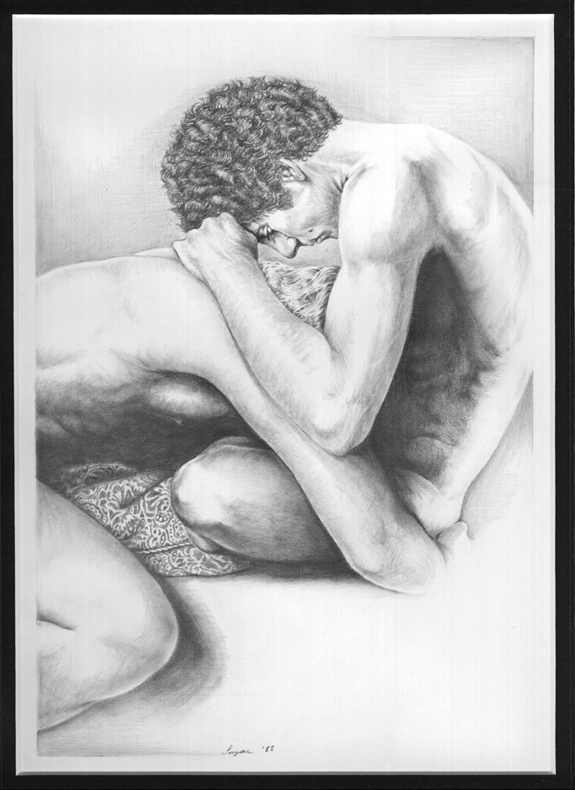
* * * * * *
The car was pulled far enough off the road to be almost invisible. Starsky gave it only a passing glance as he drove out of the gate on the way to work, and forgot about it immediately. Until the next morning, when it was there again. This time he remembered to check on the way home, and it was still there. A vague silhouette spoke of occupancy, so it couldn’t have been parked up and left by a fisherman, walker or birdwatcher.
For some reason, Starsky couldn’t get that car out of his head. For a while he pottered about preparing the evening meal, but his concentration was lacking. Just in time he caught himself about to put two tablespoons of cayenne into the casserole instead of teaspoons. He swore, and dumped the spice back in the jar. The nerves under his scalp and down his spine were hyperactive; it felt like insects with many feet were crawling over his skin, and the resulting tension was knotting his muscles. He was being watched. The conviction grew out of control and took over, so that he spun on his heel, instinctively reaching for the gun that hadn’t been there for months. The kitchen was empty but for himself. Of course. No one was at the window nor in the doorway. Not even the cat.
“Shit!” he said aloud. “Am I still crazy?” A perfectly innocent car parked opposite the driveway, and I go off the wall? For God’s sake, get your act together.
But even so, he found himself heading out of the house. Maybe he should go over and say hello, find out what the guy was doing in this neck of the woods. Be neighborly. And set his mind at rest.
Starsky cut across the garden to stay out of sight of any watcher until the last possible moment. The sound of a car engine made him freeze momentarily and Hutch’s car turned into the drive and braked to a halt.
“Hi,” Hutch smiled. “A welcoming committee?” and Starsky realized he had gained a smaller shadow. Dop was stalking beside him.
“Of course,” he said, feeling foolish.
Hutch laughed, and carried on up to the house. Starsky swung the gate shut behind him, staring across the road. There was no car. But the wheel tracks were there, grass and undergrowth straightening up as he watched.
“I’m paranoid,” he told the cat. “C’mon, let’s go finish the cookin’.”
Casually, while they were clearing away the remains of the meal, Starsky said, “Did you notice a car in the bushes opposite us when you came home tonight?”
“No,” Hutch said.
“No, there wasn’t, or no, you didn’t?”
“No, I didn’t. Why? What’s so important about it?” Hutch said, voice puzzled.
“Probably nothin’,” he smiled. “You know how it is—once a cop, and all that.”
“You think someone’s casing the joint?” Hutch said. There was no disbelief or amusement in either face or voice, for which Starsky gave silent thanks.
“It’s a possibility—kinda thin, though, I guess. This car was out there yesterday morning, this morning, and tonight when I got home. By the look of it he left right after you came home. It’s either a coincidence, or maybe we got a prospective burglary coming up.”
“Yeah,” Hutch frowned. “How much of the car did you see?”
“Not a lot. It’s a dark blue sedan. Couldn’t make a guess at the model, and couldn’t see the license plate. Tomorrow I’ll give it a closer look if it’s still there.”
“Good idea. Maybe we should think about a couple of Dobermans. It’s pretty isolated out here, and a prime target for break-ins.”
“Yeah, maybe. Though Dop won’t like it. And thanks, lover.”
“For what?”
“Not tellin’ me I’m paranoid.”
“When I think you are, I’ll tell you fast enough,” Hutch smiled. “In the meantime, why don’t we take a look at where it was parked. He might have left something lying around.”
But he hadn’t. There was nothing there but the tire marks, not even a cigarette packet or a discarded can.
“I’m being too suspicious,” Starsky admitted. “Either he took all his litter home, or he didn’t spend any time at the car. Almost certainly he was a fisherman or something.”
“Maybe. But there’s no harm in keeping an eye open for him. Just in case.”
“And think about the Dobermans,” Starsky chuckled. “Hear that, Dop? You could have some competition around here.”
“Waow,” commented the cat, emerging from a hazel stand.
The next day there was no car parked in the bushes.
* * * * * *
“There is no real improvement, Mr. Praetor,” Dr. Kalleran said. “The wheelchair has increased his mobility, but that gives a false impression of physical recovery. There is none, I’m afraid. He is operating on will-power alone.”
“Is there deterioration, then?”
“Physically, no, not yet. But it is a matter of time.”
Again, that word and its almost imperceptible stress. Praetor looked the doctor square in the eyes. “My uncle is insane,” he said bluntly, “and getting worse. Right?”
“He is obsessional certainly,” the man said with some care. “And yes, his mental condition does appear to be slowly worsening, but — ”
“He is insane.”
“I’m not qualified to make that diagnosis.”
“Fair enough.” Praetor gave the doctor a disarmingly rueful smile. “Thanks for your time.”
Dr. Kalleran accepted the dismissal and left him alone, but Praetor did not go immediately to Gunther’s room. He toyed with the idea of having his uncle confirmed insane officially by a psychiatrist. That would let him off the hook as far as this lunatic vendetta was concerned, and would give the defense lawyer a good line for the judge. James Marshall Gunther, not guilty by reason of insanity. And if the old monster was officially declared insane, then he, Robert Marshall Praetor, would become executor of his affairs. But would that give him access to those Swiss bank accounts? He had a gut feeling it would not. So the charade would have to continue, balancing the wasting of time with retaining Gunther’s confidence and cooperation until those account numbers were his.
For once the television was not on. Gunther sat in front of the window, his back to the door, his features a pale insubstantial reflection in the glass. A ghost of a man, Praetor thought, left behind in this modern world.
The chair spun round and Gunther faced him, eyes brilliant as dagger points.
“You hired the investigator as instructed?” he snapped. “Report.”
“Yes, Uncle James,” Praetor said patiently. “I have Hutchinson’s address. He’s working for Westray Electonics as a security consultant.”
“And Starsky?”
“Teaching photography in Heston High School in Visalia.”
“What have you done about it?”
“Nothing, as yet. I await your instructions.”
“I see. What else have you found out on them?”
“Not much else of any importance.”
“Really. Robert, you’re a bigger fool than I took you for. Don’t you consider the fact that they are indulging in a homosexual relationship to be of ‘any importance’?”
Praetor swallowed. How the hell did he know? “Frankly, I didn’t. This is California. In some quarters to be gay is, uh, fashionable.”
“Don’t treat me like an idiot. They don’t live or work in San Francisco.” He began to laugh quietly, a cold mirth that made Praetor feel vaguely nauseous. “They are giving me weapon after weapon with which to destroy them.” Then the laughter was cut short and those all-too-alert eyes scalpeled into Praetor’s brain. “Of course. I know what you’re doing, and why. You think you can humor me, string me along with platitudes and snippets of information to make me think you’re doing as you’re told. Hoping I’ll have another stroke and you’ll inherit those Swiss bank accounts?” He smiled, a slow evil and twisted smile. “Robert, it doesn’t work that way. The stroke may have affected my body, but not my mind. Those numbers are up here,” tapping one finger on his brow, “and nowhere else. I’ll take them to my grave rather than pass them on to someone who hasn’t earned them. No more foolish tricks, Robert. Your investigator reports directly to me as well as to you. You have one last chance to redeem yourself. And this, my dear nephew, is what you will do.”
The instructions were clear and precise. First would come the hate campaign, the anonymous letters to local papers denouncing the perverted queers living in Three Rivers, and to their employers. This would be followed up by also anonymous tip-offs to the sheriff’s office, linking them with every unsolved sex-crime going. Almiro would help out on that last order. Praetor did not need to ask what was the point of such vicious pettiness; Gunther was going to cut them off from everything they valued. Friends, careers, probably family as well. And then?
“When they’ve been hounded out of the county by the righteous citizens,” Gunther went on, “we tighten the screws a little more. Another contract, I think, on ex-Detective Sergeant Starsky. Followed by another campaign against Hutchinson’s sanity. Suicide would be appropriate, I think. A nicely ignominious death, eh, Robert?”
“Yes, Uncle James,” he croaked, bile clogging in his throat.
“And then, and only then, will I hand over those Swiss accounts. Indeed, you can have everything with my blessing. I no longer have any use for it.”
“Uncle James, it seems to be a somewhat long drawn out arrangement, and you are a sick man—couldn’t you — ”
“No. I’ve made my plans, and you’ll stick to them. I’ve sworn to God and the Devil, Robert, that I will live to see Hutchinson dead, and I will do it. Now, get out of here and start the ball rolling, and don’t attempt to draw the wool over my eyes again. If you wish to inherit, you must prove worthy. Agreed?”
“Yes Uncle James.” This time he spoke with conviction, when it came down to it, he wanted that money and all the power it would buy. Okay, so this crazy old monster was treating him like a doormat, but no one else ever would. That was certain.
CHAPTER FIFTEEN
Hutch returned to the Merced office from the Stockton plant by mid-afternoon. His secretary greeted him with a nervous smile and a couple of messages.
“Mac wants you to call him at Sacramento as soon as you got back,” she said, “and Mr. Carson wants to see you in his office even sooner.”
“That sounds ominous. Has someone used his parking space again?”
“Uh, it’s a bit more important than that,” she said, not looking at him. “Shall I get Mac’s number?”
“S’okay, I’ll call him after I’ve seen the bossman.”
“Um, Hutch, maybe you should call him first.”
He stared at her suspiciously. “What’s going on here? Has Mac got some serious trouble up north?”
“No,” she said, “he’s fine, but — ”
“Janie,” he said patiently, “am I about to be fired, or something?”
“No!” she flared. “You better not be! I don’t know what’s going on for sure, but something is. Call Mac, Hutch.”
“Later,” he said grimly. “Call the old man’s secretary and tell her I’m on my way.”
So what was coming down? Hutch was frowning as he headed for the elevator. He knew for a fact that the company director had no reason to fire him—he’d already saved the firm thousands of dollars at the Stockton plant alone, with the prospect of many more thousands at the San Francisco and Sacramento complexes soon to come. From the first meeting, he’d gotten along well with Wallace Carson, and could think of no reason for Janie’s obvious concern. Unless a competitor had got wind of the new computer project, and had made a try for the blueprints, breaking through the newly installed security systems to do it. That could well be classified as shit hitting the fan.
Carson’s secretary waved him on through with a cheerful smile, and he entered the big office with increased puzzlement. He didn’t think that Carole would be quite so happy if the manure was flying around.
“Sit down, Hutch,” Carson said. “Coffee?”
“No, thanks. I got some waiting back in my office. What’s the problem?”
“Well, Westray haven’t got any, but you might have. It looks as if someone is gunning for you, Hutch. This turned up in the post this morning.” And he pushed a piece of folded paper across the desk.
Hutch picked it up, started to read, then glanced quickly at the end of the letter.
“Don’t bother, it’s unsigned,” Carson said. “That kind of shit usually is. The bastards are so high and mighty on their moral ground, but they haven’t got the guts to put their names to the trash they write.”
“Yes,” said Hutch numbly. As anonymous letters went, this one was fairly innocuous. The writer wished Mr. Carson to know that his company had unwittingly employed a dangerous homosexual pervert who might at any minute attack his employees’ children. Did Mr. Carson know that there were a series of unsolved sex crimes in the Visalia area, and given the presence of this evil person on his staff, what was Mr. Carson going to do about it? It was his moral and God-fearing duty to take steps to protect the righteous.
Hutch dropped the letter on the desk and sat back. “So what are you going to do about it?” he asked.
“Protect the righteous,” Carson grinned, and screwed up the paper and threw it into the waste paper basket. “And the innocent. That’s the best place for that garbage. But there are implications here which I, for one, don’t like. Right from the start, let me repeat what I said when you first joined us. I don’t give a damn if you’re gay or straight. If I had to fire every gay who worked for me, the San Francisco plant would have to be shut down. I’d probably lose half my workforce, if not more. It’s the person and the work he or she turns out that’s important, and you do a damn good job. So don’t think I’m going to take any notice of that malicious shit. But if the bastard has written to me, he could be writing to other people, and he’s doing more than mudslinging. He’s making accusations here, in a very unsubtle way, and it seems likely to me someone is out to cause you as much grief as they can. You better warn the rest of your family, and go to the police.” He retrieved the letter and its envelope from the waste bin, and held them out to Hutch. “Take this and show it to them. Sheriff DeSoto at Visalia isn’t a bad guy, I’ve gone skeet shooting with him a few times. He’s one of the old school, but he’s good.”
“Thanks. This is the last thing I expected,” Hutch said quietly. “And I can’t think who’d do it, or why.” He checked the envelope—the postmark said Visalia. “We haven’t been here long enough to have made enemies, for God’s sake. We left all the old ones behind in Los Angeles,” he added with a bleak smile. “And they’re more likely to come after us with guns than with this.”
“Don’t know which is worse,” Carson snorted. “Just remember this, the company’s behind you. Any help you need in the way of lawyers, cash, whatever, come and see me. Okay?”
“Yes, and thanks. I appreciate this.”
“No sweat. Take the rest of the day and get that piece of shit to the sheriff.”
“Maybe. After the family discussion.”
“What do you mean, maybe? You’re both ex-cops, aren’t you? Isn’t that the kind of advice you used to hand out? So take it, for a change. Let the sheriff’s office earn its keep. And good luck, Hutch.”
“I think we’re going to need it.”
* * * * * *
The drive home seemed to take longer than usual, and it wasn’t until he took the turning off towards Three Rivers that Hutch remembered he hadn’t called Mac. Well, that would have to wait for the next day. If the problem was that urgent then Mac could call him at home. Starsky was sitting at the breakfast bar when Hutch walked in, and he didn’t look up when Hutch spoke his name.
“We got an anonymous letter in the mail,” he said, sitting beside Starsky and dropping an arm about his shoulders.
“Yeah. All the usual crap. How did you know?”
“The boss got one today, about me. He says to take it to the sheriff.”
“Are you fired?”
“Nope. Any help we want with lawyers, and so on, he’ll see we get.”
“That’s somethin’, I guess.” His voice was flat, and Hutch tightened his embrace. “If this creep sent one to Carson, what’s the betting there’s one on the way to the High School and I’ll bet you any money they won’t be so liberal minded. Maybe I should resign right now, before the unpleasantness really starts.”
“Where is the letter? What did it say?”
“It’s over by the coffee pot. Basically it’s tellin’ us perverts to get out of the area because they don’t want us foulin’ their clean air an’ corruptin’ their kids. What did Carson’s say?”
“Variation on the theme, with a sting in the tail.” Hutch handed it over, and examined the letter and envelope that Starsky had opened. Both were different from the one he’d already seen, and though both were typed, this one had been done on an old manual, while Carson’s had been typed on an electric.
“What gets me is, why?” said Starsky suddenly. “We’ve been here months now, and no one’s bothered. We haven’t exactly been advertisin’ that we’re gay, and there ain’t that many people who know, especially in Visalia. No one in the family is going to turn out this shit, so who’s got hold of it, and why? I don’t buy all this moral crap—it’s all too pat, you know?”
“Yes. So what do we do about it? Take it to the sheriff like Carson said? It’s what we’d advise if we were still cops and it was someone else on the receiving end.”
“Oh, sure. Ain’t so easy when the shoe’s on the other foot. First thing to do is warn Kathy and Mac what’s going on. As for what else we do—apart from fight back—I don’t know. But I do know I’m not gonna be driven out by some yellow bastard who hasn’t got the guts to put his name to this. Or her name. Hey,” he said suddenly, straightening up. “Remember that car a couple of weeks back? I’ll bet that’s part of it. Or am I being paranoid again?”
“If you are, it’s catching. Are you serious about resigning?”
“Fuck it, I don’t know! This has thrown me a real curve I’m thinking about it. But I ain’t leavin’,” he finished with fierce determination. “Yeah, call the sheriff. The worst he can do is laugh in our faces — ”
He was interrupted by the phone, and Hutch answered it to find an angry brother-in-law on the other end. “Why didn’t you call me back?” Mac yelled. “Did the bossman tell you what’s come down? The letter?”
“Yes,” Hutch said coolly. “Calm down, Mac, it’s no big deal.”
“What! I don’t believe you said that!”
“I’ve still got a job. Is that what you wanted to tell me?”
“Yeah, to warn you before you were called in to the top office. Oh, I knew he wouldn’t fire you, but forewarned is forearmed.”
“I appreciate the thought. Thanks. But one turned up at the house today. Have you told Kathy?”
“No. Not yet.”
“Then you’d better do it. If these scum are writing to Carson, the school is likely to be next. In fact, Kathy might even get one as well, if they assume we haven’t told anyone we’re gay.”
“I’ll tell her. The mushroom-shaped cloud over Visalia will be your sister.” Mac’s temper seemed to have cooled off. “It’s probably some nut who wants to buy your place cheap, trying to drive you out.”
“Maybe,” Hutch said, “but they as sure as shit are not going to succeed.”
“Attaboy. Keep us informed, huh? I’ll see you at work tomorrow.”
“Yeah,” said Hutch, and hung up.
“Good old Mac,” Starsky said wryly. “Nothin’ like family for rallying round in a crisis, is there? Listen, I’ve been thinking. Let’s wait a while, see if this is just a one-off, or if we’re gonna get a collection of these. That way we could have a good spread to show to Sheriff Whatsisname for comparisons.”
“Sounds like a good idea. I’ll pass it on to Mac and the boss.”
* * * * * *
For a week, the unsigned letters continued to appear in their mail. Kathy received a couple, kindly informing her of her brother’s sin, and demanding that she publicly denounce them. Wallace, Carson, and the rest of the board collected a dozen between them, and all were carefully kept inside polythene bags and handed over to Hutch. The principal of the high school so far did not appear to have received any, nor the PTA. Which seemed a little strange.
“Maybe,” said Starsky, “they’re saving up a real lulu for the school. Still, it’s an interesting pattern. Ours are aimed at getting us out. Kathy’s are trying to alienate her, while the rest want you fired and are suggesting we’re murderers and sex-maniacs as well as perverts. We got half a dozen different typefaces and machines, more than a dozen different kinds of paper and envelopes, and none of ’em handwritten. All of ’em were mailed in Visalia.”
“And I’ve got a hunch,” Hutch said, “that they’re written by one person, maybe two. Look at the word patterns, the phrases.”
“Yeah, I think you’re right. Wish we had access to Forensics. I’d like to see what they make of these. I’d also like to know how he, she, or they can get hold of this many different typewriters.”
“They may not need to. The electric machines have interchangeable daisywheels or golfballs.”
“Damn it, why didn’t I think of that? Maybe I need more coffee. Want some?”
“Yeah, thanks,” Hutch said absently. “We’ve got enough here to go to the sheriff,” he went on over the sound of the doorbell. “‘S okay, I’ll get it,” he called.
Hutch opened the door to a heavily built man in his late forties, made bulkier by his uniform and the wide belt slung below a paunch that looked to be more muscle than lard.
“Mr. Hutchinson. I’m Sheriff DeSoto and I’d like a few minutes of your time.” While not exactly hostile, his eyes were stone-like, and his mouth set like a steel trap.
“Come on in,” Hutch said evenly. “You’ve just saved us a phone call.”
“Yeah?” Noncommittally. Then, as he followed Hutch through to the living room: “You sure put a lot of work into this place. Quite an investment, I guess.”
“So we’ve been told,” Starsky said, coming in from the kitchen. “Only we ain’t plannin’ on cashing in on it. I just made coffee, d’you want some, Sheriff?”
“No, thanks.”
“This is Dave Starsky, my partner,” Hutch said. “What did you want to talk about, Sheriff?”
“This ‘n’ that. Why don’t you tell me what you were gonna call me about?”
“Poison pen letters,” Starsky said crisply. “Sit down, Sheriff, make yourself comfortable. Nobody here is gonna compromise your virtue.”
“Poison pen letters,” the man repeated. “Care to elaborate on that?”
“Sure,” said Hutch. “To my boss, suggesting that he fire me, and that Starsk and me are guilty of a variety of unsolved sex crimes because we are homosexual. To my sister, informing her that I am having an unnatural relationship with a man and she should publicly denounce me. To both of us here telling us we are evil perverts who’ve got no place here, in this righteous and god-fearing community of Christian souls. This has been going on for about a week now, and we’ve kept every last letter and envelope. My guess is, you’ve been sent some too, or you wouldn’t be here, right?”
“Could be,” DeSoto said mildly. “Are you?”
“Am I what?”
“A homo.”
“Yes,” said Hutch coldly. “One half of a long-term monogamous relationship. And since when did that fact justify this kind of persecution within the law?”
“Did I say it did? Whatever my personal feelings might be, I uphold the law in this county. To the letter, Hutchinson. So back down, the pair of you, and let me get a sight of what’s goin’ on. Yeah, my department’s received letters, unsigned, makin’ specific accusations against you. I’m ignorin’ them, because whoever made them wasn’t all that clued up on the progress of the various investigations. We know you two ain’t involved. But I’m kinda curious as to why this campaign has suddenly sprung up. Seems to me you been steppin’ on somebody’s toes. Either here or back in L.A. Y’see, I’ve done some checkin’ around myself. Could be you brought this trouble with you.”
“No way,” Starsky snapped. “Only three people know where we are, and two of them are cops. And all three I’d trust with our lives.”
“It’s awful hard to disappear without trace when you’re holding down a job and driving a car in your own name,” Sheriff DeSoto said. “You of all people ought to know that. You gonna show me this collection you got? I’ll have to take it away for tests. I’ll want your fingerprints, as well.”
“It’s over here,” Hutch said. “Help yourself.”
“Intend to,” he replied. “Hm. Nice set of groups. Looks like the ones we got match in pretty well. How about that coffee now? You guys got any theories?”
“No,” Starsky said, pouring coffee and handing it over. “That’s one thing we are short on. We haven’t been advertisin’ our relationship—only Hutch’s folks in Visalia and his bosses know. And our friends in L.A. The people we’ve come into contact with have all been friendly, they’ve made us welcome, and we ain’t had a fight with anyone. The neighbors are fine, always been cheerful and welcoming. I can’t think of anyone whose toes we’ve stomped on.”
“Me, neither,” Hutch put in. “I’ve got no enemies at work.”
“Security consultant, right? Maybe you’re too good at your job, Hutchinson. Thought of that one? Could be it’s the competition in the electronics business trying to get you out. If it is like that, it could get worse. I’m gonna work on it, anyhow. In the meantime, keep any more of these that turn up, and let me know if there are developments. Okay?” He drained the hot coffee and stood up, carefully gathering together the packaged letters. ”If you find out anything, get in touch,” he went on. “You ain’t cops any more. If you take the law into your own hands, I’ll come down on you so hard you’ll think Mount Rushmore hit you. Got that?”
Sure, Sheriff,” Hutch said tiredly. “We know the score.”
“Good. If you think about havin’ a couple of guard dogs, give me a call. Friend of mine breeds Rottweilers. See you around, guys,” and he headed for the door.
“Prejudiced but fair-minded,” Starsky announced wryly. “He’s not gonna get anywhere, but I guess it won’t be through lack of effort. That crack about business competitors—I hate to admit it, but he’s got a point there.”
* * * * * *
Kathy’s afternoon shopping in Visalia had left her just enough time to catch the afternoon TV news round up before starting the preparations for dinner. She fixed herself coffee and took the cup and an illicit slice of fudge cake into the living room, settling herself for a few minutes’ relaxation in front of the screen She was later than she thought. The program was almost over.
” . . . Predicting a downswing in prices, which has to be good news whichever way you slice it.” The anchorwoman gave a practiced plastic smile. “And now, Jeff Jeffries with our own ‘In the Public Interest’.” Kathy reached for the remote control. ” . . . But first, a problem in one of our high schools. There are things our children don’t need to learn, things they should never be exposed to, and it appears that things are developing in the darkroom at Heston High that aren’t just pretty pictures. Far from it, in fact . . . ” Kathy’s finger froze above the cut-off button as the scandal-monger continued his muck-raking. ” We’re not naming names here, folks, but it seems to me that our children lose their innocence all too soon these days, and they don’t need this kind of pervert teaching them all the wrong lessons. Perhaps the School Board should be looking more closely at the people they employ, even on a temporary — ”
“You bastards!” Kathy hurled the remote control at the screen and lunged for the phone, hands shaking with fury. But the station, even when she found their number, wasn’t answering. It was probably just as well.
* * * * * *
Starsky checked his watch as he headed up the valley road—if he was even five minutes late, Dop wouldn’t let him forget it for the rest of the evening. How the animal knew what time to expect him home he didn’t know, but without fail the cat would appear on the deck seconds after he got in, announcing his arrival with a deep Siamese bellow. He and Starsky would share a pint of milk or a can of beer—Dop had a preference for Budweiser—while they figured out what to fix for dinner.
Tonight would be cold cuts and salad. If Hutch remembered to pick up the French bread, there’d be enough for substantial hero sandwiches too. Either late supper—depending on what time they got to bed, or lunch tomorrow. Given a choice, Starsky would opt for a late supper. Good sex always made him hungry.
He was early—time to empty the grocery sacks into cupboards and freezer, and to switch on TV for the afternoon news while he popped a can and relished the first mouthful of ice-cool foam. It was the usual round-up of small local events, and he only half-listened as he opened the French doors and gave the two-note whistle that Dop recognized as “chow-time.” There was no response. He stepped out onto the deck to try again, and saw Dop stretched beneath the rail.
He knew, even before he saw the dark matted fur around the wound and touched the stiffened body, that the cat was dead. But he said the animal’s name anyway. “Dop?” Slowly, he knelt beside it. The analytical part of his mind registered the size of the wound—small caliber, maybe .22, a clean shot to the head—while the rest of him absorbed the reality. After a while, he picked the cat up and carried it inside, sat with it across his knees, numbly trying to stroke sleekness back into the ruffled creamy fur. The TV was still babbling. Dully, he registered what was being said, and any other time he would have reacted, but Jeff Jeffries snide scandal-mongering was unimportant compared to the truth under his hands.
The fur wouldn’t smooth out. It had lost all its living warmth. “Ah, babe . . . ” Starsky heard the choke in his own voice. There was nothing he could do, except dig a hole and bury the body.
The cottonwood tree, bark scarred by the stropping of exuberant claws, was in full glorious leaf. The grave beneath it was pitifully small, but he hadn’t finished when he heard the sound of a car engine.
Kathy’s journey to Three Rivers was a blessing in that it had given her time to collect herself. But the anger didn’t fade—transmuted, rather, from the first white-hot fury to the kind of Nordic iceberg rage that is all the more dangerous for being nine-tenths under the surface. It was a family trait, and Starsky, who must have seen it often enough manifest in her brother, probably recognized it as she slammed the car door and stalked up the steps.
“Yeah, I saw it,” he said before she could speak. “Don’t pull any punches, do they?” He looked pale.
“Is Ken home?” Kathy wanted to know.
“Not for another thirty minutes.” He led her through to the kitchen, sat her down at the breakfast bar, and poured two glasses of Scotch. “Here. Medicinal purposes.”
Kathy glared at him, then the glass, then picked it up and drank the contents in one gulp.
“Dave — ” It took a moment for her to get her breath back. “Dammit, how could they — ?”
” — Find out about me ‘n’ Hutch?” Starsky finished for her. “It doesn’t matter, Kath.”
“Doesn’t matter?” she repeated, outraged. “Of course it matters! They’ve got no right — ”
He cut her off in mid-tirade. “Kath, listen. I don’t give a shit what people think. I’ve been through all this before, one way or another. I’ve been a target before. Because I’m a Jew. Because I was a G.I., a Vietnam vet. Because I was a cop. There are always going to be people who hate anything that’s different. All I care about is if this mud-slinging hurts you or anyone else—Hutch ‘n ‘me, we’re used to it. Mostly.”
There was a deep weariness in his voice, and she could see the marks of anger and grief on his face.
“What are you going to do?” she asked after a moment. He shrugged.
“Nothing much I can do. Resign, I guess.”
“Dave, no!” she objected.
“I don’t want to make trouble for you, or the school board. It was a temporary thing, anyway—I’m just quitting a few weeks ahead of time.”
“But you shouldn’t have to do that! It’s not fair — ”
“Kath, darlin’.” His hands on her shoulders were firm, the dark blue eyes gazing down into hers gentle and understanding. “No one ever promised life was gonna be fair. For any of us. The way I see it, I’m luckier than most people. This is a pinprick, that’s all. Some killjoy trying to burst our bubble. It won’t work, and sooner or later they’ll get tired of trying and go after easier game.”
He smiled at her, and she tried to smile back. “I hope you’re right, Dave,” she said doubtfully.
“Trust me.” The blue eyes crinkled, the grin widened wantonly, and she laughed and hugged him.
“And I used to wonder why Ken was so crazy about you!”
“Has to be my pretty blue eyes—it sure as hell isn’t my cooking. Go on home, Kath. And don’t worry, okay? You’ll get wrinkles.”
She was smiling as she drove away after exhorting him to take care. Starsky watched the car out of sight, then turned back to the half-filled hole under the cottonwood tree.
Hutch got home just as he set the last turf on the small mound, and Starsky forestalled his question.
“Dop,” he said. “I found him on the deck when I got home.” He tamped the sod down and straightened up. “Someone shot the poor little bastard.” And, when Hutch didn’t speak — “Our pen pal is getting meaner by the minute, partner.”
“Christ.” It was an expletive. Hutch’s eyes were bleak. “What harm did Dop do anyone?”
“He lives with us.” Starsky got to his feet. “Hutch, Kath was here. Someone tipped off the local TV gossip-hound that a gay was teaching high school. I’m quitting before the School Board has to dismiss me.”
He had told Kathy that it didn’t matter, and it had been a lie. The weight of Hutch’s arm across his shoulders helped to salve a little of the soreness, made worse by the frustration of helplessness, and he knew that Hutch shared his feelings.
The nightmare surfaced that night, for the first time for months, and his own noise woke him. Hutch, face troubled, was holding him close, but as soon as he realized his lover was conscious, he slackened his grip a little, stroking the sweat slick back and shoulders.
“What brought that on, do you think?” he asked softly, as the shudders eased.
Starsky shook his head, willing himself to relax. “Don’t know. Maybe I’m punchy. Hutch, what kind of sick bastard would do that to Dop?” The animal had meant more to him than even he had realized — he was going to miss the little chirrups of feline conversation, of Dop figure-eighting between his legs, or demanding tidbits, or just being a warm furry weight on the bed. He felt a salt stinging behind his eyelids. “Oh, shit . . . ”
“I know,” Hutch said. “Me, too.”
* * * * * *
Starsky’s resignation took some of the wind out of the sails of the more Puritan members of the School Board, though the knowing comments of ‘no smoke without fire’ earned them the sharp edge of Kathy’s tongue at the next meeting of the P.T.A. A tigress defending her one cub couldn’t have been fiercer.
“I suppose it’s escaped your notice,” she said savagely to the assembled company, automatically tarring them all with the same brush, “that the majority of sex crimes against children are committed by heterosexuals? This accusation is not only sick, it’s inaccurate and damned unfair!”
“Mrs. McKinley — ” the Principal said placatingly, “I do sympathize, believe me, but — ”
“But you’d still see an innocent man pilloried because his lifestyle happens to be a little different from yours. And not because you even have any proof—no, you listen to the lies broadcast by that slime ball Jefferies and his cronies!” She drew breath, eyes blazing. “Let me tell you something. Dave Starsky is one of the finest human beings I’ve ever met. He was a cop for eight years and more, and he’s got commendations out the ears. He’s good, and gentle, and kind, and my kids love him and I just wish there were a few more like him, that’s all!”
“Mrs. McKinley. If I could just say a few words?” The principal waited to see if she was about to explode again. “We accepted Mr. Starsky’s resignation with considerable regret. In the present climate it seemed best not to object. But let me assure you, when the fuss has died down, we have every intention of asking him to take up his position as guest lecturer again — ”
“What the hell makes you think he’d accept?” Kathy snapped witheringly, and stalked out.
* * * * * *
The poison-pen campaign was one thing—the death of Dop was quite another. Hutch had the feeling that it was the start of something even more deadly, and that premonition was confirmed when the phone rang late one evening. Starsky was in the shower — Hutch, clad only in a towel, reached for the receiver. “I’ll get it,” he yelled. “It’s probably Kath.”
But it wasn’t.
“Shame about the cat,” said an unidentified male voice “Of course, these things happen. Nice kids your sister’s got. Particularly the girl.” And the line went abruptly dead.
Slowly, Hutch put the phone down. Gooseflesh prickled out on his exposed skin, and it had nothing to do with the temperature.
“Was it Kath?” Starsky walked out of the bathroom, toweling his hair.
“No.” The ice of fear was becoming white heat of rage—worse because it must be undirected. There was no target to aim for, no way of defending his family. Except by selling up and getting out, accepting defeat. “No. Our poisonous pal has a whole new field of operation, babe. Looks like better get in touch with the sheriff again.”
PART 5
CHAPTER SIXTEEN
Duplessis corrected his last typing error and removed the arrest report from the machine. Tip Moynihan, all wrapped up nice and tight, and his gang of juvenile muggers with him He signed the final page with something of a flourish. It was, if he said it himself, a neat bit of detective work, and Tip would need a miracle worker for a lawyer if he was going to wriggle out from under this time. When he finished this shift, he’d call Hutch in Three Rivers, let him know the good news.
“Duplessis!” The familiar bellow still had the power to make him wince, and he got to the door fast. There all evidence of haste left him, he slowed to a saunter, and stuck his head into the office.
“You whispered, mi Capitan?”
“Smartass!” Dobey barked. “Get in here. Siddown.”
Still apparently at his ease, Duplessis slouched into a chair. But his nerve ends were charged and quivering. There was a grimness to the Captain’s mouth and eyes that triggered all his instincts to a state of red alert.
“You keep in touch with Hutch, don’t you? And Starsky?”
“Sure.” This wasn’t what he expected. “Are they okay?”
“Maybe, maybe not. When was the last time you spoke to them?”
“Couple of weeks back. Not long after the dinner party.”
“They mention any problems?” Dobey demanded heavily.
“None at all. The reverse, in fact. Why, Cap? What’s come down?”
Dobey sighed, easing his bulk in the chair. “I’ve just had the Visalia Sheriff’s Office on the phone. Seems like they’ve been getting anonymous tip-offs linking Starsky and Hutch to a number of crimes.”
“What?” Duplessis yelped. “That’s crazy!”
“Right. And they’re all sex-offenses involving kids. The local T.V. station got hold of it as well, and they’re having a field day. No accusations—just hints, and the usual stuff about do we want perverts soiling our pure and lovely town.”
“They’re not taking it seriously, are they?” Duplessis couldn’t take it in. “The cops, I mean.”
“No. But the good Christian souls of the Visalia Moral Majority are, and that spells trouble. Someone’s going out of their way to whip up a hate campaign against those two, and it could turn very nasty.”
“But—why, for god’s sake?” Duplessis said, still stunned. “Who’s to gain? Captain, what’s going on out there?”
“Damned if I know.” Dobey leaned forward. “But it doesn’t sit right with me, and there’s more to this than the usual homophobia. Of that I’m certain.”
“What does the sheriff think? And what’s he doing about it?”
“He thinks it’s a personal vendetta, and so do I. They made enemies while they were cops. As for what he’s doing—nothing. Starsky and Hutch have made no official complaint, so his hands are tied.”
“Captain — ”
“So are ours,” Dobey said. “Officially. When are you visiting them next?”
“Don’t know—I was going to call Hutch about the Moynihan case tonight, but — ”
“Let’s see. Today’s Thursday. Why don’t you take a day’s personal time tomorrow? Just a suggestion. You’re looking kind of peaky. A run up-country might do you good.”
Their eyes met above the cluttered desk, and they understood each other perfectly.
“Could be you’re right, Captain. I hear there’s good fishing in Three Rivers. I always meant to give it a try.”
“Good idea.” Dobey sat back, smiling slightly. “Let me know if you land anything.”
“I’ll do that. In the meantime, just what do we have?”
Dobey picked up a sheet of teletype. “Sheriff DeSoto sent this through. There’s the tip-off to the Fresno T.V. station and six anonymous letters to date, each one accusing one or both of them of sex-abuse offenses in the Visalia area. DeSoto’s a fair-minded man and he knows a set-up when he sees one. He wouldn’t convict a dog on the evidence of an unsigned letter, let alone a couple of ex-cops, even if they are gay. Here’s the odd thing—he says that of the sex-offense cases that are under investigation, two have never been publicized. They haven’t even got near a courtroom yet. So someone must have got access to that information in order to throw the accusation at our boys.”
“Someone’s out to discredit them,” Duplessis said thoughtfully. “Maybe more than discredit.”
“If the Moral Majority gets out of hand, yes. Think about it, Duplessis. What cases of theirs are big enough, and still pending, for this kind of racket?”
“Gunther,” said Duplessis instantly. “And the Hidalgo/Benedic set-up. But Gunther’s sick, and they haven’t even set a trial-date yet. Isn’t he in a private sanatorium somewhere?”
“And unlikely to go before a jury,” Dobey confirmed. “The Escort murders are set for next month, right?”
“Late April,” Duplessis agreed.
“Okay. See what you can dig up. And keep me posted.”
“Yes, Captain,” Duplessis said dutifully, and went back to his paperwork.
He didn’t make the intended phone call to Three Rivers, suspecting that he would probably learn more by turning up unannounced than if the two men had a chance to decide on their degree of cooperation—if any. He had the feeling they wouldn’t be admitting to any kind of petty victimization. The trick would be to convince them that this was more than petty. But surely they wouldn’t have switched off their cop instincts, just because they didn’t carry badges any more?
* * * * * *
There had been even more hard work put into the house and its surroundings since his last visit, and for a moment Duplessis acknowledged a twist of envy. The fixer-upper was well on the way to becoming a choice piece of real estate, and they’d make quite a profit when they decided to sell. And maybe they would, if they were getting hassle from the neighbors. On the other hand, knowing the stubbornness of both men, such a thought would be kicked clear out of the ballpark.
Duplessis didn’t play his usual fanfare on the doorbell, contenting himself with a couple of short blasts. The door was jerked open almost at once, and Starsky stared at him, wariness and borderline hostility visible for a fraction of a second before being swamped by recognition.
“Hey, look what the wind blew in,” he drawled. “Playing hooky, Dave?”
“Something like that,” Duplessis agreed, smiling. “You got a cold beer for a thirsty traveler?”
“Are you kidding?” Hutch said cheerfully over Starsky’s shoulder. “Come on in. How are things back in the Wicked City?”
“Not so bad,” Duplessis hedged. “In fact, that’s partly why I’m here. We nailed Tip Moynihan, Hutch. Rock solid. I had a free day, so I thought I’d drive up here and tell you.”
“That’s good news.” Hutch slapped him on the back in congratulation. “I knew you’d do it. Come through to the kitchen, and we’ll get that beer. Has Dobey found you a new partner yet?”
“Nope. To tell you the truth, I kind of like working solo.”
“That’s dumb,” Starsky said. “And dangerous.”
“Different strokes,” Duplessis shrugged. “There’s always back-up around, if I need it.”
“Back-up isn’t like having a partner.”
“Okay, but there’s no such thing as total protection, and I’d sooner go solo than risk my neck with someone I may not be able to rely on. This way I don’t get caught out expecting them to do one thing and they do another.” He glanced at Hutch. “Not every team has what you two had, y’know.”
“I know that,” Starsky snapped, ”but — ”
“We can argue this all day, and never get anywhere,” Hutch cut in. “Beer, Dave. Come out on the deck and catch me up on what’s happening with the old firm.”
Ever obliging, Duplessis did just that, and at the end, after Starsky had fetched refills, he took a deep drink and said: “Well, that’s all my news. So what’s been happening with you guys?”
“Nothing much,” Starsky said casually. “We’re fixing up the house, Hutch’s job is keeping him on his toes, and that’s about it. Life in the sticks.”
“Yeah. I could go for this kind of life, let me tell you.” He looked around, as if missing something. “Hey, where’s the Dop? ‘S not like him to pass up a beer.”
Two pairs of blue eyes fixed on him. “The cat’s dead,” Starsky said quietly. “And before you ask, I’m not working at the school any more. I quit. Now suppose you tell us why you’re really here. No snow jobs. We’ve been expecting a call from either you or Dobey ever since the local Sheriff paid us a visit.”
Duplessis considered trying to bluff his way out for a moment. Then reconsidered. “Okay. But since you’re so smart, why haven’t you been in touch with us?”
“This is Three Rivers, not L.A.” Hutch pointed out. “And they don’t like gays. Big deal.”
“Who’s giving who the snowjob?” Duplessis leaned forward, holding Hutch’s unreadable gaze. “It’s more than that. And you know it.”
“It’s our fight,” Starsky cut in. “We can handle it.”
“Oh, sure. If it is only the local Moral Majority. But maybe it’s not. Maybe it’s something from when you were cops. My hunch—and Dobey’s—says someone is out to get you, and they’re using the homophobia campaign to do their dirty work for them. There are only two cases outstanding from your files, and they’re both lulus. Lots of big names, lots of big bucks. You’re both witnesses. They stand to gain a lot if you two are discredited. Or dead.”
“Butt out, Dave.” Starsky’s voice was cold. “Whatever it is, we’ll handle it.” There was bitterness in his eyes and the set of his mouth, and an iron determination. “If there is anyone behind it, then they’ll pay what’s due.”
“I will not butt out. Through me and Dobey you’ve still got the LAPD behind you. Unofficial, okay, but like it or not, you need us.”
“You’ve got no proof,” Hutch said. “A hunch, that’s all. Maybe someone wants us out of here. But we’re not going. Maybe you’re right, maybe not. You bring us proof, we’ll listen. Until then, we’ll fight this our way. On our own.”
“Okay Then bite on this. Did the sheriff tell you that some of the crimes the Phantom Pen wants pinned on you haven’t been publicized? That not even the kids’ neighbors knew? The only way that could get out is by accessing the case records, and the Sheriff is certain no one in his department is the leak. It takes money to buy that kind of information. Money and clout. Take care, you guys. I’ll be back.” He got to his feet, draining the beer can. “And keep in touch, huh?”
“Sure,” said Hutch neutrally. Starsky grunted. And Duplessis walked to his car with the ice-cold gaze of two pairs of eyes boring into his back.
* * * * * *
Duplessis’ journey back gave him time for thought, the kind of cerebral detective work that he knew best. Ongoing cases of child sex abuse — who would have access to them? The investigating officers, and their superiors. Social Services? Perhaps. Maybe the Sheriff’s Department had stenographers to type up their reports. Then there was the D.A.’s office, and any hospital involved. A careless word or two, righteous indignation spilled in the wrong ear—leaks did happen.
And not every hunch was a copper-bottom, blue chip certainty.
Duplessis swore under his breath. This was no time to start doubting his instinct. Cold hard logic worked up to a point, but now it was time for lateral thinking. And he didn’t have to make that sideways leap alone.
* * * * * *
The Pits was beginning to fill up by the time Duplessis got there, but Huggy joined him at the corner table with a couple of beers.
“The Doctor Bear prescribes alcohol for the worried frown,” he drawled, “so don’t be down, jus’ paint the town.”
“I’ll drink to that. Hug, I need a favor.”
“You got it. At a price, naturally.”
“Sure. Starsky and Hutch have picked up a load of trouble, and I think it starts here in L.A.”
“A serpent in Eden, huh? What’s goin’ on up in the wild country?”
It didn’t take long to tell, and Huggy’s mobile features grew progressively more concerned.
“No one’s come to me askin’ questions,” he said finally, “but I’m sure as hell gonna start some askin’ of my own. This don’t sound good, friend.”
“No, it doesn’t, and I’ve got a bad feeling about it. Call me as soon as you turn anything, okay?”
* * * * * *
Duplessis put the phone down gingerly, ears ringing from the creative self-expression used by Sheriff DeSoto. The Visalia Department might feel bound to co-operate with a Captain of Detectives, but a lowly Second-Grade got zilch. Except the forcefully reiterated statement that his personal investigation had found no leaks in the department, particularly in something as sensitive as child-abuse. And any further queries better be through the proper channels.
Which got him nowhere. Even if he accepted DeSoto’s word—and he wasn’t altogether sure he did—information didn’t need full-scale leaks. It tended to filter out in a process of osmosis. What was that old saying? ‘Three can keep a secret—if two of them are dead.’ He frowned at his in-tray, and the overflowing contents, and saw neither. If there were no leaks in Visalia, that just backed up his original hunch. The leak had to be here, in L.A. But how? Huggy’s enquiries had come up empty. No one on the street seemed aware that Starsky and Hutch had left the city, although word had got around that they’d quit the force.
Duplessis sighed, focused on his desk, and winced at the amount of paperwork that had piled up. Still, it provided an opportunity for him to slide his brain into neutral and let his subconscious work on the information gathered so far while he tackled some of the backlog. It was a system that had worked well enough in the past, and he had no reason to think it wouldn’t deliver the goods this time too.
Fortified with coffee, he started. He was a third down the first stack, and groping for the next file, when his fingers found a single sheet of paper. It was a Xeroxed memo, reminding all officers that the Child Abuse Information Pool had been on computer file for a year now, but was still underused. ‘Move with the Times,’ it said. ‘Make Modern Technology Work For You.’ And, further: ‘The computer can trace patterns not only state-wide, but nationwide. Save time, and nail your suspects with cast-iron evidence. Use it or lose it!’
In the back of Duplessis’ mind, something woke and sat up. If computer files had information he needed, how would he get it, if he didn’t have the correct access code? Weren’t there whole networks of hackers who claimed to be able to do just that? Sure, the code would be easier, but it wasn’t a necessity. Big business, big money, they were all into computers these days. And they’d know where to go for expert help.
Duplessis took the Xeroxed memo for a walk.
* * * * * *
The Computer Department at Parker Center still looked like new. The air-conditioning worked, the carpets weren’t threadbare, the console desks unchipped. The team was small—understaffed, was their permanent complaint—and subsequently overworked. But Duplessis was welcomed as one who knew computers and appreciated them, unlike the mossbacks who made impossible demands of both machines and operators, and then claimed such modern gizmos had no place in real policework.
Duplessis scanned the room for his favorite programmer, and finally spotted her as she straightened from leaning over a monitor.
“Barbara?” he hissed, gesturing to catch her attention. She looked up and smiled.
“Hi, Dave,” she said, joining him. “What’s the problem this time? If your PC keeps winning at chess, it’s honestly not a fault in the program.”
“Pacman keeps getting heartburn,” he grinned. “Babs, who gets these?” And he held up the Xerox. She glanced at it.
“Oh, that. Everyone.”
“Outside the Department?”
“It’s restricted. But — let’s see. D.A.’s office, for certain. Welfare, too, if they put in a specific request for what information they need, and get a one-off clearance each time.”
“And that’s it?”
“‘S all she wrote,” Barbara confirmed cheerfully.
“Okay.” Duplessis hauled out his notebook. “Can you pull out everything on these cases? They’re all in and around Visalia.”
“That’s not our jurisdiction,” she demurred. “You’ll need clearance.”
“Captain Dobey — ”
“Written clearance,” she qualified it.
“I’ll get it. Just make a start, huh? And if there’s any kind of cross-referencing, pull that too. Any kind, Babs, no matter how tedious or weird?”
Head to one side, she regarded him. “I suppose you want hard copy, too?”
“Yes, please.”
“And — don’t tell me — you want it yesterday.”
“Hell, no. Would I do that to you? Tomorrow’ll do fine.”
“You’re pushing your luck, Dave. Do you know how busy we are in here?”
“I know.” He played his trump card. “How about if I do it myself?”
She stared at him. “You’ll need — ”
” — Clearance. In writing. I know. And I’ll owe you, Babs!”
* * * * * *
Duplessis had been on his own in the computer room for some time before he realized it—and at the same time became aware of nagging backache, a splitting headache, and vision that was blurring so badly that the green letters on the dark screen crawled like caterpillars and wouldn’t stay still long enough to read.
Not that they were saying anything vital. He eased his back in the chair, and stretched. His hunch hadn’t worked out. Lazero, Corey, their lawyers, business associates; there was no link at all, however tenuous, between any of them, child abuse in Visalia, and Starsky and Hutch. At least, he modified it, no link that the computer could find. He’d even checked out title deeds. Nothing.
It seemed that the hunch had turned sour on him, but he was unwilling to let it go. Instinct still said there was something to be found, and somewhere in the bits and bytes of the computer network lurked the answers he needed. It was a case of finding the right questions.
He repeated the search with the Gunther organization, got no better result. Most of that set-up seemed to be out of business now, or were under investigation for their part in the perversion of justice. A couple of lawyers did ring bells with him — but that didn’t mean much. Law firms took what cases they could get. If one associate in a group was dirty, that didn’t mean they all were.
Duplessis sat bolt upright so fast that his chair rocked. The group. The ‘important’ unspecified business conference that Lazero had been supposed to attend in L.A. No one had found out much about it, or even bothered. Business conferences went on all the time. But the timing of this one — very soon after Gunther’s arrest. He checked it, to be certain. Less than a year. Lazero was big time on both sides of the fence. Duplessis swore softly. Try to eliminate a snake like Gunther, and what do you get?
Hydra.
The cut neck sprouts many heads. Lazero could have been one of them. It was a long shot, but it gave him a new direction.
Suppose Gunther wasn’t as sick and powerless as they thought. Suppose the empire needed an heir. And Lazero had been one of the contenders.
“Hydra,” he whispered, feeling a chill shiver of certainty up his spine and into his scalp. Gunther, deposed and sick, maybe dying, still had power. His hunger for revenge had nearly killed Starsky. Suppose that still rankled. He had money and power. Who would inherit it? Now that Corey and Lazero were out of it, who would pander to the old king’s whims to gain the keys to the kingdom?
Gunther had bought an Assistant D.A. And a judge. Top lawyers would be chicken feed. And maybe there were others, working quietly away at their jobs still, just waiting to be called on. Sleepers. In City Hall, or here in Parker Center.
Duplessis actually checked over his shoulder, the sense of menace was that strong, before mentally hauling in on the reins, acknowledging the galloping paranoia with a snort that was half mockery, half fear. He needed to talk this through, sort out the wheat from the chaff, but who with? The obvious and instinctive choice was Hutch, but —
“What the hell,” Duplessis said crisply, and called all cross-references for Gunther, Lazero, Corey, Jonathon Welles, et al, keyed machine to print out and left it to do its thing while he paid a visit to the men’s room. Cold water on the back of the neck refreshed him briefly—he detoured to the coffee machine and payphone, calling Sally as he drank the muddy brew.
“Hi, darling,” he said cheerfully. “Did I wake you up?”
“No,” said his wife blearily, “I had to get up to answer the phone. Dave, do you know what time it is? Are you all right?”
“Two in the morning and I’m fine, sweetheart. Listen, I’m sorry, but I’m not going to be home until maybe tonight. I’m in the middle of something that can’t wait.”
He heard a sigh. “I know. I married a cop. At least you have the consideration to call home . . . even if it is an unearthly hour by the time you get around to it. All right, I’ll expect you when I see you. Take care.”
“You’re an angel, Sal.” He blew her a kiss. “You married a cop, but I married a very special lady.”
“Mmmm,” said Sally, sleepily. “Bye, love.” And put the phone down on him. Chuckling, Duplessis called Dobey’s home number.
The captain was not so understanding about being woken in the middle of the night, but Duplessis persevered, told him briefly that he had a positive lead and had to go to Visalia to check it with Hutch. Then, with a certain maliciousness, he added: “It’s all in the computer, Cap. I’ll leave you a printout.”
“Thanks for nothing,” Dobey growled. “This better be good, Duplessis, or you’re back directing traffic.”
“Trust me,” he grinned. In spite of the headache, he was feeling good.
The last of the coffee washed down a couple of Excedrin, and he gathered up the computer printout. There was rather a lot of it.
He keyed a repeat print and headed for the door, stride jaunty in spite of his tiredness. But he couldn’t control the yawns, and the biggest in the series ambushed him on his way out.
“Graveyard shift-itis, huh?” said a sympathetic, vaguely familiar voice. Duplessis nodded.
“The pits,” he agreed. “‘Night.”
“Yeah,” said the uniform with an equally vaguely familiar face, “what’s left of it.”
“Enough,” Duplessis said ruefully, and went on his way.
Once in his car, he dumped the stack of printout on the back seat and logged on with Dispatch. “Authorized overtime,” he assured the slightly acid query. “Check with Captain Dobey. And tell him his hard copy will be waiting for him in the computer room, willya?”
“This is police business?” she wanted to know, suspicious.
“Absolutely. I’m en route to Visalia.”
“Oh, right. Enjoy the fishing, Detective.”
“Jealousy,” he murmured, “will get you nowhere. Over and out.”
At this hour, traffic was light, and mainly commercial vehicles. Duplessis paid little attention to his fellow travelers. Gunther, Corey, Lazero—how many others were involved? He had the strong suspicion that he was nowhere near the bottom of this particular can of worms.
Two hours out from L.A., with the sky washed pale lemon by the just visible sun, the garish message of a billboard announced the imminence of a Bob’s Big Boy Diner. Coffee, said Duplessis’ belly. Food, it added, even more longingly.
It seemed like a good idea. Also he’d made good time, and if he kept going he’d probably incur Hutch’s wrath by arriving while all right-thinking mortals were still in bed. So—breakfast. He pulled in, parking clear of the exit route beside an RV and a panel truck. The diner didn’t look busy. He climbed out of the car and headed across the parking lot, and a patrol car left the road and cruised slowly towards him. He gave it no more than a cursory glance. Every cop needs his Code Seven.
So he didn’t see the window roll down, or the stubby black barrel of the Uzi protruding. The first he knew of the attack was the karate-kick impact of the first bullet knocking him off his feet and dropping him in the dust. The second hit almost immediately after, the rest churning up dirt and gravel in a spitting swathe as the car took off in a screaming turn, siren wailing.
Duplessis lay sprawled on the asphalt. I’m hit, he thought. Shot. Christ Jesus. His hands had clamped reflexively above his belt buckle, he could feel a warm wetness pulsing out over palms and fingers. No pain. Not yet. Shock. He was in shock.
Shitshitshit
He’d never been shot before. So this was how it felt. Everything had slowed down, as if the world were spinning to a halt. People were running, shouting, but it was all a very long way away. He tried to move, assess the damage, but every muscle seemed to be locked. It occurred to him that maybe he should try to keep breathing. It would help. God, Hutch was going to be so mad at him. Someone was bending over him, and he wanted to tell them not to move him, to call an ambulance, but nothing came but a cough and a mouthful of blood. He grimaced. Now it was hurting. It was going to get worse, he knew that, and very quickly it did, waves of pain building and washing over him until he was drowning in it.
Drowning.
Sal, he tried to say. Sal. I’m sorry.
There was nothing more.
CHAPTER SEVENTEEN
“Okay,” said Starsky. “Coffee. Toilet tissue. Windex. Eggs. Anything else?”
“Check the sugar?” Hutch suggested, coming out of the bedroom and pausing to fasten his tie. “We’re out of cookies. Also the freezer’s starting to look empty.”
“Gotcha.” Starsky made a note while Hutch picked up a slice of toast and took a bite out of it. “Beer?”
“Coupla six packs. Oh, and pick up a bottle of wine. And more bread,” he added, swallowing the last of the toast.
“‘A jug of wine, a loaf of bread,”‘ Starsky had a gleam in his eye, “‘and thou . . . “‘
Hutch couldn’t resist it. ” . . . Beside me, singing in the wilderness . . .”‘ he murmured, holding his lover tight and burying his face in the dark curls.
“How about a quick chorus of ‘Blueberry Hill’?” Starsky suggested, breath catching as Hutch’s lips found the side of his neck and laid a trail of kisses into his collar. “You’re gonna be late for work.”
“So? You started it.”
“True. And I do like to finish what I’ve started.” Hutch’s tie was the first casualty, and Starsky was making short work of his shirt buttons, when the phone rang. Starsky closed his eyes and expressed himself in a short obscenity, and Hutch sighed and freed himself.
“Karma,” he said, reaching for the instrument. “Put it on hold, lover, this is probably Mac. I’ll tell him I’m going to be late.”
But it was Dobey’s voice, a somber weight to it that was sickeningly familiar. “I’m at Visalia Memorial. You better get over here, Hutch.” Deja vu. “It’s Duplessis. He’s been shot.”
“Jesus,” Hutch whispered, prayerfully. “How bad is it?”
“Bad. He’s in surgery now.”
“We’re on our way ”
“What’s going on?” Starsky demanded. “Someone’s sick? Hurt?”
“Duplessis.” Hutch was punching out Mac’s number. “He’s been shot. He’s in Visalia Memorial. Mac? Listen . . . ”
When he’d finished his brief explanation, Starsky was at the door, keys in hand, waiting. “I’ll drive,” he said. “Hutch, he must have been on his way to see us.”
“Right.” Hutch fastened his seat belt. “Times like this, I wish we still had a siren and a Mars light.”
Starsky showed his teeth as he started the engine. “Who needs ’em? Hang on, babe.”
* * * * * *
Dobey was sitting on a yellow plastic chair, elbows on knees, his face a dark mask of anger. Beside him, on the floor, was a stack of printout.
“How is he?” Hutch said. “What happened?”
“He took a couple of bullets. One in the stomach, the other glanced off a rib and punctured a lung. He lost a lot of blood. But the doctors say he should pull through.”
“Thank God.” Hutch sat down “Who did it, Captain? And why?”
“We don’t know yet. But I think it’s got something to do with you two.” For a brief second the anger was directed at them, hard and accusing, then it was gone, and Dobey gave a helpless shrug. “All I know is that he left a message saying he had a lead and needed to talk it out with you, and that he’d left it all on hard copy in the computer room for me.” He shook his head. “If he did, someone tried to make sure I wouldn’t get it. I checked before I came up here. Nothing. And the file had been deleted.”
“An inside job,” Starsky said softly. He was standing very still, one hand resting on Hutch’s shoulder.
“Had to be,” Dobey agreed.
Hutch looked up, and Starsky’s gaze met his. They didn’t need to speak. But: “Wheels within wheels . . . ” Hutch murmured.
“Luckily,” Dobey went on, “Dave brought his own copy with him. It was in the car. I want you two to go through it, see if you can find out what the kid had picked up.”
“Any witnesses?” Hutch asked quietly.
“Not directly.” Dobey eased his back. “It happened early this morning, in a parking lot of a diner not far from here. People report seeing a police car heading off like a bat out of hell, siren and lights going full blast, and they thought he was chasing the perp.”
“But he wasn’t.”
“Right. I’m waiting for the ballistics report now. Talk to Dave, see if there’s anything he can tell us.”
“The M.O. sounds kind of familiar,” Starsky said softly.
“Don’t it, though,” Dobey agreed grimly. A doctor approached, white-coated and brisk.
“Captain? Your men can talk to Officer Duplessis now. He’s conscious and stable; but I can only allow you five minutes.”
“That’ll be enough,” Hutch said, getting to his feet. “We won’t push him, Doctor.”
“Room 5c, just down the hallway.”
Deja vu. A partner lying flat on a hospital bed, wired for sound. Monitors bleeping their electronic trace. IVs catching the light, their liquid glowing like strange jewels. The arcane over-growth of tubes and wires woven in hi-tech cobweb . . . Hutch shivered, and felt the warm touch of Starsky’s hand resting lightly between his shoulder blades.
“I should have listened to him,” Hutch whispered. “He was right. I — ”
“Bullshit,” Starsky hissed. “It’s not your fault. He’s a cop, doing his job, just like we did.”
“And look where it got us. And him.”
“So much for ‘back-up when you need it’,” Starsky muttered bitterly. “The trick is knowing when you need it. Hutch, will you quit looking like you put him here?”
“I still feel responsible for the man,” Hutch said lamely.
“Sure. You trained him, broke him in. He was your partner for a while. And he’s a good friend to us both. C’mon, babe, get your head together. We got a job to do.”
“Yes.” Hutch took a deep breath and took a seat beside the bed.
The face on the thin pillow was very pale, very still, eyes closed, hair a dull tangle, but at least he was breathing without aid, and the EKG blip was reassuringly steady.
“Dave,” Hutch said quietly. “Dave, it’s Hutch. Can you hear me?”
He had to repeat himself, but there was a flicker of movement. When the brown eyes opened finally, they were unfocussed and very bewildered. Hutch reached for his hand. “Dave. You with us, kid?”
“Hutch . . . ?” The wandering gaze sharpened, and Duplessis turned his head. “Quit callin’ me ‘kid’.”
Hutch smiled. “Okay. Did you see who shot you, Dave?”
“No.” Duplessis made a restless movement. “There was a patrol car. I thought, Code Seven. Hutch, the printout — ”
“Dobey’s handed everything over to us. But what did you find?”
Brown eyes squinted in thought. “Hunch. But it’s gotta be there. The link . . . .”
Hutch leaned forward. “What link, Dave? Tell us what we’re looking for.”
“Gunther ‘n’ Lazero. Th’ whole set-up with the agencies. Gunther’s arrest and arraignment. Tha’s why Lazero was in town.”
“This is just a hunch? Or is there proof?” Starsky said.
“Gotta be proof in that mess. Somewhere. Shit, I can’t think straight . . . Must have been followed, Hutch, but I didn’t see—didn’t think — ”
“Who knew you were coming up here?” Starsky wanted to know.
“Dobey. I called Dispatch. And Sal.” He bit back a groan. “Christ, Sally, she’ll be so worried — ”
“It’s all under control,” Hutch tightened his grip on the hand he held. “It’s all going to be okay, Dave. Trust me.”
Duplessis’ mouth moved in a shadow of a smile. “Hey. I never been shot before.” A pause. “Don’t think I want t’make a habit of it. Hutch, don’t let her worry.”
“Did anyone know what you were working on?” Starsky could see Duplessis’ attention fading.
“Computer staff at Parker. But they’d all gone . . . ”
“They didn’t know what you were following up?”
“No. Don’t think so.” He frowned, trying to remember.
“Okay. Did anyone see when you left?”
“No. Uh—yes. There was this guy—almost walked right into him when I came outta the men’s room.”
Hutch glanced up at Starsky.
“Who was he?”
Duplessis shook his head. “Uniform. I’ve seen him around can’t put a name to him.”
“Did you say anything? Did he?”
Duplessis’ eyes were closing, voice slurring. “Few words in passing. Y’know.” Then: “Hutch.” He was plainly fighting to stay awake. “The printout I left for the captain — ”
“Gone,” said Hutch. “And the file wiped. Would you know him again, Dave?”
“Yeah. Certain. He’s gotta be in Gunther’s pocket, huh?
“He could’ve called someone. Got me tailed . . . ”
“We’ll check it out,” Hutch promised. “Listen to me, Dave. You’re going to be fine. Dobey’s got a twenty-four hour guard on your door. Sal’ll be here anytime. Don’t worry, okay? Me ‘n’ Starsk are going to be working on what you found. You did a terrific job. Partner.”
Duplessis gave him a weak grin. “Attaboy, Hutch. You go get ’em.”
“Promise,” Hutch said. But the grin was fading, and the brown eyes had slipped closed.
* * * * * *
Dobey was on his feet, pacing, but he paused when he saw them. “Well?” he barked. “Anything?”
“Enough,” Starsky said. “You got another rotten apple in the barrel, Cap.” And he passed on what Duplessis had said in a few terse sentences.
“He’s right,” Dobey said. “I got the ballistics report. Not only the same M.O., Starsky. The same weapon.”
“They could try again!”
“You think I don’t know that, Hutchinson?” Dobey turned on him, but Starsky cut through their anger.
“Captain. Where is Gunther?”
“The San Luis Sanatorium,” Dobey said without thinking. Then: “No, hold on. You two aren’t in this.”
“The hell we’re not,” Hutch snapped. “What do you call what’s been happening to us over the past months?”
“You can’t keep us out, Captain,” Starsky said, shoulder to shoulder with Hutch. “We’re private citizens. We’re also involved in this up past our eyeballs. We’re the targets, remember? Us, our families, our friends.”
“Protective custody’d cramp your style.” But that was bluster and bluff, and they knew it.
“Sure, and we’ll sue for deprivation of civil liberties or something. Besides, if Gunther or whoever does still have contacts on the inside, how is protective custody going to be any use?”
“Except to put us in one place with a target on our backs,” Hutch added. “Just like Lionel.”
“I can slap a restraining order on you — ”
“Sure. After you issue a warrant and get a court to okay it. How long is that likely to take? By the time it comes through, we’ll have finished our business.”
Dobey looked at them, frustrated. “Damn it, I’m trying to keep you safe!”
“What’s safe?” Hutch asked bleakly.
Any response Dobey might have made was interrupted by the arrival of Sally Duplessis, accompanied by a woman officer. She looked composed, but her pallor was eloquent. “Captain Dobey? How is he?”
Dobey took her hands. “Fine, Sally. The doctors say he’s going to be okay. You’ll want to see him—I’ll have a word with the nurse . . . ”
“Thanks. Hutch—Starsky — ” She gave her hands to both of them. “I’m so glad you’re here.”
“Sal, I’m sorry,” Hutch said lamely.
“What for?” Her surprise was genuine. “Oh. I get it. Dave says you take on the cares of the world.” She smiled, and squeezed his hand. “Don’t worry about us, Hutch. You’ve got enough problems of your own.”
“If there’s anything we can do — ” Hutch began, but she shook her head.
“We can manage. But thanks for the offer. And for being here.” And she walked into the hospital room that held her husband.
Starsky broke the silence. “C’mon, Blue Eyes, we got a date with Doctor Dracula.”
“Who? Oh, right. See you around, Cap.” Hutch gathered up the printout. “I’ll let you know what leads we find as soon as I can.” He followed Starsky out.
“Keep away from Gunther, you hear?” Dobey bellowed. He did not expect, nor did he get, an answer.
Donating blood took half an hour, and Hutch made a detour to a pay phone to call Directory Enquiries. The private sanatorium of San Luis was on the outskirts of Montecito, he discovered.
“Where else?” Starsky sighed, picking idly at the Band-Aid in the crook of his elbow. “Guess we should be glad it’s not the other side of San Diego. Or San Francisco. I’ll need to fill up with gas, then we’re on our way.”
There was something in his tone that caught Hutch’s notice; a crispness, an eagerness that had nothing to do with the wish to pay off an old enemy. Hutch took a good look at his lover, and recognized the controlled vitality, felt it in himself.
They were back in business.
Their eyes met with perfect understanding. “Then let’s go, partner,” Hutch said.
* * * * * *
The view from the gardens of the San Luis Sanatorium was spectacular, to say the least, but Robert Praetor paid it no attention. He lit a cigarette, inhaling deeply, but even the nicotine-laden smoke couldn’t deaden the heady scent of flowers, the sweetness of the fresh-cut grass. It was a reminder of the normality he had left behind. Right now, wife, children and political career seemed a very long way off, and the blame for that could be put squarely on the expensively-tailored shoulders of Dennis Almiro.
Praetor decided he didn’t like the man. He didn’t like Jonathan Welles, either. The pair of them reminded him forcefully of the kind of unpleasant creatures that left trails of invisible slime to mark their passage. Moreover, he didn’t like the way Almiro’s attitude toward him had altered. It was a subtle change, but there nonetheless—since their dealings had begun, Almiro had become almost condescending—and there had been hints of a maliciousness that brought home the realization that Almiro felt he had a hold over Robert Praetor, and would one day expect to collect.
“Damn him,” Praetor muttered, and ground the half-smoked cigarette underfoot. Almiro would find out how wrong he was when those Swiss bank accounts were in Praetor’s hands.
When.
Dear God, it couldn’t be long now.
There had been two more minor strokes, yet still the old monster hung on to life. It was unbelievable. He’d hung on to control, as well, which was why his nephew had been excluded from the conference with the two lawyers. Trial business, Almiro had said, with that almost-smirk that made Praetor’s fists clench. Good luck to them. How in hell could they hope to defend the indefensible? He’d suggested a sanity hearing, but Almiro had merely smiled. Of course, Almiro and Welles stood to collect a very fat fee. Well, let them try to collect, if Gunther died before he came to trial.
Praetor allowed himself a small grimace of anticipation. If it came to a sanity hearing, the result was a foregone conclusion. The letter campaign underlined the old man’s craziness. It was peculiarly and childishly nasty—and it hadn’t worked. So much for the outraged Moral Majority. Oh, Starsky had been forced to quit his job—but it had been a temporary arrangement, anyway, and due to finish at any time.
But that was all. Praetor felt a certain self-righteous satisfaction. He had known it would have no effect, and he had advised his uncle so. But had Gunther listened? No more than he had over that business with the cat. It wasn’t even their cat, poor brute. Its death had accomplished nothing—it was petty and vindictive and more than a little sick. If he’d known about it beforehand, he’d have put a stop to it. But he wasn’t told. He had the distinct feeling there was a lot he hadn’t been told.
The deep murmur of a high-powered car engine came to his ears, and he looked up to see Almiro’s Porsche disappearing down the drive. Good riddance. The sooner that snake was off his back, the better he’d feel. Perhaps a few words in his Uncle’s ear would sow a seed of doubt? Or perhaps he should start working off his own bat—there were other lawyers, equally as good as Almiro and Welles. He could have his uncle declared insane, committed to a private asylum, and everything would eventually come down to him.
He already had enough on both Almiro and Welles to keep them off his back. In this particular web of poisoned threads, blackmail could work both ways.
“Mr. Praetor?” An orderly had approached on silent feet. “There are two men asking to se Mr. Gunther. Doctor Westmore has told them he’s under sedation and not to be disturbed, but they said they’d wait. Do you want to see them, sir?”
“Who are they?” Praetor frowned. “Press?”
“They showed no IDs, sir. Said their names are Hutchinson and Starsky.”
Praetor’s gut knotted tight in a reflex twist. What in the name of all that was holy were they doing here? Almiro had sworn that nothing could be traced back, and the man was no fool. And anyway, they weren’t cops anymore. His hesitation was momentary. “Show them out here, Collins. I don’t want to risk any upset to my uncle.”
It had never occurred to Praetor that he might someday come face to face with the two men who had been so instrumental in bringing the Gunther empire down. He knew their faces, of course, from the newspapers and T.V. But the reality was—unexpected.
They were taller than he’d thought. And the way they moved toward him made his stomach clench again. Purposeful. Controlled. Not shoulder to shoulder, but a little apart, like two armed cops approaching a suspect.
But of course they weren’t cops, and he was a respected and well-known politician. He put on a smile and went to meet them, hand outstretched.
“Good afternoon, gentlemen. I’m Robert Praetor. How may I help you?”
“We’d like to talk to Mr. Gunther,” Hutchinson said evenly. His handshake was firm but perfunctory.
“I’m afraid that isn’t possible. He’s very frail, both physically and mentally.”
“Really,” said Starsky. The single syllable spoke volumes.
“My Uncle is a dying man,” Praetor said. “I’m handling his business affairs. So if it’s anything of that nature — ”
“Don’t jerk us around,” Starsky said softly. The faded work-shirt and jeans made him look like some itinerant laborer, but it was surface camouflage. The lightweight blue suit Hutchinson wore, silk shirt and tie, were equally misleading. These men were dangerous. And not to be underestimated. Praetor revised his strategy.
“I won’t pretend I don’t know who you are,” he said candidly. “No more ‘jerking you around,’ Mr. Starsky. I just don’t know why you’re here. If it’s something concerning my uncle’s previous illegal activities, I can’t help. That took the whole family by surprise.”
“It would, wouldn’t it,” Hutchinson agreed. “We have reason to believe that Mr. Gunther isn’t quite as frail as is made out. We were very closely involved with his case, as well as the others he is suspected of having a hand in. For the last few months, there has been a hate campaign waged against us, culminating with threats to my family and the attempted murder of a police officer. From evidence that officer had discovered prior to the attempt on his life, the prime suspect behind all of it is your uncle, James Marshall Gunther.”
“A police officer?” Praetor did not have to pretend shock and horror. “What happened? My God, I can’t believe . . . ”
“Interesting thing is, Mr. Praetor,” Starsky put in, showing his teeth in a predator’s smile, “not only was it the same M.O. as when I was shot, nearly two years ago, it was the same weapon.”
“I don’t . . . ” Praetor struggled to retain his equilibrium. “I don’t know what to say.”
“Just tell us what you know, sir?” Hutchinson’s voice was smooth as a polished steel blade.
“I wish to God I could,” Praetor shook his head. “He’s insane. Do you know that? But I didn’t think he was as crazy as that — to kill — ” He paused. “What am I saying? That man ran an empire that put the Mafia into second place, by all accounts. Why should he balk at murder? He’s crazy—senile and vindictive. If you say he’s doing this, I have no option but to believe you.”
“Who visits him?” the tall blond man said. “Does he have access to a telephone?”
“Yes. Yes, the doctor and I saw no reason . . . . But of course, that’s going to stop, as of now. As for visitors—his lawyers are the only ones I know of. Dr. Westmore makes sure that any visiting is strictly limited—any excitement or agitation could bring on a further attack. His condition is deteriorating all the time.”
“Really,” said Starsky again. “But it hasn’t stopped him sending out his orders, has it? Unless someone else is doing it for him.”
“That’s a possibility. But being without a phone should put a stop to that. As for the rest, I may not know the answers to all your questions, but I can do something about the situation. I understand you’re no longer with the L.A.P.D.? Why don’t you take a long vacation—to Europe, perhaps?” He looked at them questioningly. “All expenses paid, of course. That’ll put you well out of reach of any more of my uncle’s insanity while I do everything I can to prevent any further damage being done. How about it, gentlemen?”
They didn’t even glance at each other. “No deal,” Starsky said softly.
And Hutchinson: “We intend to carry on with our normal lives, Mr. Praetor, and find those responsible for what’s been happening.”
“Is that wise? Surely these things are better left to — ”
“No deal,” Starsky said again. “We don’t compromise, Mr. Praetor.”
He looked at their set faces, the bleak determination in the steady eyes, and had to control a shiver. No, by god, he thought, you won’t, will you? You’re as much dinosaurs, out of your time, as he is.
“The choice is yours, naturally. Contact me if you change your minds. I’ve made you a promise that I’ll do everything in my power to right this appalling situation as quickly as I can.”
“Yeah,” Starsky said. “I’ve seen you on T.V. I like your speeches. I always thought you came across pretty good. How much damage has this done to your career?”
“I don’t know,” Praetor said honestly. “Only time will tell. Listen, the police officer—I want to do something—compensation of some kind . . . . He’s married? Has he family?”
“Talk to Captain Dobey, at Metro,” Hutchinson said. “Thanks for your time, Mr. Praetor. We may be seeing you again.”
“My offer—you won’t reconsider?”
“Nope,” said Starsky. “Have a nice day.”
They turned and walked away, and Praetor watched them go with reaction churning in his stomach. He fumbled for another cigarette, discovering that his hands were shaking and it took real effort to control the tremors enough to light the thing.
“Mr. Praetor — ”
It was the orderly again.
“Yes?” Praetor snapped.
“Dr. Westmore says that Mr. Gunther appears to have recovered from the lawyer’s visit, sir. If you’d like to see him — ?”
“No,” Praetor said. “No, I’ll wait until tomorrow.” Right now I could strangle the old bastard.
Something would have to be done, if only to cover himself. It was no longer a matter of humoring a sick man. Something had to be done before Gunther’s insane plans reached their deadly fruition. Almiro, much as he disliked him, would seem to be his best bet, if he could ensure his co-operation.
If they could engineer some kind of set-up that would convince Gunther that his old enemies were dead — that might sort out the whole stinking mess, and gain him the Swiss accounts into the bargain. He should have thought of that before, but perhaps it wasn’t too late to salvage something worthwhile.
* * * * * *
“Genuine?” Hutch wondered, en route to the car. Starsky, hands in pockets, shrugged.
“Could be. He didn’t know about Duplessis. But the shock-horror could simply be because we traced it back to Gunther.”
“He hates the old man,” Hutch said thoughtfully. “And he’s probably right when he says Gunther’s as crazy as a bedbug.”
“A bedbug with rabies,” Starsky snorted. “Did you get a look at who was in the car that left as we got out?”
“Yeah. I called him a prostitute in a three-piece suit once. Jonathon Welles, the defense attorney. The other guy I don’t know, but he could be part of the same firm.”
“Defense lawyers, Praetor said.”
“Right. I think I’ll make a detour to Reception. See you back at the car.”
Starsky didn’t have long to wait, and there was a hard set to Hutch’s mouth when he rejoined him. “Dennis Almiro,” he said. “Another of the high-class hookers masquerading as lawyers. I called Dobey, told him what Praetor said, and asked him to see what he can find on Almiro. I’ll be surprised if he isn’t as deep in the shit as Welles.”
“We can make book on that.” Starsky started the car. “No one mixed up with James Marshall Gunther can be anything but dirty.”
“Well, before this is over,” Hutch said with prophetic intensity, “with any luck we’ll get to the bottom of this can of worms — and this time no one gets out of it.”
CHAPTER EIGHTEEN
Power of life and death. It was his to wield as he chose, scepter and sword. Nor would he be thwarted, not by the stupidity of others nor by the treacherous failing of his own flesh. His death was not far off now, he knew that. Almost, he welcomed it; no more the maddening confines of an infirm body. But first, there were other deaths to be arranged.
“Mr. Almiro,” he smiled at the lawyer, knowing that the paralysis made a gargoyle mask out of the expression. “I’m appointing you as my executor. You are to have power of attorney.”
“I’m pleased to be of service, sir.”
“Yes, I thought you would be. As to the matter of your fee—there is a safety-deposit box at the Bank of America in San Diego. The number and key will be delivered to you once you have carried out my instructions. In the box, you will find the number of a Swiss bank account containing five hundred thousand dollars. I trust this will be satisfactory?” He hardly needed to ask. The gleam of avarice in the man’s eyes told him everything.
“And your instructions, sir?”
“You’ve been working for me for most of your career,” Gunther said chidingly. “I understand you’ve claimed you can read my mind. Anticipate, Mr. Almiro.”
Almiro looked at the wasted frame in the bed, remembering the man as he had been two years ago, when the Gunther Industries Empire began to crumble. That was when James Marshall Gunther had first voiced the command that he, Almiro, was about to see carried out. “The elimination, now and forever, of the two individuals who are almost single-handedly responsible for the massive damage inflicted on this organization. Now and forever, gentlemen. Now and forever—gone.”
“Starsky and Hutchinson, sir. I would presume that you wish them to be removed.”
“I want them dead, Mr. Almiro.” The lizard eyes in the distorted face gleamed. “Dead. You will bring me absolute proof of their deaths, and the money will be yours. And it must be soon. Very soon. Do you understand me?”
“Perfectly, Mr. Gunther.” Almiro got to his feet. “I can assure you that your wishes in this respect will be executed immediately.” He allowed himself a smile at the apt choice of words.
“Good. You have the potential to go far in my organization, Mr. Almiro.”
“I intend to, sir.”
“Yes . . . ” Gunther chuckled. “Then pay attention. I’ll tell you exactly what has to be done.”
* * * * * *
“Mr. Praetor?”
“Speaking,” Praetor said. The voice was familiar, but with his mind on the speech he was due to deliver next week he could not immediately identify it. He switched the Dictaphone off, dropping it into his pocket. “Who is this?”
“Collins, sir. From San Luis. You wanted to know if Mr. Gunther had any unscheduled visitors? Mr. Almiro arrived half an hour ago. He said your uncle had sent for him.”
“Damn! How could he? I told Dr. Westmore to have the phone taken out!”
“He tried, sir. But Mr. Gunther became extremely agitated. I guess they’ll try again later, maybe when he’s sedated. Anyhow, I thought you’d want to know about Mr. Almiro.”
“Yes, I do. Thanks, Collins. I’ll be right over. You’ll get the usual bonus.”
Praetor’s thoughts during the drive to the sanatorium were erratic, jumping from speculation to speculation. Was the old goat planning some new insanity? Or was Almiro moving to create an advantage, gain more influence over the unbalanced mind? Praetor swore, and stepped on the gas.
Even so, he was too late to confront Almiro. The man had left by the time he reached San Luis. He glanced at his watch — almost ten. Late, but not unduly so. The old man should still be coherent. It probably hadn’t been such a good idea to postpone tackling him about the murder attempt on the police officer. Never put off till tomorrow what you can do today. The old proverb jangled inanely in his head, a singsong chant from early childhood.
Damn James Marshall Gunther. And Dennis Almiro.
Collins was on duty at the nurses’ station, manning the monitor linked to the sickroom.
“How is he?” Praetor asked quietly.
“The visit didn’t upset him, sir. He’s weak, but stabilized. You just missed Mr. Almiro.”
“I gathered that. All right, Collins. I’ll be with my uncle, so you can take a break.”
“Sir, the hospital rules — ”
“I’m perfectly competent to push the panic button if he has another attack,” Praetor said testily. “I want privacy, you understand? Complete privacy. Go on, man. I’ll take full responsibility.”
Collins wasn’t disposed to argue. A twelve-hour tour of duty with another four to go, meant that the chance of a coffee-break was too good to pass up.
Even before he reached the door, Praetor could hear laughter. To begin with, he wasn’t sure what it was—the old man couldn’t possibly be watching T.V.?—but all too soon he recognized the sound. He’d rarely heard his uncle laugh. But he was hearing it now—a ceaseless chuckling that was completely spine chilling.
The eyes in the pallid sagging face were like chips of dark ice. As cold, and as soulless. “Robert,” said Gunther, giving his grotesque smile. “It’s late. Come to report, my boy?”
“Yes,” Praetor said deliberately. “The murder of the police officer failed. He’s still alive.”
“A minor hiccough. Someone bungled, Robert. It won’t happen again. I don’t tolerate bunglers. He will be dealt with.”
“Who by? Almiro? Uncle, that man is dangerous! He knows too much — ”
“And you know very little. Almiro will serve his purpose. It would cost him too much to fail now.”
“Get rid of him,” Praetor said. “Or, by God, I will.”
“You can’t, Robert. He works for me, not for you. He follows my orders, not yours. He is serving me where you can or will not. It’s almost over,” he added with satisfaction. “And the latest moves of the game are mine. Did they teach you anything at that fancy school, Robert? Remember the Rubaiyat of Omar Khayyam?”
“What?” Praetor wasn’t prepared to trade quotations, but the mild voice went on.
“Dear me. What a lack in your education. You should read more, Robert. It broadens the mind. ‘Tis all a Checkerboard of Nights and Days/Where Destiny with men for pieces plays:/Hither and thither moves, and mates, and slays,/And one by one back in the closet lays.’ It’s time to finish the Game. Tomorrow, Starsky and Hutchinson are going to die.”
Praetor swallowed harshly. “You can’t . . . .” he whispered. Then, recovering himself: “How?”
“Simple. They aren’t fools. The trap must be baited. Hutchinson has a sister; she has a young family. The trap will be sprung, and they will die.”
“I don’t believe I’m hearing this.” Praetor looked at the man who was his mother’s brother, flesh of his flesh, blood kin. “You’re inhuman. In the name of God, Uncle — ”
“There is no God, Robert,” Gunther said gently, reasonably, as if explaining to a child. “No God except money, because money buys everything. Power. Life. Death. Money is God.” The chuckle surfaced again.
“You’re wrong,” Praetor said. He felt nauseous. “Money doesn’t buy everything. It didn’t buy me.”
“Didn’t it?” Gunther asked, and the chuckle became a wheezing crow of delight. “You’re mine, Robert. Body and soul. Bought and paid for.”
“No.” The nausea died. With ice-cold clarity, Praetor saw what had to be done. “No. You’re insane, and you have been for years. You’re out-of-date, Uncle—you’re a dinosaur, and your time is over.”
“Don’t be so melodramatic, Robert,” Gunther said dismissively. “You have my word that the Swiss bank accounts . . . ”
“I don’t even know that they exist outside your warped brain. And if they do, then they’re blood money. Tainted. It’s over, Uncle James.” He picked up the spare pillow. “Think of this as justice, too long delayed.”
“You wouldn’t dare — ” Gunther croaked, and the mad eyes bulged. “Robert — ” The pillow came down inexorably, cutting off air and light and life from the all-but helpless man.
It didn’t take long at all. When the last feeble struggle had long ceased, Praetor replaced the pillow and carefully straightened the white-thatched head, closed the staring eyes. The heart-monitor sang its continuous warning whine, but that didn’t matter any more. Nothing did.
He was expecting to feel guilt, regret, even sadness. He felt only relief that it was over at last.
Except it wasn’t. How far had Gunther’s plans gone? There were others to be made safe, the sister and her children. Almiro had to be stopped. Where would the lawyer go to make arrangements like that? Not to his home. The office, then.
Praetor left by the emergency exit. No one saw him go. Even if they did suspect, it would take time for them to prove anything—and by that time he would be ready to go to the police himself, tell them everything.
Almiro’s car was in its bay in the basement parking lot of the prestigious office block that housed his firm. Praetor pulled in beside it, took the elevator to the fifth floor. He made the ride with tensed impatience, but he never doubted that he’d be in time. So it was something of a shock to see Almiro walking out of the darkened office.
A stiff-armed shove sent him staggering back inside. Praetor groped for the lights, and locked the door.
“Call them off,” he instructed tightly. “You hear me, Almiro. Call them off.”
“Mr. Praetor—I’m afraid I don’t know what you’re talking about — ”
“Don’t waste my time. My uncle gave you orders. I am canceling them.”
Almiro, recovering from the unexpected assault, tried a shrug.
“I’m sorry, I still don’t know what you’re talking about. And when Mr. Gunther makes a request of me it is, of course, covered by lawyer-client confidentiality.”
Praetor took hold of Almiros’ shirtfront. “Listen to me,” he said through his teeth. “I don’t know what he was going to pay you, or how, or how you’re supposed to carry out his insane orders, but all bets are off, Almiro. All dealings suspended. He’s dead. He won’t be paying anyone his due, except the devil. Call them off.”
“Dead?” Almiro stuttered, half-throttled by the grip his collar “You’re sure?”
“Oh, yes, I’m sure. Come on, man—what did he have you do?”
“It’s too late,” the lawyer muttered, looking stunned. “They left an hour ago. I can’t get in touch with them.”
“Then phone Hutchinson. And his sister.”
“That won’t do any good.” The man’s voice was becoming shrill with fear. “It’s too late—they’ve been keeping tabs on her ever since I knew that he wanted to involve Hutchinson’s family. She was on her own in the house tonight—kids are sleeping over, husband away. They’ll have her by now. Hutchinson can’t do anything,” he went on, anticipating Praetor’s next words, “except walk into the trap. They have their orders, whatever the eventuality. It can’t be stopped now. Mr. Gunther made sure.”
“How?” snapped Praetor.
“The contract—’all fees to be payable only after such time as David Michael Starsky and Kenneth Hutchinson are proven deceased’. Mr. Gunther ordered me to draw it up that way.” He shuddered, eyes wild. Then, pitifully: “Are you sure he’s dead?”
Praetor threw him back into a chair. “I killed him,” he said coldly. “I smothered the life out of the monster. I just wish I’d done it months ago. So tell me where they’re taking her, and what Hutchinson’s instructions will be — because there’d better be something I can do to stop this, or I’m coming back for you, Almiro, and I swear you’ll go the same way as Gunther.”
Shock sagged the lawyer’s jaw, and he shrank into the chair.
“Well?” Praetor snapped, standing over him. “Start talking.”
* * * * * *
The slight give of the mattress, the breath of cool air as the disturbed covers settled back into place, were enough to rouse Starsky out of the dreamless sleep, and when he reached out drowsily, there was no warm body beside him. The almost silent footfall faded — the light in the bathroom went on — and the door to the living room was ajar. The moon was well up, a bar of white slashing across the floor.
Hutch?
But he didn’t speak the name aloud—some instinct forbade it. He lay waiting, aware that Hutch needed a few moments to himself and yet, knowing Hutch, would screw his thoughts and anxieties into a destructive pinwheel if left too long alone.
The bar of white drifted fractionally as the minutes lengthened, and finally Starsky slid from the bed, padding through the dark until he halted on the threshold of the deck. Hutch was standing at the rail, looking out over the river—silver-etched purity of profile, silver-touched mane, the curve of temple, cheek and jaw washed with the clean cold brightness.
A man made out of moonlight. Night creature. Dreamstuff made flesh.
To speak would be to break the magic. He was content to watch, but Hutch turned then, saw him, and held out a hand.
“I’m sorry. I didn’t mean to wake you.”
Hutch’s arm around his shoulders sealed out the chill. In the stillness, all sounds were clear, magnified by the darkness. Out there, the eternal cycle went its way—living, loving, dying—repeating itself over and over into infinity. Even humanity was only a small part of that. Even he and Hutch.
No. We got something special.
He smiled wryly, because that wasn’t strictly true, either. Love is never an exclusive gift, restricted to the elite. Anyone can have a share. The trick is to accept it when it offers. Sometimes it comes in disguise.
And it so nearly didn’t happen.
He could remember so clearly his own rejection of Hutch’s love, the morning after their first time.
I’d been waiting all my life for it, and I didn’t realize it. And times since, when it had seemed to be slipping through their fingers. But we got it back. And it just gets better.
He gave a small shiver of pleasure, smiling, his arm tightening around Hutch’s waist.
“You’re cold,” Hutch said, concerned.
“No,” he said honestly. “It’s a beautiful night. Look at those stars . . . ”
Diamond-spill arching across the zenith, a sight rare as hen’s teeth in the thick polluted nights of the city. And a flash, a trail of light almost as swiftly gone
“Did you see — ?”
“Make a wish,” Starsky said. “Quick, before anyone else does.”
He felt Hutch’s chuckle rather than heard it. “Like the song, huh? Ah, David, I don’t need to wish on a star. I already got my dream come true.”
“Why can’t I think of things like that to say to you?” Starsky wondered, aggrieved.
“You don’t need to.” Hutch turned to put both arms I around him. “I swear you’re the most eloquent person I’ve ever known, without even opening your mouth.”
“That better be a compliment, Blintz,” Starsky growled, holding back for the hell of it, and Hutch laughed and kissed him.
“So what did you wish for?” he wanted to know. Starsky gave the matter fast consideration.
“C’mon back to bed,” he suggested. “An’ I’ll tell you.”
* * * * * *
Praetor’s drive through the night took on all the surreal strangeness of the most subtle of nightmares. The steady purr of the powerful engine, the twin beams of light splitting the darkness, the occasional glaring-eyes truck to be passed, pushing the Audi to its limit—sometimes he thought he could still hear Gunther’s chuckle.
“There is a God,” he said aloud, “and it isn’t Money.” His uncle had given him the clue when he quoted from the Rubaiyat. ‘Where Destiny with Men for pieces plays . . . ‘ Or Fate. It was the same thing. He’d never thought of himself as a fatalist, but as he sped north, unhindered by traffic or Highway Patrol, he was becoming aware what was happening. Had been happening since the beginning. ‘Hither and thither moves, and mates, and slays . . . ‘ Gunther, himself, Almiro, Hutchinson, Starsky—they were all there on the checkerboard. With an unseen hand making the moves. The ending was inevitable. He saw that now. That was why he would not be stopped by a zealous CHiP. He would get there on time, and the woman would not die, and he would undo the tangle of evil that the crazy old man had woven.
In fact, he could start right now. Almiro had a lot coming to him, and was probably packing his bags and leaving town. Praetor smiled, remembering the Dictaphone in his pocket. He’d give Destiny a hand. He took the machine out, rewound the small cassette, and switched it on, laying it on the seat beside him.
“This is Robert Praetor. The time is 0345 on the morning of May 6th and I am driving north along I5 heading for Visalia. I should reach Valle de la Felicitad at 0745. The following is my statement . . . .”
* * * * * *
Dawn greyed out of night, and the trees that had been darker silhouettes against a dark sky took on ghostly color washes, deepening and strengthening with the coming of light.
Starsky lay and watched the changes. It would be a while before the sun cleared the mountain, but the birds were already loud. It was one of the things Hutch loved—the dawn chorus—but Starsky knew he wasn’t listening to it now. And he wasn’t asleep, either. Starsky didn’t think he’d slept at all. Their loving had been fierce and tender, but even as breathing and heartbeat steadied to normal, Starsky had known that the respite had been short. Hutch was thinking again, and the simple pleasures of life had small place in things when the White Knight was carrying the cares of the world on his shoulders.
You’re never gonna grow out of that, are you?
He couldn’t say it. It was as much a part of the Hutch he loved as his klutziness, or the way his hair was thinning, just a little, on the crown.
I’ll go grey, and you’ll get bald, and it won’t matter a damn. You’ll still be the White Knight.
The thought took off without warning, blossoming into images culled from a thousand childhood memories — the comic-book chivalry of Prince Valiant; Arthur of Britain, the Once and Future King; Camelot and the ‘brief shining glory’ of the Fellowship of the Round Table. Charlemagne was in the myth-cycle somewhere, and Roland at Roncevalles . . . Medieval majesty. And the incongruous Hollywood-tinsel pastiche—Tony Curtis, in broadest Brooklynese, declaiming: ‘Yonder lies the castle of my fadder — ‘
Starsky almost smiled. But as suddenly the pageantry and splendor were gone, replaced by a scorched and dusty track, where a scarecrow figure on a thin old horse, clad in battered, rusty armor with a broken lance, rode to do battle with the lowering menace of the windmills . . .
And somehow, they were the same. That same implacable desire for justice, the inability to compromise, the gentleness and gallantry and the cockeyed romantic vision — they were part of Hutch as they had been part of those long-ago paladins.
“You’re thinkin’ again,” he said to the blond profile. You’ll get wrinkles, doin’ that.”
Hutch turned his head on the pillow and tried a smile. I didn’t mean to keep you awake.”
“You didn’t. Something’s bothering you, isn’t it? Besides the obvious? C’mon. I’m your best friend. You can tell me, can’t you?”
Hutch knew it was futile to lie. Starsky could see through his attempts at deception as if they were plate glass. He reached out, and their fingers linked — he took comfort from the contact.
“It never ends, does it?” he said bitterly. “Every time we think we’ve got out from under, made a clean break, something else dumps on us. I used to think we could make a difference, you know? The save-the-world syndrome. Back when we were young . . . ” Starsky said nothing. He could feel Hutch’s rage and grief and frustration through his skin, and there was nothing he could do or say to ease it. “But you can only give so much. And it’s never enough. I thought, getting out when we did, we could get clear. But it’s like we’re haunted. Like an albatross around our necks that we can’t shake. I wanted — ” he broke off, voice stifled suddenly, and Starsky pulled him close, held him, feeling the quiver of suppressed emotion in the long muscles of back and shoulder.
“I know,” he said softly. “Me, too. But we don’t always get what we want, so I guess we learn to make the best of what we have. The way I see it, that’s pretty good. We’ve been so lucky, lover.” He stroked the pale silky hair gently. “How many partners get what we got? Find what we have?”
“Not a lot,” Hutch agreed. The words fluttered against Starsky’s neck.
“Our kind of partnership, I mean,” Starsky said sternly. “Everything else is the gilt on the gingerbread.”
That won him a genuine chuckle. “Ah, God, David . . . That’s some choice of words.”
“I call ’em like I see ’em,” Starsky told him, easing back far enough to kiss the wide mouth. “All I’m saying is—I wouldn’t change anything. I love you. I don’t care what labels the world puts on us. We get any more hassle, and we’ll go down to Bolivia and rob banks.”
“Keep thinking, Butch. That’s what you’re good at.” Hutch relaxed in his arms. But the euphoria didn’t last. “When it comes down to it,” he went on, “what can we do to change anything? Like they told us, we’re shoveling shit against the tide. And when the tide finally comes in—what then?”
“What when?” Starsky queried, valiantly trying to keep abreast of Hutch’s downbeat philosophy. He craned up on one elbow to look into Hutch’s face. The frown-line that cut deep between the brows was a permanent feature, even in repose. He touched it with a fingertip. The brand of vocation . . .
“What’s going to be left?” Hutch whispered. “Whatever we’ve done—what gets marked to our account? What difference have we made, David?”
It wasn’t a time for lightness. “We are what we are,” Starsky said gravely. “We’ve done what we could with what we had. And I promise you, lover—there will be a difference because we existed.”
There was more he wanted to say, to reassure, comfort and finally cajole Hutch into a better frame or mine—but the shrill jangle of the phone interrupted before he could get the words out.
“Damn,” Hutch said flatly. “Who the hell can be calling at—what time is it?” He reached for the phone.
“Just past six.” Starsky checked his watch.
“This better be important, then. Yeah, Hutchinson—what? Who is this?”
The voice on the other end of the line riveted him into stillness—Starsky saw his face change, felt a warning prickle of apprehension.
“What — ?” he began, but Hutch’s gesture silenced him.
“Kath,” he said. “It’s all right, Sis. Take it slow. I’m listening.”
By this time Starsky was sharing the earpiece, listening to Kathy’s explanation. No—the kidnappers would have written the script, Kathy was merely delivering it. And Hutch was repeating the instructions after her, his voice deliberately calm. “Montoya Road. Two miles, then the dirt track through the groves for another mile and a half. Kathy, I got it, it’s okay. We’ll come get you. It’s okay, darling.” They heard her sob, draw breath as if to say more—and the line went dead.
Slowly, carefully, Hutch put the phone down, his face a mask. “Dilly, dilly, come and be killed,” he said softly.
Starsky got up, began to dress. “We don’t go easy, babe.” He slid open the drawer of the dresser, drew out the .38. It fitted snugly into his hand, palms and fingers molding around it, an extension of himself. Tool of the trade. Hutch had followed his example, was sitting on the side of the bed, checking his Colt Python. No need for speech or discussion. One thought, one will, directed them.
“Montoya Road,” Hutch said at last.
“I know it. Sounds as if they’re holding her up at Valle de la Felicitad.” He gave a mirthless smile at the inapt name. “It’s pretty near derelict. Owners went bust, put it up for sale. No one bought it, so far as I know. Take us about an hour to get there.”
“They’ll know that, so we can’t afford to stall. Here — ”
From the top of the wardrobe he pulled the box of ammunition, sorting the contents into two piles, and they loaded their pockets.
“We should call Dobey.”
“Why?” Hutch demanded. “He can’t get there in time to help. And if he alerts the local cops, Kath’s dead. This is our fight.”
“Am I arguing? But Dobey ought to know what we’re doing. That way, he’s not gonna be so surprised when we call him to come haul our asses out of a sling.”
Hutch’s mouth twitched. “Yeah. He always did hate surprises Okay. But he’ll try and stop us.”
“You think I’m that dumb? This time of the morning, he won’t be at Metro yet. We’ll leave a message for him. It’ll make his day.”
* * * * * *
It was just turned seven when Praetor sounded his horn in the signal Almiro had given him. Within minutes he was pulling up beside a ramshackle building that he supposed had once housed the site supervisor. There didn’t seem to be anywhere else suitably secure. He switched off the engine, but left the key in the ignition. As he climbed out of the car into the early sunlight, a man appeared in the doorway, one arm out of sight.
“Yeah?” he said suspiciously.
“I’m the nephew,” Praetor said crisply. “I’ve got a message for you.”
“It better be quick. We’re expecting company.”
“Oh, this won’t take long.” He strode inside as if he’d been invited. The interior matched the exterior, but folding chairs provided an illusion of comfort for the four men there. All Praetor could see was the woman, her terrified eyes and bruised face above the gag. Years of politicking, dealing with difficult audiences and hostile opponents, came to his aid. He’d always been able to think on his feet.
“I’m Robert Praetor,” he said without preamble. “I’m Gunther’s nephew. I came to tell you that the deal is off. My uncle died last night. All his power comes down to me. I’ve paid off Almiro, I’ll pay off each one of you, and I’ll see this woman is compensated enough to keep her quiet. I can arrange passports for each of you to any country of your choice. Any preferences, gentlemen?”
The boldness of the stroke, his sheer confidence, took them off-balance.
“Dead?” said one.
“How much?” demanded another.
“Half a million,” Praetor announced. “Each.”
Someone whistled in awe. But the fourth man was more wary.
“Hutchinson and his boyfriend are on their way,” he said. “They’ll be here soon. And she can identify us.”
“No problem. You’ve got a car, and so have I. I’ll take her and go and meet them. That’ll give you time to get away. Contact Almiro, and he’ll arrange the passports and the cash.” He moved behind the woman as he spoke, untying the ropes that bound her to the chair. “She won’t talk. I guarantee that. The Gunther organization is big as well as rich, and she has children. She’ll take the money and keep her mouth shut. No problem.” He had her on her feet, half-pushing, half-carrying her towards the door. “Almiro will be waiting for your call, and mine. We’d better go our separate ways before Hutchinson and Starsky arrive.” Plausible. Confident. Casual. His assumption of command bought him enough time to get out of the office and across the yard. “Don’t speak,” he hissed in her ear. “Just get to the car. Around the corner.”
“Hey!” Behind him the door crashed open. “Hold it, man! What proof you got, huh?”
The first shot hit him in the back like a mule kick, and the woman screamed, as his legs folded under him and he slid to his knees.
“Get help,” he got the words out in a gasp. “The tape—give it to the police. I’m sorry — ”
If she could just get to the car, she’d make it, he knew that. But even as he fell forward into the dust, he knew they couldn’t let her get away.
* * * * * *
Huddled shivering in the doubtful cover afforded by a tilted trailer, Katherine McKinley could no longer believe, as she had at the beginning of her ordeal, that she was existing in a nightmare. This was reality, and terrifying beyond anything she could ever have imagined.
For a few brief minutes, when the man who had identified himself as ‘the nephew’ had arrived and freed her, she’d almost begun to hope. Now that hope lay dead in the dust with her would-be rescuer. The car they should have made their escape in was just a few yards away, door invitingly ajar—it might as well be on the moon. To reach it, she would have to leave her precarious shelter, expose herself to the guns of her captors. She’d be dead before she’d made two yards.
Oh, God, Kenny, what’s all this about?
She’d parroted the instructions they gave her in a kind of numb daze, hardly registering Ken’s promise to come and get her. Now she remembered his words, knew he’d be here at any time, he and Starsky, the White Knight riding to the aid of the damsel in distress, grim echo of their long-ago childhood games.
If she could have turned him back, she would. As it was, she had to wait for her brother and his lover to come to her in the best romantic tradition.
Except that this is no fairy tale. And these dragons are real.
* * * * * *
The spring morning was sweet and clear, and would later be hot. On a morning like this, two years ago, three bullets from an Uzi submachine gun had changed the course of their lives forever. Starsky drove, while Hutch checked their weapons one more time. When they reached the turn-off from Montoya Road, they had relaxed into that state of cool alertness that had become second-nature over the years, and which had carried them into and out of more deadly situations than they could count.
We’re still a team, Starsky thought. The best there is. That never changes.
He chuckled, and Hutch shot him a quizzical glance.
“I was just thinking,” he said by way of explanation. “Maybe we should have taken Praetor up on his vacation offer. See the world. Europe. I always wanted to see Paris.”
“Terrific city if it wasn’t full of the French,” Hutch said dismissively.
“Okay. Where’d you like to go?”
Hutch considered. “Australia,” he said finally.
“Australia?” Starsky repeated querulously. “Why on earth . . . What’s in Australia?”
“Kangaroos. Koalas. Kookaburras,” Hutch told him. “Also great beaches and no pollution.”
Starsky thought about it. “Okay,” he agreed. “If we can make a stopover in Tahiti.”
“Whatever.” The Torino was bucketing over the ruts, raising a pale plume that hung in the warm still air behind them. “How much further?”
“Not far.” He slowed to negotiate an irrigation ditch—Hutch saw a woman crouched a short distance away, a shapeless bundle of brown kneeling beside the narrow channel, washing something in the trickle of water. Starsky saw her in the same instant.
“She’s never hoping to get anything clean in there, is she?” Then: “What the hell — ?”
Hutch had heard the staccato rattle of gunfire too, and his Colt and Starsky’s .38 were ready to hand as the Torino rounded the last curve, slewing to a halt in the churned dust between the low building and the man sprawled face down in the dirt.
The empty eye-sockets of the windows spat fire at the car, and both men went flat, Hutch kicking his door open and sliding out, Starsky following to take cover behind the front wheel arch and the bulk of the engine block, ready to return fire. “G’wan. I’ll cover you.”
Hutch crawled to where the man lay. Dust was settling on the dark stains on the expensive silver-grey suit. Hutch felt for and found a pulse in the side of the neck, and the man moved feebly under his hands.
“Take it easy — ” Useless instruction, because nothing was going to help the man now short of a miracle. A rattling cough told of difficulty breathing, and Hutch got an arm under him to lift and turn—and abruptly the sporadic gunfire faded into the back of his consciousness. He didn’t know who he expected it to be, but he had never expected Robert Praetor. The fine patrician features, short fair hair, were smeared with blood and clotted with flour-fine dust, but the eyes were open, clear, recognizing and afraid.
“Hutchinson.” The slurred, bubbling gasp was filled with urgency. “I got her out.” Another difficult breath. “Not hurt. She’ll get help. If she makes it — ”
“Kathy’s safe?” Hutch needed the confirmation, and Praetor’s fingers clenched on Hutch’s shirtfront. “Where is she?”
“I couldn’t—let them do it. Crazy old bastard. Told you. Dead now. I tried to tell them — ”
“How many are there?” Hutch cut in. “And where’s Kathy?”
“Four.” There was a spreading sodden scarlet blossom where the suit jacket had fallen open. “Listen. Gunther’s idea. He’s ordered the contract on you. Fixed it so they only get paid after you’re dead. He got Almiro to set this up. And everything else.”
“He won’t get away with it,” Hutch promised, and Praetor’s mouth twisted.
“No. I made sure — ” He caught his breath in a groan, the pain beginning to bite. “Listen. My uncle’s dead. I killed him. Should have done it months ago, before — ” The strength was bleeding out of him, his eyes glazing, but he found breath enough for one last whisper, so faint Hutch barely heard it. “Not sorry . . . ”
The term ‘dead weight’ is no cliché. Hutch let the slackened body down, closing the eyelids over the set stare, then rolled clear and scuttled to where Starsky crouched. The Torino was listing at an ominous angle—both offside tires obviously blown, and oil was pooling underneath. “How much of that did you hear?” he asked.
“Enough. We got problems, babe. This car isn’t going anywhere.”
“Kathy’s around here somewhere. All we have to do is get her away safe and make sure these guys are still here when the good guys show up.”
“Right. How about we trade my car for theirs?”
“Sounds like a good idea. My guess is it’s around back.”
“Yeah,” Starsky nodded. “How many did Praetor say there were?”
“Four.”
“Three now. I got one of ’em.”
“Not lost your touch, lover,” Hutch congratulated him, and got a quick, brilliant smile in return. The long barn was behind them, ideal cover that could take them safely the length of the low building and give them a clear view of any car parked beside it. Shrubs, gullies, and trees could give them enough cover to get behind it. With luck.
Movement caught his attention—maybe twenty paces from the side of the house, an ancient trailer had tipped sideways, and Hutch caught a glimpse of a bare tanned leg. So did someone else, because a shot licked up a puff of dirt beside it and the leg jerked into cover—and in that instant Starsky’s .38 barked and the man on the roof slumped down.
“Kathy,” Hutch said. “Oh, sweet Jesus . . . . She’s pinned down.”
“Cover me,” Starsky said. “Maybe I can get to her.”
The Colt Python laid down a steady pattern of fire, heavy bullets gouging chunks out of window frames, punching holes in the walls, scattering glass like bright shrapnel, and he was rewarded by a yell of agony.
“Two,” he said aloud. “That evens things up . . . ”
“Hutch!” Starsky called from the barn, and the lighter bark of the .38 took over from the boom of the Colt. Hutch ran for it, a jinking zigzag that ended in a rolling dive for safety as answering fire sprayed around him.
Safety was relative, and they’d paid for it. There was a bloodstain on Starsky’s upper right arm, but it was no more than a graze. Hutch’s right hand, however, was gauntleted in red, and a deep gouge ran across the back of his hand and wrist. The fingers didn’t answer properly. He transferred the gun to his left hand. “Damn,” he said inadequately.
“You got that right.” Starsky had reloaded, and fired a quick burst to keep heads down. They slumped back to back, regaining their breath, assessing.
There were no windows in their haven, but the siding was warped into gaps wide enough to shoot through. Starsky squinted at their target, but there was no sign of movement.
“We got to get that car, and get Kathy out of here.” Hutch’s hand was numb, but a tingle of feeling told him it wouldn’t last. He wedged the Python in his belt, and wrapped his handkerchief awkwardly around the wound. Starsky reached over and tied it for him.
“You gonna be okay?”
“I’ll make it. Reload for me, will you?” And, as Starsky obeyed: “How’s the arm?”
“Fine. Just a nick.” He handed back the gun. “Ready?”
They moved the length of the barn, keeping low. Shots abruptly hammered into the doorframe and walls, but neither man returned fire — they didn’t want to advertise their new position. Then a burst of automatic fire raked the barn from end to end, and they flattened belly down in the dirt. Hutch felt a blow like a whiplash across his shoulder blades, but ignored it. Time to worry when it started to hurt.
“Hey,” said Starsky, peering through a crack. “We got lucky. There’s a car parked at the side. Wanna bet it’s Praetor’s?” There was a pause, and Hutch saw the dark head turn towards him, features clear even in the sun-barred dimness. “About thirty feet way. Wanna pick up Kath and go for a joy-ride?”
The words and the tone were light, even flippant, but Hutch knew what lay behind it. They were both wounded. His gun-hand was out of action. Gunther’s men couldn’t get far on foot before the law turned up. And they had to get Kathy to safety.
He felt a thread of disappointment, and it took him by surprise. Up to a point. When he analyzed it, the disappointment was easily explained. They were cops, doing what they were trained to do. Lack of badges was immaterial — no, that was bullshit. They were enjoying this. Cut out the high-sounding crap, take it back to basics. They were adrenalin junkies, and this was one hell of a high. They were also hunters, and their nature was to be in at the kill.
He laughed softly, and Starsky spared him a questioning glance—then smiled. “Yeah. It’s been a long time,” he agreed. “Just goes to show—what do those Review Boards know?”
“Not a lot.” Hutch tried to flex his right hand. The pain flared, but there was movement in thumb and index finger. Enough, even if nothing else was moving. “Trigger finger’s okay,” he said. “I’ll cover you.” Starsky took the Python from Hutch’s grasp and fitted it carefully into the bloody right hand.
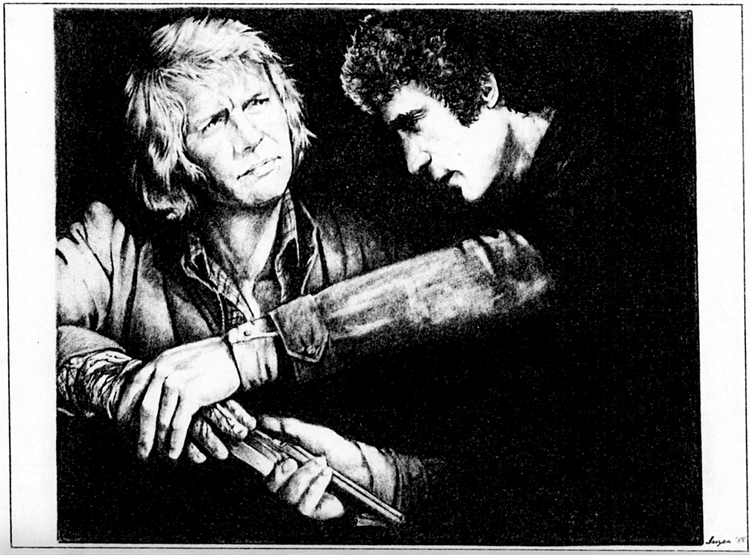
“I’ll get to the car, then swing by to pick you and Kathy up, okay?” With infinite tenderness he folded Hutch’s fingers around the gun-butt, and Hutch automatically completed the two-handed grip, left hand supporting and clamping closed the right. The consciousness of pain was somehow distant, as if it was happening to someone else. Starsky’s lips brushed his. “Keep ’em busy, and you win a Kewpie doll.”
“Promise?”
“Promise.” Starsky smiled, topped up the magazine clip, and snicked it into place with a flourish. Hutch got stiffly to his feet—he could feel a steady warmth trickle down his spine as he positioned himself behind a crossbeam, where a loose board gave him a good view.
“Ready,” he said. Starsky kicked out a couple of boards and bolted out into the sunlight, snapping off shots at windows and doors. The response was a burst of automatic fire that kicked up small dust fountains in a deadly swathe towards the running man. Hutch’s Python opened up at the same time, and the firing from the adversaries came to an abrupt halt, but not before Starsky’s sprint became a stumbling fall.
Hutch exploded out of the barn, half-crouched, the heavy gun booming wrathful thunder, and Starsky rolled to his feet and staggered back for shelter, one arm clamped to his side. As the Python’s hammer hit an empty chamber, Starsky squeezed off a few more shots and they half-fell together into the shadow of the barn, breathing harsh and labored.
I think we better think it out again,” Starsky panted.
“Give me your gun. What ammo you got, lover?”
“Half a pocketful. Starsk — ”
“Not to worry. It’s just a burn across the ribs. Like my grandmother always said, I must be born to hang.” He fished the cartridges out of Hutch’s pocket and reloaded the Colt. “Hutch. How long can Kathy hold out? That’s no kind of a cover. There could be other snipers out there. Even if there aren’t, she so much as twitches and the guys in there’ll finish her.”
“I know.” Hutch squinted into the brightness as if he could get inside his sister’s head. “If she stays cool, and we can create a diversion, she can get to Praetor’s car. The keys are probably in the ignition — he was no dummy. If we can keep ’em busy out this way — ”
“That’s a lot of ‘ifs,’ babe,” Starsky said somberly.
“Yeah. But it’s her only chance.”
“Right. But will she realize what we’re doing, and take it?”
Hutch met his eyes grimly. “That’s the chance we have to take. But—yes, she’ll realize. Sharp as a tack, my big sister.”
And Starsky grinned at him suddenly. “Well,” he said, “either they walk away from here, or we do. And I’d rather it was us.”
“I’m with you on that,” Hutch agreed. He felt slightly light-headed, as if everything was seen in microcosm, clear and sharp and distant. Starsky was refilling the empty chambers, fitting the Colt back into Hutch’s hand.
He tilted his head back against the rough-weathered planking, looking into his lover’s shadowed face. Blue-indigo eyes met his, dark with an ancient knowledge. Light splintered through the cracks in the walls, touching on an angle, a curve of curl, silvering.
Starsky. David Michael Starsky. All that was beloved, and fine, and true, and necessary.
Hutch wanted to reach out, to strain his being to absorb and become completely one with his lover. Me and thee. Forever. He watched Starsky’s hands, lean and brown, long fingers light and sure as they curled around the gun-butt.
The last battle.
“Hutch.” Starsky’s voice was quiet, endlessly tender, making music from his name. “I love you.”
“Ah, babe . . . ” He found he could smile, even if the effort was painful. “This is neither the time nor the place, y’know?”
Starsky’s smile was a caress and a promise. “Lover mine, this is all the place we need—and we got all the time there is.”
Me and thee.
Forever.
So it had been—so it was—so it would be.
“Let’s finish it.” Hutch got to his feet, and Starsky joined him.
“Way to go, partner.” Starsky’s eyes were brilliant with love. “Bound for glory.”
Me and thee.
They were laughing as they burst out into the sunlight.
THE END
Chapter End Notes:
The Epilogue to this Trilogy is The Last Full Measure and is now posted to this archive.
Have any thoughts?
Share your reaction or leave a quick response — we’d love to hear what you think!
-
 4
4
-
 -1
-1
-
 0
0
-
 0
0
-
 0
0
-
 0
0
