

Amanda (Mandy) J. Green, an assistant to producer, Joe Naar, wrote an essay of her remembrances while working on the show, mainly about canon and filming.
Originally published in the Casa Cabrillo zine, 1980, published by Theresa Wright. Artwork by Signe Landon.
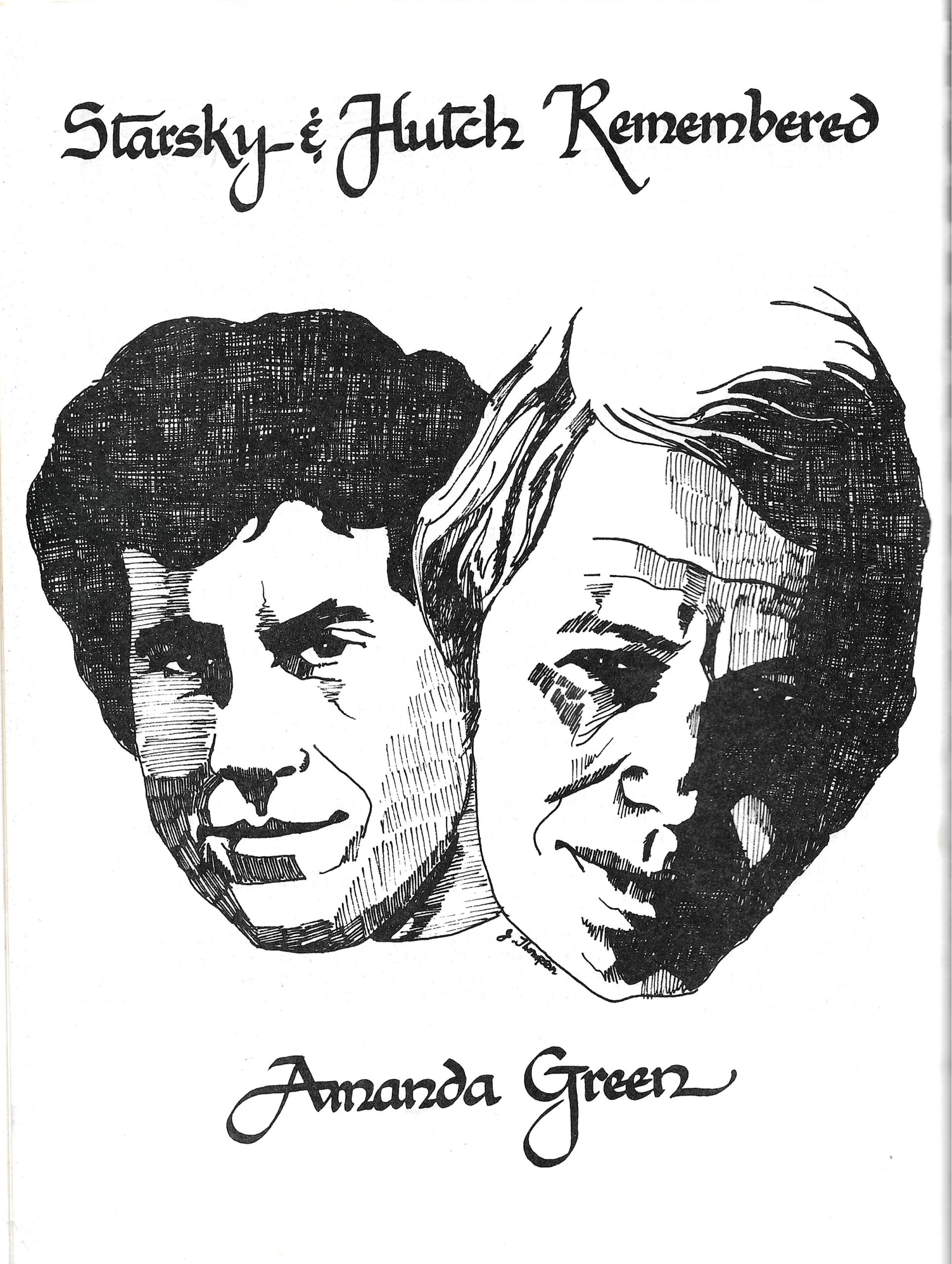
June 1980
So, you want an article from a “higher echelon” on STARSKY AND HUTCH for “Casa Cabrillo”? Well, unfortunately, since Joe Naar doesn’t write, Paul Michael’s wading around some river up to his neck in fishing gear, and David’s out playing a rapist in his new TV movie, RAGE!, I’m afraid you’re stuck with one of the lower peons… me!
I’m very impressed and somewhat flabbergasted by the fan network that seems to have sprung up across the country. (Come on, guys… I know it was a good show, but let’s not get carried away. I mean I can understand it with STAR TREK, but HUSKY AND STARCH?!?)
The one thing that strikes me about the various zines I’ve read is that they all concentrate on the characters of the show and not the actors who played them. I can almost believe that Dave Starsky and Ken Hutchinson are real people, alive and well, still running around out there chasing the bad guys, loving the ladies, and clinging to their “Me and Thee” philosophy. Don’t get me wrong, I love what has happened, it’s just that looking from the inside out, it’s a little hard to accept. You see, I’m a fan too… from THE MAN FROM U.N.C.L.E. and I SPY to STAR TREK, Science Fiction, and Harlan Ellison, none of which are compatible if you know anything about Star Trek, Science Fiction, and especially Harlan Ellison!
The point is, I cannot be a STARSKY AND HUTCH fan. For me, the show was a job and an experience which taught me a great deal about my trade and chosen industry and through which I’ve made some wonderful friends… but damn it, you guys seem to know something I don’t, and I feel a little cheated! It’s almost as if I’m the one on the outside looking in. I wonder who got the best deal?
May 1975, I was working for an ad agency In Los Angeles, bored to tears and fed up with life in general. So, being an enterprising young Britisher, I wrote a stunning resume (you can imagine just how stunning since I was only 20 at the time) and sent it out to every production company in town. One of the interviews I got from this brilliant move was with Spelling-Goldberg Productions for a new show due to start shooting the following month. Since my Dad is a TV writer, I knew a lot of inside names to throw about, so I polished up my accent, dropped every name in the book, and got the job as secretary to the producer, Joe Naar. I went home to my anxiously awaiting Mother… and promptly forgot the name of the damn show!
I started work the following week and was determined to be efficient, cool, and terribly proper in the best British tradition…. I didn’t stand a chance. The first day on the job I wrecked the coffee machine by pouring the grounds into the part where the water is supposed to go. Now, coffee is a vital part of any producer’s life, so I bless my savior (our gifted set decorator, Dave Love) who came to my rescue and tipped the entire machine out of the office window! I also thank him for not laughing and never mentioning the incident again.
After this inauspicious beginning, I gathered my shattered wits and began organizing my new office. I was so proud of it; the plants and wall lamps were beautiful, the posters on the walls were modern art, not the usual landscapes. I had real china mugs instead of Styrofoam cups and, best of all, there was even a couch! After the hole in the wall I’d had at the ad agency, this was paradise. I really felt I’d hit the big time.
Into this epitome of secretarial bliss walked two of the scruffiest fellas I’d ever seen. They wore cut-offs and T-shirts, their hair was uncombed, neither had shaved and the blond carried a basketball under one arm. I bristled with indignation that they should sully my lovely office so, but maintained my dignity and coolly asked if I could be of service.
“We’d like to see Joe Naar,” said the dark one.
“I’m sorry, he’s in a meeting at the moment,” I replied. “Do you have an appointment?”
“No,” said the blond. “When will he be back?”
Well, I told them and asked if they’d care to leave a message. I was certain Joe couldn’t possibly associate with two such obvious dropouts.
“Just tell him Paul Michael Glaser and David Soul stopped by,” they said. The names meant nothing to me… well, after all, it was my first day on the job.
Let me digress a little here and ask if anybody remembers the very first STARSKY AND HUTCH episode ever shot? Do I hear “Savage Sunday”… (written by Fred Freiberger, directed by Jack Starret)… correct. Now, does any die-hard out there recall a certain sequence in that show involving a basketball? A one-on-one game our heroes played against two street characters for information leading to the bad guys? Would anyone care to hazard a guess as to where our heroes worked out the dynamics of that particular little game? Suffice it to say that my beautiful, immaculate office looked like a bomb had hit it when Paul and David left that day, and the first thing I did was to call the commissary and order two dozen Styrofoam cups! This little incident set the tone for four years of wonderful, total insanity.
STARSKY AND HUTCH ran from 1975 to 1979; each season we would shoot 22 episodes for 24 or 25 hours of film, depending upon how many two-hour or two-part shows we did. After the first season, Paul and David were each contracted to direct two episodes a year, and I managed to sell two scripts to the show. We somehow succeeded in finding a creative unit that worked with people like Michael Fisher, Anthony Yerkovich, Rick Edelstein, and Michael Hiatt. Things did not always go smoothly, and there were moments of what is known in the trade as “artistic differences” between writers, actors, and directors, but these usually stemmed from the frustrations of doing a weekly TV show. The fact is one simply does not have the time or budget to produce a gem every week. Of those 22 episodes, if we could come up with eight or nine shows we were proud of, then we felt good at the end of the year. Most years we felt pretty good.
After the first two seasons, the “look” of the show changed drastically. This was largely due to the sudden clamp down on television violence, instigated mostly by the PTA. At one point, STARSKY AND HUTCH was voted the second most violent show on the air after THE QUEST. That same year, THE QUEST was cancelled; I supposed that left us with the dubious honor of being the leading cause of corruption of America’s youth. Surely shows such as THE CRYING CHILD, THE FIX, RUNNING, etc., which pointed up the agonies of child abuse, drug abuse, and alcoholism, not to mention the many shows that dealt with rape, the inefficiency of the judicial system, the plight of illegal immigrants and the black man in our society… surely these deserve a little credit.
By depriving us of hard-hitting realism, the powers-that-be reduced us to doing silly, inane stories like DANDRUFF and THE GROUPIE. Certainly, these episodes were fun, but after a while they became pointless, and people started laughing at the show instead of with it. I am not advocating violence for the sake of violence, simply an honest approach to police drama. In my opinion, the network went too far in its censorship of STARSKY AND HUTCH and contributed to the sagging ratings and ultimate cancellation of a fine show.
It may interest you to know that “Violence” does not have to be in the form of a killing, beating, or even the firing of a gun. If a character takes an ordinary, everyday pencil and snaps it in half out of anger, that, my friends, can be considered an act of violence. Depending upon its time slot, a TV show is allowed a certain “violence count” and cuss word quota, and it is not unheard of for a producer to barter with the network in order to wind up with the strongest finished product possible (i.e., “I’ll cut three ‘damns’, one ‘hell’ and a brawl if you let me kill this guy.”) With all of this going on, it’s not surprising that the last two seasons turned more towards comedies, character studies, and love stories.
I must say we went out with a bang though. The TARGETS WITHOUT A BADGE trilogy and the unofficial fourth part, SWEET REVENGE, constitute some of the best work we ever did. All the important elements that made STARSKY AND HUTCH so special seem to have been incorporated into those four hours, from their pursuit of justice, their desire to protect the innocent, their frustration at the system which leads to their quitting the force, to a hint of the “Me and Thee” syndrome which was so much a part of the show’s initial success. SWEET REVENGE was pure STARSKY AND HUTCH, a love story in the tradition of COFFIN FOR STARSKY, SHOOTOUT, and SURVIVAL, shaded by Hutch’s blind determination to get the bad guy at any cost. It is appropriate that this final episode was directed by Paul Michael Glaser (it would have been equally appropriate had David directed) for who knew the characters better?
The final day’s shooting was a particularly long and obviously emotional one. Thanks to some fancy footwork by our ebullient production manager, Billy D (Wilber D’Arcy), the last scene of the tag in which Starsky, Hutch, Dobey, and Huggy are practically drowned while having a midnight feast in Starsky’s hospital room was scheduled for the last shot of the day. I got down to the set around 7 PM and had great difficulty finding one sober member of the crew. There was beer and liquor stashed in brown paper bags in every corner of the stage and had obviously been put to good use for some time prior to my arrival…. I soon caught up with everybody. There were many visitors on the set that day, friends who had worked on the show over the years, writers, actors, extras, mail boys, researchers, drivers, stuntmen…. It was more like a party than a production. We rehearsed the scene several times, stopping just short of flooding the set and then around 11 PM, it was time to go for picture.
The scene began, Hutch snuck in with his veal dinner, followed by Dobey with the antipasto and Huggy with the wine. Starsky proposed a toast, and Hutch noticed the lantern hanging from the sprinkler… right on cue our special effects department (Dutch Van Derbyl) turned on the jets and…. Well, you saw the results. What you didn’t see was what happened when Paul yelled, “Cut, print… that’s a wrap, thank you for four years.” The water continued to drench the set along with the actors and everyone within ten feet, a food fight developed, the crew jumped in, I burst into tears, and for the next ten minutes, Stage 17 bore a striking resemblance to a lunatic asylum where the inmates had taken over.
Everyone finally calmed down and dried off, and then it was time for goodbyes. Paul and I cried on each other’s shoulders, David ran around thanking everybody (even those not involved with the show) and around 1 AM, we left the set for the last time. We had an official party planned for the following week at a Beverly Hills disco owned by Charlie Picerni, our stunt coordinator, but, for most of us, that night on the set was the real finalé. Eldon Burke, one of our A.D.s, and I counted fifteen people who had been with the show since the very beginning. That may not sound like much, but in this business where the turnover in personnel and crew is so high, believe me, it’s quite a record.
Much has been said of the special “chemistry” between Paul and David which set STARSKY AND HUTCH apart from other cop shows, but I’d like to mention the people behind the scenes who allowed that chemistry to work. A TV production crew is a unique family unto itself. Some fifty guys spend 12 to 14 hours a day working, eating, and playing together. They become counselors to each other, protectors, mediators, critics… There is no romanticism on a crew. They are probably the least affected people in this very hyped business. To put it bluntly, there ain’t no way you can bullshit a crew. When a show like STARSKY AND HUTCH takes off in such a dynamic way, the crew becomes the stabilizing factor which keeps everybody sane. For four years we had the best crew in town, and I would simply like to acknowledge them here and thank them for their contribution to STARSKY AND HUTCH.
In closing, here’s a bit of trivia you may not know… Bill Blinn’s original concept of STARSKY AND HUTCH was that our heroes worked the night shift and never saw the sun. Of course, ABC nixed that idea, claiming it was too expensive to shoot night exteriors every week. It would have given the show a unique look, Starsky and Hutch would have emerged two totally different personalities, and I probably wouldn’t be writing this article now. Funny how things work out.
Thank you, Theresa, for the opportunity to share some thoughts with STARSKY AND HUTCH fandom. My best to you all.
Mandy
Have any thoughts?
Share your reaction or leave a quick response — we’d love to hear what you think!
-
 4
4
-
 14
14
-
 0
0
-
 0
0
-
 0
0
-
 0
0

2 comments
Thank you for hosting this here. I had read it back in the 1990s and that basketball office event was embedded in my Starsky & Hutch brain. I would often look for this piece, and I think I remember rediscovering it when I learned of the zine it was in. Only recently was I reminiscing about it, and discovered the zine again. Now that it is planted here, I hope it blooms. This is the S&H history I’m here for!
Thanks for making us aware of it! We love any behind-the-scenes stories from our favorite series. As we continue going through old zines, we hope to find more like this!