

Table of Contents

124,026 words.
NOT A DEATH FIC
Losing Starsky follows Finding Hutch.
PROLOGUE: PROPHECY
“The door’s locked,” Starsky told him. He stood on the off-side of the squared coffee table, at the front of the sofa, and faced Hutch to make his declaration.
“I noticed,” Hutch said. It was actually a telltale sign he sought every time Starsky entered his house; did Starsky lock the door? If he didn’t, Starsky was there for other business. If he did, well, the inevitable was about to occur—and Hutch instantly got an erection.
On that occasion, however, he wasn’t sure. Starsky would leave for Australia in less than two hours; had he come over for a quick one for the road, on that, the first day of his new life?
“You didn’t think I was going to go without a goodbye kiss, did ya?” Starsky asked. He noticed how good Hutch looked to him, dressed in his sweat pants and his untucked, unbuttoned shirt, hairless chest, his disheveled blond hair and relaxed demeanor, having recently awakened, leaned forward, elbows on knees, and looking up at Starsky with a sort of want on his perfectly chiseled face. Something to devour, for sure.
“Just a kiss?” Hutch asked. Starsky would be gone for ten days, in what would be the longest and loneliest ten days of Hutch’s life. He would miss Starsky, more than Starsky would miss him, because Starsky would be preoccupied with his woman, with the exotic landscape, and with the Australian culture—whereas Hutch would be left with his daily routine, sans his everyday lover.
Starsky walked to the sofa’s end table where they kept their bottle of organic almond oil and retrieved it from the solitary drawer. “Just a kiss,” he scoffed. “We can start with a kiss,” he corrected Hutch. He noticed the bottle had since been refilled. Hutch was always prepared and Starsky liked that. He returned to the front of the sofa, to where Hutch’s expression was no longer one of want, but now one of expectation, to where he assumed Hutch’s erection tugged pleasurably at him. Starsky knew full well—and Hutch knew that he knew—that the emergence of that bottle, by either of them, was their guaranteed cue to play.
“Take your pants off,” Starsky said, as he unbuckled his own belt.
Together, they wordlessly undressed in the living room.
“You’re going to miss me,” Starsky then noted, spying Hutch’s swollen penis when Hutch sat again on the sofa.
“Something fierce,” Hutch confessed. He desperately wanted to feel Starsky’s electrifying touch, but Starsky simply knelt, naked, on the area rug beside the coffee table, in front of the sofa, between Hutch’s legs, and didn’t oblige him fast enough.
So Hutch reached to masturbate himself—only to have his hand knocked away when Starsky punched his wrist before he could make contact. “C’mon, then,” Hutch growled. “Don’t make me wait.” He wouldn’t get much of the man as soon as a couple of hours from right then, at least not for a while, and he was anxious to devote that time to the pleasure only Starsky could provide, but only if Starsky would actually give it to him.
“How do you want this to go down?” Starsky asked. He gazed into those anticipating blue eyes, that Adonis face, those lips he’d recently and often kissed and couldn’t wait to kiss again. But he was distracted by how far along they were in their immediate sexual reflexes to each other—and the kiss got bypassed.
Hutch didn’t understand the question. Usually, they just did; they didn’t talk about it. He was keenly aware of the fondness for him that shone in Starsky’s bedroom eyes, and of Starsky’s nudity: His haired chest, navel, belly, arms, his masculine face, defining nose, dark wavy hair, the hint of a whiskered shadow on his cheeks and chin. God, how he loved that man, every part of him. He dropped his line of sight to between his legs to lay eyes on Starsky’s penis. It hung at half-mast, its darker-colored skin, the circumcised head, its thick and enlivened crown, all beautiful to behold, let alone touch. Another inch over and it would nudge Hutch’s calf; even a brief, benign contact like that would have been a treat.
“Did you just ask if you can go down on me?” Hutch wondered, not certain any longer of the question, just that he’d heard the word ‘down’ in it somewhere. Nor was he certain of its intent. Starsky never needed to ask. In fact, Starsky never asked. Not anymore. He just did. That was his nature. Why was that day any different? Because he was headed to Sydney in a couple of hours? Hutch loathed the idea of Starsky’s absence, so he was obviously anxious for their sex and didn’t understand the stalling questions. But, from Starsky’s curiosity, he also figured Starsky had something up his sleeve. “I haven’t showered yet,” Hutch warned him.
“Do I look like I give a damn?” Starsky asked.
“You look like someone who should give a damn.”
“C’mon,” Starsky implored him. “Don’t go woman on me, okay? They worry about how they look and how they smell and—”
“I’m not worried about how I look,” Hutch defended himself. He looked disheveled and unkempt, like he’d only recently gotten out of bed—because he had—and his appearance around Starsky was the least of his concerns. “But I’m guessing you want to play with the wrong kind of body parts, the ones that should be showered first.”
Starsky eyed Hutch’s stiffened penis. “Oh, I think I’ll be playing with the right ones,” he said with certainty.
His penis wasn’t what Hutch meant. “Don’t make me explain it to you,” he said.
Starsky snickered. “You don’t have to explain.” He knew what Hutch tried to tell him, even though he didn’t appreciate it. “But even your bad smells smell good to me.”
“Then how can they be bad?”
“Exactly,” Starsky said. He rose to his knees and stole a kiss from Hutch’s lips—to shut him up. “I’m turned on by more things than you know,” he added quietly, making firm eye contact with his lover. “So why don’t you relax already, hm? The nastier you smell, the better I like it.”
Hutch wouldn’t debate Starsky’s sensibilities, even though he couldn’t fully understand them; he enormously benefited from them, after all. “Just don’t say I didn’t warn you,” he replied.
They kissed again—because Starsky hadn’t succeeded the first time to change Hutch’s direction, but also because that first kiss had been unexpectedly tasty and he wanted to enjoy the touch again. He savored the feel of Hutch’s warm lips and the boldness of his responsive tongue—and even Hutch’s morning smell. “If it makes you feel better,” Starsky said between kisses, “I promise not to put my mouth anywhere it hasn’t been before.”
Hutch laughed. There hadn’t been anywhere on his body that Starsky hadn’t been—with his mouth, hands, or otherwise. Not anywhere. “You’re a putz, you know that?” Hutch told him.
“A putz?”
“Or any other word that means the same thing, if that makes you feel better.”
“It doesn’t,” Starsky mumbled, not sure he cared, either. He was in pursuit of something non-verbal, so he sucked on Hutch’s mouth to shut him up.
Hutch maintained his erection just from their kisses, so when Starsky sat back on his heels again, Hutch was disappointed. “Fuck with me please,” he said with a quieter laugh.
Starsky leaned forward then and gave the tip of Hutch’s barely sheathed penis a quick lick; its slit peeked from its blanket and the touch elicited the moan he expected. “You smell animal,” he said after he inhaled the aroma. “You smell … what’s that P word?”
“Primal.”
“Yeah. You smell primal. I’ll bet your ass does, too.”
Hutch reluctantly smiled at him, but he got Starsky’s point.
“I’m going to be gone a while,” Starsky said—as if Hutch didn’t know. He reached up and lightly pinched one of Hutch’s nipples until it grew erect in his fingers and he saw the glazed-over look in Hutch’s eyes. “I thought maybe I could give you something to hold you over, the way you want it, I mean,” he explained. “You don’t want another run-of-the-mill blowjob kind of thing, do ya?”
The idea of Starsky’s sucking mouth on his enraged penis thrilled Hutch to no end and he couldn’t think of anything else. Somehow, though, he didn’t think he would receive such a gift. Starsky had other plans—he always did—and Hutch’s answers were never sufficient, despite that Starsky insisted on them.
“I mean,” Starsky began to say, but he was sidetracked by Hutch’s penis, its unsheathed head and large, engorged shaft, the emerging crown aimed right at him, quite near his face, that large bulging sac snug against his legs. All Starsky had to do was lean over, inhale Hutch’s enticing scent again, and swallow him whole. “I mean,” he repeated, “do you want me to fuck you this time or do you want to fuck me?”
Hutch didn’t know. He didn’t care, either. “It’s all good,” he was able to say. Sometimes they did both, so what did it matter? Then he remembered that Starsky wanted to make his departure memorable. But Hutch’s answer would be the same, so he said it again. “It’s all good. Do what you want.” He stroked Starsky’s forearm to encourage him to do something, and then Starsky’s cheek when that failed.
“You always know what to say,” Starsky said with an easy laugh. He felt loved and inspired by Hutch’s affectionate caress, so he hungrily soaked up the visual of Hutch’s nude body as Hutch sat on the sofa, and allowed their upcoming sex to tantalize them both. “I’ll suck you first,” Starsky decided, “and then I’ll fuck the cum out of ya.” He wanted Hutch to be the one to get the most out of their experience that morning; Starsky would have Grace for the next ten days, after all—despite that sex was more fulfilling for him with Hutch—but Hutch wouldn’t have anyone.
He savored every second of the experience they had that morning, from Starsky’s overall look, expressions, and touches.
Hutch was so oppositely built than Starsky: Hutch’s skin was bare and smooth, nearly hairless and unblemished. Yet everything else about him was pure-grade beef: His thighs and arms, his pecs, his penis and testicle sac. A lean, but muscled build of a man. And a big one, at that. A formidable male. But there was something to Hutch’s weakness when it came to Starsky that empowered Starsky. To have that much power over that much muscle was icing on the cake. Or maybe Hutch merely succumbed because he knew his passiveness pleased his partner—which only made Starsky love him more deeply because of it, regardless of its reason.
“If you suck my dick,” Hutch warned him, “this is over before it begins.” He wouldn’t even touch himself then for the same reason. Starsky had him tightly wired.
“Ditto,” Starsky said, laughing. “Looks like we’ll just fuck, hm?”
Maybe they were simply too anxious from the upcoming separation to enjoy fellatio together; it made them desire it so much that they wouldn’t be able to prolong it. Instead, Starsky pushed the coffee table out of the way, and they put Hutch on all fours bent over in front of him, Hutch’s bared butt and legs at the mercy of Starsky’s intent, Hutch’s knees on the cushioning area rug, but his elbows and forearms on the hard wood floor. Starsky liberally emptied some of the oil into his hands, tossed the bottle, and then mounted Hutch from behind. He oiled his own penis and then Hutch’s backside, squeezing a healthy amount of the oil right onto his target after he fully exposed Hutch’s anus with his fingers. He guided his penis to its entrance, found it almost immediately, pushed Hutch forward, further down onto his front end to get the accessible angle, and then carefully, and with genuine regard, drove inside the man.
Hutch gripped the wood floor to get traction, to keep himself propped when Starsky entered him, and slightly sat back to aid the determined entry. In contrast to the lengthy hardness that penetrated him, the feel was soothing—and decidedly filling and fulfilling, too.
The opening into Hutch felt tighter than Starsky remembered—and not because he hadn’t enjoyed intercourse with Hutch in some time, but because that kind of pleasure was so great, it was not possible to mentally recall just how good it was—and this new experience was rewarding because of it. He advanced deliberately, pushing in as far as he could go, ‘balls deep,’ as he sometimes liked to say, something he couldn’t do with most women, and then shifted Hutch again, shoved him almost to his shoulders, to make sure the angle of the withdrawal would be as comfortable. After a few careful drives, he was able to more fluidly roll his hips and drive his penis in and out of Hutch without reservation. The strokes were blissful and forced involuntary moans out of him.
“Yes, yes,” Hutch whispered, encouraging Starsky. He bent one arm under his forehead to protect his face against the abrasive floor—and to better enjoy Starsky’s powerful and unyielding counter-force at the backs of his thighs, breaking contact with him only for those brief withdrawals. Starsky plunged into him as deeply, as connectedly as he did each time, sort of pinning Hutch there between himself and the floor. The strength of Starsky’s thrusts disempowered Hutch; he could only endure them, or, rather, enjoy them. Starsky’s penis dilated his anus, creating an opening that heightened the mesmerizing sensation of the thrusts. It was intense—and sent an equally intense pulse of intoxicating gratification from each penetration down through his groin and deep into his penis. He was again aware that it had grown so large that it painfully ached for resolution; the repeated forceful blows he withstood reminded him of just how helpless he was—and that gave him permission to unconditionally surrender to the euphoria of it.
Hutch’s labored breathing and Hutch’s low moans of, “Oh, oh boy … oh, buddy,” on each of Starsky’s successfully delivered penetrations enabled Starsky to believe he was far from hurting him. But when Starsky accelerated the pace and the driving force of his thrusts, he pushed Hutch too far forward, way off his intended traction, and couldn’t always complete the deep plunges his body demanded of him. It interrupted his orgasmic unfolding, so he leaned over Hutch and pulled at Hutch’s arm, the one Hutch didn’t use to cushion his face.
Hutch didn’t obligate him. He was lost in the moment.
Starsky tugged again, but when that didn’t end with success, either, he ordered Hutch with words. “Let go,” he meant of the floor. “Give me your arm.”
Hutch finally released his palm-to-wood adhesion so Starsky could maneuver him; he bent Hutch’s arm and pinned it to his lower back. It gave Starsky the grip he needed to keep Hutch firmly rooted against him, a position that allowed him to feverishly breed Hutch and not lose their balance—or prevent him from burying his shaft fully into Hutch with each thrust.
Maybe Starsky held Hutch in that unmovable position because he appreciated that Hutch couldn’t voluntarily remain in place and it was important to them both that he did, or maybe Starsky just wanted to heighten the ecstasy for his partner by reminding him just how helpless he was; Hutch didn’t know. Whatever it was, nothing compared to the slippery thrusting of Starsky’s welcomed penis into and out of him as he was held tightly, by his arm to his back, against Starsky’s thighs, unable to escape the more intense orgasmic sensations Starsky’s renewed fierceness solicited in him. Hutch didn’t want to avoid them, but the fact that he physically couldn’t magnified his thrill. He had no choice but to willfully succumb to the shrill pleasure of it.
For several minutes—drenched in sweat and only able to express their delight with grunts and moans and occasional cuss words—they copulated. Though Starsky was overwhelmed by the pure pleasure of it, and by the absolutely electrifying visual of his own penis appearing and disappearing inside the division of Hutch’s buttocks, Starsky didn’t lose mindfulness of how to prolong the inevitable. Occasionally, he’d make a deep penetration without its accompanying withdrawal and hold it for some seconds, sometimes up to half a minute, to allow their bodies to recover long enough to enjoy another round of strokes. Or sometimes, Starsky would slow the pace of his thrusts, from a rather urgent speed to something much more sensual—and then eagerly resume again.
“Fuck,” Hutch said, on one of Starsky’s more aggressive entries.
Starsky misunderstood. Without breaking contact, he paused long enough to reach over and grab their lube bottle, and then squeezed a generous stream of oil from it into the crevice of Hutch’s buttocks, allowing it to dribble to where they were joined. After he tossed the bottle to the sofa again, he massaged the lubricant around his nearly withdrawn penis and over Hutch’s entrance one more time before he excitedly pushed back in.
“Fuck, that feels good,” Hutch said. All of it had; there hadn’t been any reason for Starsky to re-oil them, though Hutch wasn’t able to tell him that. But the pause made the new entry more arousing, too.
“Wider,” Starsky said, pushing Hutch’s knee with his own. When Hutch obliged him and shifted his weight, Starsky pushed Hutch’s other knee, and then both of Hutch’s knees, together, to widen Hutch’s stance as far as possible. It lowered Hutch’s hips further, which was Starsky’s intent, to enable a more direct penetration, and then he locked Hutch’s legs in receptive position with his knees. He wished he’d been able to see the both of them from behind; the image of Hutch bent over in front of him, his legs spread, his tight sac and swollen penis snug against his legs and bared belly, wanting touch, needing an ending, and Starsky furiously penetrating and withdrawing his own hardened penis in long strokes from him. It was a picture he’d have given anything to actually see, but he settled for the one in his mind.
“I . . . want to . . . come,” Hutch panted, finding strength from who-knew-where to speak and forcing the words out with each breath he took and thrust he felt. “Don’t . . . make . . . me . . . wait.”
With Hutch’s arm still clamped tightly to his back in his strong hand, Starsky reached around Hutch’s hip with his other to grasp Hutch’s shaft. His hand on Hutch’s penis and Starsky’s penis inside him were dual sensations that did the inevitable. After less than a minute of the exhilarating and pounding flesh inside his flesh, coupled with Starsky’s pumping hand, Hutch helplessly ejaculated, forcefully and with great intensity, pulsing mounds of semen onto the area rug between his knees and onto the floor below him, spurting it also onto his own belly as his penis hit up against it by every in-stroke Starsky gave him. He cried out loudly as he rode the shuddering orgasm to its end.
Starsky plunged deeply into Hutch a final time when he heard his lover spill and then held them there, in that completely joined position, while Hutch emptied himself onto the floor. It was only when Hutch’s spasms ebbed and his cries of ecstasy subsided that Starsky resumed his eagerly-paced rhythm—and slapping sounds of his hips against Hutch’s buttocks filled the room. Overcome by his own desperate need for an ending, Starsky erupted deeply inside Hutch; he rammed his pelvis hard against Hutch’s cheeks, his penis disappearing one final time into the depth of its open snugness, and then released itself inside him. Starsky writhed, he spasmed, he moaned, and he groaned, and he cussed.
When it ended, he also laughed.
After a minute, and barely able to breathe, he slapped Hutch’s butt and then slowly pulled out of him. It was the only way he could get oxygen to his brain, to withdraw as soon as possible and then to lie on the floor and hope his heart wouldn’t stop.
Hutch enjoyed that, too, the sensation of Starsky’s still-hardened penis slowly eliminated from him in a long, relieving stroke. He moaned from the pure feel of it.
Starsky pushed away from him and dropped to his back on the floor, pressed up to the leg of the coffee table. Hutch sat against the sofa. Together they heavily panted with a commingled sound of labored breathing while they immersed themselves in the prolonged blissfulness of their collective, satiating experience.
Usually it was Hutch, but that time—after stopping his head from spinning—Starsky was the first to rise. He had someplace to go, after all, and he’d probably been expected back at his house sooner. He exchanged a look with Hutch a couple of times, pleased and fondly, just to share the knowledge with him that their play had been immensely and mutually satisfying. In a sleepy, drained daze, he gathered his clothes.
Hutch rested the back of his head on the sofa cushion behind him and watched Starsky in return. He was finally able to close his mouth and still catch a breath.
“You’ll take care of that?” Starsky asked, addressing Hutch’s still-visible semen on the dark-stained floor.
Hutch glanced over at it and slowly nodded. It was his own, after all. “You couldn’t resist embarrassing me one last time before you left, huh?” he noted.
Starsky laughed. “That time,” he promised, “I didn’t do it on purpose. I just didn’t want you to forget it’s there before anyone else sees it.”
“There is no ‘anyone else’ here,” Hutch reminded him.
“Well, chances are,” Starsky joked, “if you left that jizz there, somebody’d show up just to make you wrong.” He stood to pull on his jeans. “You see how clean I was,” he added.
Hutch rolled his eyes. Starsky’s semen was impossibly visible; it was deep inside him, after all.
“Want me to put the coffee table back?” Starsky asked. He didn’t want to be responsible for a hit-and-run.
“I’ll do it later,” Hutch replied. He didn’t have the energy to move.
“Wipe up the mess,” Starsky then said with a chuckle to Hutch’s annoyed reaction, “and then come over and see us off.”
The idea of Starsky’s departure—to a foreign land, no less—depressed Hutch, and he didn’t commit.
“You’ll see me sooner than you think,” Starsky said, noticing his partner’s sudden withdrawal and seeking a way to lighten his burden. “After all, if my plane goes down in the middle of the Atlantic on the way there, you’ll come pluck me out of the water, right?” He tucked his penis inside the fly and closed its zipper.
“I would if that’s where your plane was,” Hutch said with a laugh, “but you’ll be crossing the Pacific to Australia, not the Atlantic.”
“Same difference. Atlantic. Pacific. They’re both oceans. The point is: You’ll come get me, right?”
“Maybe I should start swimming now,” Hutch suggested, appreciating that Starsky had cheered him, “so I can be there when the airliner hits the water.”
“Nah. You best wait until you know where we went in, but you’ll come get me just the same, right?”
“Just the same,” Hutch echoed, noticing Starsky’s visible drain, despite his silly questions.
“You promise?”
“Solemnly.”
Starsky put on his shirt and buttoned it. “But if we make it, and then I do something stupid while I’m there, like assault a police officer or disturb the peace in a nekkid, drunken romp through the blimey streets, you’ll come bail me out, won’t you?”
“Yeah, buddy boy,” Hutch told him. “I’ll bring you a Get-Out-of-Jail-Free card.”
“No joke?”
“Do I look like The Joker?”
Starsky picked up his socks and shoes and sat in a chair to put them on. He enjoyed the banter—and the continued eye contact. He noticed Hutch’s flaccid penis drooped against his sac and was pleased all over again by how he’d help to empty it. “And if I eat rancid kangaroo stew and I get food poisoning—”
“It’d serve you right for eating Australia’s national animal,” Hutch chastised him.
“I think they do eat them over there. But you’ll come give me a blood transfusion, right?”
“Right,” Hutch said with a laugh. “Gallons of it.”
“And then you’ll make me pancakes to put things back to normal?”
“Served up with tons of syrup—just the way you love them.”
“Swear on it?”
“On my honor.”
Neither of them said it, but neither of them relished the idea that Starsky would go so far away—nor for as long as he would be gone. And they both knew that about each other, too. In the scheme of things, ten days were a blink of an eye. But in their lives, given how close they’d become, it already felt like an eternity.
“And if I hike into the Outback and am bitten by rabid rattlesnakes and mauled by deranged dingos,” Starsky asked, tying his shoelaces, “you’ll personally come fight them off for me?”
“I’ll bring my pocket knife and a tourniquet.”
“Seriously, man.”
“Deadly.”
“Right, then,” Starsky said matter-of-factly as he got to his feet. He knew Hutch was emotional because he felt it himself. “You’re not going to cry, are ya?”
“Not until you’ve gone,” Hutch playfully swore.
“Me, too,” Starsky said. He walked to the door. “So, c’mon over and see us off.”
“Shower with me,” Hutch suggested, hoping to stall Starsky and spend more time with him before he left.
“I’m dressed,” Starsky replied. He presented himself to Hutch as if it wasn’t apparent until then.
“Get undressed.”
“Just come over, okay?” He was anxious to get back to Grace because he knew she was crazy busy packing—and he felt obligated to help her. “Will you come over after you shower?”
“Don’t you think you should clean up before you head home?”
“I’ll shower in the downstairs bathroom after I get back. She needs to know I’m helping us get out of the country—and not that I’m over here having fuck fun with you—so the sooner I walk into my house, the better.” Truth be told, Starsky would love to shower with Hutch, but he felt too guilty to stay another minute.
So they waited, neither wanting Starsky to leave. Starsky then came up with an idea he’d already talked to Hutch about and had previously been turned down over, but he thought he’d try one more time. “It’s not too late to come with us,” he said.
Hutch gave him a warm smile. He did appreciate the invitation. “I’m sure that’s just what Grace wants,” he said after half a minute of pretending to seriously think about it, “to bring her husband’s boyfriend along on her honeymoon.”
* * *
WE INTERRUPT THIS PROGRAM
It was Monday, October 3, mid-afternoon. Sometime after 3 p.m.
Hutch sat on the sofa to have a late lunch while he watched TV. He had purposefully left the coffee table askew, in the position Starsky had shoved it, as a reminder of their sexual play on the floor there the previous day. Somehow it eased the empty of Starsky’s absence.
But when Hutch settled his eyes on the television just then, he saw the breaking news graphic that splashed across the screen. He heard newscasters’ voices, but couldn’t decipher words because he was too instantly confused and inexplicably rattled by the paraded images he saw to absorb anything: Runway shots of two-engine airliners in take-off and landing trim looped throughout the live broadcast—one after another after another—interspersed with the occasional video of a wind-torn countryside, the aftermath of a devastating storm.
While Hutch subconsciously ate his lunch, he struggled to resist what he thought he read, but, eventually, there was no ignoring it:
Breaking News. Missing Plane.
A timer in the lower-right corner of the screen counted the minutes—sixty-nine minutes worth, to be exact.
He checked the wall clock. Starsky’s plane would have landed eight hours earlier. Relieved to learn it wasn’t a plane related to his life, Hutch was able to concentrate on the news anchors’ conversations about disappearance possibilities—and one that included a ‘blown-off course’ scenario, but they didn’t give specific details.
When the facts did arrive, however, they were ominous.
Eastern Airlines. Flight 1130. Bound for Sydney from Los Angeles. Missing for more than an hour. A monsoon, hundreds of miles northeast of Australia, had been in the area, but, other than the storm, there wasn’t any conceivable reason why the plane hadn’t emerged from the clear Australian skies to the runway.
It was the Los Angeles to Sydney connection and the time zone difference that made Hutch take second notice, and he could hear himself breathing while a news reporter broke into his thoughts.
“We’ve only been on the air with this story for 40 minutes,” the male voice said, “so bear with us while we bring you what we know. It appears that an Eastern Airlines flight en route from Los Angeles to Sydney, Australia, has seemingly disappeared. An hour from landing, when its transponder would have hit the glide scope, the plane never materialized. It was scheduled to land an hour and nineteen minutes ago, but still no word from the wayward aircraft.”
The detective in Hutch couldn’t let it go. Was he right about the plane not being Starsky’s? Something nagged him: That Los Angeles-to-Sydney connection, no doubt, despite that he thought Starsky’s plane had landed hours ago—well, that, and his ever-present fear of losing him. He remembered Starsky telling him that Sydney was 17 hours ahead of the United States in time, and he was just about to calculate the difference in his mind when his phone rang. It gave Hutch a relieving hope, that it was his partner calling to tell him he was all right because he, too, had just heard the news about the airplane. They didn’t have plans for Starsky to check in with Hutch during his honeymoon vacation, but Starsky probably wanted to set Hutch’s mind at ease. So Hutch grabbed the receiver from where the phone sat on the coffee table, pressed it to his ear, and said a cheerful hello. “You had me worried there for a minute,” he confessed.
But hope was dashed when he discovered the caller was Internal Affairs Agent Wade Davis. “I’m not who you think I am,” Davis said. “I’m sorry. I remembered that Starsky and Grace were headed to Sydney around this time,” he explained, “and now I’m afraid, from your greeting, that they were. Are they on that plane?”
“I was just about to figure it out,” Hutch replied, feeling his blood pressure rise. “But Starsky said his flight was to land around 7 a.m. this morning, so maybe I’m worried for nothing.” The next step was to call Starsky’s Sydney hotel and track him down that way, but Hutch would never get that far.
“Well, that’s right,” Davis told him. “Nearly all the flights nonstop from Los Angeles last night would have landed around 7 a.m.—local time, Sydney time. That was about an hour and a half ago, our time.”
Hutch’s heart sank and he felt instantly light-headed. Davis hadn’t said what he thought he did, had he? And, if he had, he couldn’t have meant its implications. Hutch stared at the television and hoped someone on the screen would tell him the entire newscast was purely a hoax and he wouldn’t have to think about any of it, even something as remote as Starsky’s plane gone missing. Or maybe Davis would tell him it was just a prank in bad taste and the laugh was on him, even if it wasn’t funny—and it definitely wasn’t funny.
“What flight was he on?” Davis asked.
“I’ll tell you in a minute,” Hutch said, setting down the receiver. He walked to his desk to search through his notes for Starsky’s itinerary and, with trembling fingers, found the airline confirmation on a slip of paper in Starsky’s handwriting.
1130.
He looked back at the television to see whether the flight number corresponded to the news flash.
1130.
There it was, as big as big could be on that brand new 19-inch television of his. His heart slipped out of his chest as he walked back to the phone, and all his blood rushed to his feet. “11-30,” he said into the receiver upon his return to the call. And then he was speechless.
From the airport the night before, about an hour prior to the Boeing 757’s departure, Hutch had received a playful call from Starsky.
“Still thinking of me?” Starsky asked.
“At least your dick,” Hutch said in reply.
“Hold that thought. I’ll be back in 10 days.”
And then Hutch repeatedly replayed those brief words as he went about his business that evening, while he made dinner, watched a movie, and read through a magazine. Starsky’s affection had eased the otherwise emptiness of the house.
He was definitely going to miss the sex.
He was sorely going to miss Starsky.
He already did.
Davis’ voice broke into his thoughts. “Isn’t that the missing plane?” he asked. “Flight 11-30?”
Hoarsely, Hutch replied, “Yeah, that’s it. Same one.” Silence echoed loudly in his ears while the television continued to spew its far-fetched possibilities and limited facts. “Do me a favor?” he asked. “Can you find out whether Starsky and Grace actually boarded that plane?” He already knew the answer wouldn’t be what he hoped. Starsky would have called him long by then to let him know his plans had changed. Why hadn’t he heard from the man? “And I’ll see what I can find out on my end.”
“Will do,” Davis said. “And I’ll get back to you as soon as I can,” he promised, and the line immediately disconnected.
Hutch fixated on the TV and tried to swallow the palpable choke in his throat, but didn’t succeed. It simply couldn’t be his worst nightmare playing out before him. The anchors discussed the same possibilities he had considered—that the plane was hijacked, the plane was off-course, the plane was still in route at some inexplicable reduced speed, the plane had simply lost radar contact, the plane had covertly landed somewhere else.
Or, out there in the vastness of the Pacific Ocean, the plane had crashed.
* * *
Wade Davis was a handsome, younger man, younger than Starsky and Hutch by about a decade, well-built, clean-cut, and neatly-groomed, with a firm, confident handshake. His trademark feature was a friendly, disarming smile under his dark eyes and hair. On the job, he was tenacious and serious; off, he was an everyday personable guy. On this afternoon, however, he moved with an obvious somberness.
He tentatively approached Hutch, who was seated on the coffee table near the television—and whose news hadn’t changed since Davis had left his house and driven the two hours to Hutch’s farm. Hutch sat with his head in one hand, his eyes tightly closed, in a drooped posture, as still as stone, while the news media continued to air its unrelenting and noisy coverage of the missing plane’s possible whereabouts.
Davis knelt in front of him to get Hutch’s attention just from his presence, but when that didn’t work, he stood, turned down the television’s sound, and brought an unearthly quiet to the room.
When Hutch still didn’t acknowledge him, despite the silence, Davis gently squeezed Hutch’s knee. After half a minute, he had to use words instead. “C’mon,” he coached. “Take a break. Go wash up. The TV will be here when you get back.”
Hutch finally stirred. He’d sat in that position, on the coffee table, with his head in his hands, for more than an hour, having hoped Starsky would have called him to let him know he was all right, and still not heard from him, but waiting. According to the booked hotel in Sydney, Starsky and Grace had not yet checked in. Hutch also hadn’t gotten far with answers from the numerous authorities he’d contacted, both in the United States and in Australia.
When he finally shifted position at Davis’ insistence, he felt the soreness in his muscles from having been motionless for so long. There was a heavy pain in his heart, one that filled his chest with dread. He silently asked Davis for the answer to his last question, the one he’d asked on the phone when they spoke earlier.
“I’m sorry,” Davis said in a hushed voice, confirming Hutch’s worst nightmare.
Hutch had hoped against hope for a different answer. He was so stunned, all he could do was study the pattern on the area rug at his feet, searching for a way around what he believed he’d heard in Davis’ apology: Starsky was, indeed, on that airplane.
“Then I need to go look for him,” Hutch said, determinedly. “I’ve booked a flight to Sydney tonight.” He’d actually put two changeable and refundable tickets on hold with the airline in case he had to go—but not thinking he’d have to until he learned Starsky was on the missing aircraft. “Come with me?” he meekly asked. He knew he’d need someone else’s strength just to stand.
“In a heartbeat,” Davis said. “What time is the flight?”
“Close to midnight, but I don’t think we should go anywhere until we know where we’re supposed to look. I don’t want to be in Australia if they find the plane in South America.” To be in the wrong part of the world would be no help to Starsky, but at least Hutch was ready to go to the most obvious place the plane would be. “Or maybe it didn’t get that far off the California coast.”
Davis pulled Hutch’s arm. “C’mon, then. Wash up. No matter what happens, you’ve gotta be up for it.” His appeal to Hutch’s strength was the only leverage he had to move him to his feet and intercept his breakdown.
For a moment, Hutch was drawn out of his melancholy. Davis’ words rang true. He’d promised Starsky he’d pluck him from the ocean if such a terrible thing as an airliner crash occurred, so Hutch needed to be strong enough for that. He looked Davis in the eye, subtly nodded that he understood, and then painfully got to his feet. He felt weak, his surroundings surreal, but he was somehow able to walk past Davis to the hall. Before he left the living room, he turned and said, “Don’t move that coffee table, okay? Leave it like that. Starsky put it there and I want him to put it back when he returns.”
“I won’t touch it,” Davis promised.
Once inside the bathroom, Hutch’s legs buckled. He braced himself against the closed door when the sink seemed miles away. It was then the haunting images flooded his mind: The reels of airliners taking off and landing, the news anchors in unhelpful discussion about a missing plane’s location—Starsky’s and Grace’s plane, Starsky’s plane, confirmed, the one that had carried away his partner of ten years and his lover of six months, his real life and forever soulmate, to an exotic landscape—but now to who knew where?
Hutch was further weakened by the limited possibilities of what had happened to the plane. No matter where it was at that very moment, the one thing it wasn’t doing was flying. By then, it would have run out of fuel, whether it nefariously landed or crashed. Every scenario Hutch imagined kept him from feeling hopeful.
He pushed off the door to avoid that fact, splashed his face with cool water, patted it dry with a clean towel, and then studied the pained expression that looked back at him in the mirror.
“I’ve been here before,” he told himself in a whisper. “I’ll be all right.” But he wasn’t really sure this time. He’d never seen himself appear so defeated, not even when Starsky was poisoned and nearly died or when Starsky got shot up and nearly died or when Starsky was abducted and sexually abused by his captors and nearly died. This couldn’t possibly be another ‘nearly,’ could it?
Or worse?
* * *
Davis kept order that day. He made certain the television stayed off for thirty minutes at a time, to break from the same news story: That a plane was missing, not that it had been found, but that it was still unaccounted for. He ordered a pizza to the house for dinner, but Davis had to practically force Hutch to eat some of it, especially after learning Hutch didn’t eat cheese. His only tool was the reminder that Hutch needed to be strong for Starsky and for himself. That seemed to move Hutch to action; it was the only thing that did. And, of course, Davis did his best to keep hope as high as possible. “The outcome could still be a good one,” he’d say.
In the kitchen, to wet his dry throat with a glass of water, Hutch looked long into Davis’ empathetic brown eyes while he leaned against the counter. After a minute, in a subdued voice, he finally said, “You know this won’t end well.” He tried to appear calmer than he was, as if he had face to save. “You know it already didn’t end well,” he added.
“I don’t know that,” Davis argued with him. “Maybe it was hijacked to some place.”
“After all this time, someone would have claimed the attack.”
“Not necessarily. Freak circumstances,” Davis suggested. He leaned against a neighboring counter and kept steady eye contact with his friend. “But even a crash,” he defended his position, “isn’t … always … terminal.”
Terminal. Fatal. All souls on board gone. Forever.
Hutch broke the contact with Davis to look beyond the floor into nothing.
Davis was crippled by helplessness, too, but for a different reason. He didn’t really know how to comfort Hutch. He knew the loss would be enormous, if there was one; the disaster already was monstrous and not a shred of information had given them a clue about the plane’s circumstance. Granted, he, too, was fond of Starsky. He didn’t know Grace all that well, but he did know Starsky. They’d gotten off on the wrong foot in the beginning—he the Internal Affairs agent assigned to investigate the gang-rape of one of the police department’s most beloved cops, and that cop, Starsky, reluctant, downright resentful and hostile, of the intrusions and the interrogations into what he desperately wanted to keep private and put behind him.
But, eventually, and especially after Davis proved his loyalty by delivering one of the assailants right to Starsky’s feet to do with as he wished, Starsky quickly warmed up to the agent. It was only after the case was closed, two rapists in prison, one dead, that Starsky completely let down his guard around Davis and accepted him into his life much the way Hutch already had.
Like most people who knew Starsky, Davis was quite fond of him, too. But his fear that night—the night of the day the plane went missing—wasn’t for his own possible loss. It was for Hutch, a man he’d come to know was deeply attached to his partner. Deeply and perhaps even fatally. He didn’t know what Hutch would do if he actually did lose Starsky to a death-do-us-part outcome. Would Hutch end his own life? Was the bond that unbreakable?
Davis noticed the shimmer in Hutch’s eyes. He hadn’t meant to make things worse. He was usually very good at taking charge of a situation and saying the right thing at the right time. It was a gift he had. But in that house, on that fateful night, he was relatively speechless. “Hey,” he finally said. It made Hutch lift his eyes and look at him. “I’m sorry,” Davis said. He meant about his inability to comfort him, but also about the tragic events of the day. He was genuinely sorry about that. “I don’t know how much use I am to you,” he added, “but I’m here if you need me. And I’m here for the duration of this, however long it takes.”
“I don’t have anybody else to hold me up,” Hutch said quietly. He needed someone stronger than he was. Almost always, that person was Starsky.
“When I got confirmation that Starsky boarded the plane,” Davis said, “the blood drained to my feet. I can only imagine how you feel.” He realized what he’d said. “Strike that,” he corrected himself. “Knowing what he means to you, I can’t imagine how you feel.”
Davis didn’t know all the ways Starsky was important to Hutch—or how demoralized and helpless Hutch felt not having been there to help his partner—and knowing Davis didn’t know left Hutch more alone with his fear.
* * *
Davis didn’t wake Hutch when the news alert broke into programming with a more ominous alert; its message temporarily stopped his own breath. But, despite the low volume, as well as his effort not to interrupt Hutch’s restless slumber, there must have been enough quiet in the room that even Davis’ most subtle move woke him. Or Hutch was keenly tuned to the TV’s sound, even in his sleep.
“Twenty-one hours after Eastern Airlines Flight Number 11-30 was supposed to land in Sydney, Australia, with 215 souls onboard,” the news anchor informed its audience, “the Australian Coast Guard claims to have found the airplane. Unfortunately, it’s at the bottom of the ocean.”
Hutch tightly closed his mouth and ground his teeth. He heard himself breathing again, that time in heavy exhales from his nostrils. His heart raced and his palms broke a sweat. He stared at the TV in disbelief. Maybe it was still a bad dream. He glanced at Davis. “I’m not awake, am I?” he optimistically asked.
Davis could only respond with a sympathetic purse of his lips. He’d told Hutch that he would wake him if there was something to report, but his comrade had done it without his help. They had sat on the sofa for a while and watched—rather, listened to—a light-hearted black-and-white film from the early 1960s, to not be bombarded by the same news over and over again, and he himself read through a World Atlas he’d found among Hutch’s books to familiarize himself with the Australian continent.
Eventually, purely from the exhaustion of an unfulfilling and trying day, Hutch had fallen anxiously asleep, there in the corner of the sofa, one foot on the floor, the other on the coffee table. Under his arm, he clutched a sofa pillow, one of the few Starsky had sometimes used to enhance their sexual experiences by maximizing Hutch’s position for entry. Now, Hutch held that pillow as if he held onto Starsky by proxy.
The clock ticked slowly, more slowly than time itself. But there it was on the console on that dark night: 5:15 a.m.
“Local time is 10:15 p.m.,” he heard the reporter say by way of a satellite phone. “Sydney is 14 hours ahead of Eastern Standard Time. But weather has hampered the search for survivors because waves are now too rough to sail.”
Hutch fidgeted with the seam on the pillow.
“Can you tell us what they believe has happened?” the in-studio anchor asked his colleague.
“They haven’t said,” came the field reporter’s reply, “not officially anyway. But they believe there are no survivors.”
“It doesn’t mean there aren’t,” Davis argued to head off Hutch’s reaction.
The reporter continued. “I’m in Honiara, the capital city of the Solomon Islands, located on the island of Guadalcanal. The Solomon Islands consist of a large chain in the South Pacific, roughly 1300 miles northeast of Brisbane. Guadalcanal is an impoverished island nation—especially where it concerns telecommunications.”
Maybe that’s why Hutch hadn’t heard from Starsky. Maybe it didn’t have anything to do with a downed plane.
“Because of outdated equipment—coupled with ongoing storms in the area,” the reporter continued, “news travels slowly. What we can tell you is that a fishing vessel near Mborokua Island has claimed to have found a jetliner—some two hours ago—submerged about 40 miles from land and about half a mile down in the water. But we’re still waiting to learn what the discovery entails.”
“Tell us where Mborokua Island is in relation to … anything.” It was apparent the anchor knew little to nothing about the region, but, then, who did?
“Mborokua, also known as Mary Island, is roughly 30 miles northwest of Guadalcanal and 60 miles from Honiara—which is where I am, here in the capital city of the Solomon Islands.”
Davis reopened the Atlas across his knees and flipped through its pages to study the identified area.
“Is there anything else you can tell us about the plane?” the anchor asked his reporter.
“Unfortunately, no. It’s pitch black out there, but the coast guard has already issued a search of the western side of the islands.”
Their discussion returned—again—to possible scenarios, mindless speculation, and more unfounded guesses.
Hutch released his breath as if he would never take another one and needed every ounce of oxygen he could retain. Then, on helpless impulse, he covered his eyes with his hands.
“I don’t want to lead you in the wrong direction,” Davis said carefully, as he browsed the Atlas and reached for anything to ease Hutch’s pain, “but, if satellite communication is that limited … maybe … ” He couldn’t finish his sentence. He knew it wasn’t plausible that anyone survived the crash of a jetliner into the ocean.
Hutch withdrew further into his melancholy, driven there by his helplessness. Out of frustration, he kicked the coffee table. It didn’t budge, but the blow enabled him to arrest his emotion, at least to intercept a panic attack. Then he got to his feet and paced to burn off the adrenalin. “I can help them look for survivors,” he decided.
“How good a swimmer is Starsky?”
“He can’t swim,” Hutch said angrily, “but maybe he was able to find a flotation—”
“The Islands cover a land area of more than 28,000 square miles,” Davis said, deciphering what he could from the two-page map in the Atlas. “That’s the land mass. Then there’s all that ocean in between.”
Hutch stopped in his tracks. He was overwhelmed, again, by his own ineptness. It would be a thirteen-hour flight to Brisbane, another three-hour flight to Honiara. And who knows how long by boat to Mary Island? He fought with himself to make rash decisions. They would need to be efficient with their time if they were going to be useful.
* * *
“I’m getting the same fucking answer no matter who I talk to,” Hutch bitterly said. He slammed the receiver into its cradle.
“I’m getting the same answer you’re gettin,’” Davis replied. At some point, the more disturbing analysis of the situation would have to sink in, but he didn’t want to help it along any sooner than Hutch could handle it.
“I’ve talked to the U.S. Coast Guard,” Hutch explained, mostly to purge his growing frustration and terror. “I’ve talked to the U.S. Navy. To the Australian Air Force. To the National Transportation Safety Board. To every private and public search-and-rescue crew in the area. And it’s the same goddamned answer.”
Davis knew that answer to be that they’d found the plane submerged in half a mile of ocean water, that it was relatively intact—and believed to have all souls on board, though not yet confirmed. They’d also learned that, if there had been a survivor, they could not have swum the 40 miles to the closest shore of Mary Island, and that even if they’d miraculously swum that distance, they hadn’t been found by the already numerous aircraft, ships, boats, and hikers who’d been dropped on the island to scour its relatively deserted beaches. The search for survivors was, in fact, over. It just hadn’t been made official yet.
Given that he wasn’t Starsky’s next-of-kin, Hutch was also at the mercy of his partner’s family, of Starsky’s younger brother, Nick, in particular, who was, bless his heart, doing his best to ease Hutch’s pain more than he tried to ease his own. He phoned Hutch to tell him he’d known for years that Starsky was closer to Hutch than flesh-and-blood. He said he even understood it, and promised Hutch he’d give him every piece of information as soon as he got it—and the latest from him wasn’t anything new that Hutch hadn’t already learned by himself from authorities.
“I can’t just sit here,” Hutch said to Davis after his call with Nick, and pushing hard against his nearly overwhelming desire to break down in front of the man. “I can’t take this another second.” The wait for an official determination of the fate of ‘all souls on board’ nearly killed him. All he could do was wait. Wait. And wait some more.
“You can do this,” Davis assured him. “You can and you will.”
Hutch knew, like Davis knew, that whether that statement was true or not, it was designed primarily to keep him strong, and he appreciated the effort. If nothing else, he needed the time to rethink the possibilities. It couldn’t have been that easy, could it? to take Starsky’s life in an international tragedy such as this one? Starsky was supposed to die from old age alongside him—some sixty years into the future—the two of them sitting on a porch somewhere in a couple of rocking chairs, reminiscing about all the bullets and other near-death experiences they dodged during their careers, talking about all the things that could have been or should have been or wished they’d done.
* * *
“Dobey.”
Hutch finally accepted his former captain’s call. “Yeah?” He didn’t have the strength to say more.
“Are you watching the news?”
“Yeah,” Hutch repeated, more quietly that time.
“I heard about the plane accident,” Dobey told him. His voice was strong, but cautious. The sound of it alone gave Hutch a momentary sense of hope, but then it unintentionally dashed it with its questions. “I haven’t made the connection until now,” Dobey admitted, “but put my mind to rest, will you? That wasn’t the flight Starsky took with Grace to Sydney, is it?”
Hutch couldn’t utter that one-word answer again, so he handed the receiver to Davis.
* * *
Hutch opened the refrigerator and gazed into its interior. He’d eaten little over the past day, despite Davis’ efforts, and was decidedly hungry. But as he looked over the colorful fresh produce, hand-picked fruit, pitcher of orange juice, and other healthy snacks, he realized he still didn’t feel like eating.
He closed the fridge, leaned in the kitchen entryway, and faced the living room. Davis had fallen asleep in a corner of the sofa; his head rested against his bent arm. It was late morning, going on noon. Hutch immersed himself in that momentary suspension of time and stood a while in the doorway and looked over the living room, its bookcases and furniture, the hardwood floor and area rug, the muted television, silently broadcasting, the potted plants and the pictures on the walls. All seemed as it should be—except it wasn’t.
The wait is what killed him. The not knowing, but believing, despite it. Or fearing to believe. Or preparing to believe the inevitable, as if it would ease the blow somehow.
But isn’t that what he should do? Prepare for the worse-case-scenario? An airliner at the bottom of the ocean, after all, could only mean one thing. The plane had crashed—ending all lives on board.
When Davis stirred, it struck Hutch only then how much devotion his friend gave him. Shouldn’t the Internal Affairs agent be at work? Or had he canceled his itinerary so he could attend to his friend? From almost the moment they met, Davis had gone out of his way to be there for Hutch and Starsky—because, as Davis had once said and since repeated, their loyalty to each other was to be commended, revered, emulated, and defended.
Davis was a divorced man. His sister the victim, the survivor, of a brutal gang-rape. Between them, he and Hutch had broken families in common. That had been their tie in the beginning. It had transcended into a casual, but meaningful friendship, Hutch more closely bonded to Davis than Starsky was to Davis, but enough that Davis had attended Starsky’s wedding only a couple of weeks earlier. Davis had failed, until he heard it from Hutch, to make the connection between the vanished airliner and Starsky’s honeymoon, but once he had, he had done nothing but be there for Hutch.
Davis stirred again; that time, he opened his eyes, glanced at the television, didn’t see anything new, and then looked over to where he expected to see Hutch, at the other end of the sofa. He quickly caught sight of Hutch in the open doorway of the kitchen, facing him. Davis didn’t smile and he didn’t get one in return.
They silently looked at each other for a couple of minutes.
It should have been Starsky, Hutch thought, who sat there on the sofa and gazed back at him. It should have been Starsky in his house that morning. It should have been Starsky who’d caught his eye.
“What are you looking at?” Starsky would have asked when he noticed Hutch’s quiet observation. But Starsky would have been distracted by the television while he waited for Hutch’s answer. He would have gone back to watching it as he sat comfortably on the sofa, both feet propped on the coffee table, crossed at the ankles. He’d be wearing his tight-fitting jeans and a half-zippered hooded red sweatshirt. Red was a good color on him. It complimented his dark hair and deep blue eyes. And he’d be wearing his years-old beat-up blue-and-white running shoes. His colors wouldn’t match overall, but who cared? Starsky certainly didn’t.
“I say,” Starsky repeated himself, “what are you looking at?”
“You,” Hutch replied.
“What about me?”
“It’s nice to see you sitting there.”
That’s what Hutch would tell him, but ‘nice’ would be such an understatement given the circumstances.
Starsky stretched and sank further into the sofa cushions. “Yeah?” He liked Hutch’s affection; it soothed him, even when he didn’t need soothing. “It’s nice to be sitting here, too.” He didn’t know what else to say. But he finally tore his eyes from the television screen and looked over at Hutch. Their eyes met, the way they often did, sincerely and with warmth. “But we’ve got things to do,” Starsky reminded him. He didn’t want to get stalled by mush.
“It’s Tuesday,” Hutch said.
“Tuesday, Schmoosday,” Starsky retaliated. He dropped his feet to the floor and sat up. “Let’s go knock on some doors.”
Knocking on doors was Starsky’s new hobby. It meant they would spend most of the day making volunteer rounds to convicted child predators’ homes—whether or not they’d been recently visited by the authorities. Starsky was determined not to let another abducted and abused child fall through the cracks. Since the gang-rape he’d endured that early spring, roughly eight months earlier, he didn’t know where to find uncaught serial rapists as easily as he knew where to find convicted child molesters. And nothing sickened him more than to learn about an abduction and imprisonment of some young girl or boy by a known offender simply because Child Services hadn’t done a decent job of a house search. “Knocking on doors” wasn’t technically legal, but he didn’t care. Whatever punishment he might face would be worth a rescued victim.
“Then let’s get to it,” Hutch agreed. He loved to spend time with Starsky no matter what they did, but he couldn’t think of a better way to spend it that day.
“Pancakes first?” Starsky asked. He flashed that little boy ‘please?’ look over his face, but he knew full well he’d be obliged, even without it. Making pancakes for him was one of Hutch’s weaknesses.
Hutch was about to push off the doorframe to the stove when he heard Davis’ voice.
“No matter how this ends,” Davis said, “you’ll come through it.”
Hutch snapped out of his trance and into his reality. The silenced TV still flashed its pictures of airliners. The room was still absent of the warmth he’d fleetingly revisited. And Davis still held eye contact with him.
Hutch didn’t say a word. He wasn’t certain he would survive the news he expected.
“You won’t like it,” Davis agreed, to read Hutch’s mind. “It’ll drop you to your knees,” he imagined. His voice carried clearly in the otherwise empty room. “It’ll be the most devastating experience of your life,” he added, “but you’ll come through it. Someday.”
“I don’t know that I’ll want to,” Hutch finally said.
Davis suspected as much, which is why he felt a need to intercept it by mentioning it then. He’d seen the impending devastation in Hutch’s eyes only moments earlier. “But isn’t that what he would want?” Davis asked. “Wouldn’t Starsky want you to come through it?”
Tears shimmered in Hutch’s eyes. He didn’t like the card Davis just dealt. It didn’t give him the escape he wanted. He finally broke eye contact with Davis and lowered his sight, unseeing, to the floor.
There was a hollow moment then, one where Hutch was able to avoid every single aspect of the terribleness of that pressing reality and grab the fleeting warmth he’d just imagined with Starsky, and, in the next, heard the television bring it all back with a vengeance when Davis went over to it and turned up the sound.
“THIS IS BREAKING NEWS.”
Hutch pressed his back to the kitchen door; it was sickening enough to hear those familiar and ominous words, let alone see whatever the news wanted to show him, as if it mattered less to anyone than ratings.
“We now have confirmation,” came the familiar voice and lead-in, “that the plane did indeed crash into the Pacific—twice as many miles from Mary Island in the Solomon Islands chain as it’s been missing in hours, and eleven hundred miles off the coast of Australia—and that there are no survivors.”
Hutch rolled along the kitchen door on his shoulder, to turn his back on the news, as if somehow it would simply go away if he ignored it, and all of it untrue. An indescribable groan left his throat. He grasped the door knob to stop his collapse and heard Davis’ voice behind him.
“Take a deep breath,” Davis said, bolting over to Hutch, and then firmly holding onto him when he reached him.
The news report continued. “Though a bit blurry, mainly because of the stormy weather and rough seas,” the anchor said, “you’re looking at a photograph taken from an aircraft carrier earlier today of the submerged airliner.”
Hutch reluctantly turned his eyes back to the television.
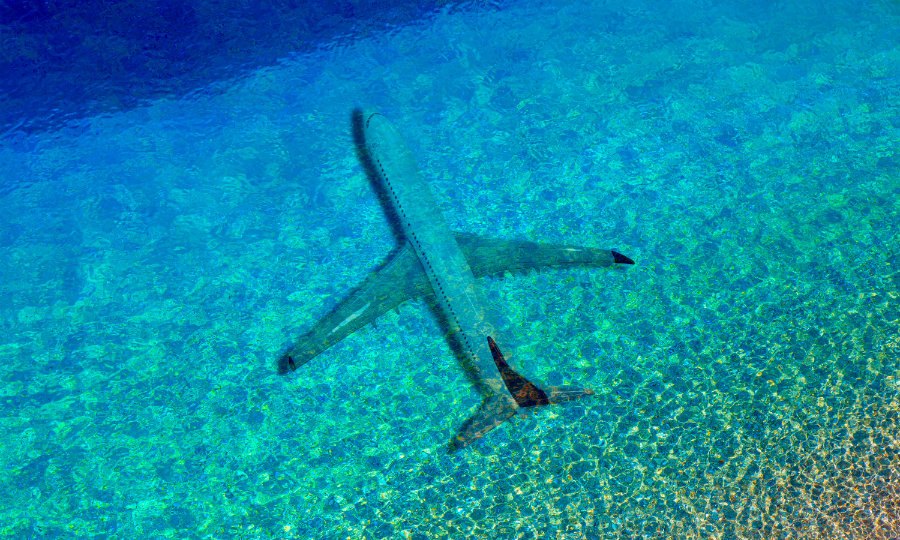
There, on its screen, was the softly out-of-focus picture, a shadow of a Boeing 757 at the bottom of the ocean, surrounded by numerous search-and-rescue boats in varying sizes and types. The plane appeared to be relatively intact—he could make out its wings, fuselage, and tail, despite that it had obviously suffered a deadly impact with the rock-hard surface of the sea. But maybe there was more to that story than met the eye. Maybe there were no known survivors on the plane because they’d all been rescued from the surrounding waters, pulled to safety by local fishermen, unbeknownst to the official searchers, and therefore hadn’t yet been claimed. Maybe that’s what had been underway in those silent hours that morning: An un-televised, unknown, unrealized, but successful water rescue.
But Hutch dreaded a different scenario.
Unfortunately, the truth was exactly what he feared.
“We’ve received reports that no one has been found alive. Is that what you’re hearing, too, Bill?” the anchor asked his first-responding journalist on the scene.
“That’s correct,” came the grim reply. “Everyone in the plane has … passed.”
Hutch didn’t hear more because he couldn’t. The swell of pain that overtook him as he stood braced against the door knocked him into the kitchen. He stumbled to the sink and grabbed the edge of the counter to avoid his slam to the floor.
“Take a deep breath,” Davis again suggested, standing immediately behind Hutch, and holding him by his elbow.
Hutch tried, but his chest wouldn’t expand. Neither would his throat when he gulped for air through his mouth. His legs buckled and he dropped his head, tightly closed his eyes, and struggled to hold onto his ebbing strength purely with internal muscle.
Davis leaned against him to keep him propped. “Take a deep breath,” he repeated. He rubbed Hutch’s upper back to enable him to breathe better, but Hutch’s choke was too strong to do more than give him shallow breaths.
“Divers at the scene were inside the plane this morning,” they heard the reporter say behind them from the other room. “Based on the evidence, they have concluded that there are no survivors. The vast majority of the passengers are still seat-belted to their assigned seats; those not seat-belted are simply afloat inside the aircraft, apparently deceased. They’ll be taken out first—and then the painstaking process of removing everyone from their seats and bringing them to the surface will begin.”
Hutch sank to the floor, despite Davis’ effort to stop him. His entire weight did what Davis feared the news would do: It dropped Hutch to his knees.
The reporter continued. “It’s now officially a recovery operation. The bodies will be brought here to Honiara for transfer to Sydney; from there they’ll go to their country of citizenship.”
Davis joined Hutch on the tile. And there they sat: Davis cross-legged on the cold floor, Hutch in his lap.
Weeping.
* * *
Hutch cried without tears.
He cried in the shower, braced against the wet tile under a stream of steaming hot water.
He cried in the kitchen when Davis offered him a glass of juice to replenish his blood sugar.
He cried throughout the day and into early evening—over a news item, a kind gesture, an unexpected memory.
It wasn’t always a cry filled with tears. Sometimes it was just an internal, noiseless, purge of the heart.
And sometimes it was just the silent contemplation of ending his pain by ending his life.
But his audible cries turned again to weeping when, later that night, he opened his eyes, there in the light of a soft bedroom lamp, and found the mattress in front of him empty.
Again.
As it would be forever.
And then he cried himself to sleep, reluctantly succumbing only from pure exhaustion.
He repeated his grief-stricken existence the next morning. And the morning after that. And the one that followed that one. Emptiness and the bottomless chasm of his loss had become his way of life.
He finally accepted the repeatedly unanswered call from his parents. And from Dobey. And from Starsky’s heartbroken mother. And from his own sister. He said little, thanked them for their condolences, cried with them and they with him. He said little to Davis, too, except the occasional hushed ‘thank you’ or ‘please’ when he was offered a kindness or asked a direct question.
“May I fix you something to eat?”
“Please,” he’d say. Quietly. In a hoarse voice.
Davis slept in the guest room each night and babysat Hutch during the day.
There were few words between them and lots of Hutch’s tears, coupled with a deep and debilitating grief that seemed unending.
* * *
Hutch sat at the kitchen table and gazed into the outside. It was probably a beautiful day. From his vantage point, it looked like one filled with sunshine, but it didn’t feel sunny. For the first time in days, he had a few minutes completely to himself. He wasn’t sure he liked it, but, as he would say, ‘it is what it is.’
He’d lost weight in the days after the tragic news. He still ate little and said even less, except that morning, when Davis came into the room and leaned on the counter near him to fetch some coffee. Hutch couldn’t muster a ‘good morning’; all he could say was what was on his mind. “He was everything to me.”
“Not everything,” Davis said.
What did Davis know?
Hutch himself believed he had nothing to hope for, despite the minor facts Davis so obviously wanted him to remember. He looked back out the window into the treed landscape, a landscape he had designed, he and Starsky, when Starsky had come to live with him after Starsky had been released from the hospital following the gang-rape. They planted most of the trees on the property together and every single flower. All that life they’d given the place, just to leave it dead and hollow in the long run; without Starsky, Hutch had no interest in scenery.
He brought his focus inside and into his half-drank coffee cup. Davis had made a pot earlier and Hutch had finally found it, poured himself some, sat with it, but barely drank any. He thought about what Davis just said. “Not everything.”
Starsky wasn’t everything.
Hutch still had his parents. And his sister. And he had his friends, one of whom was with him in the kitchen just then. And he had a meaningful job. And a beautifully treed farm. And that new muscle truck he owned. He still had convictions and a belief in justice. He helplessly surrendered. “Okay,” he said. “Starsky wasn’t everything. But he was what mattered most to me—which doesn’t mean what’s left in my life is not much or nothing; it just means he was all that more. So much more.”
* * *
Hutch heard Starsky close and lock the front door, then drop to his hands and knees when he reached the area rug and crawl over to him, to where Hutch lay on the floor, his back to Starsky, and played with a deck of cards.
“Hey,” Starsky said, as he hung over Hutch’s shoulder to presumably size up what distracted Hutch so much that he hadn’t paid any attention to who’d come through his door. He shook Hutch’s shoulder. “Heya,” he said again, more playfully that time, as if Hutch hadn’t heard him—or as if Hutch didn’t know he was even there.
Hutch grunted. He wanted to wrap up the final minutes of his game before he gave his focus to Starsky. He did smile, though, when he was distracted—because he was distracted and why—when he felt Starsky press behind him and drape an arm over his shoulder to watch. It temporarily sidetracked him and he couldn’t think straight about about his next move.
Hutch’s stall prompted Starsky’s question. “What are you doing?”
Hutch grunted again, despite that Starsky’s voice was warm and pleasing in his ear. “What does it look like I’m doing?”
“It looks like you’re losing a game of Solitaire.”
Hutch laughed. “That’s exactly what I’m doin’.”
Starsky watched him for a few minutes and then pointed to the cards. “Suppose you put that five of spades on that six of hearts?”
“Suppose you mind your own business?” Still, he did as Starsky suggested.
“I’m just trying to help, speed you up, you know? I mean, don’t you want to be doing something else?” He lightly scratched Hutch’s head above his ear.
Starsky’s touch distracted Hutch further. “Get your dick out of my back,” he affectionately said.
Starsky laughed. “I’m not even touching you.” He wasn’t. Not like that, anyway. He was propped on his elbow, stretched on his side behind Hutch, who was also up on his elbow and lay on his side. Starsky merely watched him; he hadn’t made a single sexual overture—well, except for that little head scratch he’d given him. “You must be wishful thinkin’.”
Hutch chuckled and continued to play cards. “Probably.”
“So, c’mon,” Starsky said, gently shaking him, “you can’t possibly want to do that more than you want to do something else.”
“I never said I did. But you don’t want to fuck a loser, do ya?”
“I’ll fuck you any which way,” came the bonding reply. Still, he dropped his chin to Hutch’s shoulder and watched him play for a few more minutes. For a while he, too, was caught up in the competition.
Hutch had regained his focus and strategically dealt the cards. He liked having Starsky hang on him. Their affection there on the floor that afternoon was the kind they’d have done months ago, long before they crossed the line into sex, so he appreciated the moment for its nostalgic flavor as much as he did its physicalness. Starsky was, underneath it all, his partner, his brother, his family.
Despite Starsky’s recommendations, Hutch lost the game. He tossed the cards onto the layout on the floor in front of him, pushed them all away, and then rolled onto his back, tightly up against Starsky to look him in the eye. “What do you want from me?” he asked.
“From you?”
“Okay,” Hutch said, sensing something else, “what do you want for me?”
“I want happiness for you.”
“I have happiness.”
“Suppose you can have more happiness?”
“How do you suggest I do that?”
“You have a family of your own, too. Like … suppose you consider adopting that fifteen-year-old? Jana really does love you. You think you might want to at least think about it?”
Hutch was perplexed. “So, what’s your plan here, Matchmaker? Give her the room across the hall from the one I fuck you in every day?”
“Why not?”
Hutch ruffled Starsky’s hair. “What part of my question didn’t you understand? She moves in and you move out.” He looked into those blue eyes and searched them for truth. Was that what Starsky wanted? A way out of his sex with Hutch that he’d pawn a child off on him to achieve his goal? But the longer he looked into Starsky’s eyes and the deeper he bore, the sooner he realized his fear was unfounded—and stupid. It wasn’t what Starsky wanted. What Starsky wanted was a family for Hutch, to fill in where Starsky believed he couldn’t. “We don’t want the same things,” Hutch then told him.
“You and Jana don’t?”
“You and me don’t.”
“How do you mean?”
“We don’t want the same things. That’s what I meant. What I said is what I meant.” He was hurt by that fact and then angry because Starsky didn’t understand him.
“You’re wrong, cowboy,” Starsky argued. “I do want what you want. I want this thing between us. I want to be able to walk through that door and close and lock it and know that what goes on in here is between you and me and no one else. I want to be free to have sex with you—and not sneak around. If we differ on anything, it’s only that I don’t want you to give up your life for this.”
“This?”
“I wouldn’t want you to not live your dreams because you want sex with me,” Starsky explained, gripping Hutch by the front of his shirt to convey his deeper thoughts through his playful aggression. But he saw the unpredictable and inexplicable withdrawal then in Hutch’s face and fought to keep him focused instead. “You do want sex with me, right?”
Hutch found the emotional strength to grasp Starsky’s fingers, the ones Starsky still had buried in his shirt, and pry them off him. He nudged Starsky away and sat up. “Actually,” he said cooly, “right now I don’t want sex with you. Ask me in half an hour.”
Starsky pulled Hutch back to the floor by his wrist as he tried to rise. “The fuck, you say?” He laughed, out of absurdity. “Did you just turn me down?”
Hutch landed on his butt. “Don’t let it wound your enormous pride.”
“Apparently I wounded yours.”
“We want different things,” Hutch said. He propped back on his hands to stay seated; Starsky had temporarily knocked him off-balance. They sat beside each other, eye to eye. He knew Starsky was dismayed because he could see it in his alarmed expression. “You don’t get it,” Hutch said, and he tried to sound kind. “You don’t get that I’m …” He couldn’t finish the sentence; he didn’t get it himself sometimes.
“That you’re, what?”
Hutch found different words. “I’m not the father type.”
“What’s that got to do with us?”
“You want me to take on the girl and—”
“I didn’t mean to sound like I was forcing her on you. It’s just that I thought—”
“Well, don’t think. Don’t think for me, anyway. You’re not that good at it.”
“I’m sorry.”
Hutch scowled at him. “Don’t patronize me, either.”
“Then, is there anything else I can do to piss you off?” Starsky sarcastically asked.
“I’ll write you up a list,” came a similarly delivered reply.
Starsky shifted his weight away from Hutch and settled back to the floor. He pursed his lips, looked into Hutch’s blue eyes, and gave him a familiar sheepish smile to let him know he’d given up on his proposal.
A half minute of silence passed between them.
Hutch backed down. He pushed off his hands, sat forward, cross-legged, and stared at the floor. The soft carpet enabled him to get lost in its pattern and then to relinquish his resentment with an audible exhale and an explanation. “I have what I want,” he said. “I get to play with two dicks, yours and mine.” He waited for Starsky’s wisecrack, but none came, so he looked over his shoulder at him and lightly laughed. “No comment? You don’t have anything to say about my two-dick lifestyle?”
“I’m in self-preservation mode right now.”
“Do I bite that badly?”
“More than you know.”
“But I kiss good, don’t I?” He wanted to make amends. It wasn’t Starsky’s fault. Well, maybe the sexual relationship he had with Starsky was Starsky’s fault, he thought again, amusing himself. But his frustration over wanting different things from what Starsky wanted preyed on him. Starsky had the woman of his dreams; he innocently wanted the same for Hutch, that’s all. It’s just that Hutch didn’t want a woman. He truly had everything he needed. He pushed Starsky when he didn’t get an answer to his friendly question. “I kiss good, right?”
“Right.”
Starsky’s solemnness was punishment enough. “Are you going to forgive me?” Hutch asked.
“For what?”
“For telling you to fuck yourself a minute ago.”
Starsky grunted and hit Hutch’s arm; the light blow broke the tension between them and returned their play. “What I heard you say was that you weren’t gonna fuck me,” Starsky reminded him, “at least not for half an hour.”
“You musta heard that wrong, buddy boy.” He lay back on the area rug, stretched alongside Starsky, faced him, and looked into his pleased blue eyes. “And if I did say that, I musta had a speech imped- imped- impediment.”
Starsky laughed and then gently stroked Hutch’s unshaved cheek. He looked longingly into his light-reflecting, surrendering eyes, and met Hutch halfway. “Oh, I’m sure I heard you wrong, buddy. No way you’d wait thirty minutes. Fifteen maybe, but not thirty.”
“You’re my family,” Hutch said to end their earlier disagreement, taking Starsky in his arms, pulling him onto him there on the floor, and tightly holding him—with all his might. He kissed Starsky’s cheek and his hair, felt the warmth of his skin, heard his breath, his moans of approval. “You’re my kid brother and my partner and my best friend and my lover and my mentor … all those things and then some. How could I want for anything more?”
* * *
Davis pushed off the counter with his cup and joined Hutch at the table. “I’ve never lost anybody really close to me,” he confessed, meeting those tired, pained blue eyes with as much empathy in his own as he could manage, “but I’ve always been terrified of losing someone: My mother, my father, my sister. The idea alone is earth-shattering. The reality …” He didn’t have words for it. “But Starsky was more than close to you,” he added.
In that fleeting moment, Hutch wasn’t sure what he’d told Davis about his relationship with Starsky; had he said things he didn’t realize or remember he’d said? But Davis spoke before he could ask and clarified it for him.
“Starsky was your partner,” Davis said. “They’re closer than close. I had one once.”
Hutch was afraid to ask what had become of him.
“Not as close as you guys,” Davis admitted, “but we were … inseparable—and would take a bullet for each other. Nothing bad happened,” he quickly explained to put that notion to rest. “He simply couldn’t take the pressures of the job, so he moved back to New York. I see him on occasion, but it’s not the same. I just remember how it felt, you know, to be partnered with someone you care that much about.”
Hutch stared into his coffee mug. He couldn’t find a deeper word for care. Love? Desire? Want? Need? All those things combined—and more? There was more, after all.
Idolized. Respected. Trusted. Devoted. Adored, even.
Davis spoke another truth. “You guys were above-and-beyond the call of duty,” he said. “I haven’t forgotten what I learned and witnessed while I investigated the gang-rape. The reason those men attacked Starsky in the first place was because of his ‘above-and-beyond the call of duty’ public physical relationship he had with you.”
What Davis didn’t know were the details of Starsky’s private physical relationship with Hutch.
Tears shimmered in Hutch’s eyes—again. He couldn’t believe how many he’d shed and that there were still more to come.
“I’m sorry,” Davis said. “I didn’t mean to upset you.”
“Everything is a reminder, with or without you.”
In fact, earlier that morning, alone there in the otherwise empty kitchen, Hutch noticed a stirring spoon in the sink and remembered the night he and Starsky shared a meal there—pasta and eggplant—with Starsky on the counter and Hutch wedged between Starsky’s knees.
Later that night, in bed together, Starsky made a determined declaration.
* * *
“Can I say something?”
“Maybe,” Hutch mulled.
“Well, I’m going to say something, anyway,” Starsky said.
“Then why did you ask if you could?”
Starsky pinched Hutch’s nipple—and not in a good way.
“Ouch, goddammit,” Hutch cussed at him. “One of these days—”
“Yeah, you’re going to … whatever. But, you see, I have a right to do what I just did.”
Hutch laughed because Starsky was so absurd. He grabbed Starsky’s hand and held it to his chest before Starsky could do more damage. Again, as many times before, he and Starsky lay together in a relatively blissful drifting after some rather heavy lovemaking on their king-sized bed, and Hutch got jarred out of it with pain—pain that could have been prevented. Or, at least, undelivered. “I’m not kidding,” Hutch warned him. “One of these days, I’m going to make up for all your undeserved abuse.”
“Hear me out,” Starsky encouraged him. He couldn’t pry his hand loose, so he used his voice to beg Hutch to forgive him.
“What’s to hear?” Hutch asked. “You don’t have a valid excuse for this behavior, no matter what it is you have to say.”
“But I do,” Starsky implored him. When he realized he couldn’t free himself, he explained himself instead. “Your body is my body.”
“Oh, here we go.”
“I mean, we’re an extension of each other, don’t you see? Look at it like this: In order for me to have complete sexual satisfaction, I need you. Right? And it works in reverse, too, don’t you think?”
Hutch silently agreed, though he didn’t see how it related to the pain Starsky gave him.
“That means,” Starsky concluded, “that your body is an extension of mine. My body is an extension of yours. We are only complete together. Our bodies are one. Mind. Heart. Dick. You believe that, right?”
Hutch eventually released Starsky’s hand and was relieved when Starsky didn’t use it to pinch him again. “Explain why that gives you the privilege to hurt me.”
“Because your body is my body. Didn’t you hear what I just said?”
“And you’re a sadomasochist?”
“Whatever that is.”
“Someone who gets pleasure from hurting themselves.”
Starsky snuggled closer, wrapped in Hutch’s legs and arms, and buried his face in Hutch’s neck. He closed his eyes then and inhaled Hutch’s scent. “Yeah, okay,” he sleepily agreed, not falling for Hutch’s self-defense, and singing before laughing, “I’m a say-doe if you say so.”
* * *
Davis found Hutch on the living room sofa, on his back, an arm over his eyes, and not certain he wasn’t asleep, so he didn’t pester him. Davis had emerged from his guest room that morning, noticed the master bedroom door across the hall was closed, which wasn’t unusual, but knocked on it anyway because he was concerned about the man. When there was no answer, he opened the door. The room was empty, the bed neatly made—either still or again. He called to Hutch, didn’t receive a reply, and then checked the bathroom for his whereabouts. Not finding him there, either, Davis embarked on a house search, and found Hutch right away in the living room.
After half a minute, Davis realized Hutch was, in fact, awake, but didn’t know he wasn’t alone—because Hutch broke with a quiet sob and then turned his head into the back sofa cushion.
The room was eerily quiet when he sobbed again, amplifying the pain in it—and it broke Davis’ heart. He nudged Hutch to stop him. “Hey, you,” he said to intercept the breakdown he saw forthcoming. “Did you sleep here last night?”
Hutch abruptly silenced. Then he slowly exhaled. “Yeah,” he replied with a hoarse voice, not lowering his arm. He hadn’t undressed from the day before, either, was still in his jeans and untucked shirt, soiled socks.
“Was there something wrong with your bed?” Davis asked to try to cheer him.
“It’s empty,” Hutch said, sadly.
“Of what?”
When Hutch realized his mistake, he lowered his arm to look at Davis and find a better answer than the truth. He knew Davis had heard him cry, so there’d be no hiding that part. “Every place is empty,” he explained.
“I’m sorry, buddy,” Davis replied with warm empathy and heartfelt affection. He squeezed Hutch’s hand. “I’m really sorry.”
* * *
Then there was the scary time Davis couldn’t find Hutch anywhere after another thorough search. The bedroom door, which Davis had left open the previous morning, was closed again. No Hutch in the room or bathroom. The bed was neatly made, untouched. No Hutch on the sofa, either, or in the kitchen, or in his office. Or on the patio. Or on the front porch, for that matter. But his truck was still in the driveway.
Davis peered across the expansive yard to Starsky’s house to see whether he could find Hutch at those premises, hoped he wasn’t, for Hutch’s sake, and then decided Hutch had to be in the nut orchard behind the house.
When Davis emerged onto the patio to have a more direct look around, beyond the door window, he didn’t see Hutch among the trees. Nor was he in the back vegetable garden. But just as Davis was about to go inside, he noticed Hutch—in a patio chair up against the corner of the house. Why Hutch hadn’t let him know he was there all the time he looked for him puzzled him. Perhaps Hutch didn’t realize he was being sought—or did he want to hide?
Davis slowly approached him. “I’d think you were sunbathing if you weren’t sitting in shade,” he said. He realized right away that his friend was in serious emotional trouble—again: The despair was all over Hutch’s face, a sort of desperate gloom.
Hutch looked unseeing through the deck boards at his feet. His hair was mussed. His clothes yet again unchanged from the previous two days. His face red and swollen. And he appeared to tremble, although Davis couldn’t visibly see it. He could only feel it through Hutch’s reserved demeanor.
Hutch hadn’t commented on his wisecrack, so Davis tried another. “Have I overstayed my welcome, so you’re hiding from me?” He knew the question was inappropriate in light of how Hutch appeared, or how he’d found him, alone like that in a tucked corner of the patio, but he didn’t know what else to say. Maybe it was time to brave the inevitable. “Why don’t we talk about what’s hurting so much, I mean, other than the obvious? Why, right now, is it kicking your ass?”
Without making eye contact with Davis, Hutch spoke, in broken cadence, and emotionally said, “I need to get away from myself—and I just don’t know where to go to do that.”
* * *
When Hutch reached for his pistol, which he habitually placed on the top shelf inside the walk-in closet of his master bedroom, he found the space surprisingly barren. He felt around for it and then raised onto the tips of his toes to actually see what he couldn’t apparently touch. But the shelf was bare—and that further puzzled him.
He’d been so distraught by Starsky’s loss that he couldn’t even remember where he’d placed a loaded weapon. Momentarily that startled him, to think the handgun was someplace anyone could access it—not that there was anyone at his house right then, but just the same, he had to find it, and find it soon. His next thought was that he’d left it in his truck. Under the seat, perhaps? Or behind it? The glovebox? He didn’t find it in those places, either—which was good because he knew better than to abandon a loaded gun in an unlocked vehicle.
He then returned to his room to hunt for it elsewhere in his closet—on the floor, behind his folded clothes, and at the bottom of the laundry hamper. Then he stood in the closet doorway and gave his missing Magnum more speculative thought before he searched through his nightstand, under his bed, and through the clothes he’d haphazardly thrown on the armchair in the bedroom over the past couple of weeks.
No gun materialized.
No drawer in the kitchen or bathrooms contained it. No closet—bedroom or linen or hallway—turned it up. No behind-pots or under-sinks or above-cabinets made it surface. He couldn’t find it anywhere.
But, so what?
What did it matter where his handgun was?
There were plenty of other ways to commit suicide.
* * *
REMEMBERING STARSKY
Hutch couldn’t have sung the song any sweeter than he did that late morning; it flowed from his heart. There wasn’t anything particularly special about the lyrics, either, or the notes he hit, but his voice was definitely smoother in its delivery. More peaceful. Without bias. As if it was the first time he’d ever sung that particular song. Maybe it was as perfect that morning because he had an audience of one. Of The One. Of the only one who mattered.
The guitar strum ended before the trailing end of his voice. He opened his eyes—and only then fully realized Starsky lay on the bed, on his back, his hands folded over his naked, haired belly, his eyes closed, so relaxed, he almost appeared asleep, but he wasn’t. He’d been transported, too.
Starsky wasn’t nude, but he didn’t wear a shirt. He was dressed in shorts, was barefoot, and had simply lay down on the bed because he wanted to fully engage the music and to listen to Hutch’s sweet, melodic voice fill the room with its softness and purity.
Hutch, himself fully dressed, sat in the cushioned chair. Starsky had caught him in the room during one of Starsky’s impatient endeavors to get Hutch to make pancakes, found Hutch with his guitar, and instead begged him to play something for him. Hutch had chosen “The First Time Ever I Saw Your Face.” It was poignant, loving, as close to one’s heart-in-love as a song could be.
When it ended, Starsky finally opened his eyes and looked over at Hutch. He sighed, a long, deeply satisfied exhale. “I can’t imagine a voice sweeter than yours,” he said, not facetiously, but with warmth and admiration—and as if no one could have been luckier than he to have heard such a masterpiece from the man whose heart drove it.
Hutch winked at him. What could he possibly say to that, and not just to the words, but to the tone and the respect that they carried with them? “Thank you,” he replied, as softly. There was no other way to reply.
The beauty of that memory, as Hutch recalled it then, alone in his bedroom, sitting in that same chair and studying the guitar that leaned against the wall in a corner, was that neither of them had yet engaged each other sexually or romantically before then, though it was certainly a romantic moment between them. The lyrics hadn’t meant anything, had no underlying meaning, in other words, no hidden or overt message that Hutch wanted to convey to Starsky. It had simply been a song he chose to sing because the spirit moved him. And his voice moved Starsky. It was that kind of memory, of one as immaculate as the innocence they shared with each other from the moment they’d met.
Hutch had noticed the wetness in Starsky’s eyes, that he was so moved by Hutch’s voice, by the beauty of the song itself, by the warmth of the music at Hutch’s fingertips, that he cried, quietly and almost privately, had Hutch not been as tuned to his partner as he was. Even then.
“I could listen to you forever,” Starsky told him. “If I’m ever given a last wish … it will be to hear you sing one more time.”
Hutch then laid eyes on his guitar, leaning in the corner, lit by shadow and light from the window, and felt the emptiness roll over him again.
Granting Starsky’s last wish was something he never got to fulfill.
* * *
Hutch heard a knock at the door and froze. He realized, only then, that he’d been audibly crying. Again. He waited, filled with the hope that Davis would hear that he had stopped sobbing and would then leave for work. But another knock sounded, more loudly, and he had no recourse, but to invite the man in.
“Hey,” Davis said assuringly after he opened the door and their eyes met.
Hutch was entangled in the sheets and blankets of the queen-sized bed in the guest room, even though he’d already showered, dressed, and had breakfast. The curtains were drawn and the room was dim, but there was enough light from the sunshine outside to enable both men to clearly see the other.
Hutch couldn’t reply with the customary, “Hey.” “Hey” is what he and Starsky sometimes used to greet each other and he simply couldn’t bring himself to respond the same way, as much as he appreciated Davis. So he said nothing instead.
Davis crossed the room to open the drapes. “C’mon, Hutch,” he encouraged him. “Be outside.” He then opened a window. “At least let the outside in.” Then he returned to Hutch’s bedside, looked him over, and felt guilt-ridden again; he hadn’t done all that much to alleviate Hutch’s sadness, so he sat on the edge of the mattress and looked into Hutch’s tired and swollen blue eyes while he thought up another tactic.
“I want to help you,” he said. His voice was low and filled with sorrow for his friend. He noticed Hutch was fully dressed, wrapped as he was in the sheets and blankets, and that he hadn’t completely given up, even if he didn’t quite make it out of the room.
Hutch didn’t have an answer, except to say, “It’s not unnatural to grieve.” He felt the wetness on his pillowcase, beneath the side of his face, where his tears had spilled all morning.
Davis silently agreed. “But it’s been more than three weeks,” he reminded Hutch, “and your pain is as deep today as it was then.” He squeezed Hutch’s arm. “Is there someone I can call for you?” He meant someone who could do a better job at easing Hutch’s despair than he himself apparently could.
Hutch really did like Davis. The man had taken care of him for nearly a month and never complained. Davis had skipped out of work, too, to tend to his stricken friend. He’d fed him, distracted him, held him when necessary, and sometimes even cried with him. Now Davis was at wit’s end and he wanted something more, something more effective, to bring a ray of light back into Hutch’s life.
“Steven Jade,” Hutch finally said, mostly to placate Davis—out of appreciation. He’d thought of someone Davis could call for him. “His number is on the fridge.”
* * *
“Were you happy with the therapy?” Hutch asked him. They were parked in the shade along a residential street, having just finished their sandwiches and taking a few minutes to rest before heading home. Their last session with Jade had ended and Hutch was in a reflective mood.
“I needed it,” Starsky decided. He crunched the paper wrapping from his sandwich into a ball while he spoke. “And then there’s that little matter of what I got out of it.”
“I’m not so little,” Hutch playfully reminded him. He winked at Starsky when he got the air kiss.
“How’d you know that’s what I meant by that?” Starsky asked, “that it was you I got out of it?”
“I know your mind.”
“And now my dick, too.”
Hutch watched him push the wadded paper into a small, leather trash container Starsky kept on the center console. “But, seriously,” Hutch wondered, “do you think the mind meld was worth the effort and the pain of it all?”
Starsky looked through the windshield and back into the past few months, then concluded, “Well, like I said, I got you out of it, and that was worth any price.”
“Was that the plan all along? to nail me?”
“No,” Starsky said with a laugh to let Hutch know his question was absurd, “but I did get you out of it. Are you complaining?”
“Not nearly.” Hutch wadded his own sandwich wrapper and tossed it at Starsky. “I’m glad to be got.”
“Sometimes I’m not so sure,” Starsky replied, not seriously, deflecting the paper punch. It landed on the floor of the car at Hutch’s feet. “Sometimes you make these noises that get me thinking you’re wishing you were watching a bad movie instead.”
“What noises?” Hutch asked. He didn’t think his sounds of pleasure were any different from Starsky’s, except maybe in degree or timing.
Starsky pretended to mimic Hutch with a series of guttural grunts, obnoxious squeals, and prolonged groans, all exaggerated and higher-pitched, and not anything either of them had ever uttered.
“Dream on,” Hutch said, repressing his laughter. “You’re the one who whimpers like a baby.”
“Like a baby having a good time, maybe. At least, I don’t sound like a trapped animal looking for an escape.”
Hutch finally released a laugh, a disbelieving huff of a laugh, and looked out the passenger window while he mulled Starsky’s claim. Then, to make Starsky squirm in return, he pretended to ask a serious question. “What sounds would you prefer I make?”
“You could use words.”
“I do use words. Sometimes.”
“You could use nasty words.”
They looked at each other then as if they’d just stumbled into an area of their lives they hadn’t known existed until that moment. After they busted up laughing, Starsky said, “Really, though, I’m not asking you to be somebody you’re not. You don’t have to talk dirty to me.”
“That begs the question. You use nasty words with me all the time. Is that something you do to rattle my cage or does dirty talk simply do it for you?”
“Maybe both,” Starsky said, breaking eye contact. “I do like talking like that with you, but I don’t talk like that with women.”
“Not even one you’re as close to as Grace?”
“Especially not her.”
“Maybe she’d like it.”
“Maybe you should mind your own business,” Starsky said, peeved. He again made eye contact with Hutch, saw the alarmed look on Hutch’s face, and then added, to redirect the dialogue, “Pick that up.” He pointed to the wadded paper wrapper on the car floor. “Put it in the bag. You know better than to trash my car.”
“My plan was to trash you,” Hutch recalled. He remembered tossing it at Starsky for just that purpose. “But, getting back to what you said—despite how you just tried to derail this conversation—isn’t my knowing if you talk dirty to women, or even Grace, my business because it’s a reflection on my sex with you?”
“That’s not what you asked me,” Starsky replied. “You suggested Grace might like dirty talk if I used it on her. That’s none of your business.”
“You’re right. But that answer lends itself to my next question: When Grace asks you for the details of your sex with me, do you give them to her? Isn’t that a promise you made her, that you’d answer all of her questions, including those?”
Starsky glanced out the driver’s window for nearly half a minute to elude Hutch, but there was no getting away from him because Hutch was both in the car and because Hutch waited on an answer. Starsky finally drew a breath and spoke on the exhale. “She’s the delicate one between the two of you,” he explained. “She’s the one who’d leave me if I didn’t answer all her questions.”
Hutch then looked out his window. He’d never been jealous of Grace. He wasn’t then, either. But he was, admittedly, hurt by the double standard, despite that he understood and appreciated it. It was just one of those little things that got in the way sometimes. His fault. He asked questions he didn’t already know the answers to, or maybe he did know the answers, he just hoped for different ones.
Starsky sensed Hutch’s disappointment; he knew Hutch that well. And he knew the situation was a delicate one. “Here’s the thing,” he said, his words still not pulling Hutch away from his pretend interest in the outside, but speaking his mind just the same, “I’d choose you over her if I had to. If you want me to.”
Hutch didn’t comment. He’d rebuked that offer enough times already and one more would only make him feel as if such a decision is what he sought. But he did bring his sight back into the car, to that wad of paper at his feet, so Starsky would know he was listening.
“I love you more than I love her,” Starsky also said. He wasn’t trivial. “I trust you more. I’m committed to you and me, no matter what tries to come between us. I can be myself with you. Most of the time,” he said on a second thought; those times when he was afraid Hutch would knock his head off over something made him tread lightly sometimes, but in the end, he always came clean with Hutch. That was something he was also committed to.
Hutch closed his eyes. He hadn’t meant for Starsky to take sides. But he also knew Starsky wouldn’t end the purge until it was emptied.
“I can tell you anything,” Starsky continued, on cue. “As far as I know, I have told you everything. What don’t you know about me? I can’t think of anything.” He paused, then continued with more self-analysis. “And I have better sex with you. I can make love with you—all tender and romantic and full of respect for you—and I can get downright nasty with you, too … to rattle your cage or sometimes just because it’s fun. I can be a guy with you, even when the guy in you thinks I’ve crossed the line. You might complain and roll your eyes, but you still let me be me. More than she does, more than anybody does, you accept me as I am. If I told you I choose her over you, or if I tell you I have better sex with her, or I tell you I can be myself with her more than I can with you, you won’t leave me.”
Hutch opened his eyes, but still didn’t look at him. He appreciated Starsky’s convictions.
“So … what I feel guilty about most,” Starsky finished, studying Hutch’s profile and his silence, “is that she gets less of me—and that’s why I’ll answer all her questions, so she can at least have as much of me as possible. To not feel so guilty, I won’t tell you her business. That’s a little extra icing I leave on her cake.”
“Okay,” Hutch said under his breath. “But you know that’s not what I was going for. I was simply exploring your sex life, your propensities, your dos and your don’ts, and by knowing what you did out there with others and how it compares to what you do with me, I’d—”
“There’s nothing to compare,” Starsky interrupted him. “Whatever I’ve had out there, including that one-time other man thing, and whatever I have out there now, is nothing I can’t do with you if I—if we—want to. Out there, my sex has been limited. And still is. With you, it isn’t. The sky’s the limit—I mean, short of sex toys and … your fear of … fisting, is it?”
Hutch looked at Starsky, just shy of rolling his eyes at him.
“So they should be the ones to make those comparisons,” Starsky explained, “and how it relates to them, not the other way around. When I talk nasty with you, it’s because it’s getting under your skin, and you know how much I love to do that,” he said with a wink, “or it’s just fun to play around like that with you, because I can, but it isn’t anything I have a desire to do with anyone else—even if anybody else wants to do it with me. Some things are just between us.”
“Okay,” Hutch said again. He picked up the paper wad at his feet and shoved it into Starsky’s leather trash bag. He had nothing else to say, nothing he wouldn’t feel ashamed of saying, or greedy for wanting to know.
“Hey,” Starsky said, to get Hutch’s undivided attention, as if he didn’t have it until then. When Hutch looked over at him, Starsky kissed at him and then warmly smiled. “For the record,” he said, “I love all your sex sounds.” Then he managed to etch out a subdued wolf howl—until Hutch hit his arm to stop him.
* * *
“How bad is it, Hutch?” Jade asked him.
The doctor didn’t waste time. The embrace he and Hutch shared that afternoon was tight and full of tears. Jade felt Hutch’s pain—or at least a great deal of it. No one—no one, other than the very men he’d counseled—knew better than Jade about the exact nature of Hutch’s relationship with Starsky, the often painful journey they took to reach it, and all the hows and whys it mattered so much to them.
Jade was then introduced to Wade Davis, with whom he shared a firm handshake, and—from Hutch’s introduction about who the agent was: both a ‘good friend’ and a colleague—it was clear to Jade that Davis didn’t know about the intimate relationship Hutch had enjoyed with Starsky. And he wouldn’t know—unless Hutch decided to tell him.
Jade had them sit in the area of his office by the window. The sun was pleasantly warm there and he’d since replaced and rearranged the furniture, so Hutch didn’t have to be reminded of those lengthy sessions they’d shared for months in that room with Starsky. He gave Hutch his customary glass bottle of water and a beer to Davis when Davis chose one. That was similar to Starsky’s visits: Starsky always asked for a beer and Hutch for water, but Jade noticed that Hutch didn’t notice the similarity.
“Davis is worried about you,” Jade explained when Hutch didn’t answer his first question about how bad things were. He didn’t mind that Hutch wanted Davis with them, but Jade also couldn’t get past the notion that it should have been Starsky there with them, too. Jade had only learned that day that Starsky and Grace had been in the airliner crash—and he only knew it because of the appointment Hutch scheduled—through Davis. “Are you abusing?” he asked Hutch.
“No,” Hutch replied. His voice was more hushed than usual. He didn’t know how to talk about his grief, but he was surprised to start so deeply in it. “I’m clean. No drugs. No booze.”
“He barely even eats,” Davis said. “It’s going on a month now and it’s as if this thing happened this morning, I mean, the depth of his pain, you know? I’m not saying he shouldn’t feel like shit or that he won’t feel like shit for a long time, but he’s completely shut down. He comes out of his room because I tell him to—because he needs to eat or he needs to shower or because I threaten him otherwise.”
Davis felt privileged to have been asked to join Hutch for his session with Jade, but he didn’t hold back his observations, even if they meant Hutch would throw him out for appearing unsympathetic. “From experience, I know one is always aware that it’s possible to lose a partner in the line of the duty,” Davis added. “Sometimes you even come close. You deal with that reality every day—and Hutch has dealt with that reality over the years, including this year. But this seems more than that. It’s like he lost more than his partner, more than his best friend, more than the person he cares about the most.”
“What could be more than that?” Jade asked, but he knew how else the men were bonded, beyond what Davis apparently knew.
“I’m not sure Hutch is dealing with just losing Starsky. I think his loss is compounded by survivor’s guilt.”
Davis’ comment intrigued Jade. “So I’ll ask again,” he said to Hutch. “How bad is it?”
It was easy to assume Davis might be fishing for further details about Hutch’s relationship with Starsky, but his last comment, that Hutch’s pain wasn’t completely about his partner—almost, but not completely—hit the nail on the head. Hutch shrugged at Jade. He didn’t know how to put it into words. He also knew, from months of counseling with Jade, that all he needed to do was throw out his thoughts and Jade would dig around in them with him.
“Sometimes … most of the time,” Hutch finally answered, “I don’t want to live through this.”
As Jade suspected would be his answer. “Do you think about ending your life?”
“I think about it.”
“Do you have urges? self-destructive urges?”
“Like put-a-gun-to-my-head-and-pull-the-trigger kinds of urges?” Hutch asked.
Davis interrupted him. “Don’t answer that,” he advised him, “unless you want to be committed to a mental ward.”
“You’d do that to me?” Hutch asked Jade.
“I’d be required to under the law,” Jade admitted, “but I can as easily release you into the custody of your colleague here, too. That would be my first choice. All things considered, though, I think you answered my question, so we’ll let it go at that. I trust Davis to care for you.”
There were tears then in both their eyes. Jade would do whatever was necessary to stop Hutch from putting a bullet in his head, even if Hutch hated him for it. “You’ll confiscate his pistol, I assume,” Jade said to Davis.
“I already have,” Davis confessed. “I took it from his house the day of the crash. I took a lot of things out of his house that I thought he could use to hurt himself.” He didn’t look at Hutch when he disclosed that news. “Like I said,” he added, defending his covert action, “I’ve been worried about him from the beginning.”
Hutch was surprised, mixed with gratitude, maybe even relief, but he was also sorry to learn what he did about the whereabouts of that lost handgun; had he put Davis through that kind of concern?
Jade had read about the airliner accident while he waited for Hutch’s arrival that afternoon. He’d vaguely heard about it the day it happened and again when the plane was found, but he hadn’t given much thought to it since then, other than he was sorry it happened to those involved, nameless as they were at the time. It didn’t take long to update himself about its details, however, because there was an ongoing investigation into the crash and the news was still timely.
“So, why haven’t you?” Jade asked Hutch. He leaned back in his chair and exhaled. He needed to let go of his own grief over Starsky’s death or he wouldn’t be able to help the one left standing.
“Why haven’t I put a bullet in my head?” Hutch asked, to make certain that was the question he’d been asked.
“You didn’t know until now that you didn’t have access to a gun, so why haven’t you tried? You’ve had motive.”
“I did try. I tried to find my Magnum so I could shoot myself … but apparently he’d already taken it.”
“There are other ways to kill yourself.”
“I thought about those, too.”
“But you didn’t use them.”
“Because Davis told me my partner wouldn’t want me to kill myself,” Hutch explained, “even though he’s dead himself. That’s been my excuse, at least, but I haven’t ruled suicide out, either. And I’m not the kind of guy to feel sorry for myself,” he then argued in his defense, but he weakened when he said it because maybe that’s exactly what he’d done: Felt sorry for himself. “It’s just that I don’t want to wake one more goddamn day and realize all over again that he isn’t in it.”
Hutch’s anger and his pain were very near the surface. He could easily go off on the doctor, as if it were Jade’s fault that the airliner had smashed into the sea.
“He’s gone and you miss him,” Jade noted. He wasn’t facetious. Or even frivolous. He merely stated the obvious. “And you miss him because, for the past ten years, he’s been in your life every single day of those years with rare exception. He’d go to work with you, eat lunch with you, work a case with you, argue a point with you, laugh at jokes with you, watch movies and drive cars and check out women and the list goes on … with you. Like your right arm.”
Hutch spoke to Jade through tear-filled eyes. He knew the doctor knew it went much deeper than that, too. “Like two right arms.”
Which is exactly what Jade said next. “You miss him because you love him and need him and depend on him and care about him and respect him and trust him—and because he loved and needed and depended and cared about and respected and trusted you. There has never been anyone else like him in your life.”
“And there never will be,” Hutch said. His voice cracked on his emotion as a couple of tears spilled out of his eyes and onto his cheeks. “I miss the hell out of him. I can’t tell you how much. I don’t have those words. So, ask me why I don’t believe in God. Go ahead. Ask me.”
A strained silence momentarily froze the room. There was more anger in Hutch’s voice than showed on the surface. He boiled inside. Jade sensed it—and so did Davis.
Hutch noticed the tension and knew he’d caused it. He didn’t mean to abuse anyone else, which is why he boarded himself in his bedroom so much, to avoid hurting others with his rage. But it was mixed with absolute sadness and guilt, too. He bent over in his chair and dropped his forehead into his hands to hide his sudden crying.
“This is what I mean,” Davis said to Jade about Hutch. “He’s inconsolable.”
“There’s no one to hold accountable for this,” Jade said to Hutch, not unkindly. “Since you don’t believe in God, you can’t even hold a Grand Plan responsible. It was a freak accident—for whatever caused it—and it destroyed almost everything that’s precious and necessary about your life.”
Hutch sat up then, wiped the tears from his hands on his jeans, and briefly looked at the ceiling—to search for words he needed to better explain why he was so overwhelmed. They spilled from him as impulsively as his tears continued to flow. “He was everything to me,” he said, choking on the disclosure. “He was everything that mattered, anyway. How am I supposed to live without him? And how am I supposed to live with the fact that I … promised him … and I didn’t … come through on it?” He couldn’t craft a coherent sentence. He cried audibly instead, with an extreme heartbreak, and not like a child or a woman, but like a wounded soul, damaged to the very core of his being. He was so consumed with his outburst that he had to put his head between his knees to control himself.
Davis left his chair to comfort him, so Hutch wouldn’t feel utterly alone, as he no doubt felt. He rubbed Hutch’s back and silently pled with Jade, through his own sorrow-filled eyes, to do something to help this emotionally dying man.
Jade had pushed Starsky and Hutch to the limits before; that’s why they continually came back to those seats, to put themselves on the hot plate again, to be shoved right out of their comfort zones and into places they themselves didn’t know they wanted to go until they got there. Jade was no different then in his pursuit of the underlying truth. “What was the promise you made,” he asked Hutch, “that you didn’t keep?”
Davis squeezed Hutch’s shoulders to help him purge his self-loathing long enough to answer the doctor.
It seemed to be effective because Hutch abruptly quieted, then abandoned his breakdown completely after a minute. Jade had given him a reason to come out of his melancholy and he desperately took it. “I promised I’d look for him,” he said, as if it was obvious. He straightened in his chair again, wiped his eyes onto his hands, then his hands onto his jeans. “I promised I’d look for him if his plane went down.”
Puzzled, Davis and Jade exchanged glances. Why would Hutch have made such a prophetic pledge?
“Why did you make Starsky that promise?” Jade asked. He tossed a box of tissue to the edge of his desk so Davis would hand it to Hutch.
“Because, on the morning he left, he asked me to swear to it,” Hutch replied. He cleared his throat and thanked Davis for the tissues after he took a couple and wiped his nose with them. “He asked me to promise I’d look for him if his plane crashed on its way to Sydney.”
“Why would he even think that might happen?”
Hutch remembered that morning as vividly as if it were yesterday. “He was just playing around,” he recalled. He tossed the used tissues into the waste can beside Jade’s desk. “He was giving me a bad time about leaving because he was nervous about flying over the ocean and going so far and being gone so long, I mean, you know, from home.” Hutch meant to say from himself, but he didn’t want Davis to suspect how bonded he and Starsky were, or, rather, in which ways.
“So he went off on this list of things he wanted me to do if certain things happened to him,” Hutch continued, “and one of them was to look for him if his plane went down.” He shrugged at Jade. He knew it was a stupid supposition, especially in hindsight, to think he could have done anything to have stopped the downed airliner from hitting the sea, or even to find a survivor in a vast and churning ocean.
“What other kinds of things were on his list?” Jade asked.
It was the first time Hutch laughed—despite that it was sadly—but he couldn’t help his reaction when he remembered some of Starsky’s silly requests. “That I bail him out of jail over there if he should strip naked and get drunk and assault a police officer.”
Jade tried a small smile. He wanted Hutch to remember those things, the things about Starsky worth remembering, to remember Starsky’s life and his silliness and his playfulness, and not just what had tragically happened to him.
The smile did as hoped and made Hutch laugh a small laugh again, too. “He said he wanted me to fight ‘rabid snakes’ and ‘deranged dingos’ off him if he got lost in the Outback.”
Davis felt the tension leave the room then, too, and he returned to his chair. “So the airplane comment was just that,” he noted, “a wisecrack.”
Hutch tied and untied knots in another tissue. “Yeah. A wisecrack.”
“What else?” Jade queried him.
“He wanted me to come over and give him a blood transfusion if he ate ‘rancid kangaroo stew’.” Something about all those things, then, made Hutch feel lighter in his heart than he’d felt in weeks. Starsky’s playfulness had found him—right smack in the depth of his deepest pain—and given him pause from it. He cussed at Starsky under his breath, called him a ‘bastard,’ for taking from him the momentary power he thought he had.
Jade was on a mission. He tapped his desk to get Hutch’s attention again. When those tired, pain-filled, swollen, and red eyes met his, he asked his next question. “What could you have done, Hutch, to find Starsky—and that no one else did?”
“I could have at least looked for him,” he finally said with a shrug. “I promised him I would, but I left the search to everybody else.”
“Why?”
He shrugged again. “Because …”
“Because?”
“Because we didn’t know where to look first, and because, by the time the plane was found and we knew where to fly to, it was too late to save anyone, and because the authorities knew where to look and had the resources to look. Dozens of planes and helicopters and as many ships and boats. Aircraft carriers, for crissakes. By the time we would have gotten there, it would have been too late anyway. I talked to everyone I could think to talk to; so did Davis: the airline executives, the search-and-rescue teams, the NTSB. I even got a local fisherman on the line. They all talked me out of my own private search.”
“And?”
“And all onboard dead—just the same.”
“And all you’ve got left,” Jade surmised, “is the wish that you’d at least helped find the plane.”
Hutch couldn’t even answer. New tears burned his eyes. Jade had a way of cutting to the core of a matter. After a minute, because Jade waited on him, Hutch surrendered. “I’ll forever wish I had.”
“And because you didn’t, you broke a promise.”
“I broke a promise I never even tried to keep.”
“You bought two tickets to Sydney,” Davis argued with him, “because you were going to look. But then they announced they’d found the plane. You did try; you just didn’t get a chance to put it into action.”
“Semantics.”
“I apologize for the bluntness of this next question,” Jade said, “but has Starsky been buried?”
Hutch couldn’t speak to save his life in that instance; to even hint at that finality was more than he could bear, so Davis answered for him.
“He’s still in … process … in Sydney,” Davis explained. “The bodies that weren’t seat-belted in—and his wasn’t, according to his assigned seat—will be the last to be identified, so they’ll be the last to be returned to the states.”
“I see,” Jade said. “So, is it too late?”
Too late? “To go to Sydney?” Hutch asked.
“Why not?”
“Because I couldn’t bear to see him like that.”
“Suppose then that you just put yourself out where he was last? Take something of his with you to leave on the surface of the water. Be where he was. Or bring some sea water back. Make a connection to that faraway place. Do you think that might comfort you at all?”
Hutch didn’t know.
“I appreciate why you don’t believe in God,” Jade said. “But maybe, just by being where Starsky passed, in the area he was, you’ll get a sense that he’s simply not as far away as he feels right now.”
“What’s your romantic fantasy here?” Hutch replied dryly. “That I’ll go out into that ocean after a month of his disappearance, after all the bodies have been recovered from the crash site, and somehow find him out there, alive and well and treading water?”
“Isn’t that your romantic fantasy, Hutch?” Jade retaliated. “Isn’t that why you can’t completely let go? Because you believe you let him down and he died out there without you? So, every day you replay a new scenario or repeat an old one—just to come to the conclusion all over again that Starsky got killed—along with 214 other people—and there wasn’t a damn thing you could do to stop it.”
Tears pooled again in Hutch’s eyes. Jade hit too close to home sometimes. “When is it grief,” he quietly asked, to defend himself, “and when is it over the top?”
“Statistically?” Jade answered. “Intense grief usually resolves itself in men in about six months; for women, about two years. But it’s not so much a time duration as it is how you spend that time. Davis says you’ve holed up in your room since you lost Starsky. You don’t eat much and you’ve lost weight. Even I can see that. You say you have urges to put a bullet in your head. I think those things are over the top.”
* * *
It was the first time Hutch had stayed for any length of time outside his room, except for his appointment to Jade. Davis found him seated in a lawn chair on the front porch in the warm sunshine that next morning after the doctor visit, with a half glass of orange juice in his hands.
Hutch squinted at him as Davis sat in a nearby chair.
“Life is pain,” Hutch told him. He gazed a moment into his glass while he formulated his thoughts and then looked at Davis again. “Lucky me, I get to experience it to its fullest.”
Davis sat directly across from him and thought about what Hutch told him. “Life is pain,” he echoed. “Life is also joy. I didn’t know your boy nearly as well as you did,” he added, “but I imagine he got a lot of joy out of life, no?”
Hutch thought back. “Maybe more than most,” he admitted. “He was such a kid still. Naive. Impulsive. Well-intentioned. But, yeah, he liked life. And games. And toys.”
“So, suppose you do something—do it once, do it a hundred times—to honor his joy of life by remembering what he got out of it.”
Hutch thought for another second and then fondly laughed. “Pancakes, candy, and ice cream,” he said on more reflection. He knew that’s not what Davis meant about the joys Starsky got out of life, but they were the first things to come to mind—if Starsky sat there with them just then and was asked what he liked most at that minute.
Or maybe Starsky would say sex. He wanted it as much as Hutch did. They knew that about each other. Their mutual desire enabled them to bypass the pursuit—just the way it did on that fateful morning before Starsky’s departure for Australia and in between the initial kisses, their talk of hygiene, and their inevitable intercourse.
* * *
“Sit back,” Starsky ordered. When Hutch did as instructed, Starsky realized he hadn’t been clear. He wanted Hutch turned, not just leaned back. “Get up here,” he further explained. He bunched a couple of pillows against the arm of the sofa and patted the seat so Hutch would know where to put his butt.
Hutch leaned his back to the arm, into the cushioning of the pillows Starsky had placed there, and faced the opposite side of the sofa.
“Open your legs,” Starsky said. He nudged Hutch’s legs, one toward the back, to the inside, of the sofa, the other to the outside.
Hutch dropped his foot to the floor, so his one leg was between the sofa and Starsky. The other rested against the back sofa cushions, his knee raised and bent. The position enabled him to comfortably open his legs and more visibly expose his penis.
Starsky knelt on the floor before Hutch and admired his partner’s nudity, his swollen penis and sac, and savored his own sexual stirrings caused by the picture before him. “That’s a mighty fine dick you’ve got there,” he said, pushing a finger into it to feel its hardness. “I’d give anything to have half as much.”
Hutch sucked a breath when he felt Starsky touch him. “So you’ve said,” he replied when he was able to speak. “But, just for the record, you’re packing, too. So, c’mon, stop fucking around and fuck with me.”
Starsky opened the small plastic bottle he remembered was in his hands and squeezed a few drops of the oil onto his fingers. “I’ll fuck with you all right,” he said. He watched Hutch watch him. It never ceased to amaze him how tolerant Hutch could be when it came to Starsky’s explorations and instructions. Sometimes it was to Hutch’s detriment, too, and yet Hutch continued to encourage and be seduced by his lover.
Starsky bunched the remaining sofa pillow under Hutch’s raised knee. “Here,” he said, positioning it with a pat, “put your leg on that.” He wanted Hutch as relaxed as he could make him.
Hutch lowered his leg, so the inside of his knee was on the pillow.
“Now turn your ass up,” Starsky said.
Hutch laughed. “Explain that one.”
Starsky wasn’t all that clear because he, too, was a victim of his own sexual hunger. It frustrated him that he couldn’t find the exact words he needed to get what he wanted, so he said with annoyance, “I want access to your asshole, asshole.”
Hutch rolled his hips forward so he could accommodate Starsky’s wish. “Well, why didn’t you say so, Casanova?” he cracked.
Starsky’s annoyance immediately dissolved. There was no room for negative. The willingness of his partner and the pending satisfaction of his intent were all Starsky needed to forget his momentary frustration and seek, instead, a relief to his carnal craving.
He slipped his fingers beneath Hutch’s scrotum and into the crevice there, but Hutch had to further shift to enable Starsky to actually make contact with his anus.
Even that didn’t work.
Starsky couldn’t get close enough to do what he hoped, which was to bury his fingers inside the man. So he pulled the pillow out from under Hutch’s knee, ordered Hutch to lift his hips, and slipped it beneath him before he sat back down. The pillow did the trick and raised Hutch’s pelvis off the sofa cushion; it also left a spacious hollow for Starsky’s hand. It caused Hutch’s penis to lie snugly against his belly, too, and gave Starsky a visual he had grown to love about his partner: The enlarged underside of Hutch’s erection, lined in raised veins of pleasure-filled blood, paired with those two immaculate testicles, divided in their sac by a visible fleshy seam, but also the undeniable stiffness of the engorgement of the shaft itself as it lay helplessly on Hutch’s stomach, rooted in its patch of light blond hair—and waiting for the inevitable touch.
“Damn you, man,” Starsky whispered. He lifted his eyes to complete the picture: Hutch’s bared chest, erect, dark pink nipples, the line of his neck and shoulders, his face, that blond hair and those blue eyes. “Damn you,” he said again, more audibly. “How’d I get to be the lucky one?”
“Who says it’s you?” Hutch asked. “Don’t hurt me, though,” he reminded Starsky. It was a reminder he often used, despite that Starsky seldom actually hurt him. On accident sometimes, but never on purpose. Oh, he hurt Hutch’s sensibilities, something he loved to do—part of that power-play that aroused them both.
Starsky set the bottle on the floor between his legs so he was free to fondle his own penis. The pleasure he was about to take from Hutch was one he fully wanted to experience and, because Hutch’s hands couldn’t reach him even if they both wanted them to, Starsky had to please himself. He magnified the size of his own shaft while he briefly caressed the curve of Hutch’s buttocks with his oiled fingers.
Hutch’s fondness for his lover was apparent all over his face, but how relaxed was he?
Starsky relished the visual, presented as it was on the pillow: The unobstructed view from the depth of Hutch’s promise to the tip of his penis, on full display, and all for Starsky’s taking.
He pushed his middle finger into Hutch when he sensed Hutch was relaxed enough to accommodate him just by the expectant look in his eyes. He wasn’t wrong. His finger slid in easily—and deeply. The emollient aided the penetration, but Hutch’s desire helped, too, because he allowed the entry. As slowly as he slipped in, Starsky withdrew. Then in again. Then out again.
Hutch closed his eyes and drank a deep breath. The exhale relaxed him further, and they both felt his muscles consent in its release. His legs opened as far as they could, purely from the nature of the surrender, and his weight melted into the sofa cushions. He was at his lover’s mercy, again, and the rhythm in and out of him was obviously spellbinding and enjoyable in a way he’d only experienced during intercourse; or, at least that’s how Starsky read the man’s expression.
He slipped two fingers into Hutch on one of his slower insertions; the opening slightly stretched to allow him, but its snugness made it further pleasurable—or so he assumed from the continuing blissful look on Hutch’s face. Starsky, at least, hadn’t hurt him. He pushed his fingers into Hutch as far as they could go and then held them there, devouring the look of it and how the look of it made his own penis harder and more wanting. That, and the absolute warmth of Hutch on the inside.
He loved Hutch’s anus: Its perfect diameter, its pink and hairless pucker, its seemingly small size and tightness, its heat. The reality was that his own penis had been even farther inside the man, so he knew full well how much it could take. On that morning, in that soft light, that pink, hairless, tight, warm anus perfectly gripped his two fingers and swallowed them completely. The fit was snug, slick with oil, and occasionally clenched and released him. Starsky knew from his own experience how satisfying and relieving and full it must have made Hutch feel.
He lifted his eyes to follow the fleshy underside of Hutch’s perineum to the base of his scrotum, a large sac that was snug against Hutch’s body, for warmth and protection, and ready for its inevitable deposit. As Starsky longingly looked, one testicle rolled beneath its protective blanket as it prepared to deliver; the crinkled skin that covered it actually came to life in a way he relished to witness.
Up over the rise of Hutch’s sac lay his near-to-bursting penis, finally unsheathed due to its swell; the emergence of that round crown made it impossible to hide. A viscous pearl of semen had also appeared from its vertical slit; it had been there a while, Starsky could tell, because it was about to roll off the head and onto Hutch’s bared and heaving belly.
Starsky lifted his eyes further still, up to Hutch’s wide chest and erect nipples, to his strong neck with its familiar, identifiable mole, to his jawline and full lips—and then right into what he didn’t expect to see: Hutch’s blue eyes looking back at him.
“What are you doing?” Hutch asked with a pant when they made the contact.
“Enjoying the look of you,” Starsky said, fondly.
“With your fingers in my ass?”
“Yeah. Do you feel that?” He twitched his fingers until Hutch briefly closed his eyes and then looked at him again.
“Well, what are you going to do about that?” Hutch asked. He didn’t sound embarrassed, but he probably was.
“What am I going to do?” Starsky echoed. “I’m just going to like it,” he said. He continued to fondle himself, but he could tell he was nowhere near the arousal Hutch felt. How could he be? There was nothing like having his lover stimulate him and his lover was lost in a suspended ecstasy of his own.
“I like it, too,” Hutch replied, “but do something with it, will you?”
“I am doing something,” Starsky insisted. He looked back at the visual of his fingers buried inside Hutch and enjoyed the look of it all over again. Partners for more than a decade—fighting beside each other, solving crimes and cases and locking up bad guys, and taking bullets for the other—to end up where they were, Hutch sprawled naked on the sofa with his legs wide open, his hips thrust forward, so Starsky could penetrate him with his fingers—deeply, repeatedly, and at will. “So, what’s the problem?”
Hutch rolled his head away. No doubt, he felt Starsky’s two fingers pushed all the way into his rectum, as far into him as they could go, and then held there, for a lengthy duration, with an occasional and purposeful vibration just to bring his mind back to it, and by the involuntary clench he sometimes made. He then looked at Starsky to silently plead with him to do something besides hold them in that inaction.
“You know you’re thinking about it,” Starsky said to Hutch’s otherwise silence.
“Thinking about what?”
“My fingers in your ass.”
“It’s kind of hard to ignore them there.”
“Exactly,” Starsky said. “So let yourself go. Get out of the way.”
“Of what?”
“Your hang ups.”
Hutch had been there before: At Starsky’s tease. They both knew there was only one way out and that was to surrender, completely, because Starsky wouldn’t have it any other way. Hutch drew another deep breath and audibly exhaled, the rise and fall of his stomach not going unnoticed by his partner.
“That’s it, boy,” Starsky cooed. To reward Hutch, he eased his fingers out slowly, to their tips, and then gently pushed in again—stopping where he’d stopped before. The slide was wet and slippery and it sent a pulse of pleasure into Hutch’s penis; it throbbed, bounced lightly.
“See?” Starsky said when he noticed it. “Even your body wants your mind out of the way.”
“It’s not out of the way,” Hutch said in a low voice. He at least mustered the strength to speak. “You’ve got me thinking about what you’re doing, not completely feeling it.”
“But, exactly. I want you to think about this, too. I want you to be fully aware—not just physically—of the fact that I have my fingers in your ass. That’s something, isn’t it? To think that?”
Hutch tried to laugh, but couldn’t. After a minute, after a couple of minutes of lying there and thinking, purely thinking about what Starsky asked him to think about, Hutch became more relaxed and turned on at the same time. Certainly, there was something to thinking about Starsky’s fingers inside him, because it was taboo or because it was sexy or because it was unprecedented for them or because of all those things. Hutch closed his eyes again and allowed himself to concentrate on that very fact, that he lay there, at Starsky’s will, engaging in a very sexually intimate and new experience with him.
Starsky saw it on Hutch’s face, that blissful submission, one that engaged his mind, his heart and soul, his body. He rewarded the surrender by nearly withdrawing his fingers, deeply plunging them again, withdrawing, plunging, slowly and carefully, with determination, but also with sensuality and care, mindfulness, and love. He watched his action, his fingers appearing and then disappearing inside that perfectly inviting entry, nearly hidden from view by the muscle of Hutch’s curved buttocks, but not quite, because the pillow afforded him the privilege of being able to see everything he wanted to see: His lengthy finger-penetration of Hutch’s relaxed, snugly tight anus.
Sometimes Starsky closed his eyes to purely feel it: The slide of his oiled fingers gently thrusting into the fleshiness of his lover’s most physically private virtue, its tighter ring at the opening, its slight and seemingly endless curve inside. He listened, too, to the sound of his flesh inserting and withdrawing from Hutch’s flesh, the oiled slickness of a sound, one that allowed him to speed and slow his penetrations at will and to hear the change in sound, to feel the change in sensation, to know, upon opening his eyes, that his partner enjoyed the feel and the sounds, too. Hutch’s penis had risen off his belly and that drop of semen Starsky had spied earlier had rolled off its crown and strung its viscous fluid from the edge of the penis head to Hutch’s quivering belly.
“If you had another way in, I’d take it,” Starsky said, affectionately, “but I didn’t design these bodies of ours … so this is what we got and I want to make the most of it.”
“I do have another way in,” Hutch replied hoarsely, “and you’ve used it.”
“Exactly. I’m going to penetrate every entry port I can find every which way I can do it.”
“I wasn’t complaining.”
He loved that Hutch loved what he did to him. If Hutch couldn’t say it in words, he definitely said it with every other part of him. Starsky simply wished he was close enough to reach over and lap the semen from Hutch’s penis, then take him completely inside his mouth, suck and lick him, make Hutch orgasm that way, with his fingers inside him and his penis in his mouth, but he instead abruptly withdrew altogether and sat on his bared butt on the carpet—to slow them both down. He, too, panted and sweat.
Starsky’s sudden departure made Hutch open his eyes and look over at him when the slip out of him and that pleasing, relieving fullness left him empty.
Starsky gave him a smile. “Did you like that?” he asked, huffing. He knew, but wanted to hear it.
Hutch struggled to catch his breath.
“Did you hear me?” Starsky asked.
Hutch nodded.
“You like that?”
Hutch grunted because he obviously didn’t see the point in verbalizing the obvious.
“Then get down here,” Starsky said, meaning the floor, “on your knees, and bend over the couch. Let me do something you’ll like even more.”
Hutch did as Starsky instructed and rolled off the sofa to the floor, to his knees. As he bent over the cushion, his penis pressed into the face of the sofa, pushing his erection back against his legs, and the engaging pressure apparently further nourished his hunger.
“I want to give you a better fingering,” Starsky said. “I’m going to make it feel so good, you’ll remember it while I’m gone.” He pulled a sofa pillow to Hutch’s head and crunched it under his chin when Hutch lifted to allow it. “So you relax again like you did and enjoy yourself, okay?” He fondled Hutch’s penis from behind him with his other hand, the one he hadn’t used to penetrate him, and gave the swollen shaft a few pleasurable strokes. Then he nudged the inside of Hutch’s thighs to encourage him to open them wider. Hutch’s broader stance allowed Starsky to stroke Hutch’s penis more freely. He poured almond oil into his palm after a downstroke and then liberally oiled Hutch’s shaft with it. “I know you have to like that,” he said.
Hutch closed his eyes and approvingly moaned while he was immersed in the sensualness of the slick strokes. A pause for more oil and Starsky thoroughly lubricated Hutch’s scrotum and anus with it, too—and Hutch definitely liked that, as well. He huffed and then opened his mouth to pant. Then, without warning or preparation, Starsky slid his fingers into him again, first just the one, and then eventually with the other.
Starsky himself could ejaculate just from the look of what he did and the look of Hutch bent over the sofa—Hutch’s penis and his sac pressed into the cushion, his bared butt available and on display, and Starsky’s fingers deep inside him again, that time, a view from a much different angle. The curve of Hutch’s haunches, its blend into his lower back, and his broad back into his muscled shoulders, his neck from behind and its hairline of tousled blond hair. Starsky’s fingers, first the one and then the other, together, filling Hutch as deeply as he could push them; in the soft light, they glistened with lubricant upon each withdrawal, and then made that fleshy, arousing, penetrating sound with each drive back in, simply elating them both. Starsky stroked his own penis in his left hand and thrust into Hutch with his right. But then, after a couple of minutes, he feared he’d climax, so he buried his fingers inside Hutch, held them there in that unmoving union, and bent over the sofa cushion beside Hutch, to look at his face instead.
Hutch’s eyes were closed, but his mouth was open in audible pants; it was the only way he could breathe, to meet the demands his pleasure-charged body leveled at him. When he realized Starsky had stopped thrusting in him, he opened his eyes and looked right into Starsky’s sultry blue ones. Hutch had been so engrossed in the feel of the ‘fingering’ that he hadn’t even realized Starsky had knelt beside him and lay over the cushion with him. He caught his breath, laughed beneath it, closed his eyes again, and waited, while he felt the full sensation of Starsky’s fingers still impaled in him and the palm of Starsky’s hand grip his butt cheek to keep them in place.
“I almost came,” Starsky confessed with an exhale. He twitched his fingers inside Hutch to get Hutch to open his eyes again. “I say, I almost came,” he repeated. “What about you?”
“A couple of times,” Hutch managed to say with a silly laugh.
“Well, don’t come like that, okay? And me, neither.” He gave Hutch a brief, resumed thrusting with his fingers. “I want to fuck the cum out of you with my dick,” he explained.
“Here’s hoping,” Hutch said deliriously.
They sucked in oxygen. As long as Starsky didn’t see what he did, he could hold off his climax longer, so he lay on the sofa cushion beside Hutch’s head and studied Hutch’s face instead. The sweat on Hutch’s brow, his expression of ecstasy, the way his eyes more tightly closed in a blissful grimace when Starsky resumed the finger-thrusting, tighter still when the thrusting was furiously fast, only to slow them, or stop them altogether, and watch Hutch’s face relax again.
Eventually, during one of those times of no movement, Hutch opened his eyes to read his lover. He found him where he’d left him last, there on the cushion beside him, the two of them kneeling in front of the sofa, bent over it, their nakedness aglow in the light from their full-bodied perspiration.
“Fuck me now,” Hutch begged him.
Starsky resumed a finger-thrusting.
Hutch closed his eyes to enjoy the sensation again, despite that it wasn’t what he meant. His anus widened with the deeper probes to allow for the thickness of Starsky’s fingers, then narrowed slightly upon their withdrawals. Hutch longed for the complete fullness. “With your dick,” he finally clarified.
“Look at me,” Starsky said.
Hutch opened his eyes and made a concerted firm contact.
Starsky continued to finger Hutch with a forceful and furious thrusting. When Hutch closed his eyes again, Starsky immediately said, more seriously that time, “Look at me.”
Hutch obliged.
“I want you to think about this, too, you hear me?” Starsky said. “Look me in the eye while I finger you. It’ll help you think about it better.”
It was an obvious effort to do so: The sensation was so new and pleasurable, Hutch several times succumbed to closing his eyes, though only briefly, because Starsky would grunt at him or nudge him and make him open them again to get that intimate and conscious contact.
“This is me,” Starsky said after a while, “fucking you like this. Hm? Doncha just love it?”
Hutch couldn’t speak; he was at the forgiveness, again, of Starsky’s liberated sexual appetite, but Starsky could tell his endeavor had succeeded: Hutch’s heightened delirium was written all over his expression, in his sweating hairline, in his glazed-over eyes, in his panting respiration. He struggled to make contact with Starsky’s softened blue eyes as they looked back at him and Starsky mercilessly penetrated him with his oiled fingers, deeply, at length, and with a determined speed that boiled the ecstasy deep inside his groin into a burning pleasurable ache.
“I want to suck your dick,” Starsky said, “and fuck your ass at the same time.” He laughed. “And that’s just not possible, goddammit.” His frustration made him unceremoniously pull his fingers out of Hutch. He pushed off the sofa to sit on the floor against it instead, but didn’t dare touch his own aching penis—or it would have emptied right then. He gulped air instead.
Hutch laughed, sympathetically. “I’ll just lie here then,” he said between shallow pants, mostly because he was too mesmerized to move even if he wanted to, “till you decide what you want to do with me next.”
Starsky dropped the back of his head onto the cushion behind him and stared briefly at the ceiling. Then he closed his eyes and exhaled a long breath to stall the orgasmic pleasure that had nearly overcome him. He wanted to keep his eyes on that prize, too, that they would be separated from each other for nearly two weeks, and he wanted a memorable send-off.
Without looking, so as to not tempt himself, he reached between Hutch’s legs and gripped Hutch’s engorged penis. It was still slick with oil, so he pumped it, sensually and slowly. He did it mostly to punish Hutch for having more willpower than he himself seemed to have. Perhaps if he could get Hutch to the edge again and leave him hanging, he’d be vindicated.
Hutch closed his eyes to enjoy the stroking. “I’m going to miss you,” he said in a reposed voice.
They were both aware of how accustomed to sex with each other they’d become—and how empty the void would be when Starsky left for those ten days in Australia.
“I’m going to miss you, too, partner,” Starsky said—with sincerity. It would be the longest he was away from Hutch since they met, and he wasn’t happy about it, either. He released Hutch, got back to his knees, and pulled on Hutch’s arm. “C’mon, then,” he said, pushing the coffee table out of his way, “let me suck your dick—just for a minute, till you’re close—and then, as promised, I’m going to fuck the cum out of ya.”
* * *
“I’m assuming he liked sex, too,” Davis said with a laugh. He had no idea how close to Hutch’s assessments he’d gotten. “He more than most, I imagine,” Davis added, “given all those girlfriends he had.”
The reminder of Starsky’s passion for sex made Hutch drop his eyes again to the glass in his hands and keep his face hidden until he could replace his reminiscent expression with something else, something not so telling. “Sex,” he mulled. “Yeah, he was a bit of a lover.”
“He liked the ladies,” Davis noted, “until one of them nailed him, huh?”
“She was a special one,” Hutch admitted about Grace.
“You liked her.”
“Very much.”
“Did you love her?”
Hutch squinted at Davis; such an odd question.
“I mention her,” Davis explained himself, “because her family has asked for a favor from you.”
Already Hutch wasn’t certain he could deliver. He didn’t feel strong enough for whatever it was.
But Davis didn’t hesitate, despite the braced look he got from Hutch —or maybe because of it. “She was found still buckled in her seat,” he said. “She also had identification on her person. There’s no guessing, but it has to be official. She was returned to the states last week and the family is waiting for a confirmation.”
Hutch missed Grace. She’d become a larger part of his life, too.
Despite the nearly four decades of age on his face, Starsky was still pure of heart and childishly sincere. He sported a smile that Hutch could only describe as warmly innocent; if one didn’t know Starsky, they would automatically feel safe with him. His face reflected genuine harmlessness—and yet he could be physically formidable and emotionally intimidating in the presence of injustice. It was that outrage that had attracted Grace.
Hutch remembered—again—what he had also seen in Grace more than a year before, when he first encouraged Starsky to date her. She was as Starsky was: Sincere, warm, innocent. More than Starsky, she was gentle, too. Somehow those qualities combined to give them an easier relationship than the one Starsky had with Hutch. Theirs was male and female; it required a higher tenderness—and Hutch was glad for Starsky that he’d been able to experience it in his lifetime.
Grace was classically beautiful—with striking green eyes and lush, long black hair. She rarely wore jeans and tee-shirts; she seemed much more comfortable in summer dresses, designs that flattered her figure and enhanced her femininity. He had seen her warmth long before Starsky noticed it and had often pushed his partner in her direction. But Starsky wasn’t capable of being emotionally that close to a woman then, so he resisted—until he’d been hurt by those men and was forced to reinvent his life.
Grace and Starsky were perfect for each other, maybe even more than Starsky was to Hutch—or at least Hutch sometimes thought so. Starsky, at least, seemed more comfortable with Grace, as if he had permissions Hutch would never give him, as if he was so seldom reprimanded by Grace that he could be more of a free spirit. Hutch envied that thought—though, in his heart of hearts, he knew Starsky wanted him, desired him, wished more for him than he ever found words to say. Starsky often spoke, instead, purely from action.
* * *
The weather had just turned. It seemed as if summer had bypassed fall and gone right to winter, despite that it was the first weekend in September. The skies were grey, the leaves a-rustle, and the daytime temperature had a bite of cold in it, but it didn’t stop Starsky and Grace from leaving the farm to have dinner and to see a movie in town, one of their first official dates since they’d settled into the new house. It left Hutch alone in his.
Inspired by the soft classical music he’d set to a low volume, Hutch built a wood-burning fire in the fireplace, lit half a dozen candles, which he placed around him—on the floor, on the mantle, on the hearth—turned out all but the indoor mini white lights that adorned both the front door and the doorway into the kitchen, and made a makeshift bed out of blankets, comforters, and pillows on the floor in front of the raised tiled hearth. Then he uncorked a bottle, poured himself a glass of red wine, and—dressed in comfortable sweats and thick socks—took it and a book to lie in front of the warmth he’d created.
He lay on his back, his shoulders nested into more pillows than there were candles in the room, his body cushioned from the floor in insulating blankets, and lost himself in the pages of his book. It was only when the record ended that he realized the wind had picked up and lightly battered the windows, reminding him that he would have to remove the wind chimes from the front porch. But, for then, he allowed them and the wind to sing to him while he read—though he didn’t get to appreciate the solitude for long.
A car pulled up in the driveway about forty minutes into his alone time, its headlights flashing momentarily through the living room windows when it made the turn in front of the house, and broke his concentration. It sounded like the rumble of Starsky’s car, but Starsky was at a movie, so Hutch couldn’t know whether the visitor was someone he knew. Or not.
He heard two car doors close. Even from there, he could see that the front door handle wasn’t locked, which meant the dead bolt wasn’t, either. And he was about to take some sort of protective action—at least get to his feet—when he heard muffled laughter outside, a woman’s voice, and then Starsky’s. He and Grace had apparently come home early. Rather, they’d come to Hutch’s house.
Starsky didn’t knock. He never did. The door wasn’t locked, after all, so he expectedly opened it and, scooting Grace into the house in front of him, so he could quickly shut out the cold. “Damn!” he said about the weather. “Let’s not go back out until next summer.”
Both Grace and Starsky stopped in their tracks when they, together, noticed Hutch on the floor in front of a well-healed fire. “Double damn,” Starsky said, almost under his breath. “If that don’t look like Heaven, I don’t know what does.” He held up the wind chimes he’d grabbed from their hook on the porch. “Thought I’d bring these in,” he told Hutch from across the room, “before they got blown off.”
Hutch smiled invitingly at him, as warm a smile as the room itself. “You saved me the effort,” he said.
Starsky approached him, taking Grace’s hand as he passed her to bring her closer, too. “Well, we didn’t mean to interrupt you,” Starsky said, sincerely, obviously savoring the look of Hutch, comforted into those blankets and pillows the way he was in front of a warming fire, and hoping he wouldn’t have to leave the picture any time soon. “We got home early and saw the porch light and thought you’d be awake—and lonely.”
“I’m sorry to disappoint,” Hutch said. “Lonely isn’t in my vocabulary, but the interruption is welcome just the same.” He thought about standing so he didn’t have to lie on the floor beneath them, but he was too comfortable to move.
“We don’t have to go?” Starsky asked.
“Pull up a wine glass and enjoy the fire with me,” Hutch said invitingly. “Tell me why you guys are back so early.”
Starsky released Grace’s hand, but neither of them shed their jackets. They were still too cold. But Starsky did walk the chimes, chiming as he did, to the kitchen and laid them on the counter where they instantly quieted. Grace sat on the edge of Hutch’s blankets, near his feet, and explained that the movie they’d wanted to see had been sold out, so they enjoyed a more leisurely dinner instead.
Hutch admired her green eyes in the candlelight. She was a classically beautiful woman, he thought, again, and one more reason he was pleased by the direction Starsky’s life had taken him. Starsky deserved such beauty.
“You’re sure we’re not intruding?” Grace asked, speaking softly.
Starsky joined them on the blankets, cross-legged beside Hutch, faced him, his knee pressed into Hutch’s thigh.
The touch made Hutch look into Starsky’s blue eyes; they were obviously seeking-answers-to-unspoken questions.
“You know how impulsive Starsky can be,” Grace added, “and you look so comfortable here by yourself.”
Hutch left eye contact with Starsky when Grace spoke. He smiled again at her, that warm, inviting smile. He couldn’t remember the last time he felt that contented, to be where he was, as relaxed as he was, on that cold night, in the unexpected company of the person he loved most—and the other person who loved that person nearly as much. As Starsky had once said, they had an ‘unconforming’ family. ‘Unconventional,’ Hutch had corrected him.
“You forgot a wine glass,” Hutch finally noted when he realized Starsky had returned from the kitchen empty-handed. It was also his confirmation to Grace that he expected them to stay a while and enjoy the evening with him.
“I thought I’d use yours,” Starsky said. He leaned over Hutch, at Hutch’s shoulders, grabbed the wine bottle off the raised hearth, and sat back again. “Isn’t that what we do? And you won’t mind sharing with Grace, too, will you?”
He wouldn’t, but, in Starsky’s reach, Hutch had inhaled Starsky’s cologne and his familiar scent, heard the rustle of his waterproof jacket, enlivening Starsky further in his presence, and felt a brush of warmth no fire could replicate. It was a fleeting, but powerful moment, the closeness of his lover, the reminder of what they had together, a subconscious memory that caused him a momentary pang of want.
Starsky then reached directly across Hutch to get the nearly empty wine glass he spied there. He uncorked the bottle, poured more wine into the glass, re-corked the bottle, and set the bottle back. Then he handed the glass to Grace so she could be first to enjoy a drink.
“What are you reading?” Starsky asked. He gripped the book from a corner, while Hutch held it, and spied the title. “The Secret Lives of Bees.”
When he made eye contact with Hutch, Hutch noticed Starsky’s study of him, of how the firelight and the candlelight no doubt danced in his blue eyes, how relaxed and contented he must have appeared, with his tousled blond hair, and the way the hoodie on his sweatshirt cradled his neck, how warm and inviting he lay there cushioned in pillows.
And then Starsky distracted himself from Hutch’s alluring appearance by answering his own question with a question. “So, what are you learning about bees that you didn’t already know? how they’re related to birds?”
“Related to birds?” Hutch asked, confused.
“Yeah, you know,” Starsky said with a mischievous flash of his brow, “the birds and the bees.”
Grace playfully groaned and handed Starsky the glass.
“If it’s any consolation,” Hutch told her, “I’ve been enduring him longer than you have. I’ll share some of my survival techniques with you sometime.”
She made him promise he would.
“I’ve learned,” Hutch answered Starsky’s first question, “that without bees, life as we know it would be impossible.”
“Yeah? Why don’t you read some cheerful story instead, you know, something with a happy ending?”
Hutch simply looked at Starsky to drive home the silent fact that the book was nonfiction; there was no happy ending to tell because it wasn’t a story.
Starsky shrugged when he heard what Hutch wordlessly told him. He sipped wine instead and, finally, to break Hutch’s annoyed expression, winked at him. Then he used a fire pop to glance at the flames, drank long from the wine glass, handed it to Grace, got to his feet, and went to the kitchen, telling them he’d be back with more wood.
“Are there pictures?” Grace asked, nodding at his book. “I love bees, especially among all of our flowers.”
Hutch didn’t have to reach far to hand her the book because she scooted closer to him when he extended it to her. She then set it on the blanket beside his leg and rested its back cover against his calf, which enabled her to turn the book’s pages, holding the wine glass in her other hand. Hutch watched her browse while he waited for Starsky’s return and finally noticed something he hadn’t before.
“You’re left-handed,” he said. He heard Starsky make noise in the kitchen as he sifted through the already gathered wood inside the back door. “You’re left-handed, like Starsky is,” Hutch explained, as if she didn’t already know that fact.
“Maybe our children will all be right-handed,” Grace joked. “Two lefts make a right kind of thing?”
“I’ve never told him this, but they say that the right side of the brain controls the left side of the body, and vice versa, so therefore, left-handed people are the only ones in their right minds.”
Grace laughed, pleased to have learned that one.
“What’s so funny?” Starsky asked when he joined them and heard their laughter. He stood a moment with three logs in his arms until he noticed neither of them would help him. “Seriously,” he added, kneeling. “What’s so funny?”
“We were talking about you and me … being left-handed,” Grace said. She at least opened the chained screen for him so he could shove the logs into the fireplace. “We’re going to have right-handed babies.”
He flashed a grin at her. “I’m holding out for lefties—just to drive Hutch insane.”
Hutch propped his leg against the raised hearth, bent at the knee, to get it out of Starsky’s way, lest he get hurt when Starsky leaned over him to stoke the fire. “He fails to appreciate that he’s already driven me insane,” Hutch replied. His comment made Grace giggle.
Starsky ignored him and used the nearby poker to maneuver the logs further into the oven. Then he closed the screen and sat, cross-legged again, up against Hutch. His closeness made Hutch look at him, warmly, and they exchanged a similar eye contact. They liked to touch each other. They’d always liked it. And they both knew it. But neither of them could remember a time when they fondly touched each other in front of Grace, with such familiarity, at least not since that kiss in the library when she happened to catch them in the act.
“I’ll have some of that,” Hutch said enticingly. He meant the look on Starsky’s face, the one that told him Starsky shared the same thoughts, of want and desire. But when Grace glanced up from the book when he spoke, he broke his mostly silent exchange with Starsky and pointed at the wine glass. “I’ll have some of that,” he repeated, so she’d think his comments had been directed at the alcohol all along.
Starsky winked at him and reached for the bottle. He then poured the last of the wine into the glass before he set the empty bottle back and handed the glass to Hutch. “Have some of that,” he playfully ordered him. “And then give me some.”
Hutch felt the warmth of the wine wash over him. He wanted to be careful with their conversation. It was playful, but it could be hurtful, too, if Grace understood what he and Starsky truly meant.
But then she surprised them. “You boys have some of that,” she said, not looking up. “Have all you want.” Then she lifted her eyes and exchanged eye contact with each of them, first Hutch, then Starsky. “I’ll just sit here and watch.”
Hutch was a bit embarrassed—to have gotten caught so easily. “Whatever that means,” he mumbled. He didn’t even want to say that much because it might make Grace confirm what he already suspected —and embarrass him further.
Starsky, on the other hand, seemed to relish the permission. “That means,” he said, leaning forward over Hutch, “that we can do this …” He bent down and touched Hutch’s mouth with his, briefly, but the reception wasn’t as inviting as he probably hoped.
When Starsky straightened and both boys looked at Grace, she smiled. “That was nice,” she said.
Starsky looked at Hutch and flashed an eyebrow above his wry grin. “That was nice,” he echoed. “Don’t you think?”
Hutch stared at him in disbelief. He hadn’t responded in kind to the kiss—so maybe it wasn’t a kiss. It had merely been a contact. “What are you doing?” he asked Starsky. He straightened his leg back to the blankets when the fire heated his knee too much. Whatever Grace fueled by her playfulness or her passiveness, Starsky had ignited. He was the one responsible and he was the one Hutch held accountable.
Starsky shrugged as if it was obvious. “Warming myself up,” he said with a coy laugh. “But you were colder than I expected.”
“Did you forget your fiancee is here with us?” Hutch asked Starsky. He wasn’t completely chagrined, despite the tension in his voice.
“I’d never forget my girl is with me,” Starsky defended himself. “But it’s hard to forget my boy is here, too.” He looked Hutch over, his face and his hair and his hands, the one that rested on his belly and the other that held a wine glass, his height and his comfort.
“Did you want an audience?” Hutch asked. He did feel uneasy and he knew Starsky knew it, despite the friendly once-over.
“No,” Starsky said sincerely. “You just look really … you know … appetizing.”
“Have you boys had sex today?” Grace asked them.
Together, they abruptly glanced over at her, too stunned by her question to speak, and Hutch uneasiest by it. But she didn’t seem upset; in fact, she was rather casual as she returned her attention to the bees book and slowly flipped a page. When she didn’t get a reply from either of them, she looked up again, that time with an expectant expression that told them she thought one of them should answer.
“This morning,” Starsky replied. “But I was only going to kiss him,” he explained to both of them.
“I guess that’s between you and him,” she said impishly, glancing at Hutch, “and he doesn’t seem all that happy about the idea.”
Starsky looked at Hutch and Hutch looked at him.
“What’s the matter with you?” Starsky asked. “I can’t kiss my man in front of my woman?”
Maybe Hutch had been the one to read deeper into the silent dialogue. It was he who’d felt that initial pang of lust and desire for Starsky; maybe Starsky didn’t feel it at all. Maybe Starsky simply wanted a kiss, just like he said, and Hutch thought he knew the man better. “Okay,” he said, relaxing his guard.
“Okay, I can kiss you?”
“If it doesn’t bother Grace,’” Hutch replied. He did like the idea of being able to show Starsky affection whenever and however without the fear of hurting Grace’s feelings.
“I think it’s nice,” she repeated herself. “I think whatever you boys feel comfortable doing in front of me is okay. I’d be dishonest if I told you I don’t wonder what it is you do when you’re … alone together.”
“See there?” Starsky noted. “We’d be doing her a favor, setting her mind to rest.”
“I hope the two of you know what you’re getting into,” Hutch advised them. He was partly serious; the other part wasn’t sure they were serious.
Starsky took the wine glass from him and held it up to the light of the burning fire. It was mostly empty. He asked Grace if she wanted more, that he’d get another bottle if she did, but she wasn’t interested. He wasn’t interested, either. “Mind if I drink what’s left?” he asked Hutch, showing him what little remained in the glass.
“Help yourself.”
“I’ll share it with you,” Starsky decided. He drank the last mouthful, but didn’t swallow it. Instead, he leaned back over Hutch, lowered himself onto his elbow, and kissed Hutch with closed lips. Then he allowed a few drops of wine to seep from his mouth onto Hutch’s.
When Hutch felt the coolness of the wine touch him, he lightly laughed, enough that his lips parted, and Starsky let more wine spill. When he’d emptied half of what was in his mouth into Hutch’s, they both swallowed and laughed.
“You idiot,” Hutch chided him. He went to wipe his lips, but Starsky cut him off.
“I’ll do that,” he said. He licked the wine off Hutch’s lips while Hutch continued to laugh. Hutch didn’t resist. He wasn’t that strong when it came to Starsky’s playfulness. Or especially his advances.
Hutch was also keenly aware of Grace’s presence, and that she had watched them, leaning over his calves to see around Starsky’s shoulder, to actually watch them ‘drink’ the wine together. And then she must have seen Starsky lick Hutch’s lips, too. But she never said a word. And she didn’t retreat.
Starsky lowered himself beside Hutch, that time to his forearm, and cradled the top of Hutch’s head in his free hand. They looked into each other’s eyes, dancing with firelight, and waited. Hutch waited for Starsky’s next move, but he could tell Starsky waited for a signal—the one that would convince him he wouldn’t be punished for his actions.
Starsky’s tongue on Hutch’s lips a few moments earlier had temporarily disengaged Hutch’s brain from the rest of him. All he could do was feel—and what he felt led him to want more, too.
So he gave Starsky permission in a two-fold invitation. One, from the soft, accepting look in his equally wanting eyes, from his overall relaxation and passive demeanor, and two, when he asked Grace to take the wine glass out of Starsky’s hand—so Starsky wouldn’t break it when he did whatever he’d do next.
Starsky then kissed Hutch purposefully and without inhibition, with a pure drive, with his lips and with his tongue. And he held Hutch’s face tightly in one hand when the kiss was returned to him with the same passionate ease. They sucked on each other’s tongues, took turns, smacked lips, pushed the other further into the feel of it, into the deeper meaning of it, into their precious desire for each other. They held each others faces with such firm grips, with unforgiving and unrelenting holds, as if they would hurt each other if they didn’t harness the power they subdued.
Their eyes were closed, tightly, their kisses as tight, as connected, their lips responsive to each other, keenly tuned. They were loud, both in their rhythmic smacks and in their heavy breathing. They were, upon careful reflection, aggressive with each other. Or maybe it was assertive. They engaged each other with as much a play for power as they did for the pure enjoyment of the kisses.
Two male sex drives, colliding.
When Grace sat up to shed her jacket, Starsky felt her move, and it broke his concentration. He reluctantly ended the contact with Hutch, letting go of him with a giggling laugh, having enjoyed the unexpected pleasure of that night’s deliverance, but more the look of bewilderment and gratitude in Hutch’s eyes, and only then noticed Grace had removed her jacket. He did likewise, a half a minute that gave him time to catch his breath.
“Have you been drinking?” Hutch asked him. He was afraid to even glance at Grace. The kiss he expected from Starsky, the one it appeared Grace had given Starsky permission to pursue, was much more heated than he thought it would have been, and he was ashamed to have pulled it off right there in front of her. It was best blamed on alcohol.
“Drinking?” Starsky asked with a wink. “I had less than a glass of wine—and some of it I shared with you.”
It wasn’t the answer Hutch sought. He finally had to look at Grace, to read her demeanor, to know whether his shame should magnify, but she simply smiled at him—as if she had enjoyed his enjoyment. “Did that bother you?” he asked.
“No,” she said honestly. “I thought it was sexy. Would it bother you if you’d seen him kiss me that way?”
“Well, that’s the point, I guess,” Hutch replied. “He’s never kissed you in front of me the way he just kissed me in front of you.”
“Let me fix it then,” Starsky said. He scooted to Grace and kissed her with passion, with wet lips and warm tongue, at length and with a drive that had been ignited by his exchange with Hutch.
Hutch watched them, closely. As Grace had done, he saw his man engage in behavior from the viewpoint of a spectator. When their kiss ended, Hutch realized he thought it was sexy, too, and flashed a grin at Grace when she silently asked him for his review. Before he could say anything in words to add to it, Starsky abruptly groped Hutch through his sweat pants—and caused a definite interruption of his thoughts.
The thin cloth enabled Starsky to get a gentle handful of mostly flaccid penis. “It’s not like I grabbed your dick like this in front of her,” he said.
“But I think you just did,” Hutch said, finding humor in their relay. He inwardly appreciated the contact, even if it was only playful.
“I meant …”
“We know what you meant,” Grace said to Starsky. “But don’t let me stop you. Maybe things will just get sexier from here.”
“His penis would impress you,” Starsky told Grace, not releasing his grip on Hutch. “At first, it scared me.”
“Why?” she wondered.
“Because it’s bigger than mine.” He squeezed it to silently remind Hutch how much bigger it felt even mostly flaccid.
Hutch was relieved by Starsky’s answer; he thought Starsky may have said it would have scared Grace because it was uncircumcised and that answer would have disappointed Hutch, greatly. He could argue or debate the issue about his size, but he didn’t want to encourage behavior he was afraid they’d all regret in the end, so he said nothing.
“Can I show her?” Starsky asked him.
“Show her?”
“She’s only ever seen one,” Starsky explained, “and that’s my bad boy. She’s never seen another, let alone one that’s … natural.”
“Natural?” Grace curiously asked.
“He’s uncut,” Starsky said, proudly.
“Is nothing private to you?” Hutch asked him.
“You mean, uncircumcised?” Grace wondered.
“That’s the word,” Starsky said. He gave Hutch an impressed look, to let him know his woman shared his man’s vocabulary. “Mind if I show her?”
Hutch frowned at Starsky, bewildered.
“Would it bother you?” Starsky asked, as if he hadn’t been understood the first time.
“She’s the one you should ask,” Hutch said. He didn’t mean that he wouldn’t be ‘bothered’ to show his penis to Grace, but that it was her sensibilities Starsky should be concerned about, not his.
“Would you like to see it?” Starsky asked Grace.
“Not if it embarrasses him,” she said.
Starsky and Grace looked at Hutch then, as if on cue—and waited.
Hutch was under scrutiny and didn’t know how to respond. His embarrassment, no doubt, showed, and he laughed to purge it. At least to try. “Did you guys think this through before you got here?” he asked.
“No, baby,” Starsky replied, not seriously annoyed, but definitely wanting to sound patronizing, “don’t flatter yourself.”
“Then maybe you don’t know what you’re asking.”
“I’m asking if I can show Grace your dick.”
Hutch laughed again, that time disarmed by Starsky’s directness. “Okay,” he said, “so you know what you’re asking. Have you considered the ramifications?”
“Have you considered that maybe not everything has ramifications?” Starsky snarled.
“I haven’t considered that, no.”
“I’ll kiss it so it’ll be proud to show itself off,” Starsky suggested, massaging Hutch’s penis through his sweat pants.
“Wouldn’t that defeat the purpose?” Hutch offered. He would need to be flaccid to sport a sheathed penis and just the idea of what Starsky offered, let alone how Starsky touched him, aroused him even then.
“C’mon, boys,” Grace said, interrupting them, “we were having a nice time, weren’t we?”
Hutch noticed again how pretty she was, especially in the firelight. But there was something else about her, too, a certain coyness that belied her words. Underneath it, he suspected she wanted to see what Starsky wanted to show her.
“I tell you guys what,” Hutch said, keenly aware that Starsky continued to fondle him, “I won’t mind whatever she doesn’t mind—and whatever you won’t live to regret.” He directed the last part of his sentence at Starsky.
“You’re getting hard,” Starsky said, “so I think we have to do something about that to benefit us all.”
Hutch gave Starsky his “you’re such an idiot” stare. “Do we have to?”
“If I understand correctly,” Grace interrupted them, “you’re leaving this up to me. If it doesn’t upset me, then none of us will be bothered by a little show-and-tell, yes?”
“Yes,” Starsky answered, as if he had Hutch’s permission to speak on his behalf.
“Why wouldn’t that disturb you?” Hutch asked him. “Your woman. My dick. What about that sits well with you?”
Starsky slipped under Hutch’s waistband and made skin-to-skin contact, causing them both to forget the question. Hutch was warm, warm and hardening. And then there was that look in Hutch’s eyes, the one that could end in that glazed-over bliss on his face. Starsky fondled Hutch’s patch of hair, his distinguishable shaft, his scrotum. “It doesn’t ‘disturb’ me,” he finally said, “because it’s you. And because I love you,” he added. “And because she already knows all that.”
Hutch didn’t look at Grace. He probably should have; the contact may have ended his passive behavior. But he enjoyed himself instead, closed his eyes briefly, and focused every part of his body into Starsky’s touch in the moment. When he opened them, all he could see was Starsky’s smile. And all he could feel was Starsky’s hand, naked flesh against his own heated flesh.
* * *
It didn’t sound like Davis in the house; the weight of the visitor over the hardwood floors sounded lighter … feminine. As Hutch slowly emerged from his stupor, he expected to see Emma appear in the guest room doorway—and his hunch wasn’t off. He quickly ran his fingers through his hair to tidy up, straightened his posture, tried a smile.
“Davis said you switched rooms,” Emma noted after she closed the door and sat on the bed beside him. “You’re now in here and he’s in your room?”
“He can have it,” Hutch replied, trying a laugh that time, but it wasn’t convincing. “What brings you all the way out?”
“You, of course.” She leaned over and kissed his cheek, and then tightly held his hand.
He’d forgotten her warmth—and her pretty blue eyes, her gentleness and concern. “I’m not much company,” he confessed.
“I’ll make up for it,” she promised.
They talked about finding ways for him to eat better than he had for the past month, about him making a more concerted effort to leave his bed, no matter which one he’d ended up sleeping in, and about her offer again to take care of him if he found Davis wasn’t enough.
“He probably doesn’t push you as hard as I would,” she said. She combed her fingers through his whiskers. “Would you like me to give you a shave?”
“Don’t know why,” he said. “I’m not going anywhere.”
That’s when she climbed over him, curled up against him, the two of them braced by the headboard. She held him tightly around his waist, her cheek on his shoulder. “I’m so sorry, Hutch,” she whispered. When levity and small talk hadn’t worked to cheer him, Emma joined him in his sorrow.
He knew she was sorry. He knew she loved Starsky. He knew she even loved him and felt his pain to the degree anyone was able to feel it. Of course, she didn’t know about the depth of his love for Starsky; no doubt, she didn’t fully understand his debilitating grief. But she would never judge it, regardless.
“Davis called you out,” Hutch assumed, holding her close. She’d already visited the farm, within days of having learned of the airliner accident, and spent an afternoon with him, did her best to make him eat a light supper, and spent the next day doing much the same. And she’d visited him somewhere in between, too, a couple of times; bringing food and comfort. On this day, however, it seemed her arrival had been planned. Just a hunch he had because of Davis’ failed attempts earlier to get him out of his room. “You can tell me if my keeper rang you up,” Hutch said. “I won’t hold it against him.”
“He said you needed more than he seems to be able to give you.”
“He gives more than he knows.”
It didn’t stop Emma from further maneuvering herself into a comfortable position alongside Hutch—as if she planned to stay a while. “But you won’t mind if I cuddle with you, will you? Ease some of your pain for you?”
He answered her by holding her closer, appreciating her concern and friendship, her touch and her warmth, and then he kissed her fresh-smelling hair. “I won’t mind at all.”
They didn’t speak for a while, not for minutes, but neither slept, nor cried. They simply held to each other in the silence of the room, lost in their own thoughts, in each other’s feelings, in their shared memories.
“My life will never be the same,” Hutch finally said, speaking with effort. If he couldn’t tell Emma how he felt, who was left to tell? Surely not Davis, right? His new best friend would never be able to understand the sheer emptiness of his life.
But, then, who could? Who could possibly know how it felt to be him and never make pancakes for Starsky again? Never hear his laughter? Never look into his eyes? Never banter with him, playfully smack him, wrestle on the bed with him? Never sit in a car on a stakeout with him? Never hole up in a hotel for an afternoon with him? Never watch a Glenn Ford movie with him? Never lay in the grass with him? Never listen to the rain with him? Never play the guitar or sing with him? Never argue with or debate him? Never feel his touch, the friendship kind or the lover’s? Never read to him? All he’d have would be memories. And photographs. Would he forget the sound of Starsky’s masculine voice?
The primal smell of his skin?
The sparkle of that warm smile?
“I made love to him,” he whispered. It was a secret he’d never shared with anyone but Dr. Steven Jade. He hadn’t even confessed it to Grace in all that time; he’d never had to.
But Jana, Grace’s 15-year-old friend, the young girl who’d been raped and impregnated, that astute coming-of-age woman who’d briefly pursued him for his paternal wisdom and legal protection, had guessed he’d made love to Starsky. She had made it so easy to talk about his relationship with his partner, she so forgiving, so enlightened. He would always remember her maturity and wisdom. If a child could accept the world as it is, why couldn’t everyone?
* * *
“Suppose I knew something?” Jana asked.
“Knew what?” Hutch wondered.
She giggled and then looked away. “Never mind. It’ll make you mad.”
Hutch laughed and tossed popcorn at her. “Stop worrying about making me mad and tell me what you suppose.”
She picked the popcorn out of the sofa cushions while she answered him. “Suppose I knew you love Starsky.”
He laughed again and threw more popcorn at her. “Suppose I tell you I do love Starsky.”
“I mean love him love him.”
He hesitated and watched her. When she busied herself with cleaning up the second mess he’d made, he realized he would have to pry her thoughts from her. “Love him love him? As in doubly love him?”
She giggled again and threw a handful of popcorn back at him. Then she sat in the armchair, hung her legs over its side, and munched on the snack. “He’s your boyfriend,” she said factly.
“You’re making no sense,” he replied. He thought if he took a nonchalant approach, she just might tell him what she knew. He propped his feet on the coffee table. “Like that movie we just saw: you’re talking nonsense.”
“I mean you’re in love with him. He’s your boyfriend.”
Hutch was so content that evening that he couldn’t feel alarmed by her accusations. Or maybe because she was so close to their truth that he didn’t have any qualms about what she thought. Or knew. The only person who could be hurt to know about his and Starsky’s sexual relationship was Grace—and she’d given them her blessing. He pretended to ignore Jana by flipping TV channels in search of anything better than the B movie they’d just watched.
“Did you hear me?” Jana asked.
“I hear you, but you haven’t said anything.”
“You and Starsky are boyfriends.”
“Define boyfriends.”
“You make love.”
He wondered if she spoke from knowledge or intuition. “Define make love.”
“Have sex,” she emphasized, rolling her eyes at him. “you can be so dense sometimes. I’m saying that you and Starsky have sex.”
“In your dreams,” he cracked. He threw another handful of popcorn at her, but she didn’t retrieve any of it.
She was on a mission. She’d made dinner for him earlier, a cheeseless lasagna and green salad with veggies from their very own garden. She even mixed up a tasty raspberry vinaigrette, and then they watched a silly movie while they laughed and talked about things. She seemed to feel safe and, well, at home with someone for the first time in her life, and he couldn’t fault her for it.
“I’d say you make love to him in your dreams,” she teased him, “but I think you do it in real life, too.”
He laughed and then finally confronted her. “Where are you going with this—and why?”
“You said once I could tell you anything and you’d never hold it against me.”
He remembered. “And?”
“And so that means you want me to trust you.”
He hoped she did. He ate popcorn and chewed while he contemplated her direction.
“So now I’m asking you to tell me something that I would never hold against you, so you will trust me, too.”
He smiled at her to show he really did appreciate her effort. And where it had come from. Earlier that evening, while she made dinner for them in that big kitchen of his, he learned from her what had happened in her life, from the loss of her family to the loss of her animal companions to the terrible day behind the grocery store.
She also told him that she hoped Grace and Starsky would legally adopt her, and if not them, then he. “I’d rather it be you,” she had told him. It wasn’t that she didn’t love Starsky; she loved Hutch more. She craved his ‘seriousness,’ as she put it; Starsky was too ‘silly’ for her tastes.
“You see silly,” he replied. “I see survival.”
But it didn’t change that Hutch’s approach to life was still different from Starsky’s. He was more paternal, she said, and that struck him ironic because he, more than Starsky, had never wanted children.
So, as he lay on the sofa that night and watched Jana in her armchair and listened to her accuse him of being in love with Starsky, of actually having sex with him, he understood her need to feel trusted by him. It would make her family in his eyes. He also wondered what would be so terrible to confess to such a thing as his intimate relationship with Starsky—it was true, after all—and who would it hurt if he did?
But mostly he was keenly aware that a deprived, damaged, wounded young girl on the threshold of womanhood was desperate for his attention and love. To give it as freely as he wanted to required the truth.
“Suppose Starsky and I are boyfriends,” he finally said. “It wouldn’t mean I’m gay.”
“Neither is he,” she said, knowingly. “You just love each other very much. But it wouldn’t matter if you guys were gay, either.”
He was impressed by her adult and liberated perspective. “You’re right, Jana: it wouldn’t. So, what did he tell you about us?”
“Nothing.”
“What did Grace tell you?”
“Nothing.”
Hutch felt cornered and laughed. “So it was purely me, just now, in my roundabout way, who told you?”
“It was you who told me,” she admitted, “but you told me weeks ago; I see it in your eyes all the time when you look at him. I also see it in his when he looks at you.”
“And where do you think Grace fits into all your suppositions?”
She was as certain of that, too. “She loves Starsky and he loves her, but he also loves you. And she knows it and she knows what I know because she sees it in your eyes, too, in yours and Starsky’s.”
“And she just accepts the fact that her boyfriend has a boyfriend?”
“You said earlier that life isn’t always the way we plan it, that it’s not black-and-white, that it’s different for everybody. ‘Shades of grey,’ you said.”
He chewed on a corn kernel and eyed her. “I knew my words would come back to haunt me.”
She giggled at him again and was relieved to know he wasn’t mad at her for taking liberties with his personal life. Then she said, “I suppose if you ever considered adopting me, you decided against it because it would mean you wouldn’t have your privacy with him.”
He sobered in an instant because that very thought had crossed his mind—a few times in the past as many weeks. “I have thought that, Jana.”
“So I want you to know what I know and that I’d do anything not to be in your way, so I could have you the way I want you and you could still have him the way you want him.”
He gazed kindly at her; he was humbled. Humbled and honored. She was more of an adult than he was sometimes. Grace and Starsky could give her a permanent home; Starsky had mentioned it a couple of times, especially since Grace wanted to be there for Jana’s baby. But Starsky also solicited him about taking Jana because it was obvious—perhaps as obvious as his love for Hutch and vice versa—that Jana loved him, too.
Trust. It began with honesty.
“I’ve thought about adoption more than once,” he admitted. “And then I’ve imagined you living here and—”
“We girls and the baby could live in one house and you boys could live in this house.”
He winked at her. “Why didn’t I think of that?”
“I suppose the only one who wouldn’t go for it is Grace.”
“I suppose you’re half-right. I imagine Starsky wouldn’t be open to that idea, either. We’ve known each other for more than a decade now and there’s a reason we don’t live together.”
“You have a love-hate relationship with him?”
“I have a love-shut-the-fuck-up relationship with him.”
They laughed.
“I like it when you cuss around me,” she said. “It makes me feel like a grown up.”
“You’re more grown up than you know,’ he said. “And, as I was about to say, I confess to being extremely selfish at this time in my life, maybe more than I’ve ever been. I want some place—this place—to be a place where I don’t have to schedule my life or hide or keep my voice down.”
“Because you can’t show affection to him the way you want in public,” she surmised.
“That’s a very astute way of seeing it. Thank you. This is the only place I can be completely me with him.”
“I understand.”
“I’m still your family, Jana, no matter where you live or what’s legal.”
“I love you, Mr. Hutchinson,” she said softly, accepting her fate, the good and the bad of it. Her blue eyes sparkled in the lamp light as she fondly smiled at him to prove her understanding.
“I love you back, Jana.”
A knock sounded on the front door, then it opened, and Starsky entered with a big smile. “Hey, kids,” he said as he stopped near Jana’s armchair.
“Hey, old man,” Hutch teased him. He exchanged a wordless, but friendly, fond, longing exchange with his lover, and then winked at him.
Jana tilted her head and looked up at Starsky. “Is Grace looking for me?”
Starsky cocked his head to align with hers and made her giggle. “No,” he replied. “Are you hiding from her?” He gave Hutch a silent air kiss.
Jana got out of her chair and pushed the popcorn bowl into Starsky’s hands until he took it from her. “I think Grace is looking for me,” she decided. Then she walked to the sofa, leaned over Hutch, kissed his cheek, and said goodnight. When she got to the door, she looked back at him. “You see how that works?”
“Yes,” he answered her and with sincere affection, “I see.”
After Jana closed the door behind herself, Starsky asked Hutch, “What was that about?”
“That?” Hutch mused. “Why, I do believe that was her way of giving you the opportunity to come over here and follow through on what I saw flash through your mind a minute ago.”
* * *
But this disclosure to Emma was volunteered. This utterance, despite its low risks, was something he offered, without bait, without provocation, without forethought. “I made love to him,” he’d said. He wanted her to know. It was his last ditch effort to find solace in the arms of another human being before the inevitable crash. If he had to stay alive in order to honor what he believed would be Starsky’s wish that he not end his life, did the rest of his years have to be such a lonely, empty existence?
“You made love to him?” Emma asked, repeating his words, not sounding alarmed or shocked. “You made love to Starsky?”
“He seduced me,” Hutch explained, not with complaint. “About six months ago, he wanted more from us than he’d gotten from us in the first ten years.”
Emma caressed his arm. “Did he touch you like this? That kind of making love?”
“Yes,” he whispered. Tears pooled in his eyes. He’d never feel Starsky’s fingers on him again the way she stroked him.
A minute passed while she continued to caress him. Then she pressed her face into his neck, inhaled his scent, kissed his skin. “And did he kiss you like this?”
“Yes,” he said again. A tear spilled from his eye. He would never feel Starsky’s lips on his perspiring skin, feel his tongue taste him, suck in the warmth of his mouth …
Emma kissed Hutch’s chin, then his cheek. “Like this?” she asked.
He turned his head so she could kiss his lips with warm touches, tender kisses, sensual and necessary.
“Did he kiss you like this?” she said, softly, caressing his lips then with her tongue. “And you kissed him this way in return?”
He accepted the joining, their lips and tongues, their heat and passion, felt the sweat break along his skin, the tears emerge from his eyes, even despite his closing them. He kissed her as if, by so doing, he could roll back the swell of his heartache.
He then felt her hand on his leg, squeezing caresses to his hip, her slide over to his groin to gently grasp his penis through his sweat pants. He abruptly inhaled from the unexpected contact, but he wasn’t certain it was pleasure. How could he find any excitement when it was buried as it was beneath his devastation?
“Did he fondle you like this?” she asked, pausing their kisses when she spoke, but tenderly squeezing and releasing his penis.
“He did it tighter, stronger,” Hutch said, pushing past his tears to answer her, but there was no stopping the quiet sob he expressed when she tightened the squeeze, as if it was as close to Starsky’s technique as he’d ever get again.
Because it was.
“Did he make you feel good like this, Hutch?” she asked, continuing to fondle, caress, and arousingly massage his penis and sac. Before he could answer, she tucked her hand inside his waistband, found his swelling penis, lovingly stroked it, her warm flesh to his hot. “Did his touch make you feel good like this?”
“Yes,” he said with a cry. Oh, how Starsky had turned him on, carnally indulged him, built his inevitable-to-explode orgasm so slowly, with such pure intent and thrilled determination. “Yes, he made me come,” he whispered. “Oh, how he could make me come.”
“Did you finish in his mouth, Hutch?” she asked, her accelerated breath on his skin.
He wasn’t sure where he felt it at first, but soon realized she’d begun to kiss his penis, to lick its shaft, swallow its head.
“Yes,” he whispered between his tears and his new sobs, knowing Emma would pleasure him in just that way, to its end, “yes, oh, yes, he sucked me so good.” And he accepted the gift she gave purely as a reprieve from his unending sadness—in a similar way, but not so desperately this time, to a seduction Starsky and Grace had once leveled at him on a cold September night not too long ago.
* * *
Starsky pulled down Hutch’s waistband and released Hutch’s penis from his clothes, just enough to expose its crown and less than half its shaft, just enough, some several inches, to indulge a taste, too—if he wanted one. “Look how big he is,” he told Grace. “Look how much he loves to be stroked.”
Hutch’s respiration was visible in his belly. No doubt he felt the warmth of the fire touch his exposed skin and the tightness of Starsky’s fist gently stroke him further into an inner warmth. He melted into the pillows and the blankets beneath him, as if all the wine in the world had relaxed him, and he no longer engaged thought.
Starsky bent over and inhaled Hutch’s scent, his maleness, his familiarity. He kissed Hutch’s shaft with small kisses, tender kisses, the kinds of kisses he loved to feel at his own lips—and he inhaled deeply. Hutch had to be the most familiar scent he knew.
Hutch could also be harder. And Starsky knew how to make him so. He gently sucked, first along the length of Hutch’s penis, then at its head, where the swelling shaft met the crown, then back again. Each pass he made, he sucked harder, more earnestly, wetter, so that his tongue played an arousing role as much as his lips. On occasion, the suction was so tight, it made a smacking sound when he released it. He licked Hutch and he kissed him and he held him tightly. He heard Hutch’s breath, its heaviness, felt Hutch’s belly heave, was titillated himself with each of Hutch’s moans of pleasure.
Through the soft sweatpants, Starsky massaged Hutch’s scrotum while he sucked the penis’s crown—and tried not to break a smile when he heard Hutch hiss through his teeth. The man was at his mercy; he empathized with Hutch’s enjoyment and allowed it to arouse himself.
Then, abruptly, he released Hutch from his mouth and straightened.
Hutch opened his eyes and they looked at each other. A minute passed. Starsky held Hutch’s exposed penis and Hutch continued to breathe in gulping pants, but neither of them looked away from the other. They shared the knowledge that they’d engaged themselves sexually again.
The fire crackled. The flames and the candlelights danced with the amber light in the room. They were romantic by themselves.
Starsky then saw Grace softly smile at Hutch, as if to let him know she was pleased and that he didn’t need to feel ashamed or embarrassed. He was beautiful, after all—just as Starsky said he’d be. His penis, what they could see of it outside Hutch’s waistband, was proportionate to his overall height, its girth balanced with the rest of his muscle. It glistened in the fire and candlelight.
“Are you all right?” Starsky asked her.
She smiled at him, too. “He’s beautiful,” she said.
“He is, isn’t he?”
Starsky looked to see it all again himself. He devoured Hutch’s beauty with his eyes, Hutch’s face and hair, his build, that look of pure resignation in his expression, then pushed Hutch’s sweatshirt up to expose his bared belly, to see that big, hard penis of his rest up against it. “Are you all right?” he asked his male lover, but he didn’t expect words in reply.
Hutch’s breathing slowed. He shifted his eyes from Grace to Starsky and seemed to exhale whatever apprehension he had remaining, proving it then with words. “I’m mighty fine,” he said.
“Then hang on a second,” Starsky told him, letting go of Hutch when he stood. “I’ll be right back.” He crossed the room to the end table on the far side of the sofa to retrieve the bottle of almond oil that Hutch kept in its solitary drawer. When he returned to the fireplace, he had to break the wordless eye contact between Hutch and Grace. He imagined they simply hadn’t known what to say to each other as Hutch lay there, exposed and hard.
Then Starsky tossed the small bottle onto the blankets beside Hutch’s hip and kicked off his shoes before he sat again on the makeshift bed.
Grace held the bottle to the firelight to examine it. “What’s this?” she asked.
“Almond oil,” Hutch answered her when Starsky failed to speak.
Starsky was distracted by what he imagined lay in store for them—or maybe by what he knew lay in store. He gripped Hutch’s waistband again and tugged.
Hutch simply watched him, not moving, not helping him.
“C’mon,” Starsky said, encouragingly, “let’s have more fun.” He flashed a ‘you’re going to love this’ grin at him, but he could tell Hutch was still a bit bewildered by the idea. “You know you want it.”
“You’re mean,” Hutch said. “You’re asking me to answer serious, life-altering questions when you know my brain isn’t engaged.” Despite his protest, he followed his leader and lifted his hips.
“Atta boy,” Starsky praised him. He pulled Hutch’s sweats to his knees and completely exposed him—his unsheathed, hardened penis, his bulging testicles, his patch of hair, his muscled legs, his flat, bared belly. Starsky then tugged at Hutch’s shirt, too. “C’mon,” he said, to encourage its removal. “You’re going to get too hot if you leave that on.” He had plans to heat Hutch from the inside.
Hutch sat up and, together with Starsky, removed his hooded sweatshirt. “Don’t regret this,” Hutch managed to say.
“We won’t,” Starsky promised. He looked at Grace to watch her study his lover’s nudity. Hutch was the second naked man she’d laid eyes on, his the only other penis she’d seen, erect or otherwise. Starsky knew she could only find beauty in it because Hutch was a beautiful man. “An Adonis,” as Starsky often described him. He watched her eyes scan Hutch’s uncut maleness, his chest and nipples, the shape of his neck and shoulders, his head pushed back into the pillows, those closed eyes, his entire body waiting for sensation beyond the already apparent pleasure that coursed through his veins.
Grace appeared captivated—which made Starsky feel proud of himself to have presented her with such a visually beautiful gift.
He opened the oil bottle and turned it upside down over Hutch’s belly, then allowed a few drops to land in Hutch’s navel. The coolness of the emollient made Hutch noticeably quiver and a smile turned the corners of his mouth; or maybe it was the promise the oil brought with it that made him joyfully flinch. Starsky generously squeezed until it pooled in the flatness of his stomach. Then he recapped the bottle and set it on the hearth; it would warm there and give Hutch a different pleasure later. Starsky saw the smile in Grace’s widened eyes; she was obviously fascinated.
So he smeared the oil over Hutch’s skin, first in slow, circular caresses of his palm, and then more firmly with his fingers. Hutch’s breathing deepened and showed itself in the rise and fall of his belly. His anticipation made Starsky aware of his own pressing erection. He enjoyed the fleshy contact, the one at his hand, and the one he then delivered with his lips when he kissed the trail of oil he blazed. He gently sucked the flat surface of Hutch’s bare belly—and then lightly gripped Hutch’s penis in a loose fist while he continued to kiss everywhere else. The dual pleasures made Hutch part with an appreciative moan.
“Jesus,” he swore under his breath when Starsky’s hand then stroked his hungry penis; the slickness of the oil heightened the erotic sensation and made it almost impossible for him to take another breath. He had to gulp for it after Starsky abandoned the kisses to instead lengthen and tighten the strokes he provided, from one end of Hutch’s shaft to the other. Or especially when Starsky briefly massaged its head on each upstroke. Hutch moaned and he panted and he swore again.
Starsky was elated. He loved Hutch’s responsiveness. He loved how Hutch loved what he gave him. He could feel the intensity in his hand, Hutch’s hardness hardening further, Hutch’s tightening belly, and he could hear it in Hutch’s begging voice and in his halting breath. Hutch’s ache and desire, his want and his hunger, were all Starsky’s doing. It made Starsky light-headed for him. He wanted to feel what Hutch felt, but not enough to break the contact. “God, that has to feel good,” he said, loving every second of Hutch’s obvious pleasure.
Then he watched Grace watch him please Hutch. She had an unobstructed view and seemed to take advantage of it, absorbing every detail of the action played out before her: Hutch’s writhing body, his stiffened penis in Starsky’s generous and skilled hand, being slowly and sensually pumped, Hutch’s large sac, snug at his legs, and the way the firelight flickered and glistened off them both.
“Touch him,” Starsky suggested, sensing her desire. His own penis was jammed inside his jeans, but he was more interested in the pleasure he could enhance than the one he could relieve. “He feels as good as he looks.”
Grace lowered to the blankets and lay inside Hutch’s legs, over his sweatpants, between his knees, pinning him beneath her, as if he couldn’t move if he wanted to. She followed Starsky’s direction and gripped Hutch’s penis at its base, beneath Starsky’s hand, and followed the shaft to its tip.
“Damn,” Hutch whispered with a bluntness to his voice.
They had swallowed him into their hands, into their wet, warm, tight, pleasure-giving hands. Starsky released him to allow Grace the rein. “Tighter,” he said when he noticed the subtle interruption; her grip was likely looser than his, and no one could read Hutch better than he could. “You won’t hurt him.”
When Grace obviously increased the pressure and lengthened the stroke, she was rewarded by Hutch’s approving moan.
Starsky got to his knees to relieve the cramp in his groin. He unbuttoned his jeans with oil-slick fingers, fumbling with it for half a minute, not frustrated, before he could release the button from its hole. He then unzipped himself and, with both hands, lowered his jeans to his knees. When he realized Grace had found the right stroke rhythm to keep Hutch happily engaged, he stood to take his jeans off completely.
“He’s beautiful,” Grace agreed when Starsky joined them on the blanket bed again.
He devoured Hutch with his eyes, his overall beauty, but also his maleness, and his surrender. He knelt beside them, propped on his hands, and crawled to Hutch’s shoulders. He kissed Hutch’s lips with his own warm, sucking ones. Hutch didn’t expect him, he could tell, neither of them opening their eyes when they made contact, and they shared a momentary laugh because of it, but they immediately immersed themselves into nursing each other’s tongues. Starsky growled as he kissed; he growled and he moaned. Hutch was tasty and obviously wanting; it translated into Hutch’s desperate need for the touch, and Starsky wanted him to know he received the message.
Hutch moaned with him while Grace’s tight hand mesmerized his penis and Starsky’s tongue penetrated his mouth, and Starsky’s oiled fingers held his face, sensations Starsky was certain Hutch had never felt at once before. They undoubtedly heightened Hutch’s ache and expressed themselves in his lengthy, “Ohhh.”
Starsky was in no hurry to end any one thing for another; he made Hutch wait for it all. The longer Hutch waited, the more intense his orgasm, and Starsky was determined to give him a memorable one. But, eventually, he left kissing Hutch’s mouth for kissing Hutch’s penis instead, trailing little ones along the way—from Hutch’s cheek to his jaw, down his neck and over his chest to his belly, which expectedly greeted him with a deep exhale.
Hutch sought Starsky with his hands, finding his head and gently pushing him along, tangling his fingers in Starsky’s hair. Starsky’s mouth finally reached him; it went from soft kisses along his exposed skin to opening around his penis’s head, snug and tight in its invitation. Hutch cussed at the initial contact and then tried to cuss again when Starsky slid him deeply in, but he was breathless.
While Starsky sucked Hutch’s penis, Grace fondled Hutch’s sac, pausing to squeeze oil onto his shaft so Starsky could coat Hutch’s penis with it, using his fingers and his tongue. He eventually released Hutch, opened his eyes, and looked over at Grace, his face close to hers. He wanted to kiss her, but didn’t think he should, given where his mouth had been. But she kissed him instead. They sucked tongues then, breathing deeply, while Starsky continued to stroke Hutch’s penis in a tighter fist. He was certain his mouth tasted of Hutch, a sweet mix of almond oil, male heat and musk, and a slight perspiration, an apparent arousing taste and subsequent scent Grace had never shared with Starsky before—but definitely seemed to like. She reached between his legs to fondle his penis in her oiled fingers, itself swollen and hard, and stroked it with the same rhythm he stroked Hutch.
Her hand on him increased his desire to be satisfied, too. But, despite his own ache, he couldn’t abandon Hutch at a critical moment. He broke the kiss to resume sucking Hutch’s penis—and Grace joined him. She masturbated Starsky with her hand while she licked and gently sucked Hutch’s sac. Starsky was aware their lovemaking that night was a first for her. She had never pleased two men at once, but it seemed the most right thing she’d ever done in those minutes—at least that’s what her behavior and her hands and her kisses told him. Maybe it was because the two men were men she loved and two men who loved each other.
Hutch was overcome by the sum of his sensations: Starsky sucking his penis into and out of his snug mouth, his hand as tight on his shaft, in unison, tandem, with his lips, while Grace licked his testes—and everything slick with oil.
Starsky sucked and pumped him; Grace licked and kissed his penis, his legs, his hip, his penis again. Hutch panted, he sweat, he cussed, he writhed, he whimpered, he gripped them both tightly, ranting in uncontrollable ‘oh’s—and then he expectedly exploded.
Starsky was ready for him. He felt Hutch’s arrival even before Hutch did. Hutch was lost, but Starsky kept track of him. He had listened to the cues along the way, feeling the degree of Hutch’s hardness, the raised veins and the inevitable size of his penis, the smell and taste of his perspiring skin, the changes in his plaintive voice, the acceleration of his heaving belly.
The semen was warm in Starsky’s mouth, delivered in creamy spurts, which he readily swallowed. He had pulled Grace off of Hutch to keep her touch from interrupting the flow, but he didn’t stop her from stroking his own penis—which she did then in a much more concerted delivery. That was a surreal sensation for Starsky: To drink in Hutch’s ejaculate—its delivered sound, its feel, and its taste—while he himself was masturbated. It made his head spin. He didn’t let go of Hutch for minutes longer than he would have normally—because it still felt that good to him, long after it had ended for Hutch.
But he had another lover to please before he would please himself. He let go of Hutch first with his mouth, sliding him out slowly to enjoy the heated and meaty feel in the length of him, licking him as he went, finally releasing him, before he could prop himself with both hands on either side of Hutch’s shoulders. Hutch’s face reflected his absolute bliss: That happy smile, those tightly closed eyes, his lips parted as he tried to catch his breath. No doubt his heart pounded heavily in his chest, too, an idea Starsky savored from memory.
He then kissed Hutch, lips to his lips, realizing only when he did so that it kept Hutch from breathing at all. When Hutch pulled away to gulp air, they laughed at him. It had been an unexpected and unprecedented experience for them both. What they just experienced would be memorable for a lifetime—and they knew it, together.
* * *
“Grace’s mother asked Dobey to ask you,” Davis told Hutch, “and he asked me to ask you—if you’d consider identifying the body for the family.”
Hutch drew a halting breath and exhaled. It was the least he could do, to do something, anything, in the overall scheme of this terrible tragedy. He nodded and looked away again, that time across the driveway to the house, Starsky’s house, but Grace’s design. Her presence was all over the property, especially in the fruit orchard and vegetable garden where she spent a good deal of time—and often brought him some of the harvest on the way back to her house.
He had also earlier noticed that Starsky’s car wasn’t anywhere in sight and had only then realized that Starsky had driven it to the airport the day he and Grace left for Sydney. Hutch would eventually need to retrieve it—because he’d inherited it, along with the house, and everything else Starsky owned, as previously stipulated by the man’s will, so he was responsible for it.
But how to tell Davis why he was Starsky’s heir? Yes, Grace would have been the one to take legal possession of Starsky’s property—had Starsky alone died. Because Grace had died with him, and given that the land itself upon which their house had been built was both Hutch’s and Starsky’s, Hutch was the benefactor. So maybe it wasn’t too strange an arrangement by those looking in. Perhaps it wasn’t even a secret from the detective already because he had learned about Hutch’s real estate business dealings during the gang-rape investigation earlier that spring. Maybe Davis and he could pick up the car together, without explanation, when Hutch went into the city to identify Grace.
“I’d be honored to help the family,” Hutch said. He knew it would ease pain for someone and that mattered most to him.
Davis was glad to hear it. “Okay,” he said. “I’ll let her brother know.”
“That begs the question, though,” Hutch replied.
“Which?”
“If they returned Grace, did they return Starsky?”
“I would have told you if they did,” Davis said. “What I can tell you is that his seatbelt was unfastened, not broken—”
“Which means—”
“Which means he voluntarily wasn’t wearing his at the moment of impact. And he’s still among those last to be identified since there are nearly two dozen bodies that didn’t have identification on them.”
Hutch bit his lip to stall his knee-jerk reaction, which was to break down again. But he’d promised himself—he’d promised Starsky, post mortem—to re-find his strength, along with his dignity, and he fought hard to do just that.
“Can’t we send pictures and have them match them?” Hutch asked.
“Done already,” Davis said. “I’m just saying it’s going to be a while still. Bureaucracy.” He shared most of what else he knew. “Grace died from blunt force trauma—presumably when the plane hit the water. She didn’t drown. She didn’t suffer. They believe no one did.”
Sweet relief. But … “How long a wait do you think it will be before they send Starsky back?”
Davis didn’t know. “We can do as Jade suggested,” he added, “and go to Australia to inquire first-hand.”
“I’ve thought about it,” Hutch said with conviction—he’d thought about it quite a bit—“but then I don’t think I want to see him like that.” Dead. A water-logged corpse. “I don’t think I could handle it.”
“But you could lay it to rest sooner, too.”
“Lay what to rest?”
“That little part of you that secretly wishes Starsky was still alive.”
Hutch grunted when he said, “It’s not that little a secret.”
* * *
“Suck my dick,” Starsky said impatiently, “and I’ll fuck you before I come, okay?”
Hutch knelt on the floor between Starsky’s legs while Starsky sat on the sofa and his erection rose off his hairy belly in anticipation. Hutch lightly gripped Starsky’s sac, squeezed it enough to keep pressure on its awareness for them both, and then drew Starsky’s rigid penis into his mouth, inhaling its aromatic scent. He ran his fingers through the hair on Starsky’s legs with his other hand, and across Starsky’s belly, over his chest, and back again, giving Starsky a sensual titillation throughout his body, not just in his swollen organ.
He loved the caressing affection. It stiffened his penis further—and certainly Hutch felt the change in his mouth, because he more fervently sucked and licked Starsky’s tumescent shaft, its fleshy head, the underside depression where it met the crown, that spot every man loves most to have stimulated. Starsky hissed through clenched teeth, moaned and cussed. But when Hutch used his hand in tandem with his mouth to create one long shaft for Starsky’s penis, Starsky immediately grabbed Hutch’s wrist to stop him.
“No hand,” he said. The lengthy stroke Hutch enabled for him would surely put him over the edge. But he did let Hutch trail wet kisses all over his shaft, from base to tip, to back again, to teasingly take his penis’s head into his mouth, between Hutch’s wet lips, and gently suck it, and to sometimes tickle that highly sensitive area with his tongue, to take him close to ejaculation, but not quite.
It was usually Hutch who pulled Starsky back from the edge of it, but on that day, Starsky had to do it himself each time because he was simply too sensitive for prolonged contact. He’d nudge Hutch with his knee to get him to slow down or to soften his touch, or he’d lightly bump Hutch’s chin with a knuckle to get him to release him completely and to give him a few seconds of reprieve, or he’d simply use words.
“Don’t.” “Slow down.” “Stop.”
Together, they were able to keep him extremely aroused for a while and not fail his willpower. The delectation was heightened and lengthened because of it. He’d never had a more generous lover, a more desperately giving one, or as grateful a love partner. There was no sex that had come before that satisfied him as deeply than what he and Hutch experienced together.
“Too tight,” Starsky said. His swelled testicles had snugged up against his groin as they prepared to relinquish their content. And then he said, “Stop, stop, safe word,” with a laugh. He managed to sit up then to intercept himself and bounce Hutch off him completely. “Damn, that feels too good.”
When he finally got his wits about him and some semblance of his breath, and slowed his heart some, he retaliated in kind. “Assume the position, old man,” he said, “because I’m going to take you to the edge more than once, too.”
* * *
Hutch hadn’t expected to be so dismayed by the sight of Grace, there on that slab, laid out on that metal tray, in the coroner’s office that afternoon. He’d seen corpses before, of course, but none that he’d known that intimately. None that had been through what her body had been through. Two days at the bottom of an ocean. Processed by an autopsy. Transferred from one refrigerated container to another and flown back across an ocean. After he recognized what he could of her to more-than-safely confirm her identity, he had to turn away.
One of the last times he saw her, she was full of life and laughter, warmth and gentleness. She picked fruit in the orchard out front of his house; apples, he thinks they were. She collected them in the skirt of her sundress. He couldn’t remember where Starsky was at the time, but he recalled how free-spirited she seemed, alone there among the trees, finding the right apples for a pie she would later bake.
And the last time he saw her, she had tightly hugged him goodbye before she got into Starsky’s car and headed to the airport for her honeymoon.
Well, that was the next to last time he saw her.
The very last time he saw her was just then: In the morgue.
Ashen. Stiffened. Lifeless.
He wished he’d never laid eyes on her like that, despite that he knew he spared the family more pain than the pain it caused him.
“It’s her,” he said to the coroner while Davis stood silently beside him. Her nose. Her lips. Her hair. Her height. Her breasts. Her fingers.
The coroner then asked him to sign the confirmation and release documents, which he did.
At least Grace’s eyes had been closed, so Hutch could forever remember how green they were, and how they sparkled in candlelight. Or the way they smiled at Starsky when she spoke playfully or privately with him.
“Starsky,” Hutch then said, but he had such a hard time speaking the man’s name, it came out hoarsely.
“Starsky?” the coroner asked.
“David Starsky, her husband. Has he been returned yet?”
Hutch sensed Davis shift uneasily beside him and knew his friend was anxious for him, neither of them having prepared to see Starsky’s body, if in fact, Starsky had been delivered to that cold room. Davis had told him Starsky was still in Sydney, but just in case he’d been returned without their knowing over the past couple of days, Hutch wanted the confirmation.
The coroner checked his clipboard, then shuffled through a file on his desk, until he found what he looked for. “David Michael Starsky?”
“Yes.”
“He’s at the Brussey funeral parlor in preparation for Sunday’s services.”
Hutch’s legs buckled. He may even have lost his ability to stand had Davis not grabbed his arm to steady him. More questions emerged in Hutch’s mind, but none strong enough to leave his mouth. He was speechless. That last shred of acceptance, that Starsky was dead, had unexpectedly cornered him.
“Who identified and released him?” Davis asked.
“A Mr. Nicholas Starsky,” the coroner replied when he found the notation. “Next of kin: Brother.”
Hutch swallowed his shock. “Okay,” he managed to say in a whisper. Nick would know if he’d actually seen Starsky. And Nick’s confirmation was good enough for him. He gripped Davis’ forearm to continue standing while tears formed again in his eyes. “When did he sign off on … it?”
“Yesterday,” was the reply.
It explained why Davis hadn’t yet learned of it.
Hutch had mixed feelings. Nick hadn’t told either of them that Starsky had been returned, nor had he told them that he’d identified Starsky’s body, or released it to the funeral home. Hutch was admittedly a little angry about that; at the same time, he was relieved, too, because—had he known Starsky had been returned to the city, laid out on one of those cold metal trays—he’d have felt compelled to see him. And seeing him, displayed like that, the way he’d just seen Grace, would have been more than he could have endured. It was one thing to lose Starsky to a death in his arms, or in the line of fire during a gun battle for which he’d at least been involved in some effort to save his partner, but it would be another to have lost him to a fate such as the one at the bottom of the ocean some two months earlier, from a passing that had occurred more than six thousand miles away, and lay eyes on him then.
So he was angry and he was grateful. And he was relieved and he was hurt. But, mostly, in that moment, he felt something new: He felt sorry and ashamed. He didn’t think Starsky could ever forgive him for his weak and cowardly inability to be the one to handle his remains. And he wasn’t certain he could ever forgive himself for it, either.
“A note here says that Nicholas asks that you take his brother’s bag,” the coroner then told him. He walked to a locker cabinet and rummaged through its contents until he found the one with the appropriate tag. A red duffle bag with white trim.
Hutch recognized it right away: Starsky’s carry-on. It stole his breath and he felt more blood drain to his feet.
Davis took it from the coroner and thanked him.
“He also wants Mr. Hutchinson to have his checked baggage,” the medical examiner continued, “but you’ll have to pick those up from inventory on your way out.”
Davis thanked him for that information, too.
Hutch reached for the carry-on, which Davis reluctantly handed him, and then Hutch set it on an empty exam table. If he had to identify a body of sorts, he’d do it there, in that room, where it seemed most appropriate. He unzipped the relatively lightweight bag from one side to its other and opened the canvas. Inside he discovered Starsky’s car keys, his sunglasses, a small, commercial bag of almonds, hotel reservations, a rental car contract, his airline ticket, a baseball cap, the Lewis and Clark nonfiction book Hutch had bought him nearly six months earlier, and Starsky’s wallet—all water-damaged to one degree or another.
Inside the leather fold, he found a couple hundred dollars in cash, in numerous denominations, which were relatively stuck together from their contact with salt water, along with the Torino’s similarly weathered airport parking stub, a seemingly undamaged credit card, and Starsky’s identification: His California driver’s license. Its photo wasn’t anything notable; nothing above or below average when it came to pictures of Starsky, but it sure had a powerful punch.
As did his passport, which Hutch found next, not nearly as water-damaged as some of the bag’s other items, but the picture was definitely hard to withstand: It was a recent photo of Starsky, one he’d gotten specifically for his trip to Australia. He was beautiful in it. Happy. A certain charismatic glow to him. And that head of dark hair … those sultry blue eyes … that smiling mouth … reminded Hutch of the last nine words he heard Starsky say: “Hold that thought. I’ll be back in 10 days.”
That time, under those circumstances, they again dropped Hutch to his knees.
* * *
Hutch heard Davis enter the house through the front door. It had become a predictable and familiar sound at the end of each work day, so much that Hutch didn’t have to look to see who’d arrived. Davis brought groceries, or he brought take-out food, or he brought reading material, or he brought news, but he never came out empty-handed.
On that particular late afternoon, Hutch sat at his piano and allowed his fingers to follow his heart in what became a short, but melancholic tune. He didn’t but nod once at Davis to let him know he knew he was there; he kept playing, uninterrupted, rehearsing as it were, filling the room with a sentimental, self-written melody, one inspired by his now-gone brother-by-fate.
On the hardwood floor behind and all around him were the numerous strewn photographs of Starsky, some with Hutch in them, some with Starsky’s girlfriends in them, some with his family, his colleagues, his other friends, but mostly they were just of Starsky. Old pictures. Faded pictures. Closeups and long shots. Posed and candid pictures. Tattered and torn pictures. Weathered and recent.
Hutch had spent the morning and some of the afternoon, alone in the house, going through photos, all ones he’d taken over the past decade, far numerous than even he knew until then. He cried while he browsed them. He talked to Starsky while he longingly gazed at some of them. He wept when he finished organizing them. And then he sat at his piano and allowed the music to ease his burden—which was right before Davis showed up.
Hutch ended the tune, certain he had memorized it.
“Watcha doin’?” Davis asked him after Hutch turned around on the piano bench and made eye contact with him. “I mean, other than the obvious: Playing the piano, but what’s with all the pictures?”
“I don’t think I can say anything at the service,” Hutch explained, noticing a hardcover book in Davis’ hands, and knowing Davis must have brought it for him to read. “But I thought I could set some photos to music and let Nick show them instead.”
“It’s a moving tune,” Davis said. “Very sentimental.” He stood within a cleared space in the middle of the photographs scattered about on the floor and studied some of them, nodding to himself. “So you don’t think you’ll go to the service?”
“I’ll play it by ear.”
Davis nodded again, but not like he was happy to hear that answer; more that he accepted it. “How are you going to display these?”
“A friend of Emma’s said he’ll put a slideshow together for me, something we can show on tape.” He watched Davis examine some pictures more closely than others. “That’s how I want to remember him,” Hutch said, recalling the images in his mind without looking at them then. He wanted to remember Starsky’s sultry blue eyes. His warm smile. His boyish charisma. His sensual sexiness. His sometimes laziness and his nearly always silliness. “In those ways.”
“I understand,” Davis kindly said.
“Did you bring me something to read?” Hutch asked, to change the subject.
Davis stepped over to him and handed Hutch the book. “A little something I thought you might enjoy.”
It was a collection of Sherlock Holmes mysteries.
“In fact,” Hutch said, thumbing through its many pages, “Sherlock Holmes is the reason I decided to be a detective when I ‘growed’ up—while the rest of my family was bent on me entering the ministry.”
“Yeah?”
“I guess I had it in me early on to solve puzzles.” He flipped to the front of the book to refresh his memory of its publishing date and noticed Davis had written something on the title page.
To keep you company when I can’t. —Wade
Hutch thanked him in a tender voice.
“Maybe it’ll inspire you to return to work,” Davis commented. He then let a moment pass before he asked, “Are you and Emma back together now? got a new romance budding?”
“We’ll always be friends. But, no, not like that.” Despite the human touch she’d given him, they both knew it was a special, one-time gift. She hadn’t even followed up with him afterward, which let him know, in her own way, that she held no expectations.
He still couldn’t tell Davis that he was in love with someone else, now passed, and that his heart would be broken … forever.
Well, not forever. More like forever plus one day.
* * *
Hutch emerged from the house one late weekend morning purely on his own volition and squinted in the overly bright sunshine. He didn’t know why Davis hadn’t retrieved him sooner, but he finally looked across the driveway to Starsky’s house from where he stood on the front porch of his own. It never ceased to pain him. Maybe it always would. It was utterly empty of the warmth he’d grown accustomed to when he laid eyes on it across their private road prior to that fateful Monday.
Hutch had since learned that Davis had retrieved Starsky’s Ford Gran Torino from the airport parking lot without him and stored it safely in Starsky’s home garage. The plan had been that he and Hutch would get the car, but when it came time to actually do it, Hutch couldn’t bear it, especially after having had to deal with Starsky’s carry-on and checked-in luggage on that day. He simply couldn’t be that close to what he’d lost. But he would have to deal with that red-and-white car eventually, just not anytime soon. In the meantime, it sat like an unseen ghost behind that closed garage door—and managed to haunt him even from there. Starsky so loved his car. Hutch so loved Starsky.
He tore his eyes away from the house across the driveway to spare himself that sudden and melancholic urge of empty—and that’s when he inadvertently caught sight of Davis slouched comfortably in a lounge chair at the far end of the porch. The find didn’t startle Hutch, but he was surprised to learn Davis had sat there while he stood just feet away—and Davis never spoke.
He was the picture of relaxation—cozied into his lounger as if he’d been there a while and had no intention of ever leaving the comfort. He was dressed casually, had earlier finished a bottled fruit juice drink, which sat empty on the nearby outdoor table, and draped one arm over the side of the chair while he hung a leg off the other. His head was cocked; he’d watched Hutch for those minutes Hutch studied Starsky’s house, but didn’t interfere in Hutch’s examination—in case the man was somehow further healed by whatever musings he entertained in those private moments.
Hutch realized Davis hadn’t abandoned him after all, for whatever reason he hadn’t dragged Hutch out of bed that morning, so Hutch passed a weak hello and smile over to his friend and then looked away again, wordlessly.
Davis was also without words.
Hutch’s initial impulse was to retreat into the house, into his dark cave of a bedroom, and crawl back under the blankets, but he knew Davis wouldn’t let him, not then, not since he was already outside. So Hutch stood awkwardly for half a minute before he decided to sit on the top step of the porch and soak in the sunshine that Davis would have demanded he do. At least Hutch could make one person happy that morning, and that had value, didn’t it?
He set his elbows on his knees. He’d sat that way countless times with Starsky, on brightly peaceful sunny days just like the one before him, and contemplated his life, mostly his future endeavors, his and Starsky’s. Maybe if he didn’t look over at Starsky’s house while he sat there, he could minimize the pain-filled impact the place caused him—of seeing Starsky walk up the driveway for a visit, or of seeing Starsky arrive unannounced even before the second house was built, like he did almost every morning.
And when they weren’t at the house, they were in their cabin, alone together in the woods, enjoying nothing but each other and the silence of the wilderness. Hutch would never forget that first time, his 40th birthday, and having given Starsky permission to tie—and eventually handcuff—him to the bed there. He had no idea how much Starsky relished the allowance to ravage his partner—until he tried to get Starsky to completely release him from the handcuffs. Starsky had quite the appetite for sex, and his hunger had liberated Hutch.
How could he possibly ever put thoughts and memories of that man behind him?
* * *
From the moment he’d attached the one bracelet to Hutch’s wrist until they got back to the farm, he made Hutch wear the thing. Starsky used it a couple of times that week to their benefit: Once, to cuff Hutch to the queen bed’s headboard and have his way with the man. And, again, during another time that same cabin visit for a similar purpose. But he didn’t remove it, even when they went into town for lunch or shopped for supplies, or even on the day they left the mountain to begin the journey home, having stopped for fuel at a highway filling station, and to browse the mini mart for travel snacks.
Hutch’s pleas to have the cuff taken off him, especially in public, had fallen on deaf ears.
“I like knowing it’s there,” Starsky explained, “in case I need to use it.”
“You can’t leave it on me forever.”
“Can’t I?”
He certainly set out to do that.
And, so, there they were at that mountain gas station, waiting for the car to fill up, while they wandered the mini mart collecting car ride snacks, and Hutch trying his best to keep the handcuff under his sleeve so no one would see and ask about it. Or assume anything, good, bad, or otherwise.
Of course, Starsky didn’t think about it at all—until he was near a bed, and there wasn’t one in sight during that excursion. He was carefree, relaxed, fixated on his decision to buy peanuts or cashews.
The affable shop clerk tried to help him decide. “Buy both bags,” the older man suggested.
Starsky agreed he would. “My partner will eat what I don’t,” he assumed. Of course, Starsky meant his ‘work partner,’ not his boyfriend partner, but he became aware of the distinction when the clerk simply said, “Oh?”
“Police officer,” Starsky said to clarify, realizing only after he said it that the clerk had already assumed it.
“I hear a coupla cops bought the old Harmon cabin a short while back. You guys be them?”
“We guys be them,” Starsky replied. “Me and Blondie over there.” He didn’t want to get into the private details of his life’s journey, despite how friendly the shopkeeper’s intentions were, so he let it ride that they were still working officers and not private detectives, and then asked to be pointed in the direction of the cookie counter.
Starsky and Hutch were both at the lowest point in their lives when it came to thoughts about their jobs. The mountain retreat had truly become just that: A refuge from which they escaped the violence and troubling news of their times. It didn’t matter to either of them that they had skills and convictions that had saved lives and prevented murders and gave hope to so many others. On that day, after nearly a week of indulging each other in the fine art of carnal pleasures, they were mentally drained as well. They were simply just a couple of guys.
So Starsky didn’t pick up on the immediate cues. It wasn’t until they were forced on him that he had to snap out of his personal romp through life and transform into what he’d been for most of his adult life: A seasoned police officer.
The jolt came from a light tug on his jacket sleeve, at the elbow, so subtle he only noticed it because he felt the presence of someone near him, someone other than Hutch. So he turned, more curious than alarmed, to investigate the contact.
A nine-year-old girl dressed in a sweatshirt and shorts, hiking boots, and a pigtail, stood near him, maybe a couple of feet away. She stared into the shelved collection of processed food packages—and didn’t move. Starsky had to glance over his shoulder behind him then and to his left, as well, because he wasn’t certain the girl was the one who’d tried for his attention. She didn’t acknowledge his presence, but no one else stood in the aisle, and Hutch was on the other side of the shoulder-height counter, browsing the healthier snacks.
Starsky waited, puzzled, and studied the girl’s posture, noticing only then how frozen in movement she was, while he circled back through his mind exactly what he’d felt when she presumably tugged on his sleeve. It hadn’t been an accident, had it? A prank? He looked around again, made eye contact with Hutch from the other side of the counter, got that playful wink and shy smile, and then turned further to his right. The only other person in the market, besides the clerk, was a younger man who stood with his back to him at the beer cooler.
Starsky closed half the gap between himself and the girl to solicit a reaction so he could better assess the situation, and the one he got both sickened and alarmed him.
“Help,” she whispered, not looking at him. “Please help me.”
“Is he buying beer?”
“Yes,” she said, a cry in her voice.
In an instant, and by gut reaction alone, though his mind sped at a hundred miles an hour, Starsky knew he was a critical player in the crime of a child abduction in progress. “Don’t you move,” he told the girl in a low, but strong voice. “Don’t move a muscle.” He instinctively knew she’d overheard him tell the shopkeeper that he and his partner were police officers, that she had reached out to him because of it, and that she would trust his direction.
“Hutch,” he then called above a whisper.
Hutch lifted his head and his eyes from the other side of the counter and met Starsky’s. He, too, went immediately into professional mode when he saw the look on his partner’s face. There was no disguising the seriousness of it, no misinterpretation of its meaning was possible.
Starsky nodded toward the man at the beer cooler. “Take him down,” he said. “I’ll get the girl.”
Hutch didn’t need to see the girl to know there was one. The evidence was in Starsky’s narrowed eyes. He was ready for a fight.
Starsky watched Hutch pretend to walk casually around the aisle toward the mark, as if he was still shopping. But the ensuing tackle was anything but casual; it was instantaneous, brutal—and highly successful. At the same second Hutch pinned the unsuspecting perp to the floor, Starsky grabbed the girl in his arms and ran outside with her. The moment he seized her, she began to scream, and not because she was terrified of Starsky, but because she was utterly overwhelmed by the relief of her rescue. He knew that because of how tightly she gripped him in her arms around his neck and her legs around his waist, how desperately she clung to him, how absolutely heartbreakingly she wailed. He held as tightly to her in reply and, once outside, did his best to ease her cries. “Shh,” he repeated, gently rocking her in his safe embrace, “it’s okay now, honey. It’s over. It’s over.”
Hutch had apparently ordered the clerk out of the market to hold the girl so Starsky could help him secure the suspect. “He said for me to take her,” the shopkeeper told Starsky when he ran outside as instructed. “He needs you in there, he said.”
Starsky raced back into the market, found Hutch on the floor in front of the beer cooler with the no-longer struggling assailant pinned beneath him, Hutch’s knee in the guy’s back, the suspect’s arm cranked behind him and close to breaking, and he knew Hutch had things under control. At least for then. “What the hell did you need me for?”
Hutch looked up at him, panting, with a sort of annoyed, sort of reluctantly playful expression in those reprimanding blue eyes, and then said, “I don’t suppose you know where I can find a pair of handcuffs?”
* * *
Davis distracted Hutch from his thoughts when he left the relaxed comfort of his lounge chair and knelt on the step below him. It was a position he’d had to do often in order to get Hutch’s undivided attention, but even then, it didn’t fully work, so he gently squeezed Hutch’s knees.
The physical contact made Hutch shift his eyes and look into Davis’ questioning ones. The man seemed so fond of him, much the way Starsky was in times past.
“Did you hear me?” Davis asked him.
Hutch didn’t answer; he didn’t want to admit to having ignored his friend.
“I said, maybe we should go for a drive somewhere,” Davis repeated himself.
“To where and what for?” Hutch finally asked.
“To anywhere and just because.”
Hutch understood what Davis wanted. It made him part with another weak, but grateful smile.
“I’ll drive,” Davis explained, “and you watch the scenery.”
Hutch couldn’t fully get past the fact that Davis was physically connected to him, almost intimately, so he simply couldn’t resist his curiosity. “Why do you care so much about me?”
It was an unexpected question and Davis apparently didn’t have a rehearsed or well-defined answer; he didn’t answer right away. “I like ya,” he finally said with a shrug, as if it was obvious and that was enough.
“‘Like’ like me?” Hutch wondered.
“Like like you?”
Hutch regretted his comment, despite that he was compelled to pose it. The body language between himself and Davis just then was close to experiences he’d had with Starsky over the years, and he knew Davis a lot less for a lot less time, too. “Do you want money from me?” Hutch asked. It was another stupid question, one he only felt obligated to ask to cover for his first one.
“Do I want money from you?” Davis repeated with a frown. “You don’t really think that’s why I’m here, do you?”
“No,” Hutch said sincerely. His voice carried his apology in it. “Drugs then?” he asked, to lighten the seriousness. “Sex?”
Hutch didn’t joke that time. Sex was actually the more direct question he wanted to ask, given how Davis knelt there on the step below him, his hands on Hutch’s knees, looking up into his eyes.
Davis took his hands off Hutch, but didn’t move away. “Am I too close?” he wondered, appearing alarmed.
“It reminds me of him,” Hutch said impulsively. “Everything does, I guess.”
“Are you asking me if I want sex from you because Starsky wanted sex from you?”
Starsky didn’t just want sex from Hutch; Starsky got sex from Hutch. Lots of it and every day. And just about every which way imaginable, too. Hutch had to look off to stop himself from any telltale sign of the truth. He forced a light chuckle.
“Or was it drugs and money he wanted?” Davis further joked.
Hutch contemplated that idea more seriously and then said, “Definitely money.”
Hutch remembered that Davis knew he’d bought a house for Starsky, the one from which Starsky had been abducted and then raped over the course of three terrifying days and nights. And he knew Starsky had sold the house to buy a wilderness cabin a couple of hours from the city, and then he built an even newer one across the private drive from Hutch’s house. Davis probably knew Hutch paid for that, in part, too, given how close he’d been to Starsky.
Hutch and Davis looked at each other. It was as far as they could go with the senseless humor, but the underlying original question silently surfaced—and Davis heard it.
“I care about you,” he said, “because you’re a good man with a strong record of defending and saving lives. And I like you because you’re authentic, deeply committed to your values, and loyal beyond the call of duty. I like you because you inspire me to be as much.”
“I haven’t done anything meaningful with my life so far this year,” Hutch said. He’d taken the time to help Starsky recover, but hadn’t done much more than that—especially after his relationship with Starsky crossed the line into sex.
“You nailed a rapist,” Davis remembered, “not the least of which was the scum who raped a 15-year-old girl—and got her pregnant at the same time.”
Well, that was something, Hutch had to admit. Along with Davis, he and Starsky had also nailed the men who’d brutalized Starsky, and then he and Starsky also cornered Grace’s rapist. Those were all the accomplishments necessary to consider that year’s work an award-winning success. And, if nothing else, he could also hold onto the knowledge that he’d devoted a decade to police work, saving numerous lives, alleviating immeasurable suffering, and preventing untold violence. He and Starsky had that in common, together. But he couldn’t have done any of it, he didn’t think, without his partner, despite all the verbal abuse they handed each other. Or maybe because of it.
* * *
“Do you think you’ll get rid of that any time soon?”
It took Starsky a moment to realize what ‘that’ was, so he fired back a smirk. “You don’t like the beard?” He stroked it to draw attention to its length, something he’d grown proud of because it had only taken two months to reach its fullness. Having the hair gene had its perks.
“It hides your beautiful face,” Hutch said. He got the follow-up smirk he expected because Starsky deciphered the comment to be purely sarcastic, which it was. “Between it and your overly long hair,” Hutch added, “all I see are your beady blue eyes and your long, pointed nose. Are you going for the old Jewish man look?”
That exchange was before their romantic relationship, but not long after Starsky’s recovery from Gunther’s hit on him, that lengthy stay in the hospital, those bullet wounds he’d miraculously recovered from. Hutch referring to Starsky’s ‘beautiful face’ could only have been sarcastic then; Starsky’s beauty was something Hutch discovered later, years later, when his defenses got breached by the man in question, and he’d come to experience Starsky as the long-lost lover he’d never sought, but would not want to live without.
“Gotcha,” Starsky mumbled, not sure Hutch was serious about his ‘long, pointed nose.’ He didn’t think it was all that pointed. “So, you don’t like the beard.”
“Not particularly fond of it, no,” Hutch said. They sat in a diner late one night, closer to midnight, and drank coffee so they could stay awake for the stakeout. Antagonism was another adrenaline booster. “You look like a bum.”
“It’s called undercover,” Starsky explained.
“It’s called ugly.”
“Look who’s talking, dummy.”
Hutch jutted out his clean-shaven chin to remind Starsky he didn’t have a beard.
“The mustache, stupid,” Starsky clarified.
“You no like?”
“And you could use a haircut while you’re at it, too. Have you been putting on weight?”
“So, you no like the ’stash?”
“It’s like you shaved and forgot a spot,” Starsky said. He sipped coffee and winked at Hutch. It was obvious he knew they both enjoyed the banter, not just the one-upmanship. “I wouldn’t want to kiss that mouth,” he added. “The stiff upper lip hair would make me sneeze.”
Little did either of them know then where their relationship would eventually take them.
But Hutch wasn’t pleased with Starsky’s observation. He thought his longer hair and his mustache were a reflection of his recent maturity, his desire to leave that baby face behind and be taken more seriously. “Yeah?” he said to throw the verbal punch back at his partner, “well, sometimes your beard looks like you sneezed in it.”
“Fuck you.”
“Back at ya.”
The game went as far as it could go, so they sat wordlessly for a while, mused about whatever, rested in the silence of the nearly empty diner, and slowly sipped their coffees, but their points had been made. Neither of them liked facial hair on the other. And that’s how they ended up clean-shaven again, first Starsky, and then Hutch. He even cut his hair shorter, too. Lost a few pounds.
* * *
“You have a way of kicking my ass all the way from the other side of the moon,” Hutch told Starsky, his voice so low that only the stillness of his surroundings enabled it to be heard. And he was the only one to hear it.
He sat in the Torino’s driver’s seat, having cautiously entered the garage through its side door that afternoon, hoping the inside darkness would ease the dread he feared upon seeing the Striped Tomato there, forever abandoned; one of, if not the single greatest possession Starsky held close to his heart, and Hutch could barely lay eyes on it then.
But he felt Starsky pull him into it, coax him into the garage, push him into the car itself, into his courage, what little of it he had.
The two-door Ford. Painted apple red and customized with that tapering white racing stripe over its roof and from its rear wheels to nearly its front fenders. It flooded Hutch with memories when he first laid eyes on it, good and bad ones, of high-speed chases, and accidents, of overnight stakeouts and leisurely country drives. They’d eaten in that car, negotiated in it, caught bad guys in it, slept in it, clung for their dear lives in it. It was Starsky’s pride-and-joy, despite how much Hutch hated it—or often pretended to. Even then, he wanted to despise it, but it spoke to him of his partner, of their work together, of the love Starsky had for it, and he simply couldn’t feel anything but a sort of kinship with it—it was, in the end, Starsky, by proxy.
So Hutch sat partly inside the car, one foot on the floorboard, the other outside on the cement floor. His posture served as sort of a quick escape for him; if he couldn’t endure the sadness the experience was certain to cause him, he could run away. But, once seated, running wasn’t what he imagined he’d do. Sitting in the Gran Torino, especially on Starsky’s side of the car, actually gave him a momentary connection to the man that he hadn’t felt since … well, since the fatal accident. It was then that he realized Starsky had somehow managed to bring his lover and his automobile together again.
“I know you’d kill me if I didn’t do this,” Hutch said aloud to the silence, tapping the Phillips screwdriver against his knee. He wasn’t a believer, not in the afterlife, not in spirits or tangible souls, but he did believe in energy and, if Starsky’s had somehow found its way back to that farm, then the automobile, where Hutch now sat, was where it had curled up.
“I tried for years to get you to consider a different car,” Hutch further told him, sadly laughing at how futile his relentless pursuit had been. “I even offered to buy you a new one when I got my inheritance from Uncle Ted. But now I’m glad you stuck to your guns.” The car was part of the family. It had been, for as many years as he and Starsky had been police officers. It would always have Starsky all over it. And the memories it would forever provide Hutch were too numerous to list.
Hutch inserted the screwdriver into the head of one of the screws that bolted the visor to the headliner—and then, with some exerted muscle, turned it loose. Eventually, it fell into his palm, and he removed another. When he finally got the visor free, he held it in his lap, gazed upon it in the light from the overhead lamp, and did his best to exhale the anguish it caused him. He’d already removed the passenger sideview mirror, the one thing that tied himself to that car. He couldn’t recall how many times Starsky asked him to adjust the mirror for him. But to dismantle Starsky’s car, even in those small ways, seemed somehow sacrilegious. But he also knew Starsky would sacrifice Hutch if he didn’t do what he planned to do with the car parts. Starsky was still a believer, after all.
“As if …” Hutch whispered, “as if … you can hear me at all.”
An unexpected tear emerged from his eye and splat on the visor’s black vinyl. It reflected light.
“Yeah?” Hutch said, pretending for a moment that something beyond the grave had just occurred, and he’d been answered by Starsky. “Then fuck you for proving me wrong.” He laughed then, a sorry, sad, light, empty laugh. “I’m going to miss this old car,” he said, more loudly, more surely, as he stroked the outline of the sun visor with an index finger. “I’m probably even going to miss you nearly killing me in it over the years. What I wouldn’t give to give you just one more chance to try it.”
There’d be no more car rides with Starsky. No more arguments over his driving. No more near accidents and no more accidents. No more watching that white-striped red car enter a parking garage under Starsky’s command, or turn a corner, or come down the driveway. No more driver’s side door opening … and Starsky emerging from its interior, all smiles and refreshed and anxious to get moving again, he there in his leather jacket and his mismatched colors and his blue eyes and his masculine “Hey, c’mon, dammit, let’s go!” voice ringing out to Hutch.
Hutch tightly hugged the visor to his chest, until it pinched his underarm, but he didn’t care, while he cried for a minute.
The most terrible thing in all the world had happened to him and the one person he wanted to tell about it, to talk to about it, to help him through it, was the one person who was the victim of that terrible, terrible thing that had happened. So what was left? Share with a friend? Purge with a colleague? Commune with a car? None of it changed a single thing. None of it seemed to even begin to ease the pain of loss. What was the point except to honor what he thought Starsky would want him to do if Starsky could, by some miracle, come back to life, even for just five minutes, and tell him his wishes? All those conversations about sex and relationships and food and case studies and women and politics and religion and food and none about what do if the other died.
He was left to guess.
Starsky wouldn’t want him to end his life. He was sure of that one. And it was really too bad because, if Starsky truly loved Hutch, if Starsky genuinely wanted happiness for Hutch, if Starsky was a man of his word when it came to easing Hutch’s eternal pain, loneliness, and emptiness, then Starsky would choose, instead, to let Hutch go.
In the end, in his opinion, Hutch remained alive because Starsky was a greedy bastard. He stayed alive for Starsky’s selfish reasons.
And so, he said again to the man, “You have a way of kicking my ass all the way from the other side of the moon.” He held the visor in front of him again to study its shape, to remember how often Starsky pulled it down, pushed it up, turned it into the side window, flipped it up one minute to lower it the next, his fingers on it, his prints, not visible to the naked eye, his grip and his muscle maneuvering it into position. Other than the steering wheel and the gear stick, what did Starsky touch more in that car?
Hutch looked around then and spied the siren. He collected it, wires and all, yanking the secured one from its fastener. Tears streamed from his eyes. If Starsky was going to force him to live an empty life, then Starsky would have to get used to not having his sun visor or his sideview mirror or his siren in the car. That little bit of revenge gave Hutch a bittersweet burst of energy, and he got out of the car, impulsively released the front seat from its hinge to pop it forward, and then crawled into the back to lie across the bench seat. They had slept there during stakeouts, taking turns, crawling over the front seats and each other to change places. Numerous times. Starsky never seemed to quite put the whole of himself into the back seat until he’d drifted off to sleep, and Hutch usually had to finish the job for him.
“Why don’t you let me get back first?” Hutch remembered telling Starsky, more than once, because Starsky impatiently insisted on climbing into the front seat when Hutch needed to get to the back.
Those memories washed over him. An unearthly silence enveloped him. Silence and his own deep breathing, a desperate respiration that evolved into the sounds of his cries. No cornered thought continued to push tears into his eyes, no other specific memory spilled them onto his cheeks. They simply emerged in force. He cried, audibly; he cried until his nose ran, until he coughed to catch his breath, until he thought he’d die crying.
“I love you so much,” he managed to say between his sobs. “And, oh, god, how I miss you. Everything about you. I’ll take it all back, all of you, every bit, the good, the bad … the beautiful.” He pressed his palms to his eyes, but the tears kept flowing; they soaked his temple hair and his shirt collar and spilled over his face. “Oh, Starsk … I miss you. Please don’t leave me.” He cried hard then to brace against the unyielding fact that Starsky had already left him.
Loud, wailing cries.
“Please, darling … please … don’t.”
In the midst of his breakdown, he knew he’d have to get out of the car, leave the garage, not ever come back. If he stayed another minute, he was liable to wedge himself between the front seats, use the key to turn the ignition, fill the garage with carbon monoxide, and sit there until he, too, ended up in the hereafter, wherever that was, however one got there.
* * *
Davis stood. “Are we going for that ride,” he asked, “where I drive and you watch the scenery?”
Hutch squinted Davis in the bright sunshine. “I guess so,” he said, “but I’m not much company.”
Davis nodded like he knew that better than anyone. “That’s why I’m bringing the scenery along.” After he coaxed Hutch to his feet, he added, “and we can stop for ice cream along the way, too.”
Everything reminded Hutch of Starsky—even ice cream, or especially ice cream. It was Starsky’s favorite escape—other than sex, perhaps. He even liked ice cream and sex together, even if it was only talk of sex while he ate ice cream.
* * *
“Think of it as practice,” Starsky said. He more slowly licked the vanilla ice cream from the cone, and winked at Hutch.
Hutch watched him, keenly, imagining as he did that Starsky’s tongue was on his penis instead. It was enough of a picture that he felt his erection begin right there in that ice cream parlor at that table for two. “All these years you were preparing without realizing it,” he commented, feeling the tug of his arousal and fighting to keep it under control.
“All these years,” Starsky mumbled, licking the ice cream again. “Then I guess the universe must have felt I was ready for the real thing—and there you were, all hard and eager to go.”
“And yet you still feel a need to practice.”
“Have to keep in shape, you know?”
“Because licking my dick almost daily isn’t enough, huh?”
“I can’t always practice on you,” Starsky claimed, rolling his eyes.
“No?”
“Well, I couldn’t do it here, right?” He continued to lick his cone, sort of lovingly, and devoured small bites, to provoke Hutch further. “We’d get arrested for indecent exposure.” He spoke with his mouth filled with cream just to add insult to injury.
“And then some,” Hutch imagined, enjoying the thoughts and feelings Starsky’s cone-eating caused him.
“Thank god there aren’t any laws against indecent talk, though, right?” Starsky asked, trying to sound innocent to the notion that he’d probably aroused his partner. He sucked the tip of the ice cream atop the cone, then slurped a tongue’s worth into his mouth, wiping off the excess with the back of his hand that had smeared over his lip.
When he winked again at Hutch, Hutch threw a plastic spoon at him, and said, “Keep that up, dipshit, and I won’t mind being arrested.”
* * *
There simply couldn’t have been a sadder day. More than a thousand people attended Starsky’s memorial on that otherwise quiet Sunday in November. They came as friends, as family, as colleagues, as respected members of the community, as fellow survivors of violent crimes, as former lovers, including Capt. Dobey, Adam Love, and even Huggy Bear. A few had much to say; most had little, too grief-stricken to offer more than their heartfelt condolences to Starsky’s mother and brother—and to Hutch, especially.
A three-volley rifle salute would follow the Grange Hall service at Starsky’s graveside—where he would be buried among fellow fallen officers. A casket, adorned in wreaths of splendid white flowers, and surrounded by lit candles on tall stands, was center stage.
Hutch was mostly paralyzed by the outpouring tears of those around him and memorable stories that brought on more tears. But he couldn’t feel sorry for Starsky’s family; they still had each other. He didn’t even have Grace to lean on. Maybe Wade Davis had become the unexpected brother. He’d been there for Hutch since the news broke of that airliner crash into the sea nearly two months earlier.
But it was true that Hutch couldn’t bring himself to say anything to the gathering, at least not much. When he was finally invited by Nick Starsky to share his recollections of David Starsky, he stood at the podium, speechless for more than a minute, everyone’s eyes and ears riveted on him, as the congregation fell silent. They had waited all morning to hear from Hutch. It was what Hutch would say that they would most remember about the service—and about Starsky.
“We all have our memories of the man,” Hutch softly said into the microphone, addressing the mourners, his voice as sweet and pure as it had ever been. He stood tall at the front of the gathering—he, an atheist, gazing out over a sea of mostly believers, his no-faith unwavering, perhaps even validated. “Those who know me best … know I’m not one who believes in life after death … except to say that Starsky’s life will live long in our hearts.” He thought he might say more, but then couldn’t, so he cleared his throat to at least speak what he’d come to say.
“Perhaps like some of yours, my memories of Starsky are quite personal to me … spanning ten years of some of the closest and most rewarding experiences of my life.” He paused, choked back the pain of his fathomless loss, and pushed forward again. “I didn’t think I could bring myself to actually say something today, so … I collected pictures of him that I’d taken over the years, from around the time we met until just recently—most of them are ones I’d forgotten I had, or ones I’d forgotten I’d taken, and none of them more than anything but a casual aim of the camera in a candid moment.”
The afternoon he sat on the floor at home, surrounded by the scattered photographs he’d dug out of old envelopes, stored boxes, well-used photo albums, and cluttered dresser drawers, had been one of the more painful ordeals of his life. “He was happy,” he commented even then, impulsively, recalling the pictures of Starsky’s handsome face and boyish behavior and the common thread throughout them. “He took what was serious seriously, but everything else was simply an amusement park ride to him. A roller coaster one minute, a shooting gallery the next.”
A quiet collective laugh rode a wave throughout the room.
Hutch realized what he’d said and how well that fact was known by just about everyone who knew Starsky. “He made me happy,” he said next, purely from his heart. Then he looked at Davis, there in the middle aisle of the front pew, and sorrily repeated himself, but with words he hoped conveyed the personal apology he felt for his new friend. “He’s what made me happy. Without him, I don’t know that I can feel like that again.”
Davis pursed his lips and gave him an understanding nod.
“Well, anyway …” Hutch added, returning his attention to the sniffling mourners, “I said I couldn’t say much. I can’t. I won’t survive it if I say more. Let me just show you the man I knew. I’m sure you’ll recognize him behind those mischievous eyes.”
And with that, he turned to the piano to the left of the stage, took his seat on its bench at its keys, waited for the overhead slideshow to begin, cued by an usher, and then began to play—one of the most soulful, poignant, and heartfelt pieces he’d ever written.
From the heart. By heart. And with nothing but tears in his eyes.
* * *
And, oh, those sleepy wake ups from after sex. Bliss dissipating. The room sounds seeping back into their brains. The whirl of the ceiling fan. The ticking clock. Their breathing, slow and steady, deep and contented. And then the stir. A stretch. A long inhale. Maybe a grunt, a soft one.
On this particular afternoon, Starsky had more of his famous, aimless questions.
“How come men sleep right after sex, hm? You ever wonder about that?”
“Don’t have to wonder,” Hutch replied after finding his strength to speak. “Prolactin, melatonin, and oxytocin. The hormone trifecta.”
“You and your big words.”
Hutch hit Starsky’s hand as they lay otherwise quietly beside each other on the sheeted mattress. “How about just ‘hormones,’ then, you illiterate playboy? Can you handle that explanation?”
“Hormones? How come girls don’t sleep like we do right after, hm, did you ever think about that?” He rubbed his eyes, certain he’d stumped his partner. The victory even made him giggle with pride.
“Don’t have to wonder,” Hutch said again, finishing a yawn, shooting down Starsky’s smugness. “Girls don’t have those hormones, not in that combination, and not in those specific levels, anyway.”
“Yeah? Well, how come we got ’em and they don’t? Did you ever wonder about that?”
“Don’t have to wonder,” Hutch replied with a playful laugh. “Girls aren’t supposed to have them. They don’t need them.”
Starsky rolled over against Hutch so he could look into those sleepy blue eyes. “How come you can say so much and not be all that … informative?”
“Maybe you’re not asking the right questions,” Hutch decided, ruffling Starsky’s already messed up hair, and then scratching his several days’ of dark whisker growth, enjoying the feel and the look of it on Starsky’s contented face. He definitely had animal appeal.
“What would be the right question then?” Starsky asked him.
“Probably not that one.”
“Do I have to beat it out of you?”
“That’s not a good question, either. The answer might be a harder punch in the mouth.”
Starsky laughed when he realized Hutch was going to respond the same way to every question he asked, so he thought back over what he truly wanted to know and found another way to ask it. “Why do men have all them hormones in that combination and at them levels, so they’re sleepy after sex; I mean, what’s the purpose of it? Bet you don’t know the answer to that.”
“I’m not sure anybody does,” Hutch said on reflection. He admired Starsky’s blue eyes in the daylight of the room, and appreciated all over again how much he enjoyed sex in the afternoon, and sex in the morning, and sex in the evening, and sex during the wee hours of night with his lover, this precious one who thought he had the answers to all his naive questions. “The theory is that men must sleep after sex so they’ll stay joined to the woman for a while after they come.”
“What for?” It made no sense to Starsky and his puzzlement reflected in his irritated tone of voice.
“To keep the semen in the vagina longer.”
Starsky pulled back, squinted at Hutch, as if Hutch had just made up a theory—and a stupid one at that. “You must think I’m an idiot.”
“Besides that valid point, the longer the semen stays in the vagina,” Hutch explained, “the better the chance that the sperm find their way to their destination, and by sleeping after ejaculation, the penis serves as a … plug, if you will.”
“A plug to the uterus or whatever it’s called?”
“That is what it’s called, numb nuts, but that’s not sperm’s destination; well, it’s not the immediate destination.”
Starsky frowned.
“They’re seeking an egg,” Hutch further told him. “Human Biology 101. To make a conception, you moron. To create life. Life is the purpose of life, remember?”
“Says you,” Starsky playfully snarled, rolling away to drop to his back against the mattress. He exhaled the last of his exhaustion and gave up his attempt to stump his partner. “My purpose in life is to get a come from you every chance I get.”
“No wonder you know nothing about human sexuality and biology; you’re so busy doing, you’re not learning anything.”
“I know how it’s done,” came the expected argument. “You suck me and I’ll come. Life purpose, fulfilled.”
“And that just shows you what else you don’t know: You couldn’t come right now no matter how well I’d suck you.”
“I didn’t mean right now, nimrod. I meant … the next chance I get in my life’s purpose routine.” He lifted his arm to look at his watch. “Say … in about two hours … with enough time before then for you to make me breakfast. A man needs his fuel, you know?”
* * *
After the service and before the pallbearers removed the casket, Hutch pulled Nick aside to thank him for not being asked to carry it. He appreciated the emotional protection he was afforded, but he didn’t want the record to reflect his absence, either. So he physically took Nick by the arm and walked him to a doorway that led into the back of the hall. Davis joined them there, not because he’d witnessed anything confrontational, but because he was concerned about Hutch’s concerns.
“Some of this hurts in other ways,” Hutch said to Nick. The man had been thoughtful to Hutch’s feelings throughout the proceedings, from the information he shared as he got it from the airline crash investigators to the delicacies of Starsky’s return and burial. The service, right down to excluding him from pallbearer duty, had been arranged to avoid harming Hutch more than he’d already been injured. Had he become that frail? “I’m afraid I’ll look back,” Hutch told him, “and wish I’d said more or said something different. But, for now, thank you for the reprieves.”
Nick squeezed Hutch’s shoulder. “No one in the family doesn’t understand,” he sincerely said. “We know what my brother meant to you,” he added, “and we know how utterly hard this has been on you.”
“Just the same, I …” He could barely manage to speak the words because he knew saying it would mean he’d have to actually do it. But do it he had to. “I know I’ll regret this if I don’t,” he said, “and I know I told you earlier that I wouldn’t, and here we are, at this late hour, but … but I’ve brought a few things I want to leave in the casket.”
As expected, Nick was uncertain about what to do, and Hutch figured he would need direction.
“They’re in my truck,” he quickly added, so Nick wouldn’t think that what he wanted to leave were items so small, they could just open the casket a crack, and Hutch could slip them into the box. He would need, instead, to have the casket opened, all of it, not just the head end. And if he had to lay eyes on Starsky’s corpse, it was the price he’d pay for waiting until the last minute and disrupting the service the way he was about to.
“I’d be more than happy to do that for you, Hutch,” Nick said respectfully. “It’s not too late.”
“Actually … I need to do it myself. It’s just a few things from his car … and his leather jacket … and my … my letter jacket.” The dark green one with the white sleeves. He’d stopped wearing it around the time Starsky stopped wearing his bullet-ridden leather bomber, but they each kept their respective garments because the jackets were a testament to their early years on the Force.
Nick naturally stalled as he looked about the room and imagined how he’d handle the sudden change in plans.
Hutch knew he’d put everyone in an awkward position, especially Nick, and he apologized for it, but he also knew their discomfort would fade much sooner and easier than his regret.
“I don’t want to do it with an audience,” Hutch said, stepping closer to Nick so he could be better heard when he lowered his voice. “In fact, I’d like to be completely alone in the room to do it. I know it’s a bit clumsy, but … I’ll be fast.” He pleaded with his eyes. “I only get one time to do this. It’s now or never.” He felt haunted by the casket, even though he no longer laid eyes on it, not emotionally able to while he made his request; just knowing it was there at the front of the room, adorned in fresh, white flowers, with Starsky’s lifeless body inside … was a feeling and an impression he hoped to get past quickly, and forever bury in the recesses of his mind.
“We can ask everyone to exit,” Davis suggested to Nick to help out his friend, “and give Hutch the time he needs. Then just let the pallbearers back in to remove the casket. We could even tell folks to head over to the cemetery if they aren’t part of the procession.”
Nick understood, nodding with acceptance. But he walked Hutch and Davis further into the room corner, put their backs to the gathering, and bravely faced them. He paused, as if to gather courage, and then said, “There’s something I have to tell you both. It’s the reason we had a closed casket, why we didn’t have a viewing.”
Hutch’s heart pounded. He didn’t want to hear what he thought he’d hear, despite that he needed to know it because he needed to know everything there was to know about Starsky—and that was that Starsky had probably been so badly damaged in the accident, so mangled and broken, that he was perhaps unrecognizable—or worse. Isn’t that why Nick stalled before he finished his sentence? Hutch would never forget how ashen, lifeless, and rigid Grace had been in the end; could he handle seeing Starsky that way? is that why Nick prepared him?
“Some of the passengers,” Nick said, easing into his words, “were found in the water around the airplane. They’d gotten out through the front left door of the fuselage—and died there, some by drowning and some …”
“And some?” Davis asked, encouraging the rest of Nick’s statement.
“… were torn apart by sharks,” Nick finished. “All they found were pieces of their remains.”
Hutch was so stunned, he didn’t fully understand what he heard. He was expecting to hear that Starsky had been returned—broken, not in pieces, or worse: incomplete ones. He turned away, pushed into another desperate moment of panic and feelings of self-harm. He held his fist to his mouth, shut his eyes tightly, heard himself repeat in his head, “No. No. No.” He’d feared Starsky may have been smashed beyond recognition, but he never considered shark attacks.
“It’s not what you think,” Nick quickly said to intercept Hutch’s breakdown in a large room full of people looking to him for strength. “The truth is that seven passengers were never accounted for, so the family has decided to believe Starsky drowned, a fate less horrific than—”
Hutch was hit by that proverbial fast-moving train. He abruptly faced Nick. “What did you just say?”
“We prefer to think Starsky drowned instead of—”
“Before that.”
Davis answered for him. “Seven passengers are unaccounted for.”
“Meaning no DNA on any remains that matched Starsky?” Hutch asked, his voice cracking as a fire ignited in his blue eyes.
“That’s correct,” Nick informed him, clarifying further. “No human tissue, despite how small, was matched to our brother’s. The official report is that he drowned at sea and that’s—”
“What’s in the coffin then?” Hutch asked next, a sort of demand to his tone.
“Nothing,” Nick said. “Nothing,” he repeated, solemnly. “No one. Just some items from family and friends. That’s what I’m trying to explain to you: It’s why we didn’t have an open casket.”
Hutch spun in place as he broke a sweat.
“I’m telling you this,” Nick explained, “so you understand that you can put things into the casket and not be afraid you’ll see him; you can do it in front of everyone and we won’t have to make them leave until we’re …” His voice trailed off when he realized Hutch didn’t hear him.
Hutch instead stared disbelievingly at the flower-laced coffin at the front of the room. It was empty. There was no Starsky in it. No evidence at all that he’d been killed.
“You know he couldn’t swim,” Nick reminded him, reading Hutch’s mind. “He’s not out there treading water.”
“He’s not in that box, either,” Hutch argued. His heart palpably beat in his chest and pulsed its force throughout his veins. Oh, how he wanted to believe; oh, what he would give! … “What you’ve just told me is that some passengers survived the crash impact.”
“Very few, yes, but they died before the plane was found. They’d been out in that ocean for 21 hours, remember? They—”
“And all souls have been officially accounted for,” Hutch recalled, seeking confirmation for that, too, “meaning, there is no continuing search underway; they believe they’ve found everyone, designated everyone, closed the case on every passenger, right?”
“Right. But—”
“And the official record is that seven passengers survived the crash and were never found.”
“Presumed dead—”
“Presumed dead by drowning or shark attack.”
“Right. We didn’t want to tell you,” Nick implored Hutch, “because we know what he meant to you and we didn’t want you to think for a second that he died a horrible death.”
Hutch was overwhelmed. “The funny thing,” he said, hoarsely, with a distinct cry in his voice, but with irrepressible hope, too, “is that … without evidence, my mind doesn’t think in terms of how or that he died. You and they may presume he’s dead, but until you can prove otherwise, I have to assume he’s still alive.”
And, on that note, Hutch finally had something to live for again.
* * *
TO THE EDGE OF NOWHERE
“We weigh the probabilities against the evidence,” Davis suggested. “We can’t go on hunch alone.”
“We weigh the possibilities against the evidence,” Hutch countered him, to narrow, or rather, to broaden his reasons for embarking on his own investigation. “And the evidence apparently doesn’t support the conclusion that everyone on board that airliner died. Seven people may have survived.”
“The probabilities support the official determination of all souls lost.”
“The possibilities weaken the probabilities.”
They’d gone to a restaurant after the services, after the military send off and the burial of an empty wooden box, because Hutch’s appetite had returned. He could barely stand still for the remainder of the ceremonies; he impatiently waited while the casket was lowered into the ground, and spent most of that time looking for an escape route into which no one would see him slip away. He barely remembered to leave a flower on the casket along with the procession of other mourners.
“He can repeatedly punch me in the face for all the things I didn’t do,” Hutch told Davis as they finished their meals. “And he can begin hitting me for the one thing I didn’t do that I should have done—and that was to have gone out there two months ago and looked for him.”
“I wouldn’t be your friend if I didn’t tell you I think you’re wasting your time, setting yourself up, and headed for a brick wall of unsurmountable grief all over again.”
“One of the things I love about you,” Hutch said, cleaning off the last bit of food from his plate and tossing the fork onto it, “is your pull-no-punches cheerfulness.”
“Well, having said that, you know I’ll go to the ends of the world with you to satisfy this need of yours. You know that, right?”
Hutch winked at him. “I would be disappointed if you didn’t. And the ends of the world is as far as I’ll make you go.”
Davis pushed his own plate away, having finished his sandwich. “Okay, then,” he said, acceptingly, “so, we begin at the beginning. You go.”
“Starsky was probably the first to get out of the plane,” Hutch imagined. Fact Number One.
“He couldn’t swim,” Davis said, to list the next truth.
“He found something to keep him aloft. Or adrift. Or whatever word I’m looking for here.”
“He had forty miles to cover through shark-infested waters, toward land he couldn’t even see from that vantage point,” Davis said.
“He saw the direction he had to swim while the plane was still in the air.”
“He would have reached an island that’s since been heavily searched by official and non-official personnel, and not a single person found him.”
“He had 21 hours to make that trip,” Hutch reminded him. “Forty miles … what, say, a couple hours? Let’s give him eight to be generous. That leaves another 13 hours. He reached land. No one came for him in all that time, so he began walking and ended up in some village on a different shore, got sick with a mild case of malaria, or amnesia, and has been holed up there ever since. He’s about to get well and start walking again—just in time for our arrival.”
“You, my friend,” Davis said with a sorry laugh, but fondly, “have one helluvan imagination.”
Hutch winked at him again. “Hope will do crazy things to one’s mind.”
“I see that, and it’s exactly what I’m afraid of.”
“Yeah, but sometimes, and I know you know this, sometimes you follow your leads. Sometimes you have no choice, no matter how crazy it sounds.” He himself had learned the hard way that life could take unexpected turns, and sometimes in a very good way.
* * *
“Tell me something about Starsky I didn’t already know,” Davis suggested. He sat with Hutch at a bar near his house, which was close to the international airport the night before the night they would fly to Brisbane, Australia. They had been drinking for a while; that, and they had eaten a light meal while they sat and killed time after a long day of small supplies-gathering. In fact, it was the most Hutch had eaten at one time since the airplane disaster. Davis was admittedly concerned that Hutch had decided Starsky was findable—alive; Hutch continued to eat like someone who had abruptly turned a corner back into life.
He was like someone who was no longer grief-stricken.
“Tell you something about Starsky you didn’t already know?”
Hutch repeated the question while he gave it serious thought. He twirled his drink on its paper napkin in front of him while he considered an answer. The bar was noisy and Hutch keenly felt the lightening effects of the alcohol in his blood. He laughed when he realized how much he could tell Davis that Davis didn’t know about Starsky, and then impulsively said, “He’s a good kisser. I told him once that he wasn’t, but that was before I kissed him.”
Life had a funny way sometimes.
* * *
They were in a drive in Hutch’s car. It was daytime and Starsky was comfortable in the backseat reading a magazine, his feet propped on the back of the front passenger’s seat, Hutch driving, his window down, enjoying the cool air. They’d closed their investigation into a fellow officer’s murder when Starsky brought up the subject of the victim’s homosexuality because he was still somewhat troubled by it.
“Starsk,” Hutch said, imploring him, “it’s no big thing.”
“Hey,” Starsky countered him, looking up and talking to the back of Hutch’s head, “you’re not that sophisticated. I mean, a man preferring a man is not as casual as someone having a bad cold.”
“Is that right?” Hutch asked, nonchalantly, keeping a careful eye on traffic. He sincerely didn’t see the problem to the degree Starsky did.
“Yeah,” Starsky said with certainty, but then added, “I mean, I’m not taking a position for or against it, but it is something to contend with. I mean, it’s not your usual everyday thing.”
Hutch could tell Starsky was taking more of a position on the topic than maybe he even realized he was—and it leaned to the negative, so Hutch tried to diffuse the conversation with a simple, “Right,” as if to agree with him, and then to alter direction completely by asking Starsky if he wanted anything to eat.
Starsky—for a change—wasn’t hungry, but he was open to having something to drink instead. Maybe his stomach bothered him because the idea of ‘a man preferring a man’ ate at his insides.
Hutch found a way to shed insight in a way that would ease Starsky’s disturbance, and help him to see how relationships are mostly shades of grey, not rigidly black and white.
“Starsk,” he asked, “would you consider that, uh, a man who spends 75% of his time with another man … he’s got certain tendencies?”
“75?” Starsky calculated, flipping through pages in his magazine. “You mean, three quarters?”
Hutch rolled his eyes. “Right,” he answered dryly.
“Yeah. Sure. Why not?” Assuming Hutch had returned to their original conversation, Starsky looked up to the back of Hutch’s head, and clarified, “I mean, that was the case between John and—”
“No, no,” Hutch corrected him, “that’s the case between you and me.”
“What?”
“Well, figure it out,” Hutch implored him, doing the math himself, but knowing he had Starsky’s full attention. “In a five-day week, there about 80 waking hours, right?”
Starsky closed his magazine, sat up behind Hutch, crossed his arms across the back of Hutch’s seat, and leaned in—to hear more. “Yeah.”
“We work, eat, and drink about 12 of those hours, right?” Hutch calculated. “That’s 60 hours a week—75% percent of the time we spend together, and you’re not even a good kisser.”
Instead of helping Starsky see his point, Hutch only confused him.
“How do you know that?” Starsky wondered.
Hutch didn’t, of course. Not then. But he would know it someday—and he’d have to eat his words.
* * *
Davis laughed, too—at Hutch’s answer. “He was a good kisser? And you’d know that because you kissed him?”
Davis realized they were both a bit on the other side of sober, and Hutch even further than he was, but it was simply a reply he didn’t expect. It pleased him to see Hutch happy enough to be silly, but Davis also feared the distinct possibility that Starsky quite likely had perished in that airliner crash and Hutch simply set himself up for another fall. Hutch had referred to Starsky just then in the present tense.
“Yep,” Hutch said, “because I kiss him.”
Davis laughed again and drank a swallow of beer. He glanced around the bar to make sure no one else heard their conversation, noticed how busy it had become, and that no one paid either of them any attention, not even the bartender.
“Friendship kisses wouldn’t make him a good kisser,” Davis replied. He leaned closer when he spoke because he wanted to say it more seriously than playfully. The last thing he wanted was for Hutch to get caught up in something frivolous. Davis wanted to hear something significant, something that would honor Starsky’s memory, not detract from it.
“Friendship kisses?” Hutch mulled, wondering what those meant.
“Non-sexual, but affectionate kisses between … in this case … two guys.”
“I see,” Hutch said. He then defined his relationship with Starsky more precisely. “Our kisses are definitely not friendship kisses.”
“But that’s the kind of kissing you mean when you say he was a good kisser,” Davis said, not really hearing what Hutch actually told him between the lines. “You mean non-sex-u-al kisses, right?”
“Is that what I meant?” Hutch asked playfully.
“You don’t mean you kissed Starsky, you know, like you’d kiss a sexy woman.”
“Definitely not like a woman, no,” Hutch agreed.
“So, then, how would you know whether he was a good kisser?”
“He wasn’t a good kisser,” Hutch corrected him. “He is a good kisser. And I kiss him like a man,” he explained with a hushed laugh. “He’s a man, after all. How could I possibly kiss him like a woman if he’s not a woman?”
“Never mind,” Davis surrendered. “You’ve been drinking too much to have this conversation.”
“And you haven’t been drinking enough to have this conversation,” Hutch chided him.
Davis didn’t know what that meant, either, except he was well aware that Hutch had drank twice as much as he himself had and Hutch was definitely more intoxicated and talking nonsense. At least, Davis hoped it was nonsense.
* * *
Starsky approached the bed. He rotated his hips and flopped his flaccid penis in front of Hutch’s face. “What do you think of this bad boy?”
Hutch laughed, despite himself. “You’re a riot. Are you like this with women?”
“Aren’t you?”
Hutch chuckled at the thought. “Not hardly. Has Grace been privileged to witness such mature behavior?”
Starsky pushed Hutch back on the bed, Hutch’s feet on the floor, and mounted his hips. He pinned Hutch’s wrists to the mattress, bent over him, and looked him in the eye. “Leave her out of this and tell me … where is your sense of adventure?”
Hutch knew exactly where it was at that moment. “It’s being sat on by you.”
“Then get out of these clothes, for crissakes,” Starsky said. “I’m in the mood for some man meat.” He let Hutch up so he could undress, and then he helped him to speed up the process. They both had healthy erections by then. Starsky spied the almond oil bottle on the nearby nightstand, retrieved it, and then knelt on the floor at the foot of the bed between Hutch’s legs. After he oiled Hutch, he drew him into his mouth and sucked, kissed, and licked him for a while; he took the time, as he usually did, to orally manipulate Hutch’s foreskin in the play, too.
Hutch sat first on the edge of the mattress and watched, but then he lost interest in the visual stimulation for a complete focus on the sensual, so he laid back on the bed to surrender and enjoy himself.
But Starsky wouldn’t let him finish. He released Hutch, then stood, and encouraged Hutch to his feet with a tug on his wrist. “My turn,” he said, not demanding; his tone of voice was one of encouragement and want. “You suck me now, but don’t let me come.”
Hutch knelt before him and reciprocated the pleasure while Starsky stood and watched him, his fingers entangled in Hutch’s hair. The oil made for a very wet and arousing lustful feeling, but so did Hutch’s mouth and hand, as did their collective breathing and moans. Then Starsky nudged him away after a couple of minutes and gently pushed him back to the bed.
And so the sex play between them went that afternoon: They took turns pleasing the other, orally and manually, in tandem and separately, both their penises and their scrotums, silently agreeing each time to stop near their points of no return, either by a physical gesture or an outright word, and then resuming with an even more urgent and powerful determination.
Then Starsky gave their sex yet another dynamic. He bent over the mattress in front of Hutch. “Fuck me,” he said, not as playfully, more out of desperation, “because I need it bad.”
Hutch’s unplanned hesitation didn’t come from disappointment, but because he had to make certain Starsky was well-lubricated before he entered him. He looked for the oil bottle.
“Don’t do this if you don’t want to,” Starsky quickly said.
Hutch could tell that his pause had been misread. He gripped Starsky’s hip in one hand, leaned over him, and retrieved the oil bottle from the mattress with the other. Then he pushed his groin against Starsky’s buttocks, his stiffened penis between Starsky’s yielding cheeks, to let his partner know his intention—and gleefully said, “‘Don’t’ ain’t in my vocabulary.”
* * *
“Take your pants off,” Davis ordered him. He’d practically carried Hutch into the guest room that night. Hutch then missed a step and collapsed as he reached the bed, unhurt, laughing when he also couldn’t catch his balance on the mattress before he hit the floor.
“Doofus,” he called himself.
Davis then helped Hutch to his unsteady feet and guided him onto the bed. “Take your pants off,” he said again. “Let’s get some sleep.”
“Is that why you want my pants off?”
“We’ve got another long day tomorrow to look for the rest of our supplies and then catch our flight.”
Hutch fell to his back on the mattress and sang incoherently as he bunched a couple of pillows under his head.
“Take your pants off,” Davis repeated. He grabbed one of Hutch’s ankles, pulled off his shoe, and dropped it to the floor.
“That’s what he said,” Hutch replied, laughing. He didn’t help Davis, but he didn’t resist him, either.
“That’s what he said?” Davis asked. He grabbed Hutch’s other ankle and did likewise with that shoe. “That’s what who said?”
“He,” Hutch said. “He said.”
“Who said?”
“Starsky said.”
“Starsky said to ‘take your pants off’?”
Hutch pointed a finger pistol at him. “That’s exactly what he said.”
“To take your pants off?”
“He liked me better without pants.”
“Yeah?” Davis punched the mattress with his knee to make Hutch do as instructed and asked, “When did he tell you to take your pants off?”
“The morning he left,” Hutch explained. He could tell by Davis’ expression that he best heed the order to undress or Davis would do it for him, so he released the button on his jeans and lowered the zipper. “He said it just like that, too: ‘Take your pants off.’” He laughed with the memory. “He was serious about it—like you are. He wasn’t messing around.”
When Hutch lowered his jeans, Davis realized only too late that Hutch didn’t wear undershorts. He turned away momentarily, after he’d inadvertently spied Hutch’s flaccid penis, to give Hutch his privacy before he stripped any further.
Hutch was sentimental and clumsy while he undressed, but he eventually got his pants off and tossed them to the far side of the bed. “That’s what he said: ‘Take your pants off’,” he echoed. “Partners tell each other what to do—and he’s my partner.”
“I know,” Davis replied.
“He’s my best friend.”
“We’re going to look for him,” Davis promised.
He also didn’t argue the ‘is/was’ of Starsky’s existence—at least not with an inebriated man who wanted nothing more than for Starsky to be an is, not a was. He noticed then that Hutch had pulled off his jeans and unbuttoned his shirt. Though he hadn’t completely undressed, Hutch ungracefully tried to get under the blankets, so Davis helped him.
“He’s my hero,” Hutch added as he crawled into the parted sheets with Davis’ help. “He means everything to me.”
“We’re going tomorrow to look for him,” Davis repeated.
“You’re not going to kiss me goodnight, though, are ya?” Hutch teased him. “I love ya, man, but I only kiss my partner like that.”
“You kiss Starsky goodnight?” Davis asked. He pulled the sheet and blanket up to Hutch’s chin to aid his privacy.
“I told you he’s a good kisser,” Hutch said, cozying into the bed.
Purely from playing along because he didn’t know what else to do with his drunken friend, Davis asked, “He was a good kisser, huh? Good enough to kiss goodnight?”
“He’s good all right,” Hutch said with conviction. “He’s a good lover, too. I miss the way he touches me—like I’m everything to him. He’s everything to me.”
Davis straightened. He wasn’t certain any longer that Hutch was sarcastic at all. “He was your best friend,” he reminded Hutch.
“He’s everything … to me,” Hutch whispered. He clutched the sheet under his chin and looked into Davis’ eyes to implore him to make sure they would locate Starsky somewhere in the Solomon Islands. “You’re going to help me find my boyfriend and I love you for it.”
“He was your best friend,” Davis repeated. “He wasn’t your boyfriend.”
“He’s my boyfriend,” Hutch argued, laughing. “He’s a good kisser and he loves sex with me. I love it with him, too, make no mistake.”
“He was your boyfriend?” Davis asked. He set his hands on his hips and studied Hutch’s eyes. They seemed sincere. “Did you and your partner fuck each other, Hutch?”
“Isn’t that what boyfriends do?”
Davis was disappointed, maybe even angry, and he didn’t like himself for debating a drunk man, but he was taken aback by the disclosures Hutch made. He asked one more time, using plain language, so there’d be no misunderstanding; he even spoke in present tense. “Do you have sex with Starsky?” he asked.
“Not since that Monday,” Hutch said, echoing, “sex every day until that Monday.”
The Monday Starsky left for Australia.
“Every day,” Hutch reiterated. “I mean, when he was here. When he was here, we had sex every day.” Tears pooled unexpectedly in his eyes. The reminder that Starsky still wasn’t there grieved him all over again. “It meant something, though,” he added with a cry in his voice. “It’s not just about the sex. It’s mostly love. He’s my best friend, you know.”
“Yeah, I know,” Davis said, perplexed.
“He’s everything to me,” Hutch said. He then rolled onto his side away from Davis. The mattress beside him was empty of Starsky—like the one at home: Just a couple of pillows on the bed and the bare wall across the room. Just before he closed his eyes and a tear fell to his pillow, Hutch added to the silence, “I’ve missed him so much.”
* * *
“Dobey upgraded us,” Davis told Hutch when he handed him his airline ticket.
Hutch studied the paper in his hand and realized their seats were in First Class. In his own way, Dobey continued to take care of his men. He’d also paid for a good part of their supplies, too.
Davis and Hutch spent most of that next day, the day of their nighttime flight to Brisbane, Australia, preparing for their three-week stay in the Solomon Islands. They packed the proper clothes for humid weather—including some of Starsky’s clothes, so his partner would have something clean and unweathered to wear after his rescue—and hiking boots for traipsing around on the numerous, rugged islands, beginning with the relatively barely populated Mary Island. They would purchase tents, sleeping bags, ropes, flashlights, and countless other camping items once they arrived in Brisbane, given that the Solomon Islands itself was relatively starved for the kinds of provisions they’d need, especially after the monsoon had recently devastated the area.
Davis had also purchased their tickets from Brisbane to Honiara, the capital city of the Solomons, and he reserved a few native guides to help them—including the use of a medium-sized boat and the appropriate maritime gear.
Davis ordered a drink as soon as they boarded the plane. “Are you nervous?” he asked after they settled into their seats in First Class and were immediately waited on.
“Am I nervous about flying?” Hutch rightly assumed. He glanced through the cabin of the Boeing 747 and made a conscious decision. “No,” he said. “I mean, what are the odds, right?”
Davis was nervous. He didn’t like to fly. “It’s a different flight path,” he reminded Hutch. “They were on their way to Sydney; we’re on our way to Brisbane. Different type of airplane, too. So the differences increase the odds of a crash.”
“They don’t,” Hutch insisted, not laughing at him. “There’s no way two separate airliner crashes are going to take the lives of the Thee-and-Me team,” he said.
“The what?”
“Never mind. I’m just saying it’s impossible. Two catastrophic commercial passenger plane crashes simply can’t happen inside of sixty days of each other. There are fewer stars in the Milky Way galaxy than there are odds in that possibility.” It wasn’t true, but the gist was spot-on.
Davis liked those odds; even if they were exaggerated, they helped him to relax. He buckled his seatbelt and breathed a sigh of relief. “I like you better sober,” he told Hutch. “You’re a lot more sane.”
“Oh? Did I melt down on you last night?” He couldn’t remember anything beyond that first drink.
“No meltdown,” Davis said. “Let’s just say … interesting and … drunk.”
* * *
Was Hutch fooling himself? Was Davis right? Would Hutch end up reliving all his grief? As he gazed out the window of that airliner some 32,000 feet from the surface of the earth, finding nothing but blue ocean as far as the eye could see in any given direction, he wasn’t as certain of his hope as he’d been. The sea was a mind-blowing vast body of water, something everyone knew objectively, but could only feel diminished by when directly faced with its fathomless size. As he was then.
What were Starsky’s thoughts on that evening when he crossed a similar path? Nervous, yes, because he didn’t like to fly, but nowhere near as anxious about it as Davis apparently was. No doubt, however, when the plane got into trouble, whatever kind of trouble it encountered, Starsky’s fear would have made way for his duty—to himself and to others. He would have taken charge of an evacuation, at least assisted the flight attendants and pilots, if necessary. That’s why Hutch believed Starsky was the first person to leave the aircraft when it initially hit the water, so that he could be among the first to pull other passengers to safety.
But Starsky never got that chance. Most of the people on board died on impact, according to the autopsy reports. Grace certainly had. And, if Starsky had been sitting beside her when the plane hit the water, he’d have known right away that she’d been killed. That’s why he left the airliner without her, left as in, swam away from it. He wouldn’t have abandoned Grace otherwise.
But why Grace and not Starsky? Why would she have died, but he didn’t? Was his seatbelt unfastened throughout the entire flight, or did he unfasten it when he knew the plane was in trouble—and was the release of that buckle the thing that saved him at the last second? Or at least saved him long enough to allow him outside the aircraft—where, yes, he could have drowned … or worse, but also from where, as remote as the possibility was, he could have swum away, too?
Hutch silently accepted that the possibilities were limited, but until he assimilated them, pursued and pocketed them, he’d never sleep again. If nothing else, this long flight across the ocean, this upcoming planned nearly month-long search, this adventure into the future of his life, would at least, in the end, be the closing chapter on his dreams and his secret hopes, and on his newly found, far-fetched belief that his brother-by-fate was still alive.
That had merit in itself, didn’t it?
He gazed again over the blue line of the horizon. Ocean as far as the eye could see. It was then his detective mind rose up through his emotional consciousness, and he stopped a stewardess who passed by with drinks for another passenger. Quickly, he asked, “How far can the human eye see from this altitude?”
She said she’d ask the pilots and get back to him.
“I like where you’re going with this,” Davis said, intrigued. “But the question then is … do we want to search only as far as he’d be able to see, or do we still go by our given longitude and latitude of the doomed aircraft?”
“This might be where we weigh the probabilities against the possibilities,” Hutch answered him. “If he didn’t have time or couldn’t see land 40 miles away from the airplane on its way down, then he wouldn’t know which direction to swim.”
“Unless he knew he was closer to the Australian coast than the United States—and assuming he knows east from west—he may have just headed in the islands’ direction.”
“Or the plane actually crashed with its nose pointed north, not south, and—given that he was seated on the left side of the airplane—all he saw was ocean when he looked out the window. The plane then spun 360 degrees after it crashed, and authorities naturally assumed it was headed south, not north.”
They debated and explored that concept until the stewardess returned with an answer. “Captain Roger said the human eye can see about 210 miles from an airliner at our current altitude,” she told them, “and about 120 miles at 10,000 feet, but only three miles from the surface of the ocean because of earth’s curvature.”
Three miles. That was 37 miles fewer than the 40 the airliner was from the nearest land. Starsky couldn’t have seen the Solomon Islands at all from where the plane was found at earth’s surface—even if he’d had time to look out the window.
“So how does that change our plan of attack?” Davis asked.
Hutch’s heart sank. He had no choice but to face those facts. “It means,” he said, coming to terms with his analysis, “that we have to decide whether he was simply extraordinarily lucky in swimming away from a crashed airplane and knew which direction to go because he could see land from altitude, or—if he’s to be found alive, and therefore must have reached land—we assume the airplane crashed within three miles of a beach, not 40, and he was able to see land then.”
“And from there, from crashing near land, the plane then drifted out to sea,” Davis said, agreeing with him.
“Yeah,” Hutch said, realizing their task had just magnified because they could no longer use the airliner’s final coordinates as a launching point, “but from which direction?” He gazed back out over the vastness of the Pacific Ocean below and felt humbled, lost, and again wondering if he simply fooled himself.
* * *
The most of their nighttime flight across the Pacific to Brisbane was uneventful. Even Davis fell asleep part of the way there and had to be awakened for landing. Hutch’s nervous excitement kept him moving forward. After a late breakfast, they scoured Brisbane’s supplies stores for the items they couldn’t get in the states, or for items they couldn’t get in the Solomons, more specifically. And then they managed to pack it all into one large suitcase, a new one they purchased at the airport, cramming it full with dried fruit and nuts, crackers and peanut butter, First Aid supplies, and camping gear, such as water containers, binoculars, and mosquito repellant, plus much more.
They’d spoken to their guides by phone, to their translator, in particular, and learned that the tents, sleeping bags, fresh food, and other necessities would be supplied as part of the guide service, but Davis and Hutch wanted to be sure they had personal items for themselves, as well.
The red footlocker into which they’d placed their hiking and camping supplies also contained their clothes—and clothes for Starsky, too, the ones he’d packed into his suitcase for his honeymoon. They planned to stay three weeks, longer if necessary, and needed fresh clothes, having learned that they would sweat through what they wore in a matter of hours—and there was no laundry service. They would have to wash some of it in the rivers and fresh water streams—or wear and wash it during the daily thunderstorms. Unless they expected to stay in a local village on any given island, they would truly be roughing it otherwise.
When they were finally packed and ready to go, they fell onto their backs on their respective beds. Exhausted.
The room seemed to spin for Hutch. He’d come a long way from the United States—and had such a long way to go—and he was overly excited because of it. He closed his eyes, but the spinning continued. “Am I dreaming, Davis?” he asked. His buddy would tell him the truth.
“If you are,” Davis replied, sounding as tired, “dream us up some cold brewskis.”
“It’s lunchtime.”
“Not in Los Angeles.”
“In Los Angeles, it’s yesterday today,” Hutch said with a laugh. Maybe it wasn’t so much a dream he lived, but a surrealness. Where the hell was he? On the other side of the planet, doing what? He couldn’t have written a script such as this one. “I don’t suppose this place has Room Service,” he suggested.
“I chose it for just that reason,” Davis said.
Room Service.
The last time Hutch had Room Service …
* * *
Starsky nonchalantly studied the Room Service menu as he stood at the dresser, his back to Hutch, and Hutch intently studied Starsky. He lay on his side on the hotel bed with his temple in his palm and more deeply drank in the clean line from the base of Starsky’s neck, along his shoulder and his lower back, his tightly rounded buttocks, his lightly haired thighs, to the shape of his calves, ankles, and heels of his feet—and then back over him again. After a couple of minutes of close scrutiny, Hutch sensed a subtle movement and lifted his eyes to find that Starsky looked over his shoulder at him in return.
“Are you wanting back in that ass already?” Starsky asked. “Or are you wishing it was a woman’s?”
“I thought we got past that question long ago,” Hutch said with a groan.
“Did we?” Starsky quipped. “You’ve grown to love my hairy boy ass?”
Hairy wasn’t how Hutch would have described it; in fact, it was relatively hairless. He studied it again to encourage his deeper thoughts, but realized he simply enjoyed the view. “I’ve grown to love looking at you, period.”
“Ha. Well, I’d say that’s because I’m the real man between us,” Starsky commented, “given that I have all the hair, you know? But you’ve got that bigger man muscle, so I reluctantly lose.”
“Is that how we’re measuring it?” Hutch was continually amused by Starsky’s comparisons. Admittedly, he himself wasn’t interested in the differences.
Starsky brought the menu over to the bed and dropped it, open-faced, on the mattress. He then scanned one page of it while he waited for Hutch’s reply. After half a minute, he knelt on the floor beside the bed. “What do you want to eat?”
Hutch was forced by Starsky’s new position to abandon the visual study of his naked lover, his haired belly, flaccid penis, sac, chest, and pecs, and make eye contact with his eyes instead. He thought back to the question regarding what he wanted to eat and then said, “You.”
“So I ask: Again? Already? Already and again?”
Hutch wished he could, but he knew he wasn’t physically able. “Get me a big salad then. Can you order for me?”
Starsky nodded, continued to browse the menu, and was focused on choosing something to eat when he innocently asked, “Do you think what we do with each other is a chemical thing or more like something we do because we like each other?”
“A chemical thing? Do you mean a chemistry thing?”
“Chemical. Chemistry. You know … a biology thing. Hormones.”
Hutch realized what Starsky asked him; rather, he realized what Starsky didn’t realize he’d asked him. “Dammit, Starsky,” Hutch growled, “why do you say shit like that? You think I’m here with you because I want my dick sucked?”
Starsky glanced at Hutch, bewildered, and then rolled his eyes at him. “I didn’t say that right,” he admitted. “I meant … how much of what we do, do you think, is … chemical … hormone … and how much of it do you think is … love and like and all that shit?”
Hutch squinted at him. He wasn’t sure Starsky had asked his question any differently, but he was willing to give him another try. He lightly hit Starsky’s nose with a knuckle to let him know he’d only temporarily and impulsively been angry and to encourage him to reword his question again.
Starsky flashed him a shy smile, inspired by Hutch’s gesture. “Okay … it’s like this … I like what we do, you know? I mean, I love it.” He winked at Hutch. “I love everything about it. It’s like nuthin’ I’ve done before. But I wonder if I love doing it so much because of what it is—sex, lots of sex, sex whenever and however and whatever I want, practically—and how much of it is that I like you and so I like it this much because I’m doing it with you.”
Hutch was perplexed more by Starsky’s constant analyses than he was by their content. Hadn’t they already discussed that concern with Dr. Jade that very afternoon? Or did Starsky need further analysis? Hutch dropped to his back on the mattress and covered his face with his hands. It was purely an elusive behavior, but it also served to isolate his thoughts about the question.
Then he turned his head and made eye contact with Starsky when he heard the silence between them. The sheepish look on Starsky’s face softened his approach. “I can’t answer the question for you, numb nuts,” he kindly said. “Only you know how much of this is about sex for you and how much of it is about me. But if you’re asking me what the equation is from my perspective, then I’d have to say that I mostly do this with you because of you.”
“How do you know that?”
“Because I’d have never had sex with a guy were it not for you.”
“Cool. Because it’s ditto.”
“Well, not all ditto,” Hutch said, remembering Adam. He could tell he’d made Starsky remember Adam, too, and was sorry he’d brought it up, but he couldn’t but set the record straight.
Starsky returned his focus to the breakfast menu. “Pancakes in the afternoon,” he playfully said under his breath to change the subject. “And you want a big salad, right? Do you want me to order food to the room or do you want to go downstairs?”
It was actually manipulative behavior on Starsky’s part: He wanted Hutch to call Room Service. When Hutch took the menu from him to do just that, Starsky went into the bathroom to shower. So Hutch ordered a bottle of wine and a large garden salad to the room, along with a plate of chips and bean dip, and a couple of pieces of apple pie; because the restaurant didn’t offer pancakes in the afternoon, Hutch ordered pie a la mode for Starsky.
He quickly dressed in the hotel’s complimentary bath robe when the expected knock sounded at the door thirty minutes later, graciously took the tray from the delivery boy without letting him into the room, tipped him, and closed the door. Then he set the tray on the mattress. Starsky’s shower had ended, but he hadn’t emerged from the room, so Hutch read through a tourist magazine while he waited for Starsky to join him.
But the bathroom was quiet—too quiet, too long.
“You alive in there?” he called out to his partner.
There was no answer.
Hutch finally got off the bed to tap the door. “What are you doing in there?”
“Making myself pretty for you,” came the sarcastic reply.
Concerned, Hutch hit the door open with his fist. He found Starsky standing naked in the middle of the bathroom with a blow dryer in one hand.
When he saw Hutch, Starsky aimed the appliance at his flaccid genital and hit the power button. “He’s handsomer by the minute,” he explained, “but just needs another sixty seconds to be presentable.”
Hutch laughed at him and turned away from the room. “C’mon. Hurry up. The food is getting cold—and yours is melting.”
Starsky turned off the blow dryer. “What did you say?”
“I said, hurry up.”
“Beauty is a time-consuming thing.”
“We haven’t got that much time.”
“Which explains your ugly face,” Starsky said.
Hutch returned to the room to sit on the bed. He read his magazine a while longer. Maybe he and Starsky should do something in the city before they headed back to the farm, take advantage of the fact that they were already deep in the heart of the City of Angels; maybe they’d stroll the Santa Monica Boardwalk just for old times sake.
When Starsky finally emerged from the bathroom, Hutch had to confess. “No pancakes,” he said, “but there’s ice cream in there, so you better eat it before it completely melts.”
Still fully nude, Starsky joined him on the mattress, lifted the dish cover from the first plate and discovered the garden salad. Then he replaced it, overturned another, and found his prize: His ice cream-topped apple pie. “You sure do love me.”
“Sometimes,” Hutch mumbled. He grabbed the first plate Starsky had exposed because he was as anxious to get to his salad as Starsky was to his ice cream, but first he had to mix the oil and vinegar into the lettuce, tomatoes, and various vegetables, pinch some salt over it, and dish his portion onto a salad plate. When he shifted to get comfortable on the bed, he inadvertently brushed against himself through the opened robe, and felt their caked semen in the hair of his groin. He momentarily picked at it until he realized what it was and then abandoned the effort.
“Too bad we didn’t order food earlier,” Starsky said, having noticed Hutch’s action. “We could have topped your pie with that stuff.”
Hutch repressed his smile. “If you’re trying to gross me out, it won’t work.”
“I wasn’t trying. Hoping, maybe, but not trying. Just thought you might appreciate its ‘nutritional value.’ Hell, if my coming in your mouth earlier didn’t gross you out, ain’t nuthin’ going to.”
Hutch chuckled. “What’s a little secretion among friends?”
“See-cree-shun? Or dee-scree-shun?”
“It’s discretion,” Hutch corrected him, “but, as usual, you don’t know your ass from a hole in the ground.” He lay then on his belly across the mattress with his salad plate in one hand and a fork in another. “Don’t ever play Scrabble.”
“I can’t even spell it.” After a beat, Starsky added, “but I do know your asshole from a hole in the ground.”
“It still isn’t working.”
“What isn’t?”
“You, trying to embarrass me.”
“The day is young.”
“It isn’t,” Hutch insisted. He ended up eating most of the bean dip and chips and a larger share of the salad, but there was enough leftover for Starsky to eat and feel satisfied by, too. “But, god, I must love you,” he noted.
In mid-bite, Starsky looked curiously at him.
“I’m letting you eat corn chips in bed,” Hutch explained.
“We’ve eaten nuts in bed,” Starsky said, playing off the word, “so what’s a chip or two?”
Hutch laughed, despite himself.
“We’ve even eaten tube steak in bed,” Starsky added.
“Will you shut the fuck up?” Hutch laughed again, but didn’t want to. He didn’t want to encourage Starsky’s crass talk or behavior. “Knock it off.”
“Ah, now, you’re finally embarrassed.”
“You’re confusing righteous indignation with embarrassment.”
“Am I?”
Hutch ignored him until it sunk in what Starsky had implied by his question. “Yeah,” he answered him, “you’re confused. I’m not embarrassed by any of this, not anymore—and don’t you ever think I am.”
“I stand corrected.”
Starsky dropped his pie plate back onto the tray and the fork on top of it, and then crawled over to Hutch, pressed himself to his length with just Hutch’s robe between them, and kissed the side of his head. “Don’t let me piss you off.”
“I’m not pissed,” Hutch said, Starsky’s affection having disarmed him. “I’m simply—and yet again—setting the record straight is all.”
“Got it—because I’d hate to have to get you into a good mood again.”
Hutch felt Starsky’s weight against him and was somehow comforted by that, too. “What’s that you say about you’d love to get me into a good mood again?” He turned over, onto his back, and was beneath Starsky. He looked into those dreamy blue eyes. “Or are you all worn out by now? I mean, you’ve had two to my one already.”
Starsky pressed his penis against Hutch’s hip. “Think I can’t get it up?”
“I’d never think that.”
“Are you daring me?”
“Wouldn’t dream of it.”
“Feel a need to settle the score?”
The score would net Hutch another orgasm. He pretended to think about it. “Let me give it some thought.” His erection already formed. It surprised him as much as it delighted him. Despite how often they’d had sex together, he still wasn’t used to having that much sexual arousal in so short a period of time; or, rather, he wasn’t used to the opportunity of carrying through on his sexual desire every time he felt it. He didn’t really know his limits, but he sensed he was about to find them.
“Well, while you’re thinking about it,” Starsky teased him, “let me even the playing field.” He reached over to the food tray to retrieve the small glass bottle of olive oil. Then he opened Hutch’s robe to expose him. “There’s that pretty boy,” he said, spying Hutch’s sheathed penis.
Hutch laughed at Starsky’s intent. “Olive oil? You’re kidding me.”
Starsky poured an unexpected generous amount on Hutch’s navel, watched his eyes widen from the cool sensation, set the bottle back on the tray, and smeared his palm through it to oil himself with the emollient. He gently gripped Hutch’s warm shaft and looked into his grateful eyes while he slowly pumped him. “This may take a while,” he noted. “Your recovery time may not be as short as you think it is.” He watched those baby blues temporarily lose their focus while he slid Hutch in and out of his slick, glistening fist. When Hutch hardened further in his hand, Starsky said, “Oops. I spoke too soon.”
* * *
“What’s bothering you?” Hutch asked. He’d gotten to know Davis rather well over the past two months and Davis seemed preoccupied by more than just the mission they’d undertaken, especially since he was no longer on an airplane.
After they’d settled into their room that evening, having had dinner in a restaurant across the street from the hotel, Hutch stood by the window and looked out over the Brisbane skyline as the sun set. He was impatient for Davis’ answer. “Are you worried about tomorrow’s flight now?” he asked. He turned his back to the window to face Davis when he didn’t get a reply.
Davis sat on the bed nearest the bathroom in silent retrospection. “No,” he finally confessed, “I’m not worried about the flight. I took your calculations to heart, that the odds are quite in my favor that I won’t die in an airplane crash as long as I’m with you.” He tried a smile.
Hutch noticed his effort. “So, what’s the problem?”
Davis could definitely keep his trouble to himself, but he knew it would only fester. That, and Hutch had already detected his preoccupation with something that bothered him. One thing Davis had learned about Starsky and Hutch: Never bullshit either of them. They’d see right through it and not let up until they got to the crux of the matter—much the way Davis was himself when he interrogated witnesses.
“Something you said back home,” he told Hutch. “You were rather drunk at that bar,” he reminded him, “and I asked you to tell me something about Starsky I didn’t already know. I wanted to have a conversation about the guy in a way that put him right there with us—kinda like inviting him along on our adventure to look for him.”
Hutch was touched. He did appreciate Davis’ love of them. “And I told you something crass?” he imagined.
“You said, ‘he’s a good kisser.’”
The answer surprised Hutch, caught him off-guard. He’d spent a painful two months successfully hiding his intimate relationship with Starsky from Davis, and then blew it over a couple of drinks. Hutch slightly nodded to admit that those words were probably something he said—it was true, after all. Starsky was definitely a beautiful kisser.
Davis wasn’t finished. “When we got back to my house,” he said, “you told me he’s your partner.”
Hutch crossed his arms when he felt the need to protect himself from what he was afraid he might hear. “He is,” he confirmed—about his answer that night. “He’s my partner.”
“You said he’s your best friend,” Davis added.
“He’s that, too.”
“And you said he’s your boyfriend.”
“I see,” Hutch said. He must have been significantly drunk. “So … coupled with ‘he’s a good kisser,’ you figured—”
“I didn’t figure anything,” Davis interrupted him. “You came right out and told me: that, up until the Monday he went missing, you and he had sex with each other every day.”
That definitely startled Hutch. He was momentarily speechless. Had he been that crass, that explicit about his sex with Starsky? Why would he have been that stupid and loose-lipped? Maybe he was overly excited about the upcoming search for his partner, his best friend, his ‘boyfriend,’ or maybe he trusted Davis more than he realized he did. Or maybe it was simply that, underneath it all, he didn’t care who-knew-what anymore. Only one thing mattered to him in the end.
He held eye contact with Davis. Steady eye contact. He needed to read Davis more closely before he said another word. Why would his sexual relationship with Starsky ‘trouble’ Davis in the first place? Was Davis jealous? Was he homophobic? And then Hutch realized why.
He pushed off the window, came back to the beds, and sat on his across from Davis, sheepishly, to brave the subject. “When you asked me that first day,” he said, meaning the day he and Davis met, more than six months earlier, for the reason they met, “if Starsky or I was gay, I told you then we weren’t. I tell you now, again, that we’re not.”
Davis didn’t care whether they were; he just didn’t want to be lied to, regardless of the truth.
“But I can’t tell you,” Hutch said, “that we aren’t in a sexual relationship now.” He, too, knew that wasn’t what troubled Davis—and Davis didn’t wince when he heard it—so Hutch explained what he just said. “It was long after the investigation ended—the two rapists were in prison, the one was dead, the case was officially closed—that Starsky started to feel … well, maybe confused. He had an interest, shall we say, in exploring a sexual experience with me, one he didn’t understand why he wanted, one he resisted and punished himself for craving, and one he wrestled—because of his religion, because of his sensibilities, because of his values, and because of his orientation—and I resisted for as many reasons. But we both succumbed in the end. Like I said, though … we went into our romance long after the case was closed.”
“If you’re not gay, how could you have sex with each other?”
Hutch couldn’t explain the journey in simple words; it had been a complicated and difficult path to get to where he and Starsky had gotten. How to sum it up? “It comes down to this,” he said, not lightly. “Despite how you’re wired and how much ‘free will’ you think you have, you can’t choose who you love and the ways you’re compelled to express that love.”
Davis didn’t know what to say. It wasn’t an answer he thought he’d hear. He was prepared to hear, all along, that Starsky and Hutch were gay and Hutch had lied to him during the investigation—which is what he desperately hoped wasn’t the case, to have been deceived—or that neither of them were gay and Hutch’s comments had just been the ravings of a drunken lunatic. He didn’t expect to hear that two heterosexual men were in the middle of a sexual love affair with each other.
So he didn’t know what to say—except to appreciate that Hutch didn’t lie to him. And that he hadn’t.
He pursed his lips and drew a breath through his nose. When he slowly let it out, he sincerely said, “Okay. Thank you—for being honest with me about something that, in the end, isn’t any of my business. I just didn’t want to have been played for a fool.”
Which is what Hutch understood and why he was compelled to tell Davis the truth. He relaxed; they had resolved the matter. But just as he was about to get back to his feet, Davis stopped him with a genuinely heartfelt observation.
“I understand now,” he said, “why losing him hurt you as much as it did.” Hutch had lost more than his partner, more than his best friend, more than his hero; he’d also lost his lover and his soulmate. Davis came to see that only then.
“Well,” Hutch said, his voice tinged with the newfound hope he felt, “maybe I haven’t lost him. Maybe he’s just been temporarily misplaced.”
* * *
Hutch pushed a glass of beer closer to Davis on the bar. “C’mon,” he said, “let’s drink. You know you’re dying to see me drunk again so I’ll spill the rest of my secrets.”
“There are others?” Davis asked, laughing. He drank the beer Hutch bought him while he enjoyed the music in that Australian bar they’d found. Not in a couple of lifetimes did he ever think he’d visit Down Under, let alone for the reason he was there then.
Hutch, too, drank a beer, but he wasn’t serious about getting drunk. He wanted his wits about him the next morning when they would fly to Honiara and meet up with the guides they’d hired to take a boat ride to Mary Island. He’d since learned that the aircraft to the Solomons capital was a McDonnell Douglas MD-80, which seated 130 people, so yet again, he had to ease Davis’ concerns about flying, despite what Hutch had previously told him about the odds. He was so successful in his debate about how the newer airliner was more dependable than the one that brought them to Australia that neither of them felt a need to be inebriated to make the trip.
“I do have questions,” Davis admitted as he looked Hutch in the eye. A part of him understood the attraction anyone—including someone as masculine as Starsky—would have to his blond friend; Hutch was a beautiful man, after all: Tall, well-muscled, nearly translucent hair, blue-eyed, and perfectly carved from face to foot. Michelangelo’s David, by no stretch of the imagination. But, as much as Davis loved Hutch, and he did, he couldn’t visualize sex with him. That’s where his questions came from, more out of his search for knowledge than a desire to know Hutch’s private life.
“Are you bi-curious?” Hutch teased him.
“Just curious,” Davis corrected his friend.
“Ask whatever you like,” Hutch told him. “I won’t answer if I think it’s too personal.”
Davis’ first question was nothing if it wasn’t too personal, but he asked it anyway. “How does a straight guy,” he said, audible enough so only Hutch could hear him in that noisy bar, “end up … sucking dick?”
It wasn’t the question Hutch expected, at least, not the first one Davis would have asked. His sexual journey with Starsky had been a long, difficult, but rewarding one and any short answer he could think to give would only cheapen it. He looked off for half a minute, into the room, to watch the customers and the dancers, then to study the bartender and the lights that reflected in the mirror behind him, before he came back to Davis’ brave curiosity.
“I don’t suck dick,” he finally said.
“You mean, not lately,” Davis replied.
“I mean, I never did.”
“So, you just whacked each other off?”
“We don’t do that, either. Well, I mean sometimes, but not as a rule.”
That surprised Davis. Of course, it left him no alternative but to redefine in his own mind the kind of sex Starsky and Hutch had together—which would mean anal sex, he presumed—and he wasn’t certain he liked the idea of that at all, at least not between men.
“Let me explain it this way,” Hutch said. He leaned closer to Davis so he wouldn’t be overheard. “Some years back,” he began, “more years probably than I’m remembering, Starsky was poisoned by a college physics teacher in an act of revenge for the death of his son—even though it was me who’d accidentally killed him during a struggle.” He stared into his beer glass while he reflected into how much physical pain Starsky had suffered—and how lucky they were that all had ended well.
“We were in a race against time to find the antidote before the poison killed him,” Hutch continued. He hadn’t forgotten the desperation and the nearly consuming panic that had defined those last hours of their manhunt. “We finally got a lead at the midnight hour—the only lead—and a sound one; we traced evidence to a hired assailant that I ended up chasing onto the roof of an apartment building—after leaving Starsky downstairs battling a high fever. But catching up with the thug was like cornering a wounded animal; the guy had no recourse but to try to shoot me dead.” He’d nearly lost his own life that night had Starsky not intervened.
He looked over at Davis, into his eyes, and knew Davis assumed how the encounter on that roof had played out. “To defend myself and shoot him would be to kill the only means to save Starsky,” Hutch said with a shrug. “I couldn’t do it.”
Davis whistled under his breath. He didn’t want to hear what he thought he was about to hear, that Starsky had somehow gotten onto the roof that night and that he, Starsky, shot the assailant—to save Hutch. But even before Davis could ask the question, he saw the answer in Hutch’s eyes.
“Damn,” Davis swore when he realized he was right. “That’s some loyalty.”
“And love, too,” Hutch added. “Love in the form of sacrifice. Love in the guise of devotion. A brotherhood I never deserved.”
“So you felt you owed him? I mean, you were risking your life, too, by letting that guy shoot at you and not defending yourself—”
“I’ve done the same for him,” he said, mindfully. “You can’t have a brotherhood alone. But I’m not as nice a guy as he is; I’ll always owe him for the more he gives me than I give him.”
“So what’s your point?” Davis sincerely wondered.
“That I unconditionally love him like he loves me. That I implicitly trust him like he trusts me. That I immensely respect him like he respects me. That we have sacrificed for each other and we’ve taken bullets for each other and that we’d do anything for each other—and we each know it and know that we know it.”
“Including have sex with each other if the other wants it,” Davis assumed. He didn’t know if he understood exactly what Hutch tried to tell him, so he dug around like any good detective would. He didn’t think Hutch misread him, either; Hutch appreciated that he wasn’t crass for the sake of levity or that he made light of whatever Hutch and Starsky had together.
Hutch looked back to his glass and studied the foam on the surface of his beer. He wasn’t sure any longer that he had the words to explain it, so he reached for the simplest ones. “It was a struggle,” he said, “to get outside my upbringing and my religious influences and my hard-wired sensibilities—my ‘straightness,’ if you will—to cross that line with him. It didn’t come easily. Maybe it didn’t even come willingly. But what I learned about myself was that I crossed it because of the love, loyalty, trust, respect, and devotion I’ve been blessed to have in my life. Add to that the absolute gratitude I feel to have those things come back to me—by him.”
He turned his head and his eyes again to Davis and hoped he could convey the depth of his meaning in them. “I don’t ‘suck dick’,” he said more quietly. “I give oral and sexual pleasure to someone I’d rope the moon for.” He shrugged again when he realized even those words were wholly inadequate. “That someone just happens to be male.”
Davis stared into his own beer for a minute. He understood. Maybe he even envied it: To transcend everything you’re taught—and much of what you are—to express love in every way possible for someone else, regardless of gender. He’d never known a love like that in his lifetime, despite that he believed he’d been so in love with his ex-wife. What Hutch had with Starsky was rare and Davis could only wish for such purity of soul.
He looked back at Hutch, but didn’t get to see his eyes.
Hutch gazed into the realm beyond the bar, into the life he had prior to that fateful airliner crash, into a time when he had something admirable and something unprecedented and something transcendentally beautiful with a person who had all of that, in glorious return, with him. Would he get a chance to resume it?
He felt Davis’ eyes on him, shrugged, and said, “If I was crass about my relationship with Starsky, I apologize. I was drunk. It’s not the way I would have told you about it had I not been drinking.”
“Apparently,” Davis said with a soft smile. “Because you did just tell me about it—with class and dignity—and you’re relatively sober.”
* * *
Hutch paced the dock, not caring that it didn’t cool him from the pressing humidity, but he’d never been more impatient in his lifetime. Davis told him, a couple of times, to relax, to ‘take a deep breath,’ but the advice offered little help. Hutch couldn’t wait to start his search for Starsky and there was nothing that would appease him—short of their launch on the water.
Davis sat near him, on their red footlocker. They were relatively alone on the dock in the small harbor with their luggage and supplies. They’d gotten news from a messenger that the boat was late because it couldn’t get access to a fuel pump on time. Davis wasn’t worried; their guides would eventually arrive and the trip would begin shortly, but he understood and appreciated Hutch’s anxiousness—especially having learned what Starsky meant to him. He stared into the unseen realm between himself and Hutch and imagined those men’s private journey.
Hutch interrupted his thoughts. “Speak your mind,” he said. He noticed that Davis had gotten lost in his own musings again and they positively distracted Hutch from his impatience. He stopped pacing.
Davis frowned at him, wordless.
“You still bi-curious?” Hutch played with him.
Davis snorted. “I’m curious,” he admitted, to correct Hutch again.
“Ask me. It’ll speed the time.”
Davis was invited, so he bluntly voiced his nagging thoughts. “You say you and he had sex every day.”
“Why so curious about that?” Hutch asked. “You want sex as often, don’t you?”
Davis admitted it, honestly. “But I can’t get it every day.”
“Because you’re having sex with women,” Hutch reminded him.
Davis understood that, too. “So, you wanted it every day and he wanted it every day. That’s it? You both wanted it so you both had it?”
“Every day,” Hutch said. He stepped closer to Davis. He had more to disclose. “It’s not usually once a day, either,” he added. “A lot of times it’s twice a day; sometimes it’s three.”
Davis was impressed, if not envious. “Where did you get the stamina?” he lightly joked.
“Willpower,” Hutch said with as light a laugh as he recalled how difficult it sometimes was to keep up with Starsky.
Davis squinted at him. “And you never heard ‘no’?”
Hutch did hear a boat and quickly looked to see, but it had just left a nearby dock; it wasn’t arriving. His attention returned to Davis. “Once we each got passed our own objections—he his morality mostly, me my fears that he was making a mistake—then, yes, we’ve never heard ‘no’ between us.”
Davis whistled quietly. “I can’t even imagine something like that.”
“Get yourself a boyfriend,” Hutch suggested. He liked having the conversation with Davis. It was fun to talk about Starsky; it was liberating—even if he hadn’t yet found him, and he was anxious to start looking—because it also brought Starsky freely into his soul again. He could even feel that twinge of sexual desire he so sorely missed around his partner.
“I don’t know, man,” Davis replied. “I’m not sure I can put away my, you know, repulsion for the male anatomy long enough to even experiment with some guy.”
“What, specifically, are you repulsed by?”
“I don’t know,” Davis said with a shrug. “Dicks, I guess. Maybe it’s just hard-wiring. Maybe, by nature, I’m supposed to be repulsed, so I’ll focus on women’s parts and make babies instead.”
Despite all those mental and emotional explorations, those long talks they’d had with Dr. Jade for so many months, neither Hutch nor Starsky had ever considered that their difficulties were ‘supposed’ to be difficult—under a natural plan—including their initial distaste for sex with a man. The notion interested Hutch. “We rose above our sensibilities and hard-wiring,” he finally told Davis after careful thought, “regardless of how we’ve been designed by nature.”
“One could argue it was your nature.”
“One did—me—and we argued that point often. In the end, the answer didn’t matter. We’re apparently drawn to each other that way and so it is.”
“And you just had sex then whenever you could?” He noticed how Hutch was dressed, in jeans, a tee-shirt, hiking boots, and how much stronger he appeared on that dock in Honiara, the capital city of the Solomon Islands, some 6,000 miles from home, on the verge of an adventure to miraculously find his long-lost lover. “I mean, you guys just laid into each other whenever the urge hit you and the pumps had been refueled?”
Hutch couldn’t but be amused by Davis’ analogy; such a play on words would have pleased Dr. Jade because Jade had to struggle to find ‘easy’ ways to talk to Starsky about Starsky’s desire to have sex with a man—without Starsky having to feel as if his actions and his wants were immoral and unethical and crass, all of which would be the reason Starsky believed he’d burn in hell for eternal damnation.
Hutch thought back over his sex with Starsky, and then said, “It isn’t just sex. I mean, sometimes it’s purely lovemaking—just like you’d do with a woman. Sometimes you want to make love to her—all soft and romantic and sensual and loving and full of tenderness—and sometimes you just want to fuck her.”
Davis appreciated the distinction—and the desire. “And anything went with Starsky?” he asked.
“Meaning?”
“Anal? blowjobs? Whatever?”
Hutch realized he did have a line he wouldn’t cross, that there were questions too personal that he’d never answer—such as his and Starsky’s sex play—the bondage, handcuffs, the bed-baths and bathroom showers, the role-playing and dirty talk, the rimming. Hutch knew—because he could tell by that intense look in his eyes—that Davis was genuinely intrigued. Maybe Davis wouldn’t admit to being curious about sex with a man, but his questions certainly lent themselves to it. Hutch answered him.
“Sometimes it’s anal sex. Sometimes it’s fellatio. Sometimes it’s pleasures purely with hands. Sometimes it’s all those things at once or some of those things one time and some other things the next. Sometimes it’s anal in the morning, blowjobs in the afternoon, nothing until the next day—starting off with a hand job and lots of good kissing. It’s sex, that’s all. Sex with someone you love. Sex with someone who doesn’t judge or use you. Sex with someone who wants it as much as you want it in all the ways you want it. And it’s simply accidental that that someone has the same body parts you do.”
On second thought, he added, “or, more accurately, it’s because we’re male that we’re able to bypass the limits and satisfy each other completely. And there’s nothing,” he said with conviction, “that beats waking up every single day and knowing someone out there not only wants to have sex with you that day, but will because of it. Add to that that he’s someone I dearly love and someone who dearly loves me.”
The words themselves, the concepts, gave Hutch a further twinge of arousal. He’d have to be careful about what he said or he was liable to expose his budding erection. “So, sometimes it’s him to me, him to me, him to me, me to him. He tops one time, the next and another; sometimes it’s me; mostly it’s him. He likes anal most; I like fellatio.”
“Tops?” Davis asked. He liked Hutch’s comfort with his answers; it made asking the questions easier.
“To top,” Hutch explained, “means to be the fucker, not the fuckee.” Oh, the words Starsky had taught him.
“You mean, as in anal sex,” Davis surmised. “If you’re the top, you get to penetrate. As in that?”
“As in,” Hutch confirmed. “But I suppose you wouldn’t have learned that word in that context,” he teased Davis, “given that it’s not listed under the definition of a brotherhood.”
“Am I being too personal?”
“Not unless you’re asking,” Hutch said, “because you want to hold it against us.” He didn’t believe that was the case.
“Because I’m curious,” Davis admitted. “If it makes you feel better to call it bi-curious, have at it.” He didn’t feel sexually aroused by the conversation, at least not consciously, so he didn’t think he asked for that reason. Maybe it was just the idea that people in the world lived such different lives from the one he did, or lives that he could barely imagine living, and he was intrigued by that. He found someone he cared enough about to wonder—and, further, someone who willingly shared the knowledge. “So, either way, I mean,” he noted, understandingly, “you’d both come; no faking it.”
Hutch laughed. “Yeah,” he said. “Either way, no faking it.”
“And getting to come was guaranteed every time.”
“Guaranteed,” Hutch recalled.
“Regardless of how many times in a day you did it.”
“Regardless,” Hutch echoed.
“That’s amazing.” Davis said. He was genuinely impressed and envious, for sure. “And no fuss? You didn’t have to coax him into it? You didn’t wine and dine and buy him jewelry?”
Hutch laughed again. “Sometimes we actually have sex while we eat … apple pie,” he said, “but no, no fuss, no coaxing, no bribes. No ‘no’s. Ever.”
“No hidden resistance? No misgivings on his part? or yours? No sex out of obligation?”
“In the beginning, after we got past the self-oppression, we’ve been good to go, no reservations.”
Self-oppression. Davis mulled the idea. It keenly interested him. Was that more accurately where his ‘repulsion’ came from? “So, you never heard ‘not-in-the-mood’ or ‘I’ve-got-a-headache’,” he assumed.
“Never,” Hutch said. “In fact, a few months ago, we made a concerted effort to fuck the fever out of him when he got sick one day.”
Davis laughed a hearty laugh. He loved that spirit. He, too, would have sex if he was sicker than a poisoned rat, but no woman would want to lay a hand on him under such a circumstance, let alone let him lay one on her. “And all of that not just from the need to have sex,” Davis surmised, “but out of love, too. I mean, you said he made you feel loved, right? He wasn’t just out for the experiment of the thing.”
“He makes me feel loved,” Hutch corrected Davis. “He always has. And not just because of the sex. Long before that. This is no experiment. It’s purely a rising-above, brought on by ultimate respect and implicit trust and unconditional love.”
Davis didn’t know what he felt at that moment; it was such a mix of emotion, and he was quite aware that he was relieved when he heard the boat approach, so he didn’t have to wonder about the feelings he then had. Was it jealousy, not just envy? He did want to thank Hutch for his genuine candor, but Hutch was immediately preoccupied by the arrival of their search party. Or so Davis thought he was. Just as Davis got to his feet, Hutch turned to face him.
Hutch’s determination was deeply apparent in those blue eyes. He gripped Davis’ neck and pulled him close. “Do me a favor,” he asked with affection.
“Anything,” Davis replied. He wasn’t threatened by Hutch’s physicalness nor his firm tone of voice, and he knew he could do anything for the man. “Name it.”
“Stop referring to Starsky in past tense.”
* * *
Honiara—and the entire Solomon Islands chain—had been heavily hit by the storm; even a couple of months later, the scars were apparent. So were the still-open wounds. Entire neighborhoods had been flooded, damaged beyond feasible repair, replaced by deep mud and uprooted trees and human garbage. The surrounding brush had been battered, stripped of its leaves, these in a rather humid environment, when all vegetation should have been dense with foliage. Aid from the outside world had only recently begun to clean up the city; the ruins were far from being rebuilt.
Despite it, the people were exceptionally friendly. Perhaps it was the smaller size of Honiara, compared to most nations’ capitals, that retained that ‘small town feel.’ Or maybe, given what they’d been through, the people understood the importance of strength in numbers and positive thinking. And the power of a smile.
Hutch’s hired search guides, all native to the Solomons, were no less affable. Three were local fishermen, one of whom didn’t speak a word of English; his name was Patel and, when he smiled, his eyes sparkled and his mouth filled with glistening white teeth against his black, deeply wrinkled face. Shen, his fishing partner, was quieter, shy, reserved, and as weathered. A third guide was a translator, a younger man with as friendly a face, but one that conveyed his youth. He introduced himself as Troy and spoke in pidgin English, a simplified version of the language that enabled him to better communicate with the dozens of languages represented on the islands.
Another teammate, Mahad, was the chef, a much older man, one with experience in preparing delicious meals from whatever eclectic food items were given to him. He spoke in broken English and said he’d never seen the things Davis and Hutch had brought, not having had the privilege to know American canned and dried food, so he was excited to try new concoctions. He promised them tasty and satisfying meals.
Lastly, there was Jing, a medic, who rummaged, with permission, through the First Aid items Hutch and Davis had brought with them to familiarize himself with the tools at his disposal should he need them. He carried his own medical instruments, but knew from experience that more was always better than less when it came to field work especially. When he showed Hutch and Davis the I.V. bags and his own First Aid supplies, they appreciated how serious he was about his craft.
Everyone helped load the boat; there wasn’t a chain-of-command, despite that Hutch and Davis were the employers. Muscle was used wherever muscle was needed and it didn’t matter whose it was. Each had their own special talent; together they made an impressive team, despite that Hutch and Davis were compromised by the engulfing humidity of the region. They packed the boat with boxed gear and food, enough for the seven of them to sustain themselves for three weeks.
Before they left the harbor, however, they sat around the table in the galley below, while the boat was docked, drank beer, ate native island snacks, and talked seriously about their plan of attack. They had to begin at the beginning—with the little they had to go on—and Hutch was anxious to get started.
What they all agreed to came easily and quickly. Hutch believed—or he at least hoped—that the plane had ditched closer to Mary Island and drifted those forty miles out to sea, enabling survivors to swim to shore long before the aircraft had been found at the bottom of the ocean, and despite the official search of Mary’s shores. So the team decided they would first boat around her relatively uninhabited stretches of dense rainforest and then, not finding anyone, they would scour the neighboring, larger island, Pavuvu, and its satellite islands. If Starsky had reached a coastline after the military search had ended, he would have remained lost if he traipsed the western and southern sides of the island because they were village-less and no one was there to see him. Nor would he be seen or found until he reached villages on the eastern side of the island; such a trek would take him weeks, especially if he had chosen to cut across the island, through its denser jungle, rather than hike around it.
Failing to find Starsky on either Mary and the further southeast Pavuvu islands, the search party would cruise Alokan Island to the southeast, then make its way to the smaller islands north of Pavuvu. If Starsky couldn’t be found then, the team would cruise by every island in the Solomon chain—especially if Hutch had his way.
Relief and trepidation leap-frogged over him as the boat finally left the harbor and began its trek into the open ocean.
“Would someone have seen him,” Hutch asked Patel, his non-English speaking guide, “if he’d hiked along any beach out here?” The distance between islands wasn’t all that great, comparatively, several miles apart in some instances, up to 10 in others, but nothing like dozens or a hundred, as it was between Pavuvu and New Georgia. Any fishing or tourist boat that entered the sound and sailed along the island shores would see hikers, wouldn’t they? Hutch had also learned, just from his intuition and gut feeling, that Patel was the one most familiar with the area, so he spoke directly to him, despite the language barrier, knowing tone and expression conveyed their own words.
Troy translated in a Solomonic accent, listened to Patel’s reply, and then told Hutch, “He says most people to the area are tourists who’ve come to snorkel in the lagoon between Tetepare and Rendova islands—and tourists are more rare than you think. Fishermen can’t fish inside the sound. It’s a protected fish sanctuary. It’s possible no one sailed close enough to any coast in weeks. Even 10 days might make survivors think no one would come and they should try an opposite direction.”
Hutch stood beside Patel as Patel guided the boat, scanning the horizon of the ocean and the faraway dark, silhouetted, turtle-backed islands that occasionally broke its flat line. Already, from having flown into Honiara and seen the area from five thousand feet above, Hutch knew the islands were still densely populated with trees and heavy undergrowth despite the recent monsoon’s battering; the Solomons were a tropical paradise, were it not for the reason he’d come for a visit.
The humidity was pressing, too, and seemed even more suffocating the further from the main island they got because they headed northwest into the equator. The ocean was vast—but the islands were numbered, all 992 of them—which both elated and terrified Hutch by their daunting endeavor.
Davis stood beside him to scan the horizon with him. “We’ve got to start somewhere,” he said. “Then we’ll get the hang of it and make a science out of it. We’ll turn this entire place over with a systematic expertise never witnessed before.”
Hutch needed the reassurance. He smiled affectionately at Davis. “You always know what to say.”
“Just spewing truth, my friend,” Davis replied with a wink and a pat to Hutch’s back. He drank a cooling, native beer, and relaxed, too, in his own conclusion.
When the guides spoke to each other, they spoke in both their native language as well as in pidgin English, sometimes interspersing the two in the same sentence. Whatever was pertinent to Hutch and Davis, Troy would translate. But, for the first hour-and-a-half, they were relatively wordless as they made headway toward their first destination.
It was only when land everywhere eventually disappeared altogether that Hutch finally had to ask. “Have I already lost my bearings?”
Troy translated the question to Patel. Patel responded. Not even his voice was telling. Troy then relayed it to Hutch. “He says he wants to show you the route from the right angle.” Then he shrugged, as if he, too, didn’t fully understand what Patel meant.
Less than twenty minutes later, Patel stalled the boat, roughly forty miles from the southern shores of Mary, and further yet from Pavuvu and its neighboring islands to the northeast, and twice as many from the closest island to the northwest—none of which could be seen from that vantage point. There, in that seemingly unmarked patch of open water in the middle of a humbling ocean, Patel killed the boat’s engines. He faced the men—but spoke only to Hutch, while he pointed in different directions, and despite that Hutch didn’t understand a word he said.
“He says,” Troy translated, pointing behind them, “that, to the southeast is Guadalcanal—Honiara—where we began. Due north of here lies Mary Island, the one closest to the airplane when they found it. Northwest of them,” he pointed beyond, “lies the massive New Georgia, and the lesser Kohinggo and Vonavona islands.” Patel spoke again and Troy translated. “Then there are the northern islands themselves, Kolombangara and Vella Lavella, much too far for anyone to hike and swim from island to island in the time since the crash, even if they made it to Mary from here.”
Patel interrupted Troy, thinking he had finished, and made firm eye contact with Hutch. It was clear to him, and clear to Hutch that it was clear to him, that Hutch was the man on the mission—and Patel wanted to be heard by that man, regardless of language conflicts.
Troy finished Patel’s earlier words first. “Somewhat northwest of us are Tetepare and Rendova Islands. This is how tourists get there from Honiara,” he added, “in a beeline to the northwestern islands.” It explained why the western shores of Pavuvu and Alokan islands, to the southeast, may not have been seen in weeks.
Hutch then waited to hear what Patel had said last.
“He says,” Troy began, this time carefully and with mindfulness, “that he hopes he won’t have upset you to bring you here. He says he thinks it best you come to this place because it might give you ideas you might not otherwise get.” He paused before he concluded, “He says this is the spot where they found the airplane.”
Hutch was jarred. It never occurred to him that he’d be in such a place. So much for his detective skills. It took a native fisherman to see the obvious. He’d brought them to the longitude and latitude of the missing aircraft’s whereabouts, the one from which it had been raised, partially dismantled, and flown to Sydney for reassembly and investigation. But there on those coordinates, below their boat, in the middle of a vast sea, a Boeing 757 had sunk, taking more than 200 people with it.
Hutch choked. He heard the silence and felt Davis’ eyes on him. It made him close his own and breathe deeply, as if Davis had suggested he do so. In his exhale, he let go of the pain to believe instead that Starsky had long abandoned the aircraft on his swim to the closest island. Where they were at that minute wasn’t even Grace’s last resting place because, like the airplane, she’d been removed from the ocean and flown elsewhere. To Forest Lawn. To grass, flowers, bees, and butterflies. That’s how Hutch wanted to remember her ending.
He opened his eyes and made contact again with Patel when the guide spoke in his native language, that time relaying his thoughts, almost heatedly at times, to Troy, who then translated with as much passion in his own voice.
“He believes, for your friend to be alive, the plane would have crashed closer to land. Therefore, he says it couldn’t have crashed here because no one could swim that far—to Mary or to any other island from here.”
“He’s certain no one could have swum to Mary?” Davis asked. “In a panic, with a life vest, I think I could swim 40 miles from here to that island.”
Assuming Starsky could swim, Hutch dryly thought. Perhaps in a panic, as Davis had suggested, Starsky could have done any number of heroic things—especially if he had a life vest or a flotation device.
“Besides, if he was this far out, he couldn’t have seen land—in any direction—unless he saw it from the plane before it crashed,” Troy replied. “But he’d have to navigate the sharks, then, too.” He wasn’t facetious.
Hutch scanned the horizon. The closest islands to the northwest of them were a long way away—and out of sight range from there. That was the part of the puzzle they didn’t have: Where, exactly, did the plane hit the water? Where it was found? near where it was found? miles from where it was found? Had Starsky seen land from altitude before the plane crashed so he knew which direction to swim? The unknown answers made their task all the more formidable. And demoralizing. Where to begin? Hutch decided it had to begin where most of his leads began: With his gut instinct.
* * *
MBOROKUA
For such a life-giving name, Mary Island, known by the natives as Mborokua, far from lived up to it. As magnificent as the landscape was in the Solomons, the island’s beauty lay in the eyes of the beholder. Suffocating humidity, bright sun, hot sandy shores, and mosquitoes, all were things Hutch could gladly endure if he’d made that trip for the sole purpose of experiencing a part of the world he couldn’t even imagine existed otherwise. But he was on a mission, and the Island, despite her gorgeous treed shores and her teeming-with-life beaches, gave no promise or lead to Starsky’s whereabouts, if he was alive out there at all.
Crabs and beetles, birds and lizards, them and more, called Mary their home. As far as the eye could see up either direction on the beach they walked, not another human being, other than those in their search party, was seen. Not even the constant lay on the foghorn had brought anyone out of the trees.
Hutch headed off to the west in the sand, feeling its heat come up through his hiking boot soles and into his bones. He imagined Starsky walking that same stretch of beach in his tennis shoes. Would he have left the area after ten hours or more for someplace cooler? At what point would he be forced to search for food and water? Was he off in the island’s jungle doing just that when the official search parties came through, and did he get back to the beach right after they left? It was possible, wasn’t it? But what were the chances that he ended up on Mary anyway? If he couldn’t see land from the airplane, not even within five miles, how would he know to swim here? But, for then, it was the only lead Hutch had.
Davis called him from yards away, demanding he go no further. “No point in walking it,” he yelled out to Hutch. “Let’s get in the boat and cruise the banks.”
Hutch stopped in his tracks and turned around. He didn’t want to go back. Any move in a direction from which he’d come seemed like backtracking and he didn’t like the feel of it, despite that Davis’ suggestion was a sound one. He sank his shoulders, inhaled that deep breath he imagined his new true friend would tell him to take, and then eventually headed toward him.
“It is what it is,” Davis said when Hutch reached him, and having read Hutch’s mind, like Patel had, through the man’s eyes. “Isn’t that what you always say? You made the decisions you made at the time you made them because they were good ones—based on the evidence. That, and we all sheltered you from the facts, or what we believed were the facts, to spare you the pain of them.”
“But I didn’t bother to come look for my own clues,” Hutch countered him. He didn’t want to be reprieved. If he’d left Starsky in that unbroken wilderness for nearly two months, especially alone, in that pressing heat and humidity, in a hostile rainforest, to fend for himself—for food, fresh water, and shelter from the pounding storms—he deserved punishment. Serious punishment. Further, if Starsky was on that island—or any island in that chain of islands—he waited for Hutch. Every minute of every hour of every day that passed, Starsky would have waited, while Hutch, instead, had holed up in the safety and comfort of his home, of their home together, feeling sorry for himself. Why should he ever be forgiven for such a lapse of reason, judgment, and loyalty? He didn’t feel he deserved to find Starsky. Someone else, more deserving, should find him. Why should Hutch be given such a gift in light of his ineptness?
“It’s easy to think you could have done more than you did,” Davis further debated him. He knew, from Hutch’s tone alone, that Hutch beat himself up—again. “Hindsight is easy. C’mon, you know that by now.”
Hutch didn’t want to argue. Davis would never win. There wasn’t anything Davis could say to alleviate the stupid and tragic outcomes of Hutch’s indecisions. Or the consequences of the decisions he made. He could plead his case another day. For that day, as the hot sun melted over a late afternoon sky, he would look forward— until he had thoroughly exhausted the search.
* * *
Day One failed to find Starsky. From the sunk location of the plane to the first islets they encountered on their northward trek to Mary, as well as on Mary herself, no solid leads about where to search next materialized. That part of the trip took four hours. From there they scoured the southern and western shores of Pavuvu Island before making a journey to Alokan, where they discovered lush plantations and other fruit farms on its northeastern side.
While there, the daily thunderstorm ravaged the area, battering waves against the shore, drenching the trees in its downpour, threatening to set the place on fire with its countless strikes of lightning.
While the party huddled among the trees on Alokan Island, glad to feel the refreshing rain, Hutch couldn’t help but wonder how Starsky could endure the daily onslaughts, except to know there was one place, at least, where he could get fresh water every day: from the sky.
“On the bright side,” Davis said, watching lightning strike the ocean’s surface on more than one occasion, “we’re not out there in the boat. I’m glad we decided to do this with expert help. Knowing us, our ship would have sunk by now. These guys know what they’re doing.”
Hutch gave him a forced smile. Getting struck by lightning was the least of his concerns.
And that’s when Davis stepped up and hugged him, wet clothes and all. “I know, buddy,” he said softly into Hutch’s ear, holding him close. “I’m just trying to find that silver lining behind all these ugly, grey clouds.”
* * *
After the storm passed, they climbed aboard the boat and set off to search the beaches of Baloka, an island southwest of Alokan, and the one on which their guides chose to set up camp before nightfall. Around the fireplace that night, after dinner had been prepared and consumed, and after the guides had gone to bed or into their tents for rest or privacy, Davis stayed with Hutch by the still-burning fire to enjoy the view of the moon and the stars in a very black sky.
Of course, the heavens reminded Hutch of Starsky and how they lay on their bed of sleeping bags and blankets to stargaze with Starsky’s new telescope in the meadow outside their cabin. Hutch’s 40th birthday.
“I’m glad you told me about your relationship with him,” Davis said, breaking into Hutch’s memory. He sat closely, watched the fire crackle, looked off to the twilight-lit horizon, communed with his friend.
Hutch pressed a warm smile. “I had no choice.”
“You could have lied.”
“Not to you.”
“Well, I’m glad I know about the two of you. So I can better understand why we’re here—and why you took his death so hard.”
“Did you think I was being melodramatic?”
“No. But definitely more devastated than I would expect from a broken relationship between two guys, even two men who were partners in the line of duty. I thought your grief is … was … extraordinary, given that your loss was a brother, a guy.”
Hutch filtered the fine, warm sand through his fingers while he sat in it, looked up at the last quarter of a moon phase, seeing about half of it against the blackened sky, felt the cooling sweat throughout his shirt, and reflected over the years. “I’ve nearly lost him a few times,” he sadly recalled. “Each time … the near-loss got more … painful. Time equals closer, I guess. But now … you’re right … it would be extraordinary because I’ve never been as close to him as I am now.” He then gazed into the jungle behind them, almost pitch black within its densely populated trees, the moon light on their leaves. “I’ve never been as close to anyone as I am to him. And to lose him here … in this faraway land … is something beyond the imagination.”
Davis then took Hutch’s hand in his, without hesitation or inhibition, a contact that, for himself, was something beyond the imagination. He stroked Hutch’s fingers and watched himself as he did. He appreciated that Hutch allowed him the exploration, either by intent or simply from his own curiosity. “He touched you like this, no?” Davis asked.
Hutch didn’t feel a need to pull away; he was mesmerized by Davis’ bravery and by his unexpected action.
When he didn’t answer, Davis looked up at him, into his eyes, tried a smile, and continued to gently stroke him. Eventually, he let Hutch go. “I wondered how that would feel …”
“To touch me the way a lover would?”
“To touch a man like that. A man who’s a friend.”
“And?”
“And it didn’t feel as bad as we’re taught to believe it should feel. I suppose the more you love a guy, the way you love Starsky and he loves you, it’s easier yet.”
“But it felt bad to you … in degree?”
Davis grasped Hutch’s hand again to refresh his memory or, rather, to help him isolate his thoughts and feelings. They sat cross-legged beside each other, Hutch’s hand in Davis’, a contact neither of them ever thought they’d share. Davis stroked Hutch’s fingers, noticing only then how perfectly proportioned they were, how male and masculine, and yet his skin was softer than he expected, especially for a man who’d been crawling around the Solomon Islands for the past so many hours. He set Hutch’s hand on Hutch’s knee. How had it felt?
“I suppose if I had plans to lay you,” Davis assumed, “it might have felt uncomfortable. But it wasn’t bad. I knew you could handle it; you weren’t going to punch me in the mouth. I knew you knew you could defend yourself against an advance, if that’s what it had been. So I didn’t have those fears.”
“Just the fear that maybe you’d like it?”
“Not even that,” Davis replied with honesty. “But the fear that it would sicken me somehow. I kept hearing my mother’s voice in the back of my head: ‘Boys don’t touch boys those ways. Not nice boys anyway. Not normal boys.’ So I thought maybe I’d feel punished, guilty, nasty, I guess.”
Hutch recalled having those very feelings himself about reprimands … from his father’s influence and judgment. He’d even come quite close to having been outed to his father—by Starsky, no less.
* * *
Karen Hutchinson seemed more excited to see Starsky than she did to see her own son, but that was simply because she seldom saw Starsky. That, and because he turned on the charm when he grabbed her up in his arms, forcing her to giggle, ordering him to put her down, but all the while enjoying his attention and affection, especially from such a much younger and handsome man. It wasn’t the kind of attention and affection a son could show his mother, at least not in front of Hutch’s father.
Hutch wasn’t jealous. He’d never had those feelings about his parents and their affections for any of his friends, least of all for Starsky. Hutch had long ago left their values and beliefs behind him; the reason he’d stopped worshipping or believing in God—though Starsky was the first to remind him, and perhaps there was some truth in it, that he hadn’t yet left behind his father’s disgusted opinions about man-on-man sex. Hutch didn’t need to assimilate that difference between himself and his parents, not back then, anyway. He believed gays had rights, was never offended by the kind of sex they may have had with each other, didn’t think it was a sinful way of life and all that, but he’d never had to give any thought to his parents’ gay views in his life to that degree before.
And he wasn’t about to entertain them then, especially.
Mr. and Mrs. Hutchinson had flown out to attend Starsky’s and Grace’s wedding and were only going to stay a few days with Hutch, at his house, before heading home. It was one of the reasons Starsky and Grace decided to wait a week between their wedding and their trip to Australia, to give themselves a chance to unwind from the ceremony, pack for their honeymoon, and spend time in between with the relatives who’d attended the wedding from both Starsky’s and Hutch’s respective families.
Starsky was, after all, a member of Hutch’s family—and vice versa.
So, Karen was both surprised and delighted when it was Starsky who unexpectedly opened the door at Hutch’s house and greeted her and her husband, Hutch’s father, Richard, that late morning. Richard had insisted they rent a cab from the airport to the farm because they didn’t want to waste anyone’s time during such a busy week, so there was a moment of confusion when the senior Hutchinsons thought they’d arrived at the wrong house.
“I live over there,” Starsky said, pointing across the driveway, after he put Karen back on her feet. “But I spend a lot of time over here. Don’t want your son to get too lonely, know what I mean?”
“He needs himself a girlfriend,” his mother whispered.
“A wife,” his father said, not in a whisper, shaking Starsky’s hand in a warm welcome, and giving him a brief hug, too.
“I wish all you good people would stop talking about me as if I’m not here,” Hutch said, crowding in on the handshakes and hugs.
In their cheer, Starsky offered Hutch his hand, as he was sometimes known to do. “Put it there, pal,” he said with a wink.
Hutch squeezed his hand a little extra hard until he saw Starsky purse his lips in a demand to let up on the pressure. It was Hutch’s way of letting Starsky know he’d kill him if he didn’t keep their secret, especially since they had earlier spent a romantic morning together.
“Yeah, I got it, stupid,” Starsky said under his breath. “Lighten up.” They had showered, dressed in clean clothes; there were no visible signs of their sexual encounter, so why did Hutch freak out?
They happily invited the Hutchinsons into the house, dropped their bags for them in the guest room, and gave them a brief tour.
“You did good with Uncle Teddy’s money,” Richard said, slapping Hutch on the back as he looked around. “He’d be proud of your decisions—as am I.”
“I told him for years how badly I wanted a farm,” Hutch explained, “and he joked that he was going to have to die to help me get one because I wouldn’t be able to afford a tractor on a detective’s salary, let alone the whole farm.”
“And then die, he did,” Richard said. “Bless his soul.” To lighten the mood, he extended his hand to Starsky again. “And congratulations to you, young man,” he said in another firm handshake. “We can’t wait to meet your lady. For a while there, I was afraid you might be light in the loafers.”
“Me?”
Hutch spun in place, not noticeably, just enough to confirm to Starsky how uncomfortable he’d just become.
“Me?” Starsky repeated, unwilling to let Richard’s comment lie.
“Well, you know, a forty-year-old man who’s never been married until now can make one wonder.”
“Despite all my girlfriends?”
“I didn’t mean it as an insult,” Richard said apologetically.
“‘Light in the loafers’ does sound kind of degrading, though, don’t you think?” Starsky refuted him, exchanging a long look with Hutch who pressed upon his partner with his eyes that he didn’t think the dialogue would help anyone, least of all them, and that he should back down.
Karen too tried to defuse the conversation—with nervous laughter and by reminding the men that everything had worked out as it should in the long run. “I’m sure Starsky’s lady is lovely—like he is.”
“Yeah,” Hutch said, trying to stare down his lover, to say more without words than he did with them, “so show us your lovely self and give us a smile.” He could tell Starsky was peeved and wasn’t certain he’d eased it any. “Besides,” he added, making one more attempt, “you can show us how light in the loafers you are when you dance with your bride on your wedding day.”
“If I’m light in the loafers,” Starsky replied to Hutch, trying to sound cheerful, “and I’m not saying I’m not, I’ll be dancing with you on my wedding day.” He gave Hutch a wink, but really the gesture was meant for Richard, to toy with him—that, and his comment about living up to the elder’s fears.
“Hey, c’mon,” Richard defended himself, “I meant no harm. You know me by now, Starsky. I accept everybody.”
“Oh?” Starsky asked, not believing him. “Would you accept him if he leaned that way?” He pointed at Hutch.
Richard was flabbergasted. “I don’t entertain such hypotheticals.”
“Yeah, Starsky,” Hutch angrily told him. “So, let it go.”
* * *
TETEPARE
The further north they went, the closer other land appeared on the horizon, turtle back-shaped forms that dotted the flat line between ocean and sky. From the maps, and from their guides’ instructions, they understood the horseshoe shape of the Solomon Islands layout. Hopeful, despite the previous day’s empty searches, they then cruised Baloka Island to Cape Pitt at Nggatokae Island, one of the largest islands in the chain, then along the shore of pristine beaches of Vangunu to Halisi. Not finding a single human being, survivor or native, in any of those places, they cut westward through a grouping of deserted islets until they reached the northeastern side of Tetepare. The search along those islands and the cruises between each of them took more than half the day, so they arrived at Tetepare mid-afternoon, while the threat of the day’s thunderstorm hung in the air despite the shining sun.
“Tell me about Tetepare,” Hutch asked as they headed toward its shorelines.
“Patel says the island is a wildlife sanctuary,” Troy translated. “On its northwest tip lies the lagoon—between Tetepare and the island to the northwest of Tetepare, called Rendova. Rendova, he says, is where most tourists like to go. It has civilized services there … like running water.”
“Villages?” Davis asked.
“No,” Troy replied. “But campsites set up for tourists.”
They couldn’t see Rendova or the lagoon from there because it was hidden by Tetepare’s horizon.
“Tell me more about Tetepare,” Hutch said, listening closely to his gut, though it hadn’t helped him so far.
Patel picked up on Hutch’s last word and answered him at length. When he finished, Troy relayed the message. “He says Tetepare has a couple of large huts on the northwestern shore where the lagoon is. People go there to snorkel—on occasion. It takes a certain kind of person to endure the ruggedness of Tetepare. But there are two or three huts there for tourists and for the scientists who come once a year to hatch the turtles. They would have left about three months ago and aren’t expected back until next year. They’re the ones most likely to visit the island anywhere other than the lagoon.”
“So you’re telling me it’s a deserted island?”
“It’s the largest uninhabited island in the South Pacific.”
It was those words that grabbed Hutch—and he couldn’t let the island out of his sight.
“But it’s not very big in the scheme of islands here,” Troy added. “About 120 square kilometers. It’s uninhabited because its shores are too rugged to climb; to get to the top of the island you’d have to scale a wall of rocky dirt—from all sides of it, except where the lagoon is. That’s why tourists go to Rendova first and then boat from there to snorkel.”
Hutch reexamined Tetepare and its position on the horizon. “Are you thinking what I’m thinking, Davis?” he asked.
Davis tried to catch up with him and then thought he did. “You think the plane went down near Tetepare and then drifted out to sea,” he said, “to where it sunk. And, because the other islands in this chain are populated, and Tetepare is rarely visited—it’s actually officially uninhabited—it explains why no one has seen Starsky all this time.”
“Exactly,” Hutch said. “There were seven passengers in the crash that were unaccounted for,” he recalled. “Maybe they’re surviving together on that uninhabited island.” He imagined the scenario. Those found drowned near the plane had unfortunately decided to stay with it until it was too late to leave. But maybe Starsky had escaped through its cracked door, then tried to help someone, or six other someones, scramble to an island shore than to stay behind and fight off unpredictable shark attacks while the slowly sinking craft drifted out to sea.
It didn’t matter what Starsky’s reasons were to abandon the airliner; it only mattered, in Hutch’s heart of hearts, that Starsky had indeed done what Hutch thought possible: Swam from an airplane that crashed closer to land, even this particular island, nearly eighty miles from where the aircraft had been found, and to have made it to safety—and where Starsky was at that very minute. Alive. On that island.
Tetepare.
The largest uninhabited island in the South Pacific.
That was Hutch’s hunch and there’d be no demolishing it.
Troy translated Hutch’s and Davis’ conversation to Patel. All of the guides stood then at the front of the boat and stared into the possibilities. Then Patel spoke, more quietly and with assurance.
“He says it will take two hours to reach Tetepare’s lagoon and that we should cruise the northern shore along the way to rule it out. If your friend is alive, he’s had two months to get to the lagoon; there he would find food and shelter; surviving anywhere else on the island would be brutal. If we don’t find him there, we can also go around Tetepare’s south side before nightfall to at least rule out another island in the daylight we have left.”
* * *
It was a stunningly beautiful landscape really, as were all the islands they passed, deserted or otherwise, but this one was especially gorgeous. No wonder it remained a wildlife sanctuary. Even before they were close to Tetepare they could see its steep rock-walled shores, some 30 to 40 feet high, at the top of which was a dense, untamed rainforest. Hutch was borderline demoralized as they closed in because he realized how difficult the cliffs would be to climb—especially after swimming for one’s life from a doomed airliner, no matter how close by it had crashed. Survivors could have remained at the foot of the island walls for days, out of reach of sharks, waiting for rescue crews, only to finally accept that no one looked for them, and to then make the arduous climb to the top. Or maybe they found an easier place to climb somewhere on the island’s perimeter.
Hutch looked into the direction where the plane had been found some eighty miles to the southeast; survivors would have watched it drift away on the ocean currents, taking with it what would be the scope of the search some twenty-one hours later, and leaving behind anyone’s notion that they should search beyond it.
He was ashamed of himself, more deeply then, for not having boarded a plane and come to that place on the ocean the day the airliner had been found. He could have deducted then the same conclusions he’d made in less than a day, then powered over to Tetepare and found Starsky—and possibly others—stranded at the shoreline of the island’s rock walls. He could have spared his partner and his partner’s fellow survivors the nearly two months they’d been missing.
The boat slowed as it neared the shore and they could see more clearly just how impossible the climb would have been from the ocean’s surface to the top of the island. As they maneuvered along its north side, Hutch hoped he’d see a break in the rocky terrain of the island’s fortress, one that could more easily be scaled. But no such place existed. The island’s walls were high and formidable. Even so, the rainforest that topped them was dense; too dense even to see the trees.
Perhaps Starsky hadn’t climbed up; maybe he struggled along the rock walls at the ocean’s surface until he reached the lagoon—the huts Hutch had been told were there—and where he would have found inviting beds and canned food and all the other comforts of home. How long would it have taken to make such a round on foot?
As the boat chimed slowly along the northern coast, Hutch understood that such a journey would have been barely possible at best. Starsky couldn’t survive without fresh water and food—which weren’t available on that rock-hard surface except by way of rain water; would he think to drink it, or would he have figured it out too late and died of dehydration?—and he’d need strength, too, which he may not have had after the accident. Perhaps he had been too injured even to crawl along the rocks. Maybe he perished on their banks, battered by the ocean waves, drowned, and was then devoured by fish.
Hutch could only hope that, if Starsky was alive on Tetepare, the plane had miraculously crashed in the lagoon—or near it—and he and the other survivors didn’t have to conquer such formidable obstacles from its eastern end to the lagoon.
All these thoughts and more wound through Hutch’s mind as the boat hugged the coast at a slow speed that would enable them to catch a glimpse of anything other than a rainforest jungle along the top of the island. Minutes passed slowly and turned into more than an hour. The heat pressed him, but Hutch wasn’t certain his sweat was the result of the humidity or the tension that boiled in his veins.
The men were wordless. Only the sound of the boat’s droning engine was heard—accompanied often by its foghorn. If there were birds in the trees, they could hear none. If there were shouts from the top of the island to down below, they heard none of those, either; only mile after mile of the same rugged rock walls capped by dense jungle forest passed by their eyes. It would take forever to hike through it.
But when they rounded the northwestern tip of the island, the terrain dramatically changed. The walls gave way to scaleable slopes and eventually disappeared altogether. The forest itself had reached the ocean, hugged then by a shallow lagoon, full of beauty and sun-lit reflections. It was an inspiring scenery—despite the humidity, the mosquitoes, and the daily thunderstorms. It was easy to see a variety of fish and occasionally a sea turtle in its clear waters. They also saw numerous reef sharks and black tips, too. Coral was home to countless crustaceans and tropical plants. It was a tranquil paradise, looking in. No wonder some people made the painstaking journey across that wide ocean to an impoverished capital city on a South Pacific island 1300 miles from the nearest mainland. And no wonder why they’d make the two-hour boat ride to Rendova, the island to the north of Tetepare, to set up camp, enjoy the solitude and the radiant sunsets, to wake in the mornings and boat or kayak the couple of miles to Tetepare’s nearly untouched lagoon. It was magical and brilliant with color. And it hugged most of the northwestern shore of the island, turning inward to where, finally, they could see human-built structures at the edge of the forest.
Hutch’s heart raced. Patel had slowed the boat; its motor was a quiet hum as it entered the deeper part of the lagoon and approached the inlet’s landing beach. Hutch was sure somebody—especially anyone waiting for a search party—would hear their arrival. But no one appeared, so he cupped his hands to his mouth and yelled at the top of his voice, “Starsky! Starsky!” And when that failed to rouse anyone, he yelled louder still. “Starrrr-ssskkyyyyy!”
Davis joined him in the call, and then so did the others. They made a lot of noise, as much noise as seven men could make. Patel chimed in with a blaring foghorn. Their commotion lasted nearly ten minutes, but no human appeared on the beach.
Patel stopped the boat and shut down the engines. Then he and Shen launched the row boat for transport to the island. Hutch helped, or thought he helped, to speed things along. He didn’t know what he did, if he did anything, but by tying the row boat by a rope to the larger boat’s rail, he at least felt useful. He paused then to scan the island, called for Starsky, and waited.
When the row boat was lowered to the ocean’s surface, Hutch climbed into it with Davis, Shen, and Jing, who brought along the most basic medical supplies with him. Shen steered them to the island, to where the lagoon was even more beautiful the closer it got. Its reefs and coral were just below the ocean’s surface, within reach, and spellbinding. Fish darted beneath them in pristinely clear water, many of them smaller sharks, occasionally a turtle, and, if Hutch wasn’t mistaken, he saw a trio of sting rays, too.
But he was out of the boat before it reached its destination and splashed through a couple feet of shallow warm water, above his knees, finally scrambling to shore over a rocky, nearly slippery surface beneath his boots. He was fixed on the four small thatch-roofed huts just off the beach. “Starsky!” he yelled as he approached. “Starrrr-ssskkyyyyy!”
Away from the boat’s motor, he heard the birds. The dense forest that surrounded the somewhat permanent campsite was filled with their songs. So were the clickings and clackings and chirpings of insects too numerous and unusual to identify. It was then that Hutch realized just how dense and how wild and how perilous Tetepare was. Who knew what kinds of venomous beasts lurked in its undergrowth? But danger didn’t stop him from climbing to the small clearing that embraced the raised huts. He paused only to catch his breath, bent over and held his knees, while sweat rolled off him. Only then did he realize Davis was beside him doing likewise.
One of their guides lay on the foghorn and its deep groan echoed off the trees and small buildings. If Starsky couldn’t hear it, he’d at least feel its vibration that close to the beach.
The huts’ doors and windows were boarded up with colorful plywood. They were a cheerfully decorated lot, those four huts on that deserted island, celebrated by those who paid them occasional visit, inviting and comforting in their display, despite their seasonal abandonment.
When Jing and Shen reached the beach, the four of them followed a worn path to the manmade courtyard at the center of the bungalows.
“Starsky!” Hutch yelled. Davis echoed him. “Starsky!”
No one answered. And no one appeared.
“I’ll check this one,” Davis said, leaving Hutch to explore the hut to his right, the large one in the manmade clearing. The guides tackled the third and fourth bungalows—only to find them all locked and barricaded, too. They couldn’t see through the windows, either, due to the weather-protective wood nailed securely in place across the panes. The protective armor told another story, which was, boarded up as the buildings were, no one could get inside their interiors without the proper tools.
Hutch banged on the door. “Starsky!” he yelled again. He thought he would go hoarse if he wasn’t careful because his voice was so raised, but it would be worth the payoff if Starsky actually opened the door. The idea alone stalled him in his tracks and he felt dizzy. He bent over to keep his balance and heard Davis say, from twenty yards away, to ‘take a deep breath.’ Hutch did as instructed. When he straightened, he realized Jing had a hold of his arm to keep him steady.
“Are you all right?” Jing asked. “Maybe you rest,” he suggested. “You not used to this heat. It takes the breath from you.”
Hutch didn’t have the strength to explain it was the idea that Starsky was alive and could appear at any second that took Hutch’s breath from him. That made him feel stupid, too, to think Starsky would actually materialize and Hutch would faint from the sheer sight of him. What a welcome that would be. “I’m okay,” he said. Jing let go of him when Hutch moved forward. He had the perimeter of the campsite to explore. They all did and they did it meticulously and slowly, leaving no tree, no sign post, no rock outcropping unturned.
But there was no Starsky—nor was there any evidence that anyone had been there in a while. No footprints in the sand. No material item out of place. No S.O.S. spelled out in rocks. The place was deserted, as abandoned as the day the marine biologists closed it up and left for the year.
Hutch dropped to his knees, sank his butt to his heels, out of breath and dripping with sweat, but mostly utterly disappointed. He gazed to the horizon, to Rendova, a couple of miles away. It wasn’t reasonable that anyone would swim that distance if they didn’t have to. Starsky would have found a way to break into the bungalows; he would not have set out for another island, would he have? or how could he?
The crew gathered around Hutch, wordlessly. Davis would need to pull wisdom from the late afternoon sun, but he couldn’t find a single thing to say that would ease the initial blow of not finding Starsky where Hutch desperately hoped to find him—except to remind Hutch that it was only Day Two of their search. “What sort of adventure would it be if you found him within days of looking for him?” Davis whimsically asked. His humor didn’t go unappreciated, so he added, “Think how pissed off at yourself you’d be then.”
Hutch needed to keep his spirits high, so he laughed at Davis’ crack. “Okay,” he agreed. “We wouldn’t want this to be too easy. Any structures elsewhere on the island?” he asked Shen.
“None that I know of.”
“Fresh water?”
Shen shrugged. He didn’t know the island that well. No one in their party did. “Probably,” he guessed. “But, short of that, there’s always the rain.”
But with what could Starsky catch it? A shoe?
Tree leaves, of course!
“What would he eat in a place like this?”
Shen shrugged again, that time as if it was obvious. “Coconuts. Crabs. Bugs. Berries. Oysters. Bird eggs. Lizards—”
“Well, there you go,” Hutch said, squinting at Davis. “A gourmet paradise.” But he wasn’t as cheerful as he appeared.
Starsky eat a lizard? The idea made him inwardly laugh.
* * *
“Here,” Hutch said, handing Starsky the glass, “try this.”
Starsky could only see that the liquid in the glass was an off-colored green. “You try it,” he said in disgusted reply.
“I already have. That’s why I’m asking you to try it. You’ll like it.”
Starsky sat across the table from him and eyed it again. “I have my donuts; I’m not hungry for juice.”
“I’m not asking you to eat it,” Hutch argued. “Drink it.”
“You drink it.”
“What’s the matter with you? You’ll eat god-knows-what out of who-knows-what—right there in those fat-laden donuts, mind you—without a second thought to the chemicals and the pus and blood in them, but be invited to consume organic fruits and veggies and you have a meltdown.”
“Fruits and veggies? Looks more like baby poop.”
“You’ve never seen baby poop.”
Not that he remembered anyway. Starsky still refused it, took a bite of his donut, and flashed a pleased smile at Hutch. “Isn’t it enough that I agreed to be seen here with you?” He chewed the tasty treat with earnest. They had bought Starsky his donut—rather, two—and then stopped by an organic juicer to get Hutch’s breakfast. “I have a reputation, you know,” Starsky added.
“The only reputation you have,” Hutch said dryly, “is for being a two-year-old.”
“And hence why I know what baby poop looks like when I see it.” He was as pleased with his retort as he was with his donut.
“Hence,” Hutch echoed. “Where’d you learn a word like that?” He drank his juice and found it tasty and refreshing. Maybe he’d get one to go, too.
“Hence?” Starsky asked. He didn’t know. “So are you saying I should have used a different word?”
“Oh, I remember. You’ve also got a reputation for butchering your native language.”
“I’m no native, cowboy. I was born in New York City.”
Hutch rolled his eyes. The banter was usual breakfast fare, but, admittedly, he was disappointed when Starsky wouldn’t broaden his culinary tastes. Or maybe he was sorry Starsky couldn’t. “I have a question for you,” he said. He wiped his mouth with a paper napkin and twirled the near-empty glass on the table.
Starsky waited while he chewed. “What’s the question?” he finally asked when Hutch didn’t ask him anything, and his own mouth filled with donut.
“How did you trick me into believing you’re smart?”
“Aha!” Starsky exclaimed with a broad smile. “To trick you means I’m smart.” He looked around for a glass of water or for anything to wash down the dry donut, but couldn’t find one. The only liquid within his reach was a baby-poop green mix of fruits and vegetables.
Hutch saw him spy the glass. “Help yourself. I said you’d like it.”
“I don’t know, man.” Starsky said warily. He was more sure the drink would ruin the aftertaste of his delicious pastry than it would help him clear his throat.
“So, not even when you need it,” Hutch chided him, “you can’t bring yourself to it, huh? You’d die inside an hour stranded in the desert, you know that?”
“I’d die sooner than that,” Starsky promised him, “because I’d eat hot sand before I’d eat what you put in your mouth.”
* * *
THE GIFT
“This is where the turtles come,” Patel said through his translator. They’d just rounded an arm of the island along its southern coast and entered into a quiet cove—a two-mile-long stretch of black-sand beach, broken by patches of jungle that had crept across it toward the sea—and obviously deserted. The terrain was a distinct departure from the wall-cliffed shores unique to Tetepare, but no less rugged and wild. Still, by all intents and purposes, it was an isolated tropical island paradise—were it not so utterly empty. Or, rather, so utterly empty of Starsky.
“The turtles come once a year to lay their babies,” Patel continued, slowing the boat, “and then go back in the water.” The motors soothingly hummed while the boat hugged the inlet as close as it possibly could without going aground. Still, the beach was a hundred feet away. “The turtle people are here then to help incubate the eggs,” he further explained.
Hutch was more interested in the scalable ravine on that west end of beach than he was in turtles. “I’d like to go up there,” he said, pointing to the ridge at the top of the crevice. It opened into dense jungle.
Davis stood beside him and tried to figure out what Hutch’s interest was in being atop the island. The view from there, from the entire south shore of Tetepare, opened to nothing but a vast ocean horizon.
“I want to get a feel for the forest,” Hutch said, hearing Davis’ unspoken question. He wished he’d thought to do it on Mary Island and saved themselves the time at Vangunu and Alokan and all those others, but they had been more interested in the islands’ shores, not their rainforests. “If all these islands have the same dense jungle, best to know now where and where not to look.”
Davis couldn’t help but think Hutch wanted to top that island because he desperately hoped Starsky would be there to welcome him. On a second thought, Hutch’s point was also valid, that it would save time to know whether any given jungle was worth forging. “Let’s go, then,” he said, telling Patel to hit the foghorn.
When they anchored the boat and rowed ashore, Davis noticed the change in Hutch’s demeanor; Hutch didn’t leap out of the rower as it neared the beach the way he had in the lagoon. The spark had left his step, but he did grab the foghorn from the boat when he made land.
The sand was a beautiful polished black, more like a fine gravel, and of a consistency that didn’t make them sink into it the way one would in white sands. If he wasn’t looking for Starsky, Hutch might want to lay down and die on Turtle Beach. Where else was it more peaceful, more wild, more fitting an end to his life? While he sounded the foghorn, he scanned the beach as far as the intruding jungle would allow from that vantage point, and drank in the hot air, and felt the drenching sweat under his arms and across his brow. Minutes passed. A quieter power of the more tranquil ocean waves greeted the shore, but no Starsky emerged from the forest or onto the beach. So Hutch turned his eyes to the forested ridge. Yes, he could lie down right there and die.
Instead, he climbed the ravine with Davis—and it was a daunting effort because of the humidity and heat that pushed back at them with every step. Hutch had failed to remember that Starsky’s arduous journey, wherever he was—if he was anywhere—would have been under the weight of pressing heat and hot afternoon rain. Starsky couldn’t have made it that far to the western edge of the island had he landed on Tetepare’s eastern edge, not even in the nearly two months he’d been missing—unless the plane had crashed right there in that cove—because the terrain was steeper and more hostile than it appeared on the surface.
Hutch and Davis used the tangled and gnarled branches of saplings to aid their climb, whereas Starsky, escaping the ocean on Tetepare’s southeastern coast, miles from Turtle Beach—would have had nothing to grasp to pull himself up, given the much steeper, barren, and rocky banks.
Even in that inviting ravine, Hutch and Davis struggled. Then, finally on top, they were met with what Hutch hoped he wouldn’t see—a forest so dense, he could barely make out the trees. There was no point to even entering the jungle.
“A monkey would have a hard time navigating through this shit,” he lamented. “And don’t give me any counterpoint,” he quickly warned Davis before Davis could say a word. “I don’t want to be hopeful a single second more. I’m here to do a job. I’ll do it and I’ll go home. If I’m lucky, I won’t go home empty-handed.”
Davis stood beside him and eventually caught his breath, too. Breathing was harder because of the heat, but there was a weight in the air, as well, not just in the forest. “Do you hear that?” he noted. The cacophony of insect buzzes and bird chirps was enlivening. “It’s like hell and heaven all in one.”
The view from the top of Tetepare was breathtaking in another way: A late afternoon sun promised a brilliant sunset, haloed by a lush green forest in which they stood. Heaven, for certain.
Hell, for sure, too, Hutch mused. “Starsky!” he yelled at the top of his lungs. The sound bounced off the trees and hit him square in the face. It had gone nowhere. “Starsky!” he yelled again, making a more concerted effort, but had the same result. And then he yelled a third time just on principle.
“With a machete, it would still be a difficult journey,” Davis noted. He walked a few steps under the canopy and looked up at the sky. Even the cover overhead was a criss-crossing barrier of wide and wider leaves. Glints of sunlight filtered through, but not much blue. “I’m thinking he wouldn’t have any reason to be inside the jungle. He certainly wouldn’t think he’d be found in there. Nah … if he’s anywhere, he’s on a beach somewhere.”
“Starsky!” Hutch yelled again, but it was obvious the sound had nowhere to go. It hit the wall of trees and returned to him a fourth time. His shoulders drooped and he looked Davis in the eye. He could tell by the expression on his friend’s face that the man felt sorry for him. “From this we learn there’s no point in searching jungles,” Hutch agreed. He wanted Davis to know he’d found one redeeming result to the experiment.
They returned to the edge of the ridge to look again at the picture before them: The black sand beach from which they’d climbed, the ocean that gently rolled against the shore, the jungle that had found its way from the ridge to the beach on a rather gentle slope, the one that allowed those turtles to come ashore and lay their eggs every year—as they, no doubt, had done for eons. The view was a periphery of rich greenery, scattered here, scattered there, opening to glimpses of beach beyond them, blocking the view further east about halfway to its opposite end, narrowing the beach into something cozy and secluded, and then a focus on their comrades, their guides, resting and slowly pacing the sand below. In its own way, it was a peaceful vision, interrupted by Hutch’s yells.
“Starsky! Starrrr-ssskkyyyy!”
Only to be answered with silence. And birds.
“Sit here a minute,” Davis suggested. He sat in the dirt at the top of the ridge that overlooked the far away ocean horizon, and encouraged Hutch to join him. “Let’s think about this.”
Hutch reluctantly sat beside him. “What’s to think about?” he asked. “I know I’m not being realistic.” He choked on those words because they lent themselves to the starker reality—which was that Starsky was forever lost and had been since the day of the crash. “You’re right. I’d be pissed if I found him within 48 hours of looking for him because it follows I should have looked for him the day the plane went missing. I really need to tackle this thing like a fact-finding mission, not a rescue —and I need you to help me. There’s nothing to think about. Just slap me silly from time to time.”
Davis wiped the sweat from his brow and continued to look out across the ocean. “What about this idea? What if we go back to Mary Island? Having now made a first-run at the islands that face into the ocean where the plane was found, we can regroup and refigure. We’ll be able to cross nearly a dozen islands off the list by then and that should give us a different perspective.”
“Nine hundred more to go.”
“Yeah, but there are only half a dozen islands he could have swum to, given the logistics of where the plane sunk,” Davis reminded him.
“An elementary conclusion, eh, my dear Watson?” Hutch quipped with a British accent. He, too, wiped his perspiring brow, then positioned himself into a cross-legged sit as if he’d be there a while. The ocean met his line of sight and reminded him just how insignificant he was, how helpless he’d been, how immeasurable was the task before them. He looked away from it, into the direction of the other side of the beach, where nothing but more jungle met his eye. Welled with disappointment, he said, “I just wanted to see him walk out, you know?”
Davis squeezed Hutch’s knee. “I know,” he said. “I knew it before you got here.”
Hutch lowered his eyes to where the largest section of jungle crossed the beach to the waves. “I mean,” he said, pointing to it, “why can’t the world just open up and he comes walking out from there? Is that too much to ask for?” He hit the foghorn to solicit just that thing, a long, loud groan of a sound.
And then they waited. They stared at the trees and at the sand and at the waves. But no Starsky emerged.
“Yeah,” Davis said after a while. “What an asshole he is to hide from us in there.” His crack did as he hoped and made Hutch chuckle, even though it was bittersweet. “If it will take 10 days to find him,” Davis added, “then we’ve got to get through the first nine days, right?”
“Is it all pre-written for you?” Hutch asked. He wasn’t facetious.
“Isn’t it?” Davis kindly replied. He watched the guides below them, seeming to patiently wait for their next instructions. “Let’s just sit here another minute,” he suggested, his reason for resting in the dirt in the first place, “and enjoy this moment. We are, after all, at the edge of the world—on top of the largest uninhabited island in the South Pacific. That has to be worth something, doesn’t it?”
Hutch looked at Davis—and Davis then looked at him. “That’s something he would say,” Hutch eventually told him. “He’d say the one stupid thing to ease the blow.”
“Yeah?”
“Like telling me, in a freezing snowstorm, how nice it will be when we can eventually get warm, but what he really wants is for me to build him a fire.”
Davis laughed. “I do like his style.”
Hutch noticed the tense Davis used when he referred to Starsky that time—and he appreciated it. He looked back over the sea, to its shiny, glistening surface, to the promise of a brilliant orange sunset, to the very fact Davis had asked him to consider, that he sat at the edge of the world on top of the largest uninhabited island in the South Pacific. It was worth something, after all, he thought. Maybe that was Starsky’s call to him—to bring him to that moment in time, to that place on Planet Earth, to the feel of the air and the sound of the waves and the buzz of the insects and the living freshness of the vivid picture that cradled every one of his senses. A last gift. A healing gift. One he would never have had if Starsky had returned.
Oh, the gifts Starsky gave him.
* * *
Starsky was unusually patient that afternoon. Perhaps the tranquility of the mountain had finally mellowed him; that, and Hutch’s annoyed, but instructive advice to ‘be still.’ While Hutch leaned against the truck flank outside its opened rear passenger door, Starsky climbed into the backseat to wait for him. He lay half in, half out, his butt to the edge of the opening, one foot on the running board, the other leg bent, its boot wedged between the door frame and the seat cushion, and did as he often saw Hutch do, which was to cover his eyes in the bend of his elbow. Darker allowed him to concentrate purely on all his other senses. Besides, Hutch would take as long as Hutch would take and all Starsky could do was wait.
They’d spotted what Hutch thought was a bald eagle—and he was determined to see it again, that time with his high-powered binoculars. Despite Starsky’s grumbling, Hutch insisted it would be worth the effort to see the avian predator up close—after all, it was the nation’s national bird. Hutch had talked him into the temporary suspension of their plans when he playfully accused Starsky of not being patriotic enough to honor his country’s symbol with a look-see, so Starsky reluctantly sought refuge in the back of the truck cab to compromise.
When neither of them spoke, he slowly became aware of other sounds: The light breeze passing through the high-leafed trees that surrounded them, the birds across the meadow in cheerful song, the ever-so faint hum of an airliner miles away in the sky, the buzz of meadow insects on their busy, winged journeys. Though he couldn’t hear Hutch —a shift in Hutch’s position, an audible sigh—he was at the very least keenly aware of Hutch’s presence.
Time passed. Slowly. Starsky sank further into his relaxation, into the pleasant feel of the sun’s warmth on his clothed legs, into the rhythm of natural sound, and especially into the otherwise almost-still quiet that enveloped him. He became lost in the present.
He’d never felt safer.
This visit into the wild places Hutch so loved was without threat of rattlesnakes, black bears … Satanic cults. This time it was purely an in-the-moment experience. The only thing missing from it was direct contact with Hutch. Intimate contact.
The breeze tickled the tall grass outside and momentarily held him in its unusual rustle. “Suck me?” he finally asked, breaking the peacefulness with his masculine voice, when he couldn’t think of any other way he’d rather pass that time, cradled as he was on a soft sort of bed, feeling sleepy and content with Hutch’s spontaneous bird-watching project.
Time had slowed so much, it seemed as if a half hour had passed before he heard Hutch’s reply.
“In a minute,” was the familiar voice, more magnified than Starsky expected, and yet as serene as was Hutch’s nature.
The words, “in a minute,” leap-frogged in Starsky’s mind. He was relatively thoughtless, so they were able to find a home there. He could wait a minute. He could wait two, in fact. He settled further into his realm of sound and no sound and dreamed about passing time.
Initially, he and Hutch had decided to use the daylight hours to scout the boundaries of the property, to find what did and didn’t belong to them, so they wouldn’t overstep what was legally theirs. After locating the second property stake, they were certain they were on the right path depicted on their plot map—but Hutch then saw the predatory bird, which Starsky insisted was a turkey vulture, and Hutch debated. It had just cleared the treetops when Starsky was able to glimpse it for a second in the sky, and Hutch was too excited about what he’d seen to believe Starsky saw anything different.
“You wouldn’t know a turkey vulture or a bald eagle—or a black bird, for that matter—if they came up and pecked you on the ass.”
“Says you.”
“Says anybody,” Hutch had mumbled.
Starsky recalled that crack while he lightly dozed in and out of consciousness, sometimes sleeping past a stronger breeze in the leafy trees, coming to the surface over something much quieter—the buzz of an insect on the wing—while the sun continued to warm his legs.
He rather liked this kind of serenity. It was as if time stood still—and yet there were reminders all around him that it marched on: The wind, the endlessness of it, the isolation of their wilderness surroundings. But it was slower somehow, more appreciated, made its presence known. He understood better why Hutch loved the outdoors. No telephones. No television. No bad news. No troubled kids. No bullets whizzing past his head. No rape victims—or haunting memories of rape. He and Hutch were adrift, held captive by the material, but sailing aimlessly along on the breeze.
“In a minute,” he heard again in his mind. Hutch would suck him ‘in a minute.’ The idea would normally have aroused Starsky, but he was so sleepy and serene, he could only wait for it. His senses were tuned much more to his environment—and to Hutch’s presence—than they were to Hutch’s promise.
A gentle gust of wind tickled the tall grass outside and momentarily enveloped him in its singular ripple. He heard Hutch sigh, too, a sort of soulful commiseration with the wind, as Hutch abandoned the effort to relocate the majestic bird. A minute had passed, after all—a minute that had felt like a thousand minutes to Starsky, and each one of them welcomed, unhurried—because Starsky was in no hurry. He knew what would eventually pass his way.
Hutch audibly moved, shifted outside the door, his sleeve rubbed against his shirt, and he crunched gravel under his boot with a single step. Starsky heard him set the binoculars inside the truck bed, metal clanking to metal, a hollow, weighted sound. And then he felt, not just heard, when Hutch stepped into the doorway. Starsky didn’t open his eyes. He couldn’t if he’d tried. He was no place with nothing to see, and yet he was right where he relished to be: Alone in an unplanned, private wilderness with his brother-by-fate.
He felt Hutch’s strong hand squeeze his knee; its contact warmed his skin further when his jeans were more tightly pressed against his leg. It felt good and gave him that first pang of want. He felt Hutch lean into him, his determined hip to Starsky’s willing thigh. And then he felt Hutch’s other hand nudge his bent knee, to encourage Starsky to lower his leg, which he did, resting that foot on the running board, too.
No words passed between them.
Starsky was—probably for the first time in his life—at Hutch’s mercy. At least he felt so. It was Hutch’s world, after all—the mountain and the sky and the breeze in the high trees. They held him in their timelessness. And those were now Hutch’s strong hands on both his legs, squeezing him, massaging him from his knee up, approaching his penis, which had begun to noticeably throb with anticipation.
Hutch caressed Starsky, his legs and his pelvis, his hips and his belly. He then gently pulled Starsky’s arm away from his face. Starsky knew Hutch wanted to see him in the throes of ecstasy, so he didn’t resist the request. But he didn’t open his eyes, either. He was immersed purely in the feel of the man who was about to pleasure him.
Hutch’s fingers pulled the tab of his zipper while he intentionally groped Starsky’s bulge through the denim as he slowly opened the fly—carefully—meaning, with care. Starsky didn’t wear undershorts and Hutch was mindful to not catch his hair in the teeth of the zipper.
Starsky’s smile never appeared on his mouth. He was too mesmerized to move. Instead, he anticipated, and he relished the feel of every action at Hutch’s command, and he was increasingly aroused and aching for the inevitable.
His fly was fully opened and nature’s cool breeze, the one that passed through the high-leafed trees, tickled his skin on its way through the truck cab. He had hardened, but couldn’t straighten in the confines of his jeans; relieved—and delighted—to feel Hutch reach inside to aid him. Hutch’s tug was gentle and pleasing. He pulled Starsky’s stiffening penis to the fly, massaged his sac from outside the denim to assuage whatever discomfort he perceived he may have caused Starsky in the repositioning, and then he gripped Starsky’s waistband.
In another time, Starsky would have helped his partner undress himself, but he was too relaxed and too hypnotized to lift a finger, let alone his hips. Hutch didn’t seem to mind. He certainly wasn’t deterred. He lowered Starsky’s jeans without Starsky’s help, with a bit of force and a whole lot of determination, pulling the crotch to just beneath Starsky’s scrotum, fully releasing Starsky’s sac and his penis from its confines and, no doubt, enjoying the view. Hutch couldn’t take the jeans lower because he stood between Starsky’s thighs, and it was simply physically impossible, but it was enough to free what they both hungered for.
A brief, inexplicable pause in the action actually allowed Starsky to momentarily fall asleep—contented and entranced by Hutch’s caressing touch and by his obvious want and by his precious presence; it was only when he heard the faint sound of the oil bottle being recapped did he wake to consciousness again. Hutch hadn’t moved from inside his legs except to retrieve the vial from his own front jeans pocket.
Starsky gently moaned. He knew Hutch had deposited a spot of oil into his hands; he heard Hutch rub them together to coat his palm and fingers with it. And he imagined Hutch’s knowing smile when he heard Starsky make such a sound, the moan of ache and want and desire and anticipation all rolled into one audible expression. They read each other without words, especially through the volume of unspoken ones.
Hutch pushed Starsky’s shirt further up onto his chest and then caressed Starsky’s haired belly with the almond oil. Then his hips. Then his sac. He gently massaged each of Starsky’s testicles in his slick fingers, and allowed the breeze to heighten the sensation of his touch. Warm hand. Skilled fingers. Slow motion. Hutch straightened Starsky’s penis, aligned it to his navel, and it noticeably swelled from the contact. Starsky moaned a sort of begging sound then—and was delightedly rewarded. Hutch’s wet lips expectedly kissed his penis, tongued kisses to build Starsky’s pleasure sooner, kisses that covered his glistening measurable length and widening girth.
Nature disappeared. There was no sound. No wind in the trees. No airliner on a horizon. No magnified flutter of butterfly wings in flight. All he could do was feel, to sink further into his serenity, to surrender entirely to the physical sensations with its tickle across his skin, and to feel Hutch’s lips on his stiffened and still-hardening shaft from their softest touches to their most determined ones.
There was no better lover than the man who devoured him in that tight, caressing, squeezing, warmly wet hand and mouth. No one more meticulous. Or attuned. Or sensual. Or giving. And certainly not one who was all those things. Hutch had promised ‘in a minute’ and it was a promise Starsky knew would not be broken. On that commitment alone, Starsky gave himself over completely to the man who loved him.
The first sound to creep back in was Hutch’s heavy breathing, his own soft moans of pleasure, an emotional satisfaction he gave himself in the giving, an empathy Starsky knew Hutch felt with him—from the pure joy of the physical sensations on his penis and sac. Only a man could feel it precisely so. Only a man understood its necessity. Only a man appreciated its urgency. And only a man would lengthen those desires for him, make them last, push them to the edge, bring them back, push them further again. He reached for Hutch, lightly held his head and his soft hair between his hands so he could follow the rise and fall of Hutch’s mouth and hand, in tandem, on his penis, briskly pumping it at times, slowly loving it at others, kissing and licking and caressing him, tightly, then gently, over and again till he didn’t think he could resist another minute of delaying his orgasm.
“Oh,” he whispered between his deepening pants. His heart pounded. His penis was hard and slick with oil, and hardening further because Hutch’s sucking was spurred by Starsky’s moans of pleasure. Starsky knew his lover could feel his heart throbbing into his penis, engorging it more intensely. He imagined Hutch’s heartbeat, pounding furiously, too, despite the rhythmic sensualness of the deliverance—or maybe because of it. He could hear it in Hutch’s halting breath, in those soft, drawn-out, compulsive moans of sheer and unabated enjoyment. He knew they were both captive to Starsky’s heated flesh—differently, but the same.
And then Hutch did what he did so well to Starsky when he knew the man was close: He nursed Starsky’s penis head and crown in his tight, slick lips while his fingers tightened around the shaft, stroking it in long orgasmic sensations of seemingly unending ecstasy—creating a rolling wave for Starsky, one that ebbed and flowed, but grew stronger on every upstroke.
“Oh,” Starsky managed to tell him, “oh … you make me … feel so good. Oh, god … my dick … feels … so good …”
Hutch finally put Starsky over the edge, as he knew he would, as they both knew he would, when he added his tongue to the exquisite pleasure that only Starsky could feel in those minutes—by licking Starsky’s frenulum while Hutch sucked its meaty head. The overwhelming surge of cresting ache crashed over Starsky and forced him into a helpless ejaculation.
His grip on Hutch was unrelenting; he stopped the man from making a single other move, to make certain he wouldn’t be interrupted while his releasing moans were loud and unchecked, his hiss and his cussing as equally reflective of the intense pulse after pulse of pleasure that spilled from the abyss within his dark-veined penis, emptying its creamy white spurts of semen as deeply into the back of Hutch’s throat. Starsky was too overcome with the heightened ebb of his climax to know that Hutch swallowed every drop he delivered, but he would know afterward, as he usually did, just from its absence.
Starsky still couldn’t open his eyes, even after his body fell deeper into the cushioned seat at his back. He was immeasurably spent and satisfied, too satisfied to need any sort of visual communication. He held Hutch in his grip for some minutes while he continued to enjoy the more caressing strokes from Hutch’s tongue and the looser touch of his hand.
Oh, the bask of the aftermath.
When it seemed their breathing had quieted and nature’s sounds resumed their harmonies, Starsky let Hutch go. But Hutch didn’t leave hurried. He didn’t leave for another minute. He simply held Starsky in hand, buried still in his embracing mouth, unmoving, but connected. Waiting. When he did retreat, he did it carefully, slowly, with affection and warmth, with tenderness and love. As Starsky’s shaft and then his crown slipped from Hutch, he kissed it with his tongue and lips in a sort of sensual farewell.
Then he straightened and let Starsky go completely.
Starsky reached for Hutch and soon felt Hutch’s oiled fingers in his own. He gave them a squeeze of gratitude, before he, too, let that go, and Hutch left the truck’s doorway.
Starsky buried his face against the backseat cushion to elude the light, to drown out the call of time, in his last ditch effort to bathe in the after-bliss. His fly was unzipped, his penis still too swollen to tuck inside the denim. He would patiently wait for it to subside, just the way he waited for Hutch’s ‘in a minute.’ He would wait while he dozed and woke and dozed again, and listened to the wind in the high trees, the low hum of another airliner on a faraway cloudless sky, the buzz of an insect in passing, and the sweet, cheerful song of a nearby bird.
Hutch’s presence, close and keenly felt, woke him enough to be conscious, and he couldn’t help but feel time had passed without him, more time than he could have measured. He lifted his hips to pull up his jeans, zipped them without buttoning them, and finally sat up to have a sleepy look around. Hutch was where he imagined he’d be: On his back in the grassy meadow, his arm bent over his eyes, no doubt basking himself in the satisfaction of his giving satisfaction, warmed by the sun, sung to by the breeze in the trees, and Starsky’s presence, right up front, never out of mind.
Starsky slid off the seat to his feet, pushed out of the truck cab, and walked out to where Hutch lay. He knew, despite no visible acknowledgement from Hutch, that Hutch knew he was there—the way he himself had known it some many minutes ago when Hutch stepped into the truck doorway.
Starsky sat in the grass beside him, studied what he could see of Hutch’s flawless face, his lips and his nose, his lightly creased forehead, that translucent, breeze-tousled blond hair. He swept his eyes over Hutch’s clothed chest, the tucked shirt and snug-at-the-groin zippered jeans, that bulge he longed to touch, the hiking boots Hutch wore, his ankles crossed, and then Starsky gently squeezed Hutch’s knee.
“Your turn,” he said.
* * *
It was the most pristine wilderness Hutch had ever experienced. He’d been transported. From that lonely, empty bedroom of sleepless, crying nights, to that exquisitely beautiful view before him: of the ocean and its endless, gentle rolling waves, of its nearly deserted black-sand beach, of its enveloping and dense rainforests, of its soon-to-be setting brilliant sun, of maybe a raging thunderstorm before night settled with a black sky full of countless stars and a waning sliver of moon.
Yes, it was hot and it was humid, and there were mosquitoes and tree rats and probably scorpions and who knew-what-else lurking in the underbrush? But there was also wildness. There was peace. There was serenity. There was life evolving as timeless as time itself. A cacophony of bird songs and chiming insects.
And there was a new friend beside him, one loyal to a fault.
Hutch was as removed from the life the plane accident had left him for as far as he could be. He had been given a new and different perspective. A closing chapter and a fresh start. And wasn’t it Starsky who had given it to him, who had brought him here to that place and to that time, to have that unexpected liberated moment, to openly share it, to be in it—without a two-story house to remind him, or a white-striped, red muscle car to haunt him, or another tear-soaked pillow to cradle his head? Wasn’t that its purpose, this visit to the edge of Earth?
He hadn’t been invited to hunt for a body—or, more specifically, a somebody. He’d been invited to take him out of his grief, out of his melancholy, away from his death wish, and to re-find himself. He’d been given the reprieve.
There was no afterlife beyond the stars. It began where he sat. His life after death was to leave the wallow behind and to embrace what Starsky had given him there on the cliff side of a mostly deserted island in the South Pacific. He’d given Hutch himself. Again.
Just as Starsky had done for him seven years ago: ‘S-T-A-R-S-K’ in red lipstick sprawled across that window looking into the hospital’s quarantine room where Hutch fought for his life against the plague—and to which Hutch hung on every letter, to remind himself that he still had something to fight for, to live for, and that Starsky had been there. That he was still there. And that he would be there forever … plus that proverbial one day.
Hutch had been a fool to think he could outrun Starsky. Maybe he couldn’t run to him, maybe he’d never find him alive and in the flesh, maybe Starsky was truly long gone—in that one respect. But Hutch wasn’t alone—and not because Davis sat beside him and also immersed himself in the beauty of their communion with nature, but because Starsky was there with them, the way Starsky had always been with Hutch, since the day they’d met: in heart, soul, and in spirit.
But then Hutch and Davis, together, noticed the moment at the same time. Despite its suddenness, its arrival seemed almost gradual. Some unseen sight, some unheard sound, a whisper on no breeze, a shade of yellow in a blue sky. Whatever it was, they both realized that the crew on the beach, fifty feet below them on the black sand, stared through binoculars in the same direction, to the eastern side of Turtle Beach. Before Hutch and Davis could even investigate, not even with a glance, Patel broke the symmetry, looked up at them, and with a single word called their attention.
No one translated.
No one had to.
“Starsky?” was what he said—and he pointed to the opposite end of the beach.
Hutch and Davis, together, turned their heads and their eyes toward the east side of Turtle Beach. Its farthest reach was blocked by a wall of jungle that crawled off the ridge to the sea, a forest they’d noticed half a dozen times by then, and one Hutch had just wished would purge Starsky from its grip on his whereabouts. That time, it seemed, it may have done just that.
Less than a mile away, two lone figures had emerged from the trees and advanced toward the search party. Could Patel really know it was Starsky? He’d seen pictures, after all—and he had binoculars.
Hutch did it without thinking. He lurched to his feet, accidentally dropping the foghorn, grabbed Davis’ arm on his rise, and then bolted with him down the ravine, much faster than they could ever have climbed it. He slid and he stumbled and he tripped over himself and over branches and he skidded on the rocks. He scraped his arms and hands in the dirt, but never felt a thing—except the pressing choke of hope that gripped his heart. He was sure he’d know who approached them when he reached his guides, but the figures were still too far away to ascertain identities when he and Davis reached the sand. The one thing Hutch did know, the noticeable thing that did occur to him, was that the approaching persons picked up their pace when he himself stepped forward, when he broke rank with the group he was among.
Was it Starsky? Did he recognize Hutch—that blond hair, that formidable height, the color of his skin—from that distance? Was Hutch more distinguishable from a mile away than the two indistinguishable figures that quickened their advance toward him? Or did Hutch hope against hope—again and again and again?
“Davis,” he said. “What do you see? Is it him?” Maybe Davis had super human vision at that moment and Hutch desperately needed him to use it. He couldn’t, himself, bear to use binoculars—because he was terrified he’d be disappointed—terribly, utterly, unspeakably terrified.
Davis peered through the magnifying glasses handed to him by Patel when Hutch failed to take them. “I don’t know if that’s him,” Davis answered truthfully. “They’re too far away.” Together, he and Hutch moved toward the advancing figures, but closer didn’t appease their hungry curiosity. “I don’t know,” Davis repeated, and then again. “I really don’t know. Too far to tell.”
“Starsk?” Hutch asked to no one—except, perhaps, to one of the men who approached them, the one in front of the two, the one, it seemed, from that distance, who was definitely male and dark-haired. “Starsk?” Hutch wanted him so badly, he was nearly paralyzed. Believe it was Starsky and it wasn’t and Hutch would die all over again. Don’t believe and remain hopelessly hopeless and forever lost.
He, too, quickened his pace—with Davis in tow, who tried to stop long enough to use his binoculars. Hutch could barely take the breath to utter Starsky’s name, though it repeatedly emerged from his mouth. “Is it him?” he kept asking Davis. “I don’t know,” came each reply.
The advancing figures were definitely men. Both were dark-haired. Both were in a relative hurry to reach the search party. Both were dressed in jeans and shirts. But something about the one in front. His manner. His build. His hurry. And that absolute need Hutch had that it be the man he’d come for. Had the ocean really given Starsky back to him after all that time?
There was a moment, a fleeting one, when Hutch was about to believe it. He was just about to reach for Davis’ binoculars when he decided he no longer needed them. That was Starsky on the approach, he was certain; who else could it be?—so he stepped briskly forward. The world shut down around him and he was left with the sound of his own heavy breath and the enormous joy in his bursting heart. But at the last second, he stumbled, and not just physically. His hope vanished in an instant and devastation engulfed him. Something about the one in front: too thin, too slow at that moment, his hair too long and his face … bearded. It wasn’t Starsky, but a local fisherman purely on a jaunt to investigate the investigators.
In that same instant, Hutch’s head knew what his heart had failed to conceive. A fisherman would have a boat—and no boat bobbed in the cove, save their own. Hutch’s head grasped other facts: Starsky’s appearance, of course, would be altered. He’d spent nearly two months searching for food—struggling daily to stay alive—and without a barber or a razor.
“Oh, my god,” he heard Davis say beside him, when Davis, too, realized what Hutch had only just understood. “Oh, my god, Hutch,” he said with a laughing cry as he confirmed what he saw through binoculars. “That is Starsky!”
Hutch moved forward again, that time with a certainty he couldn’t have repressed if he tried. Starsky’s name that day, first as a desperate call, then as a question, finally erupted from his lips as pure fact. “Starsky,” he said under his breath—because he couldn’t believe his eyes. The man who approached him on that black sand beach, the one who’d emerged from the jungle of trees, the one he’d once believed was dead and buried, was, in fact, very much alive and very much only minutes within his reach.
Hutch’s eyes filled with tears. He stumbled again, that time from the weakness he felt under the mountain of rapture that weighed on his heart. He didn’t deserve that moment, not a single fraction of it—no one should be given such joy, no one could have done the thing that honored it—but damn if he didn’t take it for everything it was worth. He ran forward, stumbling as he did, tripping, catching himself, stumbling again, taking steps somehow, despite his falters. Davis ran beside him, laughing while Hutch cried.
But then Hutch stopped, dead in his tracks, and Davis beside him. He stopped, not because he’d been dealt a cruel joke, but because he realized Starsky ran toward him, at high speed, with a determination so invulnerable, Hutch knew he would have to stand his ground if he was to endure the impact.
The picture cleared as the distance closed. Not even Hutch’s tears blurred his vision enough to not see and not know what he saw and knew. It was David Starsky on that beach that day, who sprinted toward him with every second of speed he could muster. It was Starsky’s manner and Starsky’s build and Starsky’s hurry that fast approached him, but Starsky’s bearded face also emerged from the blur as he closed the distance, his heavy lidded, blue eyes, tired as they were, and his definable nose and long face, his thick, wavy dark hair, albeit longer and unkempt, and a grimace of a smile on his lips, one of pain-filled joy or joy-filled pain, a sweet pain that could only come from his own belief that he’d never make those last few steps to salvation.
It was Starsky all right.
Alive and well and almost in Hutch’s arms.
And it changed everything. Nothing would ever be the same again—just as losing Starsky had once been.
Starsky slammed into Hutch so hard, the two of them would have crashed to the ground had Hutch not braced for the collision. Still, they lost balance together, grabbing and holding so tightly to the other that the grip alone kept them standing. A wail of a cry erupted between them, a collective joining of pure, raw emotion—coupled with the one-sided release of grief.
Hutch couldn’t believe the believable, not fully. He held Starsky so tightly, he feared he’d break him, given how physically frail he felt in his arms, but hold tight he did. The man was wrapped in his embrace with such strength, he’d never break loose, even if he wanted to—and he didn’t want to. Not ever again. Hutch buried his face in Starsky’s hair and his neck, inhaled his scent—its aroma hinted of salt water embedded in his clothes. He felt Starsky’s beard cushion his softer, bared skin, heard Starsky’s panting breath and his tickled laughter. Their sweat mingled where their bodies touched, wet face to wet face, their glistening necks and chests at opened collars. Starsky smelled of perspiration and of the ocean, and he tasted of salt where Hutch desperately kissed him with open lips and licks, first his neck, his ear, his cheek, his eyes, one and then the other, and then the other side of his face, only to repeat the kisses over again. He touched Starsky’s flesh with his own flesh and there was no mistaking the aliveness of their reality.
Starsky laughed and held tightly while Hutch showered him with affection. He laughed and he deeply breathed in Hutch’s smell, too, his sweat and his familiarity. His laugh sounded of sheer elation and relief and pure disbelief. But it was a joyful sound that he could only hear from himself.
“What’s the matter with you?” he kept asking Hutch—with affection, concern, and some humor to his voice. Those were Starsky’s first words to Hutch. “What’s the matter with you?” But Hutch didn’t laugh because Hutch could only weep.
Starsky broke from him, held Hutch’s head between his hands, forced a firm, bonding eye contact with him—blue eyes to blue eyes—and vainly wiped the unending tears from Hutch’s face with his fingers, stroked Hutch’s sweat-wet hair, laughed again, and then pulled Hutch back into a tight embrace with him, as if that, too, could somehow stop the man from crying.
* * *
HOME IS WHERE THE HEART IS
“Is there anyone else?” Davis asked after he was introduced to Daniel Freeman, Starsky’s companion, a younger man, early twenties perhaps, with a thick head of dark hair and striking blue eyes. He was Starsky’s height, somewhat thinner, and also sported a full beard. Davis thought Daniel could have been Starsky’s younger brother were it not for the fact that they didn’t know each other until that fateful early morning two months earlier. Both men were dressed in tattered jeans, stained shirts, and sock-less shoes. They’d been shipwrecked without a ship.
Starsky continued to be distracted by Hutch’s speechlessness and Hutch’s seemingly overreaction to their reunion. Not that Hutch shouldn’t cry, but Starsky didn’t think he should weep—not as deeply and for as long as Hutch did.
“Hey, c’mon,” Starsky coaxed, trying to soothe his partner with sarcasm. “It’s only been a couple of months, right?” He rubbed Hutch’s shoulder. “We heard the horn—a sound I knew we’d hear one day. Or something like it.”
Hutch tightly gripped Starsky, first by his arm, then by the back of his neck. He massaged Starsky’s head and his hair in his fingers and never left eye contact with him. He could barely believe the man was right there—at his fingertips.
“There were seven of us,” Daniel explained. “Two died the first day from exhaustion, we think. One guy was badly injured and died on the second day.” He spoke haltingly, still disturbed by the reminder. “Then an older lady died five days in,” he added. “She was sick with something, like food poisoning or a virus.”
Starsky noticed the blue in Hutch’s eyes, and felt Hutch’s fingers in his hair, lovingly stroking him. He squeezed Hutch’s forearm in his strong hand and kissed the inside of it, smelling and tasting him in the touch.
“But there’s Martin,” Daniel added. “He’s in the building up on the hill. He’s real sick. We’re not sure if he’ll make it.”
“The building?” Davis asked.
“We think it’s a hatchery,” Starsky explained, breaking eye contact again with Hutch to answer Davis. “There’s a structure up on the ridge in the trees. The posters inside told us biologists incubate turtle eggs there once a year. Seems they left a while ago—and we got here about an hour ago. We didn’t think anybody would come by again for a long time—except for, you know—” He looked back at Hutch. “—this guy.”
Hutch swallowed his choke with a smile.
“We were up fishing the creek,” Daniel injected, “and we’d only been back at the hatchery about fifteen minutes when Starsky heard the horn.”
“Our plan was to make an S.O.S. in the sand as soon as we got back from catching dinner,” Starsky explained, “but we didn’t get that far before I heard you calling.” He winked at Hutch.
Hutch realized a terrible thought and nearly burst into another sobbing jag: Had they passed by Tetepare’s Turtle Beach an hour earlier, they would have missed Starsky altogether—and maybe never thought to come back for a second look. He shuddered to think of it.
“You say Martin is sick?” Davis asked.
“Ate the wrong thing, maybe,” Starsky replied. “He’s in real bad shape. We decided to rest here until he can move on—if he survives.”
Davis motioned to the guide crew behind them to come closer. They had stopped a short distance from the men, to give their employers a long-overdue reunion without further interruption. “Jing,” he said to the medic, “you come with me and Daniel. Patel, take the boat to the other side of the beach. Bring supplies to the hatchery. We’ll meet you there.” Davis had hugged Starsky hello, a short but sincerely warm embrace, but brief because he didn’t want to take a moment of Starsky’s affection from Hutch until he’d had his fill. “If we can’t move Martin tonight,” he said, “we’ll set camp here.” He instructed the crew to hurry. Then he long-hugged Hutch, who was still physically attached to Starsky. Davis had never felt happier for anyone than he did for Hutch, and his own tears emerged in his eyes.
Starsky witnessed the genuine affection between the two men. It was unusual to see his partner as grateful for a hug as he appeared, his eyes closed for the duration of the embrace, his one arm tight around Davis’ neck, holding him close and warmly, and then releasing him with tears in his eyes. “Thanks, buddy,” Hutch said to Davis.
“I’ll meet you on the east side,” Davis said as he parted from them, “whenever you guys are ready to join us.”
Once abandoned, Starsky and Hutch looked longingly at each other as they stood together on that black sand beach, at the edge of the world, on the largest uninhabited island in the South Pacific, more than six thousand miles from home. But they held onto each other as if they’d never let go again. They still had smiles on their faces and they still couldn’t believe the moment.
“You okay?” Starsky finally asked when he noticed that the tears in Hutch’s blue eyes hadn’t stopped spilling on those reddened cheeks. “Did you think you wouldn’t find me?”
Hutch could barely speak. “Something like that,” he managed to say after finding his voice underneath his rapture.
Starsky studied him while the smile melted off his own face. He couldn’t help but think something else was at play below the surface of Hutch’s happiness. No doubt the search had been a long one. “I was always going to be in the last place you looked,” he joked.
Or among the first, Hutch thought. “Yeah,” he said instead. “That, you were.”
Starsky held Hutch at arm’s length to study him, to look him over, to fill in all the blanks of the past couple of months. Hutch’s disheveled blond hair, his tear-filled blue eyes, that pure raw emotion of relief and gratitude and something extra all over his face. “God, you’re beautiful when you’re sad,” he said. He knew Hutch wasn’t sad; the man’s bliss was apparent throughout every fiber of his soul, that deeply kind one Starsky remembered so well, but something beyond it was there, too, something Starsky couldn’t pinpoint. He laughed to ease the seriousness of it.
“If I know you,” he said affectionately, “you’re thinking you should have been here sooner.”
Hutch held Starsky at arm’s length, too. Strange to see his man with such long hair and a full beard again—one he hadn’t watched him grow—or to be as thin as he was, as muscled and tanned, but those bedroom blue eyes he’d never forget—and that smile. When it flashed, it shined with the gold in his heart. How did he ever come to deserve such a person or such a moment as this one? “I got here as soon as I could,” Hutch said. “I promise you on all things sacred I did.”
* * *
On schedule, and despite the promise of a clear, blue sky, an early evening rain pounded the island. The men took shelter in the hatchery, a nearly empty, wooden room with a thatched roof, lined inside with empty hatching pens—presumably for incubating turtle eggs—to wait out the storm. While Jing tended to Martin, the others sat on the wood-planked floor, Patel in the doorless entry, and silently watched him. “Malaria,” Jing concluded. It was a common disease in the Solomons and no doubt it had claimed the life of the female passenger, Jing believed.
“Malaria?” Starsky asked, repeating what he thought he heard.
“Mosquitoes,” Jing explained.
Starsky and Daniel exchanged long looks. They were well aware of the mosquitoes, sometimes in flocks so thick they were forced to move out of an area to escape them, and, of course, they were covered themselves in countless bites, but how they survived the malaria threat—at least until then—gave them a collective shudder.
Hutch slapped a mosquito on his forearm before it could penetrate his skin and the timing of his kill broke the room’s solemn mood with laughter. It was the first group laugh they shared. Hutch had earlier told Troy that he’d pay them a month’s wages and that they could keep all of the leftover supplies; there was no point in hauling them home with him, and he wanted the men to know how much he appreciated their help, even as brief as it had been. The compensation set their minds to ease and they were as relaxed as Hutch felt. There wasn’t anywhere on earth he’d rather have been at that moment, despite the malaria-biting insects.
When the rain passed nearly as quickly as it had arrived, Patel decided it better to set up camp on the beach—where the threat of mosquitoes was lessened and they could more easily build a fire with which to roast a chicken. While Starsky and Daniel helped unload gear from the boat, simply because they wanted to feel useful, Hutch and Davis carried Martin from the hatchery to the sand, careful not to dislodge the I.V. needle embedded in his arm. He was obviously gravely ill, in and out of consciousness, but they agreed he would be safer and better cared for inside the insect-repelling netting.
There was a tent for each man, but it seemed only the crew knew how to pitch them. They made overt fun of their American guests as they struggled with the nylon straps and aluminum poles. Then they eventually nudged the men out of the way to take over the task before morning, joking with Hutch that camping was definitely not his forté.
“I do prefer a cabin,” Hutch said, exchanging knowing eye contact with Starsky.
Mahad built a fire and soon created a meal, whose aroma, despite the light ocean breeze, wafted over the campsite with a promise of delicious fare. On occasion, Starsky and Daniel circled the pans of cooking food, curious and hungry, especially for anything other than what they’d eaten on that island in two months—and, on occasion, Mahad gave them a tidbit of taste—like he was feeding starving dogs at the edge of a primeval tribe ritual.
The first tent to be erected was the one for Martin. They inflated a mattress for his frail body, changed him out of his sweat-soaked, tattered clothes, lightly bathed him with cool water from the nearby fresh-water stream to reduce his fever, and then lay him gently inside. “I think he’s doing better already,” Daniel decided, and Starsky agreed. The I.V. mix of malaria-fighting medications and replenishing nutrients had at least stabilized him. The decision to stay overnight would give Martin a chance to recover before the long boat ride to Honiara, but also because it was so late in the day, Patel didn’t think it a wise idea to travel back across the ocean under the cover of night. They would leave in the morning. Perhaps by then, Martin would be noticeably stronger.
For most of that evening, Hutch sat in the sand, exhausted, propped against driftwood, near the fire, and simply watched Starsky. His eyes would sometimes collide with Davis’ by accident and he’d receive a smile that told him how elated Davis was for him. He couldn’t help but smile in reply. He still couldn’t believe they’d found Starsky.
But, not by accident, Hutch’s eyes would meet Starsky’s more regularly; their exchanged looks lasted longer, drove deeper, and spoke of joy no smile could convey. There was, of course, the dark side, the hinted reminder of why they were on that island in the first place: a tragic airliner accident, the passing of hundreds of souls on board into the great unknown, particularly Grace, the two-month-long stranding, and the near-death experiences. There was also Hutch’s silent punishment, that he had believed what he’d been told—yes, because the evidence, as it was known to him at the time, required such belief, but, oh, how he could have spared Starsky the—
“Stop it,” he heard Starsky say and only then realized he’d stared off into that abyss again. “Did you leave a burner on at the house or something?”
Hutch passed him a shy smile. “Just thinking in context,” he said affectionately.
“Yeah? Well, don’t. This is the day we all waited for, so don’t go fucking it up.”
The day they had all waited for. Hutch sized up Starsky again: his lost weight, thinner, bearded face, unkempt hair, tired eyes. “Well, you have looked better,” he said, to lighten his mood.
Starsky stroked his chin as if to tidy the hair on it. “Not going for it this time, either, hm?” He addressed the crew. “Anybody got a razor?”
Jing said he’d shave Starsky in the morning, if Starsky could wait that long.
“I’ve waited this long,” Starsky said. He looked at Hutch. “But give me your shirt, will you? I’d at least like to smell better.” He didn’t care that Hutch had sweat all day in his; it couldn’t possibly smell as bad as the two-month-old mildewed fabric he wore as his own. “I think mine’s going to give me some skin disease if I wear it another minute.”
“I’m sorry we didn’t think of this sooner,” Hutch said. He asked the crew to bring Starsky and Daniel fresh clothes from the red footlocker.
“Yeah,” Starsky agreed, noticing Hutch hadn’t begun to remove his shirt, “bring us some fresh clothes. But I want your shirt, just the same, so hand it over, darling.”
“I brought you your own clothes.”
Starsky didn’t back down in his stare until Hutch unbuttoned his shirt.
“You know how this will look,” Hutch argued. He didn’t say it quietly, either. He had nothing to hide and he knew Starsky already knew the answer. He simply wanted the crew to know he knew how it probably appeared to them. “I guess he figures he’ll be blessed somehow,” Hutch added, “if he can wear the hero’s clothes.” He stripped out of his white gauzy shirt and tossed it to Starsky who’d stripped out of his own. Starsky’s chest was noticeably lean, tanned, his skin darkened further by its hair, but he was much more attractive because of it.
“Bring me a shirt from the black footlocker,” Hutch asked the crew. He didn’t mind being shirtless were it not for the mosquitoes.
The men dressed in the open there in the twilight, Daniel in some of Starsky’s fresh clothes; they were roughly the same build, Hutch in one of his own short-sleeved cotton shirts, and Starsky in clean jeans and Hutch’s shirt. Its slightly drooped shoulders on Starsky’s thin ones made Starsky appear gaunt.
He flashed Hutch a smile and hugged the garment around him. “The hero’s shirt,” he said, liking the idea. He smelled it, too; a scent he loved: Hutch’s sweat.
“The tropical rain has already rotted his brain,” Hutch noted.
“The truth is,” Starsky replied after he finished dressing, and sitting in the sand beside Hutch, his knee to Hutch’s knee, “I figure you won’t leave here without your clothes, given how much you paid for them, so you’ll be sure to take me with you when you go.” It was his only witty comeback to Hutch’s jab—and it was lame. “I just don’t want you thinking my brain is so rotten, you should leave me behind,” he added.
Troy threw Daniel’s and Starsky’s old clothes into the fire while Mahad shoved a plate of food under Starsky’s nose. “Eat,” he said. “You must grow into your new clothes now.”
The others couldn’t repress their laughter, despite the underlying truth of Mahad’s words. Or maybe because of it.
Before Starsky looked at the meal, he looked at Hutch. He didn’t say anything, but he could tell Hutch knew what he thought. Starsky wanted Hutch’s shirt because Starsky wanted Hutch, and it was as close as he could get to him in that crowd.
Or so Hutch thought—until Daniel sat beside Starsky, his knee to Starsky’s knee, holding a plate, and asked Starsky, “Think this stuff is safe to eat?” The two of them cracked up laughing because they knew what they’d eaten in the past two months and how unnatural some of it had seemed to them. Or perhaps how deadly some of it could have been, too. Starsky leaned into Daniel, his forearm on Daniel’s thigh, Daniel’s affectionate hug in reply, and they busted up with words only they understood, like some inside joke about their private struggle. They had experienced something no one else among them had. But then, so had Hutch.
The other men gathered around and sat in the black sand together, each with plates, including Davis, near the fire, under a star-lit, twilight sky, and silently ate their meals. Mahad had remembered that Hutch was a vegetarian and gave him extra helpings of the native vegetables, potatoes, and recently baked bread, while Hutch watched to see what Starsky would or wouldn’t eat, given his distaste for anything ‘foreign.’
But Starsky didn’t complain—except he didn’t eat the meat on his plate, even after being told it was chicken. “I’ve eaten enough birds,” he said under his breath, “and enough god-knows-what sort of creepy crawly out here.” He didn’t want any part of something fleshy now that he had other choices. When he finished, Mahad gave him extra vegetables and potatoes, too. All of it was tasty and filling. “I think our stomachs aren’t so big anymore,” Starsky confessed when he couldn’t finish the second helping.
“That’s cuz all we ate were creepy crawlies,” Daniel said—and set them both to laughing again.
As the sky darkened into early evening, the firelight lit Starsky’s face, highlighting his cheekbones and the contented gleam in his eye. “I can’t believe you’re here,” he said when he caught a glance from Hutch. “I mean, I knew you’d eventually come, but I can’t believe it’s today. I thought it would still be someday.”
Hutch exchanged a look with Davis, who gave him a slight shake of his head. “Let it go,” he advised his self-abusing friend.
“Let what go?” Starsky asked; it was his turn to be on the outside of an inside joke.
“That it took us so long to get here,” Davis explained, to keep Hutch from telling a different truth.
“Yeah,” Starsky agreed, slapping Hutch’s knee, “let it go. You’re here now—and I don’t have to eat bugs no more.”
* * *
Twice on that beach, Hutch woke in a panic, both times under the mistaken belief that he’d been dreaming a dream too good to be true. The first came that night as he slept alone in his tent. It had been an exhausting and emotional day, an immeasurable euphoric experience from which there could only be a great and terrible fall. He was too wired to sleep, but Starsky and Daniel had retreated to their respective tents not long after the sun had gone completely down on the ocean’s flat horizon. They had spent two months guided by its light, awake when it shone, asleep when it set. Their own enormous relief of having been rescued had completely wiped them out; first Daniel left the fire, barely able to keep his eyes open, and then Starsky. The crew followed not long after, and eventually Hutch and Davis retired to their tents, too.
But somewhere in the night, and for no specific evidentiary reason, Hutch woke with a bolt. He sat upright in his tent, disoriented and confused, his heart pounding wildly in his chest. It was purely a sense he had, that there’d been this horrific accident, an airliner had crashed into the ocean, and Starsky was missing. In the next instant, Hutch realized the truth of it, but was immediately overwhelmed with the dread that finding Starsky had been a dream, one he’d wanted so desperately, he almost believed was true. His palms sweat and he nearly hyperventilated—only then hearing movement outside, of Jing attending to Martin again, that time talking to him in hushed tones, and hearing a muffled, but promising reply. The sound of gentle ocean waves on the beach, the cacophony of insect voices and nighttime birds, and a light breeze that tickled the flap on his door, were reminders that he wasn’t home, alone in bed, after all. There had been an accident, Starsky had been missing, but he’d been found, too—hadn’t he?
Hutch lay on the inflated mattress in the small pup tent and drew a deep breath. It’s what Davis would have told him to do. If Martin was in their care, it meant a passenger had been found. And if one had been rescued, so had another—the one he’d hoped to find. Hutch could leave his tent, poke around in the one beside him, the one into which he’d seen Starsky disappear earlier that evening, and prove to himself that, if finding Starsky had been a dream, it had been a dream come true. But it was one thing for Jing to visit Martin in the middle of the night, another for Hutch to visit Starsky. He settled for the evidence at hand: hearing the medic comfort an ailing-but-found airplane crash survivor. What more proof did he need?
Hutch’s heart rate returned to normal, his breathing slowed, and his mind rested. He covered his face in the bend of his arm to seal out the faint moonlight and to concentrate on the sound of the ocean. It soothed him with its cadence, but morning simply couldn’t come fast enough.
He was about to drift to sleep when he heard a shuffle in Starsky’s tent—and he strained to listen. His gut told him that Daniel had gone to be with Starsky, but as Hutch focused on the sounds, he realized Starsky had left his tent and was then at Hutch’s door. Hutch could see Starsky’s silhouette outside the nylon flap as Starsky struggled momentarily with its zipper.
“C’mon,” Starsky whispered, frustrated. “Open up before I get bit with malaria.”
Hutch helped him open the canvas and Starsky crawled in past him. He had to squeeze in because the area was so small, and then he lay along the edge of the mattress and the tent wall while Hutch resealed the door. When Hutch laid down beside him, they were as snug as two men could be on a single mattress inside a tent built for one. Starsky still wore Hutch’s white shirt, unbuttoned, and he was still in his new jeans. Hutch wore a light sheet over his hips. He had a fairly good idea of what Starsky wanted, enough that he felt his own erection brew.
But Starsky didn’t touch him, not like that. He snuggled instead alongside Hutch, the entire length of him pressed to Hutch’s length, faced him, shoulder to shoulder, hip to hip, knee to knee. Starsky even tucked his foot over Hutch’s foot. “I need to be home,” he said dreamily. He hugged Hutch’s arm in his arm, close to his warm chest, Hutch’s hand in his hand, pressed to his bearded face, tightly and with affection.
Tears welled in Hutch’s eyes—to see and to feel Starsky on a mattress beside him, something he’d so painfully missed for too long, a thing of absolute beauty, despite where they were, at the edge of an ocean, or maybe because it had been forgiving enough to spare his partner’s life.
Their collective breath was quiet; their movements as silent.
Starsky didn’t solicit. He said what he’d come to say, that he needed to be home, and then he closed his eyes to surrender peacefully to the feel of the man pressed to him, the one who tightly gripped his arm in return.
“I’m going to get you home as fast as I can, darling,” Hutch promised in a hushed, affectionate voice. Oh, how he loved the feel of Starsky’s strong body beside him. “As fast as I can.”
“I’m already there,” Starsky said as gently, squeezing Hutch closer, tenderly kissing Hutch’s palm. “This is home. This is home right here.”
And with those words, he fell contentedly and deeply into sleep.
* * *
The small hotel room was the best they could find on the island, given its previous devastating storm, and that so many aid workers had arrived on the scene and booked all the better rooms. But none of the men cared that it only had one full-sized bed, one worn sofa, no air conditioning, a tiny bathroom with a stained toilet and leaking faucet, and other such ‘niceties.’ All four of them were keenly aware of what mattered and what mattered wasn’t personal comfort or material goods.
They joked that Martin probably had it the best, since he’d been taken to the hospital the minute the boat arrived at its dock and no doubt enjoyed an air conditioned room and three meals a day. But they themselves were lucky to get a Honiara hotel room at all, given how extensively the small city was recently visited.
“Hutch and Starsky should take the bed,” Davis told them, eyeing Daniel to make certain the younger man wouldn’t take issue with it. He didn’t. “I’ll take the sofa, and Danny can have the roll-away bed whenever it gets delivered.”
The men silently agreed to the terms, so Starsky lay down on the side of the mattress that he used at the farm house, this one closer to the bathroom than it was at home. He faced the center of the bed and immediately fell asleep, fully dressed, including his shoes—while Hutch stood silently beside the bed, near its headboard, and watched him.
Davis sat at one end of the sofa and watched Hutch, and Daniel slumped on the other end of the sofa to wait his bed’s delivery.
For a while, some long minutes, only the sound of the squeaky overhead ceiling fan, in its endless slow spin, was heard. The humidity pervaded the room and none of them were sure the fan did much except recirculate it. They each perspired and, with the exception of Starsky, they each slowly nursed a water bottle to cool themselves.
Hutch eventually joined Starsky on the bed, faced him, hugged his water bottle to his chest, but kept his eyes on his partner, who was fast asleep. Starsky had been crudely shaved, with mostly patches of very short black whiskers on his chin and over his lip, and his hair was semi-professionally clipped shorter so that he looked more like the Starsky Hutch had lost, except this one was so much thinner—and tanner.
But, oh, what a sight for the sorest of eyes.
* * *
Less than an hour into their wait for the rollaway bed, Davis heard the sound that woke Starsky. It was Hutch, who had suddenly burst into a sobbing cry as he lay on the bed beside his partner. It broke through the otherwise stillness and the humidity in the room, at first a jarring sound, then next something so gut-wrenching as to break anyone’s heart.
Davis pulled Daniel back against the sofa cushions when the younger attempted to rise or to speak, and from his silent reprimand, he told Daniel to leave the situation to Starsky.
“Hey, Hutch,” Starsky said in a hushed but panicked voice, “hey, buddy.” He caressed Hutch’s cheek, stroked his hair, tried to console Hutch with a few words. Starsky had obviously been startled out of his sleep by Hutch’s crying, and didn’t seem to know how to touch him first to comfort him. “Hey, hey, hey,” he whispered, scooting closer, shaking Hutch’s arm to get his attention, as if Hutch had forgotten he was there. And a plaintive “What’s the matter with you?” when that failed.
Davis knew why Hutch cried and why he cried so long and so deeply. The dead-and-buried was alive beside him on that bed. Hutch simply couldn’t believe it—over and again. That, and Davis knew Hutch suffered from a deepening guilt over a broken promise, for the ordeal he felt responsible for putting Starsky through, for the pain he caused everyone by Starsky’s perceived loss; had Hutch found him sooner, two months sooner, there would only have been joy among Starsky’s family and friends. He could have proved to them how wrong the authorities had been back when it mattered.
The first call Hutch made when they arrived in Honiara was to Starsky’s brother, Nick. He made that call without Starsky’s knowledge, not by deceit, but purely because there was a telephone on a hotel desk when Starsky went into a bathroom. Starsky could call his family when they got to the mainland, but Hutch couldn’t wait to notify at least one person, to tell him that he’d found his partner, and from that one person, others would know soon enough—as would the airline authorities, the search-and-rescue teams, and the media.
Starsky would never get Hutch to answer his questions about what was wrong, what made him cry that afternoon in that overheated hotel room, because Hutch was so overwhelmed by his grief and his gladness that he couldn’t utter a single word. All he could do was grip Starsky’s shirt to pull him closer while tears continued to roll out of his eyes.
So Starsky took Hutch in his arms instead, held him tighter still, to hold him until the man’s tears subsided, if ever they would. “Did you think you’d never find me, hm?” Starsky asked him, over and again. “C’mon, buddy. I’m here now. Stop this.”
Davis watched because he couldn’t help but be drawn into that drama, having played some role in the story since its inception, and because his heart both swelled for Hutch and, to some degree, for Starsky, but it also broke in some small way for himself.
His friendship with Hutch changed the moment they found Starsky on the beach. It was worth the change, worth the loss to Davis, but it didn’t mean he wasn’t hurt to have to give up his closeness with Hutch. He accepted it all over again that afternoon—especially when he saw Starsky kiss the side of Hutch’s head, stroke his hair, whisper, ‘sh’s at him, and Starsky himself began to cry, silent tears—because, in the end, the picture played out on that bed was so priceless and precious beyond words, that no man, including Davis, should ever put asunder.
He tapped Daniel’s arm, “C’mon,” he said softly, to leave Starsky and Hutch to themselves, “let’s go see what’s taking that rollaway bed so long to get here.”
* * *
“Is there anything you need to know?”
Starsky looked up from his study of the Honiara hotel room menu when he heard Hutch’s question. At first he thought Hutch asked him about meal ingredients, or that he was about to be chastised for eating something processed, but then he could tell, from the pained expression on Hutch’s face, that the question went much deeper.
It was the first time they’d been alone since arriving in Honiara.
“If you’re asking me if I know what happened to Grace,” Starsky said, “yeah, I do. She was … killed on impact … when we hit the water.” He stared again at the paper in his hand, but couldn’t focus. That question would have been asked eventually; he just wished he hadn’t been so caught off-guard by it.
“I’m sorry,” Hutch said.
Nearly a minute passed before Starsky lifted his eyes and made contact. “I know you are,” he replied genuinely. “So am I.”
Silence embraced them before Starsky spoke again. “Did you know what’d happened to her?”
“Yes.”
“They found the plane then?”
“About 21 hours after it was supposed to land.”
“So she’s back … home, I mean? In the states?”
“Yes.”
A longer silence hung in the room.
“There was nothing I could do,” Starsky said after a while.
“I know there wasn’t.”
“It happened so fast. Everything did. One minute we’re dreaming … The next we’re in this … black cloud. A second later …”
“I’m sorry,” Hutch repeated.
“Yeah,” Starsky said again. “So am I.” He wasn’t finished. “Hey, Hutch?”
“Yeah?”
“Let me say this now too: I lost more than Grace out there.”
Hutch turned to face him, sitting as they were on the bed, up against the headboard, in that somewhat forsaken Honiara hotel room. “How do you mean?” He noticed that Starsky looked beyond the mattress, back into his life, out into his losses.
In a solemn, barely audible voice, Starsky said, “I lost my family.”
Starsky had always wanted children, but it was Grace who’d made him actually truly wish to be a father—in real life, the life driven by his dreams.
“I know,” Hutch said. He remembered that lazy afternoon Starsky had taken him into the house he was building across the driveway, into its framed structure, and pointed to entryways and floor spaces, and told Hutch where the bathrooms and bedrooms would be, and specifically where the kids’ room was located. That’s when Hutch suggested that Starsky first marry Grace before he got too ahead of himself producing children—and in whose hallway, Hutch had gotten that kiss against the two-by-four beams.
“No,” Starsky said, after he played that same memory through his mind and knew it had to have been in Hutch’s thoughts just then, too. “I mean …” He paused, brought his focus back into the room, but didn’t make eye contact with Hutch, and wondered aloud, “How do I say this?”
Hutch didn’t know what Starsky needed to tell him, so he didn’t know how to answer what turned out to be a rhetorical question anyway. He leaned forearms on his knees to let Starsky know he was close by, that he listened, and that he had all the patience in the world to wait for him, if Starsky needed it.
Starsky finally looked over at him. He saw the warm expression in Hutch’s blue eyes and it gave him the necessary courage to share the secret. “Grace was pregnant.”
The news was so unexpected, Hutch leaned back when his flood of thoughts fought for the pertinent ones. He realized what Starsky told him: Grace had been pregnant and both she and their child had been killed in the airliner crash. That’s what Starsky had meant by losing his ‘family.’ Hutch didn’t know what to say, except to look Starsky over for clues, so he could better assess what his grieving partner expected from him in that moment of painful disclosure. He found none.
Starsky had already come to terms with the loss—with the exception that he needed Hutch to know how he envisioned the remainder of his life because of it. “We weren’t going to tell anyone before we were married,” he said, to explain to Hutch why he hadn’t told him sooner. “She wanted to wait until we got back from Sydney so we could say she got pregnant on our honeymoon—you know, for appearances.”
Hutch understood; besides, it was a private matter between the parents anyway. He squeezed Starsky’s shoulder. “I’m sorry,” he said. “Tell me whatever you want to tell me … or tell me nothing else.”
“I’ve had a lot of time to … deal with it,” Starsky replied, appreciating Hutch’s affection. “Two months out there on that island … on that other island,” he corrected himself with a sorry laugh, realizing he was still confined to a South Pacific island as he sat there, “with nothing to do, but walk and walk some more, and find things to eat, and avoid the rain, and all that shit … well, you know, you do a lot of thinking when you’re in situations like that … about things you never thought you’d think about, I mean.”
Hutch could only imagine. His journey of thoughts had taken a different route during that time.
“And one of the things I came to,” Starsky concluded, “is that I’m not going to want kids anymore.”
“Because you lost one?”
That wasn’t it. “Getting married and having kids,” Starsky explained, “was a nice fantasy. But I’m forty now, and Grace was really the only woman I ever wanted to marry … or actually have kids with. So I don’t want to go into the rest of my life trying to corner that one again.” He squeezed Hutch’s wrist in a warm hand embrace, while Hutch still held his shoulder, and tightened his grip. “I have what I need,” Starsky said factly. “I know what matters.”
* * *
The air conditioning alone was worth the visit to that Brisbane Italian restaurant. They went straight from the airport to the hotel, checked in and dropped their bags, and then immediately headed out on foot to a recommended nearby restaurant for dinner. On the flight back to the city from Honiara, Starsky and Daniel had slept most of the way and they were reenergized by dinner time; on the airplane, Starsky slept beside Hutch who sat between him and Davis, with Davis on the window, and Daniel across the aisle from Starsky. Martin would remain at the Honiara hospital until he was strong enough to fly to Sydney, where he was from, and the four of them were lucky to get airline tickets on the next flight out—especially all in a row.
“The gods are smiling down on us,” Starsky cheerfully said when he boarded the plane—and then fell fast asleep, his head snug against his folded arm that was propped on the seat’s aisle armrest.
But now, in that restaurant, watching Starsky and Daniel marvel over the simplest things, like cloth napkins and candlelights, utensils and wine glasses, made for light conversation and lots of playful laughs.
Hutch tousled Starsky’s hair. “But eat something fattening, will you?” he told him.
“Spaghetti,” Starsky decided. “And garlic bread. And room for a big fat dessert.”
“Atta boy!”
“I didn’t want to ask you before we left,” Davis said, “but were you guys nervous about getting on an airplane again?”
“When you’re this anxious to get home,” Daniel answered for them, “you don’t think about it being an airplane. It’s just a means to an end.” Excitement shone in his blue eyes.
Starsky agreed. He flashed a smile at Hutch because he caught his partner admiring him there in the candlelight. “Home is right here,” he said softly, and he didn’t mind that Daniel and Davis heard him, “so I don’t care what happens to me now.”
Hutch pointed a warning finger at him, telling him, without words, that he best lay off the sentimentality or Hutch would have another big cry at that table in front of all those restaurant patrons and waiters.
“No more tears,” Starsky said to answer him. He ordered the biggest plate of spaghetti the eatery had to offer, told them to keep a steady stream of garlic bread coming, and that he’d also have a big leafy salad ‘with all the fixings’—and he made explicit instructions to leave off anything made from an animal. He didn’t look at Hutch when he placed his order; he didn’t do it for Hutch, after all. He wanted something filling, something fresh, something organic, and something he didn’t have to kill. Or have killed for him.
Daniel ordered the same, so Hutch, with Davis’ blessing, told the waiter to bring them all that Starsky had ordered, each dish in its respective big bowl, and that the three of them would share from there. They ate from their own plates and with their own forks, but the feast was simple and it was plenty and it was satisfying.
While they dined, Davis asked the plane crash survivors what they planned to do with their new leases on life. Daniel said he’d return home to Colorado, as far inland as he could go, and think about beginning his life over again.
“But you’ll keep in touch, right?” Starsky asked him, chewing on garlic bread. “You’re not going to forget about me now, are ya?”
“Not possible,” Daniel said, giving him a smile. “What we went through we won’t ever forget.”
“Come by and visit us any time,” Hutch invited him. “We have a farm and we grow our own food … and I’m sure Starsk will want to treat you to homegrown watermelon.” He asked Starsky with his eyes, and then with his words, “Assuming you want to stay living there?”
Starsky winked at him.
It wasn’t an answer, but it was friendly enough, so Hutch let it go. He didn’t think he’d ever seen Starsky look more handsome. Oh, he’d seen him properly groomed and dressed in tuxedos and alive with a playfulness, but Starsky never looked better to him than he did that night, there in the table’s candlelight, with his uneven haircut, and his mostly shaved face, and his thinner features, and what was now an oversized shirt on his frailer frame. There was still that perfectly toothed smile, that warmth in his blue eyes, his masculine voice, his attention to Hutch … not with words, not even with physical touches, but definitely through his eyes and by his expressions. He was as tuned to Hutch as Hutch was to him.
“He’s the green grocer,” Starsky said about Hutch. “He’ll be the one to treat you guys to watermelon—and all the other things he grows. But after my stay on … where was it?”
“Tetepare.”
“After my stay on Tetepare, I think I might like growing shit now, too.”
“Yeah,” Daniel agreed, “when you’re out there in a wild like that, you find out what you’re capable of.”
“You also learn what you never want to do again,” Starsky added.
“Ah, c’mon,” Daniel teased him. “You know you loved eating fresh crab.”
“It’s the killing I didn’t like,” Starsky said, knowing Daniel already knew that. He looked at Hutch then, and to his partner, he said, “I’d spend a lifetime eating eggplant than ever have to kill something with my bare hands again.”
Hutch wasn’t altogether certain Starsky’s claim was purely about killing things; he himself had such a fond memory of eggplant. “I’ll grow more of those,” he said, to see if he couldn’t bait Starsky into his innuendo.
But Starsky didn’t bite.
He simply winked at Hutch again.
* * *
“Keep going. I don’t want to stop.”
On the plane home, the four men sat in the same arrangement in that Boeing 757 as they had on the MD80 from Honiara to Brisbane, except on this second, long-haul flight, Starsky slept curled up against Hutch. And he slept that way for hours. They had little together-time because of it. And they spoke very few words to each other on the ride from the airport to the farm.
Starsky was immersed in the visuals of city life, of traffic and tall buildings, of pedestrians and parking lots, and all of it familiar, more familiar than Brisbane, because the City of Angels is where he’d made a life, and more like a homey familiarity, but one Starsky had missed for so long, he’d almost forgotten.
Hutch, on the other hand, was immersed in Starsky’s meditation.
When they turned from the country road into the driveway on that brilliant sun-filled late morning, Starsky remembered only then that there were actually two houses on the property, his own house and Hutch’s—rather, his and Grace’s house, and Hutch’s. And he couldn’t bear to lay eyes on hers, so he averted them, gazed out the passenger side of the truck as they approached, and beggingly told Hutch, “Keep going. I don’t want to stop.”
Hutch pulled up to his own house instead, pleased that Starsky would be with him, but saddened by the reasons. He, too, had once found it too painful to see that other house, because of a different loss from Starsky’s.
They exited the truck, left their baggage on the promise Hutch would get it later, and ascended the porch steps. Starsky wanted to see the farm, to absorb its reality, that he was actually home, to wonder how much it had changed or grown, but any look across its perimeter would only remind him of Grace. He went into Hutch’s house without even a glance around him.
“Hungry?” Hutch asked, following.
Starsky bee-lined for the sofa. “In a while,” he said as he slumped into the cushions and parted with a long-overdue exhale. “But don’t let it stop you from eating.”
Hutch opened a bag of nuts he spied on the kitchen counter and munched a handful of those. He’d wait for a meal, too. There was so much he had yet to do with Starsky and he couldn’t wait to get to it, even if the to-do was to do nothing. Together.
“What have you got there?” Starsky asked.
“Almonds.”
“I’ll have some of those then.”
Hutch dropped the bag in Starsky’s lap. He had grown so accustomed to seeing the coffee table askew that he only actually noticed it when he sat on it to be near Starsky. They ate almonds together and didn’t say anything until Hutch asked, “Do you want to rest? sleep?”
“I just want to be here,” is all Starsky could explain. However the day took him, he didn’t care.
“Good,” Hutch said, “because I just want to be here with ya.”
And that’s how their lives would go for some time: In moments.
Starsky curled into a corner of the sofa and napped while Hutch sat at its other end and read. Starsky showered and more closely shaved while Hutch stepped outside to soak in the sunshine. Starsky brought the luggage in from the truck while Hutch made dinner, a light meal of angel hair pasta aglio e olio, mushrooms, and asparagus. The aroma alone would have drawn Starsky into the kitchen, but he never materialized, so Hutch peered into the hallway to figure out what may have taken him so long to join him. He saw him leaning in the doorway to the guest room, relaxed as if he’d been there a while, as if he contemplated his past and future.
Starsky hadn’t given Hutch any indication that their lives would return to an intimate normal, simply that Starsky couldn’t bear to be at his own house without Grace, to be among her belongings, to feel her presence there, and not have her. Would he want to live with Hutch—forever? Would he rather they moved, or he moved elsewhere by himself? Hutch could almost hear the questions that circled in Starsky’s mind as he stood motionless in that bedroom doorway. Nine months ago, Starsky had called it his home. It’s where he’d found refuge after his release from the hospital following the rapes. The bed was still in the room, the bookcases and the writing desk were, no doubt, as he remembered them. Is that where Starsky would return again for refuge? Was that a question he mused as he leaned in that doorway?
“Hey,” Hutch said softly, breaking Starsky’s thoughts and getting his attention. “Dinner’s ready.”
Starsky pushed off the wall, approached Hutch, who didn’t move out of his way, and stopped within a foot of him.
They settled there, gazed into each other’s eyes, deeply, and for a long time. It was the first real private moment they shared—alone together. Hutch thought he might cry he was so moved, so taken, so reminded of what he’d lost, or thought he’d lost, and couldn’t believe had been re-gifted to him, so he was the one to break the connection, dropping his line of sight to the floor instead and successfully fighting off the urge to lose his composure into yet more minutes of joy-filled tears.
“Hey,” Starsky whispered.
Oh, that masculine voice, even hushed; music to Hutch’s ears.
He was forced to make eye contact with Starsky again, but the playful look on his partner’s face kept him from what had felt like another irrepressible and inevitable cry.
“How come the coffee table’s like that?” Starsky asked.
Hutch looked over his shoulder to lay eyes on what Starsky had just noticed behind him, that the coffee table was askew—still. “Because you put it there like that,” Hutch answered him, not accusingly.
“I did?”
“The morning you left for Sydney.”
Starsky had to think back; it seemed a lifetime ago. “Why would I have done that?”
Hutch didn’t answer when he faced him again. He wanted Starsky to figure it out on his own, so they could recall it together.
And Starsky finally did figure it out. “Oh,” he said under his breath, almost smiling, but not quite. “And you left it like that? I mean, you had about a day to put it back before you had to fly off and look for me, so why did you leave it out of place?”
“I wanted to remember what we’d done there while you were gone,” Hutch said, not correcting the timeline. “I just didn’t know you’d be gone so long. And, besides, I wanted you to put it back the way you found it.” He didn’t explain that, either.
“Let’s not put it back,” Starsky suggested, “at least not for a while. Let’s always remember what we did there, okay?”
“Like a past life?”
“Like a fond memory of a past life that hadn’t yet been fucked up by an airplane crashing into the ocean.”
* * *
Starsky could only eat half of what Hutch dished for him. His stomach hadn’t yet stretched enough for more and he was full much sooner than his partner. But he remained seated at the counter until Hutch finished his meal, and he continued to sip his glass of red wine, and he was content that first night home, or at least it seemed to Hutch, to simply talk about the little things, with no mention of loss or ordeal, of their past or future.
Hutch was so happy to have Starsky home—rather, to have him alive—that he couldn’t possibly care where the next step would lead them. To be where they were, which was with each other, was enough. That’s the way it’d always been and the way it would always be.
They retired to the sofa after dinner, as was also their routine, but Starsky showed no interest in television. He’d learned to live without one over the past couple of months. He also didn’t miss the cacophony of jungle songs, of its birds and insects; he rather liked the quiet. He was tired, sleepy mostly, but he didn’t want to miss a second of being home, so he fought to stay awake.
“Did you sleep earlier when I was napping?” he asked Hutch. He remembered falling asleep on the sofa while Hutch sat on the coffee table, eating almonds, and then woke to Hutch sitting at the other end of the couch, reading. If Hutch had napped with him, it had to have been a much shorter slumber.
“I’m a manlier man than you are,” Hutch teased him. “I can function on fumes alone.”
“The hell you say,” Starsky retorted.
“I haven’t been through what you’ve been through,” Hutch then said, as kindly as he could, about the energy difference between them. That, and he hadn’t endured the time zone change for as long, either. It was the closest conversation they’d broached about Starsky’s ordeal. Hutch had been through his own nightmare, but it was a much different ordeal from Starsky’s.
Because Hutch’s assessment was true, Starsky accepted it as the answer. “It’s going to take a month of Sundays to get back to normal,” he decided. He yawned even then and the sun had barely set.
“Don’t fight it,” Hutch advised him. “Sleep when you feel like it. Earth’s rotation will eventually catch up with you and you’ll get your biorhythm back.”
“On that note, I’m going to bed—if I don’t fall asleep on my way down the hall.”
“Want me to carry you?”
Starsky laughed, but pretended to be insulted, and then managed to get to his feet. “Just don’t shoot me when you find me prowling around the house at 4 a.m.”
“I can’t make you that promise,” Hutch joked. “I have a hair trigger, you know. Fire blindly away and ask questions later.”
Starsky scoffed and left the room. When he got to the corner of the hallway, he turned back to Hutch, and asked, “Are you going to get some sleep soon, too?”
It had been an uneventful, rather quiet, but long day. Maybe Hutch would enjoy his life more if he adjusted to Starsky’s pattern—awake when Starsky was awake, asleep when Starsky was asleep—instead of expecting either of them to automatically behave as if nothing gravely life-changing had transpired. He liked that better than knowing they’d be off so much; he missed Starsky earlier that afternoon when Starsky dozed on the sofa. “Yeah,” he said to answer Starsky’s question, “I’ll try some sleep—as soon as I lock up and turn out the lights.”
“Need help?”
“I think I have it covered,” Hutch affectionately replied with a wink. “Get some rest.”
Starsky passed him a warm smile and then disappeared down the hall.
After a minute, the house was exceptionally still, save the ticking of a wall clock, and not an empty quiet, but another one of those surreal moments when Hutch realized just how time had altered the picture from only a week earlier. Starsky was dead then, but damn if Hutch hadn’t just seen him flash that charismatic smile. If Hutch was brave enough, he’d crawl into bed with Starsky in that guest room, tell Starsky, the way Starsky had told him that night in the tent, that he simply needed to be home. But Hutch had never been as confident as Starsky in matters of the heart, or rather, matters of intimacy, the kind of intimacy he’d grown to love and need from Starsky before Starsky’s flight to Australia. He would have to learn how to be patient and to be happy that Starsky was at least across the hallway from him. Hutch was, after all, ecstatic, filled with more joy than he’d ever be able to measure. Maybe someday, their lives would return to some semblance of routine. Maybe a month of Sundays would pass faster than either of them anticipated.
Still, Hutch couldn’t help but be torn when he entered the hallway and saw that the light in the guest room had been turned off and all he had to do was muster the same strength he envied in Starsky, make that turn to the left, instead of to the right, and join his man in bed. So what if it was a small bed? They’d shared an even smaller one in that so-called hotel room in Honiara two nights earlier, and a tinier tent bed the night before that. Of course, in some respects, where Starsky slept those nights was somewhat out of his control. Here, at the farm, at his home, where he would sleep would be fully his decision—and Starsky had chosen to sleep alone.
On that first night, at least, Hutch would honor Starsky’s wishes, despite the rejection he felt because of them, so—when he reached the guest bedroom doorway—he turned to the right instead, into the master bedroom. And then he momentarily froze before he entered—because, much to his unexpected delight, it was, after all, the right turn.
There on his king-sized bed, haloed by two night lamps on either side of it, lay David Starsky, tucked under the blankets with just a bared shoulder exposed to hint at his nudity, his head on a soft pillow, appearing to be asleep. Hutch stalled in the doorway, too stunned to enter the room at first. For a man who hadn’t showed him an ounce of sexual interest, or even a need for romantic intimacy since they’d left Tetepare, Starsky’s decision to sleep in Hutch’s bed was a surprising one. Starsky even lay on his own side of the mattress, too, the one furthest from the bathroom, and faced Hutch’s side. Who slept where had been Starsky’s decision, long ago. Because he was left-handed and Hutch right-handed, he insisted that they each needed to sleep on the sides that freed their dominant hands—so they could better please the other—and Starsky’s practical explanation never provoked an argument from Hutch.
He slowly entered the room then. Starsky was obviously asleep, so Hutch turned off the lamp beside him before he silently stripped out of his clothes, went to his side of the bed, and crawled under the sheet and blanket. His wish to sleep beside Starsky had come true, but when he lay on the mattress to watch Starsky sleep, he unintentionally stirred him, and was about to apologize when Starsky said, half-asleep, “Good night, cowboy.”
And then he rolled over to face the wall.
* * *
“Hey, Hutch,” Starsky implored him, dancing around him like a dog about to be placed on a leash for an overdue and long walk in the park, “c’mon, let’s go. Hurry up!”
Hutch didn’t realize they were going anywhere, let alone that he was to make haste of his departure from the kitchen after having just finished his breakfast. “Where’s the fire?” he joked. He let Starsky take him by the arm and expedite his exit. “Am I dressed right for this?” After a few steps into the living toward the front door and he realized they were leaving the house—for the first time in more than a week.
“It’ll have to do,” Starsky said, about the way Hutch was dressed: in grey sweat pants and an untucked, buttoned-down, long-sleeve green shirt. “Nobody is going to care, but you and me, and I don’t care.”
Hutch didn’t argue with him. Once he made his way toward the outside as if he knew that’s where Starsky wanted him to go, Starsky let go of his arm and pushed him along instead.
“I jump started my car,” he explained when they emerged onto the porch in the warm sunshine. It was a glorious December Indian Summer. “Had to use your truck to do it because it was sitting so long.”
There, at the foot of the steps, smoothly idling with a healthy rumble, was that apple red, white-striped Ford Gran Torino; both its windows were down and the driver’s door was wide open, as if ready for a quick getaway from the farm. Hutch’s truck had apparently been moved, the only evidence Hutch had that Starsky’s car needed a jump; he didn’t even know Starsky had left the house, especially to have gone over to the other one.
“Get in,” Starsky told him, skipping off the porch, down the steps, and sliding into the driver’s seat as if he’d done it a million times already without having missed a beat. “I want to go for a spin.”
Hutch joined him in the car, thrilled to think Starsky needed his partner for his first drive in it since the airplane crash. It truly didn’t matter how Hutch was dressed; the ‘spin’ was the end to the means.
It wasn’t until they stopped at a local market and Starsky left Hutch to guard the still-idling car while he went in for a six-pack of beer and some corn chips that Hutch realized how it had been easy for Starsky to get his car out of the garage attached to a house he’d already asked to avoid. The car didn’t represent Grace. It didn’t hint at all to Starsky’s losses; the car had been their car, in a sense, the vehicle associated with the two of them, he and Starsky, for roughly a decade. Starsky was able to fetch his car from its storage because he was able to do anything he’d always done with Hutch—and that included leaving Hutch in the vehicle while Starsky shopped for snacks. What Starsky needed was Hutch; his car was second, of course, but always the perfect bait.
When he returned, he handed Hutch the bag of groceries he’d purchased—which was also his usual way of doing things. Hutch was the taker of the food, the paper bags, the newspapers and magazines, and anything else Starsky couldn’t hold onto while driving. Some things wouldn’t change—and Hutch was all the more glad because of them.
Without looking into the pack-filled plastic bag, Hutch asked him where they were going, assuming it had to be someplace they could drink beer in public.
“To the park,” Starsky said. “It’ll give the alternator time to recharge the battery,” he explained, “and we can just hang out in the sun. Got a problem with that?”
“None whatsoever.”
Starsky gave him an air kiss. “You’re such a sport.”
Two minutes later, Hutch wasn’t so sure Starsky felt as affectionate. He’d noticed what was missing.
“Where the fuck is my visor?” he asked, sounding as confused as he felt, and angry because of it. “What happened to it?”
Hutch didn’t know what to say. He had the stupid thought that, if he ignored Starsky, Starsky would abandon his need for an answer.
“What did you do with it?” Starsky asked Hutch’s silence. Guilty was as guilty appeared.
Hutch caved. “I removed it.”
“You removed it? Why the fuck for?”
“I thought maybe you wanted it.”
A strained silence filled the interior; Hutch didn’t dare look at Starsky or he was liable to confess all his secrets, and Starsky was too dismayed and shocked to say anything—for a minute. When he finally spoke, he wasn’t happy.
“You thought maybe I wanted it? What the hell does that mean?”
Hutch didn’t answer.
“Why did you—” He noticed then the other thing that was missing. “Are you kidding me?” he incredulously asked. “You took my sideview mirror, too?”
Hutch shrugged.
“C’mon,” Starsky said more calmly when he realized his rage hadn’t been helpful. “What did you do with those things and, more importantly, why?”
Hutch couldn’t avoid the questions forever, so he tried his best at an un-telling answer. “I thought maybe you wanted them … a couple of things that really mattered to you.”
“And where would I have wanted them? On Titi-pair?”
“Te-te-par-ee.”
“Who gives a shit?”
“I suppose the Solomons’ tribespeople give a—”
“But, really,” Starsky sarcastically emphasized, keeping his eyes on the road while he slowly drove them to an out-of-town park, “who gives a shit?”
Out of desperation to end the conversation, Hutch stupidly blurted, “I thought maybe you would appreciate having a couple of things from your most highly prized possession with you while you were … out there.”
Starsky maneuvered them through traffic, not talking. He wound Hutch’s reason through his mind every which way he could think to, and then came to a sudden conclusion that took even him by surprise. “Well, for the record,” he affectionately said in a much kinder tone of voice, “you’re my most highly prized possession.”
Hutch looked over at him, but Starsky didn’t look back. He even wanted to thank his partner for the sentiment, but he was afraid anything he said would reopen the conversation about the wayward sun visor and sideview mirror.
Starsky did it without provocation. “So … you took them off the car to give me something while I was ‘out there,’ and yet you never gave them to me ‘out there.’”
“I didn’t think of it,” Hutch said.
“You were just too happy to see me, hm?” Starsky gently asked, giving Hutch a forgiving glance. “That was one hell of a reunion.”
“That it was,” Hutch said under his breath. Tears pooled unexpectedly in his eyes and he bit the inside of his cheek to stall them.
“Like something from out of a feature film,” Starsky added, thinking back to it. “Two long-lost, lovestruck movie stars crashing into each other on a sandy beach. All that was missing was the slow motion and the music.”
Hutch couldn’t allow himself to be reminded of it; he’d break down sobbing again, so he said the only thing he could think to say to steer them away from the fond memory. “That sounds about right,” he said, “except for the ‘movie stars’ part.” And he wouldn’t argue with Starsky about music having been missing; Hutch had felt nothing less than the power of a soundtrack in Tetepare’s ocean waves and her breezes and her birds and that joy she’d given them both on that fateful day. Nor did he debate the ever-so-slow motion effect of his walking, running stumble toward the man that afternoon, either.
“You could be a movie star,” Starsky said matter-of-factly. “You’re beautiful—and you’re my hero.”
That tear Hutch had so desperately fought to keep in his eye spilled out despite his best efforts. He had to look out the window to hide his emotion, but he was certain Starsky saw it before he succeeded in turning away.
“Okay,” Starsky said to conclude the matter. Hutch sure seemed overly sensitive still and he didn’t want to push the man further than he apparently already had. “So … would you mind putting the visor and the mirror back on the car when we get home?”
Hutch had never placed the items in the casket. After he’d found out that Starsky wasn’t in the box, and therefore that Starsky might still be alive, he never returned to his truck outside the Grange Hall that memorial Sunday to retrieve the car parts, or to get their jackets, the other items he’d planned to give to Starsky while he was ‘out there’ in the great beyond. He didn’t have to. In fact, they were still in Hutch’s truck. If Starsky had needed something from the back seat of the cab when he took the truck to jump start the car, he’d have found them, hiding in plain sight.
When Hutch removed the visor and the mirror from the Torino, he never thought he’d be having to put them back. Starsky was dead, after all. And so was the car for all intents and purposes. That he’d just been asked to replace them was a request he never thought he’d hear. Like Tetepare’s silently heard music on that beach, so were the words Starsky had just spoken.
“Sure, buddy,” Hutch said, his soft voice cracking on each syllable as he fought to control his bursting-with-joy composure, “I’ll put them back on the car when we get home. And, no, I won’t mind at all.”
* * *
One of the items in Starsky’s plastic bag that late morning was a kite—a red one, naturally, with a white stripe. So, while he sent it up to the sky, Hutch lay in the cushioning grass somewhat in the middle of the park’s mostly unattended meadow, and watched him.
How was it conceivably possible that, just two weeks earlier, Hutch was helping to bury Starsky—along with a couple of his car parts and two old jackets—to their then carefree and lazy late morning in a sunny country park? What had Hutch done so right that he deserved those moments?
He especially felt that way when Starsky joined him the in grass, sitting quite close to his partner, and got to watch Starsky tie the kite string to a thin metal stake he then buried eight inches into the soft ground with just its top ring visible. While Starsky gazed up at the slow-flying kite, red against the blue sky, aloft on a soft Indian Summer breeze, Hutch gazed on Starsky.
He was, in part, shaded by him, but sunlight gently lit Starsky’s handsome, clean-shaven face, his dark hair and his eyelashes, and helped to outline his distinctive profile—from his curls-covered forehead to his strong chin. All as Hutch remembered him: his thick eyebrows, the slope of his nose, those slender, now-parted lips, the slight ridge of his philtrum, that face-defining mole under his right eye.
Lowering his study, Hutch noticed that Starsky had shaved his neck, too, while soft curls of hair peeked above the first button on his shirt, and his haired forearms appeared more muscled, and still tanned. His skin had always been darker than Hutch’s, but it seemed richer in color then, especially against the denim blue of his shirt’s rolled sleeve.
He was tempted to squeeze Starsky’s arm, to feel its strength and its warmth as seemed so obvious on the surface, but decided, instead, to let Starsky have his thought-wondering, kite-inspired musings without distractions. Hutch left his exploration and followed his partner’s line of sight to the toy at the end of his string.
The delta-shaped kite danced on a gentle current of air; the wave it rode was, perhaps, the least amount of wind needed to fly a kite.
“Won’t it be cool,” Starsky then said, voicing the thoughts that had played in his head, “when we all have our own personal spaceships? Mine’ll be red—with a white racing stripe. Won’t that be cool?”
Hutch shifted just his eyes back to Starsky and then bit his lip—to keep himself from saying something sarcastic.
Starsky looked at Hutch when he didn’t get an answer. “Don’t you think?” he asked again. “We go out to our garage and we get into some sort of personal flying machine … and it takes us wherever we want to go? And all in a day. Paris. The South Pole. The moon.”
Hutch bit down harder on his lip.
“You’re not taking me seriously,” Starsky decided.
“And yet you sound so serious,” Hutch replied, losing his battle to repress a smile. He always did love Starsky’s little boy fantasies.
“You don’t think that’s possible someday?” Starsky asked. “You don’t think it’ll come to that kind of thing?”
“Not in our lifetimes.”
“Okay, but wouldn’t it be cool? That’s the question I was asking you, not whether you thought we’d see it in our lifetime.”
“Yeah, it’d be cool,” Hutch said, not so invested.
“You’re just toying with me,” Starsky concluded, giving his kite its previous attention. “But I don’t mind. You’re just happy to be here with me.”
“That I am,” Hutch said in a hushed voice. “That I am.”
Whether Starsky heard him or not, Hutch didn’t know. He thought Starsky did, but it didn’t matter. Starsky understood Hutch’s gratitude, and that’s all that mattered in that moment.
“I guess they’ve got a long way to go,” Starsky said next, “before humans ever have their own private flying machines. They’ve got to perfect the ones we’ve got now first.”
It was another one of those rare moments when Starsky seemed to refer to his ordeal. Hutch didn’t speak a word. He hoped Starsky would say more, that he’d open up completely about what he’d endured out there, especially if it helped to unburden him. They sat close to each other, close enough to easily touch, close enough that, if Hutch leaned in a little, he could smell Starsky’s cologne. He wished Starsky felt safe enough to talk to him about the nightmare he’d lived through; it was as close as they were permitted to be in public.
Starsky continued to voice his thoughts, as seemingly impulsive as they were. “Of course, it wasn’t the plane so much, I don’t think, that caused us to crash. It was the weather. Or pilot error. Or both.” He tugged momentarily on the kite string, to keep the kite airborne when it was about to stall. “I guess the experts will figure it out someday, hm?”
“I assume so.”
“I don’t know that Daniel or I can give them much information to be helpful.”
“Maybe every detail is useful. Let them decide that.”
Starsky nodded and continued to gaze up at his kite.
The authorities were interested in talking to Starsky about the airplane crash, not so much his survival ordeal on Tetepare.
“Besides,” Hutch added, “maybe it’ll do you good to talk about it with them.”
Starsky nodded again. “Not much to tell, though. It was a smooth flight until about two hours before we were supposed to land. Pilot said there was some bad turbulence up ahead and we were going to go around it. ‘Vectoring,’ he called it.” He tugged again on the kite string. “No sooner did he say it, though, and we were in the bad turbulence.” He lowered his head then, looked into his lap, back into his memory.
Hutch noticed Starsky’s profile again, his reflective expression, his obvious acceptance of his fate. When he didn’t speak for half a minute, Hutch finally asked. “Were you scared?”
“Not at first. But then it went on for a while—and got more violent. When it really began to jostle us around, I had a bad feeling.”
“When did you unbuckle your seatbelt?”
Starsky looked at him, made eye contact, puzzled at first, and then silently figured out on his own how Hutch would have known that fact. “I actually took it off seconds before we hit the water. I figured we were going to survive the impact—because we weren’t in a nosedive—and I wanted to be able to open the doors immediately and start getting everybody out onto the slides.”
As Hutch had imagined he would.
“But we hit harder than I expected,” Starsky continued. “We didn’t bounce, but I got knocked back and then slammed hard into the cockpit door. The plane then … slowed down, as if it had had a hard landing and the thrust power was knocked out. It was a strange sensation, the plane slowing and stopping, and then winding down to silence.” He didn’t speak for a couple of minutes.
Hutch continued to watch him, to watch Starsky gaze up at his kite, occasionally tug on the string, look beyond the sky, make an expression to reflect a thought he had, and then cycle through those things again.
“Stranger yet,” Starsky said, more solemnly that time, with a sort of disbelief in his voice, “was when I realized the plane had stopped moving, except for the rocking of the ocean, and I stood up and looked all the way back to the tail section—and saw only a few other people standing. And not a movement or a word from anyone else. Hundreds of people and no one saying anything.”
They’d been killed on impact.
Hutch couldn’t not touch Starsky then; he squeezed Starsky’s forearm, warmly, and with genuine sorrow for him. A skin-to-skin touch. “I’m so sorry,” he said.
“So I raced back to Grace,” Starsky told him, clutching Hutch’s fingers in his own then and holding them as tightly, “only to find…”
That she’d been among those killed on impact.
“And the other passengers joined me there in the galley … there were only seven of us; none of us had been wearing our seatbelts when we hit the water … and we were afraid the plane would sink with us in it. There was a gash in its side and the forward port door was damaged enough to be open.” He let go of Hutch after a minute to tug on his kite string in order to keep his toy aloft. “We checked to see if the pilots were alive and then made our decision to leave—because we could see land and we weren’t sure for how much longer we’d see it.”
Tetepare.
“Looking back,” Starsky said, “we were on that airplane longer than we thought we were because we remembered later that we tried to figure out from the instrument readings in the cockpit where we were and where we needed to go, but we couldn’t make sense of any of it—and we couldn’t get the radio to work, either. There wasn’t a pilot among us.” Then he said, “I think the plane died with everyone else. Only the seven us managed to live. It was worse than a horror movie.”
They didn’t speak for a couple more minutes. Hutch even looked off across the park, over its grass and through its trees, to watch others for a while, to give Starsky the time he may have needed to relax his mind again and enjoy his kite flying.
It seemed to work.
“And so I’m thinking,” Starsky said, “that it’d be kind of cool if we all had our own flying machines, our own personal spaceships, so we could go wherever we wanted.”
“And everyone would be a pilot,” Hutch assumed.
“Yeah. Everyone.”
Starsky’s kite took a nosedive just then. It came straight down and landed a few feet from him. It gave them both pause. But Starsky was the first to comment on it. “Okay, so maybe I’ll be the first between us to get a pilot’s license. I should at least be able to keep a kite in the sky, hm?”
“On the bright side,” Hutch said, “it didn’t break apart in the landing.” He meant it about the kite, but it applied to the airliner, too.
“I’ll put it back up,” Starsky promised. But he didn’t move. He was in no hurry. It was a lazy day, a beautiful Indian Summer in December, and he was as comfortable where he was as was Hutch.
For a while, instead, they enjoyed the weather, the peacefulness of the late morning, the activities of others in the park: the dog walkers, the joggers, the picnic-takers, the frisbee-throwers. And just the two of them, close to each other, not threatened by the perception or judgments of others, feeling the warmth of the sun.
“Hey,” Starsky noted after a stronger breeze swept over them, “it’s after noon. One minute after, in fact. Wanna beer?”
Hutch did.
So Starsky got a beer out of the bag, a cold one, and popped the lid. He drank a sip first and then handed it to Hutch, and for a while they nursed the beer together, too.
“What do we have planned the rest of the day?” Hutch asked.
“No plans,” Starsky said certainly. “Let’s just do whatever, okay? The only good thing that we got to appreciate on Tete…”
“Par-ee.”
“… on Tetepare … were those moments when we got to do nothing, but just be. And if you must know, I like just being with you.”
“But in a much cooler place, I imagine.”
“In any place,” Starsky corrected him.
Hutch leaned toward him then and affectionately set his forehead against Starsky’s elbow, to his elbow and his hip, right there in that public park, without a single thought or care that they’d be noticed in that personal moment. Maybe it would unnerve Starsky to be that intimately connected to another man, especially without the privacy Hutch had so demanded in months gone by, but Hutch didn’t care anymore. He knew what he wanted, what he needed, what he’d missed, what he had, what he shared, how they felt. What more could there be?
Starsky reeled in his kite from where it lay in the grass. “You’re my pal, Hutch,” he said. He then draped his arm over Hutch’s shoulder and pulled him closer still.
* * *
GOODNIGHT, STARSK
“Goodnight, cowboy.”
“Goodnight, Starsk.” Or, “Goodnight, Starsky.”
That’s how their days closed. Every night.
Starsky would retire first; perhaps he needed more rest from his physical ordeal than Hutch had needed from his emotional one, and Hutch would shut down the lights in the house, make certain all the outside doors were locked, and then he’d join Starsky in the master bedroom. Starsky would leave Hutch’s bedside lamp on; he’d turn it on if it was off already, which it usually was, so Hutch could find his way in the otherwise darkened house. Then Starsky would crawl under the sheet and blankets on his own side of the bed, face Hutch’s, and drift into sleepiness while he waited. Hutch would enter the room, undress, get into bed, and—without fail—would hear, “Goodnight, cowboy”—at which point, Starsky would then roll over, away from him, and fall fast to sleep.
“Goodnight, Starsk,” Hutch would say. He’d then turn out the light and roll away from Starsky, too, to bunch his pillows, cover himself in blankets, and eventually sleep.
And that’s how every day ended after Starsky had returned from Tetepare.
“Goodnight, cowboy.”
“Goodnight, Starsky.”
It didn’t seem all that unusual to Starsky. He was the one to have begun the ritual, after all. And he so easily slept, as well.
But, on rare occasion, it became an issue for Hutch. The message it sometimes sent him wounded his pride. Starsky would say goodnight and then roll away from him, to let him know he had no interest in doing anything other than sleep. As if Hutch was an animal and needed to be caged before his wants got the better of him. As if Hutch even expected sex before sleep. As if Hutch was somehow entitled to it. On second thought, maybe Starsky was right: Maybe Hutch did entertain such desires and entitlements. But he didn’t like to be reminded of them every night. Or reprimanded the way he was every time he went to bed.
So, on one of four different nights over the course of a month, he didn’t join Starsky. He slept on the sofa instead. He didn’t go into the room and turn out the light that Starsky had left on for him. He didn’t climb under the sheet and blankets and play along with the now-ritual ‘good nights’ before leaving Starsky to sleep and secretly returning to the living room. He simply stayed on the couch after Starsky left, to read for a while, to watch mindless television, and to lie awake and muse about nothing in particular. He then draped the sofa quilt over himself, fully dressed, crunched a sofa pillow under his head, and blissfully closed his eyes. It was the first time in weeks that he didn’t have to endure the injury of Starsky’s turning away.
But peace never lasted all that long. Maybe a few hours.
A light snapped on in the room and woke Hutch with a jolt.
“You’re in here?” he heard Starsky query him, as if it wasn’t obvious where Hutch was.
After squinting in the unexpected light, Hutch re-closed his eyes while his pounding heart calmed. “I’m okay,” he said. “You can go back to bed.”
“Not without you,” Starsky replied, sleepily. “You’re my teddy bear.” He stood for a minute, silently, not sure why his partner had uncharacteristically fallen asleep on the sofa. But it was 3 a.m. and there probably wasn’t any way he could get him to move into the bedroom—unless he begged.
Hutch opened his eyes when he sensed that Starsky hadn’t left him and discovered that Starsky was still in his presence—and still completely naked, too. He rolled over to face the back of the sofa so he wouldn’t have to be influenced by Starsky’s nudity, his sexy, hairy chest and belly, that beautiful penis and sac, his haired forearms, his slender lips, and all the other sensual parts of Starsky he missed. “I’ll see you in the morning, okay?”
“C’mon,” Starsky encouraged him. “We’re both going to sleep better if it’s on the bed.”
Hutch didn’t reply.
“Are you mad at me or something?”
Hutch continued to ignore him. Or tried to.
“Are ya?” Starsky badgered him. “Did I do something wrong?”
Starsky’s persistence only served to depress Hutch, which stirred him further out of sleep. “No,” he finally said, honestly. “I’m not mad at you. I love you.” He hated how easy it was for him to remember he’d once lost Starsky—or believed he had—and that nothing Starsky could ever do would make him forget how utterly grateful he was to have him back. He was frustrated because of his own personal reasons, not because Starsky romantically ignored him. If he never had sex with Starsky again, that loss paled in comparison to the loss he’d already and unnecessarily suffered. And if he had the courage, he could ask Starsky why Starsky hadn’t wanted sex since he’d returned from the island, but that was pressure Hutch didn’t want to apply. Why ask for something Starsky once gave so readily? If Starsky wanted it, Starsky would take it; that he didn’t solicit sex only confirmed he wasn’t interested.
True, this predicament was one Hutch had been in before, but this time was different: This time, in some weird way, Starsky had risen from the dead. It was a new slate, a new life, and how Starsky wanted to navigate it was up to him, not Hutch.
“Then come to bed,” Starsky coaxed him. He rubbed his eyes and yawned. “Prove you’re not mad at me.” He scratched his hairy chest then, too, to keep himself awake while he waited. “So, you are mad,” he concluded when Hutch didn’t move.
In a fit of surrender, Hutch kicked off the quilt. He stumbled when he got to his feet and cussed. “If I wasn’t mad before,” he joked, “I’m mad now.”
Starsky flashed him a lazy grin. “So, come sleep it off,” he said, turning toward the hallway to lead the way.
Hutch followed him into the bedroom, trying unsuccessfully along the route not to notice Starsky’s tight, muscular, perfectly shaped buttocks as he walked slowly in front of him. It tugged at Hutch’s sexual desire and frustrated him further. So, naturally, when they both got into bed, and Starsky said, “Goodnight, cowboy,” right before he rolled away, Hutch almost confronted him.
But, instead, more grateful than he felt deprived, he turned off the lamp, and obligatorily replied, “Goodnight, Starsk.”
* * *
Another night.
“Are you coming to bed?”
Starsky stood again in the living room entryway, fully nude, squinting in the lamp light, scratching himself and yawning, while he waited for Hutch’s answer.
Hutch was slouched on the sofa that time, his feet propped on the coffee table, watching a low-volumne television.
A single lamp, on the end table beside the couch, and the TV’s pulsating blue light, were enough to make Starsky believe Hutch was far from retiring for the night, so he came further into the room to discover what captivated Hutch on the screen. “What are you watching?”
“A wildlife documentary.” Something to do with meerkats.
Starsky faced Hutch and waited until Hutch reluctantly honored the request for eye contact. “Aren’t you sleepy?” he asked. “It’s after midnight.”
“In a while,” Hutch replied. He tried not to steal a glance at Starsky’s nakedness, but how could he not? The man stood feet away without a stitch of clothes on. Hutch hesitatingly dropped his line of vision to Starsky’s penis, found it expectedly flaccid, and then looked back at the television to avoid the embarrassment he felt for briefly indulging himself—and to stop his desire in its tracks.
“C’mon,” Starsky said. “Let’s go to bed. You don’t really want to watch a show about rats, do ya?”
“Funny thing: they’re not rats.”
“They look like rats.”
“But they’re not rats and they don’t really look like rats.”
“So … you’re not coming to bed right now?”
“In a while. You go. I’ll be okay.”
Starsky didn’t want to go. He wanted to be with Hutch. So instead of heeding the order to return to bed, he joined Hutch on the sofa. Sat right beside him. Naked as could be. But, worse than that, he then snuggled up against Hutch, knee to his knee, hip to his hip, arm to his arm, and set his head to Hutch’s shoulder.
Hutch exhaled slowly and hoped he wasn’t heard. He did so love the affection, there was no mistake about that. He did crave the closeness he had with Starsky. And he would always enjoy it. Want it. Need it. But he felt deprived of the more intimate relationship he once had with him and he wished he could not want it if it wasn’t forthcoming. There had been a time, not so long ago, when Starsky was dead. How could Hutch want anything more than he had at that very second, which was Starsky’s living body beside him? How dare Hutch desire more. He resented his own greediness.
But avoiding Starsky didn’t seem to be working, either.
“Maybe you could wear some clothes to bed,” he told Starsky after a minute, when it seemed Starsky planned to stay a while. The comment was as close as he’d come to broaching the subject of their long-lost sex life. Starsky would either take the bait, or he wouldn’t.
“I’m embarrassing you,” Starsky decided with a smug laugh. He pulled at his penis to add injury to insult, and then squeezed Hutch’s arm in his own to hug him closer yet. “Don’t mind me,” he said after a second thought when Hutch wouldn’t pay him the attention he expected. He didn’t want Hutch to be uneasy, but he didn’t want to leave, either, at least not without Hutch in tow. “Just wake me up when you’re done watching those rats that don’t look like rats and we can go to bed.” He yawned, closed his eyes, and rather quietly added, “I don’t know about you, but I’m right where I want to be.”
“Ditto, buddy,” Hutch said, but he said it, unintentionally, after Starsky had fallen asleep.
* * *
“What’s with you lately?” Starsky asked him. “You got insomniac or something?”
Hutch didn’t want to laugh. “Something like that,” he said, repressing his smile. “Why don’t you learn to sleep by yourself like a grown man?”
It was the third night when Hutch’s neediness for sex got the better of him. He had stopped sleeping in the nude just to give himself that extra layer of protection from assaulting Starsky, but Starsky still donned his usual birthday suit. He didn’t even notice that Hutch wore the rare boxer shorts and tee-shirt. “Goodnight, cowboy,” he had said, and he rolled away. In a past life, he would have mocked Hutch. “Afraid you’ll touch yourself?” he probably would have said. The truth was that Hutch was afraid he’d touch Starsky, be rejected, and then feel needy in a completely different kind of way. It was best to avoid the situation altogether.
That night, even the boxer shorts and tee-shirt didn’t help him. Maybe professional counseling would. Perhaps he should talk to Dr. Jade. Upon reflection, there was a conversation he didn’t even want to entertain, lest he feel stupider than he already did, a repeat of similar conversations with Jade that Jade would wonder why he hadn’t assimilated on his own by then. So maybe he should be the one to be the grown man.
“I want to sleep with you,” Starsky said, ignoring the veiled insult about his immaturity simply because he wanted Hutch beside him during the night. “Is that a crime?”
“No, Starsky,” Hutch said, surrendering with a more loving tone. “Your want isn’t a crime.” He wished his own want didn’t feel like one. “But don’t waste your sleep time waiting for me.”
“Come to bed and I won’t have to wait.”
Hutch didn’t even look at him, not once, while Starsky stood on the living room area rug, near the sofa, and did his best to coax Hutch to the bedroom. He knew Starsky was naked, but he didn’t want to see it. He didn’t want to remember how steamy they could get each other, how they could sweat together, moan and writhe and laugh together, make love and have sex together, feel each other’s mouths and lips and tongues and fingers and penises and muscles and buttocks and nipples and look into each other’s eyes and bathe in their mutual orgasms, eat each other’s semen, roll around in mangled sheets, covered in almond oil and drenched in the bliss and the ecstasy that only they could give each other.
Hutch’s erection brewed even then. “I’ll come to bed in a while,” he told Starsky. He really hoped he’d be heard that time, but Starsky didn’t leave the room.
He asked, “So you’re going to be in here for a while then?”
“Yeah,” Hutch said. “For a while.” Maybe he’d masturbate before he went to bed; that would keep him from wanting Starsky, wouldn’t it? He half-watched a documentary about the founding of Pittsburgh, something else that wouldn’t interest his partner. He assumed Starsky may have paid that some attention, and then predictably dismissed it, because Starsky got quiet for a couple of minutes—and then finally walked away.
Hutch relaxed again, pushed aside his resentment for that growing hard-on he’d just experienced, and told himself he definitely needed to get a grip on his sex drive. The thought made him laugh. Maybe there was something to Starsky’s imagined question: “Afraid you’ll touch yourself?” Hutch was the masturbator between them, but he hadn’t wanted to encourage himself. Perhaps he really should. He could take care of business in the shower before bed and not have desire at all for Starsky. But then Hutch imagined he would have to masturbate all day long to kill his urge. So maybe there were some pills he could take to reduce his craving. He used his new television remote to bounce through a couple of channels with the hope he’d find such a late night infomercial, but none existed.
Starsky returned a minute later, dragging the bed comforter behind him, still naked, and then wrapped himself in it to snuggle up against his partner on the sofa. He didn’t say a word, but it was clear that he planned to be wherever Hutch was—and to sleep there, if need be.
“Wake me when you’re ready to go to the bed,” Starsky told him. He bunched the comforter over Hutch, too, so they were both blanketed by it, together. “Or we can just stay here all night,” he added, closing his eyes, deeply inhaling, and then falling asleep on the exhale.
Maybe that was the trick, Hutch thought. He could go to bed and leave Starsky on the sofa. Masturbate there. After thirty minutes of television, Hutch experimented. He didn’t wake Starsky when he slipped out from under him. He didn’t even bother to turn off the TV. Or the lamp. He simply rose, as stealthily as he could, and went down the hall to his room.
But he was in the middle of undressing when Starsky appeared.
“Finally,” Starsky muttered about getting to return to bed. He haphazardly spread the comforter over the mattress and then flopped onto his side. That was the first night since his return that he didn’t say, “Goodnight, cowboy,” when he rolled away. On that night, instead, he mumbled an audible, “Asshole.”
* * *
Hutch didn’t try to elude Starsky for a while—or, rather, he didn’t try to avoid his own frustrated, pent-up desire for him. He was sure the detective in Starsky would soon be able to figure it out and that’s the last thing Hutch wanted. He sincerely didn’t deserve to pressure Starsky; the man obviously had his reasons for not wanting to be sexually active—and maybe it was as simple as he didn’t feel he deserved that kind of pleasure so soon after Grace had been killed. All the more reason, Hutch didn’t want to burden him.
So he bucked it up. Repressed himself. Took one day—and one night—at a time.
“Goodnight, cowboy.”
“Goodnight, Starsk.”
It was Starsky’s turning away that bothered Hutch the most—as if Starsky actually said, “And don’t try nuthin’, either, cuz I ain’t interested in your sorry ass no more.” On the other hand, Starsky did present Hutch with the most beautiful ass in the world. If he thought turning away from Hutch was sending a “don’t touch me” message, Starsky was mistaken.
Hutch didn’t like his thoughts. He hated them so much, he got out of bed on that fourth night of his unavoidable desire, a couple of weeks after his last unsuccessful stay on the sofa, and crept into the guest bed instead. No lights were on in the house, not even the one Starsky had initially left for him, because Hutch had already turned it off. Perhaps the darkness of night would keep Starsky asleep. Hutch could even sneak back into the master bed come morning and pretend he’d been there all along.
He did know he was able to completely relax on that guest bedroom bed. He even slipped between the sheets without boxer shorts and a tee-shirt and it felt good just to feel them against his bared skin again. The pillow was soft. The ticking clock in the room, soothing. He took his penis in hand and immersed himself in the pleasure of his own touch—and the thoughts that spurred them: Starsky’s nudity, his heat and his sweat …
But it came over Hutch slowly: Starsky’s entry into the room, so naturally and seamlessly that Hutch wasn’t startled by his arrival—except to have been caught in the beginnings of an overdue masturbation.
Starsky crawled onto the bed beside him, immediately ending Hutch’s self-fulfillment; Starsky didn’t say a word, barely felt his way along, and didn’t get under the blankets with Hutch, at least not then. He simply lay beside him in the dark, up against him on top of the comforter, his head resting on the other pillow. After a minute, when stillness returned to the nearly pitch black room, Starsky whispered, “I’ll be quiet. I promise. You won’t have to leave.”
As if noise was what had driven Hutch out of their room. Starsky’s respiration grew deep and slow. Long inhale. Slow exhale. Over and again.
Starsky’s peaceful breathing was certainly the most beautiful sound Hutch knew. Hutch listened to him for a while, a long while, a very long while, mesmerized. Grateful. Blessed. Tears emerged in his eyes instead. Sexual self-gratification, sex itself, became an immediate distant hunger. He would never leave a bed with Starsky again. Not for any reason.
* * *
THE DEAD STILL RISE
“Answer me this,” Hutch said to Davis. His friend had come for an unplanned visit, and they were both quite happy to see each other. But Starsky was napping, still adjusting to the time zone—or purely from the need to rest from his ordeal—so Hutch walked Davis out to the picnic table that was situated midway between both houses on the property. They sat under the two largest trees—whose fall leaves had begun to litter the slower growing grass beneath them. It was a pleasant day on that mid-December early afternoon. And it was peaceful—because, as Starsky had told him in Honiara, Hutch knew what mattered, too.
“I’ll answer you anything,” Davis said playfully, but he didn’t realize the request would be a hard one.
“Did you know Grace was pregnant?”
Davis was actually stunned by Hutch’s inquiry—and therefore he was momentarily speechless. He knew, without speaking a word, that he’d just given away the answer, but a verbal confirmation was in order, too. Apparently Hutch knew Grace was pregnant. “I did know, yes,” Davis said.
They sat on their respective benches across the table from the other and made genuinely friendly eye contact, though Davis could see the confusion melt over Hutch’s face.
“It was in the autopsy report,” Davis explained.
“And you didn’t tell me.”
Because Hutch hadn’t asked a question, Davis didn’t reply. He was anxious about the conversation, about where it would lead them, and he didn’t want to be the one to take it further than it needed to go.
Hutch squinted at him, cocked his head to elicit a response, but still didn’t get one. He could see, too, that actual words were in order. “And you didn’t tell me … because?”
“Because I didn’t want to deepen your grief.”
Hutch appreciated the protection. Looking back, he got more than he should have perhaps. But he eased off the interrogation. It was water under the bridge, after all.
“Starsky must have told you Grace was pregnant, no?” Davis asked.
“How else would I have known?”
Davis shrugged, but his sheepishness didn’t go unnoticed. And he kicked himself for thinking he could outsmart this particular detective.
“Who else knew?” Hutch asked.
“Her brother.”
Grace’s brother knew she was pregnant, but Hutch didn’t know. Starsky kept her secret; she apparently hadn’t. And then there was that intriguing notion of Davis knowing Grace’s brother knew. Something felt off. Hutch gazed toward the other house on the property, to where Starsky and Grace had lived, to use its presence to liberate his mind enough to figure out what he wasn’t hearing.
He made eye contact with Davis again, who now seemed a bit disappointed in himself. “Why did you end up knowing about her brother knowing about the pregnancy?”
Davis wrung his hands and averted his eyes so he could muster the courage to confess. “We were desperately trying to match Starsky’s DNA to corpses and body parts and we weren’t having any luck.”
“Obviously.” He loved that they hadn’t been able to make a match because Starsky was alive.
“When Grace was returned to the family, it came up that we were hitting dead-ends finding Starsky—and that’s when her brother suggested that maybe the DNA we were testing wasn’t actually Starsky’s, or that we had a contaminated sample, and then innocently asked—in the interest of time, mind you; the bodies were still in Sydney—if it was possible to match him through the pregnancy.”
“Which you didn’t know about until then.”
“Which I didn’t know about until then.”
“So you didn’t read it in the autopsy report,” Hutch surmised.
“I did—after the fact, after I learned she was pregnant. Originally, all I had was a death certificate from the morgue; it listed cause of death: blunt force trauma, just like I told you. But I had no reason to look at the autopsy report until after I learned she was pregnant and I thought there might be a lead in there to finding your boyfriend. We were desperate, you have to understand. I especially wanted to put this whole ordeal for you behind you.”
“Okay,” Hutch said, accepting the directness of Davis’ disclosures. He trusted the man to tell him the truth, even if the truth was hard, though he didn’t see the concerned weight of it in this instance. “But there’s a piece you’re not telling me.”
“The piece I’m not telling you,” Davis finally admitted, “is the part where we discovered that the fetal DNA didn’t match Starsky’s.”
“So then you knew you had a contaminated sample you were working from.”
Davis momentarily pursed his lips. “That was my conclusion,” he agreed. “So, throwing the interest of time out the window, I went into Mr. and Mrs. Starsky’s household,” he thumbed over his shoulder to the house behind him, “and found a number of items I believed belonged to him—and sent those to the Sydney lab.”
“This plot only thickens,” Hutch said. “Why don’t you spare me the details and get to what you’re really holding back?” He could see it in his friend’s eyes, that underlying fear and apprehension that Hutch couldn’t decipher.
“The lab was able to match the DNA from the new items I’d sent them to the original DNA sample we had on file,” Davis said, “from when Starsky was raped and we were isolating the DNA of his attackers. You understand I don’t want to complicate matters.”
Hutch ignored the plea in pursuit of his own conclusions. “So the original sample wasn’t contaminated.”
“It wasn’t.”
“Meaning then that the fetal DNA didn’t match Starsky’s profile because—”
“It matched yours.”
There. He said it.
Hutch was stunned, so taken aback by what he heard that he nearly choked. He stared at Davis, believing if he did so long enough, Davis would crack that smile and tell him it was a mean prank, encourage him to find the humor in it, then profess his apologies, beg for forgiveness, and offer Hutch the moon. But Davis did none of those things.
“Like I said,” Davis carefully added, not defensively, “I don’t want to complicate matters. I thought this would lie forever buried. Don’t know why I thought it. Hoped it, mostly.”
Things like that don’t stay buried. Hutch realized he could only think in that minute; his thought never translated into verbal words. Things like that don’t stay buried. And when they rise from the dead, they never do it at some perfect time and place. He wound the past few months through his mind … that time from the perspective of his play with Grace. There had only been two instances. The one in front of the fireplace when Starsky and Grace seduced him into fellatio, and the second time was the night he spent on Starsky’s bed, at Starsky’s encouragement and direction, having intercourse with Starsky’s woman.
It could only have been that one time, that one moment—an intercourse that had been painfully interrupted, a pleasure Starsky had practically destroyed for him when Starsky shoved him away from her, out of her, to be more specific. Hutch had vaginally entered Grace from behind her, and just as he climaxed, on the suggestion that Starsky would finish him with fellatio, he was unceremoniously pushed out of Grace at the last minute. He remembered, only then, that he had to take himself in hand to finish because he’d just lost that warm vagina and had not yet found those warm, promised lips. His semen, he had believed, ended up on the mattress, with some of it on Starsky’s face, in Starsky’s fingers, on Starsky’s mouth, but not most of it.
“Are you sure?” Hutch asked, as his stare at Davis continued.
“I had it tested three times,” Davis confessed. “I was having a hard time accepting it.”
That last comment brought Hutch out of his shock. “Why did you care?”
The answer seemed obvious to Davis, but apparently it wasn’t, so he explained himself. “I didn’t want to believe you’d had an affair with your best friend’s wife behind his back.”
“It wasn’t behind his back.”
That time, Davis was shocked.
“In fact,” Hutch added, “it was at his invitation.”
Davis tried not to smile, but his relief was palpable. “I’m sorry,” he said in a hushed voice.
“For smiling?” Hutch forgave him for that; he empathized with Davis’ relief.
“For thinking you were capable of that kind of betrayal,” Davis said. But one thing he’d recently learned about this particular book was to never judge it by its cover.
Davis’ opinion of him was the least of Hutch’s concerns. “I’ve now got a decision to make,” he said soberly. “I either let Starsky go on believing he lost the mother of his child—and his child—or that I …”
“You understand that the reason I never told you was because I didn’t want to complicate matters.”
“So you’ve said,” Hutch replied, finally able to say what he’d earlier thought and couldn’t verbalize. “I understand your concern and your effort. But things like that don’t stay buried. In fact, it just rose from the dead.”
“Speaking of those who rise from the dead,” Davis injected, “your boyfriend is on his way over here as we speak.” He’d spied Starsky when the man emerged from the house and into his line of sight over Hutch’s shoulder.
Hutch straightened. “Do I look like I’ve been hit by a train?”
“Maybe he won’t notice,” Davis said for comic relief. He gave Hutch a wink when he got back the smirk. “You look fine. Let’s pretend we were talking about U.S. politics.”
Hutch gave the comment consideration and then laughed. “That, he might believe. I haven’t been silent about my dismay over a movie star being the President.”
“Yeah, hold that thought. It fits your demeanor right now perfectly.”
And so they were laughing when Starsky arrived. “What’s so funny?” he asked after he said a friendly hello to Davis and sat beside his partner on the bench. He slid one of two bottles of beer over to Davis and placed the other in front of Hutch. They both thanked him.
“President Reagan,” Davis said when he sensed Hutch wouldn’t speak first.
“What did he do now that’s got Blondie all peeved again?”
“Nuthin’,” Hutch mumbled. If that first word sounded all right, maybe he could carry on a sane dialogue after that.
“We were just being amazed again by the direction this country is going.”
“Beats the South Pacific,” Starsky countered them just to be ornery in Hutch’s presence and to bait him about the current President of the United States.
“Unless we’re talking Hawaii,” Hutch said, feeling more at ease when he realized Starsky couldn’t tell he’d been floored just minutes earlier. He popped the lid on the bottle when Starsky tossed the opener to him. “You wouldn’t mind going to Maui sometime with me, would ya?”
Before Starsky could answer, Davis pointed out to Hutch, “I think Hawaii is in the Central Pacific, not the South Pacific.”
“Yeah, but he didn’t know that,” Hutch argued, mocking annoyance at Davis for blowing his needling Starsky. “You couldn’t even give me a minute to razz the guy, huh?”
Starsky leaned into Hutch. “I’d have figured it out on my own, Dangerfield. Playboy Island was nowhere near as far as the South Pacific, so get over yourself. You have to get up early these days.”
Hutch leaned back into him, shoulder to Starsky’s shoulder. “But you still didn’t answer my question.”
“Yeah,” his partner replied, “I’ll go to Hawaii with you. I’ll go anywhere you go.” He looked at Davis when he said it to size up Davis’ reaction. There was none, not a noticeable one, anyway.
Davis drank beer and winked at Starsky, and then he smiled warmly at Hutch.
So Starsky waited for Hutch to take a sip from the bottle before he took it from him. He drank from it himself, never leaving eye contact with Davis, his arm draped over Hutch’s shoulders. He wanted Davis to know how close he and Hutch were, beyond the closeness he knew Davis was already aware of. Then, to provoke them both, he asked, “Did Hutch tell you he and me are boyfriends?”
Davis didn’t know what to say. He glanced first at Hutch, for guidance, saw Hutch’s startled surprise, and then, to Starsky, he said, “He told me. He got drunk one night and spilled the beans.”
Starsky was the one to be taken aback. He squeezed Hutch in his arm embrace. “You told your pal that you and I had sex with each other?”
“Well, I didn’t go that far,” Hutch said, knowing that he had, knowing full well how much Davis knew about his relationship with Starsky, but finding a new venue to rattle his partner’s cage. He took the beer back from Starsky and drank. “Looks like you yourself just blew the lid on that one.”
Starsky squinted at Davis. He could tell, or believed he could tell, that the agent’s no reaction to this latest disclosure meant it wasn’t news. “I think your buddy is telling me, without words, that you’re lying. But that’s okay.” He leaned over and kissed Hutch’s cheek. “I’m just making sure you both know where the property lines are, that’s all.”
* * *
“I’ve noticed you’re not eating … meat.”
Hutch worded his observation carefully so he didn’t put Starsky on the spot. He wasn’t asking for a lifetime change in Starsky’s eating habits, but he did appreciate what he’d witnessed since Starsky had been home. The comment had also been spurred by his notice that Starsky seemed genuinely interested in the variety of winter crops Hutch then cultivated.
Without hesitation, Starsky replied, “I ate things on that island no man should eat.”
Of course, Starsky used to think no man should eat eggplant, either. Or avocados.
“I had to kill things,” he said more solemnly, feeling a bit guilty and not just disgusted, “things that had done me no harm.” He squat in the dirt at the edge of a winter squash row and admired the lushness of its plant life with Hutch.
“Like what things?” Hutch asked. He hand-watered the garden from two hoses he’d coupled off the house.
Starsky stared into the dirt. “Like … little birds.” Rhetorically, he asked, “Have you ever had to smash a little bird with your bare hands before?” He shuddered, felt sorry, confessed further. “And some kind of mouse we’d catch. We’d have eaten baby turtles if we’d come across any. Lizards. Bugs. Shit like that. Things that should just be left alone, know what I mean?”
Hutch didn’t answer. He’d come to believe all ‘shit like that’ should be left alone—cows, pigs, and chickens included; anything that fought for its life, everything that had eyes, with the exception of potatoes.
And Starsky knew Hutch’s evolving ethical considerations, so he added, “Well, I get it now, what you think,” he said. “None of it does us any harm, so why do we harm it?” He used to have an answer, but having to kill creatures with his bare hands had given him a different perspective. “I don’t want to be two-faced about it. I don’t want to say it’s okay to kill that and eat it because somebody else does the killing for you behind closed doors and you’re only eating it because you like the way it tastes, but it’s not okay to kill that and eat it … because it’s cute and it’s helpless, but you’re starving. I get it now.” He studied the darker color of dirt where Hutch had watered compared to the places he hadn’t. The wet gave the ground a fresher look and harmonized with the plant life he watched grow beneath Hutch’s giving hands.
Hutch stood a few feet from him and continued to spray the garden patch. He didn’t comment on Starsky’s revelation, but he sorely did appreciate it. His brother-by-fate had grown, too.
“You see that?” Starsky then asked, pointing to the green leafy-looking insect he’d just spied on a taller vegetable plant.
“What of it?” Hutch asked, following Starsky’s line of sight to the little creature.
“It’s a praying mantis.”
“I’ve seen them before.”
“They were all over that island. Lunch. Dinner. And dessert. Them. Bugs. Lizards. You name it.”
“You did what you had to do,” Hutch then said, to let Starsky know he forgave him and that Starsky should forgive himself.
“I did do what I had to do,” Starsky agreed. He dropped forward to one knee, sank his hands in his light jacket pockets and reflected. “But I don’t have starvation for an excuse anymore. There’s plenty to eat.”
They were fortunate to live in a place and time where such a statement was true. Not everyone on Earth could say as much, and Starsky was keenly aware of it. Tetepare had definitely given him a new perspective. A grateful one, too.
He shook off the melancholy those deeper thoughts tugged at him. “But … having said all that …” He looked over the winter squash from where he knelt, still green, bulbous, lying in the dirt. “Answer me this: What kind of shit is that that you’re going to force me to eventually swallow?”
Hutch hit him with a spray from the hose. “Whatever it is,” he said laughing, “I promise you it won’t be praying mantises, so learn to eat your vegetables.”
* * *
“I never want to venture from home again.”
“You don’t mean that,” Hutch advised him.
“Don’t I? When was the last time you wandered too far and got your ass kicked?”
“Not since I got run off the road and left for dead in the canyon.”
“That was six years ago.”
“So I’m ready for another go?”
Starsky huffed. “It means you’ve forgotten how that feels—and why I’m saying I never want to venture from home again.”
“You win. I don’t want you to venture too far from home again, either—unless it’s with me.”
“Okay. Deal.”
They shared a meal at a Mexican restaurant, tucked away in a diner, somewhat like old times, when they’d take time from a stakeout or were about to enter one. They’d finished their dinners and then mused about trivial things while they nursed their beers.
Starsky then asked, “When you were out there looking for me, did you give up hope sometimes?”
Hutch momentarily closed his eyes. He exhaled heavily. Did he give up hope sometimes? How was he to answer that question? He’d given up hope completely at one point. But he didn’t want Starsky to know that. It wouldn’t be a lie if he isolated the question to that moment when hope was reborn.
“The second I realized I didn’t have a body,” Hutch said, opening his eyes and looking at his partner, “I was determined to find you alive.” That was the truth. It would satisfy Starsky, wouldn’t it?
“But did you sometimes think you wouldn’t find me?” Starsky wondered. He propped against the wall side of his bench seat and leveled his gaze at Hutch, prepared to wait forever for the truth.
Hutch should have known Starsky wouldn’t quit with the interrogation until he’d followed it through to its natural end.
“There were times, yes,” Hutch said, “times when I … told myself to accept the inevitable.”
“That I’d been eaten by sharks?”
That had never crossed Hutch’s mind. “You just want to hear me say I was desperate to find you.”
“Because I was desperate to be found. Because I told myself to accept the inevitable. Because I gave up hope sometimes, too.”
* * *
SOMETHING FIERCE
“What happens if we get snowed in?” Starsky asked.
“I’ll play you another song on my guitar,” Hutch answered.
“C’mon, seriously. I mean, besides doing that. It’s snowing like no tomorrow out there. What if we really do get trapped here?”
“Then … I guess we’ll have to …”
But Hutch couldn’t finish the sentence. He gazed into the falling snow through the small cabin window and let the breathtaking beauty of the drifting snowflakes ease the weight of what he imagined would be Starsky’s wisecrack.
On cue. “Were you about to say we’ll have to eat each other?”
“Maybe that’s what I would have said,” Hutch pretended to mull.
“Maybe? Or that’s what you were going to say, but decided against it because it would sound too … sexish?”
Hutch half-turned, leaned against the window frame, and looked over at Starsky—who lay on his back on the bed, his shoulders in pillows at the headboard, his ankles crossed, content, comfortable, and enjoying Hutch’s appearance. But it pained Hutch to have to talk about anything sexual when sex wasn’t something he could have—and hadn’t had in roughly three months with the exception of Emma’s gift—despite that he’d had sex with Starsky every single day before that for nearly twice as long. Or maybe because of it. There would be no escaping Starsky, however, especially given the expectant expression on his handsome face.
“You got me there,” Hutch admitted. “I would have been referring to cannibalism, but you would have taken it the wrong way.”
“If we get snowed in,” Starsky clarified, not intending to push Hutch’s buttons, “you’ll have to eat some meat, right?” He tried to sound playful to avoid anything serious, but even that could be misconstrued. He tried again, awkwardly. “I mean … if we get snowed in … and we run out of food … should we flip a coin now to see who gets to make a meal out of who first?”
“Are you really this bored?” Hutch asked, annoyed with every word of the conversation. He looked briefly out the window again for his reprieve. “Come see the trees. The entire forest is a wintry white paradise. It’s not often we get this view.”
“Winter isn’t paradise to me,” Starsky complained. “I’m already cold and it isn’t even nighttime yet.” Were he not dressed in fleece-lined sweatpants, double-thick socks, and a wool sweater over a long-sleeved tee-shirt, he’d be cold then, too. “Besides, I forgot to bring my red long-Johns.”
“Praise be to your god.”
There was a time when Hutch could have warmed them both. Or they would have warmed each other. But there they were: Hutch standing at the window, in thermals and sweats, watching the snow fall on that late morning, and Starsky lounging squarely in the middle of the bed, throwing stupid comments at him.
“Let’s build a fire,” Hutch suggested.
Starsky liked the idea. “You get the wood. I’ll light the match.”
“Only if you chop more of it for tomorrow.” It was he, Hutch, who’d chopped a medium-sized log into fireplace pieces earlier that morning—while Starsky stood in the open doorway of the cabin and watched him from the porch, mumbling something about being safe there from prowling bears. Hutch was tickled all over again that Starsky thought he could fend them off. “You’ve got the axe,” Starsky had reminded him.
“So, while you chop tomorrow,” Hutch pacified him, returning his thoughts to the present crisis, “it’ll be my turn to guard against the grizzlies.”
“You said there weren’t any in these parts.”
“Oh, right. I meant, I’ll stand guard against the black bears.”
“Now you’re fucking with me.”
Hutch pushed it further. “It might be a kinder death—to get mauled and devoured by a couple of bears—than to slowly freeze and starve.”
Starsky rolled his eyes. It was the only weapon he had to throw at that distance. “Seriously, though,” he reiterated, “you get the wood and I’ll light the match—unless you think starting a fire is a walk in the park.”
“You mean ‘a romp in the park’,” Hutch corrected him. “But you forget that I’ve built quite a few fires in my time, too,” he proudly added.
Starsky couldn’t win. “Tell me again why we came up here in the dead of winter?”
“To avoid Christmas,” Hutch said carefully. He looked back out the window, to the falling snow, to the white blanket that slowly topped the pine trees and settled on the ground around them. It was nowhere near the dead of winter, though the frozen scenery made it appear more Christmasy in that patch of woods than it did at the farm.
The real answer to Starsky’s question was to avoid being near anything that would remind him of Grace during the holidays, but that answer would simply undo the purpose of their trip. He knew Starsky knew that, too—and he also knew Starsky was aware of the reason, despite their best efforts not to mention it, let alone think about it. When the cabin got quieter still, Hutch pushed off the window frame, pulled on his hiking boots, left them unlaced, and went out into the cold falling snow for firewood.
* * *
“This was supposed to help me not think about Grace at Christmas,” Starsky finally said in a solemn voice. He had finished his fire-building task and stood on the hearth in the one-room cabin, his back to the flames, facing Hutch, who sat in a chair, at the table, reading.
When Hutch heard Starsky’s voice, and particularly his words, he gave his attention to the man in need. “It isn’t helping?” he asked, closing his book. Why Starsky was reminded of Grace while they were alone in the cabin surprised him because Grace had never been to their private refuge. Maybe Hutch was simply naive to think he could keep Starsky from an inevitable melancholy over the holidays no matter where he was.
“Well,” Starsky said, to be clear, and appreciating Hutch’s concern, “the only reason I’m thinking about her right now is because I’m here so I won’t think about her.” He said it matter-of-factly and rubbed his hands together behind his back to warm them further.
“So I misfired,” Hutch noted, sorrily.
“To not think about her is making me have memories of …”
Hutch saw Starsky look past him to the bed behind him.
“… making me have memories,” Starsky repeated, and then he determinedly finished his thought, “of us having sex here—you and me, I mean.” That was a stupid thing to say, he thought, because he’d never been to the cabin with anyone but Hutch. “I don’t mean to say I’m thinking about the sex you and me had here and that’s reminding me of Grace.” Nothing he said that day felt sound to him, but it was all he had. “My brain’s freezing.”
Hutch didn’t dare assume Starsky had opened a sexually-intended dialogue; he would only be disappointed. “I see,” he said, pretending to mull over Starsky’s dilemma. “And because you’re having those thoughts, about you and me having had sex here, you think maybe I had ulterior motives for us to come up here.”
“I believe what you told me. But, you know, c’mon … how’m I not supposed to think about sex in the woods? Last time we were here, I had you handcuffed to the headboard, or have you forgotten about that?”
“Don’t bait me, Starsk,” Hutch warned him. He couldn’t even bring himself to glance at the bed just then; what he sorely missed had never been more satisfying than those days Starsky held him captive to a mattress, and he didn’t want to remember it if he couldn’t relive it.
“I wasn’t baiting you,” Starsky defended himself. “But there isn’t much to do up here, you know? I’m left with my thoughts.”
“One of us is reading.”
“And that’s what you’re going to do? read all day?”
“I’m also enjoying the fire,” Hutch added. “And I’m drinking wine. I’ll make a meal later. Have intelligent conversation.”
“Intelligent conversation? Not with me, you won’t. I’ve said nothing but stupid things all day.”
“Relax. We can both do that together, too, can’t we?”
“But we could be doing all that with sex,” Starsky figured.
“If you’re not baiting me,” Hutch said, “then why are you mentioning it? You haven’t shown me a shred of sexual interest since you got off that island.” He did sound a bit irritated and that wasn’t his intention.
Starsky broke eye contact with him and stared at the hardwood floor between them. “I don’t know why I’m mentioning it,” he said, distracted by not knowing. “I guess because … I’m left with my thoughts. And memories. But, anyway, since we’re on the subject, let me say it isn’t about want.” He didn’t think he could explain it.
Hutch opened his book. “Whatever that means,” he said. When he laid eyes on the printed pages, he didn’t read. He waited. Would Starsky clarify himself? talk about something that troubled him? end their sexual stalemate?
After a minute of silence, Hutch decided he wouldn’t, and he went back to reading.
* * *
“Thanks for dinner,” Starsky said, quite satisfied by every bite he’d consumed. Earlier, he’d slouched in a chair at the edge of the kitchen while Hutch prepared their meal. He offered to help, but Hutch was happy to do it by himself if Starsky didn’t mind—and Starsky didn’t mind. He rather liked feeling warm in the room, his double-socked feet propped on the counter, while he drank wine and watched Hutch make magic with produce. But Starsky did help clean up afterward and he did keep the fire stoked and he did light their candles. On the mattress then with Hutch, the two of them fully dressed, he genuinely thanked Hutch for a delicious, homemade dinner.
“I don’t think it will snow so much,” Hutch said, thinking back over their uneventful day, “that we can’t leave in the morning if you want to.” He lay on his back, his head on his pillow, his hands clasped over his stomach, dressed in sweats and thick socks, relaxed. He wasn’t facetious.
“Go home before Christmas?” Starsky asked, sounding disappointed.
“If you’re bored here, we can always go someplace other than home, too.”
“I’m not bored. Really, I’m not. Just left with too many thoughts.”
“Like I said … we can leave in the morning if you like.”
“I’d not like,” Starsky replied playfully. “But maybe we can do something fun to pass the time… besides me, you know, watching you read. Maybe we could make a snowman—”
“And pretend that he is Parson Brown?”
“What?” Starsky asked, confused. He poked Hutch’s hip. “What the hell you say?”
“The Christmas song,” Hutch explained. “You know … ‘In the meadow we can build a snowman,” he sang. “Then pretend that he is Parson Brown / He’ll say: Are you married? / We’ll say: No man, But you can do the job / When you’re in town.’”
“You’re losing your mind.”
“I never had one to lose.”
“No argument here. But you still have a pretty voice.”
“Thank you.”
Starsky lay on his side, his head propped in his hand, faced Hutch, and enjoyed all over again how candle and firelight lit his partner’s face, accented his features, gave him a kind of earthy glow. When those blue eyes finally met his, the light shone brightly there, too. But he intercepted his own thoughts when the look he got from Hutch seemed to invite him to touch—and he didn’t think he should. Why was it so much on his mind? Those damn cabin memories. “What say …” Starsky began, and then faltered, “… I mean, if it isn’t going to snow so much that we get stuck out here … how about we go to town tomorrow … and find some stuff to bring back … that we can do.”
“That we can do?”
“To pass the time.”
“Like what?”
“I dunno. Like a board game or something.”
“I’m bored already with that idea.” What Hutch wanted to do he wasn’t certain he’d ever get to do again, and gazing into Starsky’s sultry blue eyes didn’t ease his desire any.
Starsky had a brilliant plan. “A jigsaw puzzle! A big badass one. We can get a board at the lumber yard to build the puzzle on.”
Hutch tried not to smile, but he could never repress his affection for Starsky’s boyishness. “That sounds like a good idea,” he agreed. “We’ll get more wine, too, and blankets, and build us a fort in front of the fireplace—which I remind you you’ll be chopping wood for in the morning—and we can do our puzzle there, where it’s nice and warm.”
It was at that moment, together, that their minds recalled the bed of blankets Hutch had created in front of his own fireplace one unusually cold September night, the one where Starsky and Grace had seduced him the first time.
He broke eye contact with Starsky when he remembered that experience—because he needed to not think about it lest his urges overtake him—and Starsky audibly exhaled when he felt abandoned to his own memory of it. There was a loss there for them both; Hutch for losing Starsky, for still feeling distanced from him even though he lay right there on the mattress beside him, and it was a loss for Starsky because he remembered all over again that he missed Grace.
But more than that, too. He’d lost Hutch. At least for then, he’d lost him; first, because of Hutch’s immediate and obvious avoidance of their collective memory, and then secondly, because Starsky didn’t know when he’d ever get to play with Hutch like that again, unless he flat-out asked him if he could. And he didn’t know how to ask, even if he had the courage for the words.
* * *
“I got you some books,” Hutch said. He rummaged through the bag of items he’d purchased that afternoon until he found what he’d chosen for his partner.
“You know I don’t read,” Starsky said with a groan. He didn’t like to be baited, or showed up. At the game store earlier that day, Hutch had suggested they buy Scrabble, which led Starsky to retaliate with a plaintive, “Why are you so mean to me?”
“Because it’s so damn easy.”
“But why would you want to rub it in my face that you’ve got a gift with words and I’m intelligible with them?”
Hutch had gotten such a kick out of Starsky’s remark that Starsky himself couldn’t but shake off the insult, as he’d perceived it, and join Hutch in a hearty laugh, especially after he learned the meaning of the word he’d actually used.
“You’re right,” Hutch said, mocking second thought. “Forget Scrabble. I like it better when my mean streak goes further and makes you cry.”
Back in the cabin, Hutch tossed three books at Starsky. They landed on the wood floor beside him, near where Starsky sat, onto the bed of blankets he’d already piled into a makeshift mattress, and from where he was about to build a fire next. He’d lit enough candles around the room to warm it without one, but he was a romantic at heart, and being close to Hutch, even when he was teased, was something he wanted to also feel in his heart that night.
“You idiot,” Starsky playfully growled when he laid eyes on the coloring books—an assortment geared to four-year-olds—that sprawled on the floor near him. When he looked up at Hutch to shoot him a displeased glare, he flinched instead—because he was tossed a box of crayons then, too, which he caught purely out of reflex. “You’re an asshole’s asshole.”
“I didn’t want my buddy to be bored over Christmas,” Hutch defended his action. He laughed at Starsky’s intercepted threat and then flashed him a shiny pack of glitter. “I even got some gold star stickers so I can grade your work later.”
“Isn’t Christmas supposed to be about love and shit?”
“And shit,” Hutch mumbled, amused. He devoted time then to unpacking the rest of his loot. They had spent several hours in town, together at times, but mostly apart, on a sort of unplanned scavenger hunt in search of tasks to ward off cabin fever.
“When I said we should get each other a Christmas present,” Starsky explained, flipping through the coloring books, “I was serious.”
“I took it seriously.”
“I mean, I meant for us to get each other something serious.”
“I did get you something serious.”
Starsky glanced up at him, but Hutch was busy unpacking his consumer bags, and he didn’t give Starsky any indication that he meant what he said—or understood what Starsky hoped he did. Starsky searched for another way to get a better answer. “So which part of this was the serious part?” He paused for a minute to look at an outlined drawing of a happy-go-lucky train. Maybe he’d color in that one, give it a bright orange smile. “Would it be the books that’s serious or the crayons?”
Hutch looked over at him—and then waited to get Starsky’s attention. When their eyes met, he said, “Those are just playing with you,” he said, meaning the books and the crayons. “I understood what you wanted when you said we should get each other a serious present. So I’ll have a ‘real’ one ready for you, something serious.”
“So when will we exchange our gifts?”
“Christmas morning.”
“I want to do it Christmas Eve.”
“Then we’ll do it Christmas Eve. Geez. You really are a four-year-old.”
“Fuck you.”
Wouldn’t that be nice? Hutch thought, imagining it only for a second before abandoning the fantasy.
Instead, while he returned to his bag-emptying task, Starsky resumed his coloring book browse.
* * *
“I knew you’d be,” Hutch noted. He’d been immersed in distinguishing flat-edged jigsaw pieces from their counterparts, and placing them around the perimeter of their flat, two-and-a-half-by-three-foot plywood board. Only after twenty quiet minutes did he realize Starsky had been busy with something else. His glance over at him ended in an inward smile. Starsky had nearly finished filling in that outlined train he’d spied in a coloring book earlier.
“Knew I’d be what?” Starsky asked. He chose an orange crayon from its box and used it around the edges of a banner that draped over the coal car in the drawing.
“I knew you’d be as happy as a pig in shit to play with something designed for someone four times younger than you,” Hutch said. He then gave his attention to his puzzle-piece endeavor. It lay on the board between them on the wood floor at the edge of their blanket mattress—in front of a newly healed fire. They were snug together on the blankets; Hutch along the length of the hearth, Starsky curled near Hutch’s feet.
Starsky then noticed Hutch’s endeavor. “You think what you’re doing is any more mature?” The puzzle was still in 5,000 pieces, despite how organized Hutch had attempted to make it.
“The box it came in was marked ‘Adults 13 and over,’” Hutch retaliated. “That’s nearly a decade older than your books’ target audience. Besides, the jigsaw was your idea, not mine, and I’m just helping out a buddy.”
“Excuses, excuses,” Starsky mumbled. He then chose a purple crayon and colored over the letters in the train’s banner: A-L-L-A-B-O-A-R-D. “But maybe this’d be more fun for us if we weren’t too lazy to open a wine bottle.”
“Speak for yourself,” Hutch said with a laugh, having been reminded of it. It was a good idea, and he rose to get it, but Starsky beat him to it.
He tossed the crayon at Hutch, hitting him in the head, and jumped to his socked feet to stall Hutch’s advance. The crayon then bounced into the middle of the scattered puzzle pieces, scattering them further. “Don’t touch my picture book while I’m gone,” Starsky warned.
Hutch flicked the purple crayon out of his new puzzle mess, which sent it across the room to who-knew-where, and then resumed his piece-placing task. “You only get a Gold Star if you color a page all by yourself,” he reminded Starsky. “Didn’t you learn anything in elementary school?”
“I guess not,” Starsky said. He returned with a wine bottle, an opener, and a single glass, sat cross-legged on the blankets up against Hutch’s knees, and proceeded to open the bottle. “The only thing I learned in elementary school was how easy it was to get Gold Stars just by flashing a smile.” He grinned at Hutch to show off his well-used and awarding talent.
It was a fake smile, but it still lit up his face, gave him a warmer look, reflected his youthful soul. Hutch took closer notice, too, because he felt Starsky there, snug against him.
When Starsky noticed Hutch’s scrutiny, his smile dropped and he checked himself over for whatever may have caught his partner’s attention. “What?” he finally asked when he couldn’t figure it out on his own.
Hutch didn’t know what to say; or, rather, that he should speak his mind at all. He didn’t want to push Starsky into places Starsky apparently hadn’t wanted to go. Instead, he found a softer approach. “You learned well then,” he said. “I owe you the entire pack of Gold Stars for that smile alone.”
“One thing else I know,” Starsky said, screwing the bottle opener tighter into the cork, “is that you’re still a corny sap.”
“Objective realities, my friend.”
“Whatever that means.”
Once the corkscrew was in place, Starsky lowered its arms and effortlessly popped the cork from the bottle. He set the glass on the floor and poured wine into it, a generous amount. Before he drank from it, he handed it to Hutch, and it was then he noticed Hutch carefully watched him. “What?” he asked again. “Too much?”—meaning the wine in the glass.
“Yeah,” Hutch pretended to agree, “you’re too much.” He accepted the glass, drank nearly a third from it, and handed it back. The wine’s earthiness warmed him further.
“But you love me just the same,” Starsky imagined aloud. He propped his forearm on Hutch’s hip and leaned into him.
“Just the same,” Hutch echoed, keenly aware of the contact between them, but not really knowing how to read it beyond the immediate.
“Then let me show you what I did,” Starsky said proudly. He grabbed the coloring book, opened it to the page he’d meticulously colored in, and presented it to Hutch. “Kinda cool, hm?” he asked eagerly, sipping wine, waiting for approval, and smiling as inwardly as he showed on his face.
Hutch studied Starsky’s use of crayons and that he’d added color to places that didn’t require it, such as the rocky hillside behind the three-car train, and the cloudless sky overhead. Starsky had stayed within the lines of the drawing, so carefully that it was hard to distinguish whether the artwork called for fill or if Starsky’s imagination simply created it. The page was definitely pretty and well-done.
Hutch nodded his approval. “Good boy, Van Gogh,” he said. But more than his desire to praise Starsky, his desire to have Starsky kept him from being more gracious. Were it not for Starsky’s unexpected and perhaps unintentional affection, pressed as he was to Hutch’s hip, Hutch may have been as reciprocating. But he was hungry for Starsky—and had been for months. He didn’t think he could hold out if their posture didn’t change. “But now are you going to blow me?” he asked, mostly self-defensively, “or are you just going to watch me put this 5,000-piece puzzle together all by myself?”
Starsky was taken aback by the first part of Hutch’s question. Not since he’d been home from Tetepare had Hutch made an innuendo, let alone a flat-out proposition, not even sarcastically, as he apparently did just then. Starsky wasn’t an idiot. He knew quite well how much sex meant to Hutch—because he knew how much it meant to himself. Hutch had been patient, maybe too patient, for a long time, not broaching the subject of sex, not a single time, not really, not explicitly. Starsky had, but Hutch hadn’t. Hutch hadn’t put any pressure on Starsky, which Starsky appreciated, but no doubt Hutch felt sexually repressed, emotionally rejected, and physically pent-up. Starsky had felt those things himself. He still felt them. But the reunion of their communion wasn’t his to decide, he didn’t think. It wasn’t Hutch’s, either, but it certainly wasn’t Starsky’s. To open that door, to fully enjoy Hutch, and in all ways possible, was out of his hands. He didn’t have answers. All he knew to have and hold onto was time. Time would be the deciding factor.
Wounded, both because he knew Hutch hurt and because he himself felt the emptiness and the void between them, Starsky didn’t use words to communicate, nor did he withdraw into melancholy as was oftentimes his defense. If enjoying sex with each other was up to either of them, he’d have said something, or even done something, anything, to move the conversation along and to find their way to lovemaking, but it wasn’t theirs to have. Starsky was forced into speechless. But he wouldn’t hold it against Hutch—because it wasn’t Hutch’s wrongdoing, either.
He pushed off Hutch’s hip, scooted closer to the puzzle board, and pretended to carefully examine the pieces Hutch had painstakingly laid across it. And then, like he’d done for a month, he donned his brave face. Hutch’s sarcasm was the cue he needed to drop the subject. “So, what’s this a picture of again?” he asked, as if knowing the outcome of the jigsaw would enable him to solve the puzzle with a single glance at the pieces.
Hutch watched him; Starsky’s profile and his lashes, his overall look and his posture, propped as he was on one hand, the wine glass in the other, appearing casual and focused at the same time. It was Hutch’s fault that the contact between them had ended. For the first time in a month, in three months altogether, Starsky had done more than just lie beside him—and all Hutch could do was thwart wherever that new affection had been headed, if it had been headed anywhere. He did it accidentally. He did it unintentionally. But he did it nonetheless.
* * *
“What are you reading?”
“The same book I was reading yesterday,” Hutch said, seated in a chair at the table.
“Yeah, but … I mean … what are you reading? what’s the book about?”
“’Twas the day before Christmas,’” Hutch joked, pretending to read those words on a page. It was, after all, the day before Christmas Eve. They had one more night before they’d get to swap presents—serious presents, as Starsky had defined them—and then they’d have to get through Christmas Day. Rather, Starsky would have to get through Christmas Day. Hutch simply wanted to share it with him, however it would go, to be there for him, but Hutch already had what he wanted for Christmas; he had Starsky.
“You’re reading Christmas poems?” Starsky asked, surprised, especially because, though Hutch loved Christmas, he was an atheist and wasn’t impressed by holiday songs—or poetry, for that matter.
“No,” Hutch corrected him. “I’m not really reading Christmas poems. I’m reading a book of short stories.”
“What kind?”
Hutch couldn’t count the times he’d planned to give Starsky that warning look of dismay only to be disarmed by Starsky’s appearance, or by his playful demeanor, or, in this case, by Starsky’s purely precious look of innocence and want.
Starsky had stretched at the foot of their mattress with his temple in his hand, his thoughts lost for minutes while he gazed into the warming flames, and then his attempt for a connection with his brother-by-fate.
“Mysteries,” Hutch honestly told him, without reprimand for the interruption. “Sherlock Holmes mysteries.”
Starsky looked at him, dumbfounded, not sure he’d heard that correctly. “No shit, Sherlock?”
“No shit.”
Hutch noticed how Starsky’s bulky, Indian-print sweater collar cradled his neck and face and gave him a sort of coziness Hutch hadn’t seen before. The ivory sweater’s thick weave added warmth and comfort to Starsky’s overall look. He also appreciated that Starsky had gained weight since his return from the island; it was more apparent then, that Starsky appeared healthier and stronger, lying as he did, on his side, his temple in his palm, in a red thermal undershirt, snug jeans, and wool socks, haloed by his quietness and his curiosity and anticipation, and for half a minute, Hutch was wordless because of it.
“What made you want to read those?” Starsky asked, “because they remind you of us?”
“I’m a detective,” Hutch sportively explained, “and I like a good mystery. But you wouldn’t know about that.”
“I wouldn’t know you’re a detective or I wouldn’t know that you like a good mystery?”
“See? I can even tell my own. But, never mind. This conversation is going nowhere.”
“Because you’re an idiot. So, c’mon, get serious. Read me one.” He rolled to his back, sunk into the mattress to allow its firm cushion and the warm room to blanket him, and further encouraged Hutch. “Start over with the one you’re reading now,” he suggested. “Start over from the beginning—only, this time, read it to me.”
Hutch smiled, even though there was no Starsky to see it. He then returned to the story’s first page, settled into the chair more comfortably, and began to read aloud.
* * *
“Have you seen Jade at all since the last time we saw him together?” Sherlock’s Watson reminded Starsky of the doctor who’d guided them through one of the more trying times of their lives. When he didn’t get an answer from Hutch, he waited an extra minute, eyes closed, not wanting to end the pleasant sedation that the story—but mostly, that Hutch’s tranquil voice—had settled over them. He asked again when the silence troubled him. “Have you seen Jade recently?”
“Yeah,” Hutch finally replied with an obvious hesitation. “I saw him one time in the past few months.”
“You’ve seen him since I’ve been back?”
“Have you been back a few months?” Hutch asked, pretending as if he didn’t know Starsky had only been back a month. The answers would catch him in a deceiving place and he didn’t want to let Starsky down; to do so would have made their holiday getaway a dismal failure.
Starsky opened his eyes, rolled back to his side, and made contact with Hutch. Since he’d last looked, Hutch had grown more relaxed, in an inviting kind of way, like someone who’d completely abandoned the outside world and was utterly content inside those logged walls with snow falling outside around them. Maybe Hutch enjoyed what he read, too. Maybe he simply liked reading to his partner. Whatever the reason, Starsky had to rise back to an elbow to get a closer look; it was Hutch’s question that intrigued him. “We were out there on that island for two of your ‘few’ months, weren’t we?”
Hutch felt flushed and covered for it by replying nonchalantly, “I saw him privately for a private matter.” He couldn’t admit, not then, to not having spent those two months looking for Starsky.
“Okay,” Starsky said, easing into the word. He could feel Hutch’s discomfort by way of his hesitancy. “So, can you answer me this much: What did you talk to the good doc about—generally, I mean, not specifically, if you don’t want to give me the gory details?”
Hutch didn’t want to say. He never wanted Starsky to feel his pain. Starsky had been through enough. “Some trouble I had,” came his impulsive answer in a futile attempt to elude the exact truth.
“Well, no shit, Sherlock,” Starsky said, deprecatingly. “But, c’mon, that isn’t an answer … Or was it so private you can’t even tell me what it was generally about?”
“I had some … difficulty … brought on by your … disappearance.” Hutch had closed his book, but wished he had it open so he could escape into its pages again. He didn’t want to tell Starsky a single word of his own ordeal.
“My disappearance?” Starsky asked, confused.
“After the plane had been missing for twenty-one hours—”
“You decided to see a therapist for help instead of the Coast Guard?”
Hutch further stalled, that time because of Starsky’s tone. He didn’t want to get beat up for his decisions then, or his lack of them. He’d abused himself enough about his inaction to physically search for Starsky when the plane had gone missing, and it was still a raw, painful regret from which he believed he’d never recover. “I was hurting,” Hutch said instead, feeling the hurt even then, feeling more hurt because he was compelled to defend himself. It reflected in his tone. “But, if it’s any consolation, I called the Coast Guard before I called the shrink.” His answer didn’t hint to a timeline and for that he was glad.
Starsky backed down. “Okay.” It was the ‘okay-I’m-sorry’ voice he spoke with that time. “But you didn’t see him because you were, you know, wanting to play with Davis or anything.”
Hutch squinted at him, so dismayed by Starsky’s speculation that he thought he could squeeze a better explanation out of him with just his eyes. When Starsky didn’t oblige him, Hutch said, “Playing with anybody for the past three months hasn’t been on my mind.”
“Not even playing with me?”
“Starsk…”
Hutch was frustrated, ruffled in a different way that time, put-off yet again by Starsky’s flippant sexual references, coupled by Starsky’s inaction, and all of it spurred by his own guilt. Then he decided to put it back on him. “Do you want something from me?”
Starsky remembered their first visit to the cabin, the day he’d given the property to Hutch, on Hutch’s 40th birthday, no less, and how they’d used that very chair to fellate Hutch, he sitting in it right there in the middle of the room while Starsky knelt on the hardwood floor between his legs to lick and suck him to orgasm. Hutch couldn’t have forgotten that, either, so why did he ask such a stupid question? Maybe it was no longer Starsky’s permission to take the lead, given that he’d lost Grace, but he’d certainly go along with whatever Hutch wanted. Why didn’t Hutch seem to want? Were they back to Hutch’s ‘fear of rejection’ that had repressed his wants in the early days of their intimacy? or did Hutch believe, like Starsky believed, that it was simply too soon to play?
Neither of them wanted to appear the insensitive one.
But especially not Starsky.
“I just wondered why you saw Jade.” That was the best answer he could manage to Hutch’s question about what he wanted from him. “But I got your message,” he continued, “that it’s none of my business.”
Hutch stood. The best way to end the conversation was to walk away from it, even if the walk was a short one. He went into the kitchen, rummaged around in the cooler to find a cold apple, and then stood at the counter, faced the window instead of the bed, and ate it.
Starsky rolled to his back and stared at the ceiling. He wanted to cry, but he decided he’d done too much of that since the plane had gone into the water. He would cry no more—if he could help it. “Tell me something,” he said to Hutch’s silence. When he continued to get Hutch’s cold shoulder, he said, “Tell me how to make eggnog and I’ll make us some.”
When Hutch stalled, when he continued to eat his apple and not reply, Starsky reached across the mattress to pick up the book Hutch had left lying there. He paged through it, inadvertently catching glimpse of inked handwriting on the title page, flipped back to it, and read the note, which said: “‘To keep you company when I can’t.’—Wade”
Starsky felt flushed then—and not in a good way. But Hutch already seemed unapproachable, at least temporarily, so Starsky didn’t dare ask him about the apparent gift Davis had given Hutch. Instead, mostly to cover for his jealousy when he assumed Hutch had noticed he’d found the inscription, Starsky said, “Do you want me to read you a story this time?”
* * *
“I want to talk about my thoughts,” Starsky bravely said. “I guess now’s a good-a-time as any, unless you want to play cards or something.”
They were in bed together later that night, undressed, under blankets. They’d made progress on their jigsaw puzzle, enjoyed another Sherlock Holmes mystery, napped, shared meals, drank wine, and often just listened to the silence of the other, happy to have it. But now Starsky wanted to end the stalemate. Apparently, he was the only one who could.
They faced each other. Made warm eye contact. Settled.
Hutch almost touched Starsky’s unshaven cheek to soothe the angst he saw in those deep blue eyes, but he caught himself at the last second. He let his words speak instead. “Tell me what’s on your mind.”
Starsky placed his hand on Hutch’s face, against his smoother skin, held it close and warmly, and looked into those concerned blue eyes. He sensed Hutch had wanted to touch him—and then didn’t—so he broke that barrier for him. “You miss me,” he said, feeling the touch between them, magnified. Hutch must still miss him, Starsky knew. They were of one mind, after all, of one heart. They’d been of one body once, too. How could Hutch not miss that as much as Starsky did?
“Miss you?” Hutch replied softly, choking back emotion. “I miss you something fierce.” He was touched by Starsky’s use of the word: its present tense, that Starsky knew Hutch missed him even then—despite his presence.
“I miss you, too,” Starsky confessed, as emotionally. “And I miss you something fierce.”
Hutch swallowed the pang of hurt that welled in his throat. He didn’t leave eye contact with Starsky. He didn’t but bask in the necessary warmth of Starsky’s touch. He didn’t even dare speak again for fear he’d not have another intimate moment for a long while. But he simply couldn’t stop the tears from welling in his eyes. Did Starsky have any idea how desperately he’d needed that touch, and especially that recognition of his continued loss?
“This isn’t about sex,” Starsky said honestly, “though god knows I’d have it with you in a heartbeat if I could.”
Hutch remembered the first afternoon they’d arrived home from Australia and Starsky fell asleep on the sofa. Hutch sat on the coffee table quite near him and watched him sleep, studied him, examined him closely in search of stories only the bruises or the cuts or the abrasions Starsky had suffered would tell of his ordeal. There’d been none, none Hutch hadn’t already seen anyway on his face and hands and arms. The next morning, in bed together, fully nude, before Starsky woke, Hutch had lifted the sheet in search of something else, some telltale sign of Starsky’s private injuries, anything that would lend itself to Starsky’s preference to slumber over sex. There were none there, either. Starsky’s haired chest and belly, his hips, flat navel, patch of dark hair, his flaccid penis and his tightly snugged sac, all as Hutch had remembered them. No visible injury to keep Starsky from getting, maintaining, and satisfying an erection. So Hutch was at a loss there on the bed in the cabin when he heard Starsky say that he’d have sex with Hutch in a heartbeat, if only he could. Had Starsky been injured internally?
“I mean,” Starsky said, gently caressing Hutch’s cheek, “what I’m telling you now I’m not telling you so we can have sex. I’m telling you because it’s bothering me, this thing.”
Hutch was afraid Starsky would withdraw his hand, so he clasped it to his face, held it tightly against his skin, warm to warm touch, looked into those struggling sultry eyes, and asked, “What thing, Starsk?”
“This thing about Grace.”
“What thing about Grace?” Hutch’s own heart pounded; he was terrified he’d be disappointed and yet he was anxious to know, too, because not knowing held its own fear. Was it finally time to come to grips with the fact that Grace’s baby wasn’t Starsky’s, but his own? Did Starsky already know that fact and their stalemate had been spawned by a grudge?
Starsky could barely speak then. He tried, but it was evident he wrestled with words. He didn’t care, though. Not then. As he’d already said, then was as good a time as any to unburden himself; Hutch would just have to help him navigate his thoughts. “I knew what happened to her,” he said. “I mean, I knew it the minute it happened, that she got killed, that she and the baby got killed. My life changed right then and I knew it did. But still I prayed I’d get to shore because I had home to go back to.”
It was evident in Starsky’s eyes that home was and always had been wherever Hutch was; he’d said so that glorious night, in the tent there on Turtle Beach, when Hutch promised he’d get him there as soon as he could, but Starsky reminded him he was already home.
“For two months out there on that island,” Starsky said, “I thought about what my new life would be like.” He slipped his hand from Hutch’s because he was ashamed to admit his failings and didn’t deserve the more tender connection because of them. “I thought sometimes it was okay what happened—her getting killed, me getting home—and not because I ever wished that to happen to her, not good that it happened, but okay that it did because it meant just you and me would be a family from then on, and all of it was out of my hands, so that was okay.”
The wetness still shone in Hutch’s eyes; he hung on every word Starsky said and was sorry Starsky was so obviously tormented by his admissions.
“Two people in my family got killed,” Starsky emphasized, so Hutch could appreciate his confession, “and there I was sometimes dreaming about how special our life—yours and mine—would then be. I don’t know. Maybe it was just my way of finding something good out of something so bad, you know?”
“I know,” Hutch said quietly. “Forgive yourself for that.”
“Well, I thought I did.”
Starsky wiped his own eyes of their tears, first one and then the other, on the back of his hand. “It was rough out there. Sharks and shit. And creepy crawly things you don’t ever want to see in a nightmare, let alone in real life,” he added with a sad laugh. “So I had some selfish thoughts. But now there’s this other thing.” He gazed briefly across the room to the wood-beamed wall to gather his remaining thoughts, watched the firelight dance across its surface, and then looked back into those patient, but shimmering blue eyes. “Now I’m in my new life,” he said, “and it doesn’t matter what I thought on that island. This is the life I have—one with just you and me—and I had nothing to do with it, with making it come to be. But …” He closed his eyes when his bravery ebbed.
“But, what, Starsky?” Hutch encouraged him. When words didn’t make a difference, Hutch gave Starsky’s hand a shake. That didn’t work, either, so he resorted to a playful threat, even though he himself was terrified of the answer. “Do I have to beat it out of you?”
A pop sounded in the fireplace and startled them. Coupled with Hutch’s nudging, Starsky blurted, “But I don’t know when I’m allowed to start living it.” There was a distinct cry in his voice, one that echoed his helplessness.
“You don’t know when you’re allowed to start living your new life?”
“Yeah,” Starsky said. “Like that.”
“Well, what’s stopping you?”
“I don’t know, man. Time maybe.”
Starsky was about to explain it, but Hutch thought he understood. “You’re waiting for some magical moment, when it feels right, when you’ve put enough time between that horrific event and where it’s left you, and you can live your life without feeling guilty or sorry for it all or in a way that diminishes Grace’s tragedy.”
“Exactly,” Starsky said.
“So, all this time, since you’ve been back, you’ve been waiting?”
“Yeah. And every day I wake up and think today is the day. Today I’m allowed to be … happy … again.”
Hutch choked when Starsky did.
“But every day,” Starsky continued, “it ends up not feeling like the day, after all. Every day is just one more day I shouldn’t feel happy, not given what happened to her and to all those other people, you know?”
It explained every second of Starsky’s inaction since his reunion with Hutch.
“I am so sorry,” Hutch said. “Why didn’t you tell me this sooner?”
“What were you going to do? Wave a magic wand or something?”
“I’d have told you what I’m going to tell you now.” He stroked Starsky’s cheek, then his hair, then affectionately held his hand when he spoke. The warmth of Starsky’s fingers momentarily stalled him—because he stole a moment to savor their feel and aliveness. He then remembered what Davis had proposed to him during his darkest nights of the soul. “I would tell you this: You take some time, however short or however long, and you search your heart of hearts for that one thing you think Grace would tell you if you could have one more minute with her and the only question you’re permitted to ask is, ‘How do you want me to live my life from this day forward?’”
Starsky squinted at him.
“Whatever you decide she’d tell you,” Hutch continued, “we both live by it, even if it doesn’t benefit us. It’s her memory you’re afraid to harm, and it shouldn’t be dishonored, so it’s what she would want that you must give her.”
Maybe that specific advice from Davis, that Hutch honor Starsky’s memory, had been its purpose, in part, to enable Hutch to pass on such wisdom to his partner.
Starsky liked Hutch’s answer and wished he’d voiced his thoughts days, weeks earlier. But, as Hutch would say, “It is what it is.” He settled. “Okay,” he said. “I’m going to do that. I’m going to do what you say. And whatever she says is what is.”
“Agreed,” Hutch echoed. “Whatever she says is what is.”
* * *
Hutch rolled the bag of marshmallows over to read its ingredients label because he couldn’t believe what the front of the package told him. To his surprise, they were as they claimed to be: No animal ingredients. “Where’d you find these?” he asked Starsky.
“At that market, where else?” Starsky quipped. He skewed a marshmallow onto an unwired wire hanger that he’d also bought at ‘that market’, scooted close to the fire, cross-legged, and shoved the treat into the flames. “I didn’t know real marshmallows were made with animal parts until I read that on the ones I bought. A Christmas treat for you, but first let’s see if they taste as good before you get all excited.”
“Let’s see, indeed,” Hutch said, retrieving a marshmallow from the bag. They looked like ‘real’ marshmallows to him, felt as spongy, even smelled as sugary.
“Aren’t all marshmallows vegetarian?” Starsky asked. He kept an eye on his roasting marshmallow. “I mean, what makes these special?”
“The one ingredient they left out,” Hutch replied. He stuck one on the end of his uncurled metal hanger and noticed how very much like regular marshmallows it glided onto the makeshift skewer.
“What’s not in them?” Starsky wondered. He was lost in their endeavor and unable to be disturbed by Hutch’s playful elusiveness.
“Gelatin.”
“How’s that an animal?”
“It’s the essence of animal.”
“But how, numb nuts?”
“Gelatin is made from animal hooves.”
Starsky looked over at him to get a read of Hutch’s seriousness.
“I don’t make this shit up,” Hutch retaliated to Starsky’s seeming bewilderment, as if Hutch had lied to him.
“I guess you wouldn’t have to,” Starsky mumbled. He remembered some of the things he’d eaten on Tetepare. “But you’d be surprised by what you’ll put in your mouth when you have to.”
“I don’t have to.”
“But, I’m saying … you’d be surprised.”
“Would I? People have eaten people in such circumstances.”
“That never crossed our minds,” Starsky said with disgust. His marshmallow had caught fire so he removed it from the flames and blew it off. “There were too many lizards and crabs and rats and birds and praying mantis to eat.” When he said it, it made him laugh. At the time, nothing disgusted him more, especially his methods to have to kill whatever he caught—he, without a weapon of any kind, save a strong tree branch or the occasional baseball-sized rock they could fish out of the ocean whenever the island allowed them to climb down to it. “I had to murder things with my bare hands,” he said in an apologetic voice, as if confessing to something he’d never wanted to speak of, let alone admit.
Hutch held his marshmallow over the flames and reflected momentarily into Starsky’s ordeal. “I remember you once telling me—after you shunned a fruit smoothie I offered you—that you’d rather eat hot sand stranded in the desert than eat the kinds of things I ate.”
Starsky broke up laughing, recalling that comment, too. “I’m such an idiot,” he agreed. He laughed so hard at himself, he lost his balance and fell into Hutch.
Hutch didn’t push him away.
Starsky rolled onto his back then, on the bed of blankets they’d made there on the hearth, and set his head in Hutch’s lap—like old times.
Hutch still didn’t push him away. In fact, Hutch relished the unpretentious touch. The spontaneous affection. The intimate position they were in.
Starsky looked up to the underside of Hutch’s chin, a view he’d engaged quite often in months past, a perspective he had only when his head was in Hutch’s lap, sometimes pleasuring him with hands and lips. Starsky pulled the marshmallow off his hanger and popped it in his mouth. He enjoyed its sweet taste while he continued to enjoy the view of Hutch’s chin and his jawline, and his chest, and to feel Hutch’s lap, his muscled leg, under the back of his head. The warmth of the marshmallow, its heat and fleshiness, were reminders, too, of times gone by when he tasted Hutch’s heat and fleshiness, his penis and his sac …
Hutch looked down at him and caught him in that private moment. The sudden alarm on Starsky’s face intrigued him. “What’s up?” he asked.
“There’s no place I’d rather be than right here,” Starsky said, still chewing, still enjoying the view, covering for his primal thoughts. He didn’t even play on the words of Hutch’s question.
“There’s no place I’d rather you be, either,” Hutch admitted. He’d roasted his marshmallow long enough and removed it from the flames to cool. Hutch had a different, more intimate memory, one more loving, affectionate, and contented, of Starsky lying in his lap while they sprawled on the sofa and watched a late night classic movie, a position they’d ended up in after their sexual lovemaking. Often, Starsky fell asleep like that, his face sometimes buried in Hutch’s shirt, at his belly. A place he was forever safe.
“What do you think?” Hutch asked.
“About what?”
“How that tastes? Is it as good as a ‘real’ marshmallow?”
“Better,” Starsky decided. “There’s no animal feet in it.”
“Better, indeed,” Hutch echoed. He ate his and thought the same. “Do you want one more?”
Starsky held up his hanger and watched while Hutch skewered another marshmallow to its end. Then he handed it to Hutch to hold over the flame for him. “I don’t want to move,” he explained.
Hutch didn’t want him to move, either, so he obliged his partner.
“Hey,” Starsky said after a minute of their silence, of their just being with each other, of their relaxation and peacefulness on that growing dark night.
“Hey?” Hutch wondered, keeping his eyes on the cooking.
“I asked Grace that question.”
Hutch could tell, with just a glance, that Starsky was serious. It was in his tone of voice, not just on his face. “What did she answer?”
“What we both knew she’d say.”
He’d come to it earlier in the day, late morning, in fact, when he watched Hutch cook them breakfast and occasionally surveyed the forest to keep his eye on the snowfall. And it was further confirmed for him when he ate pancakes with Hutch, the two of them sitting at that little table in the center of their homey cabin in the middle of those peaceful woods, and they laughed like boys at times, and they bantered, and they reflected on times gone past and those yet to come.
“She said she wants you to be happy, no matter where and how you find that happiness,” Hutch assumed.
“That’s what she said,” Starsky replied in a softened voice. He settled further into Hutch’s lap, pleased that Hutch had echoed what he’d already come to believe in his heart. Grace’s answers had been written all over their day, even when he and Hutch drove into town early afternoon and bought fresh food, popcorn, and Christmas candy.
“And because she loves you with all her heart, she said she didn’t want you to waste a single day of your life feeling sad and sorry,” Hutch continued, as soberly, assuming that’s what else Grace would have told Starsky. It’s what Davis had told him about the one he’d lost.
“She said that, too,” Starsky nearly whispered. He wished he’d found something more serious to give Hutch for Christmas, but there would never be a time or a way that he could repay him for his loyalty. Nor his insight. Not ever.
“And she said she wanted you to honor her memory by doing something noble in her name—every day, if you can,” Hutch suggested. He glanced at Starsky when all he heard was silence.
“I guess you talked to her after I did,” Starsky said with a forgiving laugh. “She and me didn’t get that far. But that’s what she would have told me if I’d stuck around longer and heard her out. She never did like that I was always running off to you.”
“Seriously?”
Starsky grabbed a bite of Hutch’s sweatshirt, but it was too thick to reach Hutch’s skin. He spit it out and surrendered to his failure instead. “No, that’s not what she ever said. She loved you, too. You have no idea how much.”
They paused for several minutes of silence. Hutch wasn’t about to say what he knew about Grace’s baby, or how little she may have come to love him if she’d lived to have found out it was his and not her husband’s, assuming she didn’t already know. Nor would he tip his hand about how loved he felt when the three of them engaged in their sexual play, a love he felt from both Starsky and Grace. Neither of his thoughts were appropriate. Or safe. Or respectful, even. Not then, for sure.
Hutch roasted two more marshmallows on a single skewer, fed one to Starsky, and ate the other himself. He hadn’t been that close to Starsky in three months and he relished every second of the encounter—especially what Starsky did next.
“Yum,” Starsky said, grabbing Hutch’s fingers so he could lick them clean afterward. “And the marshmallow was tasty, too.”
So was the feel of Starsky’s wet, warm lips, and tongue on Hutch’s fingers, meticulously sucking and licking each of them, but Hutch didn’t say so, despite how badly he wished he could. In another time, such a comment and that kind of behavior would have sparked sex between them.
Hutch fed himself and Starsky two more marshmallows before they had their fill, and then they lazed in front of the fire, Hutch cross-legged and dreaming, and Starsky in Hutch’s lap, so utterly happy to be able to embrace his new life.
“So?” he asked after a while. “Did she have any ideas about how to honor her memory?”
“She did,” Hutch said, factly.
Starsky looked more closely at Hutch’s face, pleased when it turned toward his own, and those liquid blue eyes could meet his, and he could tell that Hutch actually had a sincere answer for him.
“She said we should turn that house she helped to build,” Hutch replied rather casually, but with a purpose in mind, “you know the one; it’s across the driveway from where we’re living now…”
“Yeah, I know the one,” Starsky said, playing along. It was his home, too, the one he’d built.
“… into a safe house for abandoned, abused, and runaway kids.”
Starsky was so jarred by Hutch’s idea that tears welled suddenly in his eyes and he was consumed by unexpected relief and gratitude.
“Isn’t that what she would say?” Hutch asked when he noticed Starsky’s emotional reaction and was afraid he’d said the wrong thing.
“That is what she would say,” Starsky said, credulously. Tears rolled out of his eyes and off the sides of his head and he couldn’t catch them fast enough. He was overwhelmed. And liberated. He laughed while he cried. “That’s exactly what she’d want us to do: Turn her house into a safe house. You did the trick, partner, you and your magic wand.”
Hutch had given thought to Grace’s memory, too, while they strolled the boardwalk in that small mountain town earlier that day and bought Christmas candy and ate fudge. It was all he could think to do, to create a legacy for the work she so passionately believed in and to which she had dedicated her life. She and Starsky. Mostly, Hutch made the effort for Starsky, to help his partner with his loss because, in the end, Starsky was the only one who’d truly lost someone.
Hutch caught one of Starsky’s tears on a fingertip—and then pressed it to his own lips to give it a soft kiss. It was as close to kissing away Starsky’s emotions as he could manage in that position they were in, one neither of them wanted to abandon.
“You mean the world to me,” Starsky whispered, holding Hutch’s forearm in his embrace to pay him back for the consoling gesture—and for his love and respect, his trust and his loyalty, his everything.
Hutch briefly closed his eyes to savor those precious words—and knew the mutual sentiment was felt.
* * *
“What are you doing?”
“What does it look like I’m doing?”
“It looks like you’re destroying a perfectly good box.”
Starsky sat on the hardwood floor that next afternoon, dressed warmly and comfortably, with crayons scattered around him and a medium-sized, brown cardboard box between his legs. “Can you tell that’s a Christmas tree?” he asked, pausing long enough to angle the box in Hutch’s direction—and to show off his illustration.
“I can tell that’s an attempt at a drawing of a Christmas tree,” Hutch razzed him.
“Fuck you.”
“Now? or sometime close to now?”
“Later,” Starsky said, returning to his box endeavor, “but priorities first.”
“Priorities implies first.”
“That’s what I said.”
Hutch stood beside him, dressed as warmly, arms crossed, and watched him color in the line drawing of a pine tree he’d made with a green crayon. “But, seriously, dickhead,” he asked, “what are you doing?”
“I couldn’t find wrapping paper,” Starsky explained. He used a red crayon to place mostly round holiday ornaments on the tree.
“They do sell wrapping paper in town,” Hutch informed him.
“Oh?” He excitedly looked up at Hutch. “Can I borrow some of yours then?”
“I didn’t get any,” Hutch said. “I’m just letting you know they sell it.”
“So you didn’t get any to wrap my present?”
“The store I bought your present from wrapped your present.”
“Oh,” Starsky said again, that time feigning disappointment to learn Hutch didn’t have wrapping paper he could use. He then picked out a yellow crayon to create more tree ornaments on the box.
Hutch watched him a while before he realized what had also been implied. “So … are you saying my present is in that box?”
“I ain’t sayin’ nuthin’,” Starsky mumbled. He wanted Hutch to wonder so he’d enjoy the anticipation longer.
“Well, who else are you wrapping it for?”
“I ain’t sayin’ nuthin’,” Starsky repeated.
Hutch had his answer. It was a sizable box in the scheme of smaller boxes—squared, taped shut, and seemingly a little heavy, which he only noticed when Starsky flipped it on another side to begin drawing more Christmas illustrations with a white crayon, that time a snowman wearing a red scarf.
“I like it,” Hutch said sincerely.
“You like what I got you?” Starsky asked, like a proud little boy.
“I don’t know what you got me, dimwit. How will I know until I open the box? What I like is that you’ve made your own wrapping paper. You must think the world of me.”
Without missing a beat in both what he colored and in what he felt, Starsky replied, “I love you, shithead.”
“It definitely shows,” Hutch laughed, though he did feel loved—and not in spite of the name-calling, but because of it. He watched Starsky finish the snowman drawing and then turn the box again onto another side; that time, Starsky dropped it against the wood floor with a heavy thud. It apparently didn’t contain anything fragile. “What the hell is in there?” Hutch asked. “Rocks?”
“Special rocks,” Starsky said. He was half-interested in Hutch’s scrutiny and more focused on his new drawing: a collection of snowflakes.
Special rocks? Hutch mused. “You bought me diamonds? Wanna marry me now?”
“That’ll be the day.”
“You don’t love me enough to marry me?”
“There’s no way the world is going to let two men marry each other. What planet are you from?”
“So what kinds of diamonds did you get me?”
“Special diamonds.”
Hutch realized then that he was being played and walked away when he decided he wouldn’t get a straight answer from Starsky. But, then, why should he? It was Christmas Eve day, after all. “When do you want to exchange gifts?” he asked, slumping into a wooden chair at the table. He wanted Starsky’s attention to be on him, not on presents, but he used presents for bait. “Tonight, right?”
“Later,” Starsky said. He filled in the snowflake outline with his white crayon and then admired how nicely it contrasted with the box’s brown color. “First we have to have Christmas dinner,” he added, not really thinking about what that would entail.
“You cooking for us?”
“You cooking for us,” he corrected Hutch. “I’ll make the eggnog like you taught me.”
Without going into the kitchen, Hutch reviewed the food they had on hand in his mind to figure out what he could possibly make for ‘Christmas dinner.’ He didn’t want to go back to town for groceries, so he’d have to be creative with what they had left in the coolers. “Is spaghetti and a salad good enough for your holiday meal?”
“Dee … licious,” Starsky replied in a singing voice. He’d drawn five snowflakes and was determined to fill them in before his white crayon disintegrated. “Then we can roast marshmallows again,” he decided, as if the evening was his to direct, “drink eggnog, open presents … and then we can use the one I got you to top off our Christmas.”
That piqued Hutch’s interest, still fishing. “We’ll play with special diamond rocks?” he wondered. “Is it a gambling game?”
Starsky laughed and then mumbled, “Just do what you’re told, little boy.”
Perhaps Hutch should stop trying to guess; he should follow his hunch and assume Starsky was simply out to throw him off track. “You’re rattling my cage,” he said aloud.
“Somebody has to do it,” Starsky agreed. “There!” he said, completing his wrapping decoration. He flipped the box upright and twirled it on the floor so Hutch could see all sides of it and admire the artwork with him. The fourth side of the box, which Hutch hadn’t seen until then, was of a purple drum with two drumsticks in the foreground.
“Is that for our musical interlude?” he asked.
“No, dipshit,” Starsky said. “That’s the Little Drummer Boy, but I can’t draw people, so I just drew his instrument.”
“And by instrument, we’re glad you didn’t draw his dick,” was Hutch’s comeback. In all honesty, he was impressed by how well Starsky had colored the box; his partner was more imaginative than he’d given him credit in the past.
“Is that any way to talk about a little boy?” Starsky lamented. “Shouldn’t we have you arrested for pedophiling?”
“Or some dumb thing like that,” Hutch conceded.
They made eye contact just then, purely by accident, and for no apparent reason. It was steady and bonding and it triggered similar emotions in both of them. Maybe this Christmas wasn’t the one he’d planned, Starsky realized, but he sure was happy for it. To be with his best friend, his partner, and his savior, all those things and more, was a gift he never even asked to receive. He remembered Hutch once telling him that ‘sometimes unanswered prayers are god’s greatest gifts.’ He’d prayed for a different outcome, there on that jetliner as it rapidly descended toward the sea, but that terrifying moment was the one that had brought him to the one at hand. It had been out of his control—and he was finally allowed to immerse himself in the life it left him.
Hutch’s experience was similar; he looked across the small room and into Starsky’s eyes and saw their lives in context. He wouldn’t trade a minute of it, despite its tragedies and demoralizing moments, its losses and its pain, to not have it at all. Whatever was in that box paled in comparison by far to the gift Hutch had already been given. “Merry Christmas,” he said softly.
“Merry Christmas,” Starsky replied, knowing what had been in Hutch’s mind because it had been in his own at that moment, too. “I don’t know how things get better from here,” he added, sincerely. What more could either of them want?
“It won’t matter if they don’t,” Hutch said.
“Right,” Starsky concurred, reluctantly breaking eye contact to stare beyond the floor into their future and savor that truth more keenly. “It won’t matter how things go from here because they’re beyond the best already.”
* * *
They ate dinner on their bed of blankets in front of the fire, which Starsky had built and had even chopped the wood for that morning, convinced that the bears were indeed hibernating. Spaghetti with a jarred sauce and a fresh salad, both of which were satisfying, followed by a fill of roasted marshmallows. They drank eggnog, which Starsky also made, with a little help from his friend. Then they lay nestled in pillows on their fire hearth bed, completed a third of the jigsaw puzzle, and eventually ended up lounging together to share small, but friendly, interesting conversation about nothing in particular and everything in general.
Starsky grew reminiscent as the night wore on and Christmas Eve had become just that. “Go with me to Grace’s…”
“Resting place?” Hutch finished for him.
“Yeah. Will ya? After we get back, will you do that with me?”
“I’d be honored.”
“I suppose laying here like this,” Starsky said, referencing their leisurely visit in front of the fire, “reminds you of … her … too?” It had reminded him of Grace and he imagined Hutch had similar thoughts, given that they were of one mind.
Hutch didn’t commit; he didn’t know what Starsky implied, and the memory of that seduction in front of the fireplace on that cold September night more than three months earlier, the one during which Starsky and Grace coerced Hutch into lovemaking with them, was the beginning of their two-time play together, a risky one that hadn’t ended well, in the end.
“Is it okay that I remember her that way?” Starsky asked. His eye contact was tentative so Hutch wouldn’t feel put on the spot. “I mean, so much reminds me…”
Hutch empathized; so much had reminded him of Starsky when he believed Starsky was forever gone. “Of course it’s okay,” he said forgivingly. “The more you remember her—and in all the ways you do—keeps her alive in your heart, doesn’t it?”
Starsky liked that. “Yeah, it does. Thank you.” He wondered if she was alive in Hutch’s heart, too. “Do you think about her when we’re laying here like this?”
“I’m sorry,” Hutch replied. He didn’t want to offend Starsky, but he answered truthfully, because honesty was more important to them.
“It’s okay. I just wondered.” Starsky thought another second and then impulsively asked, “Do you think about Davis when we’re laying here?”
“No,” was Hutch’s immediate answer. The question was absurd, he thought, and he didn’t know where it had come from. “At the risk of sounding corny, the only person I’m thinking about while we’re lying here like this is you.”
Starsky was glad to hear it. He air kissed at Hutch, then asked, “But you and Davis got to be good friends, right?”
“We did.”
“And now that I’m back … did you just dump him along the road somewhere?”
“No,” Hutch said, as honestly. “In fact, he and I are going to a basketball game the week after you and I get back from our holiday.”
“I see,” Starsky said, defensively, breaking eye contact and pretending to be interested in the fire instead. He realized he felt jealous because he’d imagined that Davis and Hutch had gotten quite close during his absence; how close remained to be seen. He looked back into those blue eyes, pursed his lips, nodded, and then said, “So … open your present now?”
“Sure,” Hutch said cheerfully, though he didn’t budge. He felt too lazy to move, but it didn’t matter because Starsky was excited and jumped to get it for him. He’d earlier created a small Christmas tree by the fire, a grouping of pine tree branches and pine cones he’d gathered from the woods, topped it with tin foil he’d made from sheets into strips, and placed both his present for Hutch and Hutch’s present for himself under it.
He then carried the heavy box for Hutch back to the blankets, sat cross-legged on them beside him, his thigh to Hutch’s thigh, and set the box on Hutch’s belly. The weight woke Hutch from his daydream haze and he cussed. “Is this your way of throwing rocks at me?” he joked.
“Just open it,” Starsky insisted, eagerly. “You’re going to like it. I just know you will.”
Hutch had to push the box off him and sit up to open it. He placed it between his legs, careful not to break contact with Starsky’s thigh, and then motioned to him that he needed a cutting blade to slice open the tape.
Starsky was ready for him. “Here you go,” he said, handing Hutch the scissors.
Hutch was about to tell him he could have just closed the box flaps, tucked inside each other, and spared him the effort of sealing it, but he didn’t want to dampen the excitement he saw in Starsky’s eyes. First he genuinely admired the custom wrapping again. “One of the things I love about you, little drummer boy,” he said, “is just that: that, at heart, you’re a boy sometimes.”
Starsky giggled. “One of the things I love about you is that you’re … a man,” he countered, flashing him a flirtatious eyebrow.
It made Hutch anticipate what might be in the box. But when he opened it, he found something he least expected: a collection of books, which, upon closer examination, removing them one-by-one from the box, he discovered were all Sherlock Holmes novels.
“I got every one they had for sale,” Starsky said proudly, poking Hutch. “But I didn’t get them because Davis got you one.”
“Because Davis got me one?”
“Yeah. That book you’ve been reading from … Davis got it for you, remember? He wrote something on the inside.”
Hutch then remembered. Davis had given him the book to help distract him from his unending grief over losing Starsky. “He knew I was hurting,” he explained.
“Because I was missing?” Starsky asked.
“Yeah. Because of that.”
Starsky didn’t want to remind Hutch about a gift Davis had given him; he simply wanted Hutch to know he’d gotten the books because Hutch loved Holmes, not because he tried to outdo his rival. “That’s a lot of reading you’re going to do for us, isn’t it?” he asked. At least, he hoped so.
There had to be a dozen books in the box, some larger than others, some collections of stories, some hardbound, some used books; all written by Sir Arthur Conan Doyle, not some knock-off, which made them more special to Hutch, since Doyle was Holmes’ creator. But the message the books sent—and Starsky’s accompanying words—were beyond sweetly precious. They were life-giving. “Yeah,” Hutch said, fighting back tears, though there was no need to pretend he wasn’t moved, “that’s a lot of reading I’m going to do for us.”
There would be more nights like the one they had at that very minute. Starsky had just made certain of it.
“Read me one now?” he begged.
Hutch looked into those beautiful bedroom eyes. He could never deny Starsky. Not ever. And then was no different.
* * *
Hutch was again in an earthly Heaven. Starsky’s hand massaging his foot was an unexpected pleasurable experience he’d never felt before. He settled into the pillows, was further warmed by the fire, closed his eyes, and drifted away on the feel of Starsky’s strong fingers kneading and squeezing the arch of his foot, then his toes, then the ball of his foot again, over and over.
“Wow,” he whispered. His next thought he couldn’t voice because he was so overwhelmed by the relaxation, but he was conscious of it just the same: Who knew a foot massage could feel so good?
He’d read Starsky a short story from one of the Holmes collections, this one, “The Man With the Twisted Lip,” and neither of them guessed who’d done it before it finished.
Starsky had relished the story, but the sound of Hutch’s voice, reading to him, was so much more enjoyable this time than he expected. Melodic in nature, it was also mesmerizing, captivating, and privately special only to him. “Another one of those jobs you could have mastered,” he told Hutch. “A professional book reader.” It didn’t surprise Starsky to rediscover how beautifully Hutch could translate words from a page into life—and with such feeling and inflection; after all, Hutch could sing, too. He had a beautiful voice, whether he sang words or whether he read them. He had relaxed them both, taken them into the world of detective make-believe, made them long to return to their jobs, slowed time, bonded them closer still. He didn’t think he could repay Hutch for his time, or the mastery of his reading, with a sexual favor; it would cheapen the gift he gave, so Starsky gave him a foot massage afterward instead, first having removed Hutch’s socks.
“You think Holmes and Watson were lovers?” he asked.
“Don’t pester me,” Hutch said, trying not to laugh at Starsky’s question. “I’m enjoying this too much to get sidetracked.”
After a while, watching himself, studying Hutch’s spellbound posture and expression, Starsky commented, “You’ve got nice feet.”
Hutch smiled and didn’t open his eyes. He was hypnotized.
“I should have known that, too,” Starsky added, enjoying the look of Hutch’s face when he smiled, and then his nicely shaped, proportionately sized foot and toes, his clean, cut toenails, that strong ankle, “because you’ve got everything beautiful.”
“I’ve got you,” Hutch said, finally opening his eyes, that time to look pointedly at his brother-by-fate, sharing an unspoken love with him, “and that proves what you just said.”
Starsky squeezed Hutch’s foot tighter to let him know he appreciated the affection. “You going to let me open my present now?”
“I wouldn’t dream of stopping you.” Hutch didn’t have to get up for that item, either, because Starsky was still excited about Christmas, as he had been since Hutch had known him, and he leaned over Hutch to retrieve it from his nearby makeshift Christmas tree.
His cologne and his warmth didn’t go unnoticed in the reach. Hutch drank it in, longed for more of it, too. “Are we done here?” he asked, meaning he would get no more of Starsky’s closeness now that a wrapped present awaited him, but Starsky interpreted Hutch’s question differently.
“I’ll do your other foot,” he promised, “after I see what this is.”
Hutch laughed. “And if you don’t like it, you won’t do my other foot?” He wanted more than a foot massage, but he’d settle for one above anything else if nothing else was forthcoming.
“I’ll do it just the same,” was Starsky’s next promise, “but you’ll have to get me another present if I don’t like this one, okay?”
“Okay,” Hutch reluctantly said, laughing. While Starsky turned the package over in his lap, his thigh still snug to Hutch’s thigh, Hutch thought he should explain it before Starsky opened it. “It’s not really so much for you,” he said, easing into his words, “as it is for…”
“You?”
“Your house.”
“My house? My house is now your house, I thought,” Starsky said sort of beggingly.
“That, it is,” Hutch conceded.
“I’m going to live with you from now on, right?”
“Right. So, let me correct myself: This present is more for your ‘other’ house, the one across our driveway.”
“That house is now Grace’s house,” Starsky said factly, so there’d be no argument. “Isn’t that what we decided?”
“It is.”
“You haven’t changed your mind about what we’re going to do with it, have ya?”
“I haven’t.”
“We’re going to rescue kids over there, right?” Starsky asked. He wanted Hutch to know how serious he was about that, that he didn’t plan to ever live there, that whatever Christmas present Hutch had bought for that house may not be appropriate in their new lives.
“Yeah,” Hutch reassured him. “We’re going to rescue kids over there. I haven’t forgotten.”
Starsky turned the package over again in his lap. It was somewhat lightweight, much lighter than the box Starsky had given Hutch. It was rectangular in shape, about two-and-a-half feet long by 10 inches wide. As anxious as he was about it, Starsky was also too curious not to know what it was. So he inhaled deeply, braved it, and pulled back the first corner of the wrapping paper. The tear revealed a wooden plank.
“It’s a little something to go over the front door,” Hutch said, before Starsky could see the rest of it and understand it better when he did.
“The front door at Grace’s house?” Starsky asked, removing all the paper from the beautifully carved piece of dark-stained walnut. But he didn’t need an answer to the question, not from Hutch, anyway, because the gift spoke for itself. Tears welled in Starsky’s eyes as he read the words engraved in the wood, and his heart filled with joy for the future he envisioned, and for the enormous love he felt rolling over him from Hutch—by way of the gift Hutch gave.
Starsky lifted his eyes and looked into those now shimmering, empathetic, tear-filled blue ones that were crying with him. “God, how I love you,” he said in a hushed voice. Could he ever make Hutch know how much?
“It’s mutual, partner,” Hutch replied as sincerely. “It’s mutual.”
Starsky knew that, too. What Hutch said and what he didn’t say came poignantly through the words on the plaque that would hang over the front door of that ‘other house’—the one in which they’d rescue troubled children—and that read, simply, “SAVED BY GRACE.”
* * *
“Kiss me?”
Starsky figured if Hutch would agree to kiss him, then his step into his new life could begin with permission from someone who saw it all in context, from someone who’s judgment he implicitly trusted, from someone who had just completely freed him.
Hutch smiled at him. Nothing would please him more than to kiss Starsky—save making love to him. He was touched by the almost timid question, and that Starsky didn’t assume, that Starsky didn’t or couldn’t take that first step into his freedom without him. “I thought you’d never ask.”
Starsky leaned in slowly, a hint of a smile on his lips, that sparkle in those sultry eyes, hesitating only to savor the moment, to build their anticipation, to allow the welcome to consume them and force close their eyes. Their lips met for the first time in three months—that time with such tenderness, they both paused in the action, held it at length, with just their soft lips touching, feeling the warmth and flesh of each other, inhaling their scent, the marshmallow smell of their mouths, and then smiles on both their faces. They couldn’t not be happy and they couldn’t not let it show, not even in the kiss.
Starsky deeply exhaled. He released Hutch’s lips from his own, gently, tenderly, and then kissed him again, closer that time, longer that time, more meaningful that time. His hand found the waistband on Hutch’s sweats. “Is it okay?” he asked between kisses.
“If it feels okay,” Hutch sweetly replied, “then it’s okay.”
It did feel okay.
Together they lowered Hutch’s sweats to his knees.
Starsky fondled Hutch’s flaccid penis, massaged and stroked it, along with his sac, too, and that patch of kinky hair, and his warm skin. The anticipation, even that soon, made Starsky heavily pant; he broke a sweat, and it made them both begin to harden.
The touch was so exquisite, and so long overdue, that it felt almost like a first touch, unpracticed—despite how often they’d once engaged themselves in that intimate way. Starsky felt Hutch’s fingers in his hair when he took Hutch into his mouth, heard him breathing as laboriously, felt the heat of his arousing flesh, his baby soft foreskin give way to his hardening shaft and swelling crown. There was viscous wet and there was familiar taste and there was willing communion.
But, though it began in the right key, the key of green light, it stalled somewhere along the way, and quite early on in their lovemaking. Had Starsky lost his touch? It had been three months, after all, but it had been nearly forty years before the first fellatio he’d performed and he’d done pretty all right with that experience. Why the stall now? Was he too much in a hurry? had he moved too fast? He released Hutch from his mouth, kept hold of his wet, semi-hard penis in his massaging hand, propped himself on his elbow, looked up to Hutch’s face, and waited.
Hutch covered his eyes with both hands.
And there they remained for nearly a minute, silently, lost in their own private worlds, attached to each other in an intimate clasp.
Starsky feared he’d done wrong and could barely breathe a word. “I guess it’s not okay,” he assumed, disappointed, “because it doesn’t feel okay to you.”
“I have to come clean,” Hutch said, dropping his hands to his sides, accidentally hitting Starsky’s arm, and quickly rubbing him where he’d made impact. “I have to come clean about something first,” he repeated, opening his eyes to stare at the fire-lit ceiling.
Starsky didn’t let go of him, but his heart, pounding from the arousal he felt, then pounded for a different reason. When Hutch didn’t tell him soon enough why he couldn’t maintain an erection—especially after all that time away from each other—he braved asking.
“You and Davis?”
“Me and Davis?”
“You and he got something going while I was gone?” He caressed Hutch’s penis to let him know it was safe to confess. “All that hot electricity hiking around the Solomons for two months get you guys jacked up for each other?”
Hutch turned his head so he could look over at Starsky, meet his eyes, read from them how serious he was, couple it with Starsky’s continued affection. But Starsky simply had a question over his face. He needed truth more than he needed Hutch’s carefulness.
“No,” Hutch said firmly. “There’s nothing between Davis and me except a real and unexpected friendship, a brotherhood, but nothing like yours and mine.”
“No sex with him?”
“No sex with anyone since the last time I had it with you.”
“Not even with yourself?”
“I don’t consider that sex. In my thinking, sex involves another person—and I haven’t had sex with anybody since you. In fact, looking back, I haven’t had sex with anybody except you from the first time you and I jacked each other off.”
“No shit?”
“No sex,” Hutch playfully corrected him. His stomach still churned, though. Whatever pain he would have caused Starsky having bedded another man in his absence would pale in comparison to what he actually had to tell him. “Wait,” he said, on second thought. “Strike that. Emma gave me head about a month ago.”
Starsky didn’t calculate the timing. He was bent on a different line of inquiry. “Getting head from a woman doesn’t count in this case,” he said, “but I’m glad you got something while I was gone. I don’t think I’d have gotten by on that island for two months without the sex.”
“How do you mean that?” Hutch wondered, himself suddenly alarmed. Did Starsky and Daniel—
“No, no,” Starsky quickly corrected himself, “not actual sex. I mean to say, I’d have died out there if I didn’t have all my sex memories to keep me company.”
“Your sex memories?”
“Remembering sex with you,” Starsky explained, frustrated with his inability to have made it clear sooner. “Didn’t you think about sex with me while you were out there?”
“No,” Hutch had to admit. “I hadn’t thought about sex at all since you left. Emma ambushed me about a month in and I let her. Other than what she did for me, sex wasn’t on my mind. But let me get this straight: While I was crying in my beer, you spent the time dreaming about—”
“Fingerin’ ya.”
Hutch steeled himself.
“In explicit detail,” Starsky added, to make Hutch squirm one more second. “But what you’re saying is that you didn’t have any fantasies of you and me having sex the way we did?”
“No, none,” Hutch confessed.
“I guess you had more willpower then. All I could think about to keep from losing my mind out there was sex with you. That hot sex we had the day I left was sure damn fun to remember. It gave me something to live for,” he said with a sad laugh. “In fact, I was reliving in detail how you blew me on the mountain when we were out looking for property stakes and you thought you’d seen a bald eagle, remember that time, me in the back of your truck, you outside it?”
“I remember.”
“I had just finished thinking about that—and would have jacked off for the first time in my life if Daniel hadn’t intercepted me—when I heard the foghorn. But what I’m more interested in knowing, I guess, is…”
“Is, what?”
“Is … do you want sex with Davis?”
“No,” Hutch emphatically replied. “Stop with the Davis thing, will you?”
“Okay,” Starsky mumbled. He held Hutch’s penis against Hutch’s exposed belly and anxiously waited for his disclosure, inwardly relieved it didn’t involve Davis. But it was apparent something was wrong because Hutch had lost his erection in the middle of fellatio, a touch he had just revealed he hadn’t felt since Emma. Hutch was dressed still in his sweats, his pants lowered to his knees, his sweatshirt pushed up over his belly, flat on his back with Starsky beside him, himself fully dressed, purely giving pleasure, or trying to.
After half a minute, he gave Hutch’s meaty appendage a jiggle. “C’mon. Tell me. I don’t bite—or haven’t you noticed?” He did try his best to ease the pathway for his man, but the stab at humor didn’t get Hutch to speak, so he tried another tactic. “It can’t be all that bad. You just think it is.”
Hutch watched the flicker of light across the ceiling’s wooden beams and tried to draw strength from it. “I didn’t know Grace was pregnant until you told me.”
Silence followed.
“Okay,” Starsky said, accepting that as truth. He knew no one, but he himself and Grace—oh, and her doctor—were aware she was pregnant.
“After you told me,” Hutch continued, realizing Davis was involved in his confession after all, but not the way Starsky thought he might be, “I asked Davis if he’d known she was pregnant … from the autopsy report. He said he did know—that she was. When I asked him why he hadn’t told me, he said he wanted to ‘let sleeping dogs lie’. So I pressed him on why he thought it would have complicated matters…”
“Okay,” Starsky said again, giving Hutch’s penis a squeeze to draw his attention there and stall him from saying more. “I think I know what you’re about to tell me.” He wasn’t sure he wanted to hear it any more than Hutch wanted to say it.
Hutch looked over at him again, appreciating the affectionate hold on him, but not feeling he deserved the warmth of Starsky’s touch, relieved still to see that questioning expression on his face, and that preparedness to forgive in his eyes. His own heart pounded. He didn’t know if he should say something else or wait for Starsky to ask him.
“Would you like me to tell you what you’re about to tell me?” Starsky intuitively asked.
“It would help me enormously,” Hutch admitted—if, in fact, Starsky knew what he himself had only recently learned.
“You’re going to tell me that Davis didn’t want to tell you Grace was pregnant because she was pregnant with your kid, not mine.”
Hutch uncontrollably huffed his exhale, not realizing until that second just how long he’d held his breath. He covered his eyes again with both hands. “I’m sorry,” he whispered.
Starsky finally had the answer he’d waited months to know, if it had been possible to know it. It temporarily stalled him, too. Nothing like a good dose of reality in unexpected moments to spoil a romantic mood. They hung in the suspension of that truth together, for different reasons, but no less pained by it. Starsky was first to speak. “So, Grace was right,” he said with resignation. “I should have trusted her better.”
Hutch lowered his hands to make eye contact with him. “Trusted her about what?”
“She said it was yours,” Starsky replied, “and she was 99% sure, so I kind of knew that way. We were going to get a DNA test when we got back from Sydney—but we never got back. We never got that DNA test, anyway.” His voice trailed off, but he didn’t look away from Hutch. “The thing is, cowboy,” he said, easing into the acceptance of his truth, “it was my fault. You know that, right? Her getting pregnant with your kid was my fault. Nobody else’s.”
Hutch squinted at him. He had to decipher more than just Starsky’s words. “So … when you left here on your honeymoon, you not only knew you guys were pregnant, but you were quite possibly pregnant with my kid—and you never said a word to me?”
“She made me promise not to. That was my punishment for inviting you to play with her when she’d told me—on your way over to our house that night, no less—that she was, um, fertile, is that the word? and I wasn’t to let you have intercourse with her.”
“You’re not telling me I did something against her will,” Hutch said, the weight of his voice breaking when he spoke.
“God, no,” Starsky quickly corrected him. “She wanted you in there, but when things started to heat up … you were too busy to hear us … She said you either had to wear a rubber—which I didn’t want you to have to do—or pull out … and I thought I could time you better.”
Hutch simply glared at him, too dumbstruck to speak. He recalled that night. Vividly. And finally understood it better.
* * *
He didn’t know how long it had been since he’d drifted off to sleep, but it was long enough to have disoriented him when he briefly woke. He had to figure out where he was, remembering only at the last second, before he dozed again, that he was at Starsky’s house, alone in Starsky’s bedroom, sprawled on Starsky’s bed—and that he was nude, naked from head to foot, on his back, completely exposed.
His second sleep was nearly as deep as the first, but didn’t last as long. Why sex wiped him out more on Starsky’s mattress than did sex on his own, he couldn’t guess, except that … he’d had two lovers on this particular night. It had literally been a double whammy.
He stirred when he heard an indistinguishable noise, fell back to sleep for a few seconds before he felt movement on the bed, and finally opened his eyes in the single lamp-lit room when Starsky snugged up against him, fully clothed, and put an arm around his waist.
“Hey, sleepy head,” Starsky cooed. “We knocked you out, didn’t we?”
Hutch smiled and affectionately tousled Starsky’s hair. “You have to stop ambushing me like this,” he insincerely complained.
“Ah, c’mon,” Starsky implored him, playing along. “You had fun.”
“I didn’t say I didn’t have fun,” Hutch added with a light laugh. “Fun” was such an understatement. “But the three of us … that can only be dangerous in the long run.”
“Don’t think I haven’t thought about that. My fear is that she’s going to fall in love with your big dick and not want mine anymore.”
Hutch looked him in the eye. “Don’t joke about things like that.”
“Who said I was joking? Besides, it’s not like the three of us do it every day.”
Hutch didn’t want to argue semantics with Starsky, that the fireplace romp had been purely Starsky orally masturbating him with a little help from Grace. That night, the night he found himself in Starsky’s bedroom, on Starsky’s mattress, he’d been actively engaged in oral sex and intercourse with Grace, none of which he’d planned or initiated. “Where is she?” he wondered aloud, realizing only then that she’d apparently left the room. He noticed that Starsky was dressed, too—and in what appeared to be Hutch’s sweats.
“We went downstairs and watched TV for a while,” Starsky explained. He squeezed Hutch. “We figured you’d eventually come down and join us, but when you didn’t, it gave me the excuse to come up here and molest you again.”
“Was I to come downstairs naked?” He tugged on Starsky’s sleeve to let him know he knew his clothes had been reissued.
“No argument here,” Starsky laughed. “Come around naked anytime.” He kissed Hutch’s lips, inhaling when he did, and then licked them with a discerning tongue. “Yum,” he said desirously. “Now, there’s a taste I never expected to find on your mouth: pussy.”
“Don’t talk like that,” Hutch said. He didn’t get much of a chance to kiss Starsky because Starsky had been busy tasting rather than indulging him. “Don’t be crass.”
“I wasn’t making fun,” Starsky said with a defensive frown. “She has a sweet pussy and I can taste her on your luscious lips, that’s all.”
“You shouldn’t say things like that about your woman.”
“Or do you mean I shouldn’t let you do things like that to my woman?”
“Maybe that’s it,” Hutch mulled.
“Are you going to feel bad about what we did?”
“No, but I don’t want to make a habit out of it, either. I said that before. It’s dangerous.”
“We’ve only done it twice now in a month—and the first time was just some sucking on you.”
Hutch calculated and then suggested, “Let’s limit it to a quarterly affair then, so we’ve got time in between to make sure feelings all around don’t get bruised or damaged.”
“You mean … four times a year?”
Hutch rolled his eyes. “Yeah, like four times a year.”
“Okay,” Starsky agreed. “Four times is all. Once in the spring. Once in the summer. Once in the fall. Once around the holidays.”
Hutch lightly smacked the side of Starsky’s head. “Let me in on it before you do it next time, though. I don’t like surprises.”
“But the look on your face was priceless when you walked in the door and saw us both here, stark nekkid, waiting for you.”
“I won’t have that look again. Next time I come up your stairs, I’ll know what’s expected of me.”
Starsky had called him to the house earlier that night, having been quite brief in his invite, as if he was in trouble. “Can you come over?” was all he’d said. He even sounded as if something was wrong, so Hutch naturally heeded the request. When he skipped up the porch and knocked, there was no answer, so he let himself in. The interior was dark, a small lamp in the living room gave light, and when he closed the door, he heard Starsky call him from upstairs. “I’m up here!” Not that he and Grace were in the room, but that Starsky, presumably by himself, was alone up there. So, when Hutch opened that door, he was shocked to find Starsky and Grace on the bed, she on her back and her legs parted, he lying beside her, both of them nude, with lots of pillows on the mattress and a soft lamp on the nightstand to give the room its ambiance.
“Come on in,” Starsky had coercively said. “Or turn around and walk away. It’s up to you. But we thought it might be fun to spice up our evening by having you for dessert.”
“That was unfair bait,” Hutch recalled then. “I haven’t seen a naked woman in six months.”
“We figure if we keep it in the family, we protect ourselves better.”
“Is that your thinking?” Hutch dryly asked. “Who are you protecting us from?”
“Not who,” Starsky said. “What. We’re protecting ourselves from jealousy. This way we all have what we want and what we need and there’s no reason for you to go get it somewhere else.”
Hutch didn’t know what to think of Starsky’s assessment—or even why he thought it. He hadn’t a single urge to bed anyone else. He only had sexual want for his partner, so why did Starsky worry about jealousy? In retrospect, they were both anxious about how the future would play out; involving the three of them in sex together was simply Starsky’s way of controlling that future better.
“You enjoyed yourself,” Starsky reminded him.
“Yes, I did.”
“I enjoyed myself.”
Hutch assumed so; after he’d copulated Grace, he fell to his back on the mattress, exhausted, drenched in sweat, dazed, and listened to Starsky make love to her. He hadn’t seen it. He and she were done with him by then and he was too drained to pay attention.
“And she enjoyed herself,” Starsky added. “You made her come twice.”
“Don’t say things like that.”
“Why not? It’s true, isn’t it?”
“We’re talking about your woman here,” Hutch reminded him, again, as if it needed reminding. “A man shouldn’t be content knowing another man orgasmically pleasured his woman.”
Starsky sensed something else brewed beneath the stoic surface of Hutch’s discomfort. “You’re embarrassed,” he decided. He squeezed him again, that time playfully, just short of tickling him. “Mr. Tough Guy. Mr. Can-Make-Women-Come-More-Than-Once-All-By-Himself. And now Mr. Embarrassed-By-What-He’s-Done. You’re going to have to teach me your technique,” he said. “I can maybe pull it off with her once a session, but I gave her one to your two tonight, and I want to know how you did it.”
“You’re the Great Lover between us.”
“I have enthusiasm and want and some kind of technique, I guess. But you’ve got all heart and something else; I mean, besides that big dick—and fingers.”
“Maybe she was getting off on the excitement of two men at once.”
Perhaps Hutch was right. “It was quite a turn-on for all of us, wasn’t it?” Starsky recalled, fondly, and with a hunger for a repeat performance. “Mixed our need for pussy with our love and desire for each other, don’t you think?”
“Well, except for the part that I don’t have a ‘need for pussy’ these days.”
“You know what I mean.”
“Do I?”
“Doncha?”
Hutch admired the blue eyes that twinkled at him. Starsky obviously didn’t have a shred of a reservation for the play between the three of them that night. How jealous Hutch had been of the threesome he’d shared with Starsky and Emma—and that experience was void of sexual contact between himself and the other man in the picture, his partner. Maybe Starsky was more mature in ways Hutch never gave him credit. Or maybe Hutch was simply a lot weaker in matters of the heart.
“The problem as I see it,” Starsky added, “is that I wanted to watch you come in her and I wanted you to come in my mouth, too.”
“That is a problem,” Hutch said to play along. The thought of ejaculating in Starsky’s mouth made him harden even then. “And don’t think I wouldn’t have wanted to accommodate you in that regard, if I could have.”
“Well, you kinda almost did.”
“How do you figure?”
“I interrupted you just as you were coming in her so I could have the prize instead—and in the nick of time; I barely got any of your cum. But you know what I mean. If I was God, I’d—”
“If you were God,” Hutch corrected him.
“Yeah, whatever,” Starsky said, cupping Hutch’s sac and giving him a gentle squeeze. “My point is, I’d make it so we could come as often as a woman can.”
“What guy wouldn’t want that?” Hutch wondered.
Starsky lightly gripped Hutch’s penis, realized it was hardening, and flashed him a smile. And then he pressed his own stiffened penis against Hutch’s thigh through the sweat pants to let Hutch know he wasn’t alone with the idea. “I suck you,” he said, “and you suck me? In that order? Now?”
“Sure,” Hutch replied dreamily and with a renewed anticipation as he stroked Starsky’s hair. “You betcha.”
Starsky scooted down on the bed, while Hutch continued to pet his head, and deeply inhaled the pleasing aroma of Hutch’s penis. “Umm,” he moaned. “Your dick smells like pussy, too.”
“Stop talking like that,” Hutch ordered him, “or I’m liable to lose my erection.” He pulled Starsky’s hair to punish him for the crass comment.
“Pussy, pussy, pussy,” Starsky retaliated, wrestling himself free of Hutch’s grip. “Get over it.”
Hutch bumped him with his knee. “Now you’ve done it. My hard-on is losing its hard. Try to talk about your woman with a little more class, will you?”
“I’ll get your dick back,” Starsky said. He held Hutch’s shaft, kissed its unsheathing crown, then licked it several times before he said something he thought sounded classier, enunciating each word so he’d be rewarded for his effort. “Your … penis … smells and tastes like … vagina.”
They busted up laughing then; even Hutch couldn’t help himself. “Shut the fuck up,” he said, “and suck me.”
Suck him, Starsky did. He no longer had words. Suck, lick, kiss, stroke. He made them both sweat, them both moan, them both heavily breathe; both their hearts pounded. Starsky had gotten quite good at making his man as hard as he could be, by nursing Hutch’s penis, fondling his sac, licking his frenulum, sucking along that engorged shaft, so skilled that he could read the reply well enough to make it last—to structure it, heighten it, slow it, strengthen it again, and then time its ending, so that it was purely pleasure and not pain.
“Oh, fuck,” Hutch hissed while he came. “Oh, god … oh … baby … oh, you beautiful boy.”
Starsky swallowed what little there was of Hutch’s semen; Hutch had made a larger deposit inside Grace earlier that evening, so there wasn’t much to offer him that time. And he even gave Hutch the few minutes he needed to rally. Then he undressed himself, straddled Hutch’s shoulders, and pushed his own tumescent penis up against Hutch’s lips. “Taste me,” he said. “Vagina flavor.”
Hutch was consumed by a mix of feelings; first, his still-ebbing orgasmic pleasure, which only slightly distracted him; next his sexual satisfaction and gratitude for the unexpected gift of fellatio that night; and then from pure amusement over Starsky’s silliness and his stupid words. All he could do was laugh with him to purge the overwhelming feeling of the experience.
Starsky manually guided his penis and pushed it against Hutch’s lips again, that time with more direction. “C’mon,” he coaxed him, “open up.”
Hutch swallowed him, unable to distinguish any particular taste—except that he tasted of pure, raw sex—and because Hutch was more interested in the pleasure he’d give, not the benefits he’d get. His head was against the pillows, however, with no room to move it, so he wasn’t able to provide the stroke he’d mastered.
Starsky did it for him. He rose slightly, gripped the headboard in both hands, and then gently, carefully accepted the invitation to thrust into Hutch’s mouth when those lips parted for him. He paused on occasion to withdraw, to shift his sac against Hutch’s chin, allow him to suck and lick his testes for a while, and then scoot slightly back to penetrate with his penis again.
The mouth-thrusting lasted a while, too, during which they both broke a deeper sweat, breathed as heavily, moaned and writhed together, but it was Starsky who controlled it, and only Starsky who could emit the expressive cuss words, forced out of him by the sheer pleasure of the physical sensations, but also from the sexy appearance of that crown and shaft disappearing and reappearing inside that sweet boy’s mouth. “You’re so … beautiful,” he said. “You’re so … gorgeous.” He would never have imagined how utterly erotic such an image could be, had he not seen it for himself.
Starsky’s breathless compliments made Hutch smile—briefly breaking the seal he’d created with his lips around Starsky’s shaft. He squeezed Starsky’s buttocks in both his hands and pulled him into a deeper thrust to reward him for the praise. The penis’s head pressed to the back of his throat and nearly gagged him, but it didn’t stop either of them from honoring their agreement. When Starsky ejaculated, he delivered his small deposit of cum behind Hutch’s tongue, so Hutch never got a chance to taste that when he ate it, either. It was truly only then that both of them became aware of each other’s muscles, the ones they’d just pleasured for each other, but also their arms and legs, erect nipples, haired and bared chests, respectively, their mussed hair and perspiring skin, the gleam in each other’s eyes.
Starsky withdrew as carefully. “Atta, boy,” he jokingly whispered when he got out unscathed. But no sooner had he flopped onto his back beside a panting Hutch that they both felt movement on the bed—and Grace unexpectedly joined them.
“You boys are so sexy together,” she said, thrilled to say so, melting in between them, on her back, dressed in a silky teddy, and affectionately squeezing both their hands. “I leave you alone for a few minutes and you make magic happen right before my very eyes…”
Neither of them said a word.
Starsky simply didn’t have the strength; his head still reeled, and Hutch didn’t dare speak because he didn’t know what to say that wouldn’t prove stupid. How much she witnessed was a guess, but he imagined she’d at least seen enough to have supported her comment.
“Thank you for letting me watch,” she added with sincere gratitude, intertwining her fingers with each of theirs to convey her seriousness.
If Starsky hadn’t said what he said next, Hutch would have believed the mutual fellatio had been another set-up to appease Grace’s voyeuristic desires previously unbeknownst to him.
“I thought you were into that hunky Lloyd Bridges movie we were watching,” Starsky said, sure she’d be watching that guy while he spent time with his.
“It’s Jeff Bridges,” she corrected him, “and the movie ended. But it seems the real show was going on up here.”
Hutch closed his eyes. Was it wrong—or stupid—of him to take from her the way he had and then be so embarrassed in her presence? He didn’t know. So he waited. Maybe there’d be an opportunity to say the right thing—and to feel the right way.
Eventually, Grace rolled over into Starsky, away from Hutch, hugged Starsky’s length, and the two of them drifted to sleep, leaving Hutch on the bed beside them to do likewise. But before they surrendered to slumber, Hutch found the courage to whisper, “Thank you, Grace. The pleasure was all mine.” He could at least express his unplanned gratitude, even if it sounded cheesy.
Grace reached over her hip to tenderly pat him. By her warm touch, he knew she understood that he was grateful.
“Well, shithead,” Starsky said to Hutch, lazily and sleepily, and with a hint of mock contempt in his voice, “it wasn’t all your pleasure. I got some, too, you know.”
Grace giggled. “Ditto.”
* * *
“That whole scene was my fault,” Starsky reiterated, squeezing Hutch’s then completely flaccid penis. “She knew it. I knew it. And now you know it. My fault.” In a lower voice, he added, “I just didn’t know you’d ever have reason to know it.”
“What were you going to do about that, Starsk?” Hutch wondered, somewhat disappointed as he imagined the scenario, “when you got the DNA results after you guys got back? Were you going to tell me then? Or would you simply hope the tyke didn’t pop out blond so I wouldn’t think otherwise?”
“I don’t know what you’re getting all mad about,” Starsky defended himself. “It’s not like it matters anymore.”
Those words knocked the wind out of Hutch. He didn’t appreciate Starsky’s comeback.
But Starsky only had facts to give him. “I knew when I first met her that she was … how did she put it? pro-choice for others, but anti-abortion for herself. We talked about that because she knew so many women who’d been raped and gotten pregnant and she said if that’d happened to her, she’d still have the baby.” He hadn’t eased Hutch’s frown any, despite his grip on Hutch’s penis, so he propped his cheek in his other hand and settled into the rest of what he remembered. “When it was obvious that you hadn’t pulled out in time, I wasn’t allowed to have intercourse with her, not even that night, not for a couple more weeks, until she knew whether or not she was pregnant, and so she’d know which one of us was the father.”
He thought back to those conversations, as painful in his memory as they were at the time they were spoken. He waited for Hutch to say something, but Hutch didn’t. “She said we’d both have to accept her decision—you and me, I mean—but there was no point in mentioning it to you in case that 1% chance she was wrong about whose it was. When she came up pregnant, though, she was 99% sure it was yours since you were the only one who came in her over those two weeks.”
“How’d you feel about that? about knowing it was probably mine?”
“I was pissed off at first … Big time. But not at her. And not at you, either. And I was depressed by it, that you’d have her first kid, and that you might hate me for not handling the situation better, and I was scared because I didn’t know what you’d do if it turned out to be yours and we had to tell you—because she was committed to telling you—and if you were going to demand something from her and we were all going to be sorry.”
That was all moot then, too, Hutch realized. “I’d have done whatever she wanted me to do,” he said upon reflection. “Just as you’d have done.”
“Yeah,” Starsky reluctantly agreed, “but you and I would have hated it. You don’t want kids and I didn’t want her to have somebody else’s, you know?”
“I’ve been worried sick,” Hutch said, “ever since I learned about this, that you’d be devastated to know the kid was mine, but I couldn’t let you go into your life believing you’d lost a child, either.”
Starsky pursed his lips. It was the only way he could emotionally thank Hutch for the consideration. When he spoke, he said, “There was a 99% chance I hadn’t lost a child. That’s the way I looked at it even before you told me.” He squeezed Hutch’s shaft to get the attention he already had. “That’s why, if you think back, I never said her being pregnant was mine; I always said hers. ‘Her baby.’ Or I said I lost my family—because, regardless of the DNA, I’d be raising it and it’d be mine that way.”
Hutch hadn’t realized Starsky had carefully chosen his words. “I’m sorry,” he repeated, that time for more than just having impregnated his partner’s wife, but for all the unknown grief it had caused the two of them.
“I got over being pissed about it a couple of weeks after she told me,” Starsky concluded. “I figured it was going to be one of those ‘it is what it is’ things. There wasn’t anything you or me could do about it.” There still wasn’t anything he or Hutch could do about it. It was over. “But, now,” Starsky said, sadly laughing as he said it, “now it’s one of those ‘it ain’t what it ain’t’ things.”
“I am not going to laugh at that, numb nuts,” Hutch replied, repressing his urge to do just that. Comic relief was a powerful force, but he miraculously won out over it.
“C’mon. I know this isn’t funny, but what do you want me to do? Cry some more over this useless shit? I’m not crying tears for what could have been or would have been with that baby. Isn’t that what you would tell me? Wouldn’t you tell me that’s pointless? I’m sorry the baby is dead. I’m sorry Grace is dead. But I can’t be sorry about what could have been because what could have been is over.”
“Okay,” Hutch then said calmly, caressing Starsky’s check and passing him a warm smile. He hadn’t meant to rile him. “All of that is what I would tell you.”
“So, no more of talk of it then, right?”
“Right.”
Starsky shifted his eyes to Hutch’s flaccid penis, was aware again that he held it, squeezed it, slowly stroked it, glanced into Hutch’s blue eyes only once, and then settled into beginning again to get Hutch hard. He’d missed the man, the size and the look of him, the feel and the smell of him. As he slid Hutch into his mouth, long before he was erect, he realized how much he’d missed the taste of him, too. And when he heard Hutch moan from the pleasure Hutch must have felt to be inside Starsky’s warmth and wetness that way, despite his softness, inside the firming, but pleasing snugness of Starsky’s hand, that Starsky grasped just how much he’d missed Hutch’s primal sound, as well. He eased into a rhythmic up and down, in and out, motion, one that didn’t tease—but one that, surprisingly, didn’t last very long, either.
“Don’t,” Hutch said, unexpectedly taking Starsky’s hand in his own to stop him before he got further along. “I’m not done with the confessions.”
“Shit,” Starsky hissed, licking his lips to at least savor the brief taste he’d gotten in those first minutes. “How much trouble did you get into while you were out there looking for me?” Their lives had been so normal since Starsky’s return, so whatever Hutch needed to confess had to have happened during their two-month separation.
“In fact, take your hand off me completely,” Hutch instructed him upon hearing Starsky’s assumption, one he’d believed too long, in fact. “You’re not going to want to talk to me after this, let alone suck me off.” He knocked Starsky’s hand away.
Starsky let him go and crawled up to Hutch’s shoulders to lay on his stomach beside him and look him straight in the eye. “Ain’t nuthin’ gonna make me not want to suck you off.”
“You say that now—in poor English, no less.”
They looked at each other, Starsky with his certainty that Hutch could do no wrong, and Hutch with a twinge of fear in his eyes.
“Tell me,” Starsky said, pushing Hutch’s shoulder. “Just spit it out so we can deal with it and get on with our lives.”
“I broke my promise,” Hutch said—to spit it out.
“Which one?”
“To look for you if your plane went down.”
Starsky frowned at him. “And, yet, here I am.”
“But I didn’t look for you when it went missing.”
“And still you found me,” Starsky said with a laugh. He didn’t see the drama in Hutch’s confession, nor the sensibility of it. “You’re making a big deal out of something that doesn’t matter.”
“It does matter—because, if I’d gone looking for you when the plane went down, I’da found you in a matter of days, not months.”
Starsky wasn’t sure then what he heard. He almost laid his hand on Hutch to ease the angst in those eyes, but he remembered Hutch’s warning to not touch him, and suddenly he felt a little uneasy himself. “What are you telling me?” he asked, cocking his head.
“That I broke a promise to look for you if your plane went down.”
“Well, first of all, that wasn’t the promise.”
“It was.”
“It wasn’t. The promise was that you’d come get me if my plane went down. I’m here right now because you came and got me. Promise unbroken.”
“I’m sure that’s not what I promised.”
“I’m sure it is. I’m the one who wanted you to make it and I know what I asked for.”
“You’re mistaken, buddy boy.”
“You are.”
They realized they hit a stalemate, so they abandoned the debate.
Hutch tried another way to explain it. “I found you the day after I began looking for you.”
“The hell you say.”
“If I’d gone looking for you the day the plane went into the water, I’d have found you that day—or around that time, anyway.”
“You’re telling me that you didn’t look for me until … what? … the day you showed up on that beach?”
Hutch could tell by Starsky’s tone that he wouldn’t believe the truth—because he didn’t want to believe it. No words would convince him. “I found you the second day I went looking,” Hutch said. “When I found you on that beach, it was Day Two of our search. I’m sorry. You have no idea how much.”
Starsky laughed, and not because he found it funny. “There’s a whole big part of this story that’s missing,” he decided. When he saw the tears unexpectedly well in Hutch’s blue eyes, he knew he’d struck a nerve. “Why wouldn’t you come look for me right away?” The question was actually one he asked himself, aloud, so he could know the answer sooner than Hutch seemed able to part with it. He broke eye contact and searched the room with his eyes for that elusive answer. Then it hit him—and hard. He locked on Hutch again. “There was nobody to look for,” he realized, a cold sweat breaking lightly over his skin. “We talked about that, me and Daniel and Martin. When we watched that plane drift away, we thought they’d find it miles out in the ocean and they’d assume that’s where it’d gone down.” He could tell by Hutch’s pained expression that their worst fear had been realized, after all. “But I knew you’d need a body before you’d believe I went down with the plane.”
Hutch felt the warm room push him into a light sweat, too. “I didn’t know I didn’t have a body until a few days before I went looking for you.”
“You didn’t know?”
“It was a painstaking process … 215 corpses to identify … some of them badly damaged … mauled by fish … It took them weeks, nearly two months.” He pulled his sweats up to cover his penis when he felt exposed in more ways than just physically. “It wasn’t until after all the DNA was processed that I eventually discovered that seven passengers were unaccounted for—and you were one of those.”
Starsky had more deciphering to do. He looked off, again, to put the pieces together because Hutch seemed to have such a difficult time doing it for him. Then he came back to Hutch’s attention, to his tear-filled eyes, to his obvious fear and sorry. “So … you’re saying … up until you knew you didn’t have a body, you thought you had a body—and therefore didn’t have to look for one.”
It was a pain Hutch would never forget, standing in the doorway to his kitchen on that terrible afternoon, hearing the news break, the anchor’s voice, certain, that all souls on board had perished in a deadly airliner crash forty miles from the nearest land somewhere in the South Pacific. Hutch had to believe what was fact, not fiction, and it had dropped him to his knees, gasping for breath. He couldn’t, even then, push past the pain of the memory to utter a single word. More tears pooled in his eyes, his forehead creased, and his lips quivered.
Starsky noticed the sudden, deeper change in him. He looked more closely at his own words just then and realized what he’d said. “You thought I was dead all that time,” he whispered in disbelief and absolute shock for Hutch.
Tears spilled out of Hutch’s eyes. He quickly touched Starsky’s cheek to remind himself of his new reality, that Starsky was very much alive and beside him, and that horrific day had simply been a grave mistake, a nightmare of a dream. “I believed it,” he was able to say, to correct Starsky. “I didn’t just think it.”
“You believed I was dead,” Starsky echoed him. He felt the punch in his own gut and reacted impulsively, caressing Hutch’s face, combing his hair with his fingers, hugging more snugly to him, stroking his cheek again, trying to ease the weight of Hutch’s burden. “Oh, baby, I’m so sorry.” Tears spilled from his own eyes. “When did you know it wasn’t true? When did you know?”
“When I saw you on the beach.”
“Not until then? not before that minute?”
Hutch couldn’t speak; he was overwhelmed with emotion.
“All that time,” Starsky whispered. No wonder Hutch had wept that day, that ‘something else’ under the surface that Starsky had noticed about him, that he couldn’t quite understand then, and then again in the Honiara hotel room. “All that time until you saw me, you didn’t know; you believed I was dead.” He kissed Hutch’s cheek, his face, stroked and caressed him, held to him tightly. And cried with him. They’d feared the death of the other a number of times over the years, but never had to actually believe it. Starsky couldn’t fathom such a mortal wound. It was enough to imagine the possibility, let alone to accept such a reality. But he did understand the depth of such a loss. “I wouldn’t want to live,” he said, to let Hutch know how much he empathized with his past and unwarranted grief. “I wouldn’t want to live if you died.” He was without words to tell Hutch just how sorry he was that Hutch had endured such pain.
Hutch wrapped his arms around Starsky and hugged him with all his might. He felt Starsky’s muscle and his life blood, his pounding heart and his breath, his aliveness and his presence. “Don’t you ever go away on me again,” he ordered beneath his tears. “We do that shit together or we don’t do it.”
Starsky laughed and pulled himself out of Hutch’s embrace to look him in the eye. They both laughed then at their obvious emotional breakdown, aware as much of the joy mixed in it, and for its reasons. “We die together?” Starsky asked for clarification.
“We go down in a survivable airliner crash and get stranded on a deserted island together,” Hutch said more cheerfully. “Let’s not die, but if we have to, we can do that together, too.”
“Okay,” Starsky laughed, wiping his eyes. “Just so we’re clear on that. We do all the bad shit together from now on.”
“From now on,” Hutch said. “That way we know what is.”
“And what ain’t,” Starsky replied, cracking them up further.
They settled, locked in each other’s embrace and on each other’s eyes. Quieted. Allowed time to pass.
“How did you handle that?” Starsky then asked, squeezing Hutch, his arm around his belly, to make him confess; perhaps his confession would be a revelation that could help them both.
“How’d I handle what? You being dead?”
“Yeah. I guess you didn’t throw a party and run off with some other guy.”
“That, I didn’t.” He wouldn’t say more, though. To tell Starsky how he ‘handled’ his believed death wasn’t something he wanted to admit to—because, it turned out, Starsky wasn’t dead.
Starsky nudged him again. “Did they have memorial services and stuff?”
“They did.”
“No shit. Did they have a pretend casket with my pretend body in it?”
“Yep. An empty one. Well, empty except for the sentimental items your friends and family had Nick put into it in your memory.”
“Did you put anything in it for me?”
“I was going to,” Hutch said, “but I never got the chance.”
“What things, and why not?”
“A sun visor…”
Starsky felt punched in the gut then. “And a sideview mirror,” he said, realizing then why Hutch had removed them from his car. It about broke his heart.
“And our siren, your leather jacket,” Hutch added, “along with my green letter jacket.”
The disclosure was more than Starsky could handle in that moment and he paused his questions to keep from showing his mix of emotion to have learned such a thing.
Hutch spoke instead, explaining, “I never got the chance to put those things in the casket because, when I asked to do so, your brother had no choice but to tell me that you’d never been found, and that there wasn’t anyone in the big box. That’s how I found out we didn’t have a body.”
“That’s when? At my funeral?”
“Better late than never,” Hutch said, trying to lighten the moment.
Starsky wasn’t entertained. He tried to picture it all, but the image moved faster than he could grasp it. “Did you want to see me in it?” he asked, fighting off his own tears. “What’s that called? A viewing or something?”
Hutch cocked his head to get a better view of Starsky’s face and saw the shimmer in his eyes. “Let’s don’t talk about this.”
“I want to know what people did.”
“I’m not people.”
“Tell me what the other people did.”
“They held a memorial service. Afterward, they held a ceremony, a six-rifle salute, and then they planted the coffin in the ground.” He remembered how dazed he was during the last of the funeral procedures; but, by the time he got to the cemetery, he already had it in his mind that he’d go look for Starsky. The six-volley rifle salute and the lowering of the casket had little affect on him.
“How many showed up to pay their respects?” Starsky asked.
“About a thousand.”
“No shit.” He was impressed by such a number of mourners on his behalf. “Did you say a few words? Ecoluge me?”
“I don’t want to talk about this.”
“You didn’t say anything at the front of the room?”
“I played a piece of piano music I wrote and set to pictures of you I’d taken. I broke everybody’s heart. I wasn’t the only one mourning your loss.”
Starsky was taken aback by that information, too. The sadness of his loss to so many choked him up even then, especially how Hutch had chosen to remember him. “You’re the one who counts the most,” he said. He then recalled contacting his mother and his brother the minute he got to a phone in Brisbane to let them know he’d been found and it never occurred to him that Hutch had beat him to that news while they were in Honiara. It explained why his family wasn’t completely surprised to hear his voice, but no less emotional and ecstatic. “I’m sorry,” he said, lowering his eyes. “I didn’t know any of this.”
“How could you?”
He looked at Hutch. “You could have told me when you found me.”
“I was ashamed for not having searched for you sooner.”
“Did you think I wouldn’t find this out?”
“No. But I thought it would be some day down the road when I could handle it better.” He wiped his eyes, but his tears continued.
“And what about you?” Starsky asked, pushing him again. “What did you do when you got told everybody on the plane was dead?”
“I nearly died,” Hutch answered him. He didn’t know what Starsky looked for, or why, but he hoped he wouldn’t dig too deeply.
“Did you believe it right away?”
“Not until I’d exhausted every avenue of fact-finding available to me. I talked to authorities in all three involved countries, from local fishermen to the U.S. Navy.”
“It makes sense that they’d assume when they found the plane, they’d found everyone on board, too.”
“It makes sense,” Hutch echoed, “but apparently it was so far from the facts.”
“But you have to let yourself off the hook for what you were made to believe.”
“Maybe.”
Starsky frowned at him. Maybe? Maybe someday he’d get Hutch to let it go. “Did you cry a lot?”
Hutch laughed through tears in his eyes even then. “You have no idea how much.”
“I’m sorry,” Starsky said. He wouldn’t wish that pain on Hutch for anything. Not anything. He imagined how he would have handled Hutch’s death. “Did you stop eating?”
“Pretty much.”
“Lose weight?”
“Not as much as you did.”
“But you lost some.”
“About 20 pounds.”
Starsky poked him, playfully. “Looks like you gained it all back.”
“Ditto,” Hutch said with a sad laugh.
“Did you hole up in your room and not come out for days?”
“Weeks,” Hutch corrected him.
Starsky imagined he’d do likewise. He pictured himself, holed up in Hutch’s room on that king-sized bed, wrapped in blankets, soiling himself, dying slowly from starvation or broken heart or both. “Did you think about…”
New tears emerged in Hutch’s eyes, despite how forcefully he tried to stop them. He knew what question Starsky had asked even before Starsky finished the sentence, and he pleaded with his eyes not to hear it, for Starsky not to wonder about it, not to make him remember it.
Starsky wiped a tear from Hutch’s cheek and then licked it off his finger. “You did, didn’t ya?” he concluded, tasting Hutch’s ultimate pain in the salty evidence. “You thought about how you’d do it.”
Hutch didn’t comment.
“You’d use the sure-fire way,” Starsky imagined. “Your Magnum.”
Hutch pursed his lips.
“Why didn’t ya?” Starsky asked. “I don’t mean, why didn’t ya? like I can’t believe you didn’t when you believed I was dead, so how dare you not? I mean … what stopped you from doing something like that? Maybe it’s something I need to know in case the tables get turned.”
Hutch cleared his throat. Answering that for Starsky was a different matter. “I didn’t shoot myself because I couldn’t find my gun the day I went looking for it.”
“You looked for it to shoot yourself?”
“Yes.”
Starsky swore under his breath. “Would you really have shot yourself if you’d found it?”
“No doubt in my mind.”
Starsky stared blankly at him, too stunned and too dumbfounded to speak at first. He was dazed by the declaration. If he gave it detailed thought, he’d be emotionally injured—at a time when he simply wanted facts—so he raced ahead to his reality. “But you couldn’t find it,” he noted under his breath, more relieved to know that part of the story than he felt actually having been found on that beach.
“Turned out that Davis had taken it to prevent me from using it on myself.”
Starsky whistled to push back the choke in his throat, and then said, “Shit. Looks like I owe that guy after all.” He wasn’t irreverent.
“We both do. And then, while looking for another way out, Davis asked me if that was something you’d want me to do, to kill myself.”
Starsky was impressed by that, too. “You know I wouldn’t want you to do that.”
“Which is why I’m still here.”
They were both speechless for a minute. It seemed to Starsky, in particular, that Hutch’s existence had been serendipitous. And that scared the life out of him. He thought of something he hadn’t until that second. “Do you realize what you almost did?”
“Yeah—”
“No, I mean … if you’d killed yourself … and then I got back and found out what you’d done … I would have done the same, you know that, right?”
“Yeah.” Hutch did know what Starsky had originally meant. “I’d have killed us both.”
* * *
Starsky left the bed. The room was still warm from the fire, but he didn’t have any plans to sleep, at least not for a while, so he stoked the flames, and then added a couple of more logs to its renewed appetite. He whistled while he worked, tunes of Christmas songs that went from one to another in mid-verse, and then laughed when he realized he shared Christmas with an atheist and that he himself wasn’t technically a Christian. “Life is funny,” he said under his breath.
Hutch watched from where he’d been abandoned on the bed. He rolled to his side to face into the room, so he could follow Starsky’s movements with his eyes. The fire glow on his partner’s bare naked skin was visually stimulating, especially where it enhanced the curve of his buttocks and the shape of his lower back and muscled legs. He knew Starsky had something up his proverbial sleeve, but he couldn’t figure out what it was, short of Starsky’s need for more warmth in the cabin, and perhaps some sex, too.
He then watched Starsky wander off into the kitchen, poke around in the rather dark corner of that part of the room, to finally emerge with their half-finished wine bottle and a single wine glass. He stopped by the bed, at the foot of the mattress, and lay eyes on Hutch, snuggled as he was under blankets.
“C’mon,” he coaxed. “Join me over here. There’s something we have to do.”
Hutch didn’t budge, and not because he didn’t trust whatever Starsky had planned, but because he truly was relaxed and comfortable and cozied in the bed, enjoying the feel of the flannel sheets and the heavy blanket, and mesmerized by Starsky’s movements on that cold-outside Christmas Eve. Why couldn’t they do whatever Starsky planned right there on the mattress?
“If I can be out here in the room stark nekkid,” Starsky told him, rotating his hips to show off how free and loose he was in the cabin air, “then you know it has to be warm out here, too. So get your gorgeous ass out of bed and join me.”
When Hutch made his move to leave his existing comfort for a different kind of comfort altogether, Starsky led the way over to the fireplace—and gave Hutch a longing look at his partner’s backside. It was indeed warmer in the room than he expected, but he felt the heat inside him begin to rise, too.
They sat together on the bed of blankets they’d earlier made, faced each other, cross-legged, close to the fire, which had grown to a medium size and already crackled. Hutch was amused, entertained, happy to be at the other end of Starsky’s plans. He watched him pop the cork on the bottle and pour wine into the glass.
“Is this going to be a ‘do or dare’ kind of game?” he asked.
“It’s going to be only a ‘do’ thing,” Starsky said. He set the bottle on the stone hearth. “A must-do, in fact.” He held the wine glass out between them, but not for Hutch to take. He planned a toast. “Let’s make a pact here and now, you and me.”
“Okay.”
“Item Number One: Neither of us believes the other is dead unless we see it with our own eyes,” Starsky said.
Hutch was humbled. He thought Starsky was about to take them into a daring adventure related to sex; instead, Starsky had something much more meaningful planned than carnal pleasures—which didn’t mean lovemaking had no meaning, but that his pact had more. “Agreed,” Hutch said. “Seeing is believing.”
“Item Number Two: Neither of us ever kills ourself, not for any—”
“Himself.”
“What?”
“Neither of us ever kills ‘himself’.”
Starsky rolled his eyes. “There you go again with the spelling checks.”
“Grammar.”
“Whatever.” He hit Hutch’s knee with his knuckles. “Pay attention to the point, okay?” When he got the sheepish nod, he said, “Neither of us kills himself … ever … for any reason.”
How close Hutch had come. How could he ever think such a thing was an answer to his pain? “Agreed,” he said again. “No suicides between us. Ever. For any reason. If it’s a terminable illness, the healthy one of us can mercy kill the sick one.”
Starsky didn’t laugh; he knew Hutch wasn’t facetious. “Me, too. I agree, too.” He drank the first swallow of wine from the glass and then passed it to Hutch to do likewise—and their pact was officially formalized. It was almost too much to fathom, all that Starsky had learned that night. He shook it off with an audible exhale and a nod of reassurance. “This all goes behind us now, okay? All the pain of the last three months, all the mistakes we made, all the misunderstandings and guilt. It all goes into the past.”
Hutch kept an eye on Starsky’s eyes, how sorry and tired and overwhelmed they appeared, but also how certain they were, how they sparkled in the firelight with its same glow of warmth. He didn’t dare drop his line of sight to the rest of Starsky, to his sexy nudity or his reachable, physical presence; he didn’t want to detract from Starsky’s message, nor leave the fond look in his eyes, despite how compelling the overall picture of the man would have been.
“Item Number Three: If you want to stand by your belief that you made me a promise to come look for me if my plane went down,” Starsky finished, “and I stand by it that the promise was to come get me, then it’s on you to deal with what you think it was and what you didn’t do. But you’ll only be hurting yourself believing the promise you think you made because I don’t believe that’s the promise you made.” He gave Hutch a flash of a grin to let him know that he, at least, was happy with his conviction about the promises made that fateful morning in early October. Hutch would have to wrestle it on his own.
But Hutch didn’t know if he could abandon the guilt he felt for not having looked for Starsky sooner. That remained to be seen.
“Let me put it to you this way, then,” Starsky told him, sensing the reservations he read in Hutch’s mind. “I would take being stranded on that island for years—a lifetime—with just the shirt on my back, and eating praying mantises and rotting seaweed every day—than spend half a minute in the hell you went through.”
Hutch abruptly broke eye contact and dropped his head when he was reminded of that ultimate pain. He couldn’t keep the tears at bay, try as he might. Maybe Starsky was right: His ordeal had been worse than Starsky’s—and Starsky’s had been pretty awful.
“If that isn’t punishment enough for all the wrongs you think you did,” Starsky said, squeezing Hutch’s fingers to console him, alarmed for having caused that sudden outburst in his partner, but knowing where it came from, “then I don’t know what is.” He waited for Hutch to abate his tears before he continued, but Hutch’s crying only intensified.
He then leaned forward and hugged Starsky; their position limited them to a shoulders-to-shoulders embrace, but he held as tightly as if they had joined the full lengths of their bodies. He’d lost Starsky and then found him all over again. How would he ever be able to stop reacting to that? Tears spilled onto his cheeks and his sobs were audible and heartbreaking. How could he ever pay back the powers-that-be for the gift they’d returned to him? He’d cried so hard in the empty back seat of Starsky’s Torino, alone in the garage that afternoon, so sick with grief, he could barely breathe, so lonely and devastated that he’d contemplated turning on the car’s ignition and releasing poisonous gas into the room—to end his unbearable pain.
Now, there he sat, on a bed of warm, cushioning blankets, adrift in that beautifully treed wilderness they called their second home, with that very risen-from-the-dead man in his arms, with the sound of his voice and his handsome face and his contagious laughter and his abiding love and his sensual warmth and his … aliveness. How could he ever return the generosity he’d been granted? How could he ever make up for the pain he’d caused, the abandonment Starsky endured on that deserted island, or the forgiveness his mentor and his partner and his lover extended him?
Starsky held him as tightly, the way he’d done on that bed in that flea-bag of a room in Honiara, Guadalcanal, there in the Solomon Islands, in the middle of the ocean, thousands of miles from home. He hugged Hutch close to his own heart. “It’s okay,” he said, more than once. He understood better why Hutch had wept upon finding him, but he was in pursuit of ending pain, not prolonging it. “Hey, partner,” he said, kindly, and with all the sincerity he felt, “what say you let me get on with the making you happy again part?” Tears burned in his own eyes. He may not have known how to repair his life without Grace, but he sure did know how to fix his life with Hutch. “C’mon … don’t make me feel bad,” he further said. If it took guilt to stop Hutch’s grief in that instance, then guilt he’d use. “It’s Christmas.”
Hutch caught himself; he may not have been a believer in some afterlife, but he sure did believe in the essence of Christmas. “Okay,” he said lightly, with a small laugh, as he released Starsky, sat back, and wiped the tears from his face. “If you say so … it’s all behind us.”
“I say so,” Starsky said, joining him in that lightness. “Pact made, so enough of this shit.”
“Enough of this shit,” Hutch echoed, looking deep into Starsky’s sultry blue eyes.
“We’ve got another forty years ahead of us,” Starsky added, “so let’s put things back to normal. I’m going to suck you off and then you do me, okay?”
Hutch laughed again, more from Starsky’s playfulness and from his ease with how well he’d handled Hutch’s purge, and not just from the ecstasy that awaited him, and them, together. “Okay,” he said, accepting the clean slate, and then looking forward, despite how Starsky had chosen to take those first steps—or maybe because of them. “Okay, darling. But let me go first this time.”
Starsky took the glass of wine from him and drank, giving him a wink as he swallowed. “You betcha, partner,” he said afterward. He then gave Hutch the once over—and was glad he did, because it enabled him to recall Hutch’s beauty in his mind when Hutch took the glass from him, set it on the floor beside them, and then leaned into him for that first real kiss into their new life, and Starsky had to shut his eyes to feel its depth. Before that closing moment, he saw Hutch’s smile: in his eyes and on his mouth, a uniquely special one that lit up his face in the glow of firelight. Starsky immersed himself in the remembered pleasing visual of Hutch’s nearly hairless skin, of his mussed blond hair, his pretty blue eyes, his erect nipples, his muscled arms, enhanced by the softening light of fire. He also got to smell Hutch as he closed in, his mouth and his skin, his light perspiration, and his heat. All those had an aroma that was heightened when Starsky closed his eyes and felt Hutch’s lips touch his own.
They moaned together from the warm, arousing contact. But just when Starsky expected the kiss to grow into something more sexually stimulating, when he imagined that Hutch would indulge him with tongue and moister lips, Hutch did something Starsky never expected. Hutch paused the lip-kiss to kiss Starsky’s closed eyes, first one and then the other. It made Starsky laugh, lightly, tickled by Hutch’s intimate affection. It reminded him of similar kisses Hutch gave him on Turtle Beach when they first collided and Hutch couldn’t seem to get enough of him.
But Hutch didn’t stop there. He had knelt over Starsky to kiss him, and he stayed in that position, feeling the warmth of the fire along his naked side, over his bared legs, against his arm closest to the flames, melting over his own swelling penis, and using his own tactile senses to guide him. He kissed Starsky’s eyes, then his cheeks, then the tip of his nose. He inhaled Starsky’s scent in the kisses, felt Starsky’s enthusiasm beneath his patience, realized Starsky’s thrill to be kissed beyond his lips, and nibbled along Starsky’s chin to further intensify his sensual stirrings. When he heard Starsky laugh again, that tickled, little boy laugh, Hutch kissed Starsky’s neck, then gently pecked along his ear lobes to his relaxing shoulders. He trailed kisses over each of Starsky’s arms, all the way to his fingers, sitting back then, opening his eyes, enjoying the view of Starsky laid out before him on the blankets as he nursed his fingers, each and every one of them, slowly and with focused enjoyment, while he spied that grin on his lover’s face.
Hutch kissed Starsky’s chest, feasted on his fire-warmed skin with soft, wet kisses, gently sucked his nipples, tasted his rising and falling belly with his tongue, hair and all. He relished the kisses, the teasing, the tastes, the aromas, especially when he accidentally, but expectedly, harmlessly hit the tip of Starsky’s hardened penis with his chin. He expected to find Starsky in such a condition, but not to find him so tumescently erect. It changed his route, but only temporarily. He paused to more thoroughly nourish Starsky’s engorged and wanting penis with similar, delicate kisses, moist ones, occasional nibbles, and then swallowed him into his salivating mouth, as far in as he could take him, licking him along the way, and then slowly released him on the sucking withdrawal.
Starsky’s breathing abruptly changed then, too; he inhaled deeply and audibly, moaned and laughed, especially when he felt Hutch let him go to give him additional kisses along his thighs, over his knees, down his calves, to his feet. Hutch kept one eye on Starsky’s face, his smile, his closed eyes, his apparent enjoyment, and another on the picture of his overall look: his haired body, tanned hips, patch of groin hair, his snug sac and aching erection, his well-defined legs…
For a minute, Hutch gave Starsky a foot massage, kissing his toes while he did so, his fingers strong in their deliverance. The smile temporarily faded from Starsky’s face as he indulged the feel of the foot massage coupled with Hutch’s wet, licking kisses over his toes and ankle. He even sighed, a sort of ‘well, you’ve done it now, partner’ kind of sigh, as he absorbed every contact Hutch gave him.
Then Hutch retraced his trail, over Starsky’s calves to his knees, along his thighs, one and then the other, not missing a single square inch of skin, to his sensitive sac where he gently sucked each testicle, then up his stiffened penis, its swelled shaft to its meaty head, drawing its fleshy crown into his mouth, tantalizing its smooth frenulum with his warm tongue, releasing Starsky in the heat of the moment to kiss his hairy, heaving belly instead, and his strong chest, his rigid nipples, over his shoulders, back to his barely whiskered chin, his earlobes, his closed eyes, his sloping nose, and his sweet-tasting mouth again.
They sucked tongues that time, at long length, moaning and breathing deeply. Starsky embraced Hutch’s face in his hands, as he was known to do, as they were both known to do with each other, and only then felt the wetness on Hutch’s face, from his ever-present tears, from the love that spurred them, from his gratitude and his indebtedness. When Hutch broke from their heated kisses and sat back, not quite to his heels, he pulled on Starsky’s elbow. Without words, he asked Starsky to roll over to his stomach. And Starsky did.
After fondling Starsky’s thick head of hair, intertwining its curls in his fingers for several minutes, Hutch lowered himself again to breathe in the aroma of Starsky’s skin and his sweat, a renewed perspiration from the heat that had emerged within him. He kissed the back of Starsky’s neck, his shoulders, along his spine, into the dip of his lower back, and then each of his sexy, firm buttocks, first one, then the other. He parted them, too, where they met, with his fingers, and kissed Starsky’s relaxed anus, making his lover moan and laugh at once, before he abandoned it to continue his trail of kisses along Starsky’s thighs to his calves, to his heels, to the balls of his feet. He kissed and he licked and he breathed in the scent of every part of his man available to him—which was all of him.
On his return flight, he gave more time to Starsky’s anus, licking it, not just kissing it that time, and he licked until Starsky stopped his silly delighted laugh and exchanged it for something more adult, his deep breathing and his moans and his occasional effort to rise so he could get some touch, his own or Hutch’s, at his penis. But Hutch didn’t indulge that wish for him. He finished his kissing endeavor first, straightening to his hands and knees after he nibbled each of Starsky’s earlobes, and waited for Starsky to read him.
Starsky rolled back over when he realized Hutch expected him, and they made eye contact with each other. They smiled. Hutch stalled, mostly to allow his own sexual arousal to ebb, so he could let Starsky know he’d taken all those kisses and those licks and those deep breaths of his skin purely for the love of it and not for the sex of it.
Starsky had to catch his breath of bewilderment. “Wow,” he said after a minute of looking into Hutch’s blue eyes. “Nobody’s ever done that to me before: kissed me all over.”
“No one loves you more than I do,” Hutch explained. His warm smile proved it. “No one ever has.”
“Don’t I know it,” Starsky whispered. He massaged Hutch’s forearms and his biceps as he lay beneath him, felt Hutch’s strength, not just his conviction.
“No one wants you more than I do,” Hutch added. His voice was as soft as cotton candy. It wasn’t possible for anyone to want Starsky more than Hutch did. Simply not possible.
“I know that, too,” Starsky replied as hushed. Tears shimmered in his eyes, not just in Hutch’s.
“And no one needs you more than I do,” Hutch concluded. He’d never forget how much he’d come to know that very fact, lying in the back seat of the Torino, weeping over Starsky’s loss, knowing how empty his world had become without the man, and believing nothing would ever be as rewarding in life again. He felt Starsky’s strong hands squeezing his arms and knew his partner wanted to feel him in return.
They would give each other that gift, there on that Christmas Eve night in that snow-frozen wilderness. They would give it to each other then, share in it together, revel and bask in it, and for every night that would follow that blessed one. Those were the unspoken promises of the pact they’d made—the one they’d never break for as long as they were allowed to live.
* * *
“What the fuck are you doing?”
The noise had awakened Hutch in the middle of the night, but he didn’t think for a second that it came from anyone or anything other than Starsky.
“What the fuck does it look like I’m doing?” Starsky asked, annoyed. He stood near the kitchen counter on the other side of the room from the bed, his back to it, bundled in his clothes with just his fly open.
There was still enough light from the ebbing fire and the candles to see what Hutch imagined he saw, but he had to get up on one elbow for a real close look before he’d commit to it. “It looks like you’re peeing in a jar,” he said, dismayed, slumping back onto the mattress, more annoyed by what Starsky did than that Starsky had awakened him.
“That’s because I am peeing in a jar,” Starsky replied. “You can be so brilliant sometimes, Sherlock.”
“And you can be a crass son-of-a-bitch. Go outside and do that.”
“I’m not going out in the frigid snow to take a piss,” Starsky insisted. He held the empty jar below his sac, and his penis in one hand, to take careful aim while his urine streamed into it. “I just thank god you love olives so much you bought a big jar of them.”
“What’d you do with the olives?” Hutch wondered, sleepily. He closed his eyes and only heard the sound of Starsky’s urine stream as it filled the jar.
“I poured them into the sink,” Starsky explained. “Or would you rather I peed in the sink and left the olives in the jar?”
“I’d rather you pissed outside.”
“With all them black bears?”
“They’re hibernating, you moron.”
Starsky smirked at him even though Hutch couldn’t see it. “Go back to sleep and mind your own business.”
“The sound of you pissing in a jar woke me. That’s on you.”
“You’re a pervert for watching,” Starsky retaliated.
“I’m not watching.”
“You’re a liar if you say you’re not.”
“You’re a moron for not believing me and a dickhead for sparking this entire conversation.”
And with that, only then, did Hutch let it all go, every second of every day that had proceeded the very moment he was in. Only at that minute, as he lay with his eyes closed and listened to Starsky’s urine fill a large, empty olive jar—there in their small, wooden cabin, in the forested woods surrounded by tall trees and by fresh, falling snow, in a warm, cozy room of burning logs and candle wicks, after a nighttime of long-missed lovemaking and sometimes, uninhibited, raw sex, having then bantered with Starsky over something as frivolous as a nighttime bathroom break—did Hutch feel as if life had finally returned to normal.
“I love you, asshole,” he said softly.
“Yeah?” Starsky asked, mocking disbelief, but inwardly smiling—and feeling loved. He couldn’t feel more adored by anybody. Ever. He shook the final drops of urine off his penis into the filled jar, and said, “I love your asshole, too.”
* * *
EPILOGUE: WITH ME AS MY WITNESS
“So this is where they buried me,” Starsky said in a melancholic voice. He stood beside Hutch and looked down on the flat, black granite headstone. A simple marker.
David Michael Starsky
March 25, 1943-October 2, 1983
Gone, But Never Forgotten
With Gratitude for a Decade of Loyal Service
“I guess they’re going to have to replace that now,” he added.
“Apparently,” Hutch commented. “Obviously.”
“But they didn’t have all that much to say,” Starsky lamented. “They could have played up how I died. That was rather dramatic, don’t you think?”
“Don’t let that fool you,” Hutch replied, leaning into him for half a minute to get Starsky out of his ridiculous melancholy. “It was quite an elaborate send-off. Tons of flowers. Hundreds of police officers—from all over the state. Bag pipes. A Color Guard ceremony retired your colors. A 21-gun salute. A flag-folding. Even the Mayor paid tribute.”
“No shit.”
Starsky wasn’t certain he deserved all that. Hutch, maybe, but not himself. What had he ever done that was so special? Still, he was impressed. And flattered. It did cheer him. He then turned to gaze over the treed hill to where Grace had been buried, some four hundred feet away, having just laid a dozen red roses there and told her how sorry he was. “Why didn’t they put me with her?” he wondered, as if Hutch had the answer.
But Hutch did have the answer.
“Nick said this particular plot holds two,” he said, “and the leftover space is registered in my name.”
Starsky abruptly looked him in the eye. “No shit?” he said again. “My family wants me buried with you?” He liked it, but he was surprised to learn of it. “How did you manage to pull that off?”
“I didn’t. I learned of it the day they buried the empty casket.”
“Nick must really like you.”
“Or he fears bad karma.”
They stood another minute before Starsky said anything.
“Well, I guess we now know where we’ll both end up.” He didn’t say it in jest, but as matter-of-fact.
“Let’s make it a day long from this day,” Hutch suggested.
They were dressed in heavy jackets and jeans, thick socks and scarves; the weather was borderline freezing; it was January, after all, mid-morning, the first day of a new year. But there was something warm between them, so even Starsky barely noticed the cold.
“Hey, Hutch,” he said after a minute of reading and re-reading the headstone engraving.
“Yeah, buddy?”
“I’m sorry it took all this to make me come to terms with something that’s been underneath it all since the day we met.”
“What’s that, Starsk?”
“That you’re the only one I’ve ever needed.”
Hutch smiled at him, shyly. “It took me nearly as long,” he admitted, reflecting over the past year and how he’d eventually arrived at the same conclusion.
“Yeah,” Starsky countered him, “but you didn’t require an airliner crash and two months on a deserted island to figure it out.”
“That’s true. Must mean I’m smarter than you, huh?”
They were wordless for a while.
“Hey, Hutch?”
“Yeah, buddy?”
“I know we’ve said that friends don’t need to make promises to each other, but—”
“I think you’re the one who said that. I’ve liked our promises.”
“Well, anyway,” Starsky continued, ignoring that fact, “I’m going to make you a promise—with me as my witness.”
“With you as your witness?”
“Yeah.” He tapped the headstone with his shoe. “That me. The dead me as my witness, with the me who will have passed on and is looking back on his life…”
“I see.”
“With me as my witness … I’m not doing anything anymore that doesn’t have you in it a hundred percent.”
Hutch received a gift he never expected. Or felt he deserved.
“No wives,” Starsky continued, “no kids, no other lovers, no trips without you, no meals without you, no sex without you, no … you name it … nothing without you.”
Tears shimmered in Hutch’s eyes. “Damn you, boy,” he said softly. “You have to lay off the sentimental stuff for a while. I’m not that strong yet.”
Starsky laughed at him, and leaned into him. “Let’s go home then,” he said, “to our new lives.”
“I’ll second that,” Hutch answered him, but he didn’t budge until Starsky ended their physical contact. Then he turned with Starsky to walk back to that white-striped, red car, the one still missing its driver’s side sun visor and its passenger door sideview mirror.
Starsky clasped Hutch’s shoulder while they strolled through the evenly spaced headstones along the way, careful not to step on any of them. “And let’s do something we’ve never done before with each other, okay?” Starsky asked him with a flirtatious tone to his voice. “There’s still one thing else I need from somebody—though I will have to teach you how to do this with me.”
“Oh, here we go,” Hutch said, leaving behind his own solemn mood to exchange it for a forward-thinking, much lighter one, and letting Starsky know he was already game, whatever it was. “And what something would that be, Romeo?”
“Let’s find us someplace,” Starsky said, speaking quite sincerely then, affectionately squeezing Hutch when he spoke, to encourage Hutch to at least consider his request, “someplace safe in public, or I’ll even go for someplace private, if we must, and let’s … well, let me put it to you this way: I’m going to need a dance partner. Can you do that with me for once in your life?”
“Crank up the music, Fred Astaire,” Hutch said with a friendly laugh, reveling in Starsky’s affection for him and his lifelong plans, “because I’m ready to rock and roll with you until death do us part.”
Next: Book Five From Dandelion Series 1: Corroborating Evidence
Have any thoughts?
Share your reaction or leave a quick response — we’d love to hear what you think!
-
 4
4
-
 1
1
-
 0
0
-
 0
0
-
 0
0
-
 0
0
