

Table of Contents
Hutch has a tragic accident. Can their relationship survive all of the changes that have occurred in their lives?
Author’s Note: This story, which the author never wanted to write, is dedicated by default to the burrito which the author never should have had for lunch, which gave food poisoning and five days in hospital, during which this thing should never have been thought up as a diversion from IV bottles and daytime game shows on TV.
With thanks to Marian, Penny, Dotty, Tabby (who forgives the author anyway), Connie and Jan, Freda, Terri, and Chris.
And the author’s homage as ever to Jackson Browne, for “dancing through the fire on the edge of time.” Keep a hold on strong.
Originally written in 1984. Cover art by Freda Hyatt. The story won a Huggy Award and an Encore Award and was originally included in the anthology zine Three Eleven.
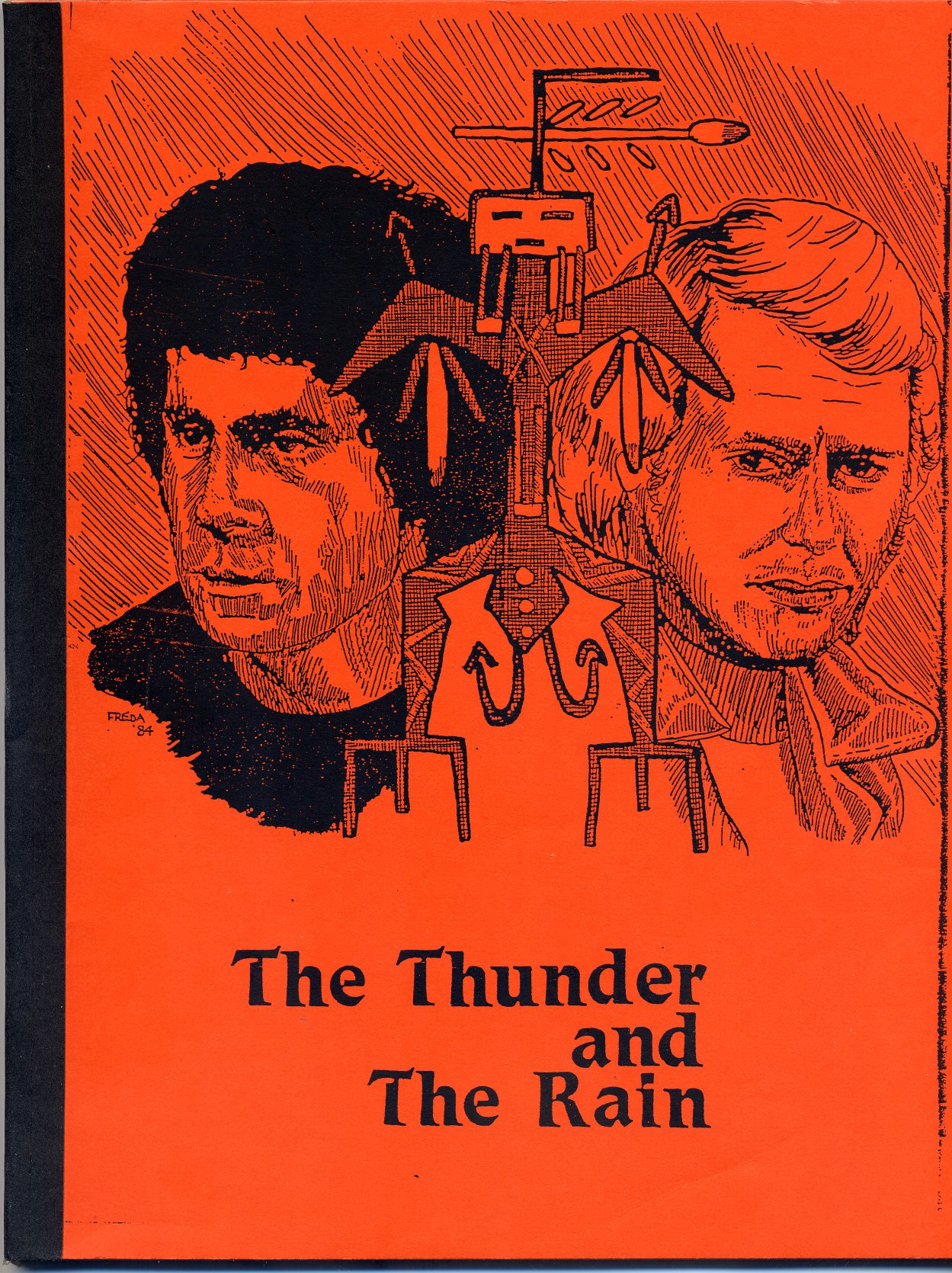
Cover art by Freda Hyatt.
And now the words had all been spoken
And somehow the feeling still wasn’t right
And still we continued on through the night
Tracing our steps from the beginning
Until they vanished into the air
Trying to understand how our lives had led us here.
–Lute for the Sky
December, 1979
“It’s no good, Hutch.”
The quiet voice startled him. He glanced over from his surveillance of the Greyhound Bus Depot, watching the headlights of a passing car illumine Starsky’s face and fade away before he answered.
“She’ll show up, Starsk. Just have to cultivate a little more patience.”
“That1s not what I’m talking about.” Starsky shifted a little in the seat, reaching over to readjust the back for the fifth time that night. “I don’t think it’s gonna work out, me bein’ back on the streets.”
“Don’t be ridiculous.” He resisted the pain that tied its familiar knot in his belly. “You’re doing great, everybody says so, and the doctors—”
“I can’t hear what everybody else says, Hutch, when my own head’s telling me louder and louder.” He turned to face Hutch, a streetlight emphasizing the fine bones of nose and cheeks and jaw. “I hate having to admit it, but I’ve got to. I can’t hack it any more. Everything we’ve done since I’ve been back—all the busts, the work, just riding through our district on patrol—”
“Is it because that thing with Newmark went sour? We can’t win all of them, Starsk. Sometimes things go wrong and we lose a round.” He heard the desperate cliches pouring from his lips and couldn’t stop them. “We’ve had to live with that for nine years and I know it doesn’t get any easier, but—”
“Hutch.” There was infinite patience in the tone, the patience of a decision made. “Listen to me. I’m telling you I’ve felt like a ghost, doing what I’ve always done. Going through the routine I wanted so bad to get back to—and one of these days I’ll fade out completely and get you killed because I’m a bad cop. I have to get out before then.”
“Starsk—”
“No, come on. You know it as well as I do.” Starsky sighed, rubbed at the base of his skull. “Physically I’m not up to par. I haven’t got the energy I used to. Maybe it’s just gettin’ older, I don’t know, but I’m tired all the time and I don’t sleep so good.”
“You’ve healed,” Hutch said, fighting still. “It’ll just take some more time for you to—
“It’s been almost six months. And don’t quote ‘massive internal injuries’ at me, either. I know I’m healed. I’ll just never be the same and I’ve pretty much faced that. And it makes me dangerous to you on the streets. I won’t live with that. And I won’t let you die from it.”
“Don’t play the martyr—it’s not your style.” He listened to the harsh accusation and it was as if he, too, were a ghost. a dream image of himself having this nightmare conversation.
“Cut it out,” Starsky said wearily. “I’m just sick of it, Hutch, makin’ demands on my body and my mind and my endurance that I can1t take any more. I was a helluva good cop and I know it—but I’mm not puttin’ my heart into it like I used to.” He leaned his head back, mouth dragging down at the corners. “I want out, Hutch,” he finished softly.
“Give it some more time,” Hutch pleaded. “You’ve felt this way before—we both have. We’ve both wanted out. Tell them all to screw it and stop asking us to live for everybody else and not ourselves.”
“I mean it this time, Hutch.” Starsky looked him full in the face, his eyes dark and strangely. “Let me go, partner.”
Hutch watched his own hand reach out, brush pale over the black hair, finger for a moment the silver in it. His hand fell like a dead thing onto the seat beside him.
“I can’t.”
“I guess I figured that.”
“Starsk—I just can’t talk about it now,” he tried. “Can it wait until I’ve had a chance to think it over?”
A frown shaded the expression in Starsky’s eyes, depriving them of light. “What’s in your head now?” he demanded. “What’re you thinking?”
“I have to think it over,” Hutch repeated. “Decide what to do.”
“You mean you’re thinkin’ about quittin’ with me?” Starsky sat forward. “You think I’m asking you to come along?”
“Aren’t you?” Hutch faltered. “You—you stayed with me, after Lionel died—”
“That was different! You’re still a good cop, Hutch, you’re—”
“You said you didn’t want to put me in danger. How long do you think I’d last on the streets with another partner? I don’t want another partner. The alternative is a desk job, maybe going for a lieutenancy—can’t you just see me at a desk? Starsky, we’ve been together for too many years for me to even consider—”
“I told you! Let me me go!!”
The force and intent of that cry made him gasp. “Starsk—”
“Zebra Three, suspect observed entering building streetside.”
They stared at each other for a full ten seconds before Starsky broke the mike off the hook to answer the radio call. “Yeah, copy. we’re goin’ in.” He opened the door and got out, moving with a quiet precision utterly different from the previous catlike grace. Hutch followed him, shaking himself out of his shock, and headed for the rear entrance of the depot.
Sherry Kester’s dark red hair was hidden under a brown wig and her trim figure was disguised by layers of bulky clothing, but Hutch had no trouble identifying her features. She made no mistakes as she approached a ticket window and bought a seat on the next bus to Albuquerque, paying small bills. She paused to buy a cup of coffee from a vending machine and stood drinking it slowly as her eyes roamed with seeming disinterest over the sparse crowd in the terminal.
Hutch sat perfectly still with his legs crossed casually at the knees, pretending to read a day-old L.A. Times. He could see Starsky on the other side of the cavernous room, buying a paperback at the counter. Frank Nicholson and Libby Monroe were here, too, covering the other exits. Kester finished her coffee and picked her purse off the floor, sauntering easily toward a row of lockers.
Hutch tensed his body, waiting. The woman passed the cigar-chomping Nicholson, bumped into a pair of hookers who pushed her out of the way and hurried toward their pimp in the far corner.
Slowly she approached the gray metal lockers. She extracted a key from her pocket and turned it over in a hand too slim and too beautifully manicured for her disguise.
“Go for it,” Hutch urged under his breath, rustling the sports section of the paper.
Kester inserted the key into a lock, turned it, opened the door, and pulled out an overstuffed flight bag. She smiled fleetingly as she allowed the locker door to slam shut behind her.
Libby Monroe shuffled toward her, faking a limp. Starsky turned from the bus schedule posted at the foot of the stairs. Nicholson threw his cigar into an ashtray. Hutch got to his feet. None of the four cops did anything even remotely unusual—and yet suddenly Sherry Kester was running headlong for the street exit, tearing past Libby and knocking her down with a powerful swipe of the flight bag.
Hutch yelled his partner’s name unnecessarily and took off after the woman, pushing aside startled travelers as he ran. He heard Nicholson shout “Stop! Police!” and cursed as Kester skidded to a halt, spun, and crouched slightly to fire an unaimed round into the crowd. Someone screamed and someone else grabbed at Hutch’s jacket.
He thrust the hands aside and started running again. Kester disappeared through the revolving glass doors out into the street.
Starsky was ahead of Hutch, tearing down the sidewalk in the all-out wind sprint he had seen so often before. Hutch followed, slowly closing the distance between them, hearing as he neared his partner’s raspy, labored breathing. Suddenly Starsky was staggering to a halt, tripping over cracks in the pavement. Hutch caught at him, keeping him upright as he sobbed for breath.
“No! Get here!! I’m okay!”
He paused an instant to look into the pain-glazed eyes, pressed his fingers into the shoulders, and broke away to continue after the fleeing woman. The brown wig lay on the sidewalk; he jumped it without breaking stride and settled into the long distance running that was his forte. A block later the purse seemed to loom up in his path. He leaped that, too, ignoring the startled pedestrians.
His lungs were beginning to send mild protests to his brain, but he kept running, the dark red mane of unbound hair growing steadily closer. Finally the flight bag appeared on the cement and he bent to scoop it up in his fist, stumbling slightly as he did so but quickly recovering his balance.
Running—the physical motions of reaching with leg muscles and pulling the ground to him and then pushing it behind him—became his reason for existence. He was no longer a cop chasing a suspect. He was a body whose brain had shut down except for the continued command for speed. The sidewalk tilted before him and he lengthened his strides, thighs aching now, feet jarred bone from bone. His quarry slowed and he still pressed on, draining his energy as a marathon runner drains himself of all but will for the final hundred yards of sheer torment.
And at last he could reach out with his left hand and grab a bulky, sweat-stinking sleeve, whirl the woman round, drop the flight bag, tear the gun from her hand with a crack of metal against bone, shove her down onto the pavement and reach around for the cuffs in his back pocket. His legs trembled and he listened to his own harsh gasps. The edges of his vision sparkled with dark explosions as he bent down to cuff her, and he bit his lip to keep from groaning.
Her legs trapped his ankles like scissors. The sloping ground was cut away from him and he fell, rolling awkwardly, something twingeing and then flaring into white agony in his back, the neon and street lights and head lamps of cars careening crazily in his head, arms flung out to find anything to hold onto, vague sound of his partner’s name in the whirring, warm wetness on his lips, coming finally to rest spread flat and staring up at the starless sky.
Hutch lay very still, the part of him that wasn’t a cop, only Kenneth Christopher Hutchinson, awakening again to smile at the irony of life. He resisted the urge to order his arms and legs to move, knowing that the numbness travelling up his limbs was dangerous, knowing without being sure of the source of the knowledge that something was terribly and permanently wrong. And the really ironic part was that he felt no fear. All decisions had been made for him, all choices taken away. There would be no debate about staying or leaving, no searching of his heart, no pros and cons to cancel each other out.
He felt a smile part his lips and blood trickled into his mouth.
‘Don’t touch him!”
“Shut up! Get outta my way!”
Gentle fingers whispered across his forehead, brushed back his hair, wiped the sticky blood from his nose and moustache and lips.
A shadow appeared between him and the smog-browned sky, softening the glare of the lights with its dark curls and invisible face.
“Don’t move, babe. I’m here, it’ll be all right. Easy, Hutch, just lie still. I’m here. It’s gonna be okay.”
And then the pain began—not in his body, but clawing through his mind. He listened to the fear-roughened voice shout for an ambulance, goddammit, and get these people the hell outta here, and take that bitch to the station and book her, and Hutch, please, babe, don’t try to move, just stay there, I’m here, it’s gonna be all right.
Air rasped in and out of his lungs and he didn’t dare tell his frightened partner that he knew every word was a lie. He didn’t dare move even his jaw to speak, knowing that any movement at all might be fatal to a man with a broken back.
* * * *
There was a place in his chest that still stabbed at him when he breathed hard. It stabbed now, even though he hadn’t been doing anything but sitting in a plastic chair for five hours, looking at his hands. Such useless hands; helpless, like the rest of him.
“I think we’d better get him to County-USC. Better facilities for what I think’s wrong with him.”
“What is it? What’s happened to him?”
“Officer, please move out of the way.“
“Tell me what’s wrong, goddammit!”
“His back. Now move it!”
He twisted the rings on his finger, wincing as the ache twisted in his lung. Old wounds. Old scars. And new ones to deal with, no end in sight.
“Your partner’s in X-ray. Sit down, Officer.”
“Is he gonna be okay?”
“Please, just sit down, and—hey! You’re not allowed in there!”
“Starsky, come on, all we can do is wait—”
“I gotta see him, gotta be with him—”
“Officer! You can’t go in there! Orderly!”
“HUTCH!”
His nails had Hutch’s blood under them. He cleaned them carefully.
No end to this. If not him, then Hutch. Simple equation, inevitable. Round and round until one of them ran out of luck entirely.
“Starsky? I brought Edith down. I think you should let her take you across the street for some coffee.”
“No, thanks.”
“David—you go on with Mrs. Dobey. You need something to eat.”
“Leave the boy alone, Libby. Harold, you come along with me. We’ll bring something back with us.”
He gripped the knees of his jeans, stretching his shoulders against the dark brown leather jacket Hutch had helped him select last weekend. He’d burned the old one, not because he wanted to forget, but because he didn’t need anything to remind him.
“David, I brought you some orange juice. Drink it, dear.”
“No, thanks.”
“Drink it. I sent Harold to take Libby home. It’s late.”
“Yeah.”
“All of it. Has the doctor been to see you yet?”
“No. Edith…the paramedics thought he’d broken his back. You’re a nurse, what does that mean?”
“I’m not a doctor, David, much less a surgeon. But don’t worry yourself sick. Kenneth is young and strong. You know that.”
“Yeah.”
“I’ll sit here with you for awhile, if I may.”
“Edith?”
“Yes, David?”
“I’m scared.”
“Are you the officer waiting for word about Sergeant Hutchinson?”
He looked up and nodded. A green-gowned man took the chair next to his, glancing around the empty lounge.
“Any of his relatives present?”
“They’re in Minnesota.”
“Then I’d appreciate it if you’d relay to his family what I’m going to tell you, Officer—”
“Starsky. David Starsky.”
“Wachtel, orthopedic surgery.” They did not shake hands. “Without going into details that wouldn’t mean anything to you anyway, your partner has a fractured spine. Third lumbar vertebra, at the base of the spinal column. He’s going to need an operation to correct some of the damage. Following that, some time in a body cast in the hospital, and then months of physical therapy.”
“And?” There was something else. There was always something else.
“And there is the possibility that he won’t walk again.”
Not Hutch. Hutch with his long running stride, his strength, his laughter when just off the mountain after a day’s skiing, cheeks flushed and hair silvery—not Hutch, who tripped over his own big feet but vas graceful as a stalking lion in a million dark alleys—not Hutch.
“If the operation is successful and he works hard, he’ll probably recover most of his physical mobility. But I have to emphasize that if complications arise…” The surgeon trailed off with a shrug.
“Does he know? When can I see him?”
“He knows. I can give you five minutes with him now. He’s been sedated and should be just about asleep.”
Starsky got to his feet, legs tingling with renewed circulation, muscles aching.
“One thing. Don’t touch him. He’s got to stay immobile until we can operate and get him into that cast.”
Starsky nodded. “Which room?”
He was escorted down the hall and left at a doorway. He waited a moment, then took a deep breath and entered. Frightening darkness; he coudn’t even glimpse Hutch’s gold hair. He waited while his heartbeats slowed and his eyes adjusted to the dimness, and advanced to the bed.
Long body unnaturally still, held in place by a brace of metal and plastic. Pallid face, all life bleached out of it by the pain and shock and the medication that slackened the sensitive features. Starsky’s hand went out automatically, then withdrew. “Hutch?” he breathed.
Sun-gold lashes fluttered weakly, lifted. Hutch’s lips moved on his name and his eyes closed again. A sudden terror swept through Starsky as tears began to leak out from beneath Hutch’s lashes.
Anger followed, a shaking fury that life could have done this to Hutch—to both of them.
“It’ll be all right, babe,” he whispered, fingertips featherlight as they brushed the tears away. “You’re gonna get better. Shit, they put me back together, you’ll be up and around in no time.” The tears ceased and Hutch’s even breathing told Starsky he had gone to sleep. “The hell with all of it, Hutch,” he told the unconscious face. “We’re getting out, you and me. I’m gonna take care of you, make you well and strong again. We’ve given all we’re gonna give. Fuck ’em all.”
He heard the violence of his grief and rage, and bit his lip. When he was sure his voice was steady and soft again, he murmured, “Me and Thee, Hutch. No more cops and robbers games, no more. We’re gonna get out while we still can. I’m not gonna lose you, not even gonna risk you any more.” His fingers were still wet with Hutch’s tears, and he looked down at them. “Nothing’s worth this, babe. Don’t you worry; we’re gonna quit and I’m gonna take good care of you. I promise.”
He left then, quietly, bringing his fingers to his lips to taste the salt bitterness.
* * * *
No matter how close to yours
Another’s steps have grown
In there end there is one dance you’ll do alone.
–For A Dancer
he is running and diana is behind him with a knife
neon colours pulsing from it red yellow orange red red red she is a slit-eyed fury and he is running from her
going nowhere
into the night
legs too weak to run
falling
falling
and she has him now her knife red
and he turns his shoulder away
but the pain isn’t there not where he expects it
the pain is in his back
NO
no
what are you doing it’s not supposed to be like this
oh god oh god twisting the knife now and
right through his spine the pain slices red
he can see her starched white cap
tilting drunkenly as she laughs
got you now got you at last
you didn’t love me well see what happens now
i’m sorry he tries to say but
he has no mouth no brain just the knotted rope of his spine
twisting red around his throat
and she laughs and laughs
want to dance?
but then he is floating slowly
no pain no red no body no diana in her starched white cap
anna is there slim graceful flower
flying in her starry white tulle
pirouetting around him god so beautiful
and i wish i was the sunlight
and i wish i wish
i wish
the pain would go away
can’t you make it go away please
dance with me she says
but he cannot move the rope is back screaming red twisting
and anna is gone
but he is floating again
and he is the white one this time
gold gone from hair and body
ghost white hands reaching pleading downward
to a body no longer his own
get up he screams with no voice
and maybe just maybe
he is dying
dancing
dying
yes dancing white and wild
no pain no colour no red no body no rope to hold him earthbound
but it’s so lonely here so alone
no pain but no warmth no light no feeling but empty
and he looks down at his empty body and knows
he is dying
i am dying
the body can only withstand
is he really the body or really the white dancer
is there any difference at all
fuck the metaphysics, hutch
just come back to me
come back here to me babe please
oh please i need you
you know that
you can’t leave me
i never left you
there’s always a chance
i’m trying, starsk
i’m trying
catch me babe
i don’t want to fall again
* * * *
“Hutch?”
Starsky ached to touch him, to make sure the man under the white sheet was real. Eyelashes fanned thick and blond across pale cheeks, no movement under the lids. Hutch looked younger, lines smoothed from his forehead, mouth relaxed at last from its tight line of pain.
“Hutch…”
“Go home, Starsk.”
He inched closer to the bed, fists clenched at his sides. “It’s gonna be all right. You made it through the surgery terrific. You’re gonna be okay.”
“Yeah.”
“Babe…” Why wouldn’t Hutch open his eyes? “Please.”
A flinch. “Lemme alone.”
Starsky gulped down his fear and found a smile Hutch wouldn’t even look at. “Okay. I’ll be back tomorrow early. You get some rest.”
He had to touch him. He brushed fingers light as wings across the forehead, down one cheek, over the clean-shaven lips. And only then did he feel it—the tension that had nothing to do with taut muscles but was the drawing thin of mind and will into a thread that if touched would snap.
“Hutch. It’s gonna be all right.”
He turned then and left the room, finding by instinct the small lounge where he’d waited the day though. He curled into a corner of the couch, hugging his arms around his drawn-up knees, and after a very long time he fell asleep.
* * * *
The squadroom was mercifully empty as he glanced in the window, the venetian blinds shadowing the office in long indistinct black lines. He’d hoped for emptiness here; he’d had enough murmured sympathy downstairs from the night duty cops. There was only one man he wanted to see here, and the visit had nothing to do with comfort.
He went into the silent room, pausing by his old desk. He ran a finger over the typewriter cover, disoriented by the tidiness of Hutch’s side of the table. Well, why not? It had been three weeks since Hutch had sat there, since they’d shared this table and their job. Starsky bent his head and swore softly, without energy.
“Starsky?”
“Yeah, Cap’n.”
“Come in.”
He pushed Dobey’s office door all the way open, stepping inside until he stood just out of the oblong of feeble light thrown by the desk lamp. “Wreck your eyes readin’ in this light, Cap’n.”
“Mmm.” Dobey pushed back from his desk, clearing a space before him on the blotter. “You could’ve picked a more cheerful hour to visit.”
“I know.” The captain’s face was in shadow, his voice gentler than Starsky had ever heard it. Suddenly it occurred to him that Dobey knew, and the knot in his chest loosened a little. Maybe that would make it easier. “I wanted to see you alone.”
“I see.” He leaned even farther back, the lamplight arcing across his folded arms. “How’s Hutch doing?”
“Better. Dr. Wachtel says he can go home in a couple weeks.” He shifted awkwardly, then reached inside his jacket pocket to produce a long white envelope. He put it on the empty blotter. “Captain—”
“I know, Dave. I’ve been waiting for it.” Dobey leaned forward into the light. His face was older, tired, touched around the eyes with sadness. Not grief, not bitterness, not a hint of impending persuasion. Just acceptance. “I’m surprised you brought it to me, though. I’d expected Lieutenant Longchamps, or one of the deputy chiefs.”
“It woulda been more formal that way—but I worked for you too long, Cap’n. It just seemed like the thing to do.”
“I know. I’ll take care of it for you.”
“Thanks.”
His other pocket yielded the leather wallet containing his badge, and he placed it almost tenderly atop the envelope. Then, slowly, he slid his gun from its holster with familiar smoothness. He looked at the three objects on the desk; pure white, battered brown, sleek blue-black. Symmetry. Simplicity. Still-life, LAPD. He heard a muffled cough, a siren outside, a voice long-forgotten (“Congratulation, gentlemen. You are now officers of the Los Angeles Police Department, sworn to protect and serve the people of this great city.”) and another voice from a December morning many years ago (“Starsky? Meet your new partner, Ken Hutchinson. Oh, you already know each other? Good.”)
“Stay in touch, Dave. I’ll miss you.”
“Yeah… Cap’n, I’ll…Hutch and me, we’ll miss…” He cleared his throat and tried again. “It’s been—aw, shit,” he finished weakly. ·
“It’s all right, Dave. I understand. You take care.” Dobey’s chair creaked as he got to his feet, his hand extended. Starsky grasped it, meeting the dark eyes in the quiet half-light. “God keep you and Hutch.”
Unable to speak, he simply nodded, pressing the Captain’s hand. Then he turned and walked out the side door, blind. As he took the steps, not quite running, he felt the empty holster chafing at his side.
* * * *
Awake again, I can’t pretend
And I know I’m alone, and close to the end
Of the feeling we’ve known—
How Long have I been sleeping?
How Long have I been drifting alone through the night?
How Long have I been dreaming that I could make it right
If I closed my eyes and tried with all my might
To be the one you need?
–Late for the Sky
Some Christmas.
Starsky sprawled on his couch with a beer in his hand, listening to the softly carolling voices on the radio. It would be another day or two before the FM stations went back to their usual programming, but December 26th was still fair game for endless renditions of ‘Silent Night’ and ‘Adeste Fideles.’
The music gave him a morbid pleasure. When he was a kid his grandfather, the rabbi, had frowned on any of his progeny’s participation in Christmas rituals. Starsky remembered how one Hanukkah he and Nicky had hummed ‘White Christmas’ under their breaths at seder.
Grandpa Rabin had been furious, ordering them from the table in a mixture of English, Hebrew, and his native French. The next night the two boys had appeared at the table suited, solemn, and still smarting from the solid whacks delivered by their father.
In California things had been different; Aunt Rosie and Uncle Al being casual in the observance of their religion. December had been a confusing but cheery mélange of menorahs and decorated fir trees in the living room. Uncle Al believed that Jewishness was a thing of the heart and blood; he went to Temple sometimes on the High Holy Days, but rarely insisted that Davey accompany him.
This year, however, Rosie had put together a traditional seder the first night of Hanukkah. Starsky had reached back to his childhood to recall the words and meanings. Most escaped him. All he could think of was Hutch and whether he could nudge his partner into something resembling the Christmas spirit. The brief party he’d arranged on the day itself in Hutch’s hospital room had been tense until Edith Dobey had walked in with Cal and Rosie in tow. The kids had been Starsky’s insurance. Hutch could and would be silent and sullen with his adult friends, but he would never ruin Christmas for a child.
Taking a long pull at his beer, Starsky leaned his head back and closed his eyes against the bright sunlight gilding the back porch.
Not even Rosie’s delight at the presents Starsky and Huggy gave her had been able to keep the smile on Hutch’s face for long. When everyone left and he was alone with Hutch, his own gift had brought a muffled thanks and an apology that Hutch had nothing to give in return.
Starsky had brushed back the blond hair and smiled. “Only one thing you can give me that I want, Hutch. You gettin’ well.”
The idiocy of that statement hit him now full force. He’d meant it, dammit, it was the only thing he wanted in the world. But bitterness had twisted his partner’s mouth and the long fingers had allowed the soft wool sweater to slip to the floor.
The radio announcer sounded bored as he detailed the singers involved in yet another recital of Handel’s Messiah and Starsky got up to switch off the receiver. That, the couch, and the bed were the only things left in his apartment. Everything else, along with Hutch’s belongings, was down at the beach house.
He glanced around at the deep gouges in the carpeting where the table and chairs and china cabinet had stood, the darker squares of paint where pictures had hung on the walls, the shadeless windows in the kitchen. He would install the new blinds himself tomorrow, replacing the ones he’d taken down to the beach. Those had been painted in whimsical patterns by his partner as a moving-in gift—how many years ago? He no longer cared. Nothing could be retained from the life he was leaving behind; looking back was the pastime of the old, and he was only thirty-six. He had a hundred and twelve years left, by God, and so did Hutch, and he wasn’t going to spend them as a cop, getting shot at and kicked in the teeth by the courts and pounding his head against walls and getting nothing done while growing old too fast.
He didn’t need to look at his watch to know that it was time to get dressed to visit Hutch. His internal clock had altered over the past weeks; from cop-time he had adjusted to person-time. He stood up, stretched, yawned, and took the beer with him into the bathroom.
Something made him reject his usual jeans and jacket for nicer clothes, as he had on Christmas Day. Gray wool pants, white shirt, dark red pullover sweater were dug out of the single remaining suitcase in his bedroom, and the transformation from policeman to civilian looked out at him from the mirror. Time was when he’d dressed this way only off-duty. Being a cop had been a uniform at first, then casual street clothes when he’d become a detective, and every so often a suit for court appearances. And the occasional odd get-up for an undercover job. Now he could wear what he wanted, and for some reason he wanted to look well-dressed today.
The ladies on duty at the lobby desk knew him by now. Yesterday they had wished him a Merry Christmas; today they were back to routine. He supposed that New Year’s Day they would all be hung over. He was met with the same glancing recognition and dismissal at the nurse’s station on the fifth floor and opened the door of Hutch’s room without having spoken to a single person.
He was not Hutch’s first visitor of the day. In a chair by the bed sat a long-boned, slender blonde woman with a mouth like Hutch’s and an expensive ruby ring on the hand that twisted in the sheets.
Behind her stood a tall man whose hair still held hints of gold. They looked up as he entered, and the woman glanced at her son for explanation.
Hutch’s eye’s darted briefly to Starsky, then away. “You’ve met my folks, Starsk?” He didn’t much seem to care one way or another.
“Not for quite awhile.” He wore a smile as he walked over to Mr. Hutchinson and held out his hand. “David Starsky. We met once when you were out here on vacation.”
The fingers were slim, stiff with arthritis, and cold. “Yes, I remember,” Eric Hutchinson said. “You and Kenneth had been partners for just a short time then, I believe.”
Starsky nodded, turning to Hutch’s mother. “How are you, ma’am?” She looked up at him, offering nothing but searching blue eyes.
“Quite well, thank you, Mr. Starsky.”
He shifted nervously, needing some sign from Hutch that would tell him to stay or leave. “Uh…maybe I should come back later, huh, Hutch?” He tried to send silent messages with his eyes, but his partner wasn’t even looking at him.
“We were just discussing Kenneth’s condition,” Mrs. Hutchinson said.
“Yes,” her husband echoed. “Kathryn and I spoke with his doctor before we came up here.”
You waited a month, flew out here the day after Christmas, then had a conference with the doctor before you walked in to see your own son? Some of his incredulity must have shown on his face, for Hutch finally spoke.
“What they mean is they want to take me back to Minnesota as soon as I’m well enough to travel, and I told them I’m not going. If you plan on staying in here, Starsky, I suggest you put on a flak jacket.”
I can’t read you any more, Hutch. Are you asking me to stay or ordering me to go? He walked slowly to the other side of the bed, consciously drawing the battle lines. “What did Dr. Wachtel say?”
“That the decision is Kenneth’s.” This appeared to annoy the elder Hutchinson greatly. “He doesn’t seem to want to go home.”
“His home is here now,” Starsky said quietly, knowing now what was expected of him. Hutch was too tired and depressed to fight, so Starsky would have to do it for him. Elation swept through him at the thought. He needs me.
“The medical facilities here are excellent, but there’s an expert in Minneapolis who specializes in cases like this,” Mrs. Hutchinson said, not to Starsky but to her son.
Starsky watched the ruby glint in and out as she pleated the white sheets. “Dr. Wachtel told me what Hutch needs is fresh air and sunshine, and I don’t think he can get much of that in a Minnesota winter.” He glanced at Hutch, who seemed totally disinterested. “A program of therapy’s been arranged, and—”
“I’ve spent the last month making arrangements of my own,” Mr. Hutchinson interrupted smoothly. “As soon as you’re able to travel, son, we can go home.”
“It’s gonna be at least another two weeks before he’s out of that cast,” Starsky said, and at last they looked at him. He held their attention by speaking quickly and calmly. “I’ve checked everything out with Dr. Wachtel and he approves. I’ve rented a house down at the beach and put in ramps for the wheelchair while Hutch still needs it. Then when he’s up and walking around again the sand is the best thing in the world to build up his muscles. Plus he’s close to the doctors who’re taking care of him, including the guy who did the surgery.”
There was a long silence. Mrs. Hutchinson’s hands were quiet on the sheets, her ruby a drop of blood.
“Don’t you want to come home to your family, Kenneth?” she whispered at last, but her wide eyes lifted to Starsky, filled with accusation and pain.
“We can give you the best care, son,” her husband went on. “We only want you to get well and strong again. Come home with us, please.”
Starsky had the distinct impression that Eric Hutchinson used that word very seldom, if ever, and certainly not to his own son. He waited for Hutch to say something, watching the pale face for the slightest expression that would cue him.
“It’s your fault!” Kathryn Hutchinson’s voice rang out and Starsky had to hold himself from a flinch. “You should have been there to see that this didn’t happen to my son! And you stand there without a claim on him, telling us what you’ve planned—how dare you?”
His temper snapped. “How dare I? Listen, don’t talk to me about claims. I know for a fact that Captain Dobey called you the day Hutch got hurt—and almost a month later you decide to come see him! Not even on Christmas Day, for God’s sake! You weren’t here for him! I always will be and Hutch knows that. No wonder he doesn’t want to go back with you—Alaska’d be warmer from what I’ve seen of you! His home is here, and there’s no way you’re gonna take him away from—”
“Starsky!”
Hutch’s voice cracked at him, thin with fury. He stared down at his partner, unable to believe the look in Hutch’s eyes.
“You either shut up or get out of here.”
“The hell I will!” He had begun by fighting Hutch’s battle and now he was fighting Hutch. This was insane. “You want to be a little boy again, fine— go back to the nest; nobody to tell you you’re bein’ a selfish bastard, nobody there but Mommy and Daddy to look after you and keep the world away!”
“That’s enough, Mr. Starsky!”
“Not by half, Mr. Hutchinson! Your son’s the best friend I got in this world—closer to me than my own brother. I got rights, too and he’s got responsibilities to me! He can walk away from ’em but I ain’t never gonna let him forget ’em!”
“Starsky—for God’s sake—do you think I could ever—”
“Go on home, Hutch,” he sneered, his chest shaking. “Since you don’t give a damn about yourself, why should I? Go home and stay a cripple the rest of your life—but you’ll have nobody to blame but yourself and you know it!”
He couldn’t see, and he couldn’t find any more breath to speak, so he fled the room. Someone crashed into him and he shoved them aside, heading blindly for the refuge he knew he would find in the doctor’s lounge at the end of the corridor. It was where Dr. Wachtel had told him what had happened to Hutch, and it was where he had spent the day of the operation, and now it was where he went to huddle in a corner of the couch, gasping for breath, terrified by what he’d done.
* * * *
Starsky’s departure took most of the anger from the room and left Hutch with nothing. He closed his eyes wearily, his mind automatically fighting the restless need of his body to move. Fifteen more days, Wachtel had smiled at him today. Only fifteen more days trapped inside this cast that held him motionless, helpless from the chest to the knees.
“Rather volatile, isn’t he?”
The cool, even tones of his father, managing to convey disapproval without allowing any emotion that definite into his voice. How often during his childhood and youth had he wished for a father who shouted and fought, a match for his own temper?
“You’re tired, darling.” This from his mother, her slim hands taking his between them. “We’ll let you get some rest, and work out the arrangements with the doctors.”
How easily they’d run his life for so many years, and had never understood why their bright-haired darling had run away. For his three years as an undergraduate student at UCLA they’d excused his absence as a brilliant transfer to a school with an excellent politic science department, intimating confidently to their friends that Kenneth would be back, armed with a degree, to enter law school and then local politics. He’d never told them about the police science courses he’d taken, nor that he’d seen Luke Huntley, another refugee from Duluth, more and more often as the months went by.
“Your mother and I are glad about one thing,” his father said. “You’re alive, you’re out of police work. You’ve no idea how she’s worried all these years.”
“Eric! Anyway, all that is past now.”
All past. He remembered the year he’d spent back home with them after the elegant wedding Vanessa had been so thrilled about. He’d acceded to his grandfather’s request to spend some time getting to know the business community, building a solid base for a run for office. And a man with a new wife and a baby on the way after only three months of marriage couldn’t afford to say no to twenty grand a year and a perfectly planned future. How had they survived Christopher’s death, that fragile infant who’d lived only long enough to be named?
“Kim and her family will be so happy to see you again. Bill just finished the plans for the new house at the Lake, and we can all spend next summer there.”
His little sister had stayed, but at nineteen had run off with her father’s lowliest assistant. Marrying the boss’ daughter had been good for Bill, both personally and professionally. And Kim, with four kids and soon two houses, lived as she pleased. Billy, Jeremy, Kathy and Erica—good God, could Kim’s youngest be eleven? And he had never seen her. It would be nice to be around Kim again.
“I think we should be leaving, Kathryn. Kenneth is obviously too tired to talk.”
Go back home, see Kim and her children, old friends, sleep in the familiar old room, wake up to Mrs. Neilsen’s huge breakfasts, visit the farm where cousin John raised quarter horses now, maybe ride through the fields down to the pond, go swimming, pick wild strawberries…
“We’ll leave you now, darling. You get some sleep.” Soft kiss on his forehead, just like when he was little and all the things that were now past had not yet had the chance to hurt him.
“And we’ll make sure your excitable partner doesn’t trouble you any further. Pleasant dreams, son.”
He opened his eyes. “I’m staying here.”
His mother’s face was white. “Kenneth—you can’t stay here with no one to take care or you!”
“I’ve got Starsky,” he said.
“I rather doubt his ability to provide the kind of care you’re going to need,” his rather said quellingly.
“I’m not going.”
“Kenneth—”
“Hush, Kathryn.” His father moved closer to the bed, lean hawk-face stern and unmoved. “If you think for one moment that we will allow you to stay here, far from your family, and be subject to the ministrations of doctors we don’t know—not to mention the highly dubious plans of your so-called friend—”
“Are you threatening me?” Hutch asked softly.
“Not in the slightest. I’m merely stating a fact. You’re coming home with us.”
“Darling…” His mother’s hand rested on his. “We just don’t feel that the people out here can be relied on to take the very best care of you. All we want is for you to get well, and be happy.”
He smiled. “Since when did you give a fat fuck about my happiness?”
His mother gasped and recoiled from the obscenity, as he’d known she would.
“Don’t use those words in front of your mother.”
“She’s heard them. Grandfather had the foulest mouth I’ve ever heard, and he never spared anybody.” He wanted to sit up, get out of bed and face this man down. “I’m not going anywhere, except with Starsky. I knew you’d hate him—he uses words like that, too. Very creatively.” He smiled again. “As a matter of fact, he and I speak the same language. We both learned it on the streets.”
“That’s enough.”
“Not quite.” He looked at his mother. “You don’t know what the streets are. They did this to me, sure—but they also gave me the best partner and the best friend a man could ever hope for. He’s volatile, as you so delicately put it, and he’s excitable—but he feels! And don’t you ever make the mistake of thinking he can’t be relied on. He found me when I’d been hooked on heroin, helped me kick it, stayed with me—you didn’t know about that, did you, mother? Nobody ever told you. Starsky’s stayed with me when anybody else would’ve kicked me out on my ass. He’s tended my wounds, cleaned up my vomit, pulled me back together more times than I can count. And he’s bled for me, taken bullets I should have taken—should have been mine.”
“And allowed you to come to this!”
“You think this is his fault? Are you out of your mind?” Staring up at his father, half his genetic heritage before him in a steel gray suit, he went on in a deadly quiet voice. “He loves me. More than anybody in my whole life—even you should’ve been able to see that today. And I love him.”
“If you’re implying that there’s some kind of—unnatural relationship between—”
“Oh, you’d love that, wouldn’t you? The frosting on the cake. Darling Kenny the Queer!” He laughed. “No, sorry to disappoint you. There’s nothing like that going on.” He paused deliberately. “But it’s never been outside the realm of possibility. Nothing is, when you love someone as much as I love him.”
His mother stumbled to her feet and fled the room. He watched her go, oddly detached from the scene. His father, tall and elegant, ignored her exit, though his eyes kindled for just an instant. “Did that make you feel better?”
“As a matter of fact, it didn’t.” He gestured aimlessly. “I don’t mean to hurt either of you. But I won’t go home with you and I won’t listen to you talk about Starsky that way. I trust him. Isn’t that enough for you?”
There was a long silence. Then, heavily, “I recall when you left Duluth that second time for California. It was right after Christopher’s funeral. I understood that you and Vanessa needed to get away, but we always hoped you’d come back. When you were divorced, it broke your mother’s heart.” He turned to the window and sighed. “I knew then that we’d lost you. Your letters came less frequently, even to Kim. You only called us on holidays, or when you thought we might have read something in the papers and been concerned. But I knew we’d lost you. And you know, the odd thing is, I never understood why or how.”
“Because you—”
“No, I don’t think either of us wants to endure a scene. Recriminations, blame, guilt—it might have been some use twelve years ago, or even five. But not now.”
He watched his father square his shoulders and turn to face him, the cold mask intact. “Why didn’t you ever talk to me?”
“I told you I don’t wish to discuss it. You told us when you left that first time that you intended to live your own life, free of us—whatever that meant and whatever it has come to mean. You’ve done so. I can only wonder if you regret the cost.” The icy eyes raked over his useless legs. “You will always be my son, and if there’s ever any help you’ll accept from me I’ll be more than willing to give it. But I think we’re both wasting our time, don’t you?”
“Never bend, do you? Never! I never saw you cry when Christopher died, or even when Brian—”
“Let’s leave your brother’s death out of this.”
“No, let’s not! Why didn’t you cry for your own son? From the day he got sick—Jesus, I remember it all and I was only four years old! All that time, eight goddamned months it took him to die and you never once—”
“Kenneth! That’s enough!”
“—but I bet you’re sorry the younger son died and not the older one, right? Aren’t you sorry it wasn’t me instead of Brian?”
For a few seconds bis father’s face began to crumple. Hitch watched, appalled at his own cruelty. But before he could speak words of apology the expression changed again, the haughty face regarding him with its own special brand of contempt.
“Have you thought that, all these years? Has that been it? You’re so utterly wrong.” Long legs carried him without hurry to the door. “I did love you, Kenneth, no matter how inadequately I may have parented you. And I’m sorry we lost you.” He stood, fingers resting on the door handle. “I’ll tell your mother you’re sleeping. We’ll be back in the morning to say goodbye.” And then he was gone.
It had been years since he’s thought about Brian. Not since they’d buried another small coffin next to his grave. The shadows in the room grew deeper as he tried to recall the faces of his brother and his son, but all he could remember was that they had both had the same white-blond hair, and that he’d lost them both. How strange. Two of the most important events in his life, and he could remember nothing but the dazed abandonment. A child’s attempts to console his grieving mother had been just as futile as a husband’s attempts to comfort his grieving wife. Bitterness gnawed at him. Maybe he’d spent his youth trying to make up for his brother’s death, and the dying year of his marriage trying to make up for the loss of a son. And, in the end, he’d lost them all —mother and father, brother, sister, child, and wife.
There remained only one constant in his world, something that had been given to him freely, someone who had become best friend and family. If not for Starsky, he would be alone now. He reached over carefully to the bedside table, picked up the phone, needing Starsky. Needing him very much.
* * * *
Starsky slammed the door of his apartment behind him, anger and fear still making ·his hands shake as he took off his clothes and huddled into his robe. Cold. So goddamned cold. Never in his life had he shouted at Hutch like that—no, that was wrong, it had happened twice before. One time over Kira, and what a joke that had been, the bitch playing each of them off against the other. Once the summer before last, when things had started going wrong for them. He didn’t remember what that fight had been about, only that they had both been drunk and viciously angry. He and Hutch knew each other too well; they knew all the hurting places, the old scars that had never healed, the little chinks in the armour where knives could be twisted with the desired effect.
Shivering, he put water on to boil, selecting a box of tea from the cupboard. What had they fought about that time? His mind snagged on the question, memory blurring with too much liquor and the blinding rage. It was after that night that Hutch had withdrawn from him, going his own way, still the best partner any cop could want but rarely his best friend any more. Jesus, how that had hurt!
The teakettle whistled and he poured water into the fat blue tea pot, letting the leaves steep for the prescribed five minutes before pouring himself a cup. He held the mug to his face, letting the steam warm his cheeks, as he walked slowly into the living room and curled into a corner of the couch.
What had their fight been about?
Did it matter? He’d lost Hutch today, lost him as surely as if their friendship was a crystal flacon smashed beneath his heel. He gulped tea, burning his tongue. Mr. and Mrs. Hutchinson would take their son back to Duluth, wrap him in their particular folds of caring, and Hutch would be lost to him forever. Maybe a letter or two, a card on his birthday and at Christmas, and eventually—nothing.
Starsky kicked himself mentally. Self-pity was an emotion he hadn’t allowed himself since Terry had died. But Hutch was always the one who brought him out of himself, gently pulling him back to the pattern of life again. And he’d lost Hutch.
A shock of pain ran through his body, centered in his chest, making it difficult to breathe. And even as he knew that the pain wasn’t his own, the phone shrilled loudly. He grabbed for it and gasped out Hutch’s name.
“Starsk?”
He nearly groaned. Hutch sounded so lost. “Yeah,” he replied, speaking awkwardly around the ache in his throat. “You okay?”
“Fine, fine. I’m okay.” He was lying. Why?
“I’m sorry about what happened today.”
“Me, too.” Something was very wrong. He heard it in Hutch’s voice, felt it along every nerve in his body. “Hutch?”
“I’m not going with them.” The words came out in a rush. “I’m not going back there. You were right.”
“Ahhh…” Relief paralysed him for a moment, but the nagging pain forced him back to awareness. “Are you sure you’re all right?”
“Yeah, I’m fine. I’d better go, I just wanted to tell you—”
“No, please—talk to me for a while. We haven’t really talked in forever.”
Hutch sighed softly. “Okay,” he said almost shyly, and Starsky breathed more easily. “What do you want to talk about?”
“I’ve got us a house, did I tell you? Down by the beach. You’ll love it. Of course, it doesn’t look too swell in the rain and cold, but come spring it’ll be great down there.”
“Sounds…good.”
“Hutch?”
“What?”
“Tell me what’s wrong.” He gripped the phone tighter, concentrating everything he had ever learned about his partner into an attempt to discover what Hutch was hiding from him. “You hurting again?”
“No, I’m fine.” Breathless answer.
“Don’t lie to me,” he snapped. “Didn’t those stupid nurses give you anything for the pain?” He broke off, a terrible suspicion in his mind. “Hutch, did you take anything tonight? Painkillers? Something to relax your back?”
“Yeah, they’ve given me five or six pills so far.”
Starsky drew in a long breath. “Did you take them?”
Hutch was silent for a long time. Then: “I can’t lie to you. Never could.”
“0h, Hutch!” He sagged back, trembling. “You bastard. You think you’re so fucking smart—pretended to swallow the pills, didn’t you, then spit ’em out! I bet there’s a whole pile of ’em in the trash by your bed, isn’t there?” He waited, then shouted into the phone, “Isn’t there?”
“…yes…”
“God damn you!”
“Starsky?”
He bit his lip, not trusting himself to speak further. “Starsky!” Panic edged Hutch’s voice. “Don’t go—talk to me, please talk to me!” After a short pause Hutch cried out, “Starsk, I’m scared!”
“You’re scared? You think I’m not? You stupid goddanmed bastard—how dare you? You and your phobia about pills and drugs—don’t you understand? If you don’t follow the doctor’s orders you’re not gonna get outta the hospital! You’re gonna end up a cripple for the rest of your life! Hutch, call the goddamned nurse! Now!”
“Starsky—”
“Do it! And when she gets there you say exactly what I tell you to say.”
Hutch gave a faint, bitter laugh. “Good evening, this is Ken Hutchinson coming to you via remote control.”
Starsky chewed his lip.
“All right, all right! I’ll call her! Will you at least talk to me?”
“I got nothin’ to say to you.”
“So what else is new?” Hutch stopped, then said away frum the receiver, “Hello, nurse.”
“Tell her you want a shot.”
“I’d like a shot of something, please. Yeah, my back really hurts.”
Starsky’s palms were sweaty on the receiver. “What’s she doing?”
“She’s gone to get it. They don’t use spoons in hospitals, you know that? No candle, no spoon—just nice clean vials of junk, all pretty and sterile and guaranteed to send you flyin’ away—”
“You’re not gain’ anywhere.” He spoke softly, knowing he’d gotten what he wanted. “You’re gonna stay right here with me.”
“No, sorry. Can’t do that. I can still remember what it was like, Starsky—all these years, and I can still remember. Isn’t that weird? Did I ever tell you how it felt to be a whore, sellin’ myself to a needleful of junk?”
“It’s not gonna be like that. You know it’s not. It’s just one shot, for God’s sake!”
“She’s here…”
He heard the tremor and said swiftly, “It’s all right, babe. I’m here.”
“But I won’t be. I just got it, Starsk. And I can feel it, just like it used to be. It spreads, you know? Up your arm and down your chest—”
“Hutch.”
“Yeah? If you’ve got something to say, say it quick. ‘Cause I’m starting to float away.”
“Hutch.” He unclenched his jaw. “Call the nurse. For real this time.”
Not even the sound of Hutch’s breathing came over the phone.
Then there was a long sob of anguish. “I can’t!”
“Call her or I’ll come down there and stick the needle into you myself!”
“Starsk— don’t make me! Please! You don’t know what the sight of a needle does to me—I don’t want it, I can make it through without it—”
“I don’t give a goddamn what you want! Call her!” He waited, hearing nothing but the agonized gasps of pain. “Call her, you fucking liar!” he shouted.
Infinitely weary, Hutch said, “I can’t fight you.”
Starsky extended his senses and heard, faintly, a woman’s soft voice. Then Hutch saying something in that defeated tone, and the quiet again.
“Starsky?”
He said nothing.
“I swear, I asked her and she’s gone to get me something. Please talk to me.”
Wiping tears from his cheeks, he rested his forehead on his drawn-up knees and waited.
“In my arm?” Hutch was talking to the nurse, her voice murmuring back. “Oh! That’s cold!” A grunt; sharply indrawn breath. “No—no, I don’t like needles.” Long pause. “Thank you. Good night.”
“Hutch?”
“Nobody here but us hypes.”
“Hutch, listen to me, babe. It won’t be like that. Do you think I’d let that happen to you again? Trust me, you’ve always trusted me. I’m gonna take real good care of you, Hutch, I promise. Got a house down at the beach and—”
“You promise? You won’t let me get hooked again?”
“You’re not thinkin’ straight, babe,” he said gently. “This is Starsky, and I’d never let anything hurt you. Nothing’s ever gonna hurt you again, Hutch, I promise. You believe that, don’t you?”
“Oh God—it hurts… I don’t want this shit in me, Starsk, Don’t wanna be a cripple—”
“You won’t be. I’ve got it all worked out. We’re gonna be okay, babe. Me and Thee, just like always.”
At last Hutch sighed deeply. “I don’t hurt anymore—but I’m so goddamned high, Starsk, I hate it…”
“I know. But trust me, huh? It’ll keep you safe. Gonna make everything all right for us again. Hutch? You believe me?”
“I—I have to, don’t I?”
“You damned well better believe it, ’cause it’s true.”
“…sleepy…”
“You get some rest, babe. I’ll be there first thing tomorrow morning, okay?”
“…Kay…”
“Hutch?”
“Hmmm…?”
“Hutch, I—” He gulped. Why was it so difficult to say it? “I love you.”
“Mmmm…”
Starsky sighed. “G’night. See you tomorrow morning.”
There was no response, and he hung up after waiting for several more minutes. Hutch had obviously fallen asleep. Exhausted, wringing with sweat, his body cramped with tension, Starsky moved woodenly into his bedroom and collapsed across his bed.
As he lay in the dark, gradually relaxing, a smile began to spread across his face… Hutch wasn’t going to leave. He hadn’t lost him after all. Turning over, he snuggled into the covers and closed his eyes.
* * **
Starsky put the potted plant into the front seat and drove away from Hutch’s Venice Place apartment for the last time. The Torino was filled with the fragile items he hadn’t trusted to packing boxes, and plants sat in neat rows on the back seat, their varied scents tickling gently at his nose.
His own efficiency rather amazed him. Hutch had agreed listlessly to whatever plans Starsky cared to propose; signatures to take care of finances had been given without comment. It made things easier, of course, but Hutch’s indifference was frightening. Still, Starsky thought, once they were living in the beach house and Hutch was working on recovery, everything would be all right again.
One of the plants began to tip over as he took a corner too fast, and he scrabbled to keep it upright. All he needed was potting soil all over the upholstery, seeping into the tiny slits made by the inward explosion of glass last spring. Somehow he’d never gotten around to having the seats recovered. It seemed appropriate to him that the car be marked in some way.
He made a wry face at his morbidity and patted the dashboard in apology. The leather of his jacket creaked as he moved; he thought sadly of the old one, with its soft, well-worn familiarity, its easy adjustments to the contours of his body. Hutch would tell him it was stupid to get attached to a material object, and in a sense he agreed. But he missed that jacket, and he missed the feel of the holster and gun under his right arm. He’d lost a fraction of his balance without them.
The freeway was clearing of homeward bound traffic, and he shifted into the fast lane, settling down for the drive to Newport. They would never have been able to afford the area on their monthly gleanings from the LAPD retirement and disability funds. Starsky was still somewhat taken aback by the revelation of Hutch’s stock portfolio; he had spent several hours with the broker (yet another of Hutch’s college friends—had the whole class ended up in business suits?) who had explained the financial arrangements Hutch hadn’t been interested in for years. Dividends had been automatically plowed back into shares to augment the original gifts from Hutch’s grandfather—not the farming one, the one who’d run some company or other in Duluth and who’d wanted Hutch to follow him into the boardroom. The stocks were real blue chip stuff, enough to keep a tidy check coming in every quarter.
Starsky had also spent some time in a bank president’s office, swearing it would be the last time he’d wear a tie, getting Hutch’s multiple accounts straightened out and going through the contents of a safety deposit box he hadn’t known existed. He’d read through a diploma, divorce decree, stock certificates, various family papers—some of which made him blink—Hutch’s birth certificate, insurance policies, and a copy of the original portfolio. He’d refused to glance through Hutch’s will.
His own bank had been an ordeal endured in jeans and a sweater.
Over in half an hour, armed with a new joint checking account and the reassuring fact of greater solvency than he’d thought, he’d finally been able to judge how much they’d be able to afford in rent and gone house hunting. After four days of working his way down the coast, he’d found the perfect place a few miles south of Newport-Balboa. Two bedrooms, a tidy kitchen, a big living room with a fireplace, sliding glass doors leading onto a wide wooden porch, and a small garage.
He pulled into the garage and patiently carried plants and boxes into the house for unpacking in the morning. He had picked and chosen from their combined furniture, deciding what could go into storage and what was ripe for selling. Standing in the middle of the living room, he glanced around approvingly as he wondered where to hang Hutch’s plants. Doubtlessly his partner would want to change them around, but Starsky wanted them to be visible in the house, familiar referents along with his own blue couch, Hutch’s coffee table, the peacock chair, Hutch’s ladderback chair and dining room table, the tall folding screen. The only problem he’d had in getting the place ready had been putting in the ramps for the wheelchair.
But it had been good to have something to do again. Something useful. The days had been too long—mornings spent with Hutch at the hospital, afternoons closing up his own apartment and clearing up the loose ends of nine years of police work, evenings with Hutch again, then going to Venice Place for packing and prowling and a few hours sleep.
All that was over now. Tomorrow afternoon Hutch would be home, and they’d start getting him well again. He had a whole sheaf of notes given him by Dr. Wachtel and the other physicians about diet, exercise, what to expect, what to look for, what to avoid, which painkillers to use when, schedules and programmes and all the little nagging details of physical recovery from a broken back. His own doctor had practically sung hosannahs when Starsky had informed her that he wasn’t going to be a cop any more; she had lectured him for fifteen minutes about staying in good shape and not overdoing anything, watching his intake of calories, caffeine and alcohol, and then hugged him with a big smile on her face.
He looked around the little house, feeling justified in his satisfaction as he hung the last luxuriant Boston fern. He liked it here. His next door neighbours were nice people who’d helped him put up the ramps—Mrs. Sprague with an extra hammer and a strong right arm, Mr. Boehlman with measurements as precise as only a retired math teacher could make them. The incline of each ramp was calculated not just for the wheelchair but for ease of access for when Hutch was able to use the chrome walker. And before spring was over, the ramps would be gone entirely. Hutch wouldn’t need them.
Starsky fixed a sandwich for dinner, opened a bottle of Chardonnay and sipped at the chilled wine as he watched the late news. A quick perusal of the TV Guide elicited no worthwhile late movies, so he suffered through fifteen minutes of the Tonight Show before flipping the set off and fiddling with Hutch’s stereo until it played a classical album to his satisfaction. Borodin’s Polotsvian Dances filled the living room and spilled into the kitchen as he washed the unpacked dishes and filed them away in the cupboards. He changed the record to Handel’s Royal Fireworks Suite, craving the baroque precision, and opened the sliding glass doors so the music could reach him on the porch.
He sat at Hutch’s redwood table with the bottle and glass in front of him, gazing out at the midnight sea. He had no idea whether the tide was in or out; he figured he’d soon be able to tell by the mere sound of the waves. Hutch’s place in Venice had been three blocks from the beach, yet his partner had always known the exact tides and that had always mystified Starsky. He remembered a night some years before when the Red Tide had come as far south as Venice, and they’d spent the whole night watching the odd coloured breakers. Hutch had brought a couple of blankets down to the beach and they’d shared a thermos of hot coffee and a selection of Chez Helene’s pastries and talked. Hutch had gone on for half an hour about the different kinds of algae or microbes or something, he reflected wryly. It would be just that way again once he got out of the hospital with its constant reminders of his injury. Living here, away from the nurses with their charts and constant hassle, would bring back the old Hutch. It’d be just like old times, only without the knowledge that the end of the weekend would see them back on the streets.
He sighed contentedly, finishing off the wine. He hadn’t known how really afraid he’d been the last few months until he’d made the decision to quit. The lifting of that incessant, insidious fear had been like – like—he struggled for a comparison. Like leaving Viet Nam, he decidedly finally. He remembered the elation that had filled him as the troop transport had left the green hell far behind him, the giddy relief of knowing he was not going to die there. But, too, there had been grief for those he would never see again, who hadn’t been as lucky as he. So many in ‘Nam, so many on the streets since. Too many.
Zack Tyler. Bill Edwards and Jack Forest. Wade Landis. Jackson Walters. Helen Davison. Mack Johnson. Gillian. Iron Mike Ferguson. John Blaine. Jake Donner. Lionel Rigger. So many…
Terry.
Pain was a hard spasm in his chest as it had not been in years at the thought of her. He tried to remember what she had looked like, how her body had felt in his arms, what it had been like to make love with her.
All he could remember was the losing.
He hurried back into the house, going to his desk to search through the drawers for the picture he’d kept of her. What had she looked like? What had her perfume been? How had her fingers laced with his, what had her mouth tasted of, what had happened to the roses he had placed on her grave? Where was the photograph?
There in his hand. Dark hair, smiling eyes, laughter on her lips. He couldn’t remember the timbre of her voice or the texture of her hair or the name of her favourite song. All he could remember was the losing.
He returned the picture to its yellowing envelope, smoothed out the creases, and slid it gently back into the dresser. He didn’t even have a picture of Rosey, and her image was as hazy as Terry’s in his mind. Helen—she’d been blonde. He hadn’t risked love in a long, long time.
It was past two in the morning when he locked up the house, turned off the few remaining lights, and went to bed.
* * * *
Hutch opened the door of the Torino and waited for Starsky to unpack the wheelchair from the trunk. In spite of himself he was impressed with the little house; it looked well cared-for, comfortable and attractive from the outside. He rubbed his thighs, the skin still dry and flaky from the weeks in the body cast even though he’d been out of the damned thing for days now. Several times he’d had an urge to take a bath in any kind of lotion that would ease the parched feel of his skin. It was worse under the jeans, since the loose material chafed at him. He looked down disgustedly at the tight-notched belt around his waist and wondered again how much weight he’d lost.
“Here we go!” Starsky’s cheerful excited voice made his head lift. His eyes ran down the strong, supple figure and he suppressed a frown and sharp words. He’d have to get over this ridiculous envy of Starsky’s health Don’t antagonize the people I need, said a soft memory voice in his mind, and he bit his lip.
Soon they were indoors, Starsky helping joggle the wheelchair over the doorsill. Hutch wasn’t quite proficient yet with the clumsy chair, and his first few minutes were spent in careful manoeuvering. “You’re going to have to get rid of that table,” he said abruptly, nodding at the piece that had been one of the few really good ones in his own apartment.
“Nah, we’ll just move it some. Here, come on into the kitchen.” Starsky was behind him, ready to push.
“I can do it,” he said, and gave the grips a turn. His left foot crashed into the couch and he swore. “Shit!”
“Guess I miscalculated,” Starsky admitted. “Oh, well, not too bad a problem. Come on, I’ll give you the grand tour.”
Cautiously he wheeled himself into the small kitchen. The tile and linoleum were obviously aged and the wood needed a new coat of paint, but the place was clean and everything was arranged neatly.
He moved to a drawer, opened it, expecting to find silverware. He would have kept the silverware in it; he should have known Starsky would not. Unerringly he turned to the opposite drawer, opened it, and found he’d been correct.
“You’ve got it all backwards.”
“Huh?” Starsky looked out from behind the refrigerator door.
Closing it, he produced two cans of beer, opening both before handing one to Hutch. “What’s backwards?”
“The kitchen,” Hutch explained. “You’re left-handed.”
Starsky looked around, bewildered. Then he grinned. “Then all the stuff in the bathroom and your bedroom’s backwards, too. I’ll switch it around tomorrow.”
“Doesn’t matter. I’ll get used to it.” He backed the chair out of the kitchen, the beer gripped between his knees, and wheeled himself into the living room again. “What’s out here?”
“Porch.” Starsky hurried to open the sliding glass doors. “Sorry I couldn’t figure a way to get rid of the bumps—but it won’t be that big a deal, will it? I can lift the front wheels over when you go out, and it’ll only a little bump.”
Hutch grunted noncommittally, peering out the doors. A set of steps led down to the sand, and beside them was a long, gently inclining ramp. He turned away and manoeuvered back to the middle of the living room. “Where’s my bedroom?”
“That one,” Starsky said, pointing to the door on the left. “Wanna see it?”
He bit back a sarcastic retort and nodded. As he waited for Starsky to open the door he took a swallow of beer—his first in what seemed like centuries—and glanced out the glass doors again at the beach. It was only mildly overcast, and someone was surfing in the feeble tide, black wetsuit molding to lean body and legs.
He’d tried surfing the year he’d come out here to UCLA and had hated it. Skiing had been more his thing. He looked down at his legs, the vast betrayal seething within him.
“C’mon, you’re gonna love it—I hope!” Starsky called.
It was a bright, well-lit room facing the sea. His brass bed was shoved against the wall, the white chenille spread decorated with a couple of pillows. An easy chair, his desk, the bureau, closet doors open to reveal all his clothes neatly arranged, his plants tumbling riotously from every available perch, the mirrored umbrella stand that had been his grandmother’s over by the window. There was no rug or carpet, only bare wooden floors, and it took him a moment to remember that the wheelchair wouldn’t navigate easily on lumpy carpeting. He surveyed the room, noting a few of his paintings framed on the walls, his artist’s supplies stacked in a corner next to his easel—which suddenly looked impossibly tall. Of course, it had been set up for a man who could paint while standing. There were a few water stains on the ceiling, and the wallpaper, once bright with blue and yellow flowers, was faded, and wooden flooring that had once been very fine was warped in places. But all in all it was a good room, comfortable and livable.
“Well?”
He looked up at the anxious face. Two sets of emotions so strong they cancelled each other out strangled his speech for long moments. He wanted somehow to thank this friend for the care he’d taken—but he also wanted to lash out at Starsky who had arranged everything without his knowledge or permission or even his desire. He watched the long face grow steadily more apprehensive, knowing he had to say something. Finally, voice thick, he managed, “It’s nice. Looks good.”
This seemed to be enough for Starsky. He smiled widely and went to bounce on the bed. “Got a new mattress—so damn firm you’re gonna have bruises,” he told Hutch. “But the doc said to get one, so—” Swiftly he was up, parting the plain blue curtains and looping them over small brass hooks. “Mrs. Sprague next door made these. You’ll like her a lot. Come look at the view—it’s gorgeous.” Quick grin, eyes shining. “You can sit here and leer at all the beach bunnies. So help me, even for January there’s more bikinis out there than a man can handle.” He raised the window, struggling as it stuck. “I hafta get that fixed,” he muttered, and turned back to Hutch. “Sunsets are pretty, too. Saw one last week that made me want my camera, but by the time I found it under the pile of junk in my room, it was night.”
“I’m tired, Starsky.” He hadn’t meant to say it in that tone, so abrupt and quelling. But Starsky only nodded.
“Here, let’s get you into bed for a nap, huh? I’ll wake you around seven for dinner, that okay?”
“Fine.”
He wheeled the chair over to the bed, turned it, and locked the wheels. Starsky was beside him, gathering him, lifting him to place him gently in bed. The spread was pulled up to cover him to the waist, and he lay on his back and sighed deeply. It had been a long drive, and he was exhausted.
“You don’t weigh that much anymore, but you sure are awkward to move around,” Starsky said, piling the small pillows onto the chair. He threw a smile over his shoulder. “Must be those long legs. Better be up and walking soon before you gain any weight back, or I’ll probably drop you.”
Hutch stared out at the sky, unable to see the ocean from this angle. “Yeah.”
“Grab some z’s and I’ll go bring the rest of your stuff in. It’ll all be backwards in the bathroom, but you can rearrange it later, okay?”
He gave no response. “Dinner’s at seven.” Hutch watched the sky. “Sleep well.”
The door clicked softly shut and he held his breath for a long moment. He was alone. No one would come in, unannounced and uninvited invading his privacy and his need to be alone. It would be three hours before Starsky would be back to wake him for dinner. He wouldn’t have to see anyone or talk to anyone or even feel another human being in the same room with him until then. He was alone, private, safe.
Slowly, for it had been a long time and he scarcely remembered how, he began to cry.
* * * *
He paused at the door of Hutch’s bedroom, chewing his lip. He hated it when Hutch closed the door against him—although he’d never locked it. However angry or resentful he became, he wasn’t fool enough to cut himself off from help if he needed it. And it was the needing he hated most, Starsky knew; help getting in and out of bed, or the wheelchair, or the couch, or the easy chair on the back porch. In the week since he’d come home, Hutch had stopped even asking, simply said Starsky’s name and nodded in the direction he wished to go. The strength had been drained from him by the operation last month to correct the damage done to his spine, the time since then in the hospital at the mercy of the nurses, the realization that even though he was freed of that jail he could not yet do for himself. He wasn’t fighting—except with Starsky over almost everything.
Opening the door very softly, holding his breath, Starsky let his eyes adjust to the dimness. Moonlight glanced off the high tide and into Hutch’s room across the motionless, helpless figure in the bed. Hutch lay on his back, sheets bunched in clenched fingers, face drawn into shadows of an agony far worse than anything Starsky had ever seen before. Always before there had been the restless movements of pain; now there was a terrifying stillness.
“Hutch?”
“I’m all right.”
“Like hell you are.” He crouched by the bed, not touching him. “Do you hurt anywhere else or is it just your back?”
“Just my back,” Hutch echoed bitterly, tight-lipped. “Isn’t that enough? It’s not that bad. I’ve felt worse.”
“Christ, you’re a stubborn sonuvabitch.” He got up, heading for the door.
“No! I don’t want anything, Starsky, I won’t take—”
“You wanna spend the whole night like this? Jesus, Hutch, don’t be such a—” He stopped, calmed his voice, and continued with what he hoped was sweet reason. “One Demerol isn’t going to hurt. You need it. That’s what Wachtel gave you the prescription for—when it got too bad to sleep. Just one, Hutch, so you can get some sleep.”
“Yeah—one, then another one, and pretty soon I’m—” He gasped, fingers digging deep into the sheets. “Oh God!”
“Hutch, babe, please.” Starsky crouched beside him again, one hand carefully placed to the sick pallor of his cheeks, brushing away tears. “Listen to me. Just one—or a half, that’ll take the edge off, let you get some sleep. You’ll be better in the morning and then you won’t need any more. Just a half, Hutch, you’ll trust me that far, won’t you?”
Transparent blue eyes looked up at him, dulled with suffering. Starsky knew he himself didn’t have this kind of courage, couldn’t have stood the kind of pain Hutch had endured since the fall. He smoothed the sweat-soaked hair from forehead and temples, the moon-light showing him the fine veins beneath delicate skin. “Please, Hutch. I can’t stand to see you like this.”
Another spasm made Hutch grip Starsky’s arm, lips stretched in a soundless cry, more tears escaping from under closed lids. Starsky waited it out, knowing there would be bruises on his arm in the morning.
At last the breath sighed out of Hutch. “All right,” he said tonelessly. “Half.”
Quickly he went into the bathroom, searching among the antibiotics, vitamins and other medications for the little plastic bottle of Demerol. He’d taken it a few times, knew the languid floaty feeling of it in his body. Although he hated pills, during his last convalescence he had learned their uses and waited anxiously in his hospital bed for the nurse to arrive with the capsules that would end, for a time, the agony in his chest. Lady Release.
Shaking out a pill, he scored it in half with his thumbnail and ran tap water until it was cool. For Hutch to agree to the Demerol so fast meant that the pain was half-killing him; usually it took ten or fifteen minutes of threats and bullying to force medication down him. Hatred of Ben Forrest returned; he had done this to Hutch. Legacy of the needle—terror.
Starsky murmured his partner’s name as he bent over him, angling his head gently so he could swallow the pill and water. He kept his hand at the nape of Hutch’s neck for a few minutes. “It’s okay now, Hutch.”
“Starsk?”
“Yeah?”
“Could you—would you mind staying for while?”
The question came almost grudgingly. Starsky knelt beside the bed, sliding his hand down to Hutch’s shoulder. “Sure,” he said thickly.
After a time Hutch relaxed, the pain down to a bearable level.
Starsky rose stiffly to his feet, circulation sluggish. He listened to the slow, cautious breathing and knew that Hutch was not yet asleep, but it wouldn’t be long. Somehow he couldn’t stay in this room any longer; he needed to leave this place of silvered light and stubborn pain.
He locked up the house and turned off all the lights except for the one in the kitchen. Standing before the sink, he looked past the winding bougainvillea to the winter sea, the moon low in the sky with its light like broken glass on the waves. He turned aside and poured a shot of brandy into a glass, tossing it off and pouring another. After a time his body stopped shaking.
* * * *
Starsky settled Hutch onto a blanket in the sand, listened to the grudging “Thanks,” and sat back on his heels. He wondered if he should mention something about the bottle of sunscreen he’d brought down, since there was a risk of the fair skin burning. He decided against it, but couldn’t help running his fingers lightly through the spun silk hair before he walked away to the waterline. Lately Hutch snarled at him for everything he said or did, usually something about not needing a nursemaid, and he would again feel that confused mixture of worry and irritation. He sighed, digging his toes deep into the wet-packed sand. Hutch had always been difficult when recuperating, but this time he was well on the road to becoming impossible.
Glancing back over his shoulder, he studied the long body stretched out in the sunlight, pale gold against the dark blue blanket. There was no difference in the form of that body, no visible wound, no deformity. The legs were as long and lean as ever, the body thinner than was healthy but just as smoothly muscled. He could have been the Hutch of five years ago, any Hutch who had sprawled gracefully in the midwinter sun on any beach. Starsky felt the tide lap cool at his feet. He, too, could have been the man who had walked beside Hutch on those beaches—Malibu, Carmel on vacation, Playboy Island, Venice—the Starsky of five years ago. He glanced down at the scars on his chest.
He wasn’t the same. Hutch wasn’t the same. Five years ago—even one year ago—they’d been young. The scars hadn’t been there—not these scars, the pale marks of bullets’ passage through his body, the curving weal on Hutch’s back. Youth was a long time gone for both of them, sliced away, shot away, drained from them in young fresh blood that no longer flowed in their veins. In a month he would be thirty-seven years old. Life had made him old, him and Hutch. Life owed them something for that. They had something coming to them to make up for the scars and the blood.
Starsky squinted at the sun, then turned his back on it and walked up the beach.
* * * * *
In the time we’ve known
That we each are a part of one another
We’ve lost as much as we have won.
And as our lives have grown,
We have found that it only brings us pain
To hang on to the things that we have done.
–The Times You’ve Come
February 1980
Hutch felt the soft movement of Starsky’s hand in his hair and kept his eyes closed. It was becoming a habit, this touch that was almost a caress. You’re gonna be all right, it said, but more, I’ll take care of everything. Resentment bristled in him, but he kept silent and after the brief touch the hand was gone.
He opened his eyes, watching his partner walk down to the water’s edge. If this hot spell lasted any longer Starsky would have a tan to rival any ever achieved on summer vacation. Skin flowed smooth and brown over the muscles of shoulders and back, the result of long hours spent on the beach in the last week and a half, wearing nothing but cut-offs. Envy seeped through Hutch like venom. He was condemned to lie here in the sand for an hour at the most while Starsky could stroll the shoreline or play frisbee with the kids on the beach or run and run and run—
He raised himself on his elbows and looked down the length of his useless body. At least six weeks in a body cast had given him back his boyish figure, he thought sardonically. The weight he’d put on last year was gone as if it had never been. His ribs were lean, his belly flat. But the muscles in his legs, clearly visible once more, not only would not support him; they would never flex in that long running stride again.
Sometimes he dreamed at night about running—track in high school and college, downcourt in basketball games, endurance tests while at the Academy, chasing someone through the streets, that last breathless sprint—and he would wake with his legs aching, lungs heaving, terror thick in his throat as once more he tumbled over and over to lie broken on the sidewalk. Only sometimes the falling never stopped, and the ground disappeared, and he spun through the neon-lit darkness forever. After those dreams sleep was impossible and he would lie shaking in bed, waiting for the morning.
He looked at Starsky again, the sun-browned legs that moved with effortless strength, and hated him.
“Hey.”
“What?” He shut his eyes again.
“Better turn over. You’ll broil like a lobster if you don’t.”
“Yeah.”
Hands gripped his arms gently.
“I think I can manage,” he said acidly.
The hands lingered an instant, then were gone. “Okay.”
How easy it used to be to do this simple thing: bend the knees, brace with the hands, and roll onto the stomach. His upper body co-operated, but his stubbornly weak legs responded only sluggishly. When he at last lay flat on the sand again, he turned his face away from Starsky and pillowed his head in his folded arms.
“Want a backrub?”
“No.”
“Time for the exercises anyway.”
Starsky was waiting, he could feel it, like a stalking panther: patient, certain of his prey. It always happened like this. The waiting. The resentment flaring in him. The capitulation because Starsky was stronger and always would be. Hutch said nothing.
The hand brushed his hair again before settling around his left ankle. It was a well-established routine, one that required little or no thought. Usually he suffered through it in tight-lipped silence as the hands reminded his legs that there were such motions as walking. The stretch and pull of muscle, the balancing structure of bone, the bend of knee and rotation of ankle—all simulated movements which, put together, would cause his legs to walk. His body remembered, mindlessly following Starsky’s hands, while his brain disconnected and dreamed of running.
“C’mon, Hutch, pay attention.”
He shifted irritably on the blanket. “That’s enough for today. I’m tired.”
“You’re always tired.” The fingers stopped for a moment, then continued. “You can have a five minute rest if you want, but then we gotta start again. You’re supposed to be up to fifteen minutes a day, and it hasn’t even been ten yet.”
“Will you leave me the hell alone!” He jerked his leg away from Starsky’s hand and ignored the twinge of pain as he rolled on to his back and levered himself up on his elbows. It was humiliating, knowing he was taller than Starsky but always having to look up at him now. “Who elected you my keeper, anyway? Get the fuck out of here!”
The dark head tilted to one side. “You finished?”
“No! I’m sick of listening to you, you know that? I’m sick of you forcing me to do these goddamned exercises and I’m sick of you treating me like I’m some kind of stupid little kid, and I’m fucking sick and tired of you!”
Starsky nodded. “I know.”
Hutch was infuriated by Starsky’s refusal to get angry. “Then why don’t you pack up and get out?”
“Too much trouble.” Starsky rocked easily to his feet, stood looking down at him. “One of these days, y’see, you’ll get mad enough at me to wanna deck me—only you won’t be able to, and that’ll just make you madder. And that’s when you’ll pick yourself up off your ass and really start getting well.”
Impotent rage deprived him of speech as Starsky walked back up the beach to the house. He damned his partner to hell, damned his healthy body and his tanned skin and his legs that walked. He ground his teeth together, loathing a stranglehold on his throat.
He’d held it back for so long—all the anger, the fear, the bitterness, the savage resentment. Bitten it back because of the guilt, the need, the gratitude that chafed his spirit raw.
“God damn you, Starsky!” he shouted at the top of his lungs. “Come back here!”
“Make up your mind, Hutch!” floated back from the porch.
Laughing at him. Amused at his helplessness. Hutch growled low in his throat and grabbed for the four-legged chrome walker he’d seen stroke victims use. He struggled to his feet alone, ignoring the flickers of pain, and leaned heavily on the support as he made his slow way to the wheelchair waiting for him by the ramp Starsky had installed. Starsky again, always Starsky, Starsky doing this for him, and that, baiting him, nagging at him, running his life, making him shake with rage. Starsky who had always been beside him to help him while he manoeuvered the walker and encouraged him and steadied him when he tottered and made him safe from another fall. But he couldn’t afford to think about that now, not with this poisonous sweet fury roiling in his guts. He thrust the walker out of the way and the muscles in his arms strained as he rolled the wheelchair up the gentle incline of the ramp.
“Starsky! Where the fuck are you?”
He wiped the sweat from his face and yanked the screen door open.
“STARSKY!”
The chair lurched over the doorframe, front wheels and then rear, and the screen slammed behind him.
“You motherfucker, come back here!”
“Ain’t goin’ nowhere, partner.” The voice drawled the words from the couch. Starsky lounged there, sipping a beer with obvious enjoyment, his eyes a startling blue against his tanned cheeks.
Hutch glared, quivering with the desire to beat the living shit out of him. He wheeled the chair around, trying to get near enough to the couch to lash out a fist and take that self-satisfied smirk from Starsky’s face.
It occurred to him then that he had performed better than a trained seal. Starsky had read him like a first grade primer.
“Proud of yourself, aren’t you?” he spat.
“Yep.” Leisurely swig of beer.
“Think you really did a number on me, right?”
“I did do a number on you, case you hadn’t noticed.” He smiled slightly, extending long legs to the coffee table, crossing them at the ankles. “Don’t ever forget that I know you, Hutchinson, down to your bones.”
He drew a breath that shuddered through his whole body. Slowly, “Do you know how much I hate you for this?”
“Yeah, I suppose I do.” He sounded utterly unconcerned. “You’ll get over it.” The smile faded and his voice changed subtly as he continued, “Just like eventually I’ll get over hating you for giving up.”
“You can hate me all you want, you sonuvabitch! I don’t need you!”
“Don’t you?” Starsky sat up, shoulders squared, a fierce light blazing in his eyes. “You don’t seem to understand something here, buddy. While you been sitting around feelin’ sorry for yourself, I’m the one who’s been taking care of everything. Everything,” he repeated, his tone growing harsh.
“Yeah, you do real good laundry,” Hutch jeered.
“You asshole! Who do you think found this place to begin with? Who pays the bills? Who did everything around here—built those goddamned ramps, broke my back workin’ to make this place livable for you, tried like hell to make things easier on you so’s you could concentrate on gettin’ well—instead of sittin’ around on your ass whinin’ about not bein’ able to run your goddamned mile anymore, you self-righteous bastard! Who the hell do you think you are, sayin’ that to me?”
Starsky was trembling, fists clenched into whitened bones and sinews.
Anger deserted him and Hutch heard the hesitation in his own voice as he asked, “All the money—you’ve paid for everything?”
“You gave me your signature, case you forgot—and I didn’t notice you sittin’ around writin’ out checks lately!”
“I’ll pay you back—” Hutch began.
Starsky leapt to his feet, pallid with insult. “Fuck you! You know what your problem is, Hutchinson? I’ll tell you—and you listen good, because it’s been your problem all your life. Nobody’s ever told you what a bastard you are. Nobody’s ever told you the truth about yourself—that you’re an egotistical motherfucker who thinks the whole world revolves around him! Everything made easy, everything smoothed over for Golden Boy—”
“That’s not fair!”
“Bullshit! You never asked me one single question about this place or where the money came from! I’m just as bad as the rest of the people in your life—I’ve tried like hell to make things easier for you. And all this time, all you’ve done is fight with me! You bitched at me when it rained, you bitch now that it’s hot, you bitch about every goddamned thing in the whole world like it’s my fault! Damn you!”
“I-I didn’t know, I—”
“Shut up! When did you ever think? What woulda happened to you if I hadn’t been here, huh? You ever take one minute outta moanin’ about bein’ in that chair to think what you woulda done? Shit! You make me sick! You’re selfish and stupid and you ain’t never gonna run that mile again, Hutch! Never! You better get used to that, because it’s one thing I can’t smooth over for you!” He paused for breath, his eyes slits of blue-black fury. “And you don’t even try! That’s what I can’t stand! You’re not even trying to get better. You’re gonna sit there and rot, Hutch, you’re gonna tie yourself to that chair until they bury you in it!” He pulled in a breath that sobbed through him. “And I don’t care anymore! I’m sick of caring about you!”
Starsky pushed past him, heading for the porch doors. Hutch spun the wheelchair around, shoulder muscles wrenching, voice raised to a piercing cry.
“Don’t you understand? I’m a cripple! For the rest of my life!” Humiliated tears welled from his eyes. “I am a cripple!”
The left front wheel knocked into the corner shelves. Maddened by his blurred vision and by the rattle of their collected bric-a-brac, he reached out, his hand closing around something cold and fragile. Starsky was standing—standing, damn him—at the window, eyes huge, angry words flowing from his lips that Hutch didn’t want to understand. I hate him. He’s whole and strong and I hate him—
With a violence that nearly dislocated his shoulder he threw the glass sailing ship at Starsky. Missed. Heard the window crash. Bent his head.
Wept.
* * * *
The long shards and wide chunks of window-glass were easy to gather up. Starsky placed them onto a discarded newspaper, separate from the shattered ice-glass of the ship. It had been so beautiful, delicate and airy, with tall spires of rigging and incredible clear curves of sail. Fashioned by a skilled and caring artist, selected for a loved friend, it had been-his birthday gift from Hutch two years ago. He moistened the tips of his fingers with his tongue and blotted up the shining shards, careful not to slice his hands. When he was finished he bundled the newspaper into the trashcan and walked down the steps onto the beach in the dying sunlight.
* * * *
Neither said a word to the other the whole of the next day. The sun failed to burn off the morning fog, and it hung thick and damp around the little house, muffling the sound of the waves and emphasizing the silence. Starsky curled on the couch and read back issues of Rolling Stone while Hutch spent most of the day in his bedroom.
Finally, during a sunset invisible through the murky gray outside, Hutch wheeled himself slowly into the living room, as close to the couch as he could manage. He gazed for a long time at his partner, noting the tension that thinned the fine-carved mouth, the eyes that stayed stubbornly on the article before him.
“Starsky?”
His voice sounded impossibly loud in the stillness. He cleared his throat, waiting for an answer, and got none.
“Yesterday…” He paused, willing the knotted muscles in his back to relax. “You told me the truth yesterday,” he said flatly. “I want to thank you for that. You were right—nobody’s ever made me look at myself, except you. I-I cherish that about you, no matter how much it hurts sometimes.”
Starsky looked up, eyes solemn.
“I just wanted to tell you that I’m gonna start trying, Starsk. For real. I don’t want to be stuck in this chair the rest of my life.” His voice trembled, but he went on. “I can’t face that.”
“Hutch…” His name was almost a sigh. “I’m sorry I yelled at you.”
He shrugged ruefully. “I deserved it. I really can be a bastard, can’t I?”
“Yeah.” Starsky’s eyes lit softly.
“I just—I have to know something, Starsk. I have to ask you—”
“What is it, Hutch?” He uncurled his legs and sat forward, the magazine falling to the floor.
“Would you—I mean…” He flushed, damning the stammer in sentences he’d rehearsed for an hour. “I can’t do it by myself,” he managed. “I need your help.” His hands, lying in his lap, suddenly fascinated him and he stared at them as he went on. “Will you stay? I wouldn’t blame you if you packed and split, but I need you to stay and help me…”
“Ah, babe.”
Before Hutch could draw breath he was gathered in strong arms and pulled gently to his feet. He leaned against Starsky, resting his cheek to the unruly curls, his legs awkwardly locked at the knees but helping to support him. They stood together for a long time before he found his voice again.
“Starsk… I’m scared.”
“I know, Hutch. I know.” Hands moved over his back in soothing circles of warmth.
“What am I gonna do if I can’t—”
“You can. Like I said, I know you, babe. And you can.” Carefully, Starsky eased them both onto the couch. Surrounded by the stubborn strength that was Starsky, he felt some of the fear slide from him, replaced by the Me and Thee he had rejected for so long. He closed his eyes, at peace.
* * * *
“Come on, Hutch!”
He balanced back against the arms of the wheelchair, gulping down his fear. No matter how many times he managed to stand up unassisted, no matter how often he negotiated the house or the ramps using the chrome walker, panic threatened his leg muscles and his coordination and ate at his confidence. He looked at Starsky, fifteen feet away from him on the sand, and saw the hands stretch out to him. Behind him was the solid security of the chair; he could sink back into it and not risk a fall.
“C’mon,” Starsky said again.
He released his grip on the chair and took a hesitant step forward. And another. The sand was warm and yielding beneath his feet, glinting white-gold in the March sunlight. Another step, more half-heard encouragement from Starsky. His left knee quivered and he had a moment of sheer terror as his body and brain skittered on the edge of the first and worst of human fears. But he did not fall. He was suddenly fascinated by the sight of his own legs, flexing, bending, toes curling to grip the sand, the light shifting as his thigh muscles moved, sensation of strength and power flowing through him. It wasn’t running, it never would be again, but by God everything worked the way it was supposed to and there was no pain, no panic, nothing but the sun on his bare shoulders and the sand beneath his feet and the breeze stroking his chest and back. He was aware of each connecting sinew, the length of each bone, all the blood ribboning its way through veins and arteries to keep him alive. “Hey!”
Starsky’s voice came from behind him. Hutch turned his head, startled, and his jaw dropped. He’d walked right past his partner and now stood ten feet beyond him.
Starsky was laughing like a madman, eyes crinkling into slits of brilliant blue. Hutch stared stammering his partner’s name, then began to laugh, too, joy exploding. There was no tremor in his muscles, no fear to shake his knees—nothing but a strength he’d thought never to feel again, his legs firm and secure beneath him once more.
They had filet mignon for dinner that night and two bottles of Cabernet Sauvignon, and got gloriously drunk.
* * * *
“I’m tired.”
“No, you’re not. You’re just bored.” Starsky rocked back on his heels, squinting at Hutch in the sunlight. “So’m I. Wanna go for a swim?”
“Me? In that?” He sat up and pointed at the ocean. “You’re crazy. I can’t.”
“Sure you can. Come on.” Starsky rose lightly.
“Starsk…” He unstrapped the leg weights from his ankles, got clumsily to his feet, and walked with careful steps to where. his partner waited impatiently. “You want me to drown?”
“Nah, you’ll be fine.” Then, with a grin, “I checked with Wachtel and he said it was okay. Just relax.”
“What in the world—”
“I told you, we’re gain’ for a swim.”
Starsky waded knee-deep into the water, the gentle incoming tide lapping up around his thighs. Hutch followed warily, shivering at the exquisite chill of water on sun-heated skin.
“Little farther…yeah. This is fine. Now have a seat. I won’t let you drown—it’s your turn to cook dinner tonight and you promised me Quiche Lorraine!”
“Starsk,” he began again, but lowered himself into the water at his partner’s urging. Seated, he gasped as the waves swelled against his shoulders and he began almost to float. Starsky half-crouched behind him, strong hands grasping his elbows and as the water swelled again they rode the tide a little farther out.
“Great! Now scrunch around and start kicking, babe—yeah, that’s it! Don’t worry, I’ve gotcha…right! Go for it!”
He felt like an ungainly baby seal but the buoyancy gave him confidence and he scarcely noticed when Starsky moved away to tread water a few feet from him. With a few powerful strokes Hutch was out beyond the incoming breakers, actually swimming. He laughed, turned to find Starsky close beside him, wet curls straggling into his eyes, laughing too.
“See?” Starsky told him when they returned to the beach and toweled dry. “You just gotta have a little faith, babe.”
* * * *
He stared at Starsky, nonplussed. “You’re not serious.”
“Well, if you don’t want to…” He opened the driver’s side door of the Torino.
“You really think I—”
“Up to you, Hutch.” Starsky dangled the keys in front of his face. When Hutch still hesitated, he closed his fist around the keys and went on. “Now that you mention it, I’m not sure I trust your drivin’. Seems to me I gotta get the car tuned up every time you—”
“That does it!” He grabbed Starsky’s wrist, grinning. The keys dropped into his hand and he slid in behind the wheel, adjusting the seat and the mirrors.
“You put the key into that little slot and turn it.”
“I broke my back, not my brain,” Hutch retorted.
“Coulda fooled me.” Starsky leaned back in the passenger’s seat, arms crossed and eyes closed. “First the market, then the bookstore, Reginald. And don’t spare the horses.”
He backed out of the driveway, turned up the road that led to Pacific coast Highway, rejoicing in the independence driving gave him. “Starsk?”
“Mm-hmm?”
“It’s so easy!”
Starsky chuckled. “Told ya, Blondie.”
* * * *
Rock me on the water
Sister, will you soothe my fevered brow
Rock me on the water
Maybe I’ll remember how….
–Rock Me On The Water
April 1980
He tested the bath water with his wrist, turned off the taps, and transferred the brandy bottle and glass to the edge of the tub before climbing in. Big night on the town, he thought, chuckling humourlessly as he poured himself a drink. Paint—originally a pale apricot, now more like rotted fruit—flaked under his picking fingernail and he fished the brittle chip out of the bath water, flicking it aside. Charming place, just charming, with his own little dream dish sleeping in the double bed under the motel’s fire regulations card.
Jesus, what a comedown.
He slitted his eyes, sweat running down his cheeks, and conjured up the girl’s face. She was pretty in the way Terry had been pretty: dark hair, soft eyes fringed with heavy lashes, slender figure, wide smile. And yet the girl—Janie? Janet? Jeannine? and who cared anyway?—was a feeble echo of what Terry had been and how she had looked. He’d picked her up because she looked nicer than any of the other girls in the lounge and because she’d recalled his dead lady fleetingly to his mind. He realised now he should have stuck to the bars on the other side of the beach, and risked gonorrhea rather than try to make it with an amateur.
The water was cooling and he leaned forward to turn the tap on full again. When the bath lapped up around his chin he cut the flow of water. A slight reversal of the cold shower routine. But then, that wasn’t his problem—profoundly not his problem. Which was exactly where the trouble lay.
He counted his heartbeats, slow and sluggish, and his eyelids drifted shut. So nice to lie here safe and alone, the water moving gently with the rhythm of his breathing. No hassles, no worries, no problems.
I can do it myself, Starsky. I’m fine, stop fussing. For Chrissake, will you leave me alone? I’m not helpless. If you need something to mother, go buy yourself a puppy. I don’t need your help.
“Oh, no?” he muttered. He sat straighter and glanced around tor the brandy bottle. “Don’t need me, huh?” He poured half a glassful and sipped it, tapping his fingers on the side of the tub.
Hutch still needed him, all right. Maybe not as much as in January, but he still needed help. Let Hutch spend tonight by himself and wake up tomorrow with nobody to bring him the paper and give him a hand out of the bathtub and make sure he didn’t get too tired and drive him to his doctor’s appointment every Thursday. Let him do without. Shit, Starsky thought, might just stay away for a week. See how he gets along without me. Let him find out how much he still needs me.
His skin wrinkling, he rose from the tub and water sloshed over the side onto the cracked tiles. He dried off, wrapped a towel around his hips, and went into the bedroom. The girl was still sleeping. She didn’t look a damn thing like Terry, but she was here and warm and alive, and he felt like fucking her.
She made a drowsy protest as he pulled her to him. He kissed her, tasting the pina colada he’d bought her stale on her tongue. With practised ease he aroused her, and she melted against him with a sigh of satisfaction, her fingers greedy on his back and ass. Rolling atop her, he rocked his hips, felt her move eagerly, legs wrapping around his waist.
Nothing. For the second time that night, nothing.
He slid his hand between their bodies, seeking her centre. Still kissing her, he fondled her and eventually felt her reach climax.
Moving away from her then, he lay flat on his back, silent with humiliation.
“It’s okay, sweetie,” she whispered huskily. “You1re prob’ly tired. In the morning we’ll—”
“Yeah, in the morning for sure.” He leaned over and kissed her cheek, brushing lank dark hair from her forehead. “Go back to sleep.”
“G’night…”
When he was sure she was sleeping again he got up and dressed. He left the half-full bottle on the table atop a twenty dollar bill.
Dawn was perfection. He sat in his car atop Mulholland, the San Fernando Valley on his right and Beverley Hills-Bel Air on his left. The streetlights faded out as the sunlight faded in, and for a good ten minutes the sky was the exact blue of Hutch’s eyes when he was happy. Starsky wondered bitterly why he was able to remember the colour; Hutch hadn’t so much as smiled at him in a week.
Funny. For a few weeks there they had been partners again. Not like being cops, but as friends striving for the same goal. Dumb jokes, teasing, laughter; small failures, exhilarating victories.
Hutch was stronger every day, and—he admitted it to the wakening sky—needed him less and less.
God, how that hurt.
* * * *
Hutch hung up the phone, battling anger and bewilderment.
Huggy’s call at eight forty-five—an hour the black man considered to be inhuman, unhealthy, and downright unconstitutional—to inform him that Starsky was staying at his place for the day had startled him out of sleep. Unusual for him to be so late abed these days, and he realized as he made his slow way to the phone in the living room that Starsky hadn’t awakened him. He took Huggy’s information calmly, chatting for a time and then making a vague promise to come up to town for dinner some night soon. Now, as he sat on the back porch nursing a cup of coffee and watching the sun bathers on the beach, he wondered what the hell Starsky had been thinking, to stay out all night. Damned irresponsible and inconsiderate.
The more he thought about it during the day, the angrier he became. What if something had happened to him while Starsky wasn’t around? What if he’d fallen or hurt himself somehow? What if—
But nothing had happened. He was all right, going through the daily ritual of exercise and rest, exercise and rest. He’d done for himself all day. True, he would be effectively defenseless if somebody decided to rob the house or beat him senseless. But those days, he suddenly realized, were gone; nobody would have a reason to come after him anymore. No more constant alertness, no more checking every shadow. He was safe—or at least as safe as any normal citizen.
For the first time he understood that he wasn’t going back to Metro when he got well again. There would be no gun strapped to his side and no need for one. He’d never sit behind his desk again, trading quips with the other officers; never answer another call on a robbery or rape or homicide; never glide down an alleyway from cover to cover, seeking to outsmart and outshoot.
“Ken? You awake?”
He jostled himself out of his thoughts and their strangely empty relief. Mrs. Sprague’s voice had come from the screen door and he got to his feet to welcome her. “Come in.”
She entered with a spray of Shasta daisies in her hands. “I finally cleared out that mess in my side yard,” she smiled. “There are more flowers than I have vases, so I thought you and David might like to share.”
“Thank you, they’re beautiful. I think there’s a vase of some kind under the sink.”
“I’ll put them in water for you.”
He joined her in the kitchen, watching deft fingers arrange the flowers. “They’re beautiful,” he repeated.
“They just grow—I can’t seem to stop them,” she smiled.
Setting the overflowing vase on the sink, she brushed graying hair from her eyes and said, “Would you like to join me in a walk?”
“I—” He stopped, looking down at his legs. He wore cut-offs and at-shirt, his uniform for weeks now. Go for a walk… what a beautiful, ordinary, wonderful idea. “Sure,” he grinned.
She was almost as tall as he, and her legs were just as long, but she shortened her strides to accommodate him as they strolled along the beach. The packed wet sand at the tide’s edge felt good beneath his feet, and it was more than a mile before he began to feel tired. She was a pleasant companion, easy silences interspersed with cheerful talk, and when she invited him into her house for lunch he accepted the kindness eagerly.
Discovering a mutual interest in pinochle, they played all afternoon, winning and losing imaginary millions from each other.
He enjoyed bringing a growl of mock fury from her deep voice and laughed at the chortle of triumph she gave as she won the last round. She was in the process of making a vegetable-laden casserole for their dinner when a breathless call from the beach interrupted the quiet.
“HHUUUTTCCHHH!”
He sighed, glanced at Mrs. Sprague, and shrugged. “Gotta go.”
“Invite him in—there’s plenty here to eat.”
“Is it all right? Thanks.” Rising, rubbing the small of his back, he went to the kitchen window. “Starsk! I’m next door, at Mrs. Sprague’s!”
Sixty seconds later a flushed and furious Starsky stood on the porch steps of the cottage. “What in hell are you doin’? Where’ve you been all day?”
“Here. On the beach. I could ask the same thing of you, except that Huggy had the grace to call and let me know where you were.” He hesitated, unwilling to fight in another person’s home.
“You got two choices,” he said quietly. “You can get rid of your snit and come in for a great dinner with a very nice lady, or you can go home and sulk. Up to you.” He turned, went back inside, and helped Mrs. Sprague set the table.
It soon became obvious that Starsky had opted for the latter choice. Hutch sat through dinner, replying to his hostess’ conversation in monosyllables, seething. Finally, after shaking his head to the offer of dessert, he got to his feet.
“I’m sorry. He can be the most difficult son of a—”
“I’ve heard you sometimes,” she said imperturbably. “It’s all right, Ken. Would it help if you talked it out to someone else for awhile?” She settled at the table with a mug of coffee.
Briefly, he was tempted. But he smiled, shaking his head.
“Thanks, but it’d take too long. I should go back and sort it out with him.”
“Okay.” She bent down, picking up the fat white Persian who lolled at her feet. “Muffin and I will be glad to have you over anytime.”
The cat snuggled into her lap, blinking once, and settled back into sleep. Hutch had often seen the animal and this was the most energy Muffin had ever displayed. He grinned, thanked Mrs. Sprague for the meal, and went back to his own house.
The living room was empty, as was the kitchen. He looked for a long time at the closed door of Starsky’s room, chewing his lip. When he finally tried the knob, he discovered it had been locked.
“Bastard,” he muttered to himself, and went to take a shower before going to bed.
* * * *
The morning drizzled through the kitchen onto the L.A. Times, filtered through the fog and the overgrown bougainvillea outside the window. Hutch sipped scalding coffee, enjoying the quiet of an early breakfast. His sleep had been deep and calm, and there was no twinge this morning from his back muscles. He felt almost well again.
“G’morning.”
Lifting his head, he regarded Starsky coolly. Pale and subdued, his partner seemed a little ragged around the edges. “Sleep well?” Hutch asked silkily, enjoying the malice of the question.
Starsky grunted an answer and headed for the coffeepot. “Want the sports section?”
“Later.”
One of their more scintillating conversations, Hutch reflected with a shrug.
“Hutch?”
Starsky sat down opposite him, coffee mug in hand, untoasted English muffin on the plate in front of him.
“What?”
“Sorry I didn’t call.”
The grudging mumble didn’t quite qualify as an apology. “You’re not accountable to me.”
“You wanted me to say I’m sorry, so I said it. Take it or leave it.”
“Accepted,” he snapped.
“If something had happened to you while I was gone—”
“I’m not an invalid, Starsky. I can do for myself.”
“I know,” Starsky replied softly. “But if something—”
“Nothing happened and nothing’s going to. Just drop it.” He refolded the paper.
“How come we fight so much?” Starsky asked suddenly. “Like worst enemies.”
“Because—oh, for God’s sake, Starsky, let it go, will you? You said you were sorry, and let’s not start another fight over it, all right?”
Starsky took his coffee with him to the couch, curling up with his legs folded under him. Hutch recognised all the signs of an incipient moody silence that might last for a whole day. In no humour to cater to Starsky’s emotional downswing, he nevertheless hesitated to let fly with sharp words again. Starsky wasn’t his enemy.
Inspiration came in the form of memory, bittersweet. “Hey.” He waited until the wide eyes turned to him. “Tell me a secret.”
“What?”
“Tell me a secret. Only friends share secrets, right?” He smiled.
Starsky glanced away. “You first. It was your idea.” Suppressing a sigh, he thought for a moment. “You know everything about me. I don’t think I have any secrets from you, Starsk.”
“You never told me about Christopher.”
Stammering through his shock, he managed, “H-how did you find out about—”
“There was an envelope of family stuff in your safe deposit box.” Starsky shrugged, looking at the cold fireplace. “You said to go through everything, so I did.”
“And what did you find?”
“Birth certificate—”
“—and death certificate,” Hutch finished for him. “What more do you need to know?”
Starsky sipped his coffee silently.
“Van and I had a son, the first year we were married.” The words came out tight and quick. “We were in Duluth—my grandfather sat me at a desk in his company and—oh shit.” Forcing relaxation into cramping muscles, he ended, “Christopher was born seven weeks premature. He lived for eight days.”
“I’m sorry, Hutch.”
“Then why1d you bring it up?”
“I wanted to know.”
“What a delightful reason! Anything else you’d care to poke at, Starsky? The details of my marriage? The reasons why I left home?”
“You want to hear my secret?” Starsky interrupted.
“Not particularly.” He got to his feet and threw the dregs of his coffee into the kitchen sink. Gripping the counter edge, he stared sightlessly out into the pale grey mist. He’d never even touched his son’s flesh, never held him except through the impersonal sterile gloves attached to the incubator, never shared one moment of joy with his wife over the birth of their child. How they’d wanted him, planned for him, laughed over Vanessa’s attempts at crocheting, cheerfully debated names for boys and names for girls, helped his mother make out the list of people to be invited to the christening, chosen the godparents, dreamed of games and growing—
“Hutch—I’m sorry.”
He shook his head. Turning to face Starsky, who stood just behind him, he tried to smile. “Haven’t thought about it in years. I just didn’t expect you to ask about Christopher, that’s all.”
“I didn’t mean to hurt you so much.”
For long moments he searched Starsky’s eyes, finding things he’d almost forgotten belonged to him. Comfort, tenderness, limitless strength—all his for the asking. A sudden rush of affection, undamaged by the months of resentment and pain, made him slide an arm around the broad shoulders and hug his partner close for an instant. When he drew away, Starsky wore a faint smile.
It wasn’t until the next day that he realized he hadn’t heard Starsky’s secret.
* * * *
Forget what life used to be,
You are what you choose to be
It’s whatever it is you see
That life has become.
Whatever it is you might think you have,
You have nothing to lose
Through every dead and living thing
Time runs like a fuse
And the fuse is burning.
–The Fuse
It was raining again at last, a hard, battering rain that found its echo in the angry waves. The cool beauty after so many days of exhausting heat relaxed Hutch. He watched as Starsky coaxed a blaze into being in the fireplace, and with the slow caution that still characterized most of his movements he went to sit in the big chair drawn up before the hearth.
Soothed by the rain, lulled by the fire, he felt his lids droop.
It felt good to be free of pain, good to be doing everything for himself again, good to have Starsky lean back against his knees, dark head cradled. Firelight glinted off the curls and Hutch idly teased them with his index finger. Lightning sliced the sky outside and Hutch turned his head in time to catch the last of the flash. He and Starsky were reflected in the windowpanes, a flickering, peaceful scene after so many weeks of sniping at each other. Hutch closed his eyes and smiled.
I think I’d like to go back to school. The idea came out of nowhere, but didn’t really surprise him. Get my master’s and credential, teach Poly Sci. Take my brain out of mothballs, do something useful again. Have to write to some schools, look into their programmes. UCLA’s too big, but maybe Cal State L.A. Or Long Beach would be all right.
“Starsky?”
“Mmm?”
He smiled again. Starsky’s voice was soft, almost dreamy, lulled by the quiet and the firelight. “I think I might go back to school this fall.”
“And study what?”
“I’m not sure yet. I might get a Master’s and teach.” Starsky was silent for a moment, then said, “You’d be good at it. But why not go for a PhD and be a professor? I can just see you in a tweed jacket with leather elbow patches and a pipe between your teeth.” He chuckled. “Professor Hutchinson.”
He ruffled the silky curls. “I don’t know that I’m that ambitious.” He hesitated, wondering how to phrase it, then shrugged mentally. “Have you thought about what you’re going to do?”
“Dunno. Could always go back to driving a cab.”
“You? You’d be bored out of your skull!”
“Yeah, it wasn’t all that much fun the first time around, even the time I got to drive Liz Taylor to the airport.” He shifted on the floor, refolding his legs. “There’s always somethin’ for an intelligent, handsome, talented man like me to do.”
A log split, flames hissing as they greedily sought new fuel. Hutch felt Starsky flinch. Surprised, he looked carefully at the top of his friend’s head, felt the tension in the slim body. The relaxation was a sham. He smoothed Starsky’s hair, hurting as he saw the silver threading through it.
Ah, Starsk. You don’t know what to do, do you? Things used to be so simple—do the job, make the bust, stay alive. And we were so young, thought we always would be. Did you know I’ve got white hairs, too? They’re just turning my hair lighter, but they really show on you.
“Hey, Hutch!”
“What?” Listless, depressed, tired of trying to drag his mind from the filth of his recent addiction, he tried to ignore his partner.
“Look at this! I got a gray hair!”
Glancing up, he met the comical consternation in the blue eyes. “Where?”
“Here!” Curls lifted to reveal a startling white hair mingled in the black. “I’m too young for white hairs, man!”
“When did it grow in?”
“How do I know?” Calculating look, teasing glints in the eyes. “But I know who gave it to me. Some friend you are, Hutch—gonna make me old and gray before I’m thirty-five!”
“So?” He smiled. “You’re giving me an ulcer. Fair exchange.”
“Huh. Ulcers you can’t see. I got a white hair. He went to the mirrored coatrack and plucked it out.
“Don’t do that, Starsk—two more will grow in its place!”
And he choked with laughter at the outrage in Starsky’s eyes.
I gave you your white hairs, didn’t I? Every one of them holds the memory of some grief. And now, these last few months—I’m sorry, babe.
“You tired?” he asked gently.
“Some.”
“Go on to bed, then. I’ll lock up.”
Starsky rose to his feet, gazed down at Hutch a minute, a smile softening his features. “Okay. ‘Night.” His fingers brushed Hutch’s shoulder and he went into his bedroom.
In the silence he left behind him Hutch watched the fire; the rain had stopped, and he was alone.
* * * *
What do you want to do, Starsk?
He repeated Hutch’s words soundlessly to himself, swirling brandy around and around in the bell-glass, watching the dark golden liquid catch the dying embers of the fire. He drank again, refilled the glass to the halfway mark, and put the bottle on the floor beside him.
What do you want to do, Starsk?
It was the first time Hutch had implied that there was going to be a future.
But Starsky had everything he wanted: Hutch, healthy again and walking, greeting each day instead of dreading it. Hutch, laughing and bright-eyed, enjoying life again, talking to him and trusting him. Starsky had everything he’d wanted for so long.
Hutch, strong and well.
So why was he afraid?
He got up from the floor and poked at the fire, scattering the coals. Picking up his now empty glass and the bottle, he moved into the dark kitchen and rinsed out the snifter, setting it in the drainer. He stared for a moment at the rain-clogged night, wishing it was clear so he could take a long walk on the beach.
“Rain keeping you awake?”
He didn’t turn at the sound of the soft voice. “Yeah.”
“Me, too.” Hutch’s bare feet made soft sounds on the linoleum as he approached, bringing with him warmth and madness. “Brandy sounds like a good idea. Think I’ll join you.” Two clean glasses appeared on the counter and Starsky poured them a quarter full. “0h, come on. A little more, Starsk.”
As he filled them he wondered why he didn’t mention that he’d already had three drinks tonight. Lifting one of the glasses he turned to the golden warmth. “Mazel tov.”
“Skoal,” Hutch grinned, and they drank.
“The lease is up on the house in July,” Starsky said. “You decide where you want to go to school?”
“I only started thinking about it tonight.” Hutch walked over to the wide porch doors and stood gazing out at the rain, shivering for a second then belting the orange robe tighter around his slender waist. “I’m going to write to a few places, see what kind of programmes they have.” He glanced over his shoulder. “Why don’t you think about going back to school, too?”
“Did I ever tell you why I quit after two semesters?”
“No.” Hutch’s brows lifted. “You never even told me you’d been to college. Where? What’d you study?”
He shrugged, drawn to Hutch’s side. “Police Science, of course at Cal State L.A. I was kind of a discipline problem.” He grinned at the memory. “You remember at the Academy, that stunt I talked you and Johnny Colby into helping me with?”
“The one that nearly got us kicked out? Yeah, I remember.”
“That was the semi-perfect version of the one I pulled when I was nineteen. I hadn’t quite gotten the hang of making the plumbing work backwards yet.”
“As I recall,” Hutch said dryly, “you didn’t get it quite right when we sabotaged Instructor McNab’s office, either.”
“Yeah, but Johnny made up for it by rewiring his light switches”
Chuckling, Hutch nodded. “It was almost worth it, seeing that strobe light go on.”
“Them was the days, huh, partner?” Starsky gulped at the brandy, not even feeling its burn down his throat.
“Well, you’ve mellowed a little since then,” Hutch observed. “Cheer up—maybe they1ve destroyed your records.”
“Aw, I’m not cut out to do the academic thing, Hutch. I had to study twice as hard as anybody at the Academy.”
“But you got the best grades of anybody there.”
“Because I worked my ass off. If it hadn’t been for you, I woulda flunked the math part—and besides, you were the brains of the class and you know it.” He shrugged. “I’ve had it with structure, anyway. I’ll find something else to do, don’t worry.”
“What do you want, Starsk?”
The liquor began to muffle his perceptions, filtering them through cotton gauze. What do I want? You. Just as simple as that, Hutch. You. “Dunno,” he lied.
“We can talk, if you want to,” Hutch offered almost shyly.
His brandy glass was empty. He went into the kitchen and brought the bottle back with him. “More?”
“Please.”
Filled, he raised his glass in another toast. “To Professor Hutchinson.”
Hutch laughed softly. “I think you’re in love with titles, Starsk. You sure you don’t have a secret urge to put a PhD in back of your own name?”
“Ma always said she wanted a doctor in the family.” In love. Yes. The gauze was gilded the colour of the brandy, changing the shades of things in his sight. Hutch’s face glowed golden, beautiful. What if I said…
“You could do something with your photography, you know. You’re good.”
“I sent some stuff into California magazine’s contest,” he heard himself say. He’d had no intention of ever revealing that spur-of-a-drunken-moment mailing.
“You did? Terrific! When are they gonna tell you that you won?”
He turned away from the brilliant eyes. “Results come out in September,” he mumbled, and took another long swallow of brandy.
“What pictures did you send in? The ones you’ve been taking here, or something older? Have I seen them?”
“Just some pictures.” The excited questions embarrassed him. Not the ones I’ve taken of you that you don’t know about. The one of you standing in front of the sunset three weeks ago. I think I knew when I took that picture. I think I really did know, then. What would you do if I …
“You’ll win.” Hutch’s voice brimmed with confidence and pride. “Unless the judges are all blind, you’ll win.”
“And how many people make a livin’ takin’ pictures?” He hadn’t meant it to sound so bitter, but all the other words in his head were unspeakable, unthinkable.
After a moment Hutch replied quietly, “I didn’t say you had to be a photographer, Starsk. I just think it’s something you’re good at, and you might think about getting into it professionally. That’s all.”
“Yeah, I’ll think about it.” His glass was empty again and he wanted badly to refill it, but he was afraid that Hutch would notice and remark on the amount he was drinking.
“You know something else?”
“What?” His voice sounded fuzzy, even to his own ears.
“I think maybe you owe it to that part of yourself that sees things with an artist’s eye.”
“Next you’re gonna tell me to rent a garrett and starve for an art I don’t got.” He heard the lapse in grammar and corrected it. “Don’t have.”
“I bet you could make a good living at photography.” Hutch fell silent, reaching for the brandy to pour himself another finger. “Sorry. Didn’t mean to push you.” He sloshed the bottle experimentally. “Have we been drinking more than usual, or are you ageing a Christmas cake out of season that I don’t know about?”
“You’re guzzlin’ it pretty good right now, y’know.”
“Put me down as a lush, then,” Hutch said cheerfully. “I’ve had just enough to send me to sleep, thunderstorm or no. See you tomorrow, Starsk.”
“Yeah. I’ll put everything away and wash up. You go on to bed.”
“Good night.”
The warmth was gone, but the madness stayed behind, mercifully muted by the liquor. Starsky walked with studied precision back to the kitchen, rinsed the glasses, put the bottle away, and went to his bed to wrap himself firmly in the golden cotton gauze. The kind hospitals use to stop the bleeding.
* * * *
I can see it in your eyes
You’ve got those bight baby blues.
You don’t see what you’ve got to gain,
But you don’t like to lose
I don’t mean tote cruel, babe,
But you’re looking confused.
–Your Bright Baby Blues
May 1980
Hutch leaned back carefully—he had grown used to making all his movements very carefully—and squinted at the seagulls who gathered their dinners from the sand. Mid-May, and he was still here. The days were all the same, the nights were all the same.
With first light he was up, stretching his muscles to keep them supple. Then a long walk on the beach while Starsky made breakfast. They’d eat on the porch, morning sunshine burnishing their tans and hinting of the scorching hours to come. Then a shower or a bath, depending on how much his body ached. At 10 or 11 o’clock they would take a drive somewhere, Hutch enjoying the hour behind the wheel. Newport or Laguna or Balboa Island for lunch or people watching; the market; up the coast; into the hills around Irvine; perhaps to the movies. Every so often they drove as far as L.A. but never visited any of their old haunts. By three they would be back, and Hutch would take a brief siesta before it was time again for more exercises, more walking, each minute resisting the still powerful urge to simply sit and do nothing. Starsky always watched from the porch or the beach, his presence both reassuring and irritating. They ate dinner when it cooled off around seven and then he would sit with one of the dozen books he worked on at a time, or watch TV, or write to his sister. Bedtime was early, never after eleven. Another day, another night, another step. Months of steps.
Mid-May, and they were still here.
“Passa gravy, Hutch.”
He blinked and picked up the Styrofoam container. He made sure the top was securely on before tossing it over. Take-out fried chicken, which he loathed; at least it made Starsky happy. The grease and salt coating his tongue was almost unbearable and he wondered how his partner could stand it. Perhaps he cut the taste with the beers.
Hutch stuck a fork into the coleslaw, chewed, swallowed, and set down his plate. His eyes went back to Starsky, whose head was tilted far back as he drained a can of Coors down his throat. A few drops spilled onto his chin, rolled down his chest and slowed as they navigated the curve of his belly. Hutch frowned. There was a subtle bulge of flesh over the waistband of tight cut-offs.
Watching him from the corner of his eyes, astonishment fought with disgust as Starsky swayed slightly while reaching for another can of beer. The glare of the evening sun over the sea did nothing to disguise the alcohol-glazed eyes, the pouches beneath them, the unhealthy pallor beneath his tan.
He’s drunk.
No.
He is a drunk.
Oh Starsk, no. Please no…
Yes. Look at him. LOOK at him! How long has it been since he did anything but sit on the beach drinking? Or in the house. Or on the porch. How many bottles did we used to go through in a month? One, if I helped. How much do we buy now? How much beer, how much wine?
Oh my God.
No, it can’t be true, not Starsk. He’s too level-headed, could always hold his liquor, used to have a couple of beers at Huggy’s after work but nothing heavy, and when he partied, he really partied but—but he was never a drunk, never needed booze to have a good time, never—
Look at him.
Shaking, Hutch ran through the well-known catalogue seen countless times on the streets. Watery, bloodshot eyes. Bad color Unsteady hands. Lousy muscle-tone. Booze fat. All present and accounted for by the liquor. For a single instant he saw Starsky as he had been—clear-eyed, healthy, moving with the lean grace of a cat, pride in the set of his shoulders and the lift of his head. The well-known, well-loved image faded into tl1e reality of the man he saw before him now.
“Hey. Put it down, Starsk.”
The blue eyes gazed at him owlishly, a lazy smile appearing.
“Hmm?”
“The beer. Don’t drink anymore, okay?”
“What’re y’talkin’ ’bout, Hutch?” He folded his legs in front of him, leaned an elbow on his knee, and rested his chin in his hand.
“You’re drunk.”
“Nah,” Starsky laughed softly. “On three beers?”
“Plus two this afternoon, plus one after breakfast, plus the one you took with you in the car when we went to get dinner, plus the one you bought there to tide you over until we got home.” Disgust thickened his voice. “You’re drinking too much and you look it.”
He sat up a bit too fast, felt his back give a warning twinge, and reached for the two beers left on the plastic-ringed sixpack. Climbing to his feet, he glanced down at Starsky who stared up at him open-mouthed. Then, very deliberately, knowing the theatricality of the gesture but doing it anyway, he threw the cans as far as he could. They splashed, then floated gently on the outgoing tide.
“Who the fuck d’you think you are?”
Hutch turned, furious. “I’m your best friend and you’re turning, into a drunk!”
Starsky recoiled clumsily from the words. “You goddamn bastard.”
“You’re a drunk, Starsky! Look at yourself! Take a good long look!”
Starsky scrambled to his feet, trembling with anger. Then he whirled and paced off to the water’s edge. Hutch felt a knot begin in the small of his back but ignored it, intent on watching his partner. Starsky’s feet were firmly planted in wet sand, head thrown back, body limned by the setting sun. Slowly the dark head bent, shoulders rounding; Hutch could feel the pain as if it were his own, and backed away from it. He couldn’t spare the strength for this, he couldn’t—
He closed his eyes for a moment, building walls around his heart and his suddenly exhausted soul. When he looked up again, Starsky was a few steps away from him, wearing that large-eyed, bewildered, lost child look that could break his heart. The walls quivered, but held firm.
“Okay, “Starsky murmured. “I’m a drunk.” His eyes were screened for a moment by long lashes. “What do I do now, Hutch?”
“What do you want to do, Starsky?”
“I want–” His voice caught, and he shrank in on himself. “I need a drink…”
The pain in his back flared dangerously. “Do you?”
“…yes…”
“Then go get one.” He couldn’t react to the shock in the eyes. He couldn’t. “Go get one, and then another and another—kill yourself. I may be a cripple, but when I’m fifty and crippled you’ll be dead. Make the choice, Starsky. I can’t decide for you. Go up to the house and get your bottle and crawl into it and don’t come out—but don’t expect me to sit around and watch!”
Starsky’s face changed, eyes crystallizing into black ice. “You wouldn’t make it to forty if I hadn’t been here! God damn you—you’d be dead if it wasn’t for me!”
A raging betrayal slammed into his chest. “I don’t know you! Jesus Christ, Starsk, look at yourself! You’re some drunk I don’t know!”
“And you’re perfect, right?” he shot back. “You didn’t need my help, didn’t need any-fuckin’-body after you got hurt! You just let me hang around to make sure your ego got fed!” His body tilted, off-balance, and he recovered himself with obvious effort. “Don’t you forget, partner, that you needed me—”
“I needed my partner—I needed David Starsky! I don’t need you!”
A little gasp, almost indistinguishable from the soft shussh of the dying waves. A line of fiery pain ripped down his thigh as the sciatic nerve twisted, and a sudden chill swept him as the sun dipped lower. Hutch shifted his weight, trying to ease the awful pain, and the flinch in his whole body blinded him for an instant.
When his vision cleared, Starsky was gone.
Something tore in Hutch’s heart as he watched Starsky run awkwardly up the beach and disappear inside the house. A few moments later he heard the growl of the Torino and the spit of gravel. A red and white blur roared up the road to Pacific Coast Highway.
When there was nothing but the crying of the seagulls and the feeble rush of the ebbtide behind him, he gathered up the plates and silverware, folded the blanket, and stuffed the half-eaten meal into its cardboard bucket. After jamming the container into the trashcan at the bottom of the steps, he climbed slowly and went into the house. The number he dialed was long familiar to him, but the wheel turned jerkily in his shaking fingers.
“Captain Dobey, please.” He waited, praying that Dobey would be working late.
“Yes?”
“This is Hutch, Captain.”
“Hutch. Haven’t heard from you in a month of Sundays. How are you?”
He hated to dispel the warmth of the voice. “I—I have a favor to ask.”
“Name it.”
“I need you to put out an APB.”
“What’s wrong? Have you talked to the local cops?”
“No.”
“Who’s the subject?”
“Starsky.”
Dobey was silent for several minutes. When he spoke again, his voice grieved. “Hutch, what’s the matter?”
“You can list it as a definite 502, captain. He’s pretty angry, and I’m afraid he’ll drive into a telephone pole or something.”
“You want me to put out a drunk driving APB on Dave Starsky.”
“Yes.”
“I can’t order you to explain—but as a friend, Hutch, I’m asking. What’s wrong?”
“As a friend, Captain, I don’t know what to tell you.” His fists clenched. “When they pick him up, they can throw him in the drunk tank. It might do him some good.”
“Dave Starsky,” Dobey murmured, as if it was the name of his own son. “All right, I’ll put it out. Would it do any good for me to go down and see him?”
“Probably not. Thanks, Captain. Can you have them call me when they bring him in?”
“I’ll call you myself.”
“Thanks. I’ll be waiting.”
He hung up the phone, unwilling to hurt Dobey or himself any longer, and sank slowly into the couch. He thought of the painkillers and muscle relaxants waiting for him in the medicine chest. No. He had to be awake and aware when Dobey called back.
* * * *
A prostitute snaked into the booth beside him, flicking a fleshy shoulder in indifferent invitation. “Seat taken?”
He gestured amiably with his beer. “All yours.”
She smiled at him and reached into her handbag for a little pot of lipstick. He watched her apply it with her finger, her eyes narrowing into mascaraed slits of red-washed brown as she peered into the mirrored wall behind the booth.
“So, darlin’, how do you earn your keep?”
Fascinated at the mysterious rituals of the female of the species, he barely heard the question. She licked her lips and frowned at a flaw. The fingertip dipped again into the plastic pot and painted more crimson across her mouth.
“What do you do for a livin’?”
The lipstick was dropped back into her purse and a flat round compact removed. Pink powder blotted up the oil on her nose and chin, the sweat on forehead and upper lip. She wiped the stained finger on a tissue and used the long red nail to poke briefly at her eyelashes. Finally she looked at him again, face complete.
“What do you do?”
There was a hint of impatience in her voice now, as if speaking to a very slow child who had taxed adult patience too long. His eyes registered the hair as being bottle-blacked and sprayed to the consistency of sticky concrete.
“What are you? Brain surgeon? Trucker? Librarian?” Eyes glanced down hist-shirt and cut-offs. “Beach bum?”
“I’m a—”
He stared at her blankly. A cop? No, not a cop. What do I do? What’s my job? What am I?
Who am I?
He surged to his feet, jostling the table. He fled without will or purpose, without thought or knowledge.
What do I do? What am I? Who am I?
WHO, goddamnit? WHO??
A uniform stood beside his car. Ticket book. He turned the other way, walking rapidly. Everybody knew the Torino—wouldn’t do to be seen like this—conduct disgraceful to the Department—what would the Chief say—Detective Sergeant First Class David Michael Starsky drunk and disorderly—but there was no order and no cop named Starsky—only a man named Starsky who had no job no work nothing except his name and his memories and a partner—except there was nothing to be partners in anymore—and where had he heard that line before—back when the world was still sane—when streetlamps didn’t reach out to grab him with their white-gold light—when hookers and pimps and pushers and thieves didn’t look at him as just another—no badge no gun no nothing—and no bottle goddammit—crawl back into it Starsky—okay fine I don’t need you either—you don’t need me—when had the world been sane—when-when he had been young and strong and Hutch had been young and strong and when he hadn’t had the incredibly bad taste to fall in love with his partner—
Someone touched his arm and he shied away in pain. “No!”
“If you’ll just come along with us quietly, it’ll be all right.”
Liar.
“We got him, Jose.”
Two uniforms. Two young faces, two strong bodies, two holstered guns, two long nightsticks, two wedding rings, two considerate voices, two hands taking his elbows, two headlights glaring into his eyes—
* * * *
He hadn’t had enough to drink.
He knew that the minute his eyes opened. It wasn’t morning yet, and he’d need at least another three beers—or a shot of brandy—before another day would be endurable. He needed a drink.
Now.
I need a drink.
Go ahead. Get one, then another and another—
Hutch?
Go crawl into your bottle, Starsky. But don’t expect me to stick around and watch.
Oh please Hutch—please?
He rolled over onto his other side, slitted his eyes open, and wrinkled his nose at the stench in the cell. In it were about fifteen unwashed, unshaven, unclean drunks.
Including David Michael Starsky.
You’re not David Starsky anymore. You’re a drunk.
He whimpered and closed his eyes. Turning his face to the wall again, he huddled with his arms around his chest. He waited until the voice in his aching head shut up, then let out his breath.
“Hey, Curly, Move yer ass.”
He levered himself up onto one elbow, glaring at the ancient geezer who’d pushed him. “Up yours,” he said thickly.
“Takin’ muh space,” the derelict slurred, scooting closer. “Everybody knows this here’s my space.”
“Yeah, we all know that, Wally,” someone chuckled from across the cell. “Oughta be a sign painted—’Wally’s Space’.”
“Wuz inna bar once called Wally’s,” someone else mumbled, and evidently the memory was too much for him. He leaned over a bucket and threw up.
Starsky was scared now, fear washing over him in great shivering waves. He didn’t belong in here, this place was for drunks. He was a cop.
Ex-cop, presently a drunk.
“Hutch?” he breathed with no voice at all.
* * * *
Inching into a corner, he drew his knees up to his chin and wrapped his arms around himself. The concrete chill of the floor came right up through the seat of his cut-offs and the soles of his feet, the walls seeping cold through the thin material of hist-shirt. Misery settled in around him, shuddering. He raked his fingers through his hair, hating the sticky stench of it.
I need a drink.
No you don’t. You don’t need a drink. I’m telling you, Sharman, you—
He stiffened at the remembered voice. His? Beautiful lost lady, unreachable crush of his early teens, cover girl with the fresh-scrubbed classy face—a drunk. Just like he was now. Last he’d heard of her, she’d gone back to New York and had married again. It had been in the papers. He’d never even gotten a Christmas card, but he really hadn’t expected one. He was part of the past, when she’d been a drunk.
And how she’d cringe if she could see him now.
David Michael Starsky.
He knew his own police ID by heart. All the wheres and whens and whats and whos of his life condensed into a neat document in triplicate. But none of the whys of him, the hows of his life.
Nowhere could be read the horror of his father’s murder, the tension of growing up on the streets, the terrors of Viet Nam that had all somehow thrown him into law enforcement. Into a career that had killed him.
For he knew, very suddenly, though the feeble dregs of liquor in his head, that David Michael Starsky was dead. The son, the street-kid, the MP, the cop—all those people were gone. What remained of him? Nothing except a blond man named Hutch who had once been his best friend. And now even Hutch was gone.
A small, humiliated cry left his lips, muffled in the crook of his arm.
No no no no—Hutch please come get me, please —oh God, if you’ll let Hutch come and get me I’ll never touch even a glass of wine so long as I live—I swear it—Let hutch come and take me home—there is no home—
There is no home. There is no Hutch. There’s nothing but me, and I’m—
Oh God. This can’t be happening to me. I’m a drunk.
Slowly his mind folded in on itself and he drifted down, down, down.
* * * *
Hutch paid off the cabbie and went up the steps of Rampart Division, thanking God they hadn’t taken Starsky to Parker Centre or Metro. He had a moment of compassion for his partner at the thought that he might easily have been taken in by cops who knew him. But his worry was more for himself as he glanced around the reception area, wondering if anyone he knew would be here. He had never worked this division and knew few people assigned to it, but transfers happened all the time. And everyone who knew him also knew that wherever there was a Hutch, there was a Starsky, too. Connected for nine years with a three-letter umbilical cord: StarskyandHutch. Well, andHutch had made it. He was walking, as healthy as he’d ever be, and independent of anyone’s help or support.
But what about Starsky? He shrugged. Who would believe that the unkempt drunk was David Starsky? Hutch rebelled once more against the pain and grasped onto his sense of betrayal. How dared Starsky do this—to himself, and to him?
It had taken an hour and a half the previous night for Dobey to return his call. After informing him that Starsky had been picked up on a routine sweep of the bars on Alvarado Street, Dobey had asked if Hutch would be going up to Rampart to bail him out.
“No,” he’d said, feeling the captain’s pained disapproval over the phone. “He’s going to stay there all night. He needs a dose of reality. He’ll be okay.”
Hutch wondered now if that hopeful prediction would come true.
“May I help you, sir?”
The perky brunette filled out her uniform quite nicely. Hutch smiled at her and said, “I’ve come to pick up a friend from the drunk tank.”
Her face wrinkled for a moment in distaste before settling in to a professional mask. “Name?”
He had a moment of panic. Had Dobey listed him under a John Doe? Had Starsky taken his driver’s license and wallet with him? He had an impulse to protect his partner, and resisted it. And was immediately ashamed of himself. No need to add another humiliation if it wasn’t necessary. “He’s about five-eleven, black curly hair, blue eyes—”
“I’ll have an officer escort you downstairs.” She eyed him as she dialed her phone and he saw curiosity plain in her face. Did he look like a lawyer or keeper for some movie star or rock singer who’d hit the sauce and been caught?
The elevator ride, in the presence of a lanky officer whose name he didn’t catch, was completed in silence. Hutch reiterated his physical identification of Starsky to the desk clerk. “He’s wearing cut-off jeans and he’s about five foot eleven, black hair, blue eyes, around 180 pounds—”
“0h, yeah. John Doe.” The sergeant riffled through a stack of papers. “Picked him up outside a bar, so all he’ll get is a night in here.”
Good old Dobey, no 502. But Hutch knew that the captain would have fixed that as well. “I’ll take him home now, sergeant.”
He signed for the brown envelope containing Starsky’s rings.
There was no watch, no belt, not even any loose change. Hutch scrawled an illegible version of his signature on the line above the words “Authorized by” and gripped the rings in his fist as the door opened and he caught sight of his partner.
Starsky was obviously in the throes of a colossal hangover. He was also dirty, unshaven, and scared. His eyes went wide when he saw Hutch, then slipped away to stare at the floor in front of him.
He didn’t touch Starsky or say a word to him as they went to the parking lot. Dobey had arranged for the Torino, too; it waited for them in a visitor’s slot, looking lonely. The keys were under the visor and Hutch got into the driver’s seat while Starsky slid in next to him, legs drawn up and head resting on his knees. Hutch stared at him for a moment, nose flinching from the stink of sweat and liquor and vomit, then shrugged and started the engine.
Eighty minutes later the Torino rolled to a stop in their driveway. Without the purr of the engine the silence in the car was even more pronounced. Hutch reached into his pocket and took out the rings. “Here.”
Starsky stirred for the first time, lifting his head to gaze with bleak eyes at Hutch.
“Here,” he repeated impatiently, anxious to go inside and lie down after the long drive. His back was beginning to hurt.
“Oh.” Starsky took the jewelry in unsteady fingers and slowly slipped the rings into place. He gripped the doorframe for support as he got out of the car.
Once inside, Hutch told him, “You look like you need something to eat.”
“I don’t need anything.” Without looking at Hutch he went to his bedroom and slammed the door.
The refrigerator contained, among other things, two sixpacks and a bottle of Chardonnay. Hutch considered for a minute, weighing his own liking for beer in the afternoons and wine with dinner against the deliberate cruelty of having the alcohol in the house. He took the cans and bottle out and put them on the sink.. Then he collected a fifth of vodka, various bottles of wine, and a half-empty litre of brandy from the cupboards. He’d take them to Mrs. Sprague with some story or other. Maybe he and Starsky would go on a health kick.
His lips twisted humourlessly. “There’s one under the sink.”
He turned. Starsky leaned in the doorway, showered, shaved, freshly-dressed, a fifth of cognac in his hand. He held it out, his eyes on his fist as it wavered slightly. “And this one,” he said. “You might as well get rid of all of it.”
Hutch took the bottle. Starsky1s eyes were still bloodshot, but hard and alert—more the eyes Hutch remembered. Starsky knelt down, reaching into the cupboard below the sink for the other bottle. He straightened, set it on the counter, and turned to go.
“Is that the last?”
“Yes,” came the answer between clenched teeth. “You can search the whole fucking house—or you can believe me. I don’t give a shit which.”
The bedroom door locked behind him.
* * * *
Hutch was sitting on the couch, a thick hardbound book open in his lap. The reading lamp behind him touched his hands, his neck, made a glowing crown of his pale gold hair. The White Knight, complete with halo. Starsky hated him.
… but sunlight gleamed off the blond hair, brightness that wrapped around him and protected him from Marcos’ “dream” and the madmen and their knives…warmth cradled him as poison severed his guts…tears bathed his soul as they cried together over his dead lady… hazy memory of his name and fingers on his cheek as he lay shattered, the flesh shot from his bones… Hutch, his Hutch, his link with the life they had shared, his only hope for a future…
He padded barefoot to the couch, quivering, his need greater than his fear of rejection. He sat beside Hutch, curling tighter and tighter inside as he felt Hutch’s eyes and couldn’t meet them. Head down, he sensed the warmth—the only real strength and safety in the world. He couldn’t touch, couldn’t beg—
He caught his breath as Hutch’s arm slipped around his shoulders.
But the arm was simply there—no pulling him close, no cherishing, no warmth, no safety. He waited for the soothing hands, listened for the familiar litany of caring, needed the reassurance that he was loved.
Nothing.
The fear and humiliation of the past day paled beside this.
He bit down on the sob that shook through him, wanting things that were no longer possible, things that had never been possible and never would be and wanting, suddenly, to kill him.
* * * *
Hutch kept his eyes closed, his body still, kept his brain from fully registering the shivering huddle beside him that was Starsky. I can’t do it for him, he’s got to do it for himself. I can’t hold him and tell him it’s gonna be all right—I can’t solve this for him! He has to do it!
Gently, so softly he barely felt it himself, his cheek brushed against Starsky’s silky curls. But this wasn’t Starsky, didn’t even smell like him, the good fresh spice he always associated with his partner. This man smelled of days-old liquor sweat, alcohol poisons changing even the chemistry of his skin. Hutch’s head lifted away from the soft mass of hair, and he sighed.
And the shaking body was gone, a door closing before he could even open his eyes.
Many hours later, Hutch went in to him, hours of self-castigation and memories and battles within himself. Guilt covered him heavily as he walked into the darkened bedroom. He would apologize, tell Starsky he still cared about him, would help him however he could.
He would be partner and best friend again, just like always.
Starsky was asleep, lying on his back beneath the cool white sheets. For just an instant Hutch was back outside the intensive care unit and all the horror returned. Over a year now, and the sight of his partner, quietly asleep under white sheets, could still bring the feelings back, raw and immediate. The loss of Starsky.
His Starsky.
Gently he touched him, fingers brushing his shoulder, tangling for a moment in the black hair. Damp. No—soaking wet with tears. Hutch remembered how much silver curled now in Starsky’s hair, and somehow that hurt more than anything else.
In the quiet moonlight he could see the other, more familiar evidences of age. Lines at the corners of the eyes, across the forehead, mouth weary; cheeks and eyelids puffy—no, that was the liquor. The bottle had done that to him, made him older.
But Hutch had given him his white hairs.
- It’s all right, gonna be all right, Hutch—come on, more coffee, that’s it—yeah, another smile, huh? That’s the Hutch I know.
- I thought you were dead…
- How many years we known each other, huh?
- whassamatter—tired of lookin’ at my pretty face?
- Forget the car! You’re lucky you’re alive!
- Hutch… babe, don’t move. It’ll be okay—oh, Hutch—
He smoothed the curls from the damp forehead, aching with the need to hold him, give in to the love that would ease his guilt.
It would be so easy to reach down and gather him up, see trust shining in the blue eyes, feel the arms go around him as they had so many times in the past. He looked so hurt, so alone, and it would be so easy to hold him.
Hutch turned and left the room.
* * * *
You were meant to play a part
In the design of a desperate heart.
And while you gave your love to me
I was betting I was getting it free.
Oh, if only I’d known
—what your heart cost
Oh, can we call it a loan?
And a debt that I owe
On a bet that I lost?
–Call it a Loan
June 1980
The evening news dealt almost exclusively with the predicted and predictable results of the primaries held that day around the country. Hutch sat down after dinner in front of the TV, intending to amuse himself with the antics of the reporters. But half an hour into the programme his ears were assaulted by a blast from the stereo. Starsky, fed up, had put on The Who’s “Won’t Get Fooled Again” as a comment on the American political system.
“Do you mind?” Hutch yelled over Pete Townshend’s almighty guitar chords. “I’m trying to watch this!”
“Go right ahead,” Starsky shouted back.
“The change it had to come / We knew it all along / We were liberated from the bullet’s song—”
Connie Chung seemed to be mouthing the words of the song as she sat in front of the CBS News election logo.
“Then I’ll get on my knees and pray / We won’t get fooled again…”
“Starsky!”
The stylus chattered across vinyl and Ms. Chung went back to her analysis of the California Primary results.
“Thank you!” Hutch snapped, and ignored the slam of the back door.
But when a retrospective of Ronald Reagan’s two terms as governor of California rolled across the screen in excruciating detail Hutch got to his feet and flipped the set off in disgust. He didn’t give a damn about the election—hadn’t even bothered to vote today. Politics was a colossal bore. So why the hell are you going for a master’s in Poly Sci? Turn the thing back on, Hutchinson; get interested in your subject. It’s your chosen field, isn’t it? Come on!
He sank back into the sofa cushions, rubbing at a sore muscle in his shoulder, and wondered yet again if he was doing the right thing by going back to school. The University of California at Irvine had accepted his application with enthusiasm. Come September he’d be on campus, reading voraciously and worrying about homework and tests and term papers. Jesus, had it really been so long since UCLA? He didn’t know if he could make the academic grind anymore—he’d really had enough of it long before his two day stint in Professor John Gage’s “Philosophy of Crime” class.
He shied away from memories of the case as he always rejected reminiscence about his life as a cop. He wasn’t ready to look back on the good old days yet. But all at once he was flooded with images—faces, files, license plates, evidence bags, coroner’s reports, phone numbers, snitches, codes—”Zebra Three, three zebras forty buffalo and a gaggle of geese—what are we, a zoo?” Unwanted, unbidden, the reply came back : “I like bein’ Zebra Three. I don’t think I could sleep at night if they look that away from us.”
“Ah, Starsk,” he sighed. Look what taking it away had done to his partner. Two and a half weeks since he’d come home from the drunk tank, and not a single beer had gone down his throat. But their relationship had deteriorated even further, and they only spoke to each other to argue.
Logically, of course, he and Starsky should have loathed each other on first sight. Two utterly divergent personalities, total opposites—yet for nine years the best partnership on the whole goddamned force. He could give a complete and detailed history of every scar on Starsky’s flesh, every haunted look in his partner’s eyes. He knew the souvenirs of his own body, needle marks that in his mind would never fade, legs that would never run again. Accounts settled, books balanced out and forever closed.
What had life done to them? And what had they done to each other?
I don’t want lo think about how it used to be. I don’t want to remember. Not the bad times or the good ones. If I start remembering, I’ll never escape it. The weight of those years—it’ll crush me, like it did Starsky. That’s why he needed the liquor. Classis case—retired alcoholic cop.
And you didn’t help much, did you, Hutchinson? Some kind of terrific best friend you turned out to be. All those years are gone—but I still have a partner, dammit. And he’s got me—if he can stand the sight of me.
Hutch got to his feet and went to the door. Through the screen he could see Starsky seated cross-legged in the sand, silhouetted in the sunlight. Everything was gone but Starsky.
Opening the door, he went down the steps to apologize.
* * * *
He heard the shifting of sand that meant Hutch was walking up behind him, but didn’t turn. He had nothing to say that wouldn’t sound bitter or spiteful or childish, and he was sick of hurting and being hurt. He stared resolutely out at the setting sun, the light spreading and distorting as it passed through the offshore smog and ribboned across the waves. He gripped two handfuls of sand and tried to blank out his mind.
“Starsk? I’m sorry.”
He shrugged. “Doesn’t matter. Have a seat.”
Hutch lowered himself onto the sand nearby, folding his legs up and resting his chin on his knees. The flowing grace was gone, but he moved easily now and without pain. Starsky glanced away. He needed a drink.
“Can I ask you something?”
“Sure.” He wondered how many lies he’d have to think up tonight.
“You think much about the old days?”
“Sometimes,” he replied, cautiously but honestly. “It’s kinda impossible not to, isn’t it?”
“I haven’t thought about them at all.”
He couldn’t help smiling; Hutch saw most things clearly, everything except his refusal to see. “Then why’d you bring it up?”
“Because we never talk about the past. I was wondering why.” That was another facet of Hutch’s brain, this always wanting to find the reasons. Sometimes it scared Starsky, sometimes it annoyed him, and sometimes it made him ache for Hutch. Most of life’s whys didn’t bear close examination.
“Do you miss it?”
“It’s gone. Why bother?” he asked harshly. “Because of the, past, we’re here now—but we gotta pick up and go on. Isn’t that we the whole idea of this thing?” He got to his feet. “I’m going inside. It’s gettin’ chilly.”
“Okay.”
He wanted to reach out both hands to Hutch but kept himself from the gesture. All the help and support and love he longed to give were bottled up, rejected. He hadn’t risked even the smallest gesture or word in a long time now.
Back in the house, he wondered as he did almost every night what he would do to pass the time. In the last months he’d read dozens of books on dozens of subjects; spent long hours working on his photographs; watched more TV than he cared to think about; listened to albums he hadn’t put on the stereo in years. Tonight he knew that any of those choices would have him a raving lunatic inside of ten minutes. So he prowled, first into his bedroom to get a heavier shirt, then into the kitchen to make tea.
In the old days there would have been hundreds of choices—anything from checking with snitches to finally doing his accumulated laundry to calling up a lady friend. The days had been so long and full then that often the doing of nothing was a luxury—or a deliberate therapy for a mind overrun by names, faces, facts, evidence, speculations. He could almost see himself sitting in the old apartment, silence and solitude wrapped protectively around him, sipping at a beer and thinking about nothing. He wondered where that man had gotten his energy, his strength. He wondered why he felt so much a stranger to the person he’d been. He still looked the same, more or less, was still interested in books and old movies and music and taking pictures. He was still, in spite of his doubts and in spite of what he’d done to himself, David Michael Starsky.
Only…all the laundry was always done these days.
“Got my registration forms today,” Hutch said when he placed mug of tea down on the dining room table in front of his partner.
“Yeah?” he attempted interest.
“Do you think sixteen units the first quarter is too much?”
“How do I know? How many classes is that?”
“Four.” Hutch tapped his pencil on the computer form before him. “Political Science, Government, Advanced Economics, and Spanish literature. I thought I’d minor in Spanish—a bilingual teacher can get a job anywhere.”
“Sounds okay to me.”
“Why don’t you take a look in the catalogue?” Hutch passed over the thick paperback that listed classes. “They have dozens of extension courses in all kinds of stuff. Ceramics, photography, lit., film—”
“Alcoholic recovery?” He gave Hutch a cloyingly sweet smile.
“Stop it. You’re fine. All you needed—”
“—was a good drying out. Yeah, heard it before. Thanks. You’d do wonders at AA meetings.” He put his cup down and got to his feet. “Why don’t you go into psychology, Hutch? You’d make a great therapist.”
“What the hell’s wrong with you?” Hutch snapped.
Nothing several shots of booze wouldn’t fix, he wanted to say. but he shrugged. “I’m sick of this place. I haven’t been out of L.A. in almost a year.” The ideas came to him quickly, as if they’d been waiting for him. “I’m gonna go up north somewhere for awhile. Maybe all the way to Canada, who knows? I gotta get outta here, Hutch, I’m goin’ nuts.”
“Find a whole new city to drink in?” Hutch asked cuttingly.
He kept hold of his temper with an effort. “No,” he said clearly. “I’m going to find a city that doesn’t have you in it. Good night.”
He carried the memory of the beautiful, hurt face with him in to his bedroom. The windows were wide open and as he undressed a breeze fingered the shade, snapping it suddenly upwards. He flinched, lunged for it, grabbed it with both trembling hands to silence it.
Cold air flowed over his naked body and tightened every muscle into a knot of pain. He wanted a drink, needed that golden muffled haze that would take away the hurts and make the decisions back off for awhile, let him forget that the only thing he’d ever wanted and the only thing he knew how to be was a cop. Jesus goddamn, he wanted a drink.
* * * *
“Starsky…Starsk… ”
Someone was calling his name softly, turning the hard syllable into a supple, gentle sound that coaxed him from sleep. The voice offered something better than his dreams; he listened critically, then decided that whatever the voice promised, it would be better than the chilling darkness he struggled through. Ile opened his eyes.
“Starsk…can’t you tell me what’s wrong, babe?”
He blinked. Only one person used that endearment to him, and he hadn’t heard it in forever. It was still dark, but the dark of a half-mooned night, not the strange gray-black fog he’d just left. And warm—one sweet place on his shoulder was blissfully warm.
“Please, Starsk. I know I’ve been a bastard to you, I know you’re hurting—but can’t we talk? We always used to be able to talk to each other.”
Hutch. He wanted to say the name but it was too much of an effort. Which was odd, because he hadn’t had anything to drink and usually he didn’t have this much trouble speaking when he was sober. Golden hair, silvered by the moonlight, pale perfect oval of strong-boned face, eyes like shattered blue crystal caught in sunlight. Hutch.
“I lost track of you for so long—I couldn’t see what changes you were going through. I’m sorry I was so selfish, babe. But I-I’m not sure who you are anymore. You don’t seem like the Starsky I’ve always known.”
“I’m not.”
He heard himself say the words quite distinctly, mildly surprised.
“What? What’re you talking about, what’re you saying?”
“I said I’m not him anymore.”
It was all very clear. He really had been correct, that night in the drunk tank. All the reassurances he’d given himself since were false, meaningless. He wasn’t Starsky anymore. And somehow that made it all okay.
“Don’t talk that way,” the soft voice pleaded, the sweet curves of the mouth drawn tight with pain. “You’re still my partner—”
“No. Nothing to be partners in, remember?” He smiled, touched the silken hair that had been spun of sunlight and moonglow. “I love you, Hutch.”
“I love you too, Starsk, you know that.”
“Yes,” he said, nodding, his fingers sliding around to embrace the back of the proud head. “I know.” Gently, with exquisite care, he coaxed Hutch’s mouth to his.
* * * *
Hutch raised his head, gazing down at the spent, sleeping face on the pillow. He’d thought he’d seen this face in every aspect, watched this man’s every emotion and thought mirrored on his sensitive features. He’d been sure this face had nothing more to show him. But—
He’d seen the eyes narrow, blue-black with passion. He’d seen the lips thin into a grim line, then soften with love. He’d seen a delicate agony of orgasm shape the contours of the face into frightening beauty, elemental and unrestrained. Now, finally, he was seeing both sleek satisfaction and a heart-stopping innocence on the sleeping face—and he wondered if he’d ever known Starsky at all.
Who was he, this man whose long lashes fanned down in black arcs, this sweet-fleshed lover pressed close in his arms? Where had this face come from, smug and vulnerable all at once? And why hadn’t he ever seen this body as it was meant to be seen—moving supple and naked in an act of passion?
Gently he brushed the curls from Starsky’s forehead, sighing. Their past didn’t matter now; had been shattered by their love-making. Memory of Starsky’s eyes, hot and dark and lit from deep within, made his cheeks colour and his groin tighten with renewed desire that shocked him. He had known a man’s body before, but that had been awkward post-adolescent experimentation—not these acts of power and grace, not this sure rush of heat through his blood. He’d never repeated that teenage experience and hadn’t touched a man sexually since. But now, with this man curled close to him, he wanted to spend the next hundred years exploring Starsky’s mouth and seeking the secret places of his body.
His hand slipped down one hip, aware that his fingers were trembling. Starsky. Friend, partner, lover.
Lover.
He couldn’t think, not with Starsky beside him and showing him a sleep-softened face that captured his heart, not with his fingers caressing that firm curve of hip, not with the scent and warmth and taste of him so near. He eased out of the bed, rising on shaky legs, turning to gaze a moment longer down at his lover.
Beautiful man, I don’t know who you are.
Hutch closed the door quietly behind him.
* * * *
“Mornin’, Hutch!”
He glanced up from his coffee, squinting in the bright sunlight. Starsky went to the chaise, stretching out like a great cat, eyes clear and face untroubled. “Good morning,” Hutch replied softly.
“How come you didn’t wake me earlier? I want to get the Torino packed and get on the road before noon, and this way I’m gonna have to haul it to get ready.”
“What?” Dumbfounded, he stared at his—lover. His body froze, much as it had the previous night when Starsky’s mouth had first—NO!
“Didn’t I tell you last night? I was sure I did. I’m goin’ on a drive. Sure, I told you.” Guileless blue eyes met his without a trace of consciousness of their changed relationship. “Up the coast. Haven’t been up to Monterey since—God, in six years at least. And I’d like to see the Oregon coast, too. I remember you tellin’ me how beautiful it is.”
“You’re leaving?”
This was impossible. Starsky had to remember what had happened. He had to know they’d made love to each other. What stupid sadistic game was this?
“I know it’s kinda short notice, but I got nothin’ to stick around here for. So I’m gonna split for a while. Couple weeks at least.”
“And I’m not invited.” He willed his body not to shake.
“You want to come with me? You can it you want to.”
He shook his head. “No, you go by yourself.” Lifting his face, he managed a smile. “Have a good time. Can I help pack?”
“Thanks, but I think I’m just gonna take some jeans and my camera. Get some great pictures up north.” He got up from the chaise and peered into Hutch’s coffee mug. “Can I get you some more?”
“No, I’m fine.”
“‘Kay.” He disappeared into the house and Hutch could hear the sounds from the back bedroom: suitcase dropped onto the floor, drawers opening and slamming, whistle of Bach as Starsky packed.
Starsky was leaving him.
He swirled the dregs of his coffee around in the bottom of the mug, staring at the uneven circles. What’re you gonna do now, Hutchinson? How do you handle this? Selfish or generous? Why is he running away from me?
“Oh shit,” he whispered weakly, rubbing his forehead with cold fingers. “Don’t leave me, babe. Not after last night. We gotta talk. I feel like you’re mine again —but I don’t know you anymore. Starsk—please?”
‘It’s not outside the realm of possibility … when you love someone as much as I love Starsky …’ His own remembered voice mocked him. The possibility was a reality now. But Starsky —was he trying to make it easy on him by pretending that nothing had happened? Was he denying with his silence that anything had happened at all? Did he regret? Was he condemning himself and Hutch?
Hating him?
Beautiful man, I don’t know who you are,
As he waved goodbye an hour later, a sick sensation in the pit of his stomach told him that he might never see Starsky again.
* * * *
Maybe the hardest thing I’ve ever done
Was to walk away from you
Leaving behind the life that we’d begun
I split myself in two.
Proud and alone, cold as a stone,
Rolling down that hill into the night
I could see the surprise and the hurt in your eyes
From behind every flashing city light
Love needs a heart and I need to find
If love needs a heart like mine.
–Love Needs A Heart
The day after Starsky left, Hutch took a taxi up to one of the boulevards lined with used car dealerships that scatter Southern California. He automatically gravitated towards something old and undemanding, like the LTD had been, but after half an hour of curling his lip at various aged models he grew impatient. He didn’t want an ancient wheezer now, and he certainly couldn’t have crammed himself into something like Belle. He winced in memory of the imbecilic impulse that had made him buy that car. He’d had Starsky sell it last December.
He looked at every permutation of Ford, Chevrolet, Dodge, Chrysler, Datsun, Toyota, and Mazda in existence.. He even attempted to climb into a VW Rabbitt. Luck sneered at him, and finally he stood in front of a foreign car dealership, wondering how many times he could afford a taxi ride to and from the shopping center.
He saw it then, of course—a forest green BMW 2002, not too small and not too large, with dark tan leather upholstery and a reasonable price tag. Inspecting it, he taunted himself about such an abrupt change in image. And an hour later he owned it.
6/7/80
Spent a couple of days camped in the back seat at the beach. Can’t pr6nounce Jalama but it’s pretty here. Got this post card at Solvang after I almost OD’d on pastries. Starsky
Grocery shopping for one was depressingly familiar. He picked up a TV Guide at the checkout stand and thumbed through it as he waited for the mother of five ahead of him to finish paying for her weekly supply of cereal, ground round, milk, and Sara Lee. Tuesday night there was an all-night Marx Brothers festival; Starsky would go wild.
No.
Starsky was up the coast, sleeping in his car because he was too much of a coward to face the fact that he’d slept with Hutch.
6/9/80
Visited this monument to bad taste yesterday. Hearst Castle is pretty amazing—but expensive junk is still junk.
Looks kind of nice in the sunset though, doesn’t it? Starsky
He spent the afternoon with Mrs. Sprague’s long-handled shears, butchering the bougainvillea outside the kitchen window. Showers of rosy blossoms fell on him as he worked, and a pile of thorny branches accumulated around his feet. Bougainvillea thrived on heat and neglect; God knew it had been getting plenty of both. When it was down to two main branches and shaped to his satisfaction, he returned the shears. Mrs. Sprague gave him iced tea and cinnamon wafers, and he sat with Muffin in his lap chatting. Then she asked him about Starsky.
“He’s up north for a while,” he replied, stroking the cat’s silky fur. “And I’m not sure when he’ll be back.” Knowing, of course, that ‘when’ should have been ‘if.’
6/10/80
Camped under a pine tree in Big Sur. I’ll go broke buying film—ten rolls so far—but I’m getting some great pictures. Found a clump of wildflowers yesterday and must have used a whole roll of film just on them. Starsky
Huggy came down to visit, bringing a bottle of Grand Marnier and a slew of stories about the street people in the neighbourhood of The Pits. Hutch learned that Orange had gone to Phoenix with a permanent “protector (“Sort of a Sugar Daddy Warbucks”) and Sweet Alice had married her parole officer. Dobey had been in a few times to play pool and ask after his two favourite ex-detectives. The cops assigned to the beat had come on like chumps for about six weeks, then on the same day had busted Pimping Louis and taken care of a newcomer from Tampa who had tried to establish a protection plan for the local merchants. Zvanut and Stafford had become as well-known, if not as feared, as Starsky and Hutch. Huggy didn’t say that in so many words, but the implication was there. He left well after two in the morning, the subject of Starsky having come up only once when Huggy mentioned that he’d stopped by on his way north. Hutch didn’t pursue the topic.
6/13/80
There’s a pottery shop here in Carmel I could spend a fortune in. Guy’s about ninety, uses techniques from Japan and China. I got some great shots on him at his wheel—incredible hands. Starsky
Dr. Wachtel called and asked him to come in for a checkup. Hutch was glad of the opportunity to try the BHW’s paces, and made the drive in under an hour. Tests and x-rays showed he was healing beautifully, and although a clean bill of health wasn’t yet his, Wachtel told him he was making even better progress than he’d hoped.
“How’s Dave?”
“On vacation up north.”
“Good for him to get away. You ought to think about doing the same pretty soon, Ken. Leave L.A. for a while, go see your family.”
“No, thanks. I’ve got a lot to do before I go back to school in September.”
“Dave told me you’d been accepted at UC Irvine.”
“When did he tell you that?” Anger thudded in his chest.
“May, I think it was. We’ve talked quite a lot on the phone.” Wachtel lit a cigarette and studied him. “That bothers you, doesn’t it?”
“No.”
“Don’t bullshit the doctor. Frankly, I don’t know how he managed to put up with you for so long.” He frowned at the cigarette, stubbed it out in an ashtray. “Gotta quit.”
“You also a practising psychiatrist?”
“You learn a lot about people, being a doctor—or a cop. What Is Dave planning to do?”
“I don’t know.”
6/16/80
Took the 17-Mile Drive today. Beautiful. Spent about half a day taking pictures of the same cypress while the light changed around it. Be sure to tell Mrs. Sprague Happy Birthday for me. Starsky
He’d done his homework, checking in the newspapers each day for apartments, doing a lot of calling before deciding which ones he would visit. He had absolutely no intention of living anywhere near the usual student ghettos that surround all campuses, and he steered clear of faculty enclaves as well. That limited his choices, and he was forced to expand the radius of his search for a place to live.
He spent a Saturday driving through the addresses on his list, finding fault with each and every building. One was too noisy, another too close to a main thoroughfare. another had a creepy landlord, several didn’t have pools. Wachtel had told him to find some place where he could swim, either in an apartment complex with a pool or by joining a club. The exercise would keep his muscles supple and his weight down.
He took Mrs. Sprague out to dinner for her birthday, determined to show her a good time and to resist any line of conversation that included his absent friend. He was surprised to find that not thinking about Starsky was relatively easy.
It was only when he was alone that the hurt and rage engulfed him.
6/18/80
Dear Hutch,
I know you think I ran away from you, and maybe you’re right. But I couldn’t say what I have to say to you, looking at you. So you’ll have to read it. I never have been real good at this kind of thing, even in person.
What happened the night before I left wasn’t exactly what either of us had planned for the future, was it? I should have stayed and talked it out with you, I know. But I had to leave. It was just too much for me to handle right then.
I’m not so sure I can handle it now, but I’ve been trying to get my thoughts and feelings together so I can understand. The funny part is, you were always the one who helped me put myself into words. You explained to me a lot of times when I didn’t understand myself. Trying to do-it on my own is a little strange after so many years of relying on you to do it for me.
But I’m not sorry I left. I need time. I have to sort out who I am, especially in reference to you. It’s not something anybody can help me with, I guess. At least, I don’t think it would be right for me to dump this on anyone, especially not you. You’ve taken too much shit from me as it is.
I’ll write you again sometime next week. I’m not very good at the postcards, but there’s no room on the things and they’re just so you’ll know where I am and that I’m okay.
Starsky
The ad in the classifieds was for an unfurnished three bedroom house. He had no idea what he would do with three bedrooms—maybe set one up as a study, the other for his painting. The rent was almost unbelievably low. He quite simply couldn’t afford not to check it out.
There were two huge bougainvillea, one blood-red, the other pink, an ocean of marigolds, and enough crabgrass to carpet a landing strip. The house was a curious mixture of care and neglect. The faucets dripped abominably, but cupboards and parquet flooring that should have been warped and stained were immaculate. A few of the windows needed repairing, and the second bathroom was a wreck, but there was beveled glass in the fanlight over the front door and the plumbing was in mint condition. Absurdly, it was the fireplace that decided him—ancient brick, a mantel as tall as his shoulders, and spotlessly clean.
He made a deal to move in July fifteenth.
6/20/80
Two hours in San Francisco was enough. Stopped to eat in Petaluma and met this guy who teaches photography at Cal State Sonoma. It’s beautiful here and Nils is letting me use his darkroom at school. Starsky
He began to pack up his books and other personal belongings for the move to Corona del Mar. There was an abundance of boxes and crates in the garage, some not even unpacked from the January move. He went through the full ones, discarded a lot of junk, kept some things as being worth the space it took to store them. He threw out his wedding pictures, a letter from Anna in Leningrad, a sheaf of Gillian’s poetry, and the cover of a 1979 issue of VOGUE with Kate Larrabee’s picture in glorious colour. He couldn’t recall how long it had been since he’d made love to a woman, taken a lady to a concert, watched beautiful eyes sparkle over a wineglass, walked in the rain with a laughing woman on his arm.
He retrieved the poetry and recognised himself in some of the imagery. Gillian had been good with words. But it depressed him to see himself pictured as rescuer, protector, prince, and White Knight when all he’d ever wanted was to be her lover.
The papers went back into the trash and he added another empty box to his hoard.
6/23/80
Camped by myself on the Russian River last night. Nils lent me a sleeping bag and told me the best spot to hike into.
Can’t seem to get away from you Scandinavian types. Starsky
He woke up early on June 28 and his first thought was that in exactly two months he would be thirty-seven years old.
He took a long look at himself as he dried after a shower, cataloguing the changes. He’d put some flesh back on; his bones no longer jutted against his skin. Months of making his arms do for him what his weakened legs could not had strengthened his upper body, remolded the contours of his muscles. His chest was more developed, his shoulders broader, his waist narrower. Slim hips, long legs taut with muscle—he turned, looking over his shoulder into the mirror. He rubbed at the scar on his back, jeering at himself for hating its ugliness. What’s the matter, Kenny, not twenty-one any more? Not the golden lad we once were, are we? Get used to it.
He loathed the curving weal that not even a deep tan could hide. Loathed, more than anything else, what it represented. Get used to it.
He turned to the mirror again, studying his face. The strong bones inherited from his Nordic ancestors showed clear and proud—but it was no longer a face one could call young. Too many lines, too deep a furrow between the brows, too many years showing. Still, it was an improvement over the other face he had worn for so long. He supposed he owed someone at the hospital a thank you for shaving off the moustache; it had added the wrong kind of maturity and he was glad it was gone. Funny, Starsky had never said anything about it one way or the other.
He gazed for awhile at the well-worn face, the eyes that were haggard with—what? Worry? Bitterness? Apprehension? Am I anything he’d want?
Fear.
Are you coming home to me, babe?
6/28/80
Dear Hutch,
I don’t know how well you’ll be able to read this. I’m writing by the dome light in the Torino because the lodge at Manzanita Lake is full and I’m parked in a campsite freezing my ass off. Mt. Lassen is really beautiful but there’s snow on it all year long and it seems like the wind at night blows the cold exactly my way.
I climbed the mountain this morning. It’s an easy trail, only about 2½ miles. While I was having lunch on top I think I finally began to see what my problem has been this last year or so. Ever since I got shot last spring I’ve been all wrapped up in myself. Maybe it started a long time before that. All I can remember about my last year as a cop is selfish stuff. And after I got well enough to go back out on the streets, even my decision to quit was selfish. I couldn’t take it any more, I wasn’t happy. While you were getting well I didn’t have too much time to think about me. I couldn’t afford the time, because I was too busy being there for you. You took all my time and energy and everything I did was for or because of you.
The only thing I really did for me was to sleep with you that night, before I ran away. I made love to you because I was so scared I was going to lose you. That’s not a very good reason, is it? Love should be for happiness and tenderness, not because of fear. But you’d stopped needing me, Hutch.
6/29/80
I had to stop writing last night because most of what I said was lies. Today I have to be honest with you.
I yelled at you and made you get better because I’m a selfish bastard. It wasn’t really for you, like I wrote last night. It was all for me. I wanted you back the way you were because I needed you to be. I see now that it didn’t really matter to me what you wanted. Like that fight I had with your folks. It was me making the decision, not you. I wanted you to stay with me and be the way you were before—that way I wouldn’t have to face the fact that everything else in my life had changed.
It’s all different, Hutch. I talked with Nils a lot about you, and almost everything I told him was a lie. He told me one good thing, though—that every so often people have to redefine themselves. I’m still thinking in terms of what we were instead of what we’ve become. It’s safer that way, but it doesn’t seem to get me any closer to answering the questions I have to answer before I can come home.
I want really bad to come home, but I can’t yet. If I drive back to L.A. without learning anything about myself as I am now, I’ll go back to the same old rut I was in before. I’m afraid I’ll start drinking heavy again. I’m just afraid.
Every time I’ve told myself that I love you, I see you the way you were two or three years ago. When I stopped writing last night I went down the road to the john and seeing myself in the mirror spooked me but good. I write these things to you and I’m starting not to see you at all. I don’t know if that’s good or bad. I startle myself in windows and mirrors all the time now.
And all that shit I wrote last week about not wanting to hassle you with my problems—that’s a lie, too. or else I wouldn’t be writing this.
But I need you to talk to, even when you’re not here. Does that mean that what we’ve always had is strong enough to survive what we’ve done to each other? Does it mean I still love you? I I’ve got so many questions, Hutch, and I guess I’m the only one who can answer them.
Starsky
Hutch lay on his belly in the sunlight, burnishing an already spectacular tan. He was rereading Shogun, the thick volume propped on a little mound of sand, his mind whirling with Japanese culture and political intrigue. How could anyone willingly have made life so complicated? he wondered as he read. A shadow fell across the pages suddenly and for one confused, angry, elated moment he thought it was Starsky returned to him.
But it was only Mrs. Sprague come to give him his mail, which included another letter from Starsky. He fingered the envelope after his neighbor left, feeling how thick it was, wondering at the return address. Pine Motel, Redding, California. Evidently Starsky had abandoned his woodsy tangent for a mattress, air conditioning, and coffee shop food.
Well, what was it to be today? Hutch asked himself bitterly. He didn’t feel up to finding out. and stuck the letter at the bottom of the pile of bills, circulars, and his bank statement. Determinedly he went back to the tale of Blackthorne and Mariko.
But the words became too convoluted for his understanding, and the sun felt too hot on his back. He closed the book, turned over, and shut his eyes. There were patterns on his eyelids, but not the usual shifting colours and shades of bright sunlight through delicate skin—he saw Starsky, familiar ghost of the past. What was it he’d written? “I see you the way you were two or three years ago.” He wasn’t ashamed to admit that he wanted that Starsky back.
Swearing, he gathered up his towel, the book, and the mail and returned to the house. He poured a tall iced tea, fixed a salad for lunch, and balanced his checkbook. He clipped the coupons he wanted from the circulars, filed the bills, and finally was left with nothing but Starsky’s letter.
Would it announce that he was coming home? It had been so long since he’d gone away. Or would Hutch find out that Starsky was going to stay away even longer? “You stopped needing me. Hutch.” Not true, never true. What were the words going to do to him this time.
He tore the letter open and began to read.
6/30/80
Dear Hutch,
I think I’m just tired enough to put down on paper everything I’ve been thinking about the last couple of days. If you don’t want to read this after that last letter I sent, then fine, I’ll understand. But I have to say it all before I lose it.
For years I’ve thought that I couldn’t be me without you. All this year I told myself the same thing, pushing both of us because of something that had to be true for the rest of life to have any meaning at all. Me and Thee, two halves of a whole, we need each other, all the rest of it. It’s wrong. It’s not true anymore, if it was ever true at all. You’re important to me, but I can get by without you. I thought I’d go crazy if I couldn’t be with you and see you every day, but that’s not true. I’m still me, and I’m whole.
When was the last time we took time away from each other? When did we not join each other on vacations? When didn’t we spend Christmas and Thanksgiving and birthdays and almost every day off together? When did we get to be such a habit with each other?
You shaped the person I was. And I’m responsible for a lot of things you were. We changed each other. But we aren’t cops anymore, we can’t be partners, and our lives are going in different directions. All of what we were is in the past now.
I don’t want to be a habit with you. I don’t want to have to depend on you for the rest of my life. We made each other into people we needed—you changed me the way you needed me to be, and I did the same to you. What we had with each other was better than we could have had with anybody else, but we can’t go on together just because we can’t be bothered to break an addiction.
That’s what you became to me, like the liquor. I had to see you, be with you, even if we were screaming at each other. I couldn’t see how you’d changed and I didn’t want to. What we did to each other the last six months is so terrible compared to what we used to be together. And yet we both stuck it out. Habit.
I think about you now and I think I can see you clearly. I don’t make excuses for you anymore, or shrug off your faults, or make you into something you’re not. And what you are has to be free of my expectations—and let me be free of what you expect from me.
I know why you went back on the force that time. Me. If it hadn’t been for me, you wouldn’t have been a cop again for anything, would you? But I wanted it, so you went back. What happened with Kira should have told us both that going back was wrong. We’d lost it. But after I got shot, you stayed with me still, helped me. In the end maybe I am responsible for what happened to you. Because there’s not much we’ve done in the last ten years that hasn’t been because of each other.
You’ve been so wrapped up in yourself, with getting well, that you haven’t had much to do with the person I’ve changed into. When I needed you, you pulled back from me. I think maybe I made love to you as a sort of punishment. I’m sorry for that, Hutch, I really am. But it hurt so bad, after all we’d been through, to have you turn your back and refuse to help me when I needed you so much.
And that’s when I started seeing that I’d have to do it all myself, that I couldn’t depend on you anymore. It all comes down to me. Can I be different? Can I stop wanting to go back? Can I take the things inside me that aren’t a cop or Hutch’s Best Friend and make something out of myself?
I’m not sure yet, not completely, but I think so. I’ve spread out all the prints and negatives I’ve taken this last month and they’re good. There’s some more rolls of film I haven’t seen yet but I know they’re just as good, maybe better. It’s kind of funny, but except for that old potter in Carmel, there’s not one picture of a person in all the hundreds I’ve taken. I think you’d probably say that I couldn’t take any portraits of other people until I was sure about a portrait of myself. I guess I can’t really get away from you entirely, can I?
I’m coming back down to L.A. next week. I’ll be at the house around noon on Thursday. If you don’t want to see me, I’ll understand. Really. It might be a long time before we’re ready to see each other again. But in spite of all of it, Hutch, I can still say I love you and it’s not a lie.
DMS
* * * *
I can hear you telling me
How you needed to be free
And you had some things to work out alone.
Now you’re standing here telling me
How you have grown,
Well, I don’t know if I can
Open up enough to let you in.
–Here Comes Those Tears Again
July 1980
Starsky was thin. The restless prowl was gone from his step but the strain of constant nervous tension was gone, too. He wore cut-offs and battered track shoes and carried a large cardboard box as he approached the porch steps, moving with the grace of a cat, his muscles supple, his body relaxed and healthy. Something had fined down in his face, showing a different aspect of the man: no tight-drawn alertness to danger, no consciousness of split-second decisions to be made, no compulsive energy frantic for an outlet. He looked ten years younger, rested and at peace.
Hutch swung the screen open. Surprise widened Starsky’s eyes, but his voice was soft and calm.
“Hi.”
Hutch stood aside silently and waited for Starsky to enter the house. Morning sunlight backlit the curls, shadowing the face as Starsky hesitated before walking past. Hutch let the door slap closed and took a steadying breath, mind racing. The scars weren’t so noticeably white on the long back, a deep tan softening even the surgery incisions on his chest. And his eyes were impossibly blue, the tips of his black lashes bleached slightly with exposure to the sun, his hair a too-long tangle around forehead and neck and sharpened cheekbones.
“I brought this for you,” Starsky said abruptly. “It’s from that pottery shop in Carmel.” He held out the box but Hutch made no move to take it. Starsky shrugged and set it on the coffee table.
“Got anything to drink? I’ve been driving since before dawn.”
He watched Starsky go into the kitchen, heard him rummage through the refrigerator. A moment later ice chunked into a glass. “I’m makin’ some iced tea. Want any?”
“No, thank you.” He remained where he was, waiting. Starsky reappeared, drinking deeply from the tall glass.
“You look good.”
Acutely aware of the sudden scrutiny, he nodded noncommittally. He sat on the arm of the couch, fingers clasped around one knee. “You get my postcards?”
“Yeah.”
Starsky paused for a moment in the center of the room, irresolute. Then, swiftly, “Willya say somethi.ng, for Chissakes?”
“Where do you want me to start?” Hutch asked, genuinely curious.
“Yeah,” Starsky said heavily and walked to the sliding glass doors overlooking the beach. “Guess you got my letters, too, huh?”
“Yes, I did.” He slid tiredly down into the soft cushions of the couch and sighed. “Oh God, Starsk—how did we ever get here?”
“Slowly.”
He couldn’t see Starsky and didn’t want to. “Was it worth it?”
“Yes.”
That quiet unequivocal affirmative held power to move him as all the words on paper had not. What happens to me, he wondered suddenly, if I have to live without him? He shook his head. “The mail’s all on your desk. I opened the ones that looked like bills and paid them.”
“Thanks, Hutch.”
It was the first time in a month that he’d heard his name, slurred and gentle in the way only Starsky said it. The sound hurt; the sight of him hurt, sinking into the armchair nearby. Again the blue eyes surveyed him, missing nothing, and he was achingly aware of his own body—and his memories of Starsky’s.
“That your car out front?”
“Yeah.”
“Changed your image, Hutch,” Starsky said lightly, an attempt to recapture the teasing. “I would’ve expected a Land Rover after the LTD and Belle.”
“It’s a good car,” he defended without spirit. What the hell did his goddamned car have to do with anything?
“Hey, I like it. It’s got class.”
Hutch wondered if there was a step beyond the absurd, if there was some point at which the meaningless finally doubled back on itself to confront reality. Or maybe a mobius strip was a better image, only one side. Paradox. Like love; there had never been a time when he and Starsky had not been, and yet the infinity of that emotion was inaccessible to him now.
“Why did you leave me?”
He hadn’t meant to say it, at least not this way. It should have been part of a bitter shouting match, not quiet and calm like this.
“I told you, Hutch. Do we have to talk about this now? I’m tired.”
“Would you rather write it all down?”
Ah, there was bitterness. It felt remarkably pleasant; he cherished it. “Don It.”
“Why not? All that crap you got so good at writing—”
“It wasn’t crap.” Starsky looked at him with vast, infuriating patience. “It was the truth. I’m sorry I ran from you, but—”
“But nothing. You weren’t running away from me—nothing that simple. You ran away from yourself and you know it.” He got up, paced, trying to stopper up his anger. It wasn’t time yet.
In a level voice he asked, “When did you think it all through? Who listened to you? Nils?”
“Jealous?” Starsky shot at him.
“Shit, no!” Christ, yes. You talked to him, not to me.
“It wasn’t Nils. And in case you were wondering, he wasn’t my lover.” Brief pause, calculated and cruel. “But not because I didn’t want him to be.”
The pain was staggering and he had no idea how he remained on his feet, let alone kept himself from turning to smash his fists into the slender body. “It’s none of my business who or what you sleep with,” he managed.
“In a way it is. He wouldn’t touch me that way—because all I could talk about was you.”
“I’d better leave,” Hutch whispered.
“No! Don’t go—please.” Starsky was beside him, swift and urgent. “Please, Hutch.”
“You got a reason why I should stay?” Goaded at last, he began to tremble. “Why should I stand here and watch you walk out of my life again? You did it once already, and I’m not gonna stick around for a repeat performance.” He sneered the insult, enjoying it. “The first time was dishonest enough.”
“Knock it off, Hutch,” Starsky said wearily, moving away. “No high and mighty Hutchinson act today, all today?”
“I do beg your pardon.” He sat on the back of the couch, his knees threatening to buckle. “I’d forgotten the great changes taking place—”
“Can’t you see that? Jesus, if one thing’s clear from the last six months it should be that we’re both different people!”
He refused to hear the anguished cry for understanding. “We’re different people because you say we are. Well, I’m still who I was. I’m still me, in every way that counts.”
“Are you?”
“What the hell’s that supposed to mean? What, you want me to be what I was five years ago? I can’t be a cop anymore and I can’t run a mile and I can’t ski and there’s a million other things I’ll never do again. But all that would’ve happened to me anyway as I got older. Those are superficial changes, Starsky, they don’t have a goddamned thing to do with the man I always was. And at least this way, I get to grow old—I won’t end up on a slab with a bullet in my back.”
“You still don’t see what I’m saying, do you?”
Hutch was quiet for a long time, still fighting his need to lash out. Finally, softly, he asked, “If we aren’t who we were, then who in hell are we, Starsk?”
“Why do we have to define ourselves in each other?” Starsky roved restlessly to the window, fingers fiddling with the shades. “Because you and I, dear ex-partner of mine, are all tied up with each other—and to cut through that is gonna take more than a month apart and an ‘I don’t need you anymore’!”
He squeezed his eyes shut. Dread began to throttle him and as the silence stretched tighter he thought he would choke.
Starsky released him with surprising gentleness. “I don’t want to lose you or let you go, Hutch. I never wanted that.”
“But you-you’re so together now you don’t need me.” Whispering, he repeated the words. “You don’t need me. Or maybe you don’t want to, is that it? Why did you keep writing to me?”
“I wanted you to know I was okay.”
“There’s more to it than that. You didn’t want me to forget that you were the one who walked out.”
“Hutch—”
“Let me talk, Starsky.” He waited while his partner pulled out a chair from the dining room table, straddled it with hands gripping the ladderback rungs. “Do you remember that first day at the Academy?” He glanced away, staring at the unopened box.
“I don’t want to talk about—”
“Bullshit. I thought I could forget the past, act like it doesn’t exist—but it does, and there’s no way to change it. I remember that first day, sitting up with you until four in the morning talking about everything that had ever happened to us. All those nights, all the times since—just talking things out. Needing to know each other. Didn’t you ever figure out why?”
Starsky was so quiet for so long that Hutch finally looked at him again. The ease and assurance were gone; he had drawn his bare legs up and had wrapped his arms around him, chin resting on the top rung of the chair back, eyes closed. Cornered, for the moment.
“Why did we get so close so fast, Starsk? Or did you throw out all our memories when you were putting together that lie about not needing me? God, Starsk—who do we have if not each other?”
“I won’t be a habit with you! I won’t stay with you just because there’s nobody else!”
“If it’s a habit for me to expect certain things from you, then okay, you’re a habit. But Starsky—isn’t that what the best kind of friendship is? To be the finest human being you can possibly be—not for somebody else, but because you take strength from what that person sees in you? You use the good things inside and don’t give in to the crap—because someone believes in the best things you can be. Can’t you see that that’s how it really is with us? I won’t be a convenience for you, and I won’t be your conscience. But I need you, and you’re going to have to make me understand why you’re ashamed to admit that you need me.”
A stillness surrounded him, separate from the silence that weighted Starsky’s head down. Fear was a small, quivering thing inside him, warning him that they were about to tear each other apart and there was nothing either of them could do to stop it.
“You hated being a cop that last year, didn’t you?”
The question was thoroughly unexpected, and Hutch blinked.
“Yes.”
“And you hated me, too.”
“Yes,” he whispered, feeling pieces of his soul break off.
“Then we’re even.” Starsky’s voice was clear and cold. He lifted his head, shoulders thrown back, feet planted on the floor and thin fingers gripping the rungs of the chair. “Because I’ve hated you, too, Hutch.”
“I know.”
“No, you don’t.” Something seemed to burst in Starsky, flooding his cheeks with colour and his words with spite. “I hated you for shutting me out—you know I can’t even remember what started that? You didn’t want me around, you pushed me away every goddamned chance you got. And God, how I hated you for Kira—you gave so much to her when there was nothing for me. Nothing!”
“Is that what all this comes down to?” Hutch asked bitterly. “Some cheap and easy lay?”
“Jesusgoddamn!” Starsky’s eyes blazed, no difference in colour between the black pupils and the blackened irises. Harsh light flared without pity, searing Hutch. He remembered the hot bright flames that had lit Starsky’s eyes that night, wondering why it hurt now and not then.
“I hated you, Hutch—not for Kira, she didn’t matter. I hated you for getting hurt, for the ruin of our lives—for not letting me be free because I had to stay and help you get better. And you didn’t even have the guts to try!” He surged to his feet, the chair clattering unnoticed to the floor. The old tense prowl returned even though the sleekness of street-strength was gone. “There were times I wanted to break your goddamned neck—you gave up—there was once, right after you’d broken my sailing ship and called yourself a cripple—I wanted—I almost wished you’d died. It doesn’t hurt to love somebody who’s dead!”
“There were times,” Hutch told him quietly, “when I wanted to die.”
“I know—and I hated that, too. But I couldn’t let you go—oh no.” Mockery of a smile, lips pulled tight, taunting voice. “Couldn’t ever let you go, partner, friend, buddy—told myself to let you do it your way, get tied to the chair, the hell with you.” His face crumpled slightly. “I—I couldn’t. You hated me, I hated you—God, how can you hate the sight of somebody you’re supposed to love?”
“The same way I hated you for becoming a drunk.”
Starsky didn’t appear to have heard him. “When you were getting better and we were close again—just like always—felt so good, Hutch, bein’ there together with you again. You’d be walkin’ on your own and I’d be sittin’ there, scared outta my mind you were gonna fall—but you never did, and I knew you were well again—” He paced for a few moments, then stood still. “After awhile I started wanting you to fall, so you’d need me again.”
“Starsky—”
“I hated you for not needing me. I had nothing but you, and you were pushing me away with both hands. You were a great excuse to drink—I felt so sorry for myself, and it made it easier to face you, not to tell you I loved you—”
The past tense made him gasp.
“I hated you when you told me what I’d become. Told myself that if you’d needed me and loved me a little more—it was easier than hating myself, easier to hate you. And when I reached out for you—when I really needed you to be there for me—you pushed me away!” Starsky bit his lip, his face a mask. “How could you do that to me? You wouldn’t help me, wouldn’t give—”
He turned, facing Hutch, white to the lips. Softly, with purposeful cruelty, he went on. “The best thing I could think of to punish you was to sleep with you. And the next morning I knew the worst thing I could do to you was pretend it never happened and then leave. So I did, and I’m not sorry.”
“Not sorry for leaving—or not sorry for making love to me?”
Starsky shuddered and turned away. “How do you do that?” he breathed, stricken. “How do you always know when I’m not telling you all the truth? Ahhh—Jesus, Hutch, I set out to hurt you and ended up hurting myself. I fell in love with you all over again that night. All I wanted the next morning was to hold you—”
“Why didn’t you?” Hutch probed his heart for the fear, found it curled into a little huddle, surrounded by the growing certainty. Strange to feel such pleasure at Starsky1s pain.
“I couldn’t face you. I was afraid you’d kick me out, anyway. Ever since I’ve been gone I’ve gone over every single reason I ever had for hating you—and I’ve got some damn good ones, Hutch.”
“And you still hate me.”
Another shiver ran through the slim body. “I couldn’t believe I could do that to you. I hated my best friend—and that’s so far from what I’d always felt for you—I lost track of who I was. The person who hated you—that couldn’t be me. All the changes, happening so fast—I couldn’t—so fast—I had to leave, I had to see if I could be somebody you wouldn’t hate. Find me again, sort out the mess—” He half-turned, as if unable to bring himself to face Hutch. “You were right, I guess. We’re better together than apart.” He shrugged, looking suddenly very helpless, all defenses gone. “You want honesty? Okay. I still hate you some, Hutch. But—but God, babe, I love you so much more.”
Hutch closed his eyes, remembering what it had been like to love Starsky. To love without pain or resentment, without fear. To love for the sake of loving. It was an old familiar emotion, yet there was something new and shy about it, too, a sweet tentative feeling that hovered on the edge of certainty: It was faith that longed for confirmation, and trust that yearned to prove its worth, and strength that needed testing, and a quivering memory of passion that sought present reality. And it was unashamed weakness that reached out both his hands and allowed his eyes to ask for reassurance.
Starsky’s fingers, hesitant at first, slipped into his palms. Hutch relied without thought on the strong arms to draw him up. He cradled Starsky’s face between his hands, stroking the fine skin over the temples. The eyes were large and wondering; a slow steady flame kindled in them that warmed and dazzled and promised.
“I love you, too, babe,” Hutch whispered. “Always.”
Epilogue
Now we’re lying here, so safe in the ruins of our pleasure.
Laughter marks the place where we have fallen.
And though our lives are here, still it wouldn’t occur to us to wonder
Is this the past or the future that is calling?
–The Times You’ve Come
September 1980
Starsky leaned back in his chair, stretching his arms high over his head and yawning. He rubbed his eyes for a moment, then picked up the magnifying glass once more to go over the proof sheets on his desk. They were moody black-and-white pieces, experimental stuff. He preferred working in colour, but Hutch had recently given him a book of Steichen’s black-and-white photographs and he wanted to see if he himself could work effectively in the medium. Not too successful yet, he mused as he studied a series of simple leaves-in-the-window shots. He couldn’t seem to get textures without relying on colour to do it for him. Irritated at his inability to record what he’d seen, he gathered the proof sheets into a manila folder and stared offendedly at the Nikon resting in its case on the bed.
“Hey, Starsk! I’m home!”
“In here,” he called, turning expectantly. He tried to curb his eagerness, but the sight of his partner—tall slender elegance dressed in the perennial college uniform of jeans and a work shirt—quickened through him. His Hutch. Really his. He smiled. “Lots of homework tonight?”
“Ugh,” Hutch groaned, collapsing onto the bed. “Brogden’s a slave driver. I didn’t work this hard in school before.”
“My heart bleeds,” Starsky grinned. “Any of that for me?” He nodded to the handful of mail Hutch held.
“Haven’t looked through it yet.” Starsky watched as he sorted the envelopes, one pile for Hutch, one for him, one of bills. “Your Uncle Harlan is in Florida again,” Hutch remarked, holding up a postcard.
“Good place for him.”
“Mmm. Here, these are yours.”
He accepted four envelopes and felt his head spin as he recognized the logo and return address on the top one.
“Starsk? What’s wrong?”
He tried a smile that didn’t quite fit his face. “Nothin'” Holding up the fat envelope, he added, “We got any old frames lyin’ around? My first rejection slip.”
“What?” Hutch squinted at the printing. “Hey, it’s from California! Open it!”
“You open it.” He handed the envelope over and got to his feet, taking the file folder over to the cabinet in the corner.
“Defeatist.”
He heard the sound of ripping paper, the rustle of sheets being unfolded. His throat wouldn’t work to swallow, his body felt heavy and numb. Carefully keeping his back turned, he focused on Hutch’s easel in the opposite corner, the tall ceramic jar that held clean brushes. Gift from the old potter in Carmel; he concentrated on it, tracing with his eyes the smoky blues and metallic bronzes of the raku firing. Beautiful piece, supple and graceful. He’d seen Hutch painting in here just yesterday, choosing vivid colours to capture the varied shades of the flowers in their garden.
Hutch cleared his throat. Starsky felt the warm body move up behind him and steeled himself for the bad news. Hutch’s hand brushed over his curls, rubbed the nape of his neck gently.
“I don’t know how to break this to you, babe,” Hutch murmured. “But you won.”
“Yeah, I figured that’s what—What?!” He swung around, grabbed the papers. “I what?”
Hutch was laughing. “You won, you idiot! I knew you would!”
He saw the words “First Prize Colour” and the numbers that meant he’d won $750 for the picture. “I won?”
“Uh-huh.” Hutch took the letter from him again, holding up a form with many carbons. “And in case you hadn’t gotten that far yet, you’ve also been asked to do a photo essay for the Christmas issue. Seems they like what you do with light and shadow.”
“A photo essay?” he repeated stupidly as the words on paper blurred.
“Yeah, this is a contract.” Hutch laughed again exultantly. “Get used to them, Starsk—you’ll be seeing a million of them a year from now on!”
Bemused, he was able to read more words, things like “sensitivity” and “chiaroscuro” and “conceptual symmetry.” They meant absolutely nothing to him. He looked at the papers which Hutch had said were a contract. His name was typed in every so often; that much he recognized. And, finally, a dollar amount. “Two hundred a day—plus expenses?”
“Will you wake up?” A long finger tipped his chin up and he stared at the delighted face. “Earth to Starsky,” Hutch teased.
“I don’t believe this.”
His face was taken in gentle hands. “I do,” Hutch murmured. “And it’s about time you started earning your keep around here.”
He bristled. “Earnin’ my keep? I do at least half the work around here, Blondie—”
“—and more than half the loving.” Hutch’s lips brushed his forehead and he dropped the papers to slide into the circle of welcoming arms. “Oh, you earn your keep all right.”
Contented, he closed his eyes and savoured their touching. Lately this bedroom, nominally his, had been abandoned to his photographs and Hutch’s painting. The big brass bed was quickly becoming theirs. Slowly, cautiously with a tenderness for the fragility of the new relationship, they were making a life for themselves in this new home. He felt the hands stroke gentle patterns on his back and almost purred.
“I’m proud of you, babe.”
With love wrapped around him, he could admit to his fears. “I’m not sure I’m good enough.”
“Don’t start.”
“I mean it.” He pulled away, frowning. “Maybe those pictures were a fluke. Maybe I can’t fill an assignment like this—”
“Hey, none of that.” He was drawn close again. “You’re good and you know it. They wouldn’t have sent you a contract if they didn’t have confidence in you—let alone offered you all that money! So quit with the insecurities, okay?”
He hugged Hutch, let him go. “Bastard,” he accused with a grin. “I was working up to areal good crisis there!”
“Idiot,” Hutch returned genially. “The man gets a ton of money and wins a prestigious contest, and he’s talking crises!”
“Yeah, well…” He shrugged, the questions still not leaving him. But he pushed them aside and went to dig through the top drawer of the filing cabinet, finally finding the folder he’d wanted.
“What’s that?”
“Something I want you to see.” He went to the bed, pushing the Nikon and mail aside. “Here. I took these last spring.”
Hutch looked over his shoulder as he spread the 8×10 prints on the bed. They were all of Hutch—waking, sleeping, in sunlight and shade, thoroughly unaware of the camera. As the Indians had believed, the “magic box” truly captured Hutch’s spirit.
“Starsk…”
“Look at this one—it’s my favourite,” Starsky said quickly. pointing to one of Hutch facing the sunset. The long body, too thin and yet completely graceful in line and form, was limned by red-gold light in silhouette, just a hint of silvery-fair hair gleaming.
“It’s beautiful,” Hutch whispered.
“You’re beautiful,” Starsky said shyly.
“You took all these and never told me?”
“Lotsa things I didn’t tell you, y’know.” He met the clear gaze.
“Like what?”
He felt colour rise to his cheeks, wondering why it was so difficult even now to admit the depth of his emotions. “Like… like I loved you.”
Quizzical smile. “The way you do now?”
“Not as much—but yeah, the way I love you now.”
“Anything else?”
He bit his lip. The tender prompting embarrassed him, and he wished for a time when he’d be able to say these words freely. Soon, he promised himself. Soon now. “I need you.”
“You’ve left something out.” Hutch smiled, eyes large and luminous.
“Greedy sonuvabitch,” Starsky grinned, and slipped his arms around the slender waist. “How ’bout I want you, beautiful man?”
“That’ll do just fine,” Hutch nodded.
“Thought it might.” He pressed his lips to the pulse beside Hutch’s ear, tasting salt and clean skin and warm man. “How about right now?”
“In the middle of the day? David Michael Starsky!”
“Middle of the day, middle of the night—whenever. I know you, Hutchinson—”
“Then you know how much I want you, too, babe.”
“And—?” he prodded in his turn.
Hutch smiled. “And I need you and I love you and you know it.”
“Mmm…Show me again, babe.”
*Finis*
Have any thoughts?
Share your reaction or leave a quick response — we’d love to hear what you think!
-
 4
4
-
 5
5
-
 0
0
-
 0
0
-
 -1
-1
-
 0
0

1 comment
WOW!!!! I cried so much reading this. So RAW, REAL. Completely fabulous. I could see each of them so clearly. Thank you SO much
Terri