

Table of Contents
94,330 words.
Two Pigs follows Corroborating Evidence.
PROLOGUE
“What the hell is that in the front yard, hm?”
Hutch literally didn’t miss a beat when he heard the question. He continued to strum his guitar and sing, enjoying those precious few minutes he’d found to play as he sat on the edge of the living room sofa in the late morning sunshine. It had been a while since he’d practiced, let alone stole a moment to belt out a song. Besides, he knew perfectly well what Starsky had asked him—and why—and so did Starsky, so what was the point of a verbal answer?
“Did you hear me?” Starsky demanded to know. He came further into the room, attempting, no doubt, to get Hutch’s attention purely from his presence, as if his bellowing hadn’t already succeeded.
Hutch could easily be offended under the circumstances if he kept singing—and let Starsky ruin his effort that way—or he could give Starsky what he wanted, and be done with the confrontation. He decided on the latter. With a final strum and then a pat down of the strings to abruptly end their harmonious sound, he stopped the music, turned his head and his eyes over to his partner, and somewhat sarcastically threw a question back at him. “Well, what the hell do you think that is in the front yard, huh?” He noticed Starsky was expectedly empty-handed: no morning newspaper.
“I mean, what’s it doing out there?”
“Probably not much of anything,” Hutch teased him, “given that it’s an inanimate object.” He set his guitar aside on a sofa cushion and prepared to be deservedly abused. “Cut to the chase. What’s the problem, buddy?”
“The problem is, it’s not supposed to be out there.”
There was a certain fire in Starsky’s blue eyes, but also a rather hopeful look on his face, as if he didn’t really want a reason to be confounded. He stood impatiently, eyes locked with Hutch’s, waiting for that relieving answer.
“I couldn’t let you live without it,” Hutch finally explained, surrendering. “And I couldn’t imagine writing this book about our years on the Force and having to admit that we sold the member of our family that got us through all those years. Seemed kind of sacrilegious.”
Starsky was stalled by the answer, maybe even glad for it. He hadn’t wanted to part with his vehicle any more than Hutch would have expected him to. Starsky did love the Striped Tomato, almost as much as he loved his partner. “But you know why I sold it in the first place, right, Hutch?”
“Of course, I know,” Hutch said emphatically. “But why should you suffer the aftermath for the rest of your life?” Starsky had only been without the car for two weeks. That was long enough in Hutch’s mind.
“So what are you saying? The buyer just sold it back to you, no problem?”
“I made him an offer he couldn’t refuse,” Hutch quipped.
“How’d you pay for it?”
“I borrowed money from Davis.”
“Seriously?”
“No, not seriously,” Hutch said with a wink, “but he did help me locate the guy, set up the call, and make the arrangements to get it back here.”
“But how’d you pay for it?”
“Davis sold my old wedding ring and, what I couldn’t make up in the difference, I gave your buyer the new hot tub from the Grace House.” They both knew Starsky and Grace never got the time to use their new tub before they left on their deadly honeymoon. “I figured those kids we’re going to house over there shouldn’t be playing around in an expensive toy like that,” Hutch added, “and it’s still worth a lot of money. He’ll come by to pick it up later this week.”
He didn’t hear an argument that time. Nor any further questions. Starsky didn’t even seem to want to know how the car got to the farm, or maybe he assumed the obvious: that Davis had driven it out during the night or very early that morning, and then went home with another driver. The truth was, he had. Hutch expected Starsky to hear the car arrive, but when Anthony Klass, the current owner of the Torino, along with Davis in his own car, finally made it to the property, Starsky was in the shower. While he bathed, Hutch and Klass exchanged the receipts and money, Klass signed off on the pink slip, and then Davis and the man with a new hot tub sped off before Starsky even knew they’d been there. The Striped Tomato had become an even bigger surprise for Starsky that day because he was left to discover it on his own, which he did when he went outside to retrieve the newspaper from the end of the driveway.
“Yeah, okay,” Starsky said, sounding reluctant about this turn of events, but the frown had definitely left his brow. “As long as you know why I sold it in the first place.”
Hutch held up his left hand and tapped the gold band on his finger with his opposing thumb. “Everything this represents,” he said, “and more.”
The acknowledgement did the trick to satisfy Starsky’s need for understanding.
“So where are the keys?” Starsky excitedly asked. “Let’s go for a drive up the county road a ways just for the fun of it. I’ll thank you later for this—in my own special way.” He winked at Hutch.
“They’re on the counter,” Hutch told him, getting to his feet. A drive in the country sounded like a mighty fine idea, especially to be privy to Starsky’s joy when he got behind the wheel of that vehicle again. “The paperwork’s in there, too.”
Hutch stopped by the toilet before they hit the road. “Grab us something to eat,” he suggested as he disappeared down the hall. “We can stop somewhere and have ourselves a snack.”
No play on words there. It was still unwise for them to partake in anything intimately private while in public, no matter how secluded they might think they were. It was the first week of April, 1984. Scientists had officially and only recently named the deadly virus, known socially as HIV, and anyone who engaged in the kind of sexual activity that spread it—specifically gay sex—was shunned by society and blamed for the perceived deterioration of moral values throughout the land. Disdain for men who preferred men had only grown deeper in the past year, not lessened. What Starsky and Hutch had to their credit was their inherent straight male mannerisms and instinctive behavior. Unless they shared a physical or overtly sexual intimacy with each other publicly, no one would ever guess just how much gay sex they indulged together in private.
Unlike gay men, Starsky and Hutch had the best of both worlds.
Hutch heard Starsky in the bedroom while he himself relieved his bladder in the guest bathroom. “Did you hear me about food?” he called out to him.
“I heard you,” was Starsky’s immediate reply, sounding deliberately annoyed.
Why Starsky would be peeved at having to be the one to assemble some traveling food, Hutch couldn’t guess: Starsky was always hungry. He was probably more anxious to get on the road, however, and be united with his long lost pal. But when Hutch finished in the bathroom and went to their bedroom to slip into his hiking shoes, he heard Starsky rummaging in the kitchen. “Atta boy,” he whispered to himself. He grabbed his wallet and entered the hallway in time to see Starsky with a paper bag headed out the front door. “Did you remember beer?” he asked.
“I’m coming back for those,” Starsky said over his shoulder as he left the house.
“I said a snack!” Hutch reminded him. “What the hell did you fill that bag with?” He got the beers himself.
When Hutch got to the car, he discovered that not everything in the bag was food. Starsky had also packed it with a sweater—and items apparently for the glove box: car registration papers, a lip balm, a hair brush, socks, his loaded pistol, an extra pair of sunglasses, and a travel pack of tissue: all the things he’d had in the car before it was sold. He’d obviously moved back in.
“We’re only going up the road ‘a ways’,” Hutch recalled. He did notice the fruit, bread, nuts, and olives Starsky had brought. Once Starsky emptied the bag of all things but the food, Hutch dropped the beer bottles into it.
“Oh, I forgot something,” Starsky said, snapping his fingers. He jumped out of the car and raced up the porch while Hutch sat in the opened passenger side and tried to guess what his partner had neglected to add to his eclectic collection. He hoped it wouldn’t be their almond oil, but what else could Starsky be that excited about? When he eventually emerged from the house, Hutch had his answer.
“We can’t go anywhere without this,” Starsky insisted when he got in the car and dropped their notepad onto Hutch’s lap.
Hutch, in turn, flung it to the back seat. “You did remember a pen, I assume.”
Starsky pulled one out of his jeans pocket and tossed that at Hutch, too, toward his face, at which point Hutch caught it before it hit him and pitched it over his shoulder. “You could have put my eye out with that thing,” he complained.
“I didn’t throw it at you,” Starsky argued. “I expected you to catch it. Zero faith in me after all these years.”
“Whatever.”
They closed their doors in unison and rolled down their windows likewise.
Starsky then grabbed Hutch’s arm and said, “Now be quiet. We’re about to hear some music.” When he let go of Hutch and turned the key in the ignition, the Torino came to life with a familiar roar. “Oh, my,” Starsky said, grinning and emotional. He revved the engine a couple of times. “If that isn’t the prettiest noise you ever did hear, hm?”
“At least you called it noise and not music that time.”
“Let’s go!” Starsky abruptly said, shifting the gear to drive, and heavily stepping on the accelerator. He sped them down the gravel driveway to the county road to feel the horsepower and to magnify the rumble in his ears. Never mind the dust cloud he left in his wake or the newspaper he’d originally set out to retrieve. “Yeah, baby!” he hollered, as he spun them onto the county road. “We’re back in the saddle!”
Hutch grabbed the frame around his opened window with both hands and held on for dear life. “Starsky!” He braced himself for an impact that never came. “Don’t make me regret this decision!”
Starsky slowed the car. “You big baby,” he whined, laughing. “You’re the extension of my dick. Haven’t you figured that out yet? I’m never going to put you in harm’s way again.”
“I salute your greedy selfishness.”
They rode in silence for nearly five miles. Although Hutch wished Starsky would drive slower, especially for the curvy, hilly mountain road they traversed, he allowed his partner the personal time to commune with the Striped Tomato while he himself basked in the warm sunshine and the breeze as it came into the car. He’d get his wish on the ride home, after Starsky had satiated both his need for speed and his soon-to-be hunger. It wasn’t that Starsky was driving too fast; he wasn’t. He even comfortably maneuvered around the one car that came from the opposite direction. Hutch simply hoped for a more relaxed excursion on that late Sunday morning. There were trees and wildflowers and other scattered farms to leisurely feast one’s eyes upon along the way.
Starsky was also not overdriving the road when they came around a sharper curve and unexpectedly discovered a large, pink pig sitting in the center of the unmarked lane. Despite how heavy on the brake he immediately set his foot, the Torino skidded into the road shoulder as Starsky made a last ditch effort to avoid hitting the animal. Hutch didn’t even have time to alert him; all he could do in that terrible instant was grab the door frame again to keep himself from going through a window.
“Shit!” Starsky cussed as he yanked hard on the steering wheel at the last second in a failed attempt to avoid the inevitable impact, but the left front bumper clipped the animal’s head, and then the car slid sideways and hit the pig again with its rear fender.
The resulting scream was hair-raising. Neither of them had ever heard such a chilling sound as the initial utterance that erupted from the wounded animal. After the car finally, but abruptly, stopped, they immediately left it the moment they realized neither of them were hurt, and found the pig on his back, kicking all four legs, pitifully squealing, and bleeding; in fact, he was nearly covered in blood, from snout to tail, mostly from his thrashing, though it took a minute before Starsky and Hutch could tell specifically how the pig had been injured. A deep gash had opened on his left side, oozing blood … and entrails.
“Holy shit, Hutch,” Starsky swore. “Oh, no, oh, no!” He paced a few steps and then spun on the asphalt. “This is bad. This is really bad. I didn’t hit it that hard, did I?”
More than the gut wound, the animal’s two hind legs appeared to have been broken. As the pig kicked the air in a panicked struggle to upright himself on the pavement, his legs flailed in unnatural directions, apparently snapped in half, mid-bone. The pig’s eyes were wild with fear, his mouth agape and profusely bleeding, and his screams evolved into asphyxiation noises as he choked on his own blood.
“Oh shit, Hutch. Oh, shit. What are we going to do?”
“All we can do,” Hutch said, hurriedly going back to the car. In fact, he’d known for thirteen years what he would do if he was ever faced with a situation the likes of that one.
* * *
THE LIGHT IN THEIR EYES
“Are we sure we did the right thing?” Starsky asked. Every bit of his question, including his voice, begged for an affirmation. “Are we sure, Hutch?” He stood helplessly in the road, arms at his sides, appearing sick to his stomach.
Hutch sat on his heels for a closer look at the dead pig, that time with a somewhat calmer mind. There was no longer a decision to be made, no pain to be witnessed. Starsky had even glove-boxed the pistol, as well as moved the car a short distance and onto the shoulder to get it away from the curve in the road. There was evidence to collect.
Hutch noticed the animal’s large testicles and concluded that the pig was a mature male, possibly of breeding stock. There were no ear tags or tattoos, not even on the pig’s gums, no ownership brand of any kind that Hutch could find, unless it was on the hide side where the animal lay. Gripping one of the pig’s hocks, Hutch showed Starsky the severing break of its cannon bone.
“Both legs, Starsk,” he explained. “They’d have put a bullet in his head sooner than later.” Probably later, Hutch thought, given that no one had since arrived from a nearby farm at the sound of his echoing gunshot. Of course, in country like that, such loud bangs were commonplace: farmers shooting coyotes, hunters shooting deer, kids shooting birds for the fun of it. “We did the right thing,” he decided.
Starsky apparently wasn’t so sure. “They could have fixed it,” he offered. “It’s not like he’s a horse.”
“He’s worse than a horse, buddy. He’s a pig. Purely a commodity.”
He examined the animal more closely. Perhaps the entrails wound would have been fatal, too. The gash was deep and exposed the pig’s guts in graphic detail. Drying blood coated his mostly pink hide, smeared over his once-heaving sides, and pooled on the asphalt. But it wasn’t until Hutch followed the blood pattern along the pig’s snout, unrelated to the bullet’s precise entry into his skull, that he discovered the as-deep laceration behind the large fleshy ear. The pig had been hit twice, once with the front of the car, the second time with the rear fender. But the broken legs alone would have required euthanasia, of this he was sure. “We made the right decision,” he repeated as he stood. He noticed the pained expression on Starsky’s face as Starsky continued to lay eyes on the dead animal at their feet. “I’ll take full responsibility,” Hutch said, relieving his partner of the guilt. “It was my decision.”
Starsky was obviously still rattled by the accident itself, not just the death he’d inadvertently caused. “I really did try to brake in time,” he said defensively. “You know I did.”
“I know you did,” Hutch echoed him. “It was either us or him; you did what you could under the circumstances.”
“But if I hadn’t been driving so fast…”
“You weren’t driving too fast for traffic,” Hutch concluded. He continued to look around him, up and down the road, across the fields before him and into the trees behind him, but no one emerged while they waited. “Who expects an animal like this to be in the middle of the street, huh?”
Starsky shrugged, unconvinced.
Hutch knew his partner, and he knew him in ways better than his partner knew himself. Starsky was no doubt feeling guilty, guilty and sorry, all at once. He had grown more sensitive to life beyond the human measure ever since his two-month stay on Tetepare, and whether it was because his own life had been so tenacious during that ordeal, or because he daily witnessed and participated in the life-and-death struggle just to stay alive, or for both those reasons, he still couldn’t forgive senseless killing, even if it was necessary. So what could Hutch possibly tell him to ease his pain?
“Maybe you saved him from a worse fate,” Hutch supposed. “This had to be more humane than a slaughterhouse.”
Starsky shifted his eyes over to Hutch. “Humane slaughter is the law,” he debated him.
“Even if it were—and it isn’t,” Hutch argued, “but even if it were, it’s still unbelievably cruel if you consider that fear is pain. Imagine how afraid this animal would have been in a slaughterhouse.”
“I don’t want to imagine,” Starsky mumbled, breaking eye contact, but not looking at the pig, either. He gazed instead up the road, then sighed after a minute, accepting Hutch’s prognosis on the exhale. “I didn’t mean to hit him,” he repeated.
“It’s done,” Hutch said. He sat again on his heels, that time at the pig’s head. “Help me move him off the road—before he causes another accident.” He gripped one of the animal’s front legs, above the joint of his cloven hoof. “Into the ditch,” he instructed.
Starsky grabbed the other front leg and, with extreme effort, they pulled the animal to the side of the road. The pig probably weighed 300-350 pounds, was additionally dead weight, but their well-muscled fitness enabled them to finally drag the body to the ditch, leaving a mucous and bloody path of entrails in the road. They each broke a sweat in the endeavor and panted off the exertion until Starsky eventually headed to the Torino, and Hutch followed. There, they silently stood at the front of the car for several minutes, watching the road while they waited for someone to appear, even just a curious someone, but no one did. Not even another vehicle passed by on the roadway while they waited.
“What next?” Starsky asked, finally braving eye contact with Hutch. He’d exchanged his shame for direction.
“I say we find the kind of place that would have lost a pig like that and tell them why we had to kill him.”
It seemed sound enough to Starsky; wordlessly, he got in the driver’s seat, Hutch in the passenger, and they drove slowly up the road, searching each side of it for the kind of farm that might have produced a sizable pig.
It hadn’t occurred to them that a pig of such consequence would have come from a commercial pig farm—and that the stench alone from such a place would have identified the property. It took two more bends in the road, and careful examination of every farm they passed, before the obnoxious odor made its presence, and they no longer had to guess. A cattle farm on the right, with its rolling hills of graze land, scattered with all-black cows, heads down, and the half dozen warehouses, presumably a hog production plant, on the left.
“Pull in here,” Hutch instructed him, pointing to the driveway that led to the back of the property and its uniformed rows of long, metal barns. “This has got to be the place.”
“Here?” Because he didn’t see a single pig—they could only smell them—them and something else disgusting—Starsky wasn’t certain they’d found the right place.
“I’m betting it’s a pig factory,” Hutch explained, sarcastically asking, “Can’t you tell from the aroma?”
Starsky reluctantly did as instructed, despite that there weren’t any signs on the road to identify the farm.
The private and graveled road was twice as long as the one at home, dustier than theirs, and pockmarked with potholes, so the ride was slower and carefully maneuvered. As they pulled up to the barns, they took a preliminary inventory. No house was on the premises. There were four large warehouse-type barns to the right of the driveway, much longer than they were wide, a couple of grain silos opposite them, and what appeared to be an unoccupied office trailer beside those. Starsky brought the car to a stop in front of it, killed the engine, and they got out of the car, initially covering their mouths and noses in the bends of their elbows in a vain effort to block the gagging stench from their nostrils.
Several tractors, including a bulldozer, dumpsters and metal bins, a few rolled industrial-sized water hoses, a couple of parked pickup trucks, and a large tool shed, completed the picture.
“Hello?” Hutch yelled into the otherwise quiet. “Anybody here?”
A couple of minutes passed. No one appeared, not even a farm dog.
Starsky reached through his window to lay on the car horn for a few seconds, but it appeared useless. “So this is the smell of pig shit,” he concluded, uncovering his nose and mouth to speak. “No wonder the land out here was so cheap.”
It hadn’t been ‘cheap,’ but it was comparatively inexpensive, partly because it was zoned for agriculture, but also because it was so far from any sizable city. Hutch didn’t debate Starsky’s assessment; they were on a different mission: to come clean about a pig they’d destroyed on the side of the road about a half mile from his farm.
“Hello?!” he called out again.
They listened more carefully for evidence of human life, only to be tuned to the sounds of animal life instead. A low hum of commingled grunts, coupled with a shifting, unseen, but keenly felt movement, reached their ears, emanating from the warehouses.
“I’ll take this side,” Hutch said, “you take the other.” Starsky headed for the barns while Hutch went to the trailer, knocked on its closed and locked door, and peered into the small windows, but saw only filing cabinets and desks, clutter and wall charts. He tried one more time to rouse someone from what appeared to be an empty office, and then walked across the drive to where Starsky stood motionless in the opened doorway of a factory barn. The door had apparently been unlocked because Starsky wouldn’t have forced his way in, but he was so obviously dumbstruck that he couldn’t move beyond the terrifying view before him.
Hutch peered into the building.
A sea of rowed cages, each containing a large pig, swept before them in every direction, barely less than their eyes could see. Maybe a dozen rows. Maybe a thousand pigs or more in cages just large enough to house them, with no room for the animals to turn around, and not enough to comfortably lie down in, either. They all faced the same direction, with those on the end aisle staring at a wall. Most of the pigs were lying on top of their legs, some were standing, a few sat on their haunches.
The stench was no less palpable inside the warehouse than it was from the outside, and the collective sound of grunts was punctuated on occasion by desperate wails, coupled with the constant grate of flesh against steel as pigs chewed incessantly on the bars of their prisons.
“Wow,” Hutch said under his breath. “I’ve only ever seen this in pictures.”
* * *
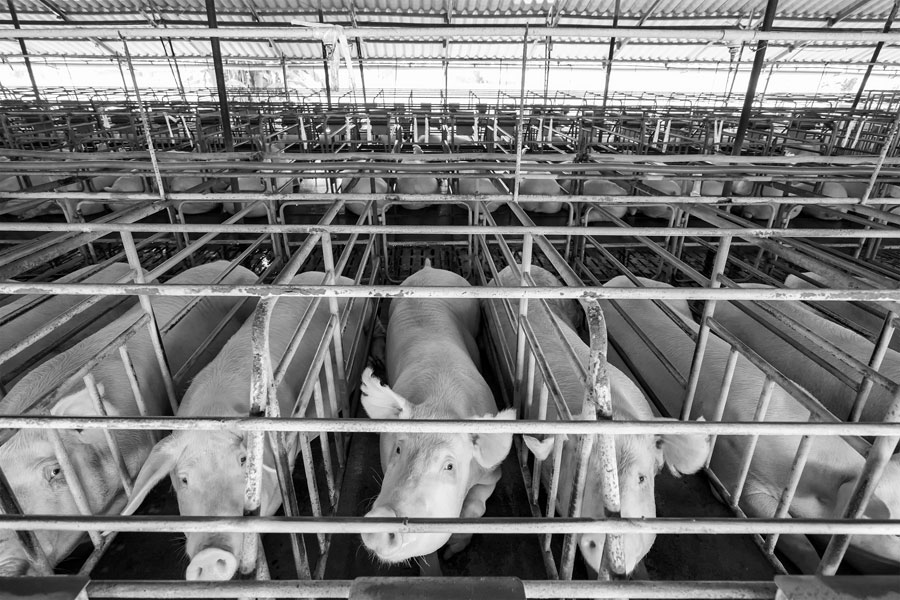
Starsky wandered into the aisle in a sort of daze. Dozens of penned pigs lined the concrete pathway, each confined to a cage of bars not much bigger than the animal herself. He was able to abandon his disgust of the odor for his disgust of the visual and audible shock to his senses. Every pig lifted her head as he approached, some struggled to their feet, others stared blankly into a realm beyond the physical. But the one thing Starsky couldn’t escape was the eye contact some of the pigs made with him—direct eye contact, eye-to-eye contact, very much the way a human being might make under similar circumstances: with an expression of fear mixed with caution and blended with … hope for escape?
Was he reading too much in their eyes? If they were dogs, he would think not, but he didn’t know anything about pigs—except that certain cuts of meat were made from them, and that they could scream like that when fatally struck by a car.
“What’s the purpose of this?” he asked Hutch when he felt his partner stop beside him. “I mean, why put them in cages like this?” He didn’t expect Hutch to have the answer, but Hutch did read a lot, so maybe he could fill in enough information to make sense of what appeared senseless to Starsky.
Hutch was able to speak in a relatively level voice because the pigs weren’t producing a near-deafening sound—probably because the humans in the room moved slowly, didn’t approach, and had never harmed them. “The more animals you cram into a limited space, the cheaper the overhead,” Hutch said.
“But why not just cram them in here loose to move around?” Starsky wondered.
“They’d eat each other alive, I guess.” Reluctantly, Hutch added, “I don’t really know. I suppose it’s easier to breed them this way, too, to keep track of each one.”
As he resumed his surreal walk through the warehouse, and only from a quick glance at the pigs caged to the left of him, did Starsky notice they were all females: the tulip shapes of their small vulvas under curly tails was the evidence.
“Maybe they just turn the girls loose in here with a boy at the time,” Starsky assumed out loud.
“I bet they don’t,” Hutch replied. “All of this ‘inventory’ has to be logged somehow. They have to know the details of every pig—and that begins by tracking every sperm.”
“So maybe they turn the boy loose in here with them at the time.”
A kind of rape rack, he thought.
“It’s probably done artificially,” Hutch imagined.
That supposition made yet another image come to Starsky’s mind—one of grown men inserting tubes of boar semen into restrained vaginas—triggering an even different shudder through him. He’d never forget the forcible violations he’d endured the previous year and the forever mark they’d left on him. Maybe pigs weren’t artificially inseminated; maybe they didn’t care if they were. Maybe they did care. Maybe they weren’t forcibly bred by boars, either. It wouldn’t matter either way; humans would do whatever humans wanted to do, he silently lamented. They housed these animals in coffin-sized cages and against their wills, after all. Weren’t pigs at least supposed to lie around in mud?
As they slowly walked, Starsky also noticed the open sores on many of the animals; those on the right side of the aisle showed scrapes and welts on their shoulders, faces, ears—from the rough metal cages, or bites from neighboring pigs?—and those on the left were pockmarked by open, and often oozing, sores on their hocks and feet, caked in dried feces.
The concrete floor had recently been hosed; it was still wet in places and water pooled in lower-lying areas. Most of the pig shit had been removed in the process, though a great deal of it still piled at the back of the cages, too; it was probably an endless stream of shit. Some pigs lay in it. Some pigs lay in mounds of it, apparently loose stools that covered their hind legs and buttocks. But no food or water was visible in the troughs at the front of each cage, no pig was eating, sans the gnawing on the cold, metal bars.
Starsky paused again, about two-thirds down the aisle, and lifted his gaze to scan the enormous room. Rows and rows of pigs, just like the ones he stood among, filled in the picture. All he could see were their long, pink backs, with an occasional pig standing up on the bars of her cage for a look back at him. “How long they have to be like this?” he asked Hutch, who again had stopped beside him.
“Three … four … sometimes five years.”
Starsky angrily made eye contact with him. “The hell you say,” he growled. He didn’t want to be patronized, not at a time like that one—when all his senses were on fire with an underlying disgust and rage. “Don’t make fun.”
“Three … four … five years,” Hutch repeated, sounding as sincere as he apparently intended. “These are the breeding stock; they’re either about to be impregnated or they’re already pregnant. Then, when she’s useless after so many litters of piglets…”
Starsky knew the ending to that sentence and appreciated that Hutch didn’t make him visualize it with descriptive words. And then he inadvertently locked eyes with a pig in his direct line of sight. She stood motionless; just her eyes turned upward and stared into his. He could see the white that outlined them, the iris and the pupil, the worried uptick in her brow. “Do you think she knows?” he wondered aloud. Hutch probably didn’t have an answer; did anyone?
“If you need context,” Hutch replied, stepping closer to Starsky, “here’s the one I use: plant life is life that lives, animal life is life that knows, human life is life that knows that it knows.”
So, by that standard, these pigs knew?
“They at least know the devil resembles a human being,” Hutch imagined.
Starsky knelt on one knee to get closer to the animal directly in front of him. Her eyes followed his eyes; they never broke contact. In some way, her eyes were almost human, more than a dog’s appeared to be. Why? He couldn’t say: shape, size, color? The way they seemed to recognize his eyes, as if they knew they connected with the soul of another creature? “I’m sorry,” he said impulsively. “I didn’t know.”
He didn’t know pigs were raised in closed confinement on concrete floors for years at a time in cages so small they couldn’t lie down naturally or turn around. He didn’t know they cried like that when they were hurt or dying. He didn’t know they had human eyes. Or that they knew anything.
The pig sat back on her haunches then, slumped back, sort of fell onto them, as if to collapse under her own weight—or the weight of his empathy—and then she opened her mouth and uttered a lengthy wailing cry from the depths of her pig soul.
The sob of that desperate animal would haunt him for a lifetime.
* * *
“I know that stink,” Starsky said with a cough when they left the building and wandered over to the adjacent large barn. “That’s the smell of something dead.”
Hutch knew it, too.
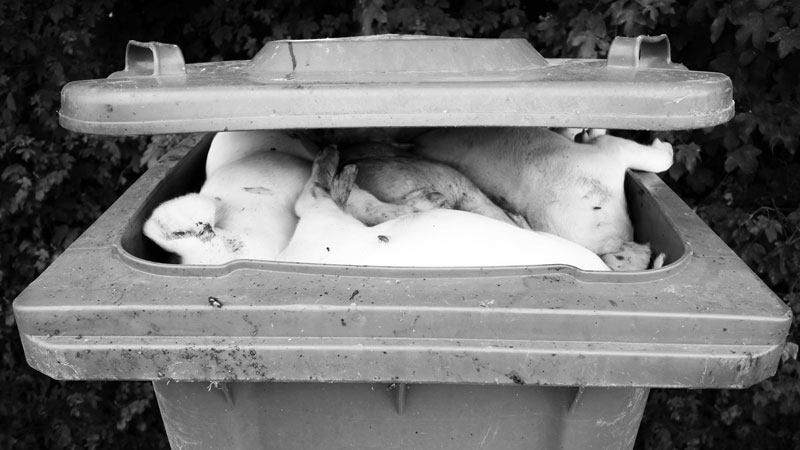
They found half a dozen dumpsters in the alleyway between the warehouses. Starsky opened the lid on one of them, out of curiosity, and found it full of pig carcasses, mainly of young pigs, piglets mostly, recently born and discarded. He dropped the lid out of disgust and left the area, but not before they discovered the more than dozen larger dead pigs piled in heaps behind the dumpsters, putrefying in the sun, covered in flies and maggots.
That’s appetizing, Hutch dryly thought, as he followed Starsky into the next barn.
No discussion was required in the new discovery: rows of pigs in cages, same as the previous barn, but these had adjoining stall space that confined each pig’s set of piglets beside her. In another environment, the baby pigs might be considered cute and cuddly, but there wasn’t a warm and fuzzy feeling in the warehouse. Like the other barn they’d visited, this one merely contained piglets with their mothers—but the mothers were still confined to cages no larger than their bodies. The attached piglet area at least enabled her to lie down on her side, with her legs protruding under the bars, to nurse her young.
The same flies, abscesses, hock sores, lacerations, ear bites, runny stools, and the same guttural sounds and imposing stench, permeated the building. None of these pigs were eating, except the babies on their mothers’ teats. Most of the adult pigs were lying down, some were sitting, but the babies who weren’t sleeping were nursing.
The cops didn’t find a single human being in that barn, either.
The remaining two warehouses were just as packed with pigs as the previous one, except these were apparently filled with the weaned piglets being fattened for slaughter. They were housed in sizable cages, row after row of them, some three dozen pigs to a block. Cages with older pigs held fewer animals. And, at the back of the building, Starsky and Hutch discovered walled cement pens that housed boars for breeding. Some of those stalls were empty of pigs entirely, some held a solitary pig, another several. It wasn’t apparent where the boar they’d killed on the road had been confined. Perhaps he’d escaped being loaded onto a transport trailer bound for the packing plant.
“I wonder about this, Hutch,” Starsky said, and perhaps he said it to appease his guilt, but it did have merit. “Suppose that pig we killed fell off the back of a livestock truck? I mean, maybe his legs were already broken. Is that possible?”
Hutch affectionately squeezed Starsky’s arm. “Makes more sense than he got out of this place on his own and wandered down the road.” His comment seemed to ease the still-pained expression on Starsky’s face. “These animals look like they can barely carry their own weight, let alone walk half a mile. I’d bet anything your hunch is right.”
They made their way to the front of the barn, passing the caged blocks of piglets along the way. Many of the younger pigs hurried toward them, some climbing up on the bars to get closer to the men as they approached.
“Do you think they want to bite us?” Starsky asked.
“I think they’re just curious—like all babies are,” Hutch said. He hadn’t heard or read anything about piglet bites, but he didn’t know pigs, either. As Starsky crossed the aisle to greet some of the animals, Hutch stopped to watch, fearing he’d accidentally set his partner up from his assumption that piglets didn’t bite.
While they sniffed Starsky’s hand, Starsky pet them, too—or mostly tried to, because they were as curious about him as he was wanting to touch them. “They’re so pink,” he noted, as if to himself. “And look at them little hoofs.” He bent over and picked up a relatively young piglet, stroking its hooves and marveling at their shapes and texture. The piglet grunted and struggled in his arms for half a minute until Starsky held him close. “Do you see this?” he asked. He turned to show the baby pig to Hutch. “Cute little tiny feet.”
They were a far cry from the sizable hooves on the boar they’d dragged off the asphalt. No doubt Starsky wanted to remember the baby feet and not the animal he’d killed. “They’re adorable,” Hutch said, certain that Starsky was more adorable in that moment.
“How old do you think this little guy is?”
“A month, maybe?” Hutch replied, guessing. “How do you know he’s male?”
“I noticed the … um … peenie protrusion under his belly.”
“I see.”
“He’s so smooth.”
Hutch watched Starsky stroke the piglet’s soft, translucent hair with a gentle hand. Did pigs have hair? Or was it fur? He couldn’t remember. So much neither of them knew about pigs. Or cows or chickens or any of the other animals they once ate. But playing with pigs hadn’t been their mission, either. They needed to find the owner or a caretaker of the farm to confess to hitting and killing the boar—and nobody seemed to be around. By then someone should have noticed their white-striped car out front. But no one did.
Once in the sunlight again, Hutch stood beside Starsky to take another long look around the place. It was as empty of human life as it had been since the moment they arrived. Were he and Starsky gullible by nature, they might think the entire human race had been plucked off the planet. Maybe they had entered a nightmarish time-warp of some kind when they slammed into the pig on the road.
“They must come out to clean and feed in the morning,” Hutch decided, “and then leave until the next feeding—whenever that might be. But you’d think somebody’d be here to watch over the place. We’ve always got some chore or another on our little farm; this shit-hole’s got to need attention every day, all day, don’t you think?”
He noticed the dumpsters across the turnaround, one so full of dead pigs, its lid couldn’t close all the way, leaving him to wonder when the trash collection was scheduled. The farm hadn’t been abandoned, he didn’t think. “We’ll check back later today,” he suggested, heading for the car.
“Good plan,” Starsky said, walking beside him, then following him to the passenger side of the vehicle. “You drive.”
“I drive?” Hutch asked. It was too bad Starsky was so rattled by the accident earlier that he didn’t even want to drive the car he’d only been reunited with for less than two hours. But when Hutch made the split to head for the driver’s seat, he understood why.
“Put that thing back,” he ordered when he spied the piglet still clutched in Starsky’s arms. “What the hell are you doing?”
“They won’t miss one,” Starsky insisted. He held the baby animal closer to his chest, as if Hutch would snatch it from him if he didn’t. “I mean, shit, did you see all them dead piggies in the trash? They won’t miss one.”
“Starsky, you don’t know anything about pigs.”
“I’ll learn.”
“Starsk.”
“You can’t stop me,” Starsky warned him. He got into the passenger seat of the Torino. At that point, the only way to stop him would be to drag him out of the car, kicking and screaming, and they both knew Hutch had no intention of taking his resistance that far.
Hutch wanted to laugh, but he was too concerned about getting caught to find the humor in it. Starsky’s action was impulsive, not thought-out, and was easy prey for a number of ramifications, ones Hutch couldn’t even list in such short notice. But he got into the car with Starsky all the same, and turned the ignition.
“I said I’ll learn how to take care of him,” Starsky promised. “You’ll see.”
“One could argue this is stealing,” Hutch said.
“One could argue it’s saving a life, too,” Starsky replied, “and that’s got to be worth something.” He was obviously anxious to leave the premises then. “Just go,” he said. “We’ll fight it out at home.”
Oh, the trouble Starsky got them into sometimes. Hutch backed the car, pausing only once to lay eyes on Starsky and his piglet, snugged tightly to Starsky’s chest, in both his arms, against his big heart, as if nothing, including Detective Ken Hutchinson, could make him part with the animal.
Hutch then hit the brake, shoved the gear into park, and—with the engine still running—got out of the car. “We forgot something,” he said, hurrying into the nearest warehouse. There was no point in having a criterion for choosing a piglet, except to scoop up the closest one from the cage block from which he’d seen Starsky grab a baby pig. The animals would at least be relatively the same age, he figured, if not related. The piglet squealed and struggled in his arms all the way back to the car. “You’re an idiot,” he said, handing the pig to Starsky, and then continuing to back the car. “But you can’t just take one,” Hutch advised. “He’d be lonely.”
“I’m the idiot?” Starsky asked, laughing. He then mimicked a piglet grunt. “Takes one to know one.”
“I wasn’t talking to you,” Hutch informed him. “You’re obviously not the only idiot in the car.” He drove them forward to the county road. “If we meet anyone,” he strategized, “we’ll just say we found them in the driveway.”
Starsky kissed the bundle in his arms, first one pig and then the other, on top of their heads. “We’ll name one Davey,” he said affectionately, “and the other Kenny.”
“I guess that’s better than naming them Starsky and Hutch,” Hutch said. “I can’t believe we’re doing this.”
“Sure you can,” Starsky said with a laugh. “Two pigs adopt two pigs. What’s so weird about that?”
* * *
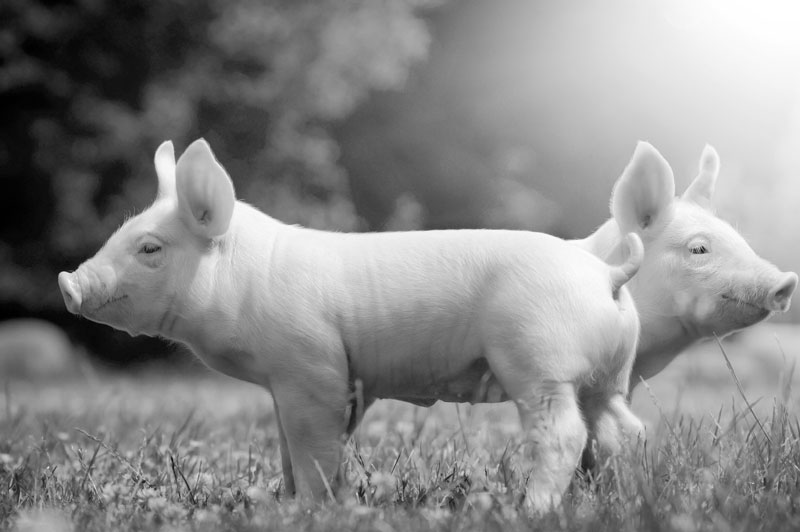
“My car took a beating,” Starsky complained. He slumped in a well-used patio chair beside Hutch and kept his eye on the piglets asleep inside their kennel. “The rear fender is dented; the front bumper, not so much.”
“It was a bad morning all around,” Hutch replied, himself sorry for Starsky’s trouble. He nursed a cooling beer and gazed over the property, using its greenery and peacefulness to ease the nightmare of their earlier ordeal. He’d done the right thing to kill the boar, but that didn’t make it any easier to do it. “Is the damage to the fender fixable by yourself?” He didn’t realize Starsky had examined the car because he must have done it on his numerous and solitary trips to the garage for various tools.
“No,” Starsky said in a subdued voice. “It’s going to need a professional.” He too, apparently, reflected over the past many hours. “But it wasn’t all bad, right, Hutch? I mean, I got my car back. And…”
Hutch followed Starsky’s line of sight to the pink baby pigs they’d snatched from the factory earlier that day. Hutch wanted to tell Starsky to be careful, to not get too fond of the young animals, but realized in that moment that it was already too late. Hutch believed they should prepare for the possibility that the production plant would come looking for their piglets—eventually. Inventory. Commodity bottom lines. Stuff like that. But Starsky needed the rescue, Hutch believed, to forgive himself from the unavoidable collision with the boar. He’d also need the escape from the disturbing memories he’d always have of a mortally wounded animal in the throes of dying, having helplessly watched the pig vainly thrash in his own blood on the rock-hard asphalt, desperately squealing, and obviously terrified.
Starsky looked over at him. “Right, Hutch? It wasn’t all a bad day.”
“Right,” Hutch told him. “The look on your face when you came in the house after finding the car in the driveway made up for today’s shit.”
Starsky sportively laughed at himself and reached for the beer, which Hutch willingly handed him. “Well, I guess everything’s got a price, Hutch,” he playfully pontificated under his breath before putting the bottle to his mouth. “My car getting dented was it.”
“That, and the lifelong commitment you’ve made to caring for a couple of pigs.”
“I couldn’t bear to leave them,” Starsky explained with a soft whine, “and there’s no way I’m going to put them back.”
As Hutch suspected he wouldn’t do, but didn’t comment, not even to ease what he sensed was Starsky’s unspoken but justifiable concern about the animals’ future. No doubt his partner was aware of the inevitable ramifications of their actions.
“Remember when you looked in the warehouse,” Starsky asked, “and saw all them pigs in the cages like that?”
“Yeah.”
“You said you’d only ever seen that in pictures.”
“True.”
“Where’d you see those kind of pictures?”
Hutch accepted the return of the beer bottle and drank from it before he answered. “A book,” he said. “‘Animal Factories.’ By a guy named…” he racked his brain to remember, as if Starsky cared to know it; there was a well-loved movie star by a similar name and that might interest him. “Mason,” he finally remembered. “James Mason. Jim. It’s on the shelf in there if you want to read it.”
“You can read it to me,” Starsky decided, sounding lazy and disinterested, except to wonder, “Is that the book that made you rethink all this stuff?”
“Stuff?”
“Eating healthy and all.”
“Yeah.”
“Where’d you find a book like that?”
“Found it in a bookstore, of all places, and read it while you were in the hospital recovering from…”
Well, they both knew Starsky had barely survived the shooting of ’79, so Hutch dropped it. “But I was on this do-no-harm track for years before that; so, yeah, it pushed me over the edge. The book isn’t just about pigs. It’s about all kinds of farm animals in factories and about the toll on our health—”
“Okay,” Starsky interrupted him, raising his hand to shut down the grim details. “I get it. But what you’re saying is that I’ve now got something to blame for your wayward lifestyle,” he snickered. “That’ll teach you to read.” He paused for more than a minute before he shared a serious reflection. “Really, though, I see why you didn’t want to be part of that kind of thing anymore. Neither do I. Do you think the corn we eat comes from farms as filthy and disgusting as that pig place?”
“I’m not sure I’d want to know,” Hutch replied with a sad laugh. “All the more reason we grow some of our own food, huh?”
“Maybe we can grow some for the pigs, too,” Starsky strategized, sounding excited about the prospect, despite his otherwise lazy demeanor. “We can all eat healthy.”
Hutch turned his head toward him when he felt Starsky’s eyes on him—and wasn’t disappointed. “You’re adorable,” he said, blowing his partner a kiss while they made eye contact. Starsky’s blue eyes sparkled in the afternoon light. He was relaxed, noticeably exhausted, maybe even passive, having broken a generous sweat during the construction of the pig pen, emotionally drained, and appearing disheveled, weak, and compromised—prime prey for a sexual advance he couldn’t deflect.
“You want to do more than throw kisses at me,” Starsky rightly assumed. “I can see it all over your face.”
“And feel the vibe in my privates?”
“I figured it was there, too. But I’m dead tired.”
“You look it.”
“I feel it.”
Starsky was more tired than Hutch because he’d experienced the euphoria of getting his car returned, followed by the abrupt and unexpected shame and guilt of hitting the boar in the middle of the road, the subsequent excitement and energy of rescuing the piglets, the unstoppable drive to purchase necessary supplies, and the physical muscle it took him to construct a dog kennel—with Hutch’s help, of course. Eventually, while Starsky bedded the pen with wood shavings and filled the water bowls, Hutch made them lunch, which they ate sitting in the grass beside their finished pig pen—and then Starsky prepared the pigs’ first meal after he housed his hapless charges in their new home.
Earlier that afternoon, they’d left the babies in Starsky’s garage with a bucket of water and several blankets to lie on—and gone off to the local feed store for supplies. The first thing Starsky put into the shopping cart was a booklet titled, “Raising Pigs for Fun and Profit,” which he asked Hutch to read aloud to him when they got back to their farm, maybe after dinner, he said—so that they both understood the kind of care their adoptees would require.
“We were going to rescue kids,” Hutch had ruefully reminded him.
“We’ll be finishing the construction at the Grace House by end of the month,” Starsky said, trying to defend their pig-stealing actions. “Our live-in supervisor moves in a week after that, and the first kids will be in that house not long after. We’ll do both: save kids and animals.”
All was true about the child plan, so Hutch didn’t further bait Starsky about the pigs. Instead, he dutifully followed him along each aisle at the feed store and agreed with him about needing every item Starsky wanted to buy, including a dog’s hairbrush and rubber toys. “We’ll need one of these,” Starsky said excitedly as he added a very large, round, heavyweight plastic feed bowl to the shopping cart; it was nearly twice the size of the animals themselves. He’d already tossed two smaller water bowls and two small feed bowls into his collection, as if the piglets would possessively dine from their own dishes, or that they wouldn’t share, but Hutch wasn’t about to debate him, for no other reason than he wouldn’t do anything to dampen Starsky’s joyful mood.
Obviously, they bought pig feed, as recommended by the store owner, and supplements, and they were given a briefing about how to care for the pigs from the check-out clerk after he rang up their book on pig raising, so they felt a wee bit more knowledgeable about what to do and how to do it than they had been even a half-hour earlier.
And, because they drove Hutch’s truck into town for supplies, there was also plenty of room in its bed for the items they purchased at the adjacent yard supply store: dog kennel panels, including a roof—as if pigs could fly—along with the largest dog house there was for sale, and the necessary hardware and tools they didn’t already have to assemble the temporary pen. As the pigs grew into adults, Starsky promised he would build a larger enclosure for the animals, but for then, a 10-foot by six-foot by six-foot-high cage would suffice.
The minute they got back to the farm, Starsky ran to the garage to make sure the pigs were safe, and then immediately went to work preparing a bowl of food for them, carefully following the instructions on the feed bag to make certain he got it exactly right. After the hungry piglets ate their fill and were asleep again on the soft blankets, he and Hutch began the task of assembling the dog kennel.
“I’m thinking we should put it here,” Starsky said after he drove the truck behind the house, backed it near the patio steps, and then stood beside Hutch on the grassy lawn. “This way, we can eat outside and watch them at the same time, you know? and they’re hidden from the driveway, too, right?”
“You be right,” Hutch affably agreed. He was also wordlessly tickled by Starsky’s enthusiasm. “We can decide another day where they’ll permanently live on the farm.”
Few words passed between them while they worked in relative and silent tandem to unload the truck bed. Hutch followed Starsky’s instructions without comment or protest, lifting and carrying the panels from the truck with him to wherever Starsky suggested they initially lay them on the ground, and then holding the panels in their upright positions so Starsky could bolt them together, agreeing that the door of the pen should open toward the patio for quicker access.
“But maybe we should put the dog house in first,” Hutch said, “because I don’t think it’ll fit through the kennel door otherwise.”
Starsky thought it a good idea, too, so they lifted it off the truck bed and placed it in the back left corner of the pig pen. Before they attached the door, Starsky finished the inside set-up with plastic toys and the single large water bowl he’d bought, and then he fit the latch to the right side of that panel. Hutch was simply so happy by his partner’s excitement that he didn’t even razz him about being left-handed after he noticed that Starsky had attached the latch to the door in reverse.
When Starsky no longer needed Hutch’s help, Hutch followed him to keep his man company. Starsky emptied a large bag of wood shavings onto the floor of the new pen and spread them evenly; he then uncoiled and dragged the water hose from the backyard faucet to fill one of the smaller bowls with fresh water, as well as the biggest bowl he’d purchased. A little wet himself, but not daunted, he drove the truck to its regular place in the driveway and parked it—and then he got his pigs from the Grace House garage, carrying one under each arm despite Hutch’s offer to take one himself. After Starsky gently placed the pig babies in their new home, he stood back to admire the completion of their unplanned project—with Hutch beside him, doing the same.
“Do you think coyotes can get in there?” Starsky asked after a minute of silent musing.
Hutch didn’t know, so again he guessed. “They might be able to dig under the panels,” he theorized. “But we could pile rocks around the perimeter to stop that, I think.”
Starsky looked at him like he was an idiot. “Where are we supposed to get rocks, numb nuts, hm?”
Hutch returned the dismayed expression as he replied, “From that rock pile,” and he pointed toward a mound of medium-sized stones at the back of the property. He’d dug them out of the ground when he first tilled the field for his vegetable garden a year earlier. “Where else would we get them, numb nuts, huh?”
Starsky rolled his eyes and, incoherently grumbling, hiked off to get a wheelbarrow. That’s when Hutch went into the house to make them lunch. By the time he brought the food to the backyard, Starsky had completed the task of piling the rocks around the perimeter of the pig pen—all by himself—and was more than ready to eat.
“How’d you know I wanted a peanut butter sandwich?”
“I saw the desire all over your face,” Hutch said. He didn’t realize his words would come back to haunt him when, sitting on the patio later and sharing that beer, he’d feel those sexual urges for Starsky. His desire for carnal pleasure had been all over his face.
Starsky had definitely done most of the physical work, though he’d have rather done it, Hutch knew, than make them lunch.
“Hey, Hutch?” he now asked.
“Yeah, buddy?”
“Do me a favor?”
“Name it, pal.”
“Give me a bath?”
Hutch had to momentarily study him to read the authenticity of that request. Those tired blue eyes did seem sincere. “A bath?”
“Yeah. The stink from that farm and all those dead ones … I just reek, you know? So do you, I bet. But I’m too damn tired to shower. Don’t think I can stand up that long, know what I mean?”
Hutch understood; Starsky was definitely wiped out, and in more ways than physically. “So, like in a bathtub kind of bath?”
“What other kind is there? We got one of those, don’t we? a bathtub?”
“In the guest bathroom.”
“Yeah, so, would ya, hm? Give me a bath?”
* * *
When the running water reached that perfect bite of hot, Hutch closed the drain so the tub would fill, and then busied himself collecting two large bath towels from the hallway linen closet, a medium-sized plastic bowl from the kitchen, and a shampoo bottle from the master shower, enabling the bathroom to fill with steam in his absence. He also collected an armful of candles, which were most of the ones Starsky had placed around their bedroom some two weeks earlier.
Hutch hadn’t bathed anyone before, least of all his partner, someone who not only wasn’t injured and in need of such care, but who was also a grown man—despite his naïvety. And, although Hutch had been the one to pull the trigger and release a bullet of mercy into the already fatally wounded boar, it was Starsky who’d emotionally taken the brunt of the kill.
“All that’s missing is a rubber ducky,” Hutch said under his breath about his bath preparation, laughing to himself. When he removed his shoes and socks, he noticed the odor of pig shit and death that saturated his own clothes, and couldn’t wait to clean himself up, too.
By the time he lit the candles—which he set around the bathroom on two separate counters and along the back rim of the bathtub—the water had nearly reached its desired level. But Starsky didn’t arrive on his own; Hutch had to wake him from where he dozed in his patio chair. “C’mon, little boy,” Hutch said. “Bath time.”
Starsky pushed off his seat and, with Hutch’s help, got to his feet. “That doesn’t sound like something a grown man oughta say,” Starsky grumbled.
“What doesn’t?”
“You calling me a little boy and then inviting me into a bath.” He followed Hutch into the house and down the hallway, shuffling his feet as he did, and sounding as drowsy as he appeared. “There are laws against that, you know—and for good reason.”
“Shut your mouth,” Hutch retaliated. “You know better than to accuse me of knowing better.” He opened the door to the bathroom and let Starsky pass before him into its ambient warmth.
“Oh, nice,” Starsky whispered when he entered, pausing briefly in the doorway to feast his eyes on the reflective glow of candlelight. “And I stand corrected. Anytime you want to call this little boy into a bath, you go right ahead and do it.”
Hutch nudged Starsky into the room with a push on his lower back. “Let’s get you undressed first and see how this goes. We may live to regret it.” After Starsky removed his shoes, Hutch turned off the tub faucet and helped him out of his clothes, unzipping Starsky’s jeans while Starsky unbuttoned his shirt.
“That place sure did stink,” Starsky disgustedly recalled. “Do you think they all smell bad?”
“Pigs?”
“Pig farms. That smell wasn’t just pigs. That was dead pigs, too. I almost threw up.”
Hutch didn’t want to remember the suffocating and pungent odor of the production plant, of its rotting and putrefying dead pig piles, especially as he lowered Starsky’s jeans to the floor and came face-to-face with Starsky’s flaccid penis and rounded sac. He’d much rather think about that familiar aroma, or feel its sexy heat, or taste its salty flesh. He’d much rather—
“You can kiss him if you want,” Starsky said, obviously sensing Hutch’s desire. Or maybe it was his own, too. “But he’s tired, just so you know going in.” That meant Starsky wasn’t planning—or feeling able—to summon an erection or, at least, an ejaculation.
But Hutch couldn’t help himself; he’d been invited, so he accepted. He gently cradled Starsky’s penis in his fingers and lightly kissed its tip. The warm touch certainly elicited his own arousal, and made him hungry for more. “Are you sure you can’t?”
“Well, I’d wash that thing first,” Starsky warned him.
“That ‘thing’ smells mighty fine,” Hutch countered him. “He was safe inside your jeans from all that stink.”
Hutch was about to steal another kiss, but instead abandoned the idea when Starsky removed his shirt while yawning. It wasn’t the reaction Hutch had hoped for. “Okay, let’s get you washed,” he said, standing. He gave Starsky’s left buttock an affectionate squeeze, pleased by the sensation of its firmness. “Step out.”
Starsky kicked off his jeans and bent over to remove his socks, holding onto Hutch’s arm for balance. While Hutch kept him steady, Starsky then turned toward the tub, and gingerly stepped in.
“Oh, that’s nice, too,” he said gratefully, lowering himself into the tub with Hutch’s help, and then letting him go. “Perfect. Too bad there’s no room for you.” Starsky meant what he said: the sincerity was in his voice. But soon he was immersed in the enveloping liquid and his whims were unavoidably drowned. “This is beautiful, Hutch,” he commented, splashing his face with water and soothingly rubbing his eyes.
No doubt, it was, Hutch imagined, sitting on the edge of the tub and feeling the heat rise off its shimmering surface. Nothing like hot water to ease the pain of sore muscles—and to aid an overdue escape from life’s trials. The bathroom’s amber glow pacified the emotional turmoil in both their lives, doubled in its reflective effect by the room’s large mirrors.
“I forgot music,” Hutch complained, but he was too invested in bathing Starsky to interrupt the bath to drag the radio into the room. He hummed instead, intermingling his soft thrum with a mishmash of lyrics from a couple of songs.
“You sing pretty, too,” Starsky said, closing his eyes, lying back in the tub, and resting his arms on both its rims. “Don’t stop—even though none of what you’re singing makes sense.”
“Give me your foot,” Hutch said, singing the words into a half-concocted song without breaking rhythm.
Starsky giggled and lifted his leg out of the water. “Here you go, buddy,” he said. “But no tickling, okay?”
Tickling Starsky hadn’t even entered Hutch’s mind. What he wanted to do—and what he did do—was massage Starsky’s foot, each of his toes and his ankle, the ball and its arch, lovingly and with a determined firmness. He watched the kneading mesmerize Starsky, make him sink lower in the tub, sigh heavily, and whimsically moan from the pleasure of its sensations.
“You’re going to feel so much better after this,” Hutch promised him. He lifted Starsky’s other foot into his lap and massaged it, too.
“I feel better already, Hutch,” Starsky swore. “You do me good, Blondie.”
Hutch gave Starsky a slow passing of time to simply bathe in the heat of his bath and to enjoy the foot massages. He immersed himself in the warming vibes of their unprecedented experience: to feast his eyes on Starsky’s full-length nudity, most of it underwater, wet and shimmering, while the rest of him reflected drops of amber candlelight. Those closed eyes and dark lashes, the hair plastered to his olive skin over his wide chest and flat belly, the still-strong shapes of his relaxed and muscled arms, his legs opened and resting against the sides of the tub, lazily exposing his haired groin, flaccid penis, and delicate sac, aroused all of Hutch’s senses. He continued to massage Starsky’s feet with his pleasure-giving fingers while he drank in the visual beauty of his man, from Starsky’s infectious captivation to his unspoken formidability. Could a woman be more beautiful in that instance? In any instance? Hutch immediately knew it wasn’t possible because, in that same moment of his silent questions, he realized he’d never trade Starsky for anyone. Not anyone. Or anything. Ever. That test had been passed.
“C’mon, sit up,” he eventually told his partner, nudging Starsky’s hip after he returned his foot to the hot water. “You’re about to fall asleep. Let’s not drown in there, okay?”
Starsky giggled again—and reluctantly sat up. “I guess that’d be a really shitty way to end the day,” he decided.
“You guess?” Hutch echoed with a laugh. He scooped water into the plastic bowl and gently poured it over Starsky’s head. “Is that too hot?” he asked, repeating his action when he got the negative reply. Hutch then squeezed a couple of dollops of shampoo into his hands, rubbed them together, and then vigorously lathered Starsky’s scalp with the soap.
“That feels good, too,” Starsky said dreamily, surrendering into the feel of Hutch’s massage so much that his head wobbled. “I’m going to be squeaky clean.”
“You will be if I can help it,” Hutch mumbled. He used the excess lather from Starsky’s hair to wash his back and hairy chest, gently scratching him as he covered him in cleanser. He scrubbed Starsky’s arms, from shoulders to armpits to fingers, using another generous squeeze from the shampoo bottle. Starsky was as lax as a rag doll beneath Hutch’s caring hands, so loose that Hutch accidentally dropped Starsky’s soapy arm when it slipped out of his grasp—and splashed them both in the face when it hit the water.
“Oops,” Starsky said with a light laugh.
“I’m clean now, too—in spots,” Hutch joked. He wiped the soap and water from his eyes with the back of his wrist, and then shampooed Starsky’s hands. “That’s your cue to wash your face.” He gave Starsky the task, figuring he’d only get soap in Starsky’s eyes otherwise, and couldn’t bear to risk it. When Starsky finished, Hutch poured a couple more bowls of water over him.
“Now stand up to finish you,” Hutch said. He helped Starsky to his feet after he unplugged the drain. Averting the shower head so the initial cold water wouldn’t hit Starsky, Hutch turned on the faucet, gave the water time to reheat, and then turned the nozzle toward his partner. While Hutch lathered Starsky’s legs, his buttocks, and his groin, Starsky rinsed the dirty soap from the rest of him, and let Hutch thoroughly bathe him from the waist down.
“I loved that foot part,” Starsky said. “That, and you singing. That was the best.”
Hutch gently soaped Starsky’s penis, noticing—with distinct self-titillation—how the water rolled over its meaty shaft and off its crowning tip, soap suds and all. Its very wet appearance gave Hutch a yearning erectile sensation of his own. “Clean enough to eat off,” he said, stroking Starsky’s penis when the urge got the better of him.
“Make sure you get all the parts,” Starsky replied. He rolled his hips forward so Hutch could wash his sac. “I had the feeling just then that you’re distracted.”
“Well, it is at eye level,” Hutch defended himself, dutifully lathering Starsky’s sac and perineum, gently and with care, when Starsky slightly opened his legs for access. “But you’re right: I did digress.”
“Whatever that means.”
“I got sidetracked,” Hutch admitted in the clarification. He rolled a soapy thumb around Starsky’s anus after he found the sought-after indentation. Then he used his fingers to make certain it was a thorough cleansing. He didn’t intend to penetrate Starsky, but Starsky’s relaxation, coupled with Hutch’s arousal, triggered the unconscious action.
“And now you just did it again,” Starsky said with a laugh when he apparently felt Hutch’s finger slide into him. “Don’t ever take a job as a washer,” he advised Hutch. “You’ll get yourself arrested.”
Hutch withdrew his finger to its tip, concentrating on the slippery glide, further aroused by his man’s suppleness, and then deeply penetrated him again. He couldn’t help but imagine his tongue or his penis inside Starsky; the desire was so palpable that his self-induced stimulation caused him to repeatedly thrust his finger into Starsky at will.
“Did you wash your hands?” Starsky asked. He didn’t pull or push Hutch away, but his words were obviously meant to slow his partner. Or stop him.
“I’ve had my hands in nothing but soap for the past half hour,” Hutch debated him. But he got the message and immediately abandoned his sexual solicitation. “Did I hurt you?”
“Nope. Not no how.”
“‘Quit it’ just the same though?”
Starsky didn’t answer with words. He finished rinsing himself, including his penis, sac, and anus, his legs and his feet, and then turned off the water before Hutch could beat him to it. “You can have your way with me in bed,” he finally said, drying his hair after Hutch handed him the bath towel.
“Hmm,” Hutch argued with a growl. “I get the feeling you’ll be asleep by the time I’m done with a shower.”
“So make it fast,” Starsky encouraged him, stepping out of the tub onto the dry bathroom rug. “And,” he further mumbled, “if I’m asleep when you get there…” He walked out of the room, fully naked, his butt cheeks still glistening, and only then finishing his sentence, “just have your way with me, big boy. I won’t mind.”
* * *
It was actually the irrepressible urge for sex that woke Hutch, having otherwise slept quite soundly throughout the night. But his need for an orgasm was followed immediately by his inability to satisfy that wanting desire: Starsky had apparently left the bed.
“Starsk?” he called into the room, rising to his elbows and hoping to hear the man’s locating reply from the bathroom—but none came. Were it not for Hutch’s disappointment and the gnawing hunger in his belly, he may have remained in bed for some time, drifting away on his laziness while he waited for Starsky’s return.
They’d gone to sleep rather early the evening before, having unintentionally skipped dinner after their late lunch outside. As expected, by the time Hutch finished his shower and joined his partner in the bedroom, Starsky was fast asleep; the hot bath had done him in. Hutch didn’t even attempt to wake him; he assumed they’d play when the day dawned, if not sometime during the night.
“Starsky?” he called again as he got off the bed and wandered into the hall.
It was empty, too.
Hutch could have dressed before he joined his partner in the kitchen for breakfast that morning; it wouldn’t have been the first time he arrived in it stark naked—and found Starsky there wearing just an apron. But Hutch didn’t smell food from the hallway, nor coffee, and not even when he entered that room. He did find Starsky, either.
Had Starsky gone off to have his car repaired?
Hutch’s silent question triggered his memory of the piglets they’d stolen, so he walked to the back door and peered through its window to satisfy his curiosity—immediately spying Starsky on the ground inside the chain-link pen in the wood chips. Hutch laughed with mild disbelief and returned to the bedroom to dress in jeans, shirt, and slip-on shoes. Combing his hair with his fingers, he joined Starsky at the pigpen—to discover that Starsky was actually asleep, lying on his side in the clean pine shavings in just a pair of shorts—and with two baby pigs tucked under his arm doing likewise. None of them woke when Hutch approached and stood beside the kennel to study them. Nor did they wake when he lightly laughed and again called Starsky, not the piglets, “adorable” under his breath.
“Who knew?” Hutch asked no one as he sat in the grass outside the pen, noticing both the shirt Starsky had obviously taken off and draped over the top of the dog house, and his camera lying safely outside the kennel door. Who knew Starsky could care that much about a couple of farmed animals? He’d apparently been busy that morning, shoveling the soiled bedding material into a wheelbarrow which still sat—filled with wood shavings, mud, and baby pig feces—inside the kennel. Starsky had also changed out the water from both the pigs’ drinking bowls, as well as their large swimming tub; he’d fed the piglets, no doubt, because the food dishes were licked clean; and he’d probably played with them before the three of them exhausted themselves and curled up together in the fresh bedding.
There they were: the perfect picture of man and beast. Starsky, naked from head to foot, except for his short denim shorts, with his bent left arm cushioning the side of his face, his eyes blissfully closed, and his just-audible respiration slow and steady, was peacefully curled into himself with two one-month-old pink piggies tucked under his other arm. The piglets snuggled into each other and into Starsky at his belly and haired chest—and all of it was quite the sight to see.
Hutch couldn’t help but to smile, both on his face and in his heart. He knew why he loved that man. He’d always known. The essence of David Starsky was right there on the surface, in that precious moment, in those specific ways, and some of it, sometimes much of it, having only recently made itself visible.
He and Starsky had been so opposite more than ten years earlier. True, Hutch himself hadn’t traveled nearly as far in all that time as he’d recently come; the beginnings of his personal evolution had been slowly brewing: dietary fasts and cleanses, fruit and green smoothies, lots of fresh fruit and salads, and surrounding himself with life-giving house plants. It was only in the most recent years that his broader awakening truly manifested itself. Chalk it up to the compounding culinary self-experiments he underwent, coupled with a news media hungry for the offbeat and trending, and for which he couldn’t read fast enough, or simply his inevitable trajectory, the ethical one he’d stumbled onto, the collision course with himself. He succumbed at the end of a long journey to the underlying wishes of his heart, not the teachings of his head—and was the better for it. Digesting animal flesh had been an unnoticed zap of his energy; purging meat from his life gave him a renewed zest for living, as well as a return to his young boy sex drive. That alone had been worth the so-called sacrifice.
But Starsky, overall, had come much farther than Hutch—and in a shorter time. That was due, in part, but most surely, to some of Hutch’s influence on him—a sort of belligerent wake-up-call seed-planting in Starsky’s brain that neither of them knew had taken root. Starsky had also come to live at a peace-making farm after he had to kill to stay alive amid the onslaughts of Tetepare’s hostile and wild environment. Didn’t Starsky tell Hutch he had to ‘smash’ little birds with his bare hands to survive while he waited for his rescue? Neither of them were comfortable with killing, even in self-defense, but to do harm because Starsky had to do harm was a rude awakening on a whole other level; of that, Hutch was sure.
Starsky had been a child of the city, of a certain hostile environment all its own. He’d lost his father at a young age so he had to grow up fast, forced into adult decisions just to outsmart and out-maneuver the mean streets. The last thing on his mind were animal lives, nature-gazing, the defense of the environment, or even the care of his own physical health—beyond the football field of his youth, or a gym, that is. He didn’t see a cow in person until several years after his move to California—when his aunt reluctantly dragged him to a friend’s farm despite his protests, and he was forced to come face-to-face with a real-life bovine. He ended up amazed by the animal’s friendliness and curiosity, by her soft sounds and affection, and by the liquid brown of her eyes—or so that was the story he told Hutch, and not with any ulterior motive or innuendo. But Starsky hadn’t been so enthralled by the gentle nature of cows that he stopped eating them. On the contrary. The rarer the steak, the better.
So to witness Starsky’s rather sudden change of heart, mind, and soul was, well, astounding. There he lay in a bed of wood shavings with two piglets in his embrace, so offended by what he’d seen the previous day that he couldn’t leave the premises without stealing the hapless animals, and as certain that he’d never eat one again. No small feat for a man who had only recently devoured bacon with relish. Starsky hadn’t grown up with any companion animal: no dogs, no cats, no fish or birds. What he knew about animals could be measured in an ounce glass. Maybe he had all the time on Tetepare to make connections to the natural world and his role in it that he wouldn’t have made otherwise, even with Hutch’s unwelcomed nudging. Maybe he had to picture in his mind’s eye what it meant to swallow the severed parts of a once-living animal and follow its digestion through his own gut into a toilet. Or maybe he just felt guilty about killing the boar—and any other animal who’d died for him, whether by his direct lethal power, as it was on Tetepare, or by his consumer purchases—and he sought a way to make amends for that underestimated and hidden violence. Whatever his reasons, there was no more precious a picture to Hutch in that moment than to see Starsky asleep with a couple of piglets tucked to his chest, and ones who obviously craved his affection, too.
Hutch lifted Starsky’s camera from the grass, popped off its lens cap, focused it on his sleeping partner through an opening in the chainlink, and snapped the first of several shots, assuming one of them would be a keeper. He then lowered to his back in the cool morning grass, shielded the blue light from his eyes with his arm, and drifted into a lazy and silent mesmerization of their lives and what had brought them to that moment in time.
Hutch should have known from the first day they met what lay ahead in their differences: he’d noticed even then just how much sugar Starsky had dumped into his coffee during their visit to the cafeteria. Hutch would spend the next decade chastising Starsky for his sweets addiction—lectures that never did any good. But he wanted to be able to tell Starsky—at the end of their lives—that he’d given it his best effort to keep his partner healthy, fearing Starsky would wind up a diabetic, or his teeth might rot out of his head, or he’d get fatter than the hippopotamus reference he’d once used in an argument with Hutch over their respective diet preferences. It was true that Hutch had never seen a skinny hippo, but there was no winning an argument with Starsky’s determined and flawed logic. As he did on many occasions, Hutch abandoned the debate.
From their differences in food and health, politics and religion, women and sex, to their acceptance and understanding of each other’s seemingly unchanging convictions and indelible characters, they’d come to a place of mutual respect, maybe despite, but probably because of them. In the end, however, it was Starsky who’d drawn closer to Hutch’s values than the reverse. He’d made the longer journey, crossed the wider chasm, grown the most and in more profound ways. From a boy of the streets to what now appeared to be a farm boy; well, that was an amazing change of heart by anyone’s standards. But it was no surprise. Hutch loved Starsky because Starsky was a reasonable man, because he was a curious spirit, one willing to learn and be impressed by what he learned, a man who was willing to alter his behavior and even his morality when faced with compelling evidence or argument. The proof was right there: in that pigpen, in the wood shavings, with baby pigs snug in his arms.
Hutch only stirred when he heard Starsky wake, but he didn’t open his eyes; he continued to drift along on his silent musings and the love and respect they instilled in him—all over again. “I love you” was never enough to say. “I’m awed by you.” “I’m privileged to know you, to be loved and respected by you.” Again, not the words that truly captured the swell of absolute fortune that Hutch experienced in his heart and in every other fiber of his soul whenever he gave a second’s thought to the essence of the man he’d give his life for.
“Hey,” he finally heard Starsky say, to get his attention.
“Hey,” Hutch said in hoarse reply, still not opening his eyes. Maybe Starsky had nothing further to add beyond his one-word greeting, so Hutch didn’t want to inconvenience himself were that the case.
“How long have you been out here?” Starsky asked, sounding refreshed and curious, though not alarmed.
“A few minutes, maybe,” Hutch said. Perhaps it had actually been a while, but he wasn’t certain; time had a way of passing slowly even when it didn’t. He imagined what Starsky must have seen: his partner lying in the grass outside the pig kennel, appearing to doze—and maybe for the hour or more Starsky had been asleep—to be beside him, near him, with him, even in silence. Maybe those were the more powerful ways they spoke to each other, through experiences no mere words could describe or explain.
“Did you take some pictures?” Starsky wondered, apparently spying the camera near Hutch.
“Of you,” Hutch said, “sleeping with your bacon.”
“Don’t make fun.”
“You know I love you.”
“Don’t make fun of them,” Starsky corrected him. “I don’t like talk like that anymore. It’s not funny.”
Hutch couldn’t help but drop his arm from his face, open his eyes, turn his head, and look over at Starsky. The epiphany had gone further than Hutch had earlier realized. “I’m sorry,” he said under his breath. “I won’t do it again.” He pushed himself into a seated position and locked eyes with his partner. “After what we saw yesterday,” he agreed, “it’s not funny.”
He noticed that Starsky sat cross-legged in the shavings—wood chips stuck in his hair—and scratched behind one of the piglet’s ears. The animal was immersed in obvious pleasure, sitting on his haunches in front of Starsky with his neck outstretched and his eyes closed. The other baby curled in Starsky’s lap the way a cat might, with one leg propped over Starsky’s knee. “Which one is Davey?” Hutch asked.
“This one,” Starsky said, breaking eye contact to draw Hutch’s attention to the piglet he scratched.
“Why him and not the other one?”
Hutch couldn’t tell the difference between the two pigs.
“The other guy is kinda shy,” Starsky said, sounding pleased with his decision about who got which name, “so that has to be Kenny, don’t you think?” He flashed Hutch a sheepish grin as he tapped the pig in his lap. “He’s not as trusting yet,” he added.
Hutch bit the inside of his cheek to keep from making a defensive comment. He believed they’d gotten past his insecurities, quite recently, in fact, so Starsky simply baited him. “He’ll warm up,” Hutch said instead. It did as intended and forced a sincere smile out of Starsky. “Besides, he’s in good hands,” Hutch decided. It ended Starsky’s baitful play.
“You shoulda seen them this morning,” Starsky said, giggling. “First, they were really hungry, so I fed them the feed, you know? But I also gave them some apples and an old banana. It was like candy to them; they ate them up like they were starving—and they’d just eaten. They were all over me after that, too.” He laughed at his memory. “Then they took a swim in the tub while I shoveled the shit out of the pen, and when I was done and put the fresh wood in, they jumped around in it like it was snow!”
Hutch was, yet again, not certain which was more precious: Starsky’s excitement or the everyday behavior of baby pigs. Maybe Starsky. He had a wide, tooth-filled smile on his face and his eyes sparkled as if he’d just discovered gold in the backyard. Hutch could have told him that animals, any and all animals, have personalities—dreams, feelings, affections, preferences, fears, and more—but he’d rather Starsky discovered them on his own. Apparently he was well on the way.
“And look at these little hoofs!” he said, stroking Kenny’s cloven hoof and rolling the halves in his fingers. It was the second time he’d noticed baby pig feet. “Miniature toes,” he said laughing. “I can’t believe they walk around on these things.”
“It’s hooves,” Hutch informed him.
“Hoofs,” Starsky insisted, still visually engrossed in the tiny foot in his hand.
“Hooves,” Hutch said again. He stretched his legs out before him, propped back on his hands, and settled into enjoying the show.
“Hoof is one,” Starsky explained, making eye contact with Hutch as if that would force Hutch to see it his way, “and two hoofs is hoofs. Four is also hoofs,” he added with a laugh. “Pigs have four hoofs.”
“You’re sure about that, huh?”
“Well, you tell me, smart mouth. If you got a chicken and it lays an egg, what is that?”
“A hen.”
“The egg, I mean, numb nuts.”
“An egg.”
“Right. But if you put a bunch of those in a carton, you got, what?”
Hutch didn’t dare give Starsky the answer he sought because he didn’t want Starsky to win the argument. “A week’s worth of omelettes,” he said.
“Right,” Starsky pointed out to him, “eggs. And one egg is an egg. Two or more of an egg is eggs. Same with a hoof. One is a hoof. More than one is hoofs. I thought you knew that.”
Maybe, Hutch imagined. He couldn’t remember if both versions of the hoof plurality were correct, but he was done with the debate, especially after his stomach growled and reminded him of his hunger, the one in his belly and the one in his groin. “Hey,” he said ruefully, “seems I missed out on my sex last night.”
Starsky abruptly looked at him.
“I said,” Hutch repeated, “I missed my—”
“Yeah, I heard you. So you didn’t use me last night?”
“You were asleep.”
“Well, I know that, dummy. But I gave you a green light to take what you needed even if I was out.”
“It’s not my style,” Hutch argued.
“Yeah,” Starsky agreed in a softer voice. “It isn’t mine, either.”
“Oh, and by the way…”
“Yeah?” Starsky asked.
“I missed out on my sex this morning, too.”
“It’s still morning,” Starsky replied with a raise of his eyebrows. “We can go in now, if you want.”
It would probably never cease to amaze Hutch how easily sex came for him ever since he succumbed to his desires for the person he loved most. All he had to do, really, was wish for sex, and it could be his. “I need food,” Hutch admitted, his need for sustenance outweighing his need for carnal pleasures, “so what say we go to town and get us some breakfast first?”
Starsky gently lifted Kenny from his lap and set him delicately in the wood shavings beside Davey. He knocked the wood shavings off his shorts and where it clung to his legs and arms after he stood, then made his way to the kennel door—with the piglets following. “Oh, no,” he said when he noticed them at his feet as he attempted to leave the enclosure, “you guys have to stay here where it’s safe.” He nudged them away, first with his bare foot and then with his hands. When that failed to work, he straightened and looked over at Hutch. “Would you help me, please?” he begged, slightly annoyed. “I’ll hold them back and you take out the wheelbarrow, okay? Make sure they don’t get loose.”
Hutch believed the piggies would follow Starsky no matter where he went, enclosed or otherwise, but he didn’t want to scare Starsky should that supposition fail to materialize, so he obeyed the instructions instead. When Hutch got to the pen door, and before he lifted the latch, he noticed the small and uneven wooden board that hung from its top bar. On it were words in white paint.
Two Pigs Sanktuary, they read.
“‘Sanctuary’s spelled with a C,” Hutch said, entering the pigpen and poking Starsky in the belly to admonish him. “I thought you knew that,” he mocked Starsky’s earlier words.
“It’s with a K around here,” Starsky replied defensively, “so get used to it, pal. Get used to things being different from now on. We’re no longer prisoners of the mainstream.”
“That’s some getting used to I can get used to,” Hutch admitted.
* * *
“Do you want that with a side of bacon?” the waitress asked. She stood at the ready to write down the addition to Starsky’s order, but all she heard was a snarl.
“I don’t eat pigs anymore,” Starsky said, hoping he sounded as annoyed as he felt, so there’d be no follow up questions. And when did a bowl of soup and some crackers come with a side of bacon?
“No?” she wondered, glancing at Hutch, it seemed, to better read Starsky’s sincerity. “You gave up bacon?”
“Permanent-like,” Starsky replied, giving the menu his attention again, though he’d already told her his choices. His fault. He’d eaten enough bacon at that restaurant—and she knew it—to justify her question. “You know, pigs are a lot smarter than you think.” He looked sharply at her to back up his conviction. “They shouldn’t be raised like they are, either, in cages like that.”
Hutch kicked him under the table and made Starsky realize he’d shared information that could prove to backfire on him. “Well, anyway,” Starsky said to cover for it, “don’t ever ask me again if I want a side of anything made out of an animal, okay?”
“Okay,” she whispered under her breath. “I won’t forget. And you, sir?” she asked Hutch, seeming to hope for a better demeanor in the blond. “Do you know what you want for breakfast?”
“Same as he’s having,” Hutch said, passing his partner a gentle smile before he sipped coffee from his cup.
The waitress took their menus and left the table for the kitchen.
“You have to be more careful,” Hutch warned him. “We don’t want anyone connecting the dots.”
“Yeah, I know my mistake,” Starsky admitted, silently cussing at himself. The last thing he wanted was to put anyone on their trail, if there was even a trail to follow, and end up losing his babies, least of all to a slaughterhouse. “Maybe we should get a few more animals—like a cow and some chickens or something—and make people think we’re just an animal farm, so naturally we’d have a couple of pigs.”
“And ruin a perfectly good name like Two Pigs Sank-tuary?” Hutch said with a wink.
“We could keep the name,” Starsky argued. “Nobody has to know better.” He noticed Hutch biting his lip. “What’d I say?”
“Nothing,” Hutch said.
“Probably something,” Starsky decided, looking out the window to the street. He didn’t care about the reason Hutch seemed amused; it didn’t matter. Whatever it was, it wasn’t anything new. Hutch relished making fun of Starsky’s citified language—or maybe it was his lack of education. Either way, it was insulting. Or maybe Hutch just thought Starsky was—what was Hutch’s earlier word?—“adorable.” When he glanced back at Hutch, his partner kissed the air at him. Starsky should have known Hutch had been affectionate with him, not antagonizing; for some reason, Starsky felt overly sensitive that morning. “Back at ya,” he said to Hutch’s kiss, “but with some tongue.”
“I’m in a delicate place right now,” Hutch playfully confessed. He did look ‘delicate’: sort of malleable and submissive, unshaven, his hair appearing as if he’d used his fingers for a comb, and dressed in a flannel shirt, unbuttoned to mid-chest; his willingness to surrender to anything Starsky asked for was apparent in his compelling blue eyes and hinting in his soft voice. “I missed my refuels is all,” Hutch added. “Maybe we’re both a little on edge because of it.”
It was Starsky’s fault they’d missed both their nighttime and morning sex rituals. “When we get home,” he promised. “You’ll see.”
“I don’t doubt it for a second.”
The waitress interrupted them to report from the kitchen that the soup they ordered contained chicken broth and did they still want it? When Starsky simply gave her an unwavering glare, she asked if she could replace it with some other item.
“Do you have black bean soup?” Hutch asked with a smile.
“Without the chicken?” Starsky injected.
She said she’d ask the kitchen and bring them something comparable if it didn’t contain animal broth or parts.
“Boy, the things you don’t think about when you don’t have to think about them,” Starsky complained after he drank some of his cooling coffee. “All those times I was eating soup … maybe it had that other stuff in it.”
“It probably did.”
“It doesn’t leave much to eat here, does it?”
“There’s something like eight types of meat,” Hutch said, “but about twenty thousand different vegetables, fruits, and grains … so you do the math. In the meantime, we should expect our restaurant meals to be more restricted. going to have to grow more of our own stuff.”
“Yeah, I guess so,” Starsky replied, disappointed. On the other hand, it might help him to feel better, too. He could grow things for themselves and for his piglets, as well. That might prove to be fun. So off he rode on a daydream wherein he was in a vegetable garden rooting around in the dirt for carrots and turnips and potatoes with his pig buddies doing likewise beside him.
“Remember when you were going to raise chinchillas?” he heard Hutch say, breaking into his otherwise pleasant thoughts. When he looked over at Hutch, he saw his partner’s chagrined grin, and heard the inevitable follow up questions. “What was her name? Loretta?”
“Louise,” Starsky said. He felt the shame wash over him.
“That’s right. Louise. You were going to breed her and sell her babies’ skins. Wasn’t that the plan?”
Starsky didn’t comment. He’d been an idiot. Louise turned out to be a guinea pig, anyway.
“How did you plan to kill those chinchillas?” Hutch wondered, obviously trying to sound innocent in his question, but Starsky knew better. “Were you going to ring their necks with your bare hands? Shove steel rods up their asses to electrocute them? Drown them in—”
“Stop it,” Starsky angrily interrupted him. “C’mon. I wasn’t thinking back then. And is that really how they kill those kinds of animals?”
“Among other ways.”
“Well, shit. Look, I didn’t think beyond the idea of the money-making part of my plan—and I didn’t even do that right.”
“That goes without saying—or you’d have known you’d be raising unsalable fur coats.”
“Like I said a minute ago: all the things you don’t think about when you don’t have to think about them. I didn’t think about how I’d have to kill them. You know what else? It didn’t even dawn on me that they’d have to die. I didn’t go that far with my thoughts.”
“The Starsky I know wouldn’t have gotten that far, anyway,” Hutch said. “Watching you fuss over that guinea pig that morning told me all I needed to know then.”
“Yeah.”
“It’s a bitch to see what you’re taught not to see, isn’t it?”
“And you can’t unsee it, either.”
“Look at all we’ve had to deal with in our lives,” Hutch continued. “Drug dealers, murderers, rapists, child abusers. Sure, everybody knows those kinds of scum are out there, but they don’t see them up-close-and-personal the way we do. We’ve spent our careers seeing what most people never think about, let alone see—and now we’ve got this other unseeable thing added to the list.”
“Yeah, but in this case, we were part of the animal cruelty all these years—and me more than you.”
“It’s a brainwash,” Hutch explained, obviously trying to comfort his partner, but not succeeding. “From the time we’re born: ‘here, play with this teddy bear’—or some other stuffed animal, like a pig or a goat or whatever. ‘Now, eat this. We’ll call it bologna or beef and—’”
“What is bologna? I mean, I remember telling you about the shit they put in hot dogs, but I never thought of it as an animal; just that it was gross. But now I see that stuff as…”
“Well, I think bologna is … pig, but don’t quote me. I didn’t eat it even before I didn’t eat it.”
Starsky frowned with disgust and twirled his coffee mug on the table in a failed effort to purge it. Bologna was made from pigs, pigs just like his pigs? How’d that get past him? And, if it wasn’t pig, what was it—and how did that get past him, too?
“And then,” Hutch continued, “by the time you start asking those questions: ‘What’s beef?’ ‘What’s bacon?’ ‘What’s whatever?’—it’s too late. You’ve done the damage and the damage has been done to you. Now try breaking free of it, and you’ll see just how ingrained it is in our society and how tough it is to rise above it. Hell, even your own partner can be on your case when you’re trying to set things right for yourself.”
Starsky realized Hutch had just referenced all the times Starsky had teased him about his evolving lifestyle into the country boy Hutch had been born to live. “Are you going to keep throwing punches at me—and society—all throughout breakfast,” Starsky countered him, feeling demoralized and punished all at once, “or do you think we could talk about something more uplifting? How about, you know, we talk about … stopping by the hardware store on the way home and getting ourselves a lock and chain for the kennel door?”
“Seems we just now talked about it. What’s our next topic of conversation?”
“Well, let’s see,” Starsky mulled, forcing himself to cheer up because Hutch had followed his wishes. “We’ve discussed food, sex, animals, and hardware so far.”
“An interesting combination,” Hutch observed—and made them both laugh. “But I’ve said enough today,” Hutch added, “so I’ll leave it to you to steer this dialogue.”
“Not only that, but you’re preaching to the choir. You should love me more for seeing things your way, not beat me up over all the times I didn’t.”
“I didn’t realize I was taking shots.”
“Maybe you weren’t,” Starsky mumbled, gazing out the window again to avoid what was probably the truth. “Maybe I just feel guilty about my past involvement and that I should have known better long ago and so now everything you say is pouring salt on that wound and I’m deserving it anyway.”
“So this wouldn’t be the time to pick apart your run-on sentence?”
“About that: stop with the grammar checks.”
Starsky noticed Hutch’s silence after half a minute and shifted his eyes over in time to see Hutch’s pressed lips and that look of apologetic surprise in his expression. He’d apparently—and inadvertently—thrown a punch at Hutch. “Okay, never mind that last part,” Starsky said, forgiving him. “I know you tease me because you love me.”
“More than life itself,” Hutch said. “Oh, and one more thing while we’re on the subject, buddy.”
“Starsky was wordlessly pleased by Hutch’s verbal affection and showed it on his face with a smile—because he simply couldn’t help himself. “Yeah? What’s that?”
“It doesn’t get past me how much you’ve grown from Day One.”
* * *
“Where are you going?” Hutch asked when Starsky quickly left the car as soon as they returned to the farm and headed toward the side of the house instead of the porch. “I thought we had plans.”
“We do,” Starsky replied as he disappeared around a bush. “I’ll just be a minute!” he yelled, from out of sight.
Their plans would begin, apparently, after Starsky checked on his piglets—and probably to chain and padlock the kennel door to its neighboring panel. Hutch had never felt like Second Place when Grace lived on the farm; funny how he’d been upstaged by a couple of baby porcines. Or was ‘porcine’ itself plural? Like swine. Swines? He mulled the concepts as he ascended the steps, crossed the porch, and entered the house.
Then he stood, at first patiently, in the living room, with his eye on the back door, waiting for his partner to appear. He’d give him two minutes. How long did it take to wrap a chain around the panel posts and lock it to itself? Probably not long—unless Starsky stopped to play with Kenny and Davey, as he most probably did. The reminder of the pigs’ names made Hutch inwardly laugh. He left his now-impatient position, the one with a direct line of sight to the patio door, and went into the kitchen instead—to retrieve a cold beer from a shelf in the refrigerator. He may as well satisfy one of his desires and cool the other.
How Hutch came to his graver thoughts, he couldn’t have guessed, even if he rewound his mind from start to finish. But there they were: the sudden memories of how he wept in Davis’ lap on the hard tile, having just learned of Starsky’s horrific death in an airliner crash some seven thousand miles from home. Hutch leaned his butt to the counter and gazed unseeing at the floor, replaying that particular moment in a sort of incoherent jumble of thoughts and flashes of disturbing mental pictures. Maybe he’d come to them that late morning so soon after breakfast because he’d been dismissed, at least temporarily, by the man in whose lap he really wanted to be in just then, but instead was abandoned in preference for—
He heard the back door open and close, interrupting and stopping his grim thoughts in their tracks, and Starsky’s footsteps come down the hall. They hesitated, presumably, outside the master bedroom door, and then Starsky called for him.
“Huuttcchh!”
“In here,” Hutch said in a raised voice. He didn’t move off the counter because he didn’t have the motivation in that moment; why make a new effort for sex when all his others had failed that morning?
When Starsky entered the kitchen, he undoubtedly found Hutch appearing dejected and melancholic; only a few minutes earlier, he’d been outwardly excited and anticipating. “What’s the matter with you?” Starsky asked on his approach. When he got close enough, he took the beer bottle out of Hutch’s hand and drank a swallow from it, not leaving eye contact with him. “Are you mad at me?”
“No.”
“Did I take too long?”
“Maybe.”
“Are you feeling jealous of my new buddies?”
“Not jealous,” Hutch admitted. He was, underneath it all, very impressed and pleased to see Starsky care so much about something other than wayward human beings—and his car. “But maybe a little less loved,” he reluctantly confessed. Even that sounded more than he really felt. “Disappointed.” That was a much better word.
“Disappointed because I took too long?”
What was it really? Hutch wondered to himself. What, beneath the negative images he’d played in his mind before he was interrupted, caused his self-pity? He gazed into those sultry blue eyes as they looked questioningly at him, and he noticed the curls of hair that peeked over the collar of Starsky’s blue sweater, and he felt Starsky’s warmth near him, and his presence, his aliveness, and his masculinity. And then those thoughts led to Hutch’s truer feelings. “I’m disappointed,” he explained, “because I haven’t been laid since yesterday morning.”
It broke them both into light laughter.
“Well, c’mon, then,” Starsky said, grabbing Hutch by his elbow and pulling him away from the counter. “Let’s make sure you can’t say anything remotely like that tomorrow.”
Hutch followed Starsky out of the kitchen and down the hall to their bedroom, but when he entered the room and headed for the bed itself, Starsky veered off to the master bathroom. “Where the hell are you going now?” Hutch asked, annoyed and further frustrated. “Didn’t you piss at the restaurant before we left?”
“Who said I have to piss?”
“The almond oil is right here,” Hutch informed him as he sat on the edge of the mattress near the nightstand and grabbed the bottle from its lower shelf. So what else could Starsky possibly need?
“I’m getting me a sex toy,” was the reply.
“Starsk.” Sex toys were a thing Hutch had repeatedly told Starsky he didn’t want between them. “You know I won’t use one.” He set the oil bottle on the table beside the bed and exhaled his frustration as best he could.
“It isn’t for you, you chicken shit,” Starsky admonished him. “Imagine that: a grown man afraid of toys.” He returned from the bathroom dangling a robe sash so his partner could see what he’d meant by a sex toy. “It’s for my viewing pleasure,” Starsky explained, twirling it like a lasso before he dropped it at the foot of the mattress, and then pulling his sweater over his head.
Hutch’s mind raced. “I’m not tying you up,” he insisted, having already explained his reasons in sex-times past. “Or didn’t you hear me then?” But, boy, did that man look good without a shirt on: his strong chest, dark haired skin and nipples, the shape of his muscled arms.
“It’s for my viewing pleasure,” Starsky repeated, unbuckling his belt, “or didn’t you hear me just now?”
“You’re going to tie me up? To what?”
“Why don’t you just shut up and get undressed, hm?”
There wasn’t any place for Starsky to tie Hutch, not if they played on the bed. Their farm headboard was a solid block of refurbished barn wood, and there was no footboard. But without reluctance, Hutch dutifully undressed as Starsky did likewise. Once nude, they crawled into the middle of the mattress, and immediately embraced, pressing their naked bodies to each other’s from head to foot.
“Now, doesn’t this feel nice?” Hutch softly asked, kissing Starsky’s lips and his cheeks and forehead, and holding him close and tightly, as he wiggled into him. “Huh, buddy? Why’d we wait so long?” His erection had already formed, so he gently pressed it to Starsky’s softer one, carefully grinding it against Starsky’s haired belly and hips so as to not hurt either of them, and enjoying the pleasurable sensations it gave him.
All Starsky did in reply was laugh.
The laughter broke Hutch’s concentration. “What’s so funny?”
“You,” Starsky said, still laughing. “Acting like 24 hours without sex is going to kill you. You forget we went about three months once not long ago—and more than ten years before that.”
“If you don’t watch yourself, 24 hours without sex is going to kill you—because I’m going to beat the devil out of you for making me wait so long.”
“So let’s get to it,” Starsky urged him, resuming their lip kisses, seductively licking Hutch’s mouth, sucking on Hutch’s tongue—until they broke a sweat together.
Their bantering words ended, were replaced with their deeper and panting breaths, soft moans, smacking lips. Hutch felt Starsky grip his hair and painlessly pin his head to the pillow while he rose to an elbow for deeper penetrating kisses. In reply, Hutch entangled his fingers in Starsky’s and sucked on his lover’s warm tongue, allowing Starsky’s assertiveness and his moist mouth to further arouse him, and noticing only briefly that Starsky’s erection had hardened.
“Tell me something,” Starsky said in a breathless voice between kisses.
“I love you,” Hutch managed to say.
“Ha ha,” Starsky said, speaking the words, not actually laughing. “Not that.”
“Fuck me?” were the only other ones Hutch could imagine Starsky wanted to hear.
“That’s closer. But I was hoping for something to slow this down.”
Starsky broke them apart, sat up to his heels on the mattress beside Hutch, and ran his fingers through his own hair, as if to recompose himself. “Man,” he complained, “I hate it when we’ve gone so long that we want it in a hurry.”
“See what I mean?”
“Yeah. I’ll ’fess up: I was afraid that’d happen, too.”
“I figured that already,” Hutch countered him. He gazed longingly up at his lover, noticing the sweat over Starsky’s brow, and the expectation in his expression, but also his erect nipples, and his even more erect penis when Hutch lowered his gaze to treat himself to the overall picture of the nude body next to his, one that definitely wanted him in all ways sexual. A man was a much more obviously willing sex partner than a woman. “So, you were hoping I’d talk about the weather instead?” Hutch asked, stroking Starsky’s haired thigh near his blood-filled penis.
“Yeah, something like that,” Starsky said, laughing that time at himself, and at them, most surely. “But I want some wild play, too.” He reached behind him to fetch the robe sash. “Remember this?”
“I do now.”
“I want to tie you with it.”
“I figured that much.”
“So, can I?”
“Anytime.”
“Tie your hands behind your back, I mean?” Starsky asked, more specifically.
That picture hadn’t entered Hutch’s mind; he assumed Starsky wanted to tie him to something. “Okay,” he agreed, without hesitation. “And then?”
“And then you on your knees—at the edge of the mattress.”
There was no point in stalling. Hutch didn’t want to wait to resume their sex play, and he knew Starsky didn’t want to, either, so he clumsily got to his knees on the mattress and half-turned to cross his wrists behind his back. “Have your way,” he said.
Starsky didn’t stall, either, but he did take his time to slip the sash around Hutch’s wrists, intertwining their ends between his arms, and then back again, even before he tied the knot—and of those, he made two. “Can you get out of that?”
Hutch genuinely fought the bondage, but couldn’t free himself. “I’m definitely not going anywhere.”
“Is it too tight?”
“No.” The cotton material was a far cry from the rope and handcuffs Starsky had used on him more than six months earlier when they first visited their cabin, Hutch’s birthday gift to them both. “In fact,” Hutch said, “I might let you keep me like this for a while.”
“I hope I can,” Starsky said. “That would be the point.” He scooted off the foot of the bed to stand on the floor. “Do you remember your safe word?”
“Trees,” Hutch recalled.
“Good. Now, come toward me,” Starsky instructed. He leaned over the mattress to hold Hutch’s bicep and keep Hutch’s balance for him while Hutch walked on his knees. “Some more,” Starsky encouraged him.
Hutch had felt his feet and calves leave the bed, so he hesitated. He didn’t think Starsky would drop him to the floor, but he was afraid he’d lose his balance and do it himself.
“I want your knees at the edge,” Starsky explained.
Hutch closed the short distance, but it felt awkward to be hanging over the floor the way he was. Before he could verbally complain, Starsky seemed to have sensed Hutch’s discomfort because he gave further instruction to make Hutch’s posture more secure.
“Open your legs so you can rest them on the bed,” he said. He nudged Hutch’s knees apart to demonstrate his intention, despite that he didn’t have to. “Better?”
“Better,” Hutch agreed, repositioning himself. Only his feet and ankles were over the edge, but his weight was sustained by his calves and thighs and, after Starsky pushed his shoulders to the mattress, Hutch realized he could shift weight to his front end, too, making it an easy position to be in. “You’ve done this before.”
“Nope. Never.”
“It’s what you wanted me to do you a while back.”
“Only if you wanted to—and you didn’t. But, since I can’t tie you to the bed…” He brought a pillow to Hutch and pushed it under his face when Hutch lifted to allow it. “You lay here real nice, okay? We’ll both know you can’t go anywhere so I can take my time.”
The promise those words implied sent a relaxing wave of warmth over Hutch, magnifying the girth of his penis, which he felt significantly swell and snug up to his bared belly. He felt the pre-cum at its tip, too, and wished he could slide into it, but he was right where Starsky wanted him: unable to move—and leaving his own undelivered want to harden him further.
Starsky tugged on the sash knot, presumably to remind them that he was, yet again, in control of their erotic experience—at least in play. “Do you like feeling helpless with me?”
His question may have been an awkward one, but Hutch knew what it meant. “I want to come and can’t, if that’s what you’re asking.”
“Because you’ll come when I make you.”
“Please make me.”
He felt Starsky’s hands sweep over his thighs and buttocks, in tandem, gently and with warmth, heightening caresses that made him long to feel them on his penis and sac. But they swept over his back instead, massaging his skin and spine, pleasingly rubbing his shoulders and neck, before they made the slow journey to his legs, feet, and toes.
“You’re such a pretty boy,” Starsky whispered, his voice breathless and affectionate, “even from behind.”
Hutch realized his exposure in that minute, was keenly aware of his vulnerability and his surrender, though they didn’t embarrass him that time, nor would they again, he didn’t think. He’d grown beyond his insecurities. Starsky didn’t care, after all; in fact, Starsky relished the view. Isn’t that why he’d brought the sash to bed—for his ‘viewing pleasure’?
“You know I love licking your ass,” Starsky pretended to confess in a whining voice, as if Hutch had tried to stop him and the only way to satisfy his wish was to tie Hutch the way he had.
“I know you do, buddy,” Hutch said with a friendly giggle. “You’ve made that abundantly clear.”
Starsky walked to the nightstand, grabbed the oil bottle he’d apparently spied there, and then returned to the foot of the bed, to behind Hutch, to between his open legs. He drizzled oil over Hutch’s buttocks, seeming to make certain that it would roll over their curves and pool into the indentation.
Then he used his thumb to gently rub the oil into Hutch’s opening. “You’re okay with this?” he asked.
“Mighty fine,” Hutch said—as if there was much he could do about it anyway—except end it by way of a safe word. Though his arms were tied at the wrists over his lower back, he wasn’t uncomfortable, and the soothing caress of Starsky’s oiled thumb took his mind off just about anything else.
Starsky finally made oral contact with Hutch’s anus, kissing it while he licked him, penetrating it with his stiffened tongue while he licked, sometimes with several deeper thrusts, and then licked and sucked Hutch’s surrounding skin, coupling those touches with gentle bites of fleshier muscle.
Hutch felt overwhelmed with an internal heat, and his penis grew harder, finally sliding against his belly in pre-cum, though not enough to push an orgasm, but he was definitely losing the war between his own desire to make the tonguing pleasure linger and his own body’s immediate demands. Could he ejaculate just from the sensualness of the erotica he received at his anus and over his buttocks? Of course, there was mind-involvement, too; the idea of the contact and all of its extenuating evidence: Starsky’s sexy lips and stroking tongue, his audible panting and telling moans, his warm breath, and his blatant desire—that he would enjoy rimming Hutch to that extent and for as long—that, commingled with the physical touch to drive Hutch into a helpless, desperate, wanting-more existence.
But just as he imagined it might be possible to ejaculate purely from having his anus licked and kissed, Starsky ended the contact and instead gently gripped Hutch’s penis in what was an unexpectedly oiled hand. Starsky pulled it away from Hutch’s belly, away from its enjoyment at the crown where his skin had briefly met his viscous pre-ejaculate and further heightened his arousal, but into a more pleasing slickness—this of Starsky’s strong fingers, his all-encompassing palm, his tighter squeeze.
“Oh, how you do me,” Hutch said with a moan. He felt his penis be slipped back between his legs and close to Starsky’s mouth. He’d done the same to Starsky in the past, had him on his knees to fellate him from behind, but Hutch never planned on the return gift, so it always arrived unexpectedly and therefore as erotically stimulating. “Kiss my dick for me,” he begged. “Kiss it and lick it like you did my ass, will you, baby?” The pillow cushioned his head as he sank deeper into his relaxation and desire, his eyes closed against the morning light in the room, his every fiber of flesh tuned into what Starsky would do next. He dropped his shoulders and realized his arms were still pinned to his back, double-knotted in a bathrobe sash, holding him, in part, in that unmovable position, the one that prevented him from maneuvering into what he wanted, not just waiting for it.
Whether it was already Starsky’s plan, or whether he was granting a verbal wish, Hutch couldn’t know, but he did feel the fresh spill of oil as it rolled over his shaft, coating its length, dripping off the tip of his genital to the mattress, or to the floor, or both. Starsky was unusually wordless, and he didn’t immediately make any further skin-to-skin contact. Hutch begged him with a soft, “please, honey?” but that didn’t expedite the unfolding, either. Instead, he felt Starsky’s cooling and purposeful breath on him, intentionally tickling his skin, titillating his penis, causing him to subtly squirm. “You’re so … mean,” Hutch whispered.
Starsky giggled. “I knew if I didn’t tie you, you’d have pushed us both over the edge by now.”
There may have been truth in Starsky’s assessment.
“You have little faith in me,” Hutch pretended to complain.
“Faith isn’t what I plan to put in you, either,” Starsky retaliated, laughing. He continued to grip Hutch’s penis, but not stroke it. “You’re so swollen,” he noted, as if he examined what he saw up close. “Same as me. But we have to take our time to make up for time.”
“Flawed logic,” Hutch managed to say. He didn’t want to figure out Starsky’s meaning, despite that it initially puzzled him; his detective skills were dulled by his amplified physical cravings. Perhaps if he kept his mouth shut and didn’t engage Starsky in conversation, the man would do more than just squeeze him.
It seemed to work.
The slide of his partner’s warm hand from the base of his shaft to its tip was both meticulous and firm. Oh, and exquisite, too—as if the long-last had finally come to fruition. Hutch released his breath, oblivious to the notation that he held it in the first place. A long exhale that matched the length of the stroke, with as deep a moan from the absolute pleasure that single, intentionally drawn-out slide gave him. Oh, what you do to me, he thought, but never verbalized, lest it break Starsky’s concentration and denied him the return upstroke.
Starsky’s wet tongue made unexpected contact with his anus again, gently licking its diameter while, at that very same moment, Hutch felt the firmer grip of Starsky’s hand make its lubricious climb back along his stiffened penis. It would take both of Starsky’s hands to swallow him whole, so wherever Starsky’s hand wasn’t, there was cool air and tingling, and where it was, there was glorious ache and desperate craving, all of which flushed Hutch with heat and a light dizziness. He mostly bathed in the enjoyment of Starsky’s teasing strokes of his erection, but Starsky’s warm and wet tongue on his anus, in tandem, amplified the pleasure throughout his entire groin.
Oh, what you do to me.
Could it feel any better than it did in those moments? Most definitely, given how much Hutch’s entire body ached for something else, something satisfying, but he was so focused on the immediate pleasure that the desire for a more powerful experience simply magnified the pleasant sensations he’d been gifted. Starsky’s steady but accelerating pace therefore was appreciated beyond any words Hutch could think, let alone say, but his unconscious expressed his immense gratitude with an audible moan, one he repeated, one that broke into a rhythm of verbal, “Ohs”—a sort of musical beat to the now drop and rise of Starsky’s slick hand along his blood-filled shaft, and of his now sucking lips on his anus, sometimes over his sensitized perineum, on rarer occasion, a testicle, once both of them.
Hutch’s sweat soaked his pillow on that side of his head. If he could see himself, he’d be aroused purely from the expression on his own face: a grimace of bliss, intensified when those wet lips and tongue abandoned his anus, paused to suck his sac, and finally made their pleasing journey to his hyper-charged penis. The contact of mouth to shaft—coupled with a hand stroke—broke into Hutch’s lament of “Oh, oh, oh,” and paralyzed him from uttering a single sound, other than the gulping breaths he took. It was Starsky’s turn to verbalize the enjoyment he made for himself: his own soft moans of delight, his own heavy breathing, his perceived sweat and pounding heart, as if—because Hutch knew he did—Starsky devoured Hutch’s penis with an insatiable passion for the delicious.
The suck was mesmerizing in its delivery, having found a pleasing rhythm completely from instinct, it seemed. Hutch weakened and sank to his heels so that his buttocks and thighs settled over his ankles and feet, and supported his limp weight, surrendering his erection into Starsky’s willful possession. His lover took advantage of his acquiescence, accelerating the pace of his hand-to-mouth stroking as he pulled Hutch’s penis further away from his belly, aiming it completely downward between his legs, and enabling—or at least, requesting—that the stroke be more aggressive, faster-timed, tighter, all of which were delivered. And, oh, the lubriciousness of it, the slick glides, the dripping wet feel of it all.
Hot, wet, warm, slick, tight, tickling the edges of his crown, teasing his frenulum with each pass of his pleasing tongue. “I’m gonna come,” Hutch was able to tell him; it was a subconscious blurting of those words, not to warn Starsky as if something to avoid was about to happen—Hutch’s ejaculation into Starsky’s mouth; such a notion was completely the opposite. No, but to tell Starsky so Starsky could have what he wanted, which was to orgasm with Hutch while deep inside him.
The information did as needed. Starsky abruptly abandoned Hutch’s penis, and despite that there would be more pleasure, deeper pleasure, more wanting pleasure to be had by both, it was, understandably, extremely disappointing for Hutch to feel the sudden end of his slow build to explosion. His penis throbbed, ached, seemed to implode instead. He cussed.
“Don’t you be sorry,” Starsky told him, heavy exhales punctuating his words.
Hutch heard him stand, realizing only then that Starsky had earlier gotten to his knees. He felt Starsky’s oiled hands caress his hips and sides, then one of them leave his skin to grab the almond oil bottle from the mattress, which Hutch saw only briefly when he opened his eyes and then closed them again in anticipation of those next blissful sensations. Starsky tugged on the tied knots at Hutch’s wrists, reminding him again that he was in bondage, felt Starsky’s nudge against his thigh with his own hip, but still needed Starsky’s verbal instruction. “Get back up,” he said. When he pushed against Hutch’s backside, Hutch felt a brush at his penis from Starsky’s erection, and it titillated him enough to be disappointed again when Hutch rose to his knees and subsequently lost the contact.
Starsky’s unyielding grip on Hutch’s tied wrists served to keep him rooted while a spill of oil trickled over his fingers, no doubt intended for Hutch’s lower back and buttocks. Hutch heard the bottle snap close, heard it when it landed on the mattress very close to his face, and then felt Starsky’s already oiled fingers steal the lubricant from where he’d deposited it to coat Hutch’s anus with it, seductively and with intent. A finger slipped into him and pushed pleasure into his penis.
“Do you feel that in your dick?” Starsky instinctively asked. He thrust more rapidly and aggressively into the opening after he heard the barely audible “Yeah” escape Hutch’s lips. “Then let’s get that boy back to the edge,” Starsky said.
It wasn’t just the repeatedly penetrating finger into his anus that rebuilt Hutch’s orgasm; it was also—and suddenly—the bondage that stimulated him. He was aware, both physically and mentally, that Starsky stood behind him, that his feet were on the floor while Hutch knelt at the edge of the mattress, his hips raised in ultimate submission, exposing what was vulnerable and private. Starsky fingered him, for a while with one finger, then with two, and with complete control over how deep, how long, how fast. Starsky’s other hand seemed to hold Hutch in inescapable place, his fingers tangled in the robe sash around Hutch’s wrists, tugging on occasion, it seemed, to remind Hutch that he was a captive. Starsky would do as Starsky wished, for as long as he wanted, to take Hutch to the edge, bring him back, push him further, build both their ejaculations for them, and Hutch was helpless to alter or enhance or to finish without Starsky’s permission. His safe word didn’t even come to mind.
The only tool Hutch had at his disposal to pull more pleasure out of the experience was to be conscious of his helplessness. Perhaps for the first time, even despite the more aggressive and prolonged bondage he’d experience at Starsky’s mercy on his 40th birthday at the cabin, this time seemed satisfying in ways that the previous endurance hadn’t been. It was probably because Hutch no longer felt embarrassed; he could feel utterly helpless instead, without the adulteration of any negative emotion.
So he surrendered to the delirious idea that he was being used for another man’s sexual want and take, a man he dearly loved and needed. Hutch gave up his own desire for more, faster, harder, now, and instead melted into the moments as they were delivered to and for him. How the pleasure continued to unfold was out of his hands; in fact, his hands were tied. Every muscle in his body relaxed with the exception of the one between his legs. Every finger-penetration into his anus pushed orgasmic pleasure into his penis, each withdrawal leaving him open for its return. He sweat, he moaned, he breathed hard, his heart pounded, every inch of his skin was aflame. Starsky could tie him anytime, in any which way, to anything or to himself, and he would welcome that newly found rush of helplessness.
Hutch was so overwhelmed by his surrender and the seemingly unending but enjoyable penetrations into him by Starsky’s two fingers—was it now three?—that he only realized they’d left him when he felt that softer meat push into him. Starsky’s oiled penis drove into Hutch’s lubricated anus with ease, dilating the relaxed opening to accommodate it. Starsky stood directly behind him then, using one hand to guide his own penis—because Hutch could feel it against him—and his other to hold Hutch’s tied wrists, preventing him from shifting forward off the initial penetration. They both moaned upon the entry, deeply and at length, and continued those sounds until Starsky had buried his entire shaft in Hutch. Starsky held them for a moment to bathe in the feel of the union, and then slowly withdrew to its tip. The withdrawal was relieving, the re-penetration welcomed all over again.
“Do you like feeling helpless,” Starsky asked in a hoarse voice, evidence of his own delirium, “while I fuck you, I mean?”
“Yes,” Hutch said, and that time he was able to convey it.
“Does it let you feel it … better?”
Neither of them would have been able to find a more appropriate word.
“Yes,” Hutch whispered on an exhale. “And deeper … and harder.”
Those words became more like cues than observations because Starsky picked up his pace, bending over Hutch to enable longer, deeper penetrations. He grunted as if the otherwise easy thrusting was an effort—or because he hoped to distract himself, and thereby minimize how good it felt to prolong the pleasing experience. Hutch didn’t know—didn’t care, either. He was overwhelmed by the force of Starsky’s thrusts, despite that they weren’t frenzied or overly paced, or without mindfulness.
But they didn’t succeed if Starsky’s goal was to stall them—or at least himself. He slid in each time, fluidly, as if he’d been made to order. Hutch could feel how hard he was, meaty, and determined. He could also tell how close to ejaculation Starsky had suddenly become. He felt Starsky’s thighs slap the backs of his, heard their flesh-to-flesh contacts; occasionally, he felt Starsky’s sac snug up to his own on a tighter entry, one that paused when Starsky could go no further in, as if to interrupt the intensity of his nearing surrender, to push back against the persistently arriving crest, even temporarily.
Starsky’s heavy and breathless panting, his wet skin where it slapped Hutch’s perspiring skin, his moans, sometimes seeming angry or frustrated because he couldn’t control the inevitable to the degree he apparently wanted to, his slippery withdrawals and more urgent returns, told Hutch what he needed to know about how close to an orgasm his lover had come. He tried himself to take his own hardened penis for a climaxing spill, one already dripping with pre-ejaculate, and so stiff with blood and bliss that it rubbed up against his belly, giving him the only direct and truly external orgasmic pleasure he felt—but his hands were tied. He struggled against the knots that held him, but it was no use; they were secure and would not loosen without Starsky’s involvement, and it didn’t seem as if Starsky had any intention to release him. His partner was preoccupied—with the ecstasy that overwhelmingly built throughout his own body, and by the ‘viewing pleasure’ of his endeavor.
So Hutch gave up trying to keep up. Eyes closed against the light of day, he bathed instead in the feel of Starsky’s penis sliding in and out of him in a rhythmic and sensual rocking. His man’s meat filled and then relieved him, barely ending before beginning again, viscous and deeply, providing that almost completely satisfying internal stroke of his own penis. A kind hand would finish him, a mouth, perhaps that sexy licking Starsky seemed to love so much. Hutch didn’t know. He couldn’t figure it out. He felt close to ejaculating and yet hours from it, a sort of teasing game for which he didn’t quite know the rules. But Starsky didn’t have a problem reaching climax—not one of endurance, anyway.
He must have swelled beyond his usual because Hutch could feel that extra bit of dilation in those last few strokes. He tried to stop Starsky with one word. “Wait”—as if Starsky could at that moment. Hutch tried again to catch up with him, but not only did the sash prevent him from clutching his own erection, but Starsky’s hands tightly gripped his wrists, the sash, and Hutch’s fingers, squeezing Hutch so passionately that he was afraid it might hurt him. But that’s how he also knew Starsky had arrived at his end. Starsky had crossed that point of no return. He pushed as deeply into Hutch as he could physically go, his haired legs to Hutch’s naked buttocks, his penis buried inside him so far there’d be no retreat until his sac emptied. When it did, it forced a howl out of Starsky—as long a sound and as intense a voice as his ejaculation. He froze, joined to Hutch’s body, while his semen pumped out of him, having gripped Hutch’s hips in both hands to keep them snug to each other while the waves of blissful orgasm washed over him. The emptying would take but a minute, maybe two, but it may still have been long enough for Hutch to join him—if only Starsky had released his hands. But Hutch couldn’t reach himself, try as he might in that moment.
“Yee-owww,” Starsky cried, mocking himself, breathing as if he’d run out of breath, and laughing, and then, immediately afterward, perhaps when some of his senses returned to him, he cussed and uncharacteristically said, “I’m so sorry.” He pushed away from Hutch, carefully but quickly. “I’m sorry,” he repeated as he withdrew his oiled and spent penis. “I’m really sorry,” he said again.
The leaving had its own unique pleasure; Starsky was gentle, and his penis was still hard and engorged, so the fullness was a relieving and satisfying departure. But it didn’t appease Hutch’s need for a resolution.
“I’m sorry,” Starsky reiterated, only then untying Hutch’s hands, frustrated at first until he loosed the first knot. “I didn’t see that coming.” He released the second knot. “Take yourself,” he encouraged Hutch when he finally pulled the sash free of Hutch’s arms.
“You take me,” Hutch insisted. He could barely move. He felt weak in the knees and trembled. “Do it now,” he added, rising to his hands. “Do it. I’m close.”
Starsky’s hand was immediately on him, pulling his penis away from his belly and back between his legs again. Moments later, Starsky’s mouth found him, wet, warm, and sucking. A clumsy start of hand-and-mouth action, but then he found his rhythm, one that was fervent, noisy, and snug.
Hutch dropped his head, closed his eyes, grabbed a desperate moment to relax his mind, and then allowed himself to finally be taken. Less than a minute passed—a noisy one, filled with Starsky’s sucking sounds, his moans and hot breath, before Hutch’s orgasm crested into waves of indescribable pleasure, he in that hands-and-knees position on the bed, Starsky behind him devouring his penis in earnest with that wet and lubricated hand, and eagerly swallowing Hutch’s ejaculate as it was delivered.
* * *
“Don’t look at me like that,” Starsky warned him.
“Or you’ll, what?” Hutch replied.
“I really tried to hold on,” Starsky explained, whining. “You have to know I did.”
They lay on the mattress afterward, in the late morning light from the window, drenched in drying sweat, catching their breaths, and hoping their heads would stop spinning long enough to have a more coherent conversation. Hutch didn’t feel like speaking at all; he wanted to float away on the aftermath of his orgasm, regardless of how it came to pass, but Starsky was feeling guilty about something and there’d be no stopping his purge.
“I had a good time,” Hutch said. “Or maybe you didn’t notice.”
“I left you behind.”
“Behind was definitely where you were, but I came right after you did.”
“I asked you to finish yourself.”
Hutch opened his eyes, turned his head, looked over at Starsky, met his gaze, and couldn’t escape the expression of dread that seemed to appear there. “Yeah, about that,” Hutch said, not letting Starsky cry his way out of that particular notation, “why’d you try to make me finish me, huh?”
“Because I’d left you behind and figured you could get yourself there faster.”
Starsky’s voice was warm, masculine, apologetic. Hutch rose to his elbow beside him and continued to make eye contact. Those blue eyes, that needy desire to be all-pleasing for Hutch, and the fear that he wasn’t: written all over Starsky’s handsome face. Hutch combed Starsky’s damp hair away from his lashes, bent over and kissed his forehead. “Don’t try so hard, lover boy,” he softly told him. “Sex with you is the best sex of my life—no matter how it ends. I’m having experiences I never even fantasized about and don’t know how I’ve lived without. Don’t let my impatience ever mean more than ‘It feels so good with you, I can’t wait or get enough.’”
Those words softened the lines around Starsky’s eyes; he even broke the bonding eye contact temporarily to savor the visible relief that washed over him. “There I was,” he laughed at himself, “telling you what a baby you were for complaining about going 24 hours without.”
“Well, that’s on you,” Hutch said, joining Starsky in his self-ridicule. He tickled him, his hairy armpit, until Starsky made him stop by clutching his hand. “Next time just let me be a baby,” Hutch advised.
“Next time, I’ll cry with you,” Starsky said. He held Hutch’s hand to his warm skin at his belly. “But that doesn’t answer my question.”
“Was there a question?”
“Not out loud—until now. So the question is: did you like it, being tied like that, I mean?”
“Very much. Rather sexy. Definitely provocative. And it seemed to turn you on more, too. Whatever turns you on, turns me on double.”
“That’s how I feel.”
“Well, here’s to jacking each other up over the coming years.”
“And decades.”
“Them, too.”
They drifted in silence for a while, Hutch still up on his elbow, eyes closed, feeling Starsky snug to him, nude beside him, his hand in Starsky’s hand against Starsky’s haired and warm skin. There could be no greater love, Hutch knew again. The norms and the chasms they’d crossed, the deaths they’d avoided, the tears between them, only to come together again, physically, emotionally, sexually. What had Hutch done so right to deserve so much? After a minute, he opened his eyes, noticed Starsky lightly dozed, and spent another few minutes admiring his face, his hair, his shoulders, his chest … the whole sweep of him.
“I do love you,” Hutch said in that soft voice. He’d said it earlier, while they were having sex, when Starsky asked him to ‘tell me something,’ and Hutch assumed he wanted to know how Hutch felt—not that Starsky hoped to hear something that would stall his growing urgency for orgasm. It was true, after all: Hutch did love him. More than life itself. He’d proven it more than once, too; came close to succeeding on purpose. How privileged was he to be given a man as beautiful as Starsky was to him?
Hutch circled back to that moment in time, to their very first meeting, across the classroom through eye contact, not knowing then how life would play out for them over the next thirteen years. But they were destined to be together—forever. The proof lay there with him. To rewind his own life and play it forward without Starsky, to have never known him, never had him to trust as implicitly, to love as deeply, to respect as unconditionally, would have given him an okay life, an acceptable life, but an empty one. Only a great love, one as strong as theirs, could make a life that fulfilling.
Starsky stirred. He stretched. He slipped his hand out from Hutch’s as if by accident, or for the purpose of a scratch, and then opened his eyes, gripped Hutch by the back of his neck, and pulled him into a kiss with him. Starsky smelled of almond oil and semen, was warm in body heat, his skin still damp from desire. Hutch nursed Starsky’s tongue for a minute, breathing deeply, inhaling more than Starsky’s scent, sucking in his strength and his essence, drinking it into his previous thoughts of love, loyalty, devotion. He pressed more tightly to his man, feet to feet, knee to Starsky’s knee, his hip to Starsky’s hip, chest to his chest. They kissed and devoured and tasted each other for some minutes. It was Starsky who let him go.
“Thank you,” Starsky said under a quiet breath.
“For what?” Hutch asked. Neither of them had an erection; the kissing had been much more titillating than it could have been sexually stimulating because they had emptied their sacs only some minutes earlier. “For what?” Hutch repeated when Starsky didn’t immediately answer him.
“For not complaining.”
“About what?”
“My having licked your ass earlier before I kissed you just now—and without brushing my teeth in between.”
Hutch didn’t know whether to smack Starsky against the side of his head or laugh at himself for having a moment of clarity about how far he’d come sexually. So he said nothing. He stared at Starsky, mesmerized and sheepishly, feeling exposed, but safe.
“So, hey,” Starsky said.
“Hey, what?” Hutch replied, finding his voice, and doing his best to brace himself for the next shocking revelation.
“Thanks.”
“This time, for what?”
“For what you said a minute ago when you thought I was asleep. For telling me you love me even when you didn’t think I could hear you.”
* * *
THE CASE FOR
When he heard Starsky’s tickled laughter coming from outside the front of the house, Hutch hurried to the window in time to see his partner in the circular gravel driveway, headed for the grassy front lawn—while being chased by a couple of one-month-old piglets. Hutch opened the door and stepped onto the porch to watch Starsky run a circle under the shade trees when he reached them, trailed by his porcine babies, giggling as they squealed, and not certain Hutch had ever seen anything more precious. Starsky loved bacon, really loved bacon, would have injected it directly into his veins if it hadn’t tasted so good in his mouth. Yet, there he was, having sworn off the meat, and pigs in general, obviously having fallen in love with his two adopted swine. Swines? Swine. Maybe Hutch was right the first time.
Starsky froze in a semi-crouched position once he reached the center of the lawn—and the piglets froze with him. They seemed to wait on each other, their sides and his belly heaving, proving they’d been running long before they’d reached the grass, and Starsky laughing as he tried to catch his breath. “You think you got me?” he challenged the babies. He was dressed in shorts and shoes without socks, no shirt. “You boys can’t catch me, try as you might.” He abruptly turned on his heel and ran a larger circle; the piglets bolted after him, bouncing into their gait as if they’d been electroshocked. When one of the pigs passed Starsky, grunting in short bursts of seemingly delighted victory, Starsky immediately dropped to his butt on the soft ground, threw back his head, and heartily laughed.
The pigs climbed into his lap, barely fitting together in the cup between his knees, and quickly settled as if the invitation had been their end goal. “You’ve got four legs,” Hutch heard Starsky tell his companions, to justify losing the race. “It isn’t fair,” he added, vigorously scratching their bellies with apparent affection.
Hutch stood with his hands on hips and watched the playfulness his partner and his partner’s charges had made before his eyes. When they didn’t seem to notice him after they’d snuggled into each other, he sat on the top step of the porch, propped back on his hands, lifted his face to the blue sky, and bathed in the warmth of the sun. Their mornings had become a new ritual: sex, as usual, upon waking, but followed by Starsky’s eager escape to the pigpen for feeding and cleaning, and Hutch left to shower alone and make breakfast. On this particular morning, Starsky had taken longer to join him in the kitchen. Hutch now knew why: he and the piglets were playing games.
It had been a couple of weeks since the mercy killing of the boar—and the ‘liberation’ of Kenny and Davey from the fattening pens, but Hutch was still concerned the factory would connect some dots and reclaim their pork in the long run. He hated to see Starsky get as attached to the piglets as he’d obviously become, but he didn’t dare broach the subject lest he caused undue and unfounded stress that trampled Starsky’s newly discovered joy.
“Hey!” Starsky yelled in a loud voice.
It was Hutch who was interrupted. He quickly opened his eyes and lowered his head to look in Starsky’s direction, expecting to see another man-beast challenge underway, but Starsky simply gazed back at him from where he sat—with a different kind of smile on his face from the one he’d earlier worn for the pigs.
“Hey, yourself,” Hutch said, not as loudly, knowing they could hear each other without the volume.
“Come over here,” Starsky encouraged him in a softer voice. “Be with us.”
“You guys come over here,” Hutch suggested, enjoying the warm sun too much to move.
“C’mon, be a sport.”
“You’re in the shade,” Hutch observed for him, leaving Starsky with the deduction.
“Yeah, and if you join us, you can be in the shade, too.”
“It’s the sun I want to be in,” Hutch had to finally explain.
“Don’t make me choose,” Starsky playfully warned him.
“I can already guess the outcome.”
Starsky frowned at him. “It’s not as cool over here as you think,” he said. “I’m not wearing a shirt—”
“I can see that.”
“—and I’m not cold.”
Hutch reluctantly pushed off the porch and walked out into the lawn to sit before Starsky in the grass. The view was definitely better from there: Starsky’s haired chest and muscled arms, his darker nipples and strong neck, his navel peeking above his shorts waistband, and his presence was more keenly felt in that close proximity. Sometimes Hutch’s desires and his habit of teasing Starsky only served to backfire on him: in the end, being within arm’s reach of Starsky was the necessary ingredient to his own happiness.
“So you’ve let them out of the pen,” Hutch noted, also noticing the tenderness in Starsky’s pig-petting. “You trusted they’d stick around.”
“They got out by accident,” Starsky explained. He lowered his head to gaze upon Kenny and Davey, who’d since fallen asleep in his lap, seemingly mesmerized by his gentle affection. “I took the wheelbarrow out and musta left the door open. So they pushed past it and came running after me. They haven’t left my side since.”
Who knew pigs could be as loyal as dogs?
Starsky looked up at him, made eye contact, warmly and with love. “I can’t live without these guys,” he said solemnly. “I’m terrified someone’s going to find out we have them.”
So much for Hutch’s quiet concern. “We’ll do our best to keep them, Starsk.”
“Well, I mean, maybe we should get some chickens and a cow or a goat or something—to kinda mask it, know what I mean?”
“Do we steal those, too?” Hutch joked. He understood Starsky’s proposed strategy; in fact, Starsky had already mentioned having an animal farm, but Hutch wondered if it wouldn’t complicate matters—more responsibility and animal care added to their about-to-be rather booked schedule. They’d be meeting the first couple of boys for residence at the Grace House with no time for chickens, cows, or goats. But Starsky’s pout as he waited on Hutch’s answer made Hutch surrender. “We can start with a few chickens,” he said. “Or one goat.”
Starsky seemed satisfied. “There has to be places where they can be bought legal-like.”
“I suppose so.”
“So, how old do pigs have to be for … you know … the end game?”
“For slaughter? I don’t know.”
“Didn’t it say in that book of yours?”
“It’s not a detail I retained.”
“Well, would you find out for me? Maybe I can stop worrying about us being caught after that time has passed? I mean, maybe after they send all those other piggies to the, um, plant, they won’t have a need to look for these guys—and then we can figure it’s a done deal.”
Hutch nodded. It was a sound plan. “So, which one is Kenny?” He still couldn’t distinguish them from each other.
“This one,” Starsky replied, poking the pig closest to his belly. “Can’t you tell? He’s the one who loves me more. Makes sense, doesn’t it?” he asked with a wink. “Davey likes to play. Kenny likes to snuggle.”
“Kenny does like to snuggle,” Hutch agreed.
“Did you know pigs have a sense of humor, too?” Starsky asked, the sound of his marvel oozing in his masculine voice. “Davey, especially.”
“Yeah?”
“When I laugh, he gets crazier—like he’s trying to make me laugh.”
“I suppose he is.”
“But can a pig be like that? Have a sense of humor, I mean? Do you think they really know they’re having fun?”
“Would a kid know?”
“A human kid?”
“Yeah, a human kid. Would a human kid have a sense of humor and know they’re having fun?”
“Sure.”
“How young, do you think?”
“Probably pretty young, too,” Starsky calculated after a pause. “But pigs aren’t humans.”
“They’re smarter,” Hutch said with a light laugh. “And, okay, they may not be human, but how else would you describe the behavior you’re seeing, if not that they love to play and make fun?”
“Well, that’s the thing. I think they do. But I was wondering what the truth is.”
“Go with what you think. Don’t cave to the dogma. Humans have a vested interest in denying animals their feelings, intelligence, and capacities.”
“How do you mean?”
“Well, figure it out. If these pigs are smart, can feel pain and love, are capable of reason and a sense of humor, then it gets harder to justify slitting their throats, doesn’t it?”
“Don’t talk like that,” Starsky mumbled, lowering his head to avert his eyes from Hutch’s. He squeezed the pigs into his arms more closely and emotionally withdrew.
Hutch hadn’t meant to upset him, so he quickly found a way to put the smile back on Starsky’s face. “Tell me about something funny they did.”
The solicitation succeeded in its intent.
“Well, I was raking up the pig poop and the dirty shavings this morning; made a couple of piles in the pen, and while I was shoveling one pile of shit into the wheelbarrow, Davey was jumping around in the other pile, destroying it like it was his life’s mission. Oh, man, you shoulda seen him!” he added, laughing with his memory. “He was bouncing around in it and tossing the shit in the air with his snout—and making all these grunty noises.”
Much the way the little pig had grunted in spurts of joy earlier while chasing Starsky in the grass, no doubt.
“So I shooed him off the pile,” Starsky continued, “and raked it back to the way I needed to shovel it, know what I mean? I turned around to get the wheelbarrow, and Davey was destroying the first pile! Same way, too: bouncing in it and tossing the shit and shavings in the air and grunting like a happy boy.”
Hutch couldn’t help but picture the scene; it kept a smile on his mouth, one that Starsky seemed to notice and feed off of, too.
“So I scared him off that pile,” Starsky furthered, “and raked it up—only to find him tearing apart the other pile. But that time, I caught him early on, and I started over toward him. He sensed me coming—like he expected me to come after him, or like he wanted me to—and tore out of there like I was going to kill him. He wasn’t afraid, I don’t think. He was still grunting that squealy way of his, and then he jumped head-first into the pool bowl and thrashed around in it like he was daring me.”
“No doubt, he was,” Hutch imagined.
“I couldn’t stop laughing and the more I laughed, the crazier in the water he got, splashing it every which way. Oh, you shoulda seen him, Hutch. He was a silly boy. So, I raked up that pile, went back to the other pile, and I looked over and he’d gotten out of the pool and was standing between it and the pile I just raked up—like he was waiting for my next move, for me to turn my back—so he could destroy what he was determined to destroy. We stood there a couple of minutes just staring at each other. I didn’t dare breathe or he was going to know how funny I thought he was and take advantage of me. So, to stop him from thinking about it another minute, I said—in a firm voice—‘Don’t you dare, Davey’—and he turned around and jumped back in the pool. Oh, yeah, he knew he was fucking with me.”
“You know what I like most about that story?” Hutch said, pleased to have heard it. “I mean, besides the obvious good time you guys are having and the friendship you’re building? That you believe pigs can feel and think and reason.”
“I never thought about it before,” Starsky confessed. “I guess they can all do that, hm?”
“You have a better idea about why I didn’t want to be part of what happens to them.”
“Yeah, I get it. But how’d you know that all this time and I didn’t?”
“I read.”
“Just from reading? They write articles about pig smarts, do they?”
“About animals in general.”
“But even when you started eating healthy, you still ate their … parts. Dissected liver, I remember.”
“I did. It’s a slow evolution. But you mean desiccated liver.”
“Whatever. I wish I’d known about this stuff sooner.”
“I wish I’d known sooner, too. But, it is what it is.”
“Yeah,” Starsky said in a whisper, as if he needed to agree in order to purge his guilt.
“Enlightenment is better late than never,” Hutch said to ease it further.
“Yeah,” Starsky said again, whispering.
“I love you more for your better-late-than-never revelations, so pat yourself on the back for where you are now,” Hutch advised him. He pushed off his seat and onto his hands and knees, his face close to Starsky’s. “And then give me a kiss, will you?” he coaxed with a smile.
* * *
“Sheriff?”
“Boys,” Reed replied with a friendly demeanor. “Hutch. Starsky.”
They hadn’t seen each other since the public indecency and other sex scandal charges were dropped against Hutch, so Starsky could only guess why Sheriff Reed had arrived on their property that late morning—and he didn’t like his guess. But the best defense was a good-natured greeting, to appear as if he and Hutch had nothing to hide. After all, they’d already proven their ‘innocence’ in that prior matter; who would think they were up to no good again, especially so soon after?
“What brings you out this way?” Starsky asked. He stepped on the porch and shook Reed’s hand. Hutch followed suit. “Miss us already?”
“You won’t believe it,” Reed said with a laugh, his eyes hidden behind his sunglasses. He was dressed in a freshly pressed uniform, a loaded pistol on his hip, a shiny badge on his shirt. “There’s a pig farm up the road.”
“And you think we belong there?” Hutch joked.
When the Sheriff looked blankly at each of them, Starsky realized their affable nature might backfire on them and make Reed suspicious where he wasn’t yet suspicious, so Starsky led the way into a more serious conversation. “How can we help you with that, Sheriff?”
“Seems a pig got off the farm a few weeks back and ended up on the road where it got itself killed,” Reed explained. “Nobody knew it was in a ditch until the stench drew a biker’s attention. At the rendering plant, it was discovered it had been shot in the head.”
Starsky sensed Hutch’s pause at the same time he realized his own. There’d be no denying their involvement in the boar’s death, and any attempt to do so could only prove fatal in other ways. “We hit him by accident,” Starsky said, coming clean. No doubt there’d been ballistic tests, pointing directly to state-issued bullets; and the only cops in the area were the two Reed had come to visit. “Fatally wounded him,” Starsky added, “so—”
“So I shot him,” Hutch quickly said. “If you’d seen his injuries, you’d have known it was a mercy kill.”
“I see,” Reed replied, sounding surprised. Was it because he hadn’t expected a confession, or because he didn’t believe the explanation? “Neither of you contacted animal control?”
“It was a judgment call at the scene,” Starsky defended them. “You could see his guts.”
“Can you explain why you didn’t report it?”
Starsky could have let Hutch answer the questions, but he was feeling the pressure to protect his babies, two stolen piglets he housed in the backyard, and he was nervous. It was better if he expelled that anxiety through some kind of action rather than stew in it. “We went to the farm,” he said truthfully. “Knocked on the trailer door. Didn’t find anyone on the property.”
“Not to mention we stood on the road a while,” Hutch said, “waiting for someone to show up after hearing the gunshot—but no one did.”
“So we left and didn’t think about it again,” Starsky explained with a shrug. “I guess you could say we forgot.”
“You fired a pistol on a county road and then forgot about the incident?”
“We’ve been on a deadline to open our safe house,” Hutch said, motioning toward the Grace House, “and got sidetracked, but we’d be happy to file a report now that you’ve brought it to our attention.”
Reed looked across the driveway to the Grace House, nodding to himself, then noticing Starsky’s red car. “Were you driving that at the time?” he asked.
“Yessir, Sheriff,” Starsky answered with a ring of excitement in his voice. Perhaps the car would prove their story and it would end the matter without a search of the premises for a couple of missing pigs. “Still has the dents to prove it.” He walked to the edge of the porch with Hutch following to encourage the Sheriff’s due diligence, and was rewarded. They descended the steps to the graveled circle, and approached the car. “We came around a bend in the road with no time to stop, really. I ended up hitting him first with the front bumper.” He showed the Sheriff the still-unrepaired damage. “And then we skidded sideways and hit him with the rear fender.” He showed that damage as well. “I have an appointment to have it fixed next Tuesday, but there it is: all banged up.”
Reed examined the dents closely, running his hand lightly over them, and then straightened to look around the property, as if he searched for something else. “How long have you boys lived out here?”
“About a year now,” Hutch said.
Starsky wrung his hands to burn off the apprehension he felt. He and Hutch had answered the questions required of them, hadn’t they? What else did Sheriff Reed need to know?
“You say you’re opening a safe house?” he asked the resident cops.
“All permits filed and approved,” Hutch offered. “We meet the first of the kids this month.”
“Admirable,” Reed commented, sounding sincere. “So, you boys live here in this house?” He gestured toward the main house, to Starsky and Hutch’s home. “Together, I mean?”
“It was either that,” Starsky said, “or I’d have to live with kids. We’ve got a three-bedroom house here, so it was the most logical thing to live in this one and use the other one for our safe program.”
“No crime in that, right?” Hutch quipped.
Starsky detected Hutch’s annoyance with the latest line of questions; their personal lives were nobody’s business. But Starsky didn’t want to rock any boats, either, give away his trepidation, expose his criminal activity of stealing piglets, so he was light-hearted in his defense. “He cooks. I clean.”
“Teamwork,” Hutch echoed.
Reed moved toward his police car, seeming to take a longer look around before he reached it. “You guys come on down to the station on Monday and fill out an accident report about that pig,” he advised them. “We need to log the weapon discharge, too.”
They followed him, agreeing without hesitation to do as instructed.
When Reed got into his patrol car, he rolled down the window, hung his arm over its frame, and looked squarely at Hutch. “I didn’t know you were married,” he said. He’d obviously spied Hutch’s gold band, and most likely assumed Starsky wore his from the marriage that had left him a widower. “How does your wife feel about sharing the house with your partner?”
The awkward silence left Starsky and Hutch speechless.
“Sore subject, huh?” Reed asked with a laugh. “Sorry to have mentioned it.” He turned the ignition, shifted gear, and rolled out of the circular drive with a friendly wave of his hand. “See you around!”
“He’s not telling us everything,” Starsky suspected as he watched the car disappear to the county road.
“And that makes two of us,” Hutch mumbled. “We’re not telling him everything, either.”
* * *
“C’mon. Eat something.”
Hutch slid the bowl of soup in front of Starsky, pushing it directly under his nose so the aroma would entice his partner into taking a bite should Hutch’s voice and his words fail—as they seemed to do then.
“I’m not hungry,” Starsky complained, staring into the steaming green mash, his voice as solemn as his posture.
“You have to eat something to keep your strength up, and so we can fight these motherfuckers. That’s what Kenny and Davey would want you to do, isn’t it?”
Starsky shifted his eyes over to Hutch’s as he sat at the counter and Hutch stood on its off-side; he’d joined Hutch in the kitchen with Hutch’s persistent encouragement, to keep him company, Starsky said, while Hutch made them dinner, but he hadn’t changed his mind about eating. Not until then, anyway. Finally accepting the soup spoon when it was handed to him, Starsky slipped it into the bowl.
“Atta, boy,” Hutch playfully praised him. “Now put some of it on the spoon. Go ahead. You remember how.”
Starsky smirked at him. “What is it?” he asked, spooning through it, but still not eating.
“Pea soup.”
“It looks like pea stew.”
“Then pea stew. Have it your way.”
Hutch pushed the basket of freshly baked sourdough bread over to him, too.
“Are you going to have soup?” Starsky wondered.
“I wouldn’t dream of letting you eat alone,” Hutch replied, returning to the stove to ladle himself a bowl of his creation. “We both need to keep our strength up—at least for each other,” he added with a flirtatious giggle.
“I don’t feel like fucking,” Starsky mumbled.
Hutch joined him at the counter, sat beside him on the bar stool. “Crap,” he said, teasingly. “You’re losing strength already. Since when do you turn down a good fuck—I mean, other than the night of your bath? Are we going to make a habit of this?”
Starsky didn’t answer.
The realization that Starsky’s fear of losing his pigs was that great made Hutch speechless, too. He broke a large slice of bread in half, handed one piece to Starsky, and set the other on the edge of his own bowl. Starsky didn’t take it from him, so Hutch tossed it back into the basket, and ate in silence while he waited for Starsky to join him.
“Reed seemed suspicious of us, know what I mean?” Starsky asked, finally voicing his thoughts, but in a subdued tone. He slowly stirred his pea soup with the spoon. “I mean, he looked like he was fishing for something.”
“Or maybe he already suspected we were the ones who killed the boar and he was fishing for truth.”
“Maybe.”
“And maybe if you eat something, you’ll have a sharper mind to figure this out.”
Those words of encouragement pushed Starsky into finally putting a spoonful of soup into his mouth. As he continued to eat, Hutch glanced at him and noticed the frown over his thick-lashed eyes, the stern grimace in his profile, the slump in his dejected posture. He would need to eat a lot of soup to get his mind off his piglets.
“This is actually pretty good,” Starsky eventually commented, the two of them eating half of what was in their bowls before Starsky said anything. “What did you do to this to make it so good? Pea soup isn’t exactly one of my favorites, but I really like this.”
“I didn’t use water,” Hutch said. “Gives it the more ‘stew’ texture.”
“But that wouldn’t change the taste, would it?”
“Probably not. It has to be the onions then.”
As expected, Starsky looked sharply at him. “Onions? You know I hate onions.”
“Apparently, you don’t.”
“But…”
“But nothin’,” Hutch teased him.
Starsky’s face was full of his incredulous surprise as he stared into the half-finished bowl of soup and realized he’d eaten onions. “So what did you do to them that I didn’t notice they’re in there?”
“Caramelized them.”
“Carmeled them?”
“Didn’t you hear me the first time? Caramelized them.”
“What does that mean, I mean? You put them in caramel first?”
“It means I slowly cooked them until they turned sweet.”
“Oh.”
Starsky continued to look into his bowl as if he was afraid to eat what he then knew was in the food.
“Mashed peas,” Hutch explained, himself eating without hesitation and enjoying the filling taste, “caramelized onions, seasonings, salt, and a little olive oil. No ham hocks. You liked it a minute ago.”
“I like what you left out, but a minute ago, I didn’t know what you put in.”
“A minute ago, the same thing I put in it was in it.”
Starsky got the bread from the basket that Hutch had earlier tried to give him, broke it into small pieces, and ate those while he silently debated his newly found dilemma. “Did you bake the bread, too?” he asked.
“Without onions,” Hutch promised him.
“So why would you make something for us with onions when you know I don’t like onions?”
“I figured it’s the texture you don’t like, not the taste, so I decided you’d like them if they had a different texture.”
“You think you know me, hm?”
“Better than you know yourself.”
“Maybe,” Starsky mumbled as he resumed eating the pea stew. “Maybe so,” he said between bites. “Yeah, okay, maybe you do,” he finally concluded. He used another piece of bread to sop up the residue in his bowl. “I should know better than to think you’re always fucking with me.”
Hutch squeezed Starsky’s forearm, didn’t let go, finished his meal while he held onto him, to let it sink in as far as it could go that Hutch most often didn’t play with Starsky’s feelings.
“How come things have to be the way they are, hm, Hutch?”
It was another one of those extremely vague questions for which Starsky was known to ask and, further, that he believed and trusted Hutch would have the answer. Was Starsky looking for wisdom about caramelized onions, or that he may not be able to keep his pigs, or that life itself was simply too complicated and cruel to comprehend?
Hutch didn’t want to guess, so he followed his gut instead. He squeezed Starsky’s arm, then stood, wrapped his arms around him from behind him, enveloping him in a protective embrace, pressed his face to the side of Starsky’s head, and said into his ear, “We’re going to do everything we can, buddy. Everything we can.”
“The thing that scares me, Hutch,” Starsky replied, crossing his arms to squeeze Hutch’s as tightly in return, “is that everything we can do … won’t be enough.”
* * *
Hutch had no sooner taken a seat on the sofa later that night to enjoy his after-dinner drink when Starsky immediately joined him, rolling onto his back on the cushions, and setting his head in Hutch’s lap. Hutch nearly spilled red wine on him during the unplanned and unexpected union, but decided not to chastise his partner when he noticed the book in Starsky’s hands.
Animal Factories.
“Are you sure you don’t want me to read you Sherlock instead?” Hutch asked.
“I want to know what I need to know,” Starsky explained. He rested the closed book on his belly and sighed heavily, as if to prepare himself for what he knew wouldn’t be easy to hear. “Maybe it won’t sound so bad coming from your beautiful voice,” he sleepily added. “We could follow it with Sherlock, okay?”
Hutch settled into the sofa, set his socked feet on the coffee table, crossed at the ankles, drew a long drink of red wine from the glass, and gave himself a minute to enjoy the feel of Starsky’s head in his lap and his shoulders snug at his thigh. When he realized Starsky hadn’t wavered from his request, Hutch set the glass on the side table and picked up the book.
“The part about the pigs,” Starsky said, folding his hands over his belly. “I don’t want to know about the other animals … just yet.”
“It’d definitely spoil your ice cream addiction.”
“C’mon,” Starsky pleaded with him. “I don’t want to hear about that right now—not in any way, okay? The pigs’ll be bad enough.”
That, they would be.
So Hutch cracked the cover, thumbed through the book’s index until he found the largest section of pages on pork production, and then flipped to them, found the subtitle he sought, and began reading. The passages refreshed his memory: of pig gestation cages, farrowing stalls, fattening pens, and transportation cruelties, to the finishing plants. All the while that he read, Starsky lay motionless against him, not making a sound, not even after hearing some of the grimmer details.
Hutch relearned what Starsky just learned: about the rate of disease and injury to animals in factories, about the deprivations of their most basic instincts and needs—clean water, fresh food, companionship, warmth, sunlight, and the freedom to move about—about the early separation of young from their mothers, of self-inflicted stress-injuries and manmade mutilations of ears, tails, testicles, and even penises, without painkillers.
Hutch read about the boredom that the sows, in particular, endured, living as they did in cages not much bigger than their bodies—and for most of their comparatively short lives, unable to turn around, lie down comfortably, root in the dirt, lie in mud. Boars were kept mostly for their semen; they were repeatedly hand-masturbated for collections of sperm which was then delivered into sows’ vaginas by way of tubal injections.
They learned about the unhealthy but fattening diet factory farmed animals were fed. About their foot and leg injuries. About the reasons for keeping the animals in the dark most of the time. About the astronomical number of their premature deaths. About their often cruel treatment by disgruntled and pressured farmworkers. About additives in their feed, and the use of antibiotics and growth hormones, all designed to keep them alive in such otherwise stressful conditions—and still turn a satisfactory profit. About their days-long crowded transportation to the kill plants without food or water—and on legs they’ve barely used in their lifetimes.
In a nutshell, factory-raised animals are deprived of just about everything: of their most basic behaviors, of their sex lives, of their offspring, of their mental and physical health; and, lastly, of their lives.
“‘There is a final ethical cost to the animal factories,’” Hutch concluded, reading then from the back of the book after he bypassed the pages on battery hens, veal calves, sheep factories, and dairy farms. “‘We often seem to assume that animals were put here for us to use as we please. But no good reason can be given for regarding animals as things. They are not things. They can feel pain. They can suffer frustration and boredom. They have lives of their own to lead. Much of the ‘progress’ in factory farming methods raises an ethical question: do we have the right to make animals live miserable lives just to satisfy our taste for a diet rich in animal products that it exceeds any sane nutritional requirement?’”
“No,” Starsky said, as if the question had been asked of him.
“No, indeed,” Hutch echoed. “Well, anyway,” he finished, closing the book, “from there, they enter the slaughterhouse.” When Starsky didn’t say anything, Hutch set the book aside, got his wine glass, and drank from it, scratching Starsky’s chest through his shirt to comfort him. “Are you okay?”
“How do they kill pigs in slaughterhouses?”
“They’re electrocuted.”
Starsky rubbed his face with both hands.
“The lucky ones, anyway,” Hutch said.
“What does that mean?”
“It means the assembly lines are so automated and fast that not all the pigs are unconscious or dead when they hit the boiling water to burn the hair from—”
“Okay. I’ve heard enough.”
Hutch was surprised Starsky had been able to hear any of it. No doubt he imagined Kenny and Davey enduring that kind of pain and suffering, or even to know what sort of deprived and frightened lives they would have led had they not been taken from the factory when they were.
“I’m sorry things are like that,” Hutch whispered, continuing to rub Starsky through his clothes; the touch comforted him, if not his partner. And the wine relaxed him, too, made it easier for him to accept the reality of farming animals for food. Hutch wished he could have done more over the years beyond not participating in the violence, but he would have to be satisfied with having made that decision at all for his life, later than never.
Starsky abruptly sat up, swung his legs over the front of the sofa, and dropped his feet to the floor. He didn’t look at Hutch, didn’t say a word to him, didn’t sigh or groan or shake his head. Instead, he stood for a moment and then immediately left the room for the hallway. Hutch expected to hear the back door open and close, to learn that Starsky had gone outside to the pig pen, to sit with his babies in the wood shavings, even in the dark, to feel his sorrow in their presence rather than in Hutch’s. But Hutch never heard the back door open. He instead heard the guest bathroom door close—and Starsky get sick to his stomach.
Both the physical and emotional pain he knew Starsky must have felt weighed on Hutch’s conscience. Hutch knew what he would read because he’d read it before, and he suspected Starsky couldn’t handle it, but his partner insisted, so he obliged. Hutch should have just summarized the book’s pages, despite Starsky’s protests, and read the pertinent points aloud—to spare him the gruesome reality of bacon-making. If he knew his lover’s heart at all, Hutch assumed Starsky wished he’d taken every pig from the grips of that factory.
Nothing about their evening felt romantic anymore, not the amber light from the table lamps, not the red wine in his glass, not the comfort of his sofa and Starsky’s recent presence in his lap. Their lives had entered a new chapter, one of awareness and culpability, a step into a sinister domain in which they had both been complicit, a lifetime of trading violent acts and unnecessary slaughter for what had tasted good. Their desire not to know had eventually been demolished. Starsky had to know because he had no choice but to know. Not knowing, as bad as the knowing had become, was worse—because it was steeped in tacit dismissal for which he could not forgive himself.
Hutch heard the toilet flush, then the running sink water, and finally the bathroom door opened. He waited—for the sound of footsteps, for his partner’s return, for a conversation that could ease the pain Starsky’s stomach couldn’t purge. But time passed in silence. Hutch drank his wine while he waited. He rested his head against the back cushion and stared at the ceiling while he waited. He heard his own breathing and felt his own heartbeat while he waited. It was minutes before Starsky returned to the room; where he’d gone and what he’d done in that time, Hutch couldn’t have guessed, except that he’d stood in the hallway, alone and in retrospective thought, calling upon his own strength to face whatever it was he feared waited for him in the living room.
Hutch turned his head against the cushion back to look Starsky in the eye when he finally arrived. He’d seen that expression before on Starsky’s face: one of absolute sorry and regret, coupled with shock and dismay, and with that hint of helpless inaction. Hutch extended the wine glass toward him. “Drink it,” he said. Those had been the words Starsky had used on him in demoralizing times past, in particular on the night of Vanessa’s murder when Hutch himself felt as helpless, as sorry, as shocked and dismayed.
Starsky approached him and accepted the glass, drank long from it, and handed it back. “I used to make fun of you,” he said in a rough voice. “I used to think you were the sick one between us because you didn’t want to eat meat anymore. You were going to ‘be a vegetarian,’ you said, like you were telling me you could fly to the moon as soon as you could grow some wings. It was just as absurd to me then.”
There wasn’t anything Hutch could say that Starsky didn’t already think; of that, Hutch was certain, so he didn’t comment on Starsky’s revelations.
Starsky sat on the sofa beside him, forward on the cushion, knee to his knee. “I said I could only speak for myself,” he continued, “and that you could pry hamburgers from my cold, dead hands.”
Hutch drank while he listened.
“I said you’d die of malnutrition if you kept that up,” Starsky shamefully recalled.
The irony: that violently killed animals who’d been raised in filth and feces, in disease and confinement, through torment and torture, could somehow be nourishing—for either one’s body, mind, or soul.
“I said you were less than a man, remember that?” Starsky asked, looking over his shoulder at Hutch and making direct eye contact, to let his partner know how sorry he was by way of that ashamed expression in his blue eyes. “Remember how much I razzed you about your decision, about how you were taking the low road when you kept saying it was the high one?”
Hutch touched Starsky’s cheek to ease the anguish in his eyes, but Starsky shrugged Hutch’s hand away after a couple of strokes and said, “I don’t deserve it. You know I don’t.”
“I don’t know that,” Hutch replied, squeezing Starsky’s arm instead. “Cut yourself some slack. You were taught what we were all taught.”
“You unlearned it.”
“Only sooner than you did.”
“I could have respected you more, Hutch. I could have trusted your judgment on all that—instead of assuming the rest of the world had the answers.”
“It’s a tough thing to change. If it was easy, there wouldn’t be animal factories and no need for this conversation about them.”
“I’ve changed other tough things in my life,” Starsky said. He sat with his face in his hands for a minute while Hutch gave him time to find his thoughts. “I had to kill things,” Starsky admitted—again, dropping his hands from his face to blurt the words as if they were difficult to say. Perhaps they were. “I had to kill things because I had to kill them to stay alive. I hated it.”
“I know you did.”
“I felt sick doing it.”
“I’m sure you did.”
“But when you’re hungry…”
“You’ll eat anything.”
“And you’ll kill to eat it.”
“When you have to.”
“So, how do I reconcile this?” Starsky lamented with a cry in his voice. “How do I get past the fact that I let someone else kill for me all my life and not because I was that hungry, but because it tasted good with ketchup?”
“Had you known sooner, you’d have changed it sooner.”
“That’s not true, and you know it isn’t,” Starsky growled in anger. “You tried to tell me. More than once.”
“Then why now?” Hutch wondered. He caressed Starsky’s back to ease the pain for him. “Why now are you listening to your inner voice? I’m not asking facetiously. Is it because of Davey and Kenny? or the pig we killed? or the factory we saw? And, if it’s any or all of those things, then that’s what it took to hear yourself. Not a moment before those things would have made a difference. The brainwash was that deep.”
“It was those things,” Starsky agreed. “It was what we did and what we saw—and learning that a couple of pigs are … well, that they’re somebodies, Hutch; they’re not just somethings. What pisses me off is that we could have grabbed any two pigs in there and I’d be feeling this way—which means they’re all like that, every one of them—they’re all somebodies—and I’m only now seeing that.”
“Which is what I meant when I said had you known sooner, you’d have changed sooner. Those were the things that took you to know what needed knowing.”
“I’m going to listen to you better,” Starsky promised. “I’m going to know, without you telling me anything more, that it’s just as bad with the dairy, with the cows, I mean.”
Hutch answered him purely by stroking his back, squeezing his shoulder, lessening the blow in his silent reply.
“And it’s probably the same with the chickens, too, yeah, Hutch?”
“I’m sorry, Starsk.”
Starsky interlaced his fingers and pressed them to his mouth to stop his further sick or his cry or his shame.
“You weren’t eating any of that shit, anyway,” Hutch reminded him. “Not for some time now.”
“Because I wanted you to swallow my cum,” Starsky admitted, not proudly, not with any sarcasm or snideness, but from fact. “I didn’t not do it because it was the wrong thing to do to the living things.”
“I’m sure it didn’t matter to them what your reasons were—any more than it mattered to me.”
Starsky looked over at him again, met those forgiving blue eyes with his own troubled ones, sighed a final apology, and asked, “How come you’re letting me up so easily from this, hm?”
Hutch tried a smile. “Because, sometimes, epiphanies are painful enough.”
* * *
Hutch had just put his wine glass in the drainer after washing it and stepped into the hallway on his way into the bedroom when he caught Starsky in a most unexpected and surprising moment. His partner had emerged from outside, was on the inside of the patio door, in fact—it had closed on him as they met in the hall—with a piglet tucked under each arm. Starsky froze when he saw Hutch, locked eyes with him, and pursed his lips. The pigs seemed to freeze, too, sensing their caretaker’s sudden change in demeanor, no doubt, and hung lifelessly in his arms, their pink and heaving hairless bellies giving away the only signs of life.
Maybe Hutch wouldn’t have thought too much about what he guessed was afoot had Starsky not appeared so paralyzed with palpable dread and private embarrassment—and Hutch desperately wanted to burst out laughing over it—but it was more fun to make Starsky squirm that little bit extra. So he bit his lip instead, and stood wordlessly with hands on hips to wait for the explanation he already predicted verbatim.
“Just so I can sleep tonight,” Starsky promised, coming forward into the hallway. “I’ll put them in the bathroom. They’ll be quiet. You’ll see.” As if he had Hutch’s unspoken approval, he slipped into the guest bathroom from a few feet in front of Hutch, and immediately crouched to the floor to drop his burden as Hutch stepped into the doorway.
“Who do you think’s going to get them from that locked pen—” Hutch wondered, interrupting himself mid-sentence when he noticed that Starsky had already prepared the room for his babies. Their water and dish bowls, rubber toys, and a cardboard container of wood shavings that served as a makeshift litter box, were scattered about the tiled floor. Several towels were layered near the edge of the bathtub in front of the toilet for the piggies’ bed. Starsky had worked quickly—obviously.
“I want to make double sure the pen is safe,” Starsky explained, “so I know nobody can get to them.” He gently pushed one piglet toward the bedding and watched the other climb into an empty food bowl.
Hutch supposed there were easy, though clumsy, ways to get through the chain link panels: one could unscrew the brackets. Did Starsky plan to padlock the panels to themselves? That might be the most effective and secure method. But anyone truly wanting into that pen could easily push it over. Who would care enough anyway? Even the authorities would have to go through some sort of due process to retrieve stolen merchandise. Or maybe Starsky feared the farmers would materialize in the middle of night to take back what rightly belonged to them. It didn’t matter. What was important was Starsky’s peace of mind. As he listened to his partner explain again why he’d brought them into the house, and that Hutch wouldn’t hear a peep from the piglets, Hutch decided to ease that concern, too.
“Whatever you want to do with your pigs, you have my blessing,” Hutch said. “There may have been a time when I would have given a damn; I don’t know if pigs can be potty trained, but I don’t care about things like that anymore, Starsk. You know I love you first and foremost.”
Starsky took the piglet out of the bowl he’d curled into and placed him on the towels with the other baby. “Stay,” he said to them both, placing his palm in front of their snouts to demonstrate his intentions. “You’ll be okay in here,” he promised them. He stroked their floppy ears, one in each hand, and hummed to them, something he’d apparently done before because the animals seemed to settle at the sound of his thrumming voice.
Starsky then stood and gazed down on them, still humming. “You’ll be okay in here,” he repeated a final time when both piglets slumped against each other, cocked their heads, and looked up at him.
Hutch was struck by the deliberate eye contact they made with Starsky, how he and the pigs held each other’s gazes, how intent on each other’s faces they seemed to be, keen to the barely noticeable movements and subtleties of the other’s demeanors. The bond between Starsky and his baby pigs had never been more evident to Hutch than it was at that moment.
Reading Animal Factories had obviously scared Starsky; knowing what lay ahead for farmed swine had made him more nervous about his particular pigs’ fate.
“Take your time with them,” Hutch said. “Come to bed when you’re ready—and not a minute before. I’m going to shower. I’ll see you in a while.”
“Hey, Hutch?” Starsky called as Hutch began to leave the room.
“Yeah, buddy?” Hutch said, turning to face him for a similar and affectionate eye contact.
Starsky nodded at him. “Just for the ongoing record, I love you first and foremost, too.”
* * *
Hutch couldn’t repress the burst of laughter that erupted from him when he emerged from his shower, walked into the bedroom, and laid eyes on his partner. Some things were simply out of Hutch’s control—such was his reaction that night when, towel-drying his hair, himself nude, he glanced over at Starsky to see a picture he never thought he’d see.
Yes, Starsky was his usual naked self, lying under the sheet and blankets on his own side of the bed, facing into its center so their eyes could meet before sex or sleep, appearing tired and disheveled in a primal way, but this time he had a one-month-old piglet tucked under his arm, close to his chest, affectionately and protectively at once. The other baby pig was outside the covers playing in the makeshift cardboard litter box Starsky had set at the foot of the mattress.
“You said I could do whatever,” Starsky quickly explained, his voice tinged with a beggar’s plea. “They won’t be in the way. You’ll see.”
Hutch wasn’t so certain, but he couldn’t stop laughing long enough to share his thoughts. Was there anything more adorable than Starsky snug in bed with piggies—and all three of them stark naked?
“C’mon,” Starsky whined, “it’s not funny. Every time I tried to leave the bathroom, they got upset. I think they love me.”
“I don’t doubt that they do,” Hutch said, an observation he was finally able to speak. “You’re lovable.” He returned to the bathroom, chuckling to himself, and added, “Just the same: flattery will get you everywhere.”
“Your ass is beautiful,” Starsky said behind him.
Hutch hung the bath towel on the rack, then combed and fluffed his damp hair with his fingers while he studied himself in the mirror. If only his aging face got as many adulations from his partner as his butt apparently did. How many times in the past had Starsky admired his blue eyes, and how long had it been since he’d paid them a compliment? Hutch couldn’t remember. Starsky loved him, of that Hutch was sure, but did Starsky still find him outwardly beautiful?
“We can compromise,” Starsky said when Hutch joined him again in the bedroom. “The pigs and me can sleep in the guest room tonight.”
Hutch climbed onto the bed, atop the blankets, and scooted close to Starsky. “Do you not want to play?” he asked, fearing disappointment again.
“Do I not want to?” Starsky echoed him.
“Would you rather just sleep, I mean?”
“You mean no sex?” Starsky wondered, sounding confused.
“That’s what I’m asking you. Would you rather not have sex, just go to sleep? Is that what you’re telling me?”
“I don’t know where you got that idea.”
“From your question about you sleeping in the other room.”
“Oh,” Starsky said, sort of to himself, and squeezing the pig under his arm. “I don’t want to sleep in the other room,” he admitted in a complaining voice. “I was asking you if that’s what you wanted me to do.”
Hutch scowled at him. Their entire conversation since he’d come back from the bathroom felt confusing and strained—and it triggered resentment and annoyance in him. He didn’t want to express either of those emotions, so he bit his lip instead. Maybe there was some graceful way he could feign exhaustion and suggest they get to sleep, but Starsky wouldn’t leave eye contact with him. Maybe Hutch had lost the blue eye praise, but Starsky never would. His eyes gleamed in the lamplight of the room, questioning in their expression, appearing innocent and fragile. And, as they usually did, they softened Hutch’s feelings.
He stroked the piglet under Starsky’s arm—the animal’s round forehead and the tip of his tiny snout—without a reaction from either the pig or Starsky. And then he remembered seeing Starsky scratch the piggy behind his ear, so he tried that, gently, and noticed the subtle response: a slight cock of Kenny’s head, a raise of his chin, the total immersing in the good it felt. And there was Starsky’s smile, too, one that seemed to grow broader the longer Hutch scratched the piglet.
“Do you think Little Kenny would mind if Big Kenny kissed Big Davey?” Hutch asked. Starsky’s face was simply too beautiful not to touch lips. His sparkling eyes and long lashes, his relaxed expression and inviting mouth, his whiskered cheeks and warm smile—would forever draw Hutch into an emotional and physical craving he could not ignore or escape. Nor did he want to. But something had changed in the past couple of weeks. There was yet another love—or two—in Starsky’s life. There were now moments when Hutch couldn’t expect to satisfy his wants, when he had to ask and to hope, when he felt the need to tread lightly.
“How’d you know this one’s Little Kenny?” Starsky sleepily asked. “Are you finally seeing the difference?”
“He’s the one who wants to be loved,” Hutch said, choosing words to reflect his own desires. Would Starsky notice? “The other one is off playing in the sandbox.”
“Yeah, he’s the troublemaker,” Starsky agreed with a giggle. “He likes to play in sandboxes. I named them right.” He let go of his pig baby to grip the back of Hutch’s neck. “But we’ll ignore them,” he promised, pulling Hutch’s face to his, “and play in our own sandbox.”
“Won’t mind if we do,” Hutch whispered before their lips met. He was careful not to squish the piglet wedged between them, but soon completely forgot about Kenny when kissing Starsky flushed him with an internal heat and broke his skin with perspiration. The warmth and wetness of their passionate union aroused him, his senses and his penis, his love and his affection. “I’ve missed you,” he said in a breakaway.
“Missed me?” Starsky asked, pressing a palm to Hutch’s bare chest and pausing them so he could get answers to his questions. “Why would you say something like that?”
“All I meant is that you’ve been distracted these past couple of weeks.”
“But I’ve been here.”
“Physically.”
“I thought we were in this together,” Starsky said.
“You more than me.”
“But, I mean, it’s not like you’re not in this with me. I’m here enough not to be missed.”
There were so many negative words in Starsky’s last reply, and a hint of an apology, too, neither of which Hutch intended. He’d simply been happy to engage Starsky, and then told him how much he’d missed the physical contact. It seemed to have backfired. “I’m needy; that’s all, Starsk.”
“Even after the nasty sex we had this morning?”
“Do you think I’ll ever get enough of you?” Hutch asked flirtatiously. It was the only means he had to diffuse what had become an awkward conversation. “You could give me everything and it wouldn’t be enough.”
“Now you’re talking horny,” Starsky said. He tugged on Hutch’s arm to encourage him into more affection between them, and it succeeded.
The kissing fueled their mutual desires, aroused and motivated them. Hutch forgot about pigs; he forgot about what he missed, what he needed, and the stupid things he’d said. He bathed, instead, in his wants and his certainty that they’d be fulfilled. And he was so focused on pleasuring himself—taking Starsky with him—that he couldn’t, for the life of him, have told anyone how he managed to lean over the mattress to retrieve their oil bottle from the nightstand, and then pull the blankets off Starsky, without injuring a one-month-old pig in the maneuver. But somehow he did just that. When the picture of Starsky’s haired and naked body materialized before him, Hutch was completely spellbound again, emotionally determined, and sexually unstoppable. He swept his hungry gaze over Starsky’s hairy chest and belly, his stiffened penis and his snugged sac, the quiet smile on his beautiful face and his already mussed hair. Their eyes melted into the other’s, hardening their bodies further, softening their compliance.
“Can I take you this time?” Hutch asked, the persistent urge to be inside his man overwhelming him in that moment.
Starsky silently rolled to his belly on the clean sheet and rose to his knees in reply. He then exhaled, audibly and at length, wordlessly expressing his apparent relaxation and invitation. Hutch’s heart immediately surrendered to his penis when he went suddenly from warm eye contact to the stimulating view of Starsky’s submissive posture, of his raised hips and dip of his lower back, of the profile of his face against the white pillow, blissfully closed eyes, and still wearing that smile.
A spill of oil into the crevice between his buttocks made Starsky giggle—and Hutch was aware again of his pleased expression. He also drizzled oil over his own rigid shaft, then capped the bottle, tossed it to the mattress, and coated himself and Starsky’s backside with the emollient in graceful sweeps of his lubricated hand and fingers. He could have prolonged the tease between them with more foreplay, but he was anxious to be joined; despite making Starsky think otherwise, Hutch still felt greedy. Besides, Starsky had obviously offered to bypass the foreplay. Maybe he knew how insatiable Hutch had become, and the reasons why, so he was willing to sacrifice even a taste of his own pleasure for Hutch’s.
But nature had other plans.
Hutch dropped to his left hand in order to guide himself with his right, and used his braced arm against Starsky’s side to keep his balance. The position felt momentarily awkward and required a visual check in the room’s lamp light before he could make direct contact between the opening he sought and the tip of his penis. He pushed in, glancing at Starsky’s face to make certain it hadn’t hurt him, and then returned his sight to the joining he created as he pushed in deeper.
“Oh, that feels nice,” Starsky whispered. Maybe it did, maybe it didn’t. It sure felt nice to Hutch. “Take me anytime,” Starsky added, either because he was sincere or because he tried to ease his lover’s earlier frustration. Hutch didn’t care about that, either. They were both clues and cues to enjoy himself because, either way, Starsky’s pleasure was his own—even if Starsky’s pleasure was summoned for Hutch. “I think I’ve missed you, too,” Starsky joked. Or maybe he didn’t.
That first slippery entry, coupled with the initial craving-heightened withdrawal, ended up being the only heaven Hutch got to feel—because it got derailed by the painful sensation of a sharp nip—or perhaps it was only a nibble magnified by his own hyper-charged skin—from one of the piglets on the bed with them. He felt the small snout first hit his scrotum, quickly distracting him from his glorious endeavor, followed by the light pinch on the inside of his thigh near his genitalia. Luckily for Starsky, and not just himself, Hutch was on an outward stroke before he felt the bite; the shock and panic it caused forced him into a complete and sudden withdrawal, and he cussed on the exit. And then he lost his balance.
“What the hell?” Starsky cried out, apparently knowing Hutch fell off him, and grabbing for him in an urgent effort to keep his partner from hitting the floor.
They desperately clutched each other in the breakaway, clasping and clinging, Starsky rolling over to grip more than Hutch’s arm, but also his hip and buttocks, while Hutch clung to Starsky’s shoulder with his un-oiled hand, righting himself at the last second, but falling behind Starsky at the edge of the mattress. When they both realized they’d succeeded in stopping Hutch’s fall off the bed, they laughed, Hutch from sheer relief, and Starsky with a mix of disbelief and confusion. “What’s the matter with you?” he begged to know in sheer bewilderment.
“Your buddy bit me,” Hutch said, laughing, though he didn’t find it funny. He continued to hold onto Starsky when he felt the edge of the bed behind him at his butt.
“He, what?”
“Bit me.”
“He bit you? Where?”
“My dick.”
“Be serious.”
“Inside my leg,” Hutch confessed. “I didn’t wait around to find out where he was going to bite me next.”
Starsky rose to his elbow to look over at his pigs; Hutch couldn’t see them, so he didn’t know what evidence his partner found there. No telling which of the two pigs had done the dirty deed; Kenny could have nipped him out of jealousy, Davey because he was mischievous by nature. “You naughty boy,” Starsky said, perhaps to them both. “I love you, but there are rules around here.”
“I don’t think they read.”
“Pigs are smart,” Starsky explained, slumping back into his relaxation, “so I believe he knew what he was doing when he did it. I’m sorry, Hutch.”
Hutch snuggled into him, pressed along Starsky’s length, to both move away from his precarious teeter on the edge, but also because he felt affectionate and loving. His erection had faded somewhat, though his penis was still slightly swollen, so he pressed it between Starsky’s thighs and enjoyed the diminishing pleasure it gave him. “It’s definitely a winner-take-all swine fight,” he playfully said, “except now there are three of us pigs vying for your affections.”
“I’ll put them in the bathroom,” Starsky said, not laughing as he rose to fulfill that promise.
“Don’t worry about it,” Hutch told him, not letting him go. “I didn’t take it personally.” He hadn’t. “Don’t leave.” The loving warmth of their skin touching each other’s was too precious to surrender at that moment. He wrapped his arm around Starsky, spooned him, nuzzled his hair. “Besides,” he said in a soft voice, “if you get up right now, I’ll fall off the bed for real this time.”
Starsky scooted away from him by several inches, to move them further into the center of the mattress, encouraging Hutch to follow simply by his lead, and by his un-breaking clasp of Hutch’s forearm. “I’m sorry, Hutch,” he whispered, repeating his apology despite Hutch’s assurance that he wasn’t terribly offended.
Hutch pulled the sheet up over them and used it to wrap Starsky in the bed with him, squeezing him in his snug embrace, and deeply inhaling the scent of his skin and his cologne. “In the end,” he said, “I have you right where I want you.”
“From behind?”
“In bed. In my arms. In my life. This other thing,” Hutch noted, drawing their attention to the sex part of his sentiments by sliding his oiled but flaccid penis into Starsky’s buttock cheeks, “well, that’s just the icing on the cake.”
“Sometimes the icing’s the best part.”
“It’s just the sugar fix,” Hutch said. “It’s the cake itself that keeps us satisfied.” He knew Starsky wanted to play word games with him in order to flush Hutch’s deeper thoughts, but Starsky had already succeeded in that effort. Hutch had Starsky right where he wanted him, like he’d said: In bed. In his arms. In his life. There was no way to top that, not then, and not ever. “The pig bite was simply a reminder of what matters and what doesn’t.”
“Sex matters,” Starsky said.
“I mean to say what matters most.”
“Did he hurt you?”
“Startled me—and, like I said, I wasn’t sure he wouldn’t find someplace more sensitive to make his point.”
“He’s a rascal.”
“Do you know which one did it?”
“Had to be Davey.”
“Or Kenny might be jealous.”
“He might be jealous, but he’d never hurt you. He’s a lover, not a fighter.”
As was Hutch, in some respects. He loved that Starsky knew that about them both. He nuzzled his hair again with his face, closed his eyes, and relinquished the remaining tension in his muscles with an exhale. He felt sleepiness wash over him, Starsky’s warm hand around his forearm, holding snugly to him. He listened to Starsky’s quiet respiration, to his comforting silence, and felt his heartbeat’s every pulse. They drifted in a light doze together; the piglets seemed to have found their own places to rest, Kenny returning to his tuck under Starsky’s arm, the other probably along Starsky’s thigh, as had been their earlier snuggles.
A clock rhythmically ticked. Their breathing found its tandem-ness. Warmth and peacefulness enveloped them. The night passed slowly. Neither Hutch nor Starsky actually slept; they were absorbed instead in a light and sleepy existence, content with the passing of their lives in each other’s arms.
* * *
Starsky cheerfully whistled that next morning while he busily packed a paper bag in the kitchen with various food items. He was fairly certain Hutch would join him in the unplanned excursion, though he feared he’d have to wake the man from his sleep to get the party rocking. But, as he searched the refrigerator shelves for anything he may have missed, he heard Hutch enter the room, to the side and behind him. Starsky quickly straightened and looked over at his partner, prepared to let him in on what he wanted to do that morning; instead, he was immediately distracted by Hutch’s appearance: the man was dressed in grey sweat pants and an untucked, unbuttoned flannel shirt, was barefoot, disheveled, whiskered, and sleepy, rubbing his eyes. There was no one, nor had there ever been anyone, as beautiful as Ken Hutchinson. Starsky may not have seen the overall beauty of his man during that first decade of their friendship—though he did know the man was beautiful—but it sure didn’t get past him any longer.
“Hey, blue eyes,” he cooed at Hutch, still admiring Hutch’s demeanor and physique, his posture and his beefiness. “Did you get enough sleep last night?”
“I think so,” Hutch said in a spent voice. He dropped his hands from his face and finally made eye contact with Starsky. “You?”
“Yah,” Starsky chirped, resuming his bag-packing, pleased by Hutch’s tone of passiveness. “But I think I may have gotten a hoof up my nose at some point in the night; other than that, it went well.”
“Did either of your buddies soil the bed?”
“I’ll never tell,” Starsky said with a snicker. “Or maybe you’ve never heard of the Blue Wall of Silence. Pigs don’t turn on pigs, you know.” He laughed at his analogy, proud of himself, but when he didn’t hear a similar sound from Hutch, he looked over at him again. “Did you hear me?”
“I heard you,” Hutch mumbled, sounding displeased, but not in a serious way. “More importantly, what are you doing?” He joined Starsky at the counter and peered into the bag, obviously spying its contents of dried and fresh fruit, nuts, bread, beer, peanut butter, crackers and dips. “Heading out on a picnic, are ya?”
“Sure am, Sherlock.”
“Now or later?”
“Now.”
“For breakfast?”
“For breakfast.”
“A breakfast picnic?”
“A breakfast picnic,” Starsky also echoed, using a voice that let Hutch know he was equally proud of his partner’s deduction. “Your mind is as sharp as a—”
“Tack.”
“I was going to say, as a soup spoon.”
“And yet, for a moment there, I was sure you were going to compliment me.”
“I was, but then I decided at the last second not to stroke your ego.”
“I see,” Hutch replied under his breath, peering again into the bag. Maybe he wanted to be sure there were items in it that he would eat. Or perhaps he wondered whether the picnic was about to be staged for pigs and not people. But instead, he said, “Maybe later you’ll stroke more than my ego.”
“I didn’t stroke your ego. I did just the opposite.”
“You haven’t stroked my dick, either.”
“It’s for us,” Starsky said about the bag of food, and not knowing Hutch’s mind in that moment, but looking for a way to redirect it. “It’s a beautiful day outside and it’s only going to get more pretty with every minute, so let’s be in it.”
“More pretty, huh? Did you read that somewhere?”
“I was out there,” Starsky explained. He shoved a handful of paper napkins into the bag, not certain if Hutch had, just then, patronized him after all. “When I put the boys in the kennel, I noticed how warm it is already. Spring has sprung.” Even as he said it, he braced himself for Hutch’s correction about the official start of the season, whatever date that was; Starsky could never remember. But no self-righteous pontification came. Hutch was genuinely affable that morning, despite that he hadn’t yet enjoyed sex.
Starsky tousled Hutch’s hair. “I like this mood you’re in.”
“Which mood is that?” Hutch asked, turning his eyes over to his partner’s.
“Sort of easy-going,” Starsky replied, quickly stealing a kiss from Hutch’s lips, a brief and affectionate touch that lasted long enough to feel receptive and warm. “And you look tasty, too.” Starsky felt his own sexual arousal, his blood heat up in his veins, and his pressing urge to take more, but he was on a mission and didn’t want to be derailed. “Why don’t you grab us a blanket and we head to the backyard?”
Hutch stood a moment, probably waiting for more than just that quick kiss, realized nothing else was forthcoming, and then turned away to leave the room. “I’ve have to put on some clothes,” he decided.
“No,” Starsky said sharply, grabbing Hutch’s elbow and forcing him back around. “Don’t change. I’m liking this look, and I want to see more of it.” He swept his gaze over Hutch’s appearance: his disheveled demeanor and relaxed posture, his bared skin and blue eyes. Starsky himself was dressed in similar clothes: sweatpants and sweatshirt, no socks. When Hutch began to at least button his own shirt, Starsky slapped his hands away. “Don’t do that, either. Can’t you just get us a throw from the sofa and come outside with me?”
“Nag, nag, nag,” Hutch mumbled as he left the room.
When they met at the back door—Hutch with a small blanket tucked under his arm, and Starsky with a paper bag of groceries—Starsky couldn’t help but steal another kiss from him, this one lasting longer than the one in the kitchen, and using his lips to momentarily and gently suck on Hutch’s, knowing he aroused his partner as much as he did himself. But he soon let him go to keep either of them from returning to the bedroom. “Let’s do this,” he said, opening the door. He gave Hutch a swat on his butt to push him out in front of him, and then passed him to lead them off the patio. He figured Hutch expected they would stop at the pig kennel and consume their meal outside its perimeter, so Starsky could be near his babies, but Starsky already planned to take the picnic to the rear part of the yard—where the grass was higher and felt more wild, and where it seemed somehow secluded, there in the corner off the end of the driveway. He was right, too, about Hutch’s assumption; Hutch stalled at the door to the pigpen expecting to stay in its proximity, but Starsky kept walking.
“I’m barefoot,” he heard Hutch say when his partner understood that they had some distance to go.
“So am I,” Starsky reminded him, not looking back, and only having to gingerly cross a narrow portion of the graveled driveway without shoes before he reached the grass. “Man up. Don’t be such a whiner.”
The reality was that Hutch hadn’t said another word to him; he followed Starsky and, when he realized they’d reached the desired destination, Hutch unfolded the blanket and lay it on the ground. It didn’t initially lie flat because the grass was so high, but it was inviting, and it would eventually do the job.
Starsky set the bag in its middle and sat at the edge of the blanket. He lifted his face to the sky, drew a deep breath of fresh morning air, lazily stretched, exhaled, and then lightly pounded his chest with his fists to further invigorate himself. “Gorgeous day, isn’t it?” he asked, opening his eyes, finding Hutch sitting on the blanket across from him, eyeing him closely, as if Starsky had emerged from an inexplicable trance. “Don’t you wish every day was like this?”
“And not have you burrow into my arms for shelter in a lightning storm?” Hutch countered him, pretending to wonder. “But, yes, it is a beautiful day.” His eyes seemed to shimmer as he admired Starsky—or desired him. Or both. “I did think we were going to feed piggies, though.”
It hadn’t been as easy as it appeared for Starsky to walk past the pig kennel on their way to the property’s corner; he’d earlier fed and watered his babies, changed out their bedding, and then left them asleep inside the dog house, noticing they were still there, deep in slumber, when he and Hutch moseyed past. But they were safe and, from that corner of their farm, Starsky could see both the kennel and the driveway—all the way to the county road.
“They already ate,” he told Hutch, using the notation as his cue to empty the contents of the paper bag. “I took care of what I had to, and now I’m going to take care of what I want to.”
“There’s a better way to my heart,” Hutch said. He lowered to his elbow on the blanket, eyes on his partner’s every move. “But maybe you don’t remember it.”
“Oh, I’m well aware of how to get to you,” Starsky said smugly. “I prefer to feed you first, though, so you don’t have an empty stomach to complain about.” He could see that his promise to take care of Hutch in other ways was all Hutch wanted to hear in that moment—because Hutch broke eye contact with him and hungrily eyed the pile of food between them instead. Starsky rooted through it to show him all he’d brought: an unopened box of crackers and a loaf of whole wheat bread, artichoke and olive dip, peanut butter and grape jelly, raisins and dried apricots, a fresh banana and two medium-sized apples, a small bag of peeled carrots, a container of Hutch’s homemade hummus, and a baggy of freshly sliced tomatoes. He’d also brought bagged and shelled almonds and walnuts, raw peanuts, and salted pistachios still in their shells. Bottled juice, one beer bottle, a single plastic glass, a couple of paper plates, and utensils and napkins rounded out the eclectic stockpile. Hutch immediately went for the fresh fruit, as Starsky expected he would, so he set out to build himself a peanut butter and jelly sandwich, satisfied that Hutch would find enough to eat.
Hutch munched his apple while he opened the hummus container. “You know your way to my heart,” he said.
“Through your dick, right?” Starsky asked with a wink.
But Hutch seemed more interested in his stomach. He tightly spread the blanket to set the food items neatly between them, pressing the grass to the earth underneath it, all the while munching on an apple, and clumsily succeeded in his intentions despite that he couldn’t use two hands at once. He lifted his head when he finished the display and proudly winked at Starsky. “Well, sir, may I get you anything?”
“A knife,” Starsky said after he opened the peanut butter jar. He’d already put two slices of bread on a paper plate. While Hutch rummaged through the few utensils, Starsky used the moment to gaze longingly at him. It would never escape him—not even in decades to come when they would grow into elderly men—just how beautiful Ken Hutchinson truly was and forever would be. He was all man, purely male, muscled and fit, formidable and alpha. Coupling his blond hair with his nearly hairless skin, and all the rest of him in looks alone, Hutch’s beauty was unmatched. Softer in features than any chiseled fashion model, exuding warmth in his manner and movement, Hutch was to be envied. Not even the most homophobic man could deny Hutch’s appeal, of this Starsky was sure; oh, such a man might pretend to be offended to even be asked to consider Hutch’s attractiveness, but that would simply be a lie anyone could detect, or a veil anyone could see through. Starsky was mesmerized by Hutch’s smooth skin, drawn to Hutch’s physical position there on the blanket, down on his elbow, his lap open, legs outstretched. Starsky was also distracted by Hutch’s deeper pink nipples and that ever-so-slight indentation at his breast collar where it—
“What’s going on over there?” Hutch interrupted his thoughts after a quick glance. “Have you never seen a man eat hummus before?”
Starsky broke from his trance to notice Hutch was eating crackers and garbanzo dip. “I was just thinking,” he said, not really thinking as he spoke, instead feeling his way along. Maybe it was he who needed sex before he could satisfy his stomach—and how’d he ever become that guy? It had to be because Hutch was simply too gorgeous to ignore, to not notice his unkempt blond hair, crystal blue eyes, quiet smile, the way his unbuttoned shirt draped his shoulders and opened over his bared chest, how strong his legs appeared even dressed in sweatpants, and to know his haired groin, flaccid penis, and bulging sac were loose inside the garment, a sex-making combination that aroused Starsky from their memory alone.
“I thought I heard a noise,” Hutch said, “and I’m still hearing it. What’s on your mind?”
“Well, I mean, I was thinking how lucky I am.”
“To have two pigs instead of one?”
“To have you.”
Hutch abruptly looked at him, obviously caught off-guard by the answer. He passed Starsky a shy smile and bit into another hummus-topped cracker. “What’s made you so loving this morning?”
“You’re so damn hot,” Starsky replied, annoyance in his voice to convey how obvious an answer it was. He spread peanut butter on his bread with the knife, watching it instead of Hutch, and salvaging his willpower in its stall.
“Again or still?” Hutch asked.
“Forever and always.”
“So, like I said … Did your piggies wet the bed, or did you do something you need to be forgiven for?”
“Because you’re gorgeous,” Starsky explained, reaching for a spoon from the utensils pile. “And you know it.”
“I haven’t felt it lately.”
“Because you think I think the pigs are cuter than you now?”
“Yeah, because the pigs are cuter.”
“Be serious.”
“I’m not. You’re the one who said it. Fact is, You’re the one who’s cuter than baby pigs.”
“Well, anyway,” Starsky lamented, scooping jelly from the jar with the spoon, “I never said you’re cute. I said you’re hot, damn hot, and gorgeous. A man with all the big words ought to get what I’m sayin’, you know?” He spread the jelly on the other slice of bread, waited for Hutch to comment, and then, when he didn’t, added, “Whether you feel gorgeous or not is irrelevant. What’s that word you use to describe something that’s true no matter what you believe?”
“An objective reality.”
“That was three words.”
“I don’t think I’ve ever had a single word. Delusional, maybe.”
“That works,” Starsky said with a laugh. “You’re delusional if you think you’re not hot, damn hot, and gorgeous, and that you’ll always be those things.” When he didn’t hear a response to his comments that time, either, he looked up at Hutch, noticed Hutch’s cocked jaw, his softened eyes, his obvious and shy satisfaction to hear those words, and then admitted to Hutch, “Well, maybe I don’t say it enough to you, but if you ever doubt it, you just ask me, okay? I’ll be happy to set you straight.”
Hutch winked at him and resumed chewing. And then, perhaps because he felt bashful and modest, he deflected it with a stupid observation. “You can’t live on peanut butter and jelly.”
“Watch me.”
“Promise me you’ll eat more than that.”
“Yeah, yeah, yeah,” Starsky said, pretending to be annoyed. “But I’m starting with this.” He slapped the two bread slices together and took a bite with his eyes locked on Hutch’s. A silly grin filled with sandwich and winked back at his partner. “With you around, I won’t be dying from malnutrition,” he added with a mouthful of food, muffled and laughing at himself. “So don’t you worry your pretty little head about it.” He swallowed before he finished with, “And it is pretty. I just got through telling you that.”
“So you did,” Hutch replied, smiling, eating, and not leaving the contact with Starsky’s eyes.
“Do you want me to tell you more?”
“I think you’ve made your point.” He used his foot to nudge Starsky’s thigh. “It’s sweet what you did here, buddy.”
“Yeah?” Starsky replied, summoning his playfulness. Hutch’s touch, foot to his thigh, redirected him. “But I was hoping for sexy, not sweet.” He pushed off his seat, leaned over the food display between them, and nuzzled Hutch’s nose with his own, inhaling Hutch’s morning scent. “I don’t suppose you can help me get there, hm?”
Hutch didn’t say, but he did willingly open his mouth for a welcoming and sensual kiss of wet lips and tongue, one that ignited their heat and built their sudden arousal, and he was as receptive as he was giving. Starsky didn’t care if he made a mess of the food pile; he pushed much of it out of his way with his knees as he scrambled to get closer contact with Hutch. They giggled first, mouth-to-mouth, and then laughed when they were tickled by their mutual amusement.
“You’re so easy to please me,” Starsky joked, nursing on Hutch’s nipple after he spied it, and taking advantage of Hutch’s open shirt. Its hardening nub stiffened his own penis and made him crave for something more, something bigger, sweeter, sexier. He trailed kisses over Hutch’s warm chest and heaving belly toward his waistband, gently gripped Hutch’s obvious and expected erection through the soft cloth of his sweatpants, and moaned with the pleasure he already felt from the sensations those actions gave him.
But Hutch stopped him. “Starsky, Starsk, Starsky,” he said quietly. “C’mon, boy. That’s far enough.” He laughed to express his playful intention, but his voice was serious.
And Starsky knew why. “I’ll just pleasure you,” he insisted, trying to push past Hutch’s preventing grip of his wrist, but having no luck. “You won’t even be undressed, not really.”
“Starsk,” Hutch warned him. “We can’t risk anything like this.”
Despite even Starsky’s best judgment, he debated the issue. “In all the time you’ve lived out here, nobody’s come into this corner of the property, have they?” His desire was so great, he knew he’d hate himself later for expecting Hutch to surrender. “I mean, we can see the road from here and, if you just put your mind into it, it won’t have to take that long, either.”
“What say we finish our breakfast,” Hutch suggested, “and go into the house?”
Starsky sat back on his heels, frustrated and rejected, but he hadn’t acquiesced. “Don’t you want to lay here under the blue sky in the high grass with the birds all around and feel my hands and mouth on your dick until you come, hm, doncha?” He made concerted eye contact with Hutch, noticing Hutch’s somewhat sorry expression, but more his tousled look and primal appeal. “Remember when you sucked me off in the back of the pickup on the mountain near our cabin last year?”
“Well, that’s the point, isn’t it, Starsk, that we were in the truck?”
“You stood outside it, going down on me.”
“But you—and your dick—were hidden in the truck. You also fail to remember, when you came out into the grass afterward and offered to reciprocate in kind while I was lying out in the open enjoying the sun, that I turned down the offer—for this very reason.”
Starsky hadn’t forgotten; he simply hadn’t remembered until then. “Okay,” he said. “What about the time we got each other off in the hot tub? That was outside in broad daylight.”
“In the hot tub,” Hutch argued, “which is on the patio under the overhang close to the house. You have to admit it’s a more private place than anywhere in the yard.”
“We’re kinda hidden back here, too. I won’t undress you—just enough that—”
“Why are we taking about this?” Hutch sharply asked. “I mean, other than because you want sex in the grass, sex outside, why would you think there’s a valid argument to do that right here and now? Suppose some farm kid came hiking through the property?”
Starsky figuratively bit his tongue. He drew a breath to calm himself—and to ease his feelings of hurt and disappointment. Hutch was right, of course; mostly, anyway. No place was truly private, not the experience they shared in the hot tub, and even less private for the pleasure he indulged in the backseat of the pickup on the mountain. It could be argued that he was hidden inside the truck and that made the difference. He would never forget how relaxed he was, how mesmerizing were the sounds of nature, the halo of a quiet silence, how bathed in the physical and sexual feelings he was permitted. He wanted as much for Hutch.
“We have to be even more careful,” Hutch said, seeming to sense Starsky’s emotional withdrawal, and seeking to intercept it. “There’ll be young boys here someday.”
They’re not here now, Starsky thought to himself.
“If we get caught even remotely in this position,” Hutch added, “we can kiss our reputations and careers goodbye.”
You got caught in a sex scandal, Starsky continued to think, retaliating without verbal words, and we survived that okay in the long run.
“It’s not worth this risk, is it, Starsk?”
Starsky hated the reasons. He loathed the world sometimes. In that moment, he also resented Hutch—for reminding him of its existence. “No,” he said in a low voice, reluctantly agreeing, “it’s not worth the risk.” He’d been growing fond of the outdoors, ever since he got his pig babies and found himself sitting in grass with them, basking in the sunshine, enjoying the mellow and relaxing touches of the natural world around him. He knew how much Hutch loved the wilderness, and all things wild, including their sex drives and desires, so he despised any manmade obstacle that prevented them both from being, well, human.
“So let’s finish up here,” Hutch suggested again, “and go inside.”
“In a while,” Starsky solemnly replied, crossing his arms over his chest to protect himself from anything else Hutch might say to further injure him. “You go when you want to. I’m going to sit with the pigs.”
* * *
Kenny climbed into Starsky’s lap when he sat cross-legged in the clean wood shavings with his pigs as if the porcine knew Starsky was demoralized and sad. Perhaps he did know. Starsky believed anyway. And Kenny obviously sympathized with him because Kenny cocked his head and looked squarely into Starsky’s eyes, a sort of plea in his own, and held them in that contact for more than a minute. It was Starsky who broke it; he gently grasped Kenny’s face in his hands, kissed the end of the pig’s wet, pink snout, and then hummed to him. “You have blue eyes,” he noticed, again. The light that shone from his pig soul was more hauntingly precious than words could convey, and Starsky melted in it.
How a creature relatively so small could shine with such an enormous aliveness amazed him, that an animal could be so in tune with a human’s emotions further astonished Starsky, and eased his pain.
“You’re a beautiful little boy,” he sang. He stroked Kenny’s nearly hairless and soft skin, from his neck, over his short back, to his rump; he ruffled Kenny’s floppy ears, kissed his nose and his eyes, first one and then the other, and all while the piglet let him, seeming to relish the affection. “I love you, baby,” Starsky cooed, inhaling the animal’s fresh-wood-shavings scent. “And you smell good, too, especially for a pig,” he chuckled.
Davey brought him a rubber dog chew and dropped it on his knee. “Look at that!” Starsky exclaimed, giggling. “Look at what you did. You brought me … oh, wait. I see. Yeah, okay, you’re a beautiful little boy just like your brother,” he said to him, briefly scratching Davey’s head. Starsky didn’t know if the pigs were related, but not knowing didn’t stop him from claiming they were. He tossed the toy into the wood shavings and watched Davey run after it. “But you think you’re a dog, silly man!”
Several minutes of laughter later, while tossing the rubber chew each time Davey brought it to him, and marveling over how quickly Davey did it, Starsky forgot about his melancholy. He was lost in animal time, in the present moment, in the here and the now. He may have even forgotten Hutch existed if he hadn’t heard the faint sounds of movement from inside the house behind him. “I guess I better go take care of that piggy, too,” he eventually said to his babies, tickled by his play on words—though being called a ‘pig’ used to piss him off. “He deserves more attention than I’ve been giving him lately.” He picked Kenny up from his lap and set him in the wood. “Now, don’t cry,” he begged the animal. “You break my heart when you do that—and you’re the ones who got me straight this morning, so let’s all be happy, okay?”
He patted them both, pushed them toward their mostly empty meal dishes and their makeshift swimming pool, hoped the material items would distract them long enough for him to slip out of the kennel, and then encouraged them several more times to stay in the pen before they understood his intention. “You’ll learn,” he told them. “When you come to believe I’ll never leave you, you won’t be so needy.” It was only when he locked the paddock door and headed up the steps to the house that he realized he could have said those very words to the other boy on the property, that blond one who was sometimes shy and insecure about Starsky’s devotion. “Pigs are the same wherever you go,” he playfully mumbled to himself when he entered the hallway. “And speaking of pigs … Hutch?!”
His partner didn’t answer. Maybe he’d gone back to sleep, but he wasn’t in the bedroom when Starsky arrived there. Nor was he in either bathroom, the living room, the gym, the office, or the kitchen. “Hutch?” Starsky continued to call. “Where’d you go, boy?”
After a minute of looking, Starsky found a note on the floor inside the front door. “Be back in a bit, buddy,” it read in pencil in Hutch’s writing. Starsky looked out the window to figure out whether Hutch had simply gone outside or if he’d left the farm. His truck was missing from the driveway. “The hell you say?” Starsky complained, staring again at the note as if more clues would emerge. None did. “Be back in a bit, buddy.” What was a ‘bit’? Fifteen minutes? A couple of hours? All day? Starsky was not happy. Why didn’t Hutch invite him to wherever it was Hutch went? Was Hutch that jealous of the pigs?
When Starsky climbed down from his anger, he contemplated another explanation: Hutch hadn’t wanted to interrupt him from the peaceful and loving moments he shared with his pigs. That was a possible angle on it, too. But, still, where would Hutch have gone without him? That Starsky couldn’t figure it out no longer disgruntled him; instead, it puzzled and confounded him, and he didn’t like not knowing. So he wandered around the house, fussing with small things, such as emptying the kitchen trash into the outside barrel, making the bed after he cleaned off the scattered wood chips from the pig litter box, scrubbing the master bath toilet with disinfectant, and then watching it flush as if answers would materialize in the swirl of water. Small chores. Mindless ones. Minutes ticked by. They evolved into more than an hour. Someday, he mused, someone was going to invent wireless phones and he’d make certain Hutch never left home without him or such a device. Someday.
“Be back in a bit, buddy.”
A bit was definitely longer than an hour.
Starsky emptied the paper bag of picnic food, realizing only when he noticed it on the kitchen counter that Hutch must have brought it into the house when they parted company at the pig kennel after breakfast. He slowly put the leftovers into the refrigerator and cabinets, concluding that Hutch had gotten enough to eat and hadn’t gone into town for food. And it wasn’t a holiday or special day that Starsky could recall that forced his partner into the village to find some present or another. Maybe he’d gone to the bank. On a weekend? But why wouldn’t he take Starsky along with him for something like that—or even just for the ride?
It was nearing an hour-and-a-half into Hutch’s absence before Starsky heard a vehicle drive up to the house. He was excited, mostly to lay to rest his anxiety about Hutch’s disappearance, but also to find out why his partner had abandoned him. The truck, however, wasn’t in the circular drive. Starsky didn’t see it anywhere in his field of view when he peered through the front window. So, either he hadn’t heard Hutch’s truck, or some other car had arrived on the property—and gone into the backyard. Panicked, Starsky raced down the hall to the outside door, momentarily fought with it to get it open, and bolted across the patio and down its steps. Adrenalin coursed through his veins and his heart heavily pounded. He broke a sweat as he expected to see the sheriff’s car or a pig farmer’s truck near his pigpen, but there were neither. He immediately noticed Hutch’s pickup in that far corner of the farm, in the area where they’d held their picnic, backing into the tall grass.
“Boy?” Starsky whispered to himself, inwardly amused by his initially frantic race to save his piglets from the jaws of death. He shook himself of both his dark thoughts and his physical discomfort, and strolled out to meet Hutch, repeating his question when he got close enough. “Boy?”
Hutch had braked to a stop, killed the engine, and just left the cab when he heard Starsky, so he turned to face him, smiling broadly and with warmth. “How was your visit?” he asked.
“My visit? With myself?”
“Your piggies,” Hutch said.
“Oh. Them. It was good. Real good. But where the hell have you been?”
“Taking care of business.”
“What business?” What business isn’t my business, too?
When Hutch walked to the rear of the truck, Starsky followed, noticing that Hutch had changed into jeans, tucked shirt, shoes and socks, for his romp into town, and Starsky was disappointed to have lost the relaxed nature of Hutch’s earlier appearance—but relieved and glad Hutch was home was an understatement.
“Help me unload this,” Hutch said, dropping the tailgate and gripping the edge of a large cardboard box in the bed.
“What is it?” Starsky asked, reading the giant text on the box’s side as he grabbed the other end of it. Coleman, it read in large type, telling him nothing.
“A compromise,” Hutch replied.
His choice of words made Starsky take a closer look at the box, but it was the photograph on the label that finally reached his consciousness: it was an image of a two-person dome tent. “Why, you … beautiful genius,” Starsky exclaimed in a hushed voice. He could tell from the picture that the tent also had big windows on each side and as wide a door in the front.
They worked quickly: opened the box, removed its parts, erected the tent, pounded the stakes into the ground with a couple of large stones they found nearby, and then tossed the cardboard box and its packing material into the truck bed. They then stood back to admire their handiwork.
“So now we put it to use, right?” Starsky excitedly asked when he could wait no longer.
“Almost,” Hutch said. “I forgot something.” He quickly turned on his heel and marched toward the house without his partner. “Back in a minute,” he called over his shoulder.
At least he didn’t say he’d be back in a ‘bit.’ And, unless Hutch drove the Torino somewhere, Starsky was determined to hold the truck hostage until Hutch’s return from the house. He even sat on the opened tailgate, as if that would keep the vehicle in his possession. And it was a long-enough absence that Starsky did begin to feel anxious; he was about find out what had stalled Hutch when he saw the man finally emerge from the back door, barefooted. Something about his no-socks, no-shoes manner did make Hutch look more delicious, even from that distance. Starsky was mesmerized all over again by Hutch’s imposing height, his muscled physique, his choice of clothes, his upright posture, and his casual stride. That blond-haired, blue-eyed babe was more beautiful than any one person should be allowed by law. Starsky hummed to himself, amused by his private effort to control his urges before they got the better of him.
In Hutch’s hands were a bag of chips and a single bottle of beer; their picnic blanket was tucked under his arm. As he approached, he smiled, pleased and warmly. “I thought we’d pick up where we left off,” he said.
“Don’t mind if we do,” Starsky replied, sliding off the tailgate and swatting Hutch’s butt as the man walked past him. “Let’s get in there, partner, and stop wasting our time.” He dropped to his knees and followed Hutch into the tent, which was high enough inside that they could comfortably sit.
Together, they spread the blanket over its nylon floor and, while Hutch opened the bag of potato chips and popped the lid on the beer bottle, Starsky unzipped the nylon coverings from around the two side windows, rolled them, and tied them off; their finely-woven mesh would keep the bugs out and let the light in. Hutch zipped the meshed door closed, so Starsky bundled its nylon covering to the side and tied it, too. “Our outdoor bed … where we’ll give head,” he sang to himself, laughing when Hutch told him to “stop it already.”
“You don’t like my singing?” Starsky wondered, mocking indignation. “I can carry a tune, in case you hadn’t noticed.”
“It’s not the tune,” Hutch countered him. “It’s the mood you’re setting.”
“Silly’s not doing it for you, hm?”
“And, yet,” Hutch gently said, “it’s one of the things I love about you, too.” He drank beer and then handed the bottle to Starsky. “I’m just lookin’ for something a little more … grown up, is all.”
“I’ll show you grown up,” Starsky insisted. After he drank his fill of beer, he set the half-finished bottle aside, pushed Hutch back onto the blanket, and mounted his hips. “You want to see adult, hm, lover boy? I’ll show you some man moves.” He laughed when Hutch made eye contact with him—and especially after Hutch popped a potato chip in his mouth and chewed obnoxiously. “Look who’s being the silly one now,” Starsky chastised him.
“Oh, c’mon, Starsk,” Hutch teased, his mouth full of food as he spoke. “This relationship has always been a ‘don’t do as I do; do as I say’ kind of one, don’t you think?”
“I do,” Starsky agreed, stealing a quick kiss and tasting salt from Hutch’s lips despite that Hutch still munched a potato chip. He inhaled Hutch’s scent, one of cologne and sweat, of his familiar skin; Starsky then sat back over Hutch’s groin to admire the boy in the soft light of the tent’s privacy. He was keenly aware of the outside: of its natural sounds and openness, that the air around them was fresh and rich with oxygen, that a blue sky stretched to the horizon from the corners of his eyes—as blue as his lover’s warm ones. “I do,” he repeated himself in a soft voice, not sure of what he’d previously answered; instead, he used those words to convey his willingness to love his man with every fiber of his soul. “I like your way of doing things,” he added, breaking eye contact to sweep his gaze over Hutch beneath him, and trailing a finger along Hutch’s bared and smooth skin from the middle of his neck to his navel. “I mean,” Starsky explained, “I was never the nature boy; that’s always been you.”
“You’ve been a nature boy in a completely different way,” Hutch replied. He set the chip bag aside and reached for Starsky’s hand. “We’re here in this moment,” he said, “because of you, not because of me, but because you, Mr. David Starsky, followed your inner voice and your … humanness—and that brought us to this place.” He kissed each of Starsky’s fingers and never left eye contact with him.
“You didn’t have to follow,” Starsky noted, mesmerized by the soft touch of Hutch’s lips and wet tongue. “You caved because you wanted to cave, but you could have stood your ground.”
“Not against you,” Hutch said with a certain conviction. “Not against you,” he repeated. “Not in the long run.”
They paused on that revelation. So, when Hutch set Starsky’s hand back to his bared belly, Starsky deeply exhaled, realizing that he’d held his breath while Hutch kissed his fingers. Hutch’s unbuttoned flannel shirt seemed to obligingly fall off his sides, revealing his hardened nipples, his rising and lowering belly, and his glistening skin. Starsky also felt Hutch’s arousal while he sat over Hutch’s blood-filling erection; the thin cotton cloth of both their sweatpants enabled them to more keenly feel the other.
“You’re the most beautiful living thing in all the world,” Starsky said; the words slipped from his thoughts without effort. “What I wasn’t looking for all these years had been under my nose all that time.” He scooted back over Hutch’s thighs so he could cup Hutch’s penis through his sweats. “I hate how long it took us,” he said, massaging his man and watching Hutch’s eyes sleepily close from the pleasurable contact.
“But better late than never,” Hutch said with an obvious effort as he won over the sexual stimulation Starsky gave him. “And, hey?”
“Yeah?”
“It’s you who’s the most beautiful thing in all the world.”
Starsky quietly laughed, flattered. He gripped Hutch’s waistband and pulled; together, they lowered Hutch’s sweatpants to beneath his sac, liberating his stiffened penis from its confines. It snugged toward his belly, already unsheathing itself as it grew larger—both from the skin-to-skin contact in Starsky’s hands and no doubt from the stimulating cool air, too. “Hey,” Starsky said as he admired the absolute visual of his lover’s arousal and overall beauty.
“Yeah?”
“I just noticed…”
“What’s that?”
“What you did when you went back to the house.”
“What’s that?” Hutch repeated himself, breathlessly.
“You changed your clothes,” Starsky explained. It tickled him that he hadn’t noticed it right away, that he’d been keenly aware of Hutch’s sexiness from the moment he’d returned from the house, but hadn’t realized it was also from the way he’d redressed. “You changed back into your comfies, from jeans into sweats.”
“So?”
“You did that for me.”
“Name something I wouldn’t do for you.”
Starsky leaned over him, forced a more intimate eye contact, melted in the crystal blue of those eyes, and replied, “I don’t think I can.”
“No,” Hutch said in a whisper, agreeing with him. “I don’t think you can, either.”
* * *
“Have a seat, boys,” Reed told them. He also offered Starsky and Hutch refreshments; they accepted the first invitation, but not the second because they’d just had breakfast and weren’t expecting to stay long in the sheriff’s office. “Give me a minute to look this over,” Reed continued, sitting behind his desk as Starsky joined Hutch in the chairs in front of it. “Can’t thank you enough for coming in to file it.”
Starsky passed Hutch a smirk when they made eye contact and while Reed read their first-hand account of the boar shooting. Hutch had written it at the reception counter; Starsky had hung over his shoulder and verbally punctuated it with mostly impertinent details. The physicality of the composition was actually sort of comical for them, despite the grim scenario, with Hutch trying to write a concise accounting of the event and Starsky needling him about including irrelevant observations, such as the weather that day. And, though they never mentioned it to each other, the drafting of the report reminded them of the first day they met, some thirteen years earlier, discussing the hypothetical situation with Professor Murphy about how they’d handle a mortally wounded pig on the side of a road.
“You’re definitely a man of your word,” Starsky said when Hutch put the final period on the narrative and handed it to the filing clerk. He pat Hutch on the back and proudly added, “I knew you had integrity from the moment I laid eyes on you.”
Hutch shrugged off the compliment, but savored Starsky’s touch and verbal praise, especially in the public venue of the local county police station. The gesture was Hutch’s confirmation that Starsky hadn’t abandoned all of their physical affection while they visited the world beyond the farm, least of all because of Hutch’s previous sex scandal; it was the same precinct as the one Hutch had spent a couple of days in lockup. Together, and side-by-side, they confidently walked the hall to Reed’s office, their heads held high, even despite the clerk having refused to accept the police report, telling them, “Sheriff said he wants to see you boys if you came in and did this today. Take it up with him. Fourth door on the left down the hall.” He flipped the paper back at Hutch and forced a smile.
Still, from Reed’s friendly greeting, neither Hutch nor Starsky felt like a couple of junior high boys sitting reprimandingly before the school principal. They politely declined Reed’s offer of refreshments, took their seats, smiled at each other by way of their eyes, despite Starsky’s smirk, and waited for the sheriff to finish reading the report.
“Well done,” Reed said when he finished. “And, again, thank you for writing it up. It’d been a mystery around here for a while until I learned the ballistics of the bullets.”
Was that redundant? Hutch silently wondered. Bullet ballistics? Maybe not. Ballistics were probably performed on other projectiles.
“Then I put two-and-two together,” Reed concluded, “and remembered you guys lived out that way.” He set the paper document in a stack of other papers on his desk, sat back in his chair, and folded his arms over his chest. “The pig farm has been breathing down our necks to find out what happened. It appears that hog was one of their breeding stock. Can you believe they regularly hand-jacked that pig for his cum and then sold it around the country?”
The art of artificial insemination, Hutch dryly thought. Aloud, he said, “I’d get arrested for cruelty to animals and sent to a mental institution for hand-jacking my dog, if I had one, but what they get away with on—”
“Hell,” Reed laughed loudly, “you got locked up for letting another human being wank your chain.”
“I know you didn’t mean to be as crass as you sounded,” Starsky sternly said to Reed when neither he nor Hutch laughed at Reed’s crack. Starsky sat with his ankle on one knee, his arm draped casually over the side of his chair, his voice low, deep, and direct, like the Starsky Hutch knew him to be when he was offended: appearing relaxed, but unmoving and easy to trigger. “Making fun of something as personal as that is to us is no laughing matter.”
“It was also a public matter,” Reed countered him, though not as firmly as Starsky had been with him. “Further, it was something I witnessed and—to be honest with you both—it’s the reason I wanted to see you today, too.”
“I was acquitted,” Hutch defended himself. He couldn’t even guess why Reed would want to reopen that case. “So was everyone else involved.”
“But it did make the media rounds,” Reed replied, sounding genuinely sorry about that. “And it didn’t mean you weren’t guilty of sexual misconduct in a public place. I’ll never be able to unsee what I saw and I wasn’t alone in seeing it.” He waved his hand to stop Starsky and Hutch from reacting to his comments and quickly said, “I apologize for my insensitive wisecrack. I know both your track records and, although it’s pockmarked with a few indiscretions and maybe even some borderline lawbreaking, you’re respectable cops.”
“But?” Hutch asked. He was more nervous about Starsky’s unspoken reaction to being reminded of what Reed had witnessed that night in the bar restroom than he was of whatever Reed was about to say.
Reed drew a breath, as if to draw courage from it, and bluntly said on the exhale, “But I’ve already taken some heat over this safe house you’re about to open. I do believe it’s a commendable effort; I back the concept a thousand percent. It’s a small county, as you know, and news travels fast here. Folks take it quite personally.”
“But they’re not keen on us having a safe house,” Starsky surmised, still firm in his voice, despite his lazy appearance, “because of what happened a couple months ago in that bar?”
“Look at things through their eyes,” Reed suggested. “An out-of-town police officer gets caught with his pants down—literally—in a gay bar playing musical fellatio with a dozen other men, shoots a neighbor’s hog in the street, is living with a guy—both of whom wear wedding rings, but aren’t actually married, not even to each other—and now wants to open a house for young abused boys who’ll live there on his property within his reach?”
Hutch broke eye contact with Reed, bit down on saying anything, and ground his teeth when he heard those words, followed by Starsky’s disbelieving laugh. He himself was too moved by anger and rage to respond to the veiled accusation, but Starsky was in full swing.
“The county consensus is that gay men—which, by the way, for the record, we’re not—are also child molesters?” he sharply asked, fuming.
“Not that by itself,” Reed explained. “Factor in the lawlessness of that sex indiscretion and—”
“And so acquittal means nothing?”
“Folks don’t understand ‘acquittal’; the word isn’t something they can define. ‘Not guilty’ would have been better.”
“Semantics.”
“I’m not saying I agree with this, mind you.”
“But you’re the only one who knows we’re living together,” Starsky argued, “and that we’re not married. You’re the one using those things against us.”
“Because the bar misconduct lends itself to bad behavior.”
“Like you’d never get so drunk you’d let anyone suck your dick?” Starsky snarled. “And, if you did, it would mean that you’re automatically a…”
“Pedophile,” Hutch finished for him, mostly to keep Starsky from embarrassing himself by using the wrong word, but also to join the conversation in his defense, once his blood boil simmered to a tolerable degree.
“I don’t drink,” Reed defended himself. “Even so,” he debated Starsky, “I don’t think I’d let myself get that drunk. Maybe it’s an age thing, me being older and around the block a few more times; maybe it’s a family man kind of thing. Who knows? Your partner had a weak moment; I get it. No, I’m not saying he’s a child predator, or even a pervert, but I am the Sheriff in this county and I do have to answer to Council and voters and public sentiment.”
Hutch didn’t want to argue with Reed, nor especially with the public, but he did want to know where it put them, so before Starsky could say another hostile word, Hutch asked Reed what he expected them to do under the circumstances. “Are you telling us to close the safe house before we’ve even opened it?”
“I’m not saying that,” Reed replied, leaning forward, elbows on desk, addressing Hutch. “But I am telling you there’s a bad vibe out there and it may come to closing it. When you guys get past your defensiveness—which I’m not saying isn’t justified—try seeing it through the eyes of the common person. There is a police report on that barroom incident and, although I left a lot out of it, there’s enough in it to put people off, despite that you were acquitted. I’ve been the sheriff in this county for the past eighteen years and folks have gotten to know me as someone they can trust. You’ve been in these parts, what? A year?”
A year and a half, but Hutch didn’t correct him. “We just want to salvage some lives,” he said instead. “What happened in that bar has no bearing on what we have planned; I’d no more hurt a child than I would him.” He referenced Starsky with a nod toward him. “And if you know anything about us,” he said to Reed, “you know how seriously I mean that.”
Starsky slowly got out of his chair, as if it was an effort or that he was reluctant, and stepped up to Reed’s desk. He rested a loose fist against it and looked into Reed’s eyes. “I believe you believe what we’re wanting to do with that safe house is a good thing, but I also believe you think somebody else oughta be running it. You’ve made up your mind about Hutch and me: we’re good cops, you say, but you don’t respect us as men.”
“That’s not what I said, Starsky.”
“Not in so many words.”
“Not in any words. I may not like your lifestyle, but that doesn’t mean I can’t respect—”
“You don’t know my lifestyle. You’re assuming it. And, even if you were right—even if Hutch and me were in a romantic relationship with each other—you still wouldn’t know my lifestyle, because you’d have to be me and you’d have to be him to know it, to know it beyond your prejudices and your misconceptions. If we lose this safe house, it’ll have been because you let public sentiment win out over the welfare of some desperately needy boys who could use some serious stability in their lives.”
“I haven’t made a decision,” Reed said. “In the end, it’ll be up to the Council anyway; they approved your applications. Let’s see whether those stand in the face of growing concern.”
Starsky half-turned toward Hutch. “Are you coming?” he asked his partner. “I don’t want to stay a second longer where we’re not welcome.”
Hutch got to his feet. He didn’t know whether he should thank the sheriff for letting them know what they’d been told, or if he should feel as angry as Starsky was; Hutch simply wasn’t sure Reed was their problem, so much as it was simply yet another price they’d pay for his own misconduct. Starsky’s anger should be directed at Hutch, Hutch believed. But, without a verbal word to Reed, Hutch pressed his lips, gave Reed a farewell nod, and then followed Starsky out of the room.
* * *
“You sure are quiet over there,” Starsky said. He’d been behind the wheel of his car for about twenty minutes, comfortably driving south in the slow lane on the 405 over the Sepulveda Pass, himself deep in thought, before he pulled out of his own silence and realized Hutch hadn’t said anything in all that time, either.
“I could say the same about you,” Hutch replied, as if on cue.
Starsky glanced at Hutch to find him gazing out the window at the passing landscape, slumped in his seat, seemingly relaxed, not appearing concerned about anything, but no doubt he was. Their conversation with Reed had silenced them both. “I say we do what we set out to do today,” Starsky suggested, “and then we grab some lunch before we head home. I have to get back to my puppies. And you‘re even more gorgeous in sunglasses, by the way.”
His comment did the trick to make Hutch look over at him—at which point Starsky flashed him a forced smile. “I said, you’re gorgeous in sunglasses,” he reiterated.
“I could say the same about you,” Hutch repeated his first comment. “But what are you really telling me? that my jeans aren’t tight enough?”
Starsky laughed, mostly from relief to learn that Hutch wasn’t so pissed off about what had transpired in Reed’s office that he couldn’t be playful. “Oh, your jeans are plenty tight,” Starsky said, returning his eyes to the road. “But truth be told, I’m liking your sweats better these days.” He remembered how sexy Hutch appeared when he arrived in the kitchen the previous morning, sleepy and disheveled, and again when he emerged from the house for their tent rendezvous. They’d satisfied their sexual needs under its dome, then again in bed that night, as well as that very morning before their visit to the police station, but the good mood it had left them got sidetracked by Reed’s accusations and threats, and Starsky was determined to forget those for a while. He’d left his pigs in the guest bathroom with their food, water, toys, and an older blanket he’d found in the hall closet, figuring the animals would make a mess before he got home, but at least they were safe. The trick, he’d discovered, was putting his babies in the bathroom before he made advances on Hutch, or vice versa, to keep the mischievous piggy from intercepting either of their intents. “I like you better in sweats,” Starsky said again.
“What makes you think I’m not hearing you this morning?” Hutch answered him, more curious than concerned.
“You didn’t say anything back to that,” Starsky explained.
“What’s to say? Comments like those make me think instead.”
“Yah? About what?”
“What else, numb nuts? About why you like my sweats better than my tight jeans.”
“Why don’t you just ask me why?”
“Because I’m a detective. And you used ‘why’ twice in that sentence. Don’t do it again.”
Starsky laughed before he surmised, “So you have to figure out what I mean for yourself, hm?”
“Something like that,” Hutch replied, his attention on the passing scenery.
“Well, let’s hear what you’ve come up with.”
“That you like my boy better when he’s loose; a kind of wild and free thing, I guess.”
“Yah. But, for the record, I like your boy no matter what he is—in clothes, on the loose, hard, soft, wet or dry.”
It was Hutch’s turn to laugh, but with an embarrassed reluctance.
“I’m remembering how warm he is, too, even when he’s soft,” Starsky continued. He squeezed the steering wheel for a moment when his memory triggered a twinge of arousal in him and he felt a need to control it. “All snuggled in his blanket,” he recalled, picturing Hutch’s sheathed penis, its flaccid meaty size and still-assuming length, its perfect cylinder shape and unblemished skin, “so soft to the touch—like a baby pig’s skin, you know?”
“I didn’t know.”
“Yeah, it’s like that. Super soft to the touch. In a good way, I mean. And your boy lies there natural-like inside your sweats, the way he wants to, not being squished by your jeans, and he moves every which way when you move, like jelly or a beanbag, rolling with you.”
Hutch looked at Starsky. “Are you on something this morning that I should know about?”
“I’m thinking about your dick in your sweats,” Starsky said, “that’s what I’m on: high on thoughts of your nakedness.”
“Maybe you should keep those thoughts to yourself.”
“Maybe you should learn to listen.”
“If this conversation had a point, I would.”
“The point is…” Starsky began, but didn’t finish. He wasn’t certain there was a mission to his musings, but he also didn’t think a purpose was necessary. “How about this then?” he suggested, slightly changing the subject. “If I’d never been circumcised, my dick would look like yours, right?” When he heard Hutch patronizingly huff, Starsky quickly added, “I don’t mean in size, you idiot. I mean, it’d be in a cocoon, too, like it was supposed to be if nobody had taken a knife to it.”
“I’m betting it was a somebody, not a nobody,” Hutch dryly replied.
Hutch’s comment had been triggered by Starsky’s bad grammar, whatever it was, but Starsky didn’t want to figure it out. “My parents,” he said, to end the direction the dialogue had taken them, and to get back to his original intent. His parents were responsible for his circumcision—obviously. “What do you think of that?”
“Your parents?”
One of Starsky’s parents was dead, so that may have solicited Hutch’s question; it didn’t matter. Starsky tried again. “What would you think of my dick if it wasn’t cut?”
Starsky sensed Hutch had turned his head to look at him, but he needed his eyes on the road just then as he exited the freeway at the Culver Boulevard off ramp, and couldn’t confirm it. So he imagined what Hutch told him without words, and clarified, “I’m sayin’, what if my dick hadn’t been circumcised. What would you think of it then?”
“I would have had conversations with you by now about how you felt about it,” Hutch said, turning toward the passenger window, his voice more subdued and sincere. “I’d be wondering how much we shared in common over our manhoods, given our respective sex exploits, body image insecurities, and religious upbringings—”
“I’m not talking deep thinking here,” Starsky corrected him, mainly to get Hutch out of the unexpected melancholy he seemed to have caused his partner. “I’m asking you what you’d think of it—like, would it make a difference to you if I hadn’t been cut up?”
“None whatsoever,” Hutch said matter-of-factly. “None.”
Starsky had actually hoped for a much less serious, more playful, sexy conversation about their penises, for no reason than to have it, and perhaps to avoid thinking too much about Reed’s somewhat justified misgivings about their safe house for boys. But Starsky could tell—finally—that his partner wasn’t keen to the discussion. Maybe Hutch was still sensitive to the reaffirmed fact that he wasn’t circumcised, but Starsky was—making Starsky the ‘normal’ one between them by society’s standards. Or maybe Hutch had been more affected by Reed’s concerns, given that Hutch had, in his own mind, felt responsible for the scandalous situation, despite Starsky having taken the blame, even in a court of law.
“Get the list from the glovebox,” Starsky said, changing the conversation. He accelerated out of the intersection at the bottom of the off ramp and onto Culver Boulevard. “I think there are two houses on Vinton Avenue we can hit.”
Hutch did as instructed, reading to himself as he scanned the well-used paper in his hands, but he didn’t give Starsky an address until they turned onto the residential street. “Here,” Hutch said, when they arrived at the house. He also noticed the absence of vehicles in the driveway and on the block itself because he said to Starsky, “It doesn’t look like anybody’s home.”
Starsky stopped the Ford along the curb under a giant tree and shifted the gear into park, then grabbed Hutch’s arm before Hutch could open his door and exit the vehicle. “Hey, c’mon, buddy,” he said gently when he got Hutch’s attention. “I didn’t mean to make you sad.”
“I’m not,” Hutch said, looking at him—through sunglasses.
“Or mad.”
“I’m not that, either.”
“Or embarrassed.”
“My dick has gotten me into a lot of trouble over the years,” Hutch explained apologetically. “With women. With relationships. With the police. And now over The Grace House.”
“You don’t think I’m holding it against you, do you?”
“Listening to you outline the virtues of my sex organ isn’t exactly flattering me under the circumstances.”
“Well, maybe hearing about the virtues will help you balance it out,” Starsky argued, trying to sound cheerful as he let go of Hutch’s arm. “All you’re seeing is negative. All I see is positive.”
“Was that the purpose of this conversation, to balance things out?”
“Yeah, let’s say it is.”
“But it wasn’t.”
“The purpose was to have fun in light of what’ll otherwise be a grim day. I mean, doesn’t that have some value?”
Hutch seemed to acquiesce; his shoulders dropped and a softening washed over his expression. “Yeah, okay,” he said to agree, and maybe because he truly did, “finding the silver lining in this day has value.”
“Now let’s go knock on this perp’s door and make sure he doesn’t have a kid stored in a closet,” Starsky suggested, feeding off Hutch’s positive change in body language and words, and himself sounding optimistic. “That’s got value, too—and then today won’t have been a total waste.”
* * *
Hutch’s hunch had been right about the first house: nobody was home. When they couldn’t see anyone inside from any of the unshuttered windows, they walked from it to the second house on their list; it was only five down on the opposite side of the street. Besides, it was a pleasant day for a walk, even a short one. As they approached, Hutch noticed a couple of nondescript cars in the driveway and instinctively felt his hackles rise. More people in the house meant the possibility of confrontations that met their match. No doubt Starsky felt likewise—because he seemed to stiffen in both posture and tone the closer they got to the residence.
“This should be fun,” Starsky commented when they reached the porch. They ascended the steps as if they’d been invited, and Starsky knocked on the door. He could have used the doorbell, but they’d learned over the years that the sound of such an alarm usually created anxiety among those they visited, and that a knock wasn’t as intimidating. “You take the twin wrestlers,” Starsky said with a chuckle, “and I’ll take the bald guy.”
“I’ll take the bald guy,” Hutch played along. “I had the twins last time.” He scanned the windows on either side of the door for signs of entry, should that be necessary; after dismissing the possibility, he turned his attention to the neighborhood to check behind them for any threats they may not have noticed until then, but there were none. The avenue was quiet, save the occasional passing car. It was peaceful, too, with its large shade trees and middle-class feel. But two child molesters on the same street sent a shudder down his spine. What were the odds of that?
The door finally opened, but only after Starsky had knocked again while whistling a tune as if he hadn’t a care in the world. Both his and Hutch’s line of sight had to drop, though—to the young girl in the doorway. Hutch’s heart sank when he saw her, despite that she appeared friendly, unharmed, unafraid, not anxious or concerned. “Detective Hutchinson,” he said, showing her his badge. “This is my partner, Detective Starsky.”
Dressed in a freshly pressed dress, she looked at each of them with her big blue eyes under a head of long blonde hair, as if to size them up.
Starsky quickly showed her his badge, too.
“Is this about Uncle Jerry?” she finally asked in a bold voice.
“Is he home?” Hutch wondered. “We just want a word with him.”
She left Starsky and Hutch on the porch to fetch her uncle after telling the cops he was on the patio.
“Eleven,” Hutch decided, about the girl’s age.
“Nine,” Starsky insisted. He gently pushed the door open to see further into the house.
“Shame on you,” Hutch teased him about the violation, himself peering inside. “But I still say eleven.”
The visible furniture was in good shape; the room was uncluttered and clean. From there, the kitchen was in view and it, too, looked well cared after. If nothing else, Jerry Allen was tidy. They each took silent stock of the home, but aware that the other was mentally compiling data, too. When they heard footsteps, they straightened, appeared nonchalant, and waited for the man-in-question to arrive.
“Can I help you guys?” Jerry asked. He took up most of the open frame while the girl stood behind him; he, a large but unassuming male of similar height to them. And, funnily enough, he was mostly bald, nicely dressed, seeming friendly and brave all at once. “Oh, hey, are you that guy, Starky?” His question took them both aback—and it must have showed because Jerry quickly explained. “I’ve seen you on television. Last year,” he recalled. “You’d been kidnapped, right?”
“Yeah,” Starsky said slowly, still obviously amazed that anyone would remember him from over a year ago, but, then, Jerry was probably more interested in police news than the average person, having been arrested in his past for crimes of violence. “I’m that guy. Back now and kicking. Out for a stroll with my partner and thought we’d drop by for an unplanned visit to check things out.” He didn’t correct Jerry’s pronunciation of his name, nor did he give him Hutch’s.
“Come on in,” Jerry said, making room for them to pass, and luckily not having asked them to produce a search warrant. “I have nothing to hide. You’ll see. I’ve never missed an appointment with my parole officer or my counselors, either.”
Despite his declarations, Starsky and Hutch entered the home. When Jerry told them his brother and his brother’s family were visiting, hence the girl, his niece, Starsky told Hutch he’d explore the right wing of the house and Hutch could take the left. They had noticed from the kitchen window that a young man and woman sat in lawn chairs on the patio, presumably Jerry’s relatives. After making brief, but agreeing eye contact with each other, they felt comfortable splitting up.
The girl followed Hutch down the hallway. “Are you looking for something in particular?” she asked. When he answered that he was, she inquired further. “What are you hoping to find?”
“I won’t know until I see it,” he replied, not unkindly. He entered one of the two bedrooms, the master, dropped to his knees to peer under the bed, and then rose to open the closet. It was nearly empty, save some hanging clothes and a couple of small cardboard boxes on the floor. “What’s your name?” he asked the girl as he passed her in the doorway to the next bedroom.
“Kaitlin,” she said cheerfully.
“How old are you, Kaitlin?”
“Eleven,” she said.
As he’d guessed. “Do you visit your uncle often?”
“Just for holidays and such.”
“Is today a holiday?” He couldn’t remember the date, but the question enabled him to be as cheerful in his reply as she’d been in her answers. Perhaps she’d tell him something he needed to know—inadvertently. “I can never keep track.”
“It’s my dad’s birthday,” Kaitlin explained. “We were just about to have cake. Maybe you can have some, too.”
“That’s kind of you to offer,” Hutch said. He looked under the bed in that next bedroom, but there wasn’t anything beneath it, either. “My partner and I just had breakfast,” he added, gently declining the invitation as he got to his feet. Only then did he pause and make eye contact with her. Up until that moment, she’d been a fixture in the house, one he hadn’t paid much attention to beyond the surface. A pretty girl. Seemingly not shy, but outwardly personable. Medium height. Blonde and blue-eyed. Clothed in a dress and ribbons in her hair. She reminded him somewhat of Jana, the young and pregnant rape victim Grace had rescued the previous year. In contrast, this girl was eleven years old, and her immediate trust in him made him believe she’d never been molested. But there was only one way to find out.
While he nonchalantly opened the closet in that bedroom and took a long look inside, moving hanging clothes out of the way, he began his secret interrogation. “When we told you we were police officers,” he said, “you wondered if our being here was about your uncle. Do you remember saying that?”
“Because he was in jail once,” she said. “For a long time, too.”
“Do you know why?”
“Because of something terrible he did to a boy at his last house.”
Hutch paused to study her again because she was so forthcoming with answers. “What terrible thing did he do?”
“He touched the boy where he shouldn’t touch a boy.”
That was a good enough answer for Hutch. But something about the compartmentalization of her statement troubled him and he was compelled to correct it. “He shouldn’t touch a girl that way, either,” he reminded the child. He waited for her reply, but she didn’t speak to it, except to subtly nod. “Do you live nearby?” he asked, to change the subject.
“We live an hour away,” she said, stepping aside when he walked to the hallway again. “We haven’t been here since Christmas.”
All details he used to formulate a mental picture of the family dynamic. There wasn’t anything out of the ordinary in the bedrooms, nor in the only bathroom, which he explored next; its cabinets and behind the shower curtain were as they should be. Starsky would have done likewise with the living room, kitchen, and garage; Hutch assumed Starsky had also made his acquaintance known to the family on the patio. It was time to join him to get his read, but Hutch stopped in the hallway first to speak more directly to the girl who’d followed him throughout that part of the house.
“Uncle Jerry has never made you uncomfortable, has he?” he pointedly asked. He sat on one heel and leaned against the wall at his back to be both closer to Kaitlin, but also to appear more inviting in his questioning.
“Well, Mom says I’m never to be alone with him,” she offered, not shyly. “She says he’s probably still sick.”
“Sick?” Did she mean mentally or physically?
“His mind isn’t right,” Kaitlin explained. She was within a foot of Hutch when she added, “Mom says if he ever tries to touch me, I’m to punch him as hard as I can right here.” And she reached to cup Hutch’s crotch at his zipper.
It was purely by reflex that he blocked the contact—not because she was an eleven-year-old girl, or because the touch could be misread, or because he was afraid he may have solicited her response, but because it was an otherwise unprovoked assault toward him. He caught her hand in his at the last second and gently held it, so he didn’t slap her hand away, or push her, or growl or laugh. He simply intercepted her action.
Despite his instinctual self-protection and how quickly he was able to abort the contact, it wasn’t soon enough to stop Starsky from seeing what had happened between him and the girl in those unexpected, albeit fleeting, moments. Starsky had stepped into the hallway when Kaitlin reached for Hutch’s groin. He felt Starsky’s presence long before he heard his quiet sigh, long before he sensed Starsky’s close proximity, long before he saw the change in the hallway light from Starsky’s shadow. Hutch briefly closed his eyes, bit down on his unfounded embarrassment and shame, and then spoke to Kaitlin, her hand still clutched in his. “You do exactly that if Uncle Jerry ever tries to touch you: punch him as hard as you can. But, more importantly, don’t ever be alone with him, okay?”
She nodded.
The guidelines didn’t satisfy Hutch. No child should be in the position of having to avoid a known and convicted sexual predator, let alone how to handle one. Kaitlin’s parents should be her protectors—at all times, even then, apparently. Hutch was certain she’d have grabbed his bulge had he not stopped her in time, and he may have given her additional advice right then, but the predator-in-question stepped into the hallway seconds after Starsky did, and left Hutch no recourse. He let go of Kaitlin’s hand, rose to his feet, and looked over at the men. Starsky still had an expression of surprise and shock on his face; Jerry was immediately defensive.
“I never touched her,” he insisted, presumably about Kaitlin. It probably did appear to him that Hutch was interrogating the girl about her uncle; Jerry had missed seeing the physical exchange between Kaitlin and the cop. “It was the one boy and the one time,” Jerry defensively added. “And she knows that, too. I’d never hurt her. The boy was a mistake I made. You know the record.”
Hutch wasn’t sure they knew Jerry’s criminal record; maybe Starsky did, but the details never played into their decisions about who they’d visit. The convictions were reason enough.
“I think we’re done here,” Hutch said, given that Starsky had joined him empty-handed—and obviously concerned only by what he saw in the hallway, not in the rest of the house. They said their goodbyes and left—without either of them wishing Jerry a happy birthday.
“You’re right about one thing, Hutch,” Starsky said on their short walk back to the car. He followed Hutch along the narrow sidewalk.
“Yeah? What’s that?” Hutch wondered. He braced himself for Starsky’s verbal abuse, not sure he didn’t have it coming. Maybe he shouldn’t have been so soliciting there in that hallway, alone with the girl? Time for the ramifications.
“That dick of yours sure does get you into trouble,” Starsky noted, on cue.
Starsky thought he was funny, but Hutch didn’t.
“And a nine-year-old at that,” Starsky added to deepen the dig, tsk’ing.
“She’s eleven,” Hutch coolly replied.
“Believe what you want, cowboy,” Starsky told him, chuckling. “But I says different. Maybe it’s your bedroom we should be searching.”
“You’re not as adorable as you think you are,” Hutch said. He knew in that moment that he’d never live down what had transpired in the house.
“That’s true,” Starsky replied, sounding sad—but he wasn’t. “But, the way I hear it lately, I’m more adorable than I think I am.”
* * *
“Damn that traffic!” Davis cussed. He motioned for Hutch to move over on the diner bench so he could sit beside him—and then did. “I swear I got here as soon as I could.”
Starsky had suggested that Hutch call Wade Davis while they were in the city; they hadn’t seen him since the sex scandal in the gay bar had been resolved, and it would possibly cheer up Hutch, if not Starsky, too. They found a pay phone on a city street and were able to reach him. As Starsky hoped, the sight of their friend eased both their moods and, for then, set their minds to rest. Starsky even noticed how naturally Hutch smiled when he spied Davis in the parking lot on his way into the restaurant.
“So what brings you guys to the valley?” Davis asked, looking at both of them for an answer when neither man immediately spoke.
“My car,” Starsky said, frowning before Davis could protest, to let him know he thought it was a stupid joke, too. “We came down to check on a couple of released felons,” he answered truthfully. He knew Davis was aware of their outside hobby of “knocking on doors,” as Starsky liked to put it, so he wasn’t worried that he’d betrayed any secret, despite that their endeavor was mostly illegal. Of course, some laws needed to be enacted—like not allowing pedophiles to live in neighborhoods with children whose parents didn’t know resided among them.
In fact, as he drove away from the second house on Vinton Avenue, Starsky impulsively stopped to talk to a woman on the sidewalk who pushed a stroller with one hand and held to a toddler with the other. He didn’t leave the car when he pulled up beside her; “Detective David Starsky,” he introduced himself after he rolled slowly to the curb and opened his window. She kept walking until he introduced Hutch and Hutch showed his badge to her from the passenger seat, beating Starsky to the punch.
“That doesn’t look like a police car,” she told him, stopping to face them, and firmly clutching her baby boy’s hand, not approaching the vehicle.
“You can call L.A.P.D. and ask them for details about my partner and me,” Starsky said. “Detectives Starsky and Hutch. They’ll know who we are without having to check a database.” He appreciated her distrust, so he repeated their names to make them indelible. “They’ll describe his and my ugly mugs to a tee and tell you this car is a Ford Gran Torino, candy apple red with a white stripe—”
“A striped tomato!” Hutch called out.
Starsky wore a more serious shade of intent. “I simply wanted to tell you that a child molester lives in that blue house over there,” and he pointed it out to the woman, “and another in the white one behind us, across the street. Give her the house numbers,” he told Hutch, and then he relayed those to the young woman after Hutch read them from the list. “We stopped to check up on them; that guy wasn’t home,” he said about the blue house owner, “but the other one was. Just be aware that they’re in the neighborhood. There oughta be a law that perverts like them can’t live within so many miles of children.”
The woman appeared shocked, as he expected she’d be, and made him fairly certain that she’d tell the other mothers and parents on the street, which was his main reason for stopping her. He then apologized for scaring her, either from the news or by his approach, or both, and then he and Hutch drove to a diner in Sherman Oaks, having again crossed over the Sepulveda Pass in relative silence.
“Well, here’s hoping your worst fears never materialize,” Davis told him, knowing Starsky’s effort was to rescue a child who may have fallen through the cracks. “I’m impressed by your determination.” He ordered a coffee and accepted a menu when the waitress came over. Starsky and Hutch had already downed one cup and were on their seconds, but they’d waited for Davis before ordering their meals.
Once small talk and ribbing ended, Davis noted the obvious. “Why are you guys so glum, huh?”
“Sheriff Reed is threatening to close our safe house before it opens,” Starsky blurted. The one thing he’d learned about Agent Wade Davis was his ability to handle any news. He also appreciated that Davis noticed the grey cloud over their heads.
“He’s troubled by the idea that young boys will be on the same premises as a public wanker,” Hutch explained, not humorously. “He saw what no straight man should see when he came into that gay bathroom that night, so it doesn’t matter that I was acquitted. I’m guilty in the public’s eye.”
Wade nodded that he understood the situation, but he was unable to reply to it just then because the waitress returned for their food orders. Starsky gave a nod to Davis; as their guest, he should place his first—but the exchange didn’t go well.
“I’ll have ham on rye,” Davis said, reading from the menu.
“No,” Starsky said sharply.
Davis looked up at him. “No?”
“No ham.”
They locked eyes for a moment. Starsky’s were as serious under his furrowed brow; there would be no denying that he meant business.
“Okay,” Davis said slowly, obviously confused about the request, but heeding it just the same.
“In fact,” Hutch added, “you might be best to avoid eating anything with a dead animal in it—at least while you’re with us.”
“Okay,” Davis repeated himself, as slowly and as confused. He perused the menu again while Hutch ordered bean soup and sourdough bread. Starsky asked for what he called a ‘salad sandwich’: lettuce, tomato, avocado, sautéed mushrooms, and cucumber on wheat toast. Davis, both impressed and amused, settled for salad in a bowl with a side of fries. “What gives?” he asked his comrades when the waitress left.
“My partner has had a change of heart,” Hutch said. He himself had been on a different path for years—and Davis was aware of it. Now he’d know Starsky had joined Hutch on the journey.
“Long story,” Starsky said, resisting the urge to exchange glances with Hutch about how he’d really come to stop eating animals. “It began on Tete…”
“Tetepare,” Hutch, yet again, finished for him.
“Eating praying mantises, you know?” Starsky said. “I mean, if I was grossed out eating bugs and lizards and such, why was it okay to come home and eat some pig’s asshole? Am I right?”
“Well, when you put it like that,” Davis mumbled with a laugh.
“Yeah, that’s how I put it these days. I won’t be eating their assholes or their ears or their eyeballs or their insides or their kneecaps or their feet or their hearts or their flesh. See what I’m saying?”
“I got it.”
“And I don’t want to watch anybody eating that shit, either. It’d spoil my appetite.”
“I hear you.”
“And I know what you’re thinking, blondie,” Starsky added, finally making contact with Hutch’s blue eyes. “You’re wishing I’d thought of that when I was eating that shit in front of you all the time.”
“I didn’t say a word—then or now,” Hutch replied, appearing sheepish. Or chagrined.
“You’re thinking it.”
“I was actually thinking about your change of heart and how you came to it. Puppies, did you say?” He winked at Starsky.
“Yeah,” Starsky said with a repressed smile, remembering his babies. “Puppies. You wouldn’t eat a puppy, would you, hm?” he asked Davis.
“But a pig’s another matter,” Davis argued. “One’s raised to be a pet, the other to be … dinner.”
“And why’s that?” Starsky demanded to know.
“It’s just how it is.”
“But why? Why don’t we eat puppies? Why is it okay to eat a piggy, but not a puppy? They both got hearts and eyes and feelings and fears, you know. They both suffer and want to live. They both love to play and be happy. They both want to snuggle and be loved. In some countries, they eat dogs. In other countries, they don’t eat cows. It’s all so … what’s the word, Hutch?”
“Arbitrary.”
“Yeah, like that,” Starsky said, proudly, as if he’d discovered the word himself.
“We have to eat some kind of meat,” Davis said, trying to sound un-argumentative. Maybe he was more curious than anything else. “How else are we going to stay strong?”
“Ever seen an elephant?” Starsky quipped.
“Or 800 million Hindus?” Hutch injected.
“I don’t want to argue, Starsky,” Davis said. He may have been feeling outnumbered in that instance. “I won’t eat anything like that in front of you, okay? So, let’s change the subject. Tell me about your puppies. You did get some puppies, sounds like, right?”
Starsky busted up laughing. It was the reason he’d called his piggies puppies in the first place; so he could talk about them without letting on that they were swine, stolen swine, at that. Nor was talking about them changing the subject unbeknownst to Davis. “They’re more than two months old now,” Starsky said. “Cute as can be, still. One loves to play and the other loves to love. I never met anything so sweet that wasn’t human.”
“What breed are they?”
“Pink,” Hutch said, not thinking, and apparently because he thought he was funny.
“Pink?” Davis wondered.
“Pink-en-eeze,” Starsky said, scowling at Hutch. Then to Davis, he said, “Don’t know what they are. I found them.” Davis would probably eventually know the puppies in question were pigs, but for then, Starsky didn’t want to tip his hand.
“So mutts maybe,” Davis concluded. “Have you ever had animals before?”
“Just the blond here,” Starsky said with a snicker. “And all he’s done lately is get me into trouble.” He said it to be playful, but noticed Hutch’s abrupt change in expression, from cheerful to shameful. “But I wouldn’t trade him for all the puppies in the world,” Starsky quickly added. He also kicked Hutch under the table until he got the man to wink at him.
“What are you boys going to do about the safe house?” Wade asked. His tone, too, evolved into serious. “Can I help you figure something out?”
Their food was delivered, so they spent the time eating and talking, eating and discussing, eating and strategizing. Maybe they could sell the property and start over someplace else, Hutch suggested. Starsky would have none of it. “After all the love and care I’ve seen you put into that farm?” he said, dismissing the sale as an option. But it wasn’t until their friend mentioned selling off the Grace House, assuming the acreage could be split for sale, that Davis had a newer, perhaps better idea.
“What if I run the house?” he said impulsively. “I mean, what if we take your names off the house completely, the safe house part of it. Make me the director. I could even live there on weekends and oversee it. Hell, I could live there full-time; gone for work when the day supervisor takes over, and on duty when he’s not.”
Starsky had stopped chewing a mouthful of sandwich when he heard Davis’ offer. He stared blankly at the agent until he realized Davis was definitely sincere, and then he glanced over at Hutch, filled with an immense elation and relief. “I knew he’d have something profuse to say.”
“Profound,” Hutch corrected Starsky. “But is that really a responsibility you want?” he asked Davis. “Sounds like you’d be doing more work than we’d be doing.”
“Make me a deal then,” Davis said. “Sell me the house and the land it sits on. I’ll run the safe house. I’ll live there. I’ll work part time for the Department until the safe house can afford me full-time, and it’ll be my job to make certain my ass is covered when I want to travel or take time off. But, hell, guys, I was envious of your lifestyle up there from the moment I set foot on that place last year. Live off the land, hang out with you guys whenever, and meet your pink puppies. Who could want anything more than that?”
* * *
Starsky appeared to be crying after he opened the bathroom door and was rushed by Kenny and Davey—they, squealing and grunting and running circles around him, and he, dropping to his knees on the tile floor to hug and pet and kiss them. “I’m so sorry,” he kept saying, apologizing for his long absence. It almost brought Hutch to tears—not just Starsky’s submissive posturing with the animals, his endless apologies, or his tear-filled voice, but also the way the pigs themselves reacted to his return. They scrambled over each other to stroke Starsky’s face with their snouts when he set his forehead on their blanket. They burrowed under his arms, wiggled free to run another circle around him, and then nudged his chin for yet another kiss. Or an apology.
Hutch stood several feet away in the hall and watched the reunion in silence. How could Starsky ever eat a pig again after experiencing what he did in the loving presence of two rescued piggies whose fate was one almost worse than death? When Starsky finally sat with his legs crossed and first Kenny and then Davey scrambled into his lap, exchanging their squeals for low-volume grunts of affection, Hutch pushed off the wall and left to empty his bladder in the master bathroom. One thing was certain: there was no place like home—and nothing like the love found there.
Hutch made a fruit salad in the kitchen afterward while he listened to pleas of affection from both pigs and man; Starsky had followed Hutch down the hall on his way to the kitchen and the pigs had followed Starsky—redirecting Starsky’s direction. The three of them ended up on the area rug between the coffee table and the fireplace, laughing and snuggling. Hutch himself couldn’t stop smiling as he cut up a cantaloupe at the counter and listened to the love-filled noises from the other room. By the time he finished his salad preparation, a certain quiet had settled over the house and, as expected, he found the two piglets asleep in Starsky’s lap—with Starsky lazily gazing at them, his chin propped in his hand, elbow on his knee. He looked up when Hutch entered the room and then accepted the bowl of fruit that got handed to him.
“Thanks,” he said quietly, as if speaking louder would wake his babies. “Tastes as good as it looks,” he added after the first bite.
Hutch sat on the floor in front of him, cross-legged, too, and smiled at him while he ate.
“You think pigs can be taught to ride in a car?” Starsky asked.
“I hear they’re smarter than dogs,” Hutch recalled, “so I suppose so.”
“Maybe we’ll take them with us sometimes when we have to be gone for a while.”
“That might not be in their best interest,” Hutch imagined. “You wouldn’t want to leave them alone in the car—or put them in the line of fire.”
Starsky silently agreed, eating fruit and studying his pigs. “Maybe we just won’t be gone so long.”
That didn’t seem practical, either, but Hutch didn’t want to dampen Starsky’s reflective, solution-seeking mood.
“I wonder why they’re not trying to eat my fruit,” Starsky wondered. “They have to be able to smell it.”
Hutch examined the pigs more closely, noticing their tightly shut eyes, their relaxed bodies tangled in each other’s, the blissful expression on their tiny, upturned lips. “I think they’re in a different kind of heaven,” he softly noted. “They’re right where they want to be, doing what they’d rather be doing.”
He knew the feeling.
And he must have unintentionally conveyed it, too, because Starsky looked abruptly at him, out of the corner of a wary eye, and then finished his fruit salad without a word, as if he might trigger another veiled sentiment he didn’t intend. When he was finished, he set the bowl and spoon aside on the floor, and gently picked up one piglet, set him, still sleeping, on the rug, and then placed the other one beside him. The pigs immediately snuggled into each other and continued to dream.
It was the cue Hutch secretly hoped for—and didn’t need to see more to know he’d been invited. He set his bowl and spoon on the floor behind him, and then pushed off his seat, onto his hands and knees, and close to Starsky’s face. “I don’t mind taking turns,” he promised. He kissed Starsky’s warm and receptive lips, gently at first, then with more passion and lust. Starsky surrendered to him when Hutch walked forward on all fours, pushing Starsky onto his back against the rug and straddling him. He sat over Starsky’s groin, pressing most of his weight into his legs so he didn’t injure his partner, and toyed with his jeans button. “It’s been a long day,” he decided; he noticed Starsky’s passiveness and figured he was tired, maybe too tired to play.
“I was thinking about something the guy on the patio said earlier,” Starsky explained, though vaguely.
“The guy on the patio?”
“The brother of the perv—you know, the house we visited today, the one where the nine-year-old girl sexually assaulted you?”
“Eleven,” Hutch replied, “and she never made contact.” He knew he was teased, but he still felt compelled to keep the record straight.
“Well, her dad said something like, ‘Jerry doesn’t want to molest boys.’ Like he was forced to molest boys. Isn’t that how you’d read that kind of comment?”
“Maybe.”
“He doesn’t want to molest boys; he just does—because it’s in him.”
“Maybe it is.”
“He said, ‘It’s like gay people. They don’t want to be gay. They just are—because it’s in them.’ That kind of thing.”
“Comparing gay people to child molesters?”
“Yeah, I get what you’re saying, but I was hearing him say more that people who have these kinds of … problems … they don’t want to be a problem like that. Like, if you could ask any gay guy, he’d say he’d rather be straight.”
“I see.”
“He can’t help but be gay. It’s not what he wants, though.”
They gazed at each other in the soft light of the room. Beside them, two piglets dozed on the carpet. Hutch savored the feel of Starsky beneath him, of the way he looked to him there, sort of a tired willingness to be engaged on the floor with his police partner, his best friend, his brother of sorts. “What are you trying to tell me?” he finally asked. He stopped playing with the jeans button and instead caressed Starsky’s hip, mostly to encourage his thoughts into words.
“Just how people see other people,” Starsky explained, never leaving firm eye contact with Hutch. “They lump them all together like that. Reed did it. He didn’t like that he thought that way, that anything out of the ordinary is perverted, but he did: painting you as some sort of sex fiend because you got drunk and let some guys blow you—and who then might molest boys. One and the same.”
Hutch understood Starsky’s direction. “And you?” he asked. “Do you sometimes wish you weren’t … like this with me?”
“I can’t say anymore that I’m like this with you because I have a choice. I mean, I used to think you were right about that: that we’re not gay because we choose to be like this with each other.”
“We’re not attracted to other men. We don’t fit the definition of gay in that respect.”
“But it doesn’t mean we’ve had a choice in this, either, does it? I mean, maybe we’re attracted to just each other out of … the same kinds of ways other people do the kinds of things they do that aren’t normal.”
“So it’s a perversion, this thing between us? Are we back to that?”
“Well, that was some of my thoughts when we were driving home,” Starsky said. He seemed to search his mind then to corral his earlier musings. “I thought about what that guy said, that gay people don’t want to be gay; they just can’t help that they are. And I got to thinking about you and me … and I came to the conclusion that, despite how difficult it’s been—how we have to lie and watch ourselves, how we can only play with each other or even hint about playing with each other when we’re in private—I like being this way with you.”
Hutch smiled. He hadn’t felt threatened by Starsky’s mental wanderings. He didn’t think he would hear that Starsky wanted to reevaluate their relationship, but he was still relieved that his partner, especially in light of what he’d heard from the brother of a child molester and from the county sheriff, was happy to be where he was, was content inside his male-on-male relationship.
“So, maybe,” Starsky added, seeming to conclude it for himself, “gay men do like being gay. How is it that other people—straight people—get to decide for them what they feel, know what I mean?”
“I guess they believe if gay men don’t like being gay, then it’s easier to tolerate them. They can pity them instead.”
“And if they lump them in with child predators,” Starsky imagined, “it’s easier to forgive them, too—because they know nobody wants to harm a kid.”
“Maybe,” Hutch said in a whisper. He cocked his head and continued to watch Starsky, to listen closely to his verbalized explorations, to feel him beneath him, to be more than content with the male-on-male relationship he’d found—with this particular man. Maybe it had been a compulsion, not a choice. He was happy that neither of them cared about the why.
Starsky’s eyes sparkled. He seemed as happy to reach the same silent conclusion. He was, at least, settled in his thoughts. “We’ll beat Reed and his kind at their game,” he promised in a low voice. “They can try to trip us up all they want, but they’ll never break us.”
“We’re unbreakable.”
“We know what we have here.”
“We’ve always known.”
Hutch admired Starsky’s demeanor: his assertive passiveness. Was there such a thing? It was in his eyes and on his face, in his relaxed posture beneath Hutch: that never-ending conviction of holding onto what was right for him and what was perfect for them both. The heart that beat in that chest was bigger than either of them realized—two piggies asleep on the floor beside them was just one example of Starsky’s generosity and kindness.
Hutch pushed off his seat and onto his hands, one on either side of Starsky’s shoulders, to look more longingly into his eyes, to send home his appreciation for Starsky without words, in the only other ways he had: through a smile and then a soft lover’s kiss.
* * *
Hutch panted off a steamy internal heat in deep gulps of oxygen to feed his brain. The survival felt mostly like his own until his pulse began to slow and the sweat over his skin began to dry, and he eventually realized Starsky lay on the mattress beside him, doing the same to stop his heart from exploding. They lay next to each other, on their backs, closed eyes; the top sheet and blankets had been inadvertently kicked to the floor, and the slowly turning ceiling fan did its best to cool the figurative fire they’d ignited only moments before.
Starsky giggled. “Oh, man,” he playfully swore, breaking the silence with his tempered and masculine voice, “you are the best. I’ve never felt safer in sex than I have with you.”
“Ditto, buddy,” Hutch replied, himself laughing about how satisfied they’d made each other. “Ditto.”
“I came so hard.”
“You always come hard.”
“Seems I come harder every time.”
“Who am I to judge?” It would mean he’d provided Starsky with the best he could deliver, so why not agree to Starsky’s assessment of its intensity? “All I know is, I wouldn’t trade you for a hundred insatiably sex-crazed women.”
“Would you trade me for a thousand?” Starsky asked. He rolled over and into Hutch, up against him. “Hm? Would ya?”
“Not on your life. You’ve got something none of them could ever have.”
“My sexy ass?”
“Your integrity.”
“Who knew a thing like that could be an aphrodite?”
“Aphrodisiac.”
“That’s what I meant.”
“And yet you said something else.”
Starsky nudged him—maybe to get Hutch to open his eyes so he could see Starsky’s disgruntled expression, or to make a face at Hutch that would cause him to laugh, or maybe even to patronizingly kiss at him, but Hutch didn’t give in. “I haven’t got the stamina for you this morning,” he said. “You wiped me out.”
“You topped me,” Starsky reminded him.
Hutch couldn’t resist him then; he opened his eyes and looked into the blue ones smiling back at him. “If you hadn’t cried when you came,” Hutch said, “I could have survived the annihilation.” He ran fingers through Starsky’s mussed hair, admired his face, immersed himself in the man’s warmth.
“When you empty inside me,” Starsky explained, his voice now soft and pensive, “and I know how good you’re feeling in that moment, well, I can’t help but get emotional for you. You’re my pal, Hutch.”
His words made Hutch speechless. The only way to express his love in that instance was to pull Starsky’s head to his so he could kiss his mouth. But right before they were about to make physical contact, Starsky balked. “Wait,” he said, rushed. “I heard something.”
Hutch strained to hear, too, but only silence answered him. Perhaps the piggies were fighting or playing, sounds only Starsky could hear because he was so tuned to them. Half a minute passed and then Hutch heard what Starsky must have actually heard: the sound of knocking on the front door. Starsky bolted upright; Hutch grabbed his arm. “Where are your pigs?”
“In the bathroom,” Starsky said, maneuvering out of Hutch’s grip and stumbling off the bed. “I’ll get the door. You cover me.” He laughed when he said it, as if he’d greet the visitor in the nude and Hutch would be behind him, likewise, dressed only in his pistol.
“Don’t be long,” Hutch told him. “It’s probably Davis coming to check the Grace House.” Davis would be early, of course, but who else would arrive at the farm, unannounced? After Starsky disappeared from the bedroom, pulling up his jeans on the way out as he did, Hutch heard him yell back that he couldn’t close his zipper because his erection hadn’t completely subsided; at least that’s how Hutch read Starsky’s laughing words: “My dick won’t fit!”
Davis would understand. He’d probably even get a kick out of it. Hutch, himself, found it a reason to chuckle. He didn’t want to get out of bed; not yet. If it was just a neighbor borrowing sugar, he wanted to be where Starsky left him: naked and still on the sheeted mattress with his man. But after he heard the door open and Starsky say hello, Hutch knew it wasn’t Davis: the sound of a woman’s voice responded to Starsky’s flirtatious greeting. Hutch couldn’t make out their words, just their inflections, and she said something to him, not as friendly; he said something back to her, and then he closed the door. If Starsky hadn’t grunted on his return to the bedroom, Hutch would have thought his partner had been abducted by a dominatrix—from the sound of it. That made Hutch inwardly laugh, too.
Starsky appeared in the doorway, paused in its frame, an envelope in his hands, reading its return address, after which he immediately looked up and met Hutch’s gaze. “‘Food Providers America,’ it says,” he explained. “With a pig picture in the corner.” He walked up onto the bed, barefoot, still dressed in—zipped—jeans, no shirt, and surveyed a place to sit down—settling on Hutch as his preference. He mounted Hutch’s hips, carefully lowered himself onto his partner, and rested his clothed butt over Hutch’s bared thighs. “I think we’ve been served.”
“A thank you note,” Hutch said, not seriously. That it had been hand-delivered apparently gave them a twinge of concern. “For doing the kind thing,” he added sarcastically, “by ending the misery of that boar.” He watched Starsky open the envelope, unfold the letter it contained, and read over the document.
The expression of curiosity on Starsky’s face evolved into a frown that shadowed his anger. He looked up at Hutch again, over the piece of paper, and said, “They want us to pay damages.”
“For that pig we killed?”
“Eight thousand two hundred dollars.”
“The hell you say?”
Starsky turned the paper around so Hutch could see it for himself, but Hutch had to rise to his elbows, hold the document steady, and scan it—finding what Starsky had found. The letterhead read: “Porkadilly Farms, A Subsidiary of Food Providers America: ‘No One Beats Our Meat’” and was a “Bill for Damages,” specifically for one 350-pound, breeding stock boar, “unnecessarily killed by Detectives David Starsky and Ken Hutchinson.” Below it was their farm’s address and the words, “Total for damages: $8,200. Due upon receipt.”
“They have to be kidding,” Hutch said in a reserved voice. “This can’t be serious.”
“It looks serious,” Starsky countered him.
“Did you sign for this?”
“I didn’t even give her my name.”
“Then we never got it.”
Hutch knew, like Starsky knew, that it wouldn’t end the billing notices—or the failure to pay repercussions. “We’re fighting this,” he said, “and not just because we can’t afford it. They can’t prove that pig wasn’t mortally wounded before we hit him.”
“But we can’t prove he was.”
“The burden of proof is on them.”
“What’s their beef anyway?” Starsky wondered. He shifted his weight to his palms to presumably take it off Hutch. “If we had only fatally injured the pig, not outright killed him, would they have sent us a bill? I mean, did they plan to cut his balls off first for cum distribution before they murdered him?”
“It’s all he was good for to them,” Hutch agreed. He felt as angry as Starsky appeared, as incensed and disgusted. But he did love the feel of Starsky on him, of seeing his haired chest and bared shoulders, his strong neck and tousled hair. He even loved the weight of him and the knowing Starsky was careful not to harm his exposed and unprotected penis and sac. Starsky’s thoughtfulness eased the blow of the news they’d received that morning. “And what’s with the ‘no one beats our meat’ slogan? Is that really a sound marketing idea?”
“It can be taken a number of ways,” Starsky said, stating the obvious.
“Competitively,” Hutch imagined.
“Literally: that they beat the pigs to death.”
“Sexually: hints to masturbation.”
“Hints to masturbating their pigs,” Starsky finished with a snarl. “All of it makes me sick to my stomach, Hutch.”
* * *
THE CASE AGAINST
“Porkadilly Farms vs. David Michael Starsky and Kenneth Richard Hutchinson.”
Starsky and Hutch rose to stand before Judge Ross in the small, packed courtroom. It was a typical Monday morning lineup of defendants and their lawyers, a rather busy docket for the county judge. Victor Wyatt, the lawyer for Porkadilly Farms, joined Starsky and Hutch—he, dressed in suit and tie; they, in casual street clothes. The three stood quietly, wordlessly, appearing patient, but weren’t, while the judge read over the complaint. When she finished, she looked up at the men and made an abrupt and closer study of Starsky and Hutch, finally seeming to recognize them.
“I expected to never see either of you again,” she said scoldingly. “This time it’s for killing a pig?”
“For not paying for the pig,” Wyatt interjected. “They weren’t able to prove the pig needed to be killed and now claim they can’t afford to replace it.”
Starsky bit his lip to keep from reacting to the accusation. Perhaps if it were any other judge, he’d argue his case with a passion, but he realized he and Hutch were on delicate ground in Judge Ross’ courtroom—for Hutch’s sins of the past—and despite that she’d dismissed the charges against Hutch. Still, there was nothing like being remembered for a sex scandal in a gay bar bathroom, no matter the outcome. But Starsky did make eye contact with the judge, to let her know he did have personal convictions about the circumstances, if she cared to hear them. She’d been lenient with them when she pardoned Hutch for his sex crimes. Maybe she’d do the same for what they’d done to an animal in the name of mercy.
Instead, Ross read over the complaint again, that time with more scrutiny. “Eighty-two hundred dollars,” she said, not looking up as she continued to read. “That is a lot of money for a pig.”
“It was a breeding specimen,” Wyatt noted. “One of our finest.”
“How did it escape the farm onto the road?” Ross asked him.
Wyatt didn’t have an answer.
But the Porkadilly Farms complaint was rather thorough from a legal standpoint. It listed its perceived damages for the individual boar Starsky and Hutch had killed, along with an assessment of the number of piglets the boar could have spawned had he lived another five years and what those animals would have been worth as bacon and sausages, coupled with the boar’s value upon his slaughter for meat, too. The document also put forth the argument that neither Starsky nor Hutch contacted Animal Control to both assess the pig’s injuries and to handle the situation accordingly, one that may have ended differently for the pig. The only legal compliance the cops had adhered to was filing a police report about the accident and the weapon’s discharge, but, even in that instance, their statement had been made a couple of weeks after the fact.
“What do you have to say for yourselves?” Ross asked the defendants.
“We simply can’t afford to pay the damages,” Hutch offered in his quiet, compelling voice.
“And we don’t have any evidence to prove we did the right thing to kill the animal,” Starsky chimed in, “but I know we did, Your Honor. His hind legs were broken, his head was smashed in, and you could see his guts on the road.”
“Are you a veterinarian?”
“No, but—”
“Are you a farmer?”
“Not of animals,” Hutch admitted.
“Why didn’t you call Animal Control?”
“We were miles from home,” Starsky explained, defensively.
“Wasn’t there a farm nearby you could have called from?”
“We didn’t think of it,” Hutch said. “We were more concerned about the welfare of the animal; anything we did other than end his suffering right then would have caused him more pain.”
Judge Ross seemed to appreciate the explanation. She studied the complaint again. The matter was cut-and-dry: two off-duty police officers ended what they believed to be the agony of a mortally wounded breeding stock pig, an animal with obvious value to the farm from which he had somehow escaped. But police officers weren’t the most aptly paid public servants in the nation, despite that they laid their lives on the line on a regular basis. These men, she had to know, were at least honest about their faults and failures, and therefore she could trust their assessments, too. But would she?
“I assume the farm hires ranch hands,” Ross said, addressing Wyatt. When she received the expected answer, she stated the obvious. “Those hands cost the farm in wages. My judgement, therefore, is that Mr. Starsky and Mr. Hutchinson are to be sentenced to 200 hours of community service—between them—beginning this weekend for no more than four hours per day.” She then calculated the math to explain the sentencing more fully. “You’ll each work four hours at the farm, two days per weekend for the next six months, as ranch hands and under the supervision of its foreman.”
“Your Honor,” Starsky immediately protested, “I can’t work in a place like that.”
“Why not?”
Every reason he could think of—from its stench to the emotional pain of having to bear witness to animal suffering—would only fall on deaf ears, or else she would not have asked him for a reason. He needed an objective excuse and, at that moment before the judge, he didn’t have one.
“Why not?” Ross asked again.
“It goes against my morals,” was all Starsky could think to say.
“How so?”
“I’m a vegetarian—because of the animals.”
There was laughter in the courtroom, a sort of snickering, and the only reprimand the judge gave to those present was a stern look of disapproval.
“And your partner?” Ross wondered.
“He is, too,” Starsky said. He could tell she didn’t quite believe them, especially after the second round of laughter in the room.
“I’m not asking you to eat the pigs,” she said.
She didn’t make light of her comment, but the courtroom did, so she asked for decorum.
Starsky sensed Hutch’s resolve to silence, so he assumed his partner may have decided they should handle it differently. Starsky said no more, too. They had a non-working lawyer in their extended family, a proven friend and confidant, an agent of public service. They would meet up with him to discuss the sentencing, to search for a loophole, to avoid further ridicule, and perhaps to be vindicated of the mockery for both themselves and the animals they sought to defend.
* * *
“Where are your buddies?” Hutch asked. He’d stepped into the living room after he’d swept off the front porch, and found Starsky curled in the corner of the sofa, appearing dejected and sad—and obviously alone. Hutch’s guitar leaned against the outside edge of the coffee table, as if Starsky had played it, but Hutch never heard the music.
“I think they’re in the bathroom,” Starsky said in a low voice about his piglets.
“You think they’re in the bathroom?”
Why Starsky had to basically imagine where his pigs might be was alarming unto itself, but before Hutch could act or ask, Starsky called him over. “I got to reading that vegetarian book,” he said.
“Vegetarian book?” Hutch wondered.
“The one you read parts of for me a while back.”
“Animal Factories?”
“That one.”
It wasn’t a vegetarian book, but Hutch appreciated Starsky’s connection of the dots. “What made you want to read more from that?”
Starsky patted the sofa cushion beside him, so Hutch sat on it, pressed up to him, sort of protectively by his close proximity. He could tell from Starsky’s withdrawn expression that Starsky needed to vent.
“I did some math,” Starsky said reflectively, avoiding eye contact, too. The book lay on the coffee table, overturned. “Did you know that the number of animals killed to eat in this country alone every year is in the billions?” He heavily sighed. “300 animals every second of every day—day after day after day.”
“I’ll ask you again,” Hutch said. “What made you want to read more from that book?”
“I figure if I have to work in that hell hole for pigs,” Starsky explained, “then I should know more about what goes on in those places—but damn, Hutch, there’s a lot to stomach. How does anyone with a human heart do the things they do?”
“Most farm workers are migrants. Hunger will drive anyone to anything.”
“Yeah,” Starsky said solemnly. Hutch hadn’t intended to make Starsky remember the desperation he’d suffered on Tetepare, but he could tell from Starsky’s tone of voice that the memory had been triggered. “I don’t want to be there when they do those things to pigs that I read they do to pigs,” Starsky complained. “They cut off their balls and whack off their tails without painkillers; they even pull out some of their teeth without…” He visibly shuddered. “I can’t do it, Hutch.”
Hutch wasn’t certain he could do it, either, but what was their recourse?
“And did you see what they do to baby boy chicks?” Starsky asked, alarmed and dismayed at once.
Starsky had chosen the word “see” because the practice of dumping unwanted-while-still-alive male chicks by the hundreds into large plastic bags and dumpsters to slowly suffocate to death was among the photographs in the book. Hutch tried again to steer Starsky from the grisly facts of factory farming and put his mind toward a solution to their own personal situation instead.
“Davis is right, I think,” he said. “Even if Dobey could give us an undercover case for the next few months, the penalty we face from the court would simply be postponed. We need a legitimate and all-consuming legal reason to get out of this bullshit.”
Starsky finally turned his eyes over to Hutch, making soft but compelling contact. “I don’t think we’ll ever find one big enough,” he said regrettably. “After reading more of that book, I know better how we’re up against Big Ag and Big Pharma, and the courts that let them get away with anything—even shit you can’t do to other animals. It’s a monster, Hutch.”
Hutch couldn’t disagree. Still, it hurt him to see such grief in his lover’s eyes, a kind of emotional defeatism he wasn’t used to witnessing in his partner. Easing Starsky’s pain was foremost to his personal endeavor, more than how disgusted by the food industry he’d become over the years. “Well, let’s put our Big Boy hats on,” he suggested, “and find a way out of this mess. They may be smart, but we’re smarter, aren’t we?” Hutch did appreciate the immensity of the war they waged, especially in light of the details Starsky had outlined in just a few words, but Hutch strove for an upbeat response to first get Starsky off his negative track.
Starsky seemed to pick up on Hutch’s optimistic effort and allowed it to carry him. “Not even Sherlock Holmes can outwit us,” he said, mocking pride. “But first I’ll need more cheering up. Will you cheer me up, Hutch, hm? Like, your guitar,” he said, as if to state the obvious. “I brought it in here so you’d play me something after you were done on the porch. Sing, too, will ya?”
Hutch got the instrument from the edge of the coffee table and positioned it on his lap while he searched the air for a song that would both entertain and appease Starsky’s emotional needs. When he found it, he smiled at Starsky, and began the strum. “I was just thinking,” he sang, to a simple tune, “about the way it’s supposed to be.” He noticed that Starsky seemed to settle into the cushions, cross his arms, and allow himself to be carried off by the music and Hutch’s sweet voice. “I’ll eat the plants and the fruit from the trees,” Hutch continued. “And I’ll live on vegetables, and I’ll grow on seeds… but I don’t eat animals and they don’t eat me.”
Starsky laughed, gleefully, and clasped his hands. “Wonderful! Did you just make that up?”
“It’s a song by Melanie,” Hutch explained, still strumming. “I heard it at an outdoor concert about fifteen years ago.”
“Musta had a sublime impact on you, hm?”
“Subliminal, you mean?”
“You knew what I ‘mean’,” Starsky chastised him in that playfully doofus voice of his.
“I did,” Hutch confessed. He nudged Starsky to encourage more laughter from him, to push him further into good feelings and away from his bad ones, and then sang the next verse of the song, which was sure to give Starsky a wider smile. “I don’t eat white flour; white sugar makes you rot…”
Starsky laughed again. “Oh, boy,” he whispered, the delight shining through his words and in his blue eyes.
“Oh, white could be beautiful,” Hutch added, “but mostly it’s not.”
Starsky snickered with a squeal.
“A little bit of whole meal, some raisins and cheese,” Hutch said, singing the words, and strumming as softly as his voice was mellow. “But I don’t eat animals and they don’t eat me.” He entered the part of the song he loved the most. “Oh, no, I don’t eat animals because I love them, you see. I don’t eat animals: I want nothing dead in me.” And finished with, “I’ll live on life and my life will live on me.”
Starsky applauded, giggled, and even wiggled at the closing line. “Wow,” he said. “You heard that fifteen years ago? I guess it wasn’t very popular, but I like it!”
From the corner of his eye, Hutch saw movement that immediately drew his attention. Two piglets had arrived in the living room from the direction of the hallway. They stood at the edge of the area rug, shoulder to shoulder, seeming to hesitate, as if to wait for an invitation to approach. The reason Starsky hadn’t known where his pigs were when Hutch asked him was because they were apparently loose in the house and could have been anywhere. Maybe they’d joined the men because of Hutch’s singing or because they heard Starsky’s excited voice. It had been a fitting end to a song that lifted Starsky’s spirits and brought his pigs on the run.
Starsky dropped his arm off the edge of the sofa and snapped his fingers. “C’mon, boys,” he said, cooingly. “Come to Papa.”
The piglets immediately bounced up to him, grunting lowly and pushing past Hutch’s legs to get to Starsky’s stroking hand. He then leaned forward and attempted to lift one of the pigs off the floor, but it was a clumsy effort and he nearly dropped the animal. Hutch quickly caught him and, together, they set the pig on Starsky’s chest. If Hutch had to guess, he would have said Kenny was the fortunate one because the piglet nuzzled Starsky’s face with grunts and squeals of affection and then promptly dropped to his belly over Starsky’s.
“Don’t forget the other guy,” Hutch said as he carefully lifted the second pig onto his partner and watched both babies snuggle into Starsky’s arms. Starsky kissed and hugged him, too, spoke in soft whispers, and giggled, a far cry from his previous appearance of melancholy and depression. His piglets seemed to do likewise with their glee and affection, in pig-anese-style, before they completely settled on Starsky’s chest and inside his arm against the back of the sofa.
When Hutch abandoned his quiet study of the animals, he made unexpected eye contact with Starsky; his lover already watched him in return.
“Mind if I join you guys?” Hutch asked, sensing an invitation. He didn’t need an answer and didn’t wait for one, either. After leaning his guitar against the coffee table, he told Starsky to “scoot over”, and then he pressed himself to Starsky from head to foot, easily nudging him toward the back of the couch to make room along the outside edge of the cushions. Not even the piglets complained when they were momentarily jostled to accommodate Hutch.
“Now I have all my boys with me,” Starsky said with a certain contentment. He gripped Hutch by his elbow to keep him from falling to the floor, but Hutch didn’t feel he was in peril. He’d scratched out enough cushion to keep him solidly in place.
“Did you see that?” Starsky exclaimed excitedly. “Hm, Hutch, did you see that?” He pointed at the piggy who was on his chest but closest to Hutch, and then tickled the pig’s head.
Hutch hadn’t noticed anything out of the ordinary—except that the piglet had yawned. “He’s tired,” Hutch observed.
“He yawned,” Starsky said—as if he’d just found a shiny object. “Did you see him do it?”
“I did.”
“He yawned just like a person!”
“Or like a pig,” Hutch said dryly.
“But who knew pigs could yawn?”
“Somebody, I’m sure,” Hutch replied, amused by Starsky’s discoveries; thrilled, actually. “All those things they do like people,” Hutch noted, mostly to tease his partner. “They sleep, eat, run, play, jump, scratch, pee and poop, snuggle and cuddle, love, fear, dream… and yawn—among other things.”
“Yeah,” Starsky said, sounding pleased by the perfect comparison. “They’re like people who happen to be pigs.”
Hutch bit his lip to keep his smile from making Starsky think he made fun of him. He didn’t; he was purely impressed by Starsky’s awakenings—and happy for him, too, because of them. “So, I suppose this one is Kenny?” he assumed, petting the now sleepy-eyed piglet in question. He marveled again over the pig’s long eyelashes and noticed how immersed in the scratching stroke the little animal seemed to be.
“You still can’t tell them apart?” Starsky asked, not accusingly.
“Only when they’re behaving.”
“You mean, misbehaving?”
“I can only tell them apart when they’re doing something,” Hutch clarified. “But when they’re lying around like this, I don’t notice the difference.”
“That one’s Davey,” Starsky informed him.
“But you can see how I might be confused, right?” Hutch said defensively. “They’ve each got a snout,” he noted, touching the end of Davey’s, “and they’ve each got a tail.” He strung what was left of Davey’s previously butchered tail through his fingers. “They’ve each got four… hoofs,” he said with a laugh, gently kneading the cloves of one hoof in his fingertips. His “hoofs” comment made Starsky laugh, but more at him than with him. “And they each have two ears.” He pet Davey’s floppy ear flap. “Those things, and they’re both mostly hairless and pink.”
“Yeah,” Starsky agreed, “but they got differences, too, even in their ears.” He extended Davey’s ear to prove his point. “See those dips on the top there?”
Hutch had never fully examined the indentations before. But “Kenny has those, too,” he recalled. He remembered wondering if they had been manmade markings.
“Yeah, but see the one on the bottom of his ear?” Starsky showed him. “Kenny has his dip further to the edge, to the tip, I mean.”
As far as Hutch was concerned, it didn’t matter, because those were minor differences that he’d never be able to compare. “Is that how you tell them apart when they’re not ‘behaving’? The little things?”
“Davey is bigger,” Starsky answered. “And his snout is shorter—not by much, but enough that his face is rounder. And he’s just a shade pinker, too. Don’t you notice that stuff?”
Hutch didn’t dare admit that he didn’t. Instead, he squeezed Starsky closer and hoped the affection would derail the lecture—as he perceived it. “Okay,” he said, accepting Starsky’s assessment. Who would know better than he, anyway?
“So what are you really saying, Hutch?” Starsky snickered. “That all pigs look alike?”
“And not have noticed that you’re not blond?” Hutch joked. He nuzzled Starsky’s ear when he received the light laugh he had aimed for. “Hmm,” he moaned. “You smell good.” Starsky’s scent was a mix of cologne and warm skin. “Have you always dabbed yourself with man perfume and I’m only now noticing it as much?”
Starsky closed his eyes, contentedly, and stroked his sleepy pigs while he answered. “If you’re asking me if I’ve worn cologne all these years, well, yeah, depending on the event, you know? But if you’re asking me if I’m wearing it all the time now and that’s why you’re noticing, yeah to that, too. I wear it every day these days because I’m having sex with you every day.”
It was the answer Hutch hoped for—and not because he was jealous of Starsky’s attention to baby pigs, or because Starsky had earlier wanted Hutch to play and sing for him rather than have sex, but because Hutch appreciated Starsky’s subtle ways of expressing love and affection for him. “You smell wonderful,” Hutch repeated, broadening Starsky’s smile. “In fact, you smell good enough to eat.”
* * *
“Hey, Hutch?”
He hated to wake his partner, but he needed him more than he feared the punishment for it. “Hutch?” he said again, louder than the previous time. Starsky lay on his side and was about to physically poke Hutch’s back, but Hutch stirred, shifted, and turned his head over his shoulder toward him.
“Yeah, Starsk?”
“My tummy doesn’t feel very good.”
Hutch rolled all the way over then. They faced each other. Hutch’s voice was tinged with concern. “Are you nauseous,” he asked, “or feel pain?”
“It hurts,” Starsky said with a whine. “It’s been hurting for hours now and I can’t take it anymore.”
“Your stomach or your guts?”
“My stomach.”
Hutch got out of bed then, without hesitation, without complaint, without punishing Starsky for having awakened him in the middle of the night. “Where are your boys?” he asked. He temporarily stood beside the bed and lazily scratched himself while he waited for the answer.
“Behind me,” Starsky said, feeling the animals’ sleeping presence at his back and along his right thigh. He could distinguish Hutch’s face in the relative darkness by the room’s nightlight, the one they’d plugged into a wall outlet between the bed and the toilet for those frequent night visits before and after sex. His stomach hurt so much, he didn’t care if Hutch verbally abused him. He needed help, no matter that he couldn’t read Hutch’s demeanor in that instance.
But Hutch left without another word—and not to the bathroom, but out to the hall. Starsky stared into the dark and waited, not sure then if he also didn’t feel sick to his stomach, but maybe that gnawing feeling came from his deepening concern that Hutch was quietly annoyed.
Hutch was gone for less than a minute. When he returned, he climbed onto the mattress beside Starsky and handed him a tall glass of clear liquid. “Drink this,” he said with a kind tone to his words. “All of it and all at once.”
“What’s in it?”
“Water.”
“And what else?”
“Just water.”
“How’s that supposed to help me?” Starsky asked, certain his stomach couldn’t handle even a swallow. The pain was dull and unrelenting. He thought Hutch would have given him some surefire medical procedure or obnoxious and distasteful concoction. “How’s water going to help?”
Hutch shoved the glass toward Starsky’s face. “It’ll dilute whatever’s in there hurting you. Drink it.”
Starsky pushed away the blankets, rose to his elbow, and accepted the glass. While he drank, he eventually sat up to crossed legs and a pig he’d disturbed from sleep in his lap. He consumed the entire amount of water, trusting that Hutch’s remedy would work, despite that he’d never heard of such a solution for a bellyache. His mother never gave him water to solve anything—except with soap, to rid the daily stench of his youthful sweat. He handed Hutch the empty glass. “Thank you,” he whispered.
Hutch sat with him on the bed for a minute, as if waiting to hear he’d magically erased Starsky’s stomach pain. When he inevitably leaned over to set the glass on the nightstand, he turned on the lamp, too, and brought a quiet amber light into the otherwise darkness. They then made eye contact, Hutch’s expression was one of concern and inquisitiveness, Starsky’s of appreciation and sheepishness. He stroked the pig in his lap while he rubbed his own belly, hoping the pain would end under his self-caresses.
For some minutes, he and Hutch didn’t speak; they eventually didn’t even look at each other. They instead waited, in the nude. A clock ticked. A piggy shifted, fell back to contented sleep; the other had never moved and still lay on his side to Starsky’s left, seeming oblivious. Starsky’s pain hadn’t diminished, so he rocked himself as he searched for new words to ask Hutch for some other kind of help, something from the medicine cabinet. But then Starsky unexpectedly belched, loudly and with force, a long expulsion of gas and pressure released in its jarring sound. It made the piggy in his lap wiggle and grunt.
“It’s working,” Hutch said with a quiet laugh. “Do more of that.”
So Starsky did. He even encouraged the belches until they were both laughing at him and he lost his balance and fell back to the mattress. “Oh, boy,” he said as he snuggled with Kenny under his arm, “that really did the trick. You sure it was only water?”
“It filled you with volume, so either the water had to go through you or it’d push the gas out.”
“You shoulda been a doctor. Scratch that,” he said quickly when he realized he’d have never met Hutch had Hutch not joined the police force. He didn’t even have to explain his afterthought; he knew Hutch understood why Starsky was glad Hutch wasn’t a doctor. “You’re my private medic,” he said instead.
Hutch lowered himself to his elbow and wantingly looked Starsky over, but Starsky didn’t feel up to more than resting. The pain had drained him; he shouldn’t have waited so long to ask for Hutch’s help. He should have known better than to think waking his partner in the middle of the night to ease his suffering wouldn’t have been met with punishment or annoyance. But he was grateful for the relief, so if Hutch wanted pleasure then, Starsky would at least gladly give it.
Hutch stroked Starsky’s cheek with a warm hand and said, “You had a rough day.”
It was those words that made Starsky realize Hutch wasn’t looking for decadence. He still wanted to ease Starsky’s pain, the kind that wasn’t physical, the amount of it Starsky had suffered earlier in the day during their first four hours at the pig production plant—witnessing, early on, some farming practices Starsky had only read about and never wanted to actually see.
“I’d have killed that guy if you hadn’t stopped me,” he admitted upon reflection. “I don’t handle cruelty so good,” he added woefully. “I guess I never did, but the older I get, the less of it I can stand.”
“You’ve had more experiences in life,” Hutch assumed, as if thinking aloud. “Like wisdom, empathy grows, too.”
“It makes no sense, Hutch.”
“What doesn’t?”
“That they can legally get away with the things they do there—at the pig place, I mean. Imagine if those had been puppies, right? And some guy grabs one by the foot, hangs him upside down, and another guy spreads the puppy’s legs and slices open his ballsack, yanks out his gonads, and then slices them off with a razor blade—just like that, like peeling potatoes. Worse than potatoes. More like cutting through a rock with a dull blade.”
“It would be illegal.”
“Wouldn’t it? Illegal because it’s cruel. No numbing agent. No pain reliever. No follow-up. Just grab and slice. And give no mind to the screaming he hears while doing it. I mean, the heartlessness of that guy, you know?”
“He’s been doing it for years,” Hutch said.
“He gets away with it because he can,” Starsky imagined. He squeezed Kenny’s warm body to his shirtless chest to remind himself that not every man ignored his heart. “Because the law says he can,” he furthered, “and because he doesn’t give a shit. Maybe they have to do that, for whatever reasons they have, but they couldn’t do it different?”
“It’s all about the overhead. The faster the job is done, the cheaper the cost, the higher the profit.”
“I know you said he’s not the problem, that the factory isn’t even the problem, that it’s on the shoulders of the people who buy the bacon and the ham and stuff, but those guys that work there… they shouldn’t be in those jobs. They either got hired for not giving a shit or they learned not to.”
Starsky couldn’t imagine ever losing his soul like that, not to that degree. Yes, there had been times over the years when he thought he’d never find his way home to his center, to his integrity, his sense of self-respect, but he’d never been so far gone that he could cut up an animal while it was still alive, mutilate its body, listen to its wailing, ignore its physical struggles, drench his hands in its blood, and then just toss the creature away like a bag of garbage into a dumpster. Then, “Next!” And do it to another animal, in stride, whistling while he worked.
Starsky had first told the castrating ranch hands to leave the piglets alone, that they were only pig babies, but he got laughed at. He told the men to do something else with their time while he was on the property, but they shrugged and turned away from him to continue their task of castrating dozens of piglets in the fattening pens as if they were in a race against time. That’s when Starsky approached them, hackles raised, his rage and his disgust boiling over, his fists clenched. “I told you to stop,” he demanded, locking eyes with the leader of the castration crew who’d turned to confront him.
“They’re just animals,” the younger male said, dismissively, not defensively, more like his way to educate Starsky about their role in those warehouses and to not take it all so personally.
“You’re the animals,” Starsky retaliated. If the human heart could be that damaged, if it could operate purely off greed, purpose, disregard, lack of empathy, then it wasn’t human—which made it worse than human, worse even than animals, in Starsky’s mind. “Just leave them alone, will ya?” He couldn’t bare to hear another squeal, nor ones so highly pitched during the bloody procedure, not even to watch them from the corner of his eye, to see that frenzied struggle, imagine that pain… “Find something else to do—or I’ll find it for you.”
It was at that moment that he felt Hutch’s firm grip on his elbow—and knew the inevitable walk outside was in store for him.
Even then, as he lay in bed in the middle of the night, awake with his lover, holding his piglet to his own heart, did Starsky feel guilty all over again. Shame on him for not wanting to bear witness with his eyes to something that the victims themselves couldn’t avoid with their bodies; out of sight, out of mind. That had been his relationship to the animals who’d made their way to his plates over the years. If he didn’t see it, didn’t know it, couldn’t feel it, then it didn’t exist. And to think he could somehow escape it again by not having those cruelties practiced in his presence, but while he was elsewhere, shamed him as deeply. Wasn’t it better to fight for the weak, even despite the impossible outcome, than to conceal it away as if it never existed?
“You saved two,” Hutch said softly. He stroked Kenny’s head as gently as he’d earlier stroked Starsky’s cheek.
“Only two,” Starsky lamented, “out of millions.”
“You saved two,” Hutch repeated.
Starsky knew Hutch wanted him to be grateful for what he had done and not be ashamed of what he couldn’t do. “If you’d let me kill one of those fuckers,” he said, trying for a laugh, “I could have saved more.”
“And gone to jail,” Hutch reminded him, not finding a shred of humor in Starsky’s intent. On seemingly a second thought, Hutch suggested, “But maybe there is a way to save more. Suppose we research the laws that do protect animals in places like that, and maybe we’ll find a loophole or a piece of legislation that’ll ease some of this pain?”
“I’m up for that. What did that book tell you about the laws?”
Reluctantly, Hutch said, “I don’t remember that there was much about that when it comes to farm animals, even less for birds.”
“Birds?”
“Chickens. Turkeys.”
“Oh, right,” Starsky said with a sigh. “I forgot those were birds. See how stupid I am?”
“Naive, not stupid.”
“Brainwashed is more like it—like you’ve said all along.”
“You’re awake now,” Hutch said, obviously meaning consciously.
“Yeah, but in this world, none of them are living beings,” Starsky argued. “I mean, they’re not lives that matter. They’re all just… what’s that word?”
“Commodities.”
“Yeah. Things.”
He squeezed Kenny again. Kenny was no thing. Neither was Davey. No commodities, they. No lives that didn’t matter. His babies were sensitive, intelligent, affectionate, funny little men who happened to live inside creatures known as pigs. “We have to do something, Hutch,” Starsky said with conviction. “I won’t make it six months of seeing shit like that. Somebody’s going to get killed.”
“We’ll do something,” Hutch promised. He eased off his elbow and placed his cheek against his pillow, as if resigning himself to whatever Starsky needed them to do. “I can’t help but think we were put into this situation for a reason.”
“Maybe,” Starsky said under his breath. He closed his eyes and walked back the path they’d been on. Maybe they were meant to hit that boar in the middle of the road; if the animal had already been mortally wounded, they at least ended his agony. But maybe Hutch was right and they were supposed to do something beyond that, something Starsky couldn’t quite envision in the early morning hours of that night. It was also possible that none of it was true—that their recent lives were simply some cruel joke played out on them by invisible forces. But for then, for that night anyway, he would allow himself the dream that he was meant to do something greater—or what was the purpose of seeing that which was so horrible that it could never be unseen?
* * *
“Look at that face,” Starsky said. He held Davey up off his chest and pointed the pig’s snout toward Hutch who lay on the bed beside him, both men on their backs, having only minutes earlier sexually exhausted themselves. Starsky was already busy playing with his pigs, whom he’d let stay that time while he and Hutch engaged each other, he and Hutch oblivious to their presence—so much that they weren’t interrupted by the animals during their intense moments of ecstasy.
Kenny had fallen asleep on Starsky’s offside afterward, snug to his hip. “They know what it’s all about now,” Starsky assumed with a promising ring to his voice, “and they could care less about us fucking and sucking each other.”
“Couldn’t,” Hutch said.
“Couldn’t?”
“Couldn’t care less; that’s how little they care.”
“I’m not sure you’re right about that,” Starsky argued, still dangling Davey over his haired chest and aiming him at Hutch. “But if it makes you feel better to believe you know what the hell you’re talking about, go ahead and be wrong. See if I could care less.”
“Whatever,” Hutch mumbled. He reached up and scratched Davey behind the ear, much to the piggy’s delight. The pig tightly closed his eyes and leaned into the satisfying touch. “How much does that little guy weigh now, do you think?”
Starsky did several pushups with the baby pig to gauge his weight and calculate it from the minute he’d taken the animal from the farm, and realizing the piggy was definitely heavier. “I don’t know,” he finally decided. “Maybe 20 pounds. How big do you think he’ll get?”
“Too big for you to lift,” Hutch said with certainty. “Enjoy being able to hold him while you still can.”
“But look at that face,” Starsky reiterated, pushing past the prediction Hutch had made so it wouldn’t depress him, and tilting Davey toward his partner. “I mean, what’s he got that we don’t have, right? Ears. Eyes. Tongue. Lips. Even a cute little nose.”
“It’s a snout.”
“That’s still a nose.”
“And does he really have lips?”
“Lips sweet enough to kiss,” Starsky said, lowering Davey to his chest, resting him over his bare skin, and close to his face, so he could kiss the piggy’s sweet-smelling mouth and prove his claim. He kissed Davey several more times while the baby responded with affectionate nibbles over Starsky’s lips and chin. “He’s a kissable boy,” Starsky added, giggling. “And look,” he continued, showing Hutch the pig’s face again, that time by turning him slightly in Hutch’s direction. “He’s got eyelashes and pupils. Ear lobes and a chin.”
“A chin?”
Hutch pet the pig while Starsky showered the beastie with loving kisses and grunts, mimicking Davey’s audible replies, but Hutch’s tone seemed more affectionate for Starsky than it was mocking him, despite his choice of words.
“A forehead,” Starsky said, “and a little neck. He’s got shoulders and tiny knees—”
“Yeah,” Hutch said, “I can see all that with the eyes on my face.”
“Well, I’m just saying: other than the obvious differences in shape or whatever, how’s he—”
“Or whatever?”
“—how’s he different than us?”
“‘From.’”
“From what?”
“‘From us.’ ‘Different from.’”
“C’mon, you know what I’m sayin’.”
“I have to or I’d never figure out what you mean.”
Starsky giggled, despite himself. “How’d you ever get so mean, hm, Hutch?”
“Hanging around with stupid, I guess,” Hutch said with a low, but warm voice. He continued to pet Davey while Starsky admired the animal for them. “Lucky for us both,” Hutch said, “I can read Starskyese. But to answer your question: the difference, as I’ve said so many damn times before, is purely in degree, not in kind.”
“Meaning that he’s not really all that different, right?”
“Right.”
“So why do we get to treat him different?”
“He’s different just enough that we can justify the different treatment.”
“Like we did to really simple people, retarded ones, I mean. And to dismembered and defective people, too. Or someone with a different religion.”
“All those things.”
“Or those guys who like to suck other guys’ peenies.”
“Them, too.”
“I don’t know, Hutch,” Starsky said with disappointment. He closed his eyes when he noticed Davey had already closed his, and drifted for a few moments in relative silence with his pig. All he could hear was Hutch’s hand still lightly stroking the pig’s head and his nearly hairless, pink body. He felt Davey’s warmth on his chest, the harmless hardness of his hooves, the pig’s hind leg dangling over his side between himself and Hutch.
“What don’t you know?” Hutch finally asked.
Starsky had to think back over his thoughts to remember what he’d said that made Hutch ask him the question. “I don’t know why there has to be differences such that we can use them against others,” he replied when he finally remembered where his mind had gone. He opened his eyes to stare at the ceiling into a world beyond the one he lazed in. “I mean, when you get to know somebody—anybody, whether they be a mentally dysfunctional human being or a guy who sucks other guys’ peenies or a pig who’s got all the same parts, just ordered different is all, then you see how much they’re the same.”
“You know, Starsk,” Hutch said—and he used that voice that told Starsky he was about to be ridiculed for something, “if you had these revelations while you still had your mental faculties—meaning, you weren’t drained of your brain function—you might just have some profound insights into the social construct of the human condition.”
“What you’re saying is that I’m fairly smart when I haven’t had all the cum sucked out of me,” Starsky determined, glad he hadn’t been disappointed in believing Hutch would eventually mock him. “Right, Hutch? If I was still functioning on cum-power, I’d be as prolific as you.”
“Profound is what I said.”
“And proficient, too, right?”
“Right,” Hutch said with a light laugh. “That, as well.”
Starsky grunted with the observation. “Well, lucky for you I’d rather be sucked off than smart.”
“Lucky for me,” Hutch said, “I’ve never felt threatened by your genius.”
“And you never will be,” Starsky said, satisfactorily, but not sure he hadn’t just insulted himself.
Hutch laughed, heartily, proving he had. “Making my point for me, buddy,” he said. “Making my point.”
* * *
“Holy shit,” Starsky said under his breath. He hadn’t expected to find as many filing cabinets in one row as he did when they broke into the pig farm office trailer, careful not to damage the door lock, and turned on the light. From the window, they had only been able to see a few of the storage containers, but once inside, they found the window wall was lined in them. He whistled through his teeth. “These guys must be really smart,” he said sarcastically. “I bet they’ve read and memorized everything in here.”
“I won’t take that bet,” Hutch replied, distracted by the apparent task before them, so he spoke in a sort of dismissive voice.
It was late night, shortly before midnight, and they’d learned enough from the farm’s scheduling and staffing that there wasn’t anyone on the premises—sans thousands of pigs—between mid-evening and early morning each day, so they snuck in as part of a new investigation, a private research endeavor they planned during an after-sex conversation. Just what were the laws governing the welfare of animals raised as food?
There was the standard protocol way to finding out: they could contact the state department of agriculture, or even the Washington, D.C.-based USDA, submit a formal request for copies of legislative and legal records pertaining specifically to pig-rearing, and then wait for the mail to arrive—if it ever did, and presumably without a second or third attempt to get such documents. No, the simplest, fastest, most economical method for obtaining such information was to go directly to the source: a pig farm. And they just happened to know of one and, further, when it was available for a surprise visit.
“I’ll take the left side,” Starsky said as he approached it. “You take the other.” An overhead light was enough to see by, but he still turned on a desk lamp near the first file drawer he pulled open.
The office trailer was standard size, one vehicle width wide, several long, but it was packed, too: with desks and chairs, cabinets and phones, charts and notices cluttered over the walls. A window air conditioner was off, too early in the season to use, but it made Starsky wonder how hot the warehouses full of pigs would get in the summer and what sort of cooling the animals could expect to be given, accordingly. He hoped his and Hutch’s search that night would tell him all they needed to know about how pigs were supposed to be raised—legally.
Hutch got busy on the right side of the filing cabinet line, beginning with its top drawer, and in relative silence as his fingers crawled over the crammed folders. Maybe he was having as little luck as Starsky was: that none of the content in the drawers was marked as legislation, pertinent laws, or legal paperwork. It all seemed to be more related to inventory: pig inventory—and thousands of the animals, referred to purely by numbers. “How’s this different from the Holocaust thing?” Starsky asked, his voice subdued and depressed. Every living being that had passed through the pig farm since its inception seemed to be logged in the storage containers, each assigned a number, its brief life spelled out by agricultural trade data.
“It’s different,” Hutch said, but he didn’t sound very deep in thought; he was a man on a mission and seemingly not interested in Starsky’s verbal musings.
“Yeah, I get the differences, dummy,” Starsky replied, thumbing through more file folders of numbers and charts in the second drawer he tackled, “but the mentality is the same, isn’t it? I mean, those fucking Nazis treated their victims like animals. And we treat animals like… animals. When you think about it like that, I’m sayin’.”
“Uh-huh,” Hutch mumbled, shutting the first drawer he opened to explore the one beneath it. He seemed to be at Starsky’s speed in determining what was and what wasn’t in the filed paperwork. “Except,” he added, as if second thought, “the Germans didn’t eat the Jews.”
“What the hell has that got to do with the price of tea in China?”
“I thought we were talking Germans.”
“We were talking samenesses.”
Every piece of paper in a folder marked by a number was of a chart detailing the birth, weight, length, height, markings, and other nonsensical data about a specific pig. Other notations were made about that pig’s transfer from the farrow house, where he lived with his mother, to the fattening barn, and from there to the kill plant. But it was only after several drawers of non-productive research that Starsky paid attention to the drawing at the bottom of each page. He’d gone past it dozens of times by then and not noticed its implications until then. “Hey, Hutch,” he said. “Check this out.”
Hutch left his position at the opposite side of the filing cabinet lineup and joined Starsky at his. Starsky bent the sheet of paper so it isolated the graphic and brought it to sharper focus. “Those are what I think they are, aren’t they?” he asked. He felt his own heart sink.
“Yeah,” Hutch eventually agreed after studying it for half a minute. “The locations of those notches tell them what litter the pig was born in and which piglet he is in that litter.”
The pre-printed drawing was of a pig’s face, head-on, with dotted lines that crossed the opened ears from top to bottom to designate the determining area, close to the head. The right ear was marked “Litter Number” and the left was marked “Individual,” both with notching marks in various positions along the outer ears in added red ink. Another folder revealed a similar pattern of red-inked notches about that specific pig, and presumably corresponding to the number on the folder tab itself. The one thing the farm was meticulous about was keeping inventory.
“Shit, Hutch,” Starsky whispered, his heart racing as he imagined the consequences. “So, if they ever find out that two piggies are missing, they know exactly which two.”
“Assuming they pay close attention, then, yes, that seems to be the case.”
They weren’t the words Starsky wanted to hear. “All this time, I thought the boys just had strange ear shapes, you know?”
Hutch pat Starsky on the back—as an affectionate, “hang-in-there” kind of gesture—and left him to resume his task of finding legal guidelines about commercial pig raising. “On the bright side,” he genuinely said, “you might be able to determine whether Kenny and Davey are actually brothers.”
That was the only piece of information that Starsky could positively hold onto. In fact, hours into searching for the law books or documentation that safeguarded pigs from cruelty or even suggested how they be treated—from housing, insemination, size of gestation stalls, transfers from warehouses, birth, castration, ear-notching, tail-docking, teeth-pulling, weaning, handling, transporting, and killing—they came up empty. They rifled through desk drawers, paper trays, even the waste cans, but not a single animal welfare document could be found on the premises.
Starsky stood, defeated, hands on hips, and watched as Hutch rummaged through the last box of papers that had been stashed behind an overused printer, and then straightened to face him. They were wordless for a couple of minutes—well, audibly wordless; they spoke volumes through their eyes: Starsky’s sadness and fear, Hutch’s sorry and incredulousness.
“How’re we supposed to protect these animals if we don’t know what’s legal and what isn’t?” Starsky asked, rhetorically. “How do they run an operation of this size without knowing the rules?”
“They know them going in,” Hutch surmised. “But then they do it their way, whatever is expedient and cost-effective.”
“Nobody like you and me comes around here,” Starsky said. “They never have to answer to anybody. I mean, maybe all them dumpsters full of dead pigs and piggies… maybe all of that is illegal.” He knew as he said it that Hutch would have the more reasonable answer, which was that “an operation of that size” would always have casualties, legally or otherwise. “They suffer for nothing,” Starsky continued on his thought path. “Born just to die—and miserable in between.”
“C’mon,” Hutch replied, turning toward the door, “let’s get out of here before you sink any further.”
But it wasn’t soon enough. After they snapped off the light, relocked the door, and headed for the car in the cool night air across the graveled driveway, Starsky was keenly aware of the fact that, as they passed the warehouses to the left side, hundreds of imprisoned pigs wasted away in cages no larger than their bodies, forced into basically the same position day after day, month after month, year after year, on concrete floors, through cold winters and hot summers… losing their offspring, their freedom, their minds, and eventually their lives.
He turned up the collar on his jacket in a vain effort to avoid his overwhelming shame, his perceived ineptness, and his previous role in such misery. “I hate this place,” he said, getting into the car. There must be some way to never come back. Physically. He was sure he’d never be able to leave it behind in his mind and heart.
* * *
When Starsky entered the kitchen and slumped on the stool at the counter, Hutch didn’t have to turn around to know his boy was in a funk. He could hear it in the man’s weight and in his desperate sigh. The two baby pigs had arrived with Starsky and quickly trotted to the food bowls that were customarily lined up against the wall near the pantry. Hutch had already filled them with fresh scraps from the fruit salad he’d just finished making, and with leftover greens from the smoothies he’d concocted the night before. He tossed in chunks of wheat bread for good measure, and the pigs ate as hungrily as they were noisy, grunting with appreciation of the tastes and for the satisfaction while they dined. If only Hutch could elicit similar sounds from his lover.
“Cheer up, buddy,” he told Starsky. “Things are only going to get worse from here.” He meant to be sarcastic, to make Starsky change his mood from fear and depression to annoyance and anger, but the attempt fell short. Starsky was wordless, either way. So Hutch slid a peanut butter-covered warm slice of wheat toast on a plate in his direction. The offering abruptly stopped at Starsky’s elbow; only his saddened blue eyes lowered to see it. He didn’t budge.
“C’mon,” Hutch encouraged him. “Remember that we’ve have to keep our strength up for whatever lies ahead in life. You can’t let your guard down, not even for one damn minute. Fiber and protein,” he added, referencing the bread and peanut butter, respectively. “You shouldn’t start the day without them.”
Starsky grunted, not like a pig, but with dissatisfaction, as if he didn’t care. But he eventually began to eat the toast and to stare blankly into the cup of hot coffee Hutch placed in front of him while he chewed. Hutch wasn’t sure Starsky tasted the food, but he dished up a bowl of fruit salad for his man just the same. “Good for blood sugar,” he said, as if that would make Starsky want to eat it faster than he ate the toast. He placed it beside Starsky’s coffee cup, one he’d already mixed with sugar and almond milk, perfected to Starsky’s tastes.
Starsky picked out the grapes from the small bowl and ate those, but it wasn’t until Hutch had joined him at the counter and leaned into him that he broke unseeing eye contact with the objects in front of him, and glanced over at his pigs instead. They were just finishing their own meals and were twirling what was left of their tails in expressions of the joy they obviously felt about what they’d had for breakfast that morning. It did make Starsky part with a reluctant chuckle. “At least somebody’s happy,” he noted. He went back to picking out the grapes, then the melon pieces.
“On the bright side,” Hutch replied, “you learned that Kenny and Davey are actually blood brothers.” They’d compared the missing pieces of flesh on both pigs’ right ears, the ones that indicated which litter they were from, and the notches were a spot-on match. Starsky had brought home one of the inventory sheets he’d found in a filing drawer in order to make the comparison; he and Hutch were a hundred percent positive the two pigs were siblings. That had made Starsky happy at the time, but since then he’d obviously fallen again into his depression about the pigs’ futures.
“We should take a break this week,” Hutch suggested, patting the back of Starsky’s hand to focus his attention, “and take the boys up to the cabin. Get away from the factory work, away from knocking on doors, away from the cold case Dobey just gave us, and vegetate with pig babies in the woods instead.”
Starsky was silent for only half a second. “That’s a great idea,” he said, excitement returning to his voice. “We can introduce them to our secret place.” He ate with more gusto as his mind reeled. “Oh, that will be so fun, to let them run around in the grass without worrying somebody’s going to see them.”
“This is where I have to remind you about bears.”
“Oh, yeah,” Starsky said, somewhat crestfallen, but then he quickly rose above it. “I’ll guard them with my life, I will.”
“Bear wrestling is illegal—or should be.”
“Ha. I’ll blow their heads off with my handgun if they come too close.”
“That’s the spirit. I have to admit: I love how brave you are when it comes to your children.”
“Wouldn’t you be?”
“But not so brave when it comes to me. Let me think… how many times did you let me chop wood in the forest while you hung out in the safety of the porch?”
“How many times?”
“Too many times,” Hutch answered for him. He tousled Starsky’s morning hair, mussing it further. “It’s okay. I don’t take it personally. I’ve said this before and I’ll say it again: whatever makes you happy makes me happy. If those pigs make you happy, I love them just for that.”
They both turned their heads and their eyes to the pigs, as if to silently sum up how they each felt about the animals—to find Kenny and Davey sitting on their haunches near Starsky’s stool, looking up at him. The light in their eyes shone with admiration, the affection they felt for him written all over their piggy faces: ears pricked forward as they listened to his masculine voice, the sniff of air as they strained to touch his sound, but couldn’t. Kenny sat with one hind leg out to the side, his upturned cloven hoof proving he was purely pig, and as if his belly was so full he couldn’t close his legs. It made Hutch chuckle. “Pudgy little men,” he commented.
He shifted his eyes to Starsky’s profile, to immerse himself in his own admiration for the man. Starsky had left behind his melancholy, both from the upcoming plan to take his pigs to the cabin, but also to focus his attention on the animals who obviously craved some affection from him. He didn’t leave his stool, but he spoke to them in a quiet voice, one they coveted as much, as was obvious from the unbroken eye contact they made with him, while he showered them with verbal praises and his undying love.
He’d been through so much over the past couple of years; well, through so much over his entire lifetime. Maybe it wasn’t possible to be the cop he’d become without having endured so many trials—from losing his father, to raising his sibling in those first years absent their patriarch, to his breakup with lovers, his wounds from battle, the assaults and the beatings and the end of his marriage—not to mention the battles and wounds he’d suffered just from his relationship with Hutch.
And now here he was, having been accidentally forced to witness a violence so hidden by complicity that the rude awakening had brought him yet again to his knees. He’d connected to two survivors, a couple of hapless animals who’d escaped the grinder. Would they be, in the long run, the thing to give Starsky’s life the reprieve from pain he so rightly deserved? Animals are capable of so much that humans are not: implicit trust, unconditional love, unadulterated honesty. Sure, Hutch had felt he’d given Starsky as much, and Starsky as much in return, but only an animal’s nature was purely without question. Only animals don’t lie about how they feel. Ever.
If Starsky loved his pigs more than he loved his man, Hutch would understand it. In fact, while he then gazed on those babies with the same admiration he felt for Starsky, he couldn’t help but believe it would be impossible not to love them more—at the very least, so differently as to be matched. Like other animals, Starsky’s pigs weren’t capable of betrayal, nor contempt, deceit, chastisement, ridicule, or a host of other purely human emotions and actions. Hutch himself was guilty: he sometimes played mind games with Starsky, sometimes hurt his feelings, sometimes lost his patience, sometimes belittled and baited him. Animals never did, never would.
“Pig” was a word used to degrade police officers, or any other person considered slovenly or contemptuous, filthy or greedy—and, yet, as he watched those two pigs listen intently to Starsky’s soft cooing and instruction, Hutch couldn’t help but feel that the animals were more pure of heart than any human being he could name. Well, any human being he could name—except Starsky.
Hutch silently promised himself to be kinder and more forgiving. If animals couldn’t teach him those qualities, then what did it mean for him to be human?
* * *
“I can’t do this anymore, Hutch,” Starsky said, his voice seething with rage. He’d broken a sweat, nearly hyperventilated, and was doubly angry because Hutch had prevented him from stopping the killers. In fact, Hutch had gone so far as to literally shove Starsky out of the farrowing barn, completely against his will. They wrestled once outside and almost came to blows. “Stop it!” Hutch kept yelling at him, but Starsky was in a free fall, attempting to throw punches no matter who was in his proximity. Hutch wasn’t the enemy, and he said as much. When he tightly wrapped his arms around Starsky, pinning Starsky’s elbows to his torso, Starsky was finally able to relinquish the physical fight, but his heart still pounded and his blood still boiled.
Only moments earlier, he’d come close to landing a punch to the face of the barn supervisor. Feeling taunted by his superior was second to his determination to stop the horror he’d just witnessed. He and Hutch had been ‘promoted’ to farrow barn cleanup; they’d graduated from hosing down the gestation barns each weekend morning, pigs and all, and emptying trash barrels, dumping feces, scraping up spilled pig feed, and other mundane chores, but on this day they were assigned to the baby pig barn, where newborns suckled on their caged mothers. Starsky and Hutch had been in the warehouse less than an hour, and had just been given their instructions, when they heard the pigs squealing—a panicked sound that was followed closely by the slap of skin.
A slap of skin—against cement.
Halfway down one of the dozen aisles of cages, two workers were busy killing piglets. The barn supervisor, who only moments earlier had seemed so affable as he explained to Starsky and Hutch how they were to hose the pens and be careful not to hurt the babies, was then smashing days-old animals to death by slamming them repeatedly against the rock-hard floor. One, and then another. And then another. Piglets squealed as they were lifted out of the pens by their hind legs, squealed while they were swung over-shoulder, squealed while they were driven toward the cement, and then screamed as they hit it, screamed as they writhed, screamed as they were struck against the floor again. Two to three blows did the trick. The second worker grabbed the now presumably dead piglet and tossed it into the adjacent wheeled cart, after which he made notations on a clipboard. Standard practice. Routine.
The first killing Starsky fully witnessed left him paralyzed by shock. He wasn’t sure what he saw at first. He was known for his quick reflexes, for his interceptive moves, for his successful interfering in the pending harm of another, but on that morning, he couldn’t decipher the happenings soon enough. It wasn’t until the next squealing piglet was lifted out of the pen by its hind leg that Starsky understood the impending action. He dropped the water hose and bolted toward the men. “Put it down!” he yelled on his approach. But the supervisor swung the piglet overhead and slammed it against the cement floor, seeming to notice Starsky only then.
He straightened. A writhing screaming and obviously bleeding pig baby dangled head-down in his grip. “What’s your problem?” he barked at Starsky.
“What the fuck are you doing?” Starsky demanded to know, incredulous, horrified, sickened. He felt Hutch’s wordless presence beside him. “What’s the matter with you guys?”
His supervisor, a younger, beefier man than himself, unshaven, paunchy, sandy blond and dark-eyed, dressed in apron-less work clothes of jeans and a white tee-shirt covered in splotches of blood, seemed to understand Starsky’s outrage—because he paused long enough to explain it. “We’re putting pigs out of their misery,” he said. He held the still-struggling, now bloodied piglet in the air in front of Starsky’s rage-filled eyes. The side of the baby’s face was smashed in, its left eye grotesquely protruding from its socket, its soft hair and pink skin covered in its ebbing life blood, its mouth agape and bleeding; it spasmodically shuddered and vainly writhed, frantically twisting and kicking its free feet, all to no avail. “You don’t want them to suffer, do you?”
Of course Starsky didn’t. Wasn’t that the point? But it was obvious the piglet had been mortally wounded in the slam against the floor; Starsky didn’t dare try to stop the inevitable repeat of the blow—that time to truly put the animal out of its misery. Its blood sprayed from its then-split-open head onto Starsky’s sneakers when the supervisor bashed it again on the cement—effectively ending its life. The smashing at least ended the piglet’s screams, but it was still kicking when it was handed off to the aide to be recorded and tossed into the cart. Those were the piglets who would end up in the outside dumpsters—and all in a day’s work.
Fury burned in Starsky’s entire expression as he locked eyes with his superior, a fire he couldn’t extinguish even with his best effort. He felt sick to his stomach by what he’d just seen—to his stomach and in his heart. And he felt helpless and guilty and scared, all at once.
“These are runts,” the supervisor explained as he bent over the bars of the closest pen and grabbed another piglet from the litter. “They’re sickly,” he added, showing off his latest catch as if Starsky could tell anything about the animal except that it was a tiny, relatively newborn piggy, obviously aware of itself and that it had been abruptly separated from its mother and siblings, or so its immediate squealing said so. “They won’t make the grade. You don’t want them to starve to death, do you, or get trampled?” He stepped forward as if to force Starsky to make room for him to kill it, but Starsky didn’t budge. “Dude,” his supervisor implored him, “this is purely business. It’s the quickest and kindest way. It’s nothing out of the ordinary.”
That was obvious from how casually his boss killed baby animals.
“Not on my watch,” Starsky said. He trembled with his anger. Two of those dead—or dying—pigs in the wheeled cart could have been Kenny and Davey, as sweet as his pigs, as smart and funny and affectionate. What had they done to deserve such a brutal end?
“Starsk,” Hutch said beside him. It was the first and only word Hutch used—his effort to either shut Starsky down or warn him about escalating the situation into something more than it already was. Whatever Hutch’s intent, it didn’t succeed.
“This is my watch,” the supervisor told Starsky in no uncertain terms. “You get back to your job and I’ll get back to mine.”
“Not today.”
Starsky felt Hutch take his elbow, but he jerked himself free of it.
“You guys have given us nothing but grief around here,” the boss told him. “I’m sorry you can’t handle it, but it’s none of your business. Your job is to hose down the stalls—and I don’t see you doing that.”
Hutch tried again for Starsky’s arm—only to be roughly sloughed off a second time.
“Suit yourself,” the foreman told him. He stepped back and began to swing the piglet over his shoulder.
That’s when Starsky lunged at him—and Hutch lunged at Starsky, effectively grabbing Starsky around his waist and spinning him into the opposite direction, the way he often did while playing basketball. He dragged Starsky backward as Starsky shot his fists in the air, both fists, but never made contact with his superior’s face as he’d intended. Starsky’s emotion weakened him under Hutch’s muscled strength and he was pulled away against his own effort.
The piglet was smashed against the cement, its screaming filled the barn with a chilling pitch, the blood splattered, and the sick welled in Starsky’s stomach. He turned away from the grisly scene and walked toward the door to outside, shoved forward into a stumbling stride by Hutch’s fist to his back whenever he stalled.
The piglet screamed a second time before Starsky could push open the door and escape into the sunlight. He’d never forget the bashed-in face he’d seen, the blood oozing from the piggy’s eye, its frantic but useless struggle. Never forget. As the door closed behind him, he heard the scream a third time as the piglet was obviously and finally beaten into the silence of inevitable death. Why did it take so long to kill such a small animal—except to know that every living thing wanted to live and therefore fought valiantly for its life?
“You should have let me stop them, Hutch,” Starsky angrily said. He turned to face his partner when they reached the middle of the graveled driveway, and noticed Hutch’s similarly angry concern, though he suspected Hutch’s emotions differed from his in kind. “I mean, this is bullshit what they do here. How can they get away with smashing babies to death, huh?” His voice was raised, his fists still balled, his eyes burning with his rage.
And maybe his anger was so great it kept Hutch from responding to him with words; instead, Hutch raised his hands to silently ask Starsky to check himself. He noticed a sort of plea in Hutch’s squinting blue eyes, one that begged Starsky to de-escalate his simmering hostility toward the employees—and the atrocities he’d witnessed. A cool, nearly unfelt breeze lifted uncombed stray hairs on Hutch’s blond head and promised to calm their respective tensions. They were alone together in that moment.
Starsky drew a deep, settling breath.
“You don’t want to give them other reasons to extend our stay here,” Hutch finally said, stating the obvious, in a quieting voice. “You can’t afford to get an assault-and-battery charge leveled at you. I know you’re—”
“But this is how these things are handled—and nobody’s supposed to care?”
As if on cue, the muffled but distinct sound of a baby pig screaming inside the farrowing warehouse reached their ears. Shoving the arrest warning aside as if he’d never heard it, Starsky bolted toward the barn—but Hutch grabbed him again, by his arm that time, and then his shoulders, and they wrestled in the open air. Hutch was ultimately the victor, letting Starsky go when Starsky pulled away from him and somehow ducked another grab, ending up on the far side of Hutch from the barn. It gave Hutch the opening to push Starsky in the direction of the furthest property line, reminding Starsky again that he would only lengthen their court sentence if he interfered.
Despite the crunch of gravel beneath their shoes, the piglet who was being bashed in the barn could still be heard above the white noise. Starsky covered his ears with his hands, locked his elbows under his chin, closed his eyes, and trustingly let Hutch push him to the right place.
That little piggy could have been Davey. Or Kenny. Regardless, the piglets being smashed were unmistakable living, thinking, breathing, feeling creatures, helpless newborn animals who deserved better than to be treated like inanimate commodities. The reality was they weren’t sacks of flour. Or disposable diapers. Or heads of cabbage. But on this ground, in those warehouses, far from the public eye, they appeared to be nothing more than profit-driven bottom lines. The price of bacon.
When he no longer felt Hutch’s hand on his back, Starsky stopped in his tracks. His respiration was labored and his eyes still shut. Hutch stood beside him.
“I’m sorry, Starsk,” Hutch gently said. “You know I am. If I didn’t give as much a fuck about you as I do, I’d join you in punching some faces, but you can barely get through a month of Saturdays, let alone six—or ten or more.”
Starsky knew Hutch was right, though it didn’t lessen his disgust or alleviate the pain he felt. But why should his discomfort matter? If the animals couldn’t physically avoid what happened to them, why should Starsky be able to avoid what they endured? “We have to do something, Hutch,” he said, opening his eyes and facing Hutch. “We can’t stand by and do nothin’. I can’t anyway. I promise you that.”
“Then let’s do something,” Hutch agreed. “What have you got in mind?”
“You saw what I had in mind.”
Hutch pursed his lips.
They stood momentarily on the offside of the trailer they’d recently broken into; it was apparently the only spot on the factory where they couldn’t hear the goings on in the farrowing warehouse. But the stench was as suffocating, one of feces and urine, blood and putrefying flesh, an obnoxious odor that had become too familiar to them over the past few weeks. Out of sight behind a forklift and a couple of pickup trucks, the dumpsters full of dead pigs made its presence known—subconsciously as well as through its stink. That light breeze that had earlier tousled Hutch’s hair had since pivoted in their direction and, with it, the memories of those disturbing images of trashed animals wafted into their psyches.
“Let’s do what we would normally do,” Hutch finally suggested. He stood with his hands on his hips, his feet apart, as if ready to tackle Starsky again, if necessary. It went without saying that neither he nor Starsky could turn the tide on the factory farming industry; billions of dollars were at stake, hundreds of millions of animals were caught in the grinders, corrupt governments and lawless practices were everyday routine, coupled with the enormous appetite their countrymen had for the taste of pig. And cow. And chicken.
“So let’s hear it,” Starsky encouraged Hutch, settling into his posture as they faced each other. He realized he had to show patience before Hutch would let down his guard—and Starsky needed to hear what possible avenue he had to stop the pain of animals. “What would we normally do?”
“We’d open an investigation,” Hutch said, factly.
“Into whether they’re allowed to do those things? We’ll have to go to the capitol or to D.C. to—”
“Into whether we killed a salvageable pig or we committed a mercy kill.”
“And how we going to do that, Hutch?” Starsky asked dryly. “Nobody did an autopsy on him.”
“You know better than that,” Hutch argued. “C’mon. We’re skilled at one thing: finding evidence. Aren’t we?”
Starsky kicked himself for belittling Hutch in the midst of his anger—or for belittling them both, especially when they worked together. “So we go back to the scene of the crime,” he assumed, “and we figure out whatever may have been overlooked.”
Hutch tapped the middle of Starsky’s chest with his determination and conviction. “That’s exactly where we begin, buddy.”
“And then what? If we can prove we did the right thing killing that pig, we ask for a new hearing?”
“Of course.”
“And the judge overturns our sentence and we don’t have to come back here anymore.”
“That’s the plan.”
“And then what? What did we change besides getting ourselves off the hook? I mean, what happens to all these pigs?”
Hutch ground his teeth as he stared off across the fields.
It wasn’t Hutch’s fault. None of it was. But who else did Starsky have to rail against if not him?
Who else?
* * *
“You know what I like about having you in bed with me every night?”
“The ‘having’ me part?” Hutch lazily wondered.
“Well, yeah,” Starsky replied with a contagious giggle. “That goes without saying.” He’d just spent himself—within minutes of Hutch’s orgasm—and had finally emerged from his sex-induced daze to ponder the contentment he felt. Starsky then rolled onto his shoulder, propped his temple in his palm, and admiringly gazed at his undressed lover on the bed beside him. “But I’m talking about something different.”
“Naturally.”
“I’m saying that I like knowing where you are every night.”
Hutch made eye contact while he affectionately stroked Starsky’s unshaven cheek in reply.
“No matter what happens,” Starsky continued, wordlessly enjoying the touch, “and no matter what we do or say, at the end of the day and while I’m sleeping, I know exactly where you are every minute of every night. Know what I mean?”
Hutch’s blue eyes softened, a smile slowly emerged on his lips, and he gently whispered, “I do.”
Of course he did. Six months earlier he’d accepted the false reality that Starsky was dead from an airplane crash into the ocean—and excruciatingly long before that, that he was missing. They’d both had similar experiences of not knowing what had happened to the other or where the other was—be it Hutch’s days-long stay pinned under his car, or Starsky’s terror in the kidnapping hands of Satanists, from Hutch’s drug-fueled imprisonment by the Ben Forest gang and his ultimate escape, to Starsky’s near-fatal Gunther-directed gunshot wounds. And, of course, there were those several nights Starsky had been held, bound and gagged, gang-raped, and left for dead—just a year earlier.
Starsky sighed with dismay after visualizing a few unforgettable glimpses of those experiences—his and Hutch’s—a heavy exhalation, one that purged him of the most haunting and painful memories. When he realized he’d come out of his sidetrack, he noticed that Hutch still held friendly eye contact with him. “I know you know,” Starsky said to Hutch’s previous comment that he understood why Starsky relished having Hutch in bed with him every night. “But isn’t it beautiful?” Starsky asked, rhetorically. “I mean, even while I’m sleeping—dead to the world—I know you’re right here next to me.”
“Next to you is where I belong.”
“Don’t I know it,” Starsky said as he lay beside Hutch, wrapped his arm around Hutch’s waist, snugged alongside him, and kissed his cheek. “I just wanted you to know what I know.”
“I know what you know,” Hutch said playfully, “and then some.”
Starsky giggled again before he drifted away on his lazy thoughts. “What fun thing can we do today that we don’t already have planned?” he eventually asked. It would be another day of home office investigative research, one he hoped would be productive, and four hours of ranch work at the pig factory, but also followed by something completely different, something to escape the inevitable pain he’d feel there. “Any ideas?”
“If we decide to do something other than what we have planned,” Hutch said, “then wouldn’t it be part of what we have planned?” He hugged Starsky’s arm more tightly around him as he lay on his back, eyes closed, and posed his word-baiting questions.
“Do you think you’ll ever just talk to me like a normal person?” Starsky whined. “I mean, you’ve gotten a lot worse about this English thing since… since…”
“Since you lived through Gunther’s attack, and I subsequently got a new lease on your life.”
“Yeah, since then,” Starsky reluctantly agreed. He didn’t know how to finish his own sentence, so he settled for Hutch’s stupid one. “You can read between the lines. You know I’m asking you to do something fun with me today besides what we’re going to do anyway.”
“Jesus, Starsk, if I don’t have your chain to yank every day, whose chain will I?”
“Your own. Yank your own chain.” He let go of Hutch and rolled over to his opposite shoulder—not out of spite or disgruntlement, but because he was done playing the game and wanted to send his mind out on his own fact-finding mission.
Hutch didn’t seem ruffled when he joined Starsky in the new position, pressed his long legs to Starsky’s haired ones, wrapped his arms around Starsky’s arms and torso, and nuzzled the back of his head. “You tell me what I can do to make my man happy today,” Hutch said, “and I’ll move Heaven and Earth to get it done.”
Starsky closed his eyes to enjoy the feel of Hutch’s embrace, but also the sound of Hutch’s voice, and his affectionate breath against his skin. In the end, that was the Hutch he knew: a man who dearly loved and craved him. “Get me out of this pig factory work,” Starsky said, lamenting.
A minute of silence passed before Hutch spoke. “How about we stop at some of the farms south of where we killed that pig? Maybe someone rode a bike or took a walk in that direction and saw something we can use.”
It was the only idea they had left. Their search for an eyewitness the day before had been fruitless. “And then let’s play in the hot tub later,” Starsky suggested in a sleepy voice, “you know, after our four hours in pig hell.”
“That reminds me,” Hutch replied. “Where are your piggies?”
“They’re probably in the kitchen eating leftovers. They jumped off the bed while you were pounding me and ran out of the room. They’re not big enough to get up here by themselves, but they can jump down now.”
“Pounding you?”
Starsky wiggled his taut buttocks into Hutch’s warm groin behind him. “You know what I meant,” he said ruefully.
“Yeah,” Hutch surrendered, despite his disapproving grunt. “I suppose I do.” He caressed Starsky’s hip and thigh, then reached over him to fondle his flaccid penis and relaxed sac, but only for half a minute. They were both spent; it was purely a tactile enjoyment for Starsky and presumably for Hutch, not a sexual one. “Come shower with me,” he said.
“You go,” Starsky replied, refusing, not unkindly.
“C’mon. You’ll feel better if you do.”
“I want to lay here a while and daydream. When I smell the coffee, I’ll get up then.”
“Suit yourself.”
When Hutch left the bed, Starsky hugged his pillow, settled into the mattress, and tried to imagine what could possibly come from knocking on more farm doors in the hope they’d find someone, anyone, with information they could leverage to end the factory work to which they’d been assigned. The previous day’s endeavor hadn’t unearthed a single pair of eyes. Either the homeowner didn’t answer the door, wasn’t home, couldn’t be found on the property, or those available hadn’t seen a pig, let alone an injured one, nor heard a gunshot, and didn’t have a clue whatsoever that two cops had been arrested for killing him.
Nor had a clue emerged from the scene of the crime, despite how thoroughly and closely they examined the road and its adjacent ditch. “Tires, the heat of the sun,” Hutch had presumed, “and whatever blood was here is now gone.” They sat on their heels not far from the parked Torino to study the asphalt, the relation of the road’s curvature, the contemplation of their speed, how far it was from the factory—and all to nothing tangibly useful. Starsky eventually got to his feet and stared up the road toward the pig farm from which they’d just come, feeling as incompetent and helpless as he’d felt on its premises. Hutch should have let him punch somebody.
But maybe Hutch’s new idea about possible witnesses south of the accident, as opposed to north of it, would be productive. Failing that, Starsky would be consigned to fulfilling his sentencing for his part in killing the boar. He wouldn’t survive the remaining five months; he could barely live through the four weeks he’d spent in its warehouses, hosing down pigs confined to cages barely larger than their bodies, knowing they’d been trapped in those prisons since near to their births—and would be until their deaths—weeks, months, years before he’d arrived on the scene, and with years to go before impending doom set them free. Their incessant chewing on the metal bars disturbed him most of all, the constant reminder that intelligent beings had been reduced to nothing more than culinary commodities, animals who had lost their minds so that people—people like he once was—could dine on their flesh without a moment’s thought to those animals’ lives or the misery they’d suffered along the way.
It was the bump to the bed that knocked Starsky out of his increasingly desperate thoughts. He’d already listened to water through the pipes that delivered Hutch’s shower, to its minutes-long spill onto tile and presumably over his man’s nude, sleek, glistening body, to its inevitable and abrupt interruption when the shower ended, and to Hutch’s quiet dressing in the room behind him soon after. Those gentle noises gave way to the more muffled sounds of utensils in the kitchen and, for a while, Hutch’s soft whistling, all of which stroked Starsky into a sleepy contentment—filled with opposing thoughts. The bump startled him—and he shot open his eyes, expecting to see Hutch, but quickly noticed the tiny hooves at the edge of the mattress, the top of Kenny’s head and his large and flopped-over ears, as the porcine attempted to join him under a blanket. “Silly boy,” Starsky said, as he scooted closer and then helped the piggy onto the bed. Davey had just arrived in the room, grunting lowly, so Starsky lifted him from the floor, too, and the three of them settled into their respective enjoyments, Kenny cuddling with Starsky while Davey played in the tangle of blankets at the foot of the bed.
Kenny wasn’t that much smaller than Davey, but he was small enough to make Starsky wonder whether he’d been the runt of the litter, and would the factory supervisor have repeatedly and brutally smashed him to the floor simply for his size? How many bashed and bleeding pigs had Starsky been responsible for during those years he craved and consumed bacon? How many lives had his dollars ended in such violence? He wrapped Kenny in his arms—much the way Hutch had spooned Starsky less than half an hour earlier—and nuzzled Kenny’s warm, nearly hairless skin. How far Starsky had come: from chewing pig flesh to kissing it, preferring it alive and wiggling beside him more than any taste it’d given him in the past. There was a certain light in Kenny’s eyes, a sparkle of all things precious on earth, perhaps a reflection of innocence only animals could claim—well, them, and newborn human babies before they were brainwashed into gods and consumers. Oh, how had Starsky become so cynical?
Davey rooted under the blankets and sheets until he found Starsky’s bared toes and tickled them with affectionate, playful nibbles. “Stop that,” Starsky said laughing, kicking his feet away. For a moment, though, given his thoughts, he imagined Davey wanted to treat him to his own medicine—and eat him alive. “I’m going to make up for all the piggies I ate,” Starsky promised them in a whisper. “I don’t know how,” he sighed, “but I’ll find a way. You’ll see.”
Kenny grunted, and his entire body jerked beside Starsky as if he had put his entire soul into generating the sound.
“Oh, you doubt me,” Starsky said, admonishingly. He pulled Kenny onto his haired belly and gripped him behind his front legs so the piggy was forced to make eye contact with him. Blue eyes—just like Hutch’s, though not as bright. But even after a couple of months, Starsky hadn’t noticed until then how slightly and oddly shaped Kenny’s irises were; a touch of oblong on the far side. That seemed more fitting for the shape of his piggy head. He compared it to Davey’s eyes as the other pig looked back at him from the foot of the bed as if to wonder why he was being examined. Both pigs’ eyes were similar in shape. Oh, the things Starsky noticed; how had he fallen so hard for the little guys, and so quickly and completely?
Kenny stretched his neck, tried to reach Starsky’s face with his snout for some of those mutually satisfying kisses they often shared, but then grunted in protest, short bursts of seemingly annoyed growls, when he couldn’t make contact. “That’ll teach you not to believe my promises,” Starsky said, giggling over Kenny’s failed effort. Kenny struggled a second time to reach Starsky’s face, squirming in his hands, again without success. “Rethink yourself,” Starsky instructed him when Kenny finally settled down. “You should know by now that I’m a man of my word.”
The familiar aroma of a hot brewed beverage suddenly wafted into the room—and reminded Starsky he’d made Hutch a promise, too: to get out of bed and join his partner for breakfast when he smelled the coffee. So he set Kenny on the mattress, gently kissed his piggy head to reassure the beastie that he’d meant no harm with his words, and then patted Kenny’s pudgy belly simply to feel his warm and fleshy skin, before he gingerly crawled over the pig baby to put his bare feet on the floor.
Stark naked and scratching his crotch in several places, Starsky arrived in the kitchen in time to spy the freshly toasted bread on a plate near his usual place at the counter—flanked by a jar of apricot jelly.
“You’re so good to me,” he said to Hutch, who had glanced at him from where he stood at the toaster—and then gave Starsky a double-take and a once-over; Starsky was fully nude, after all, and that vision always caught Hutch’s attention. He probably expected Starsky to have showered and dressed for breakfast—to at least have dressed. He tossed Starsky a potholder, and it spun through the air like a frisbee.
“Like I said,” Starsky replied to the unspoken dialogue between them as he caught the double-clothed disc in his left hand, “you sure are good to me—but it’s damn scary how well you can read my mind.” He positioned the potholder squarely on the stool seat and then sat on it.
“What’s scary,” Hutch playfully debated him, “is that you’re such a toddler, you need a cushion for your tush.”
“My tushie is a gift to you from the gods.”
“Well, I can’t argue with you there.”
“Didn’t think so,” Starsky snickered. “Besides, I need the cushion to protect my enormous dick, not so much my tight ass.”
Hutch grunted and rolled his eyes.
When he slid a bowl of fresh, colorful, and mixed fruit toward him, Starsky felt guilty for baiting his partner. “Thank you,” he said, in a much more polite and friendly voice. “I do love how you care for me.” All the fixings for coffee and breakfast were on the counter in front of him. Peanut butter. Sugar. Utensils. Paper napkins. A plate of still-hot hash browns. “In fact,” Starsky added as he reached for a table knife, “I do love you. Period.”
Hutch came to the counter with his own plate of toast in one hand and a coffee cup in the other, pausing along the journey to bend around Starsky at the last minute to touch his lips to Starsky’s mouth. Starsky had just begun to chew a slice of orange he’d eagerly craved, but he was able to work his tongue around it and still engage Hutch’s warm and probing one in reply. They gently nibbled each other’s lips, took turns sucking each other’s tongues, and then mutually ended the kiss. Before they completely broke from it, Starsky squeezed the citrus fruit between his teeth and forced a dribble of it past his own lips into Hutch’s open mouth, making them giggle over the silly exchange.
“Won’t mind having breakfast that way every day,” Hutch said, licking his lips as he sat beside Starsky on the neighboring stool.
“Well, full disclosure, partner: you should know I kissed a pig a couple of minutes ago.”
“And you kissed another one just now.”
Starsky laughed, enjoying Hutch’s comeback more than he expected, but not trying to figure out why; it was more fun to just immerse himself in Hutch’s affection. “You’re a funny man,” he quipped, “but like I said: I do love you.”
* * *
Despite his anxiety over another fruitless investigation and his ongoing incarceration at the pig factory, Starsky couldn’t help but be entertained as he stopped to watch Hutch gently stroke a flower petal along the pathway to the farmhouse they approached. Even Starsky had to admit it was a rather beautiful garden that led from the driveway to the front porch. He scanned its rich foliage of red roses, white spring daisies and purple bellflowers, but also its vivid orange poppies and baby blues, and appreciated the feast to Hutch’s eyes, if not his own. Bees and butterflies inhabited the vibrant colors, providing their own splendor of peace and tranquility to the serene landscape that flanked both sides of the sandstone walk to the door. From any house window, the flower gardens were so dense and deep, one couldn’t see the driveway, let alone the road.
Starsky was unusually patient; it wasn’t often that Hutch got to immerse himself in such an inviting array of flowers and wild grasses, not even at their own farm—where he’d produced so much greenery himself—but Starsky was also eager to talk to the landowner; he didn’t want to be disappointed by the answers they sought. Either they’d be greeted by a woman, he predicted, or by a gay man—as he gazed over the flower beds and noticed the birdbaths and cutesy animal statuettes mingled throughout the plant life.
“Think anyone would mind if I picked one?” Hutch asked, bent over and inhaling the scent of a freshly blossomed rose.
“We’re in enough trouble,” Starsky said, tugging on Hutch’s sleeve. He hoped Hutch would just leave well enough alone. “Try not to piss off the neighbors, will you? We’ll go to the nursery tomorrow and get you some flowers, hm?”
That seemed to satisfy Hutch. He abandoned his flower-aroma enjoyment and followed Starsky up the porch steps to the front door of the farmhouse.
Each property in the neighborhood had to be a legal minimum of five acres; this one seemed to have been entirely turned over to nature with its wild-growing trees and absence of farm crops. The welcoming garden was the only manufactured product on the grounds—and it was naturally lovely. Starsky’s hunch had to pay off: a woman or a gay man had nursed it to life; no straight guy could possibly be that meticulously dedicated to planting flowers.
Then he laughed over his second thought.
“What’s so funny?” Hutch asked.
“Nuthin,” Starsky said as he tried to repress his smile. “Just thinking about you is all.”
Hutch nudged him to the door, but before either of them could knock on it, it quickly opened, and a woman stood behind the screen. At her side, dutifully sitting, was an apparently well-trained, adult German shepherd. They hadn’t even heard him bark. “May I help you?” she asked, not guarded. The dog was obviously all the protection she needed.
Starsky immediately removed the fold from his hip pocket and flipped it open to show off his badge. “Detective David Starsky,” he said, expecting her to slam the door at the sound of his name. But she didn’t. One thing they had learned over the past couple of months was that not everyone had read about their scandals in the local newspapers. “My partner, Detective Ken Hutchinson,” he introduced Hutch. That name didn’t seem to ring a bell with her, either. Starsky got right to the reason they visited. “Okay, well… we’re wondering if you saw a loose pig in the road a couple of—” But he didn’t get to finish his sentence.
After she ordered the dog to heel, she opened the door, stepped onto the porch with him, and immediately said, “It took you guys long enough.”
Under normal circumstances, Starsky would have noticed on first glance, without the screened door between them, just how strikingly beautiful and sexy she was, both in her manner and in her appearance. He would have stolen unseen glances at her curvy figure, imagined her 30-something athletic body without its attractive clothes, perhaps adorned with just a couple pieces of sparkling jewelry that draped her neck and contrasted against her dark brown hair, this woman in a form-fitting sundress—and then felt his blood begin to warm as an unplanned and uncontrollable arousal commandeered his veins. He would have tried his damnedest to impress her with his charm, his own sex appeal, and his wittiest words—probably failing in all instances—physically stumbling over his feet in that stupid imbalance he always seemed to suffer in the presence of beautiful women. He would have immediately noticed her blue eyes, made a subconscious and silent comparison about how he and she matched coloring, right down to their skin tone, and melted in the warmth of her kind expression. He would have at least seen his partner endure the same fate of speechlessness and subtle embarrassment, and then done his best to outmaneuver and outshine the beautiful blond, and sometimes, on rare occasion, with success. But, on that day, under those circumstances, all of the above went right past Starsky when he heard her startling words: “It took you guys long enough.”
“Long enough, ma’am?” Hutch asked, apparently not as stunned as Starsky felt.
“It’s Lisa,” she politely corrected him, “not ma’am.”
“Lisa.”
“I called you guys the day the pig fell off the truck.”
“Us guys?”
“A truck?” Starsky asked. His heart began to pound—but not in a negative way. He was so desperate to hear what he hoped that he was excited even before he knew its outcome. “You say a pig fell off a truck?”
While her dog continued to sit obediently by her side, Lisa explained in detail how she’d gone running that morning, as she often did, without the shepherd for his own safety, and for several miles up the road. From the opposite direction of the pig factory—as if it was common knowledge such a place existed—a wood-sided truck came around the bend, “with a large pig hanging over the edge on the driver’s side.” She said she yelled at the top of her lungs for the truck to stop, but she wasn’t hopeful the driver heard her because he didn’t slow down. “How could he have missed that pig hanging over the edge by his hindquarters?” she wondered, her voice now upset. “The truck had trailer-sized mirrors on both sides.” She said she was certain the pig would have fallen off the vehicle at the next bend in the road, given the speed at which it was moving. So she raced back toward her house—in time to see the large animal sitting in the middle of the right lane—and no truck in sight.
“Sitting?” Hutch asked.
“Well, yes,” she explained, as if that were obvious, too. “Because of his legs.”
“His legs?” Starsky echoed, his voice now uneven with the prospect that he’d never mortally wounded the pig and his joy left him rattled.
“The back ones were broken,” she insisted. “Right above the hocks. I told you guys that when I called it in that day. Well, anyway, he was screaming and pivoting in the road, trying to get up, I think, but couldn’t. I knew he’d never walk again.” She described how bloody he was, from snout to tail, that there was a large gash behind his left ear and an even larger opening into his gut. She couldn’t see it clearly, but she imagined he’d been disemboweled when he hit the asphalt because he bled through his mouth, too. “Oh, that poor thing,” she recalled, momentarily staring off. “My heart just broke.” She ran home and called the local animal control agency, got their answering machine, left a detailed message and her phone number, and then called the county police.
“Isn’t that why you’re here now?” she asked, “to finally follow up? But it’s too late, isn’t it?” Her eyes narrowed into contempt.
“Do you remember who you spoke to at the Department?” Hutch asked.
“I do not,” she confessed. “A receptionist, I assumed. I gave her the same details I left with Animal Control and she said she’d send out a car. So I got some water in a bucket, jumped in my Jeep, and went back to the pig. He wouldn’t take any water; I don’t think he could. He was stunned and mortally injured. So I poured it over him to keep him cool. When no one came to help him, I went home and called both Animal Control and the police again.” She was obviously frustrated a second time in recalling that terrible day, but also because she was having to explain herself one more time, and none of it was useful in her mind—given that the pig had long been dead.
“Did you speak to anybody at Animal Control?” Starsky asked. He wanted to stay focused on the facts of her statement, but he was enormously relieved to know he hadn’t caused the fatal injuries to the pig after all—let alone how that might help him get out of pig factory work.
“I didn’t,” she said. “I left a second message on the machine. Of course, I was very upset with them by then. They may not have liked my choice of words.” She didn’t strike Starsky as the kind of woman who could be vile or vulgar, but he remembered how emotional he’d been that late morning after hitting the pig with his car, and she had as much reason to be enraged. “I was told a police officer would call me back inside of 10 minutes,” she continued, “so I waited another 15 before I decided to take more water to cool the pig. By then, however,” she concluded in a solemn voice, “he’d managed to crawl off the road and into a ditch where he died.”
Starsky began to tell her the truth about the pig’s death, but Hutch interrupted him. From Hutch’s next question, Starsky understood that he wanted the woman to describe her experience without knowing about their involvement.
“Did you see anyone else on the road during that time?”
She paused, looked off for a moment, seemed to rack her memory for further details, then said, “Yes. I had to stop before turning into my driveway because a car was passing, but… you don’t suppose they had something to do with the pig being in the ditch when I went back?”
“Do you recall what the car looked like?” Starsky asked, his voice nearly caving as he prayed his wishes could come true and she’d answer that question exactly the way he hoped.
“I’m not good at cars,” she apologetically admitted. “I train dogs, so I know a little something about trucks. But I remember the car because it didn’t really fit in around here; it was racy, sport-like, and candy apple red with a white stripe.”
* * *
THREE PIGS
“The Three Little Pigs by Ken Hutchinson.”
Starsky knelt on the bed of blankets he’d made in front of the cabin fireplace that late afternoon. In front of him, eagerly grunting, tails twitching, jostling for position, were his pigs, Davey and Kenny. When they climbed on his thighs to get closer to his hands—in their courageous efforts to steal food from his spoon—Starsky reprimanded them by pushing them back to the blankets with his forearm and telling them, quite firmly, to “Sit!” Each time they obeyed, he gave them a spoonful of the mixed fruit he shared with them. “Good boy!” he’d say—and then he’d take fruit off the same spoon for himself. After a couple of minutes, when the pigs and he had nearly satiated themselves, and they patiently sat for their next mouthful, Starsky realized Hutch had said something.
“He’s making fun of you,” Starsky told Davey, slipping the spoon into the piggy’s mouth, himself enjoying the expression of sheer pleasure on Davey’s face, the pig’s squinting eyes, and his softer grunts of contentment, as the animal quickly devoured the treat. “And he’s making fun of you, too,” Starsky said to Kenny, giving him a spoon of fruit salad, and watching the piggy savor the taste. It was only then that Starsky realized he’d heard Hutch say “The Three Little Pigs” and he immediately made the deduction. “Smart ass,” he said to Hutch, looking over his shoulder at his partner who stood facing him in the kitchen, leaning against the counter, a glass of red wine in his hands. “You think you’re so clever.” Clever, Starsky thought, but also sexy enough to eat alive.
“Because you’re so damn adorable,” Hutch affectionately said. “I made us a fruit salad and you shared it with a couple of pigs—because you’ve obviously become one of them.”
“Are you mad because I didn’t spoon-feed you?”
“Not mad. Amused.”
“Come over here,” Starsky coaxed him. “I still got a mouthful left for you.” His comment could have two meanings; one: the obvious, tangible explanation, the other: a play on words about serving up some fellatio for his lover.
“No thanks,” Hutch said, pushing off the counter, but joining Starsky on the blankets. “It’ll spoil the taste of this.” He drank wine from his glass and then presented it to Starsky so he could have some. “Don’t go giving the animals any of that, okay? You have to draw a line somewhere.”
Starsky smirked at him as he accepted the glass. “I’m fighting cruelty to animals,” he mumbled right before he drank, “remember?” He handed the wine to Hutch—and then ate the last spoonful of fruit salad from the bowl, not put off by the commingling of tastes. “But did you see how they’re learning to sit, hm? I started teaching them that this morning and already they know what to do.”
“Well, yeah, you idiot. They’re pigs, not petunias.”
Starsky gave the bowl and the spoon to the boys to lick clean. “They can even wash dishes,” he noted with a chuckle. He sat cross-legged, folded his arms, watched the pigs for half a minute, and then studied Hutch. “You’re looking mighty tasty, too,” he said. Hutch was unshaven, uncombed, dressed in sweats and socks, sipping a glass of wine on a bed of blankets in front of a fireplace in a cabin in the woods. His blue eyes sparkled as he seemed to enjoy the word play. “But I have to take these guys out to pee first,” Starsky said, sorrily. “We don’t want to be rolling around on a bed and having them interrupt us, do we?”
“I didn’t say a word,” Hutch replied, defensively playful.
“I wasn’t accusing you of anything.”
“I didn’t say you were.”
“Because I wasn’t.”
“You do what you need to do. But be careful out there. I’m not sure your buddies could outrun a bear.”
A wave of dread washed over Starsky. “Did you have to say that?” His heartbeat accelerated and sweat broke over his skin. He’d visualized a nightmare worse than any he’d had to date. “I’m going to take my gun with me. You come, too, and bring yours.”
“I didn’t bring mine.”
“You didn’t bring your handgun up here?”
“That’s what I said the first time.”
“Why would you leave it behind?”
“I didn’t plan to shoot anything.”
“But for protection, I mean.”
“When I have you?”
“C’mon, you can’t be serious.”
“And, yet, I am.”
Hutch looked serious. He even sounded sincere.
But Starsky needed to watch his babies while they were outside so he could grab them or herd them to safety. “You’re in charge of the firearm,” he decided. “I’ll take care of the boys and you take care of the bear, okay?”
Hutch nodded, squeezed his lips, squinted, and winked at Starsky. “I’ll take care of the bear,” he echoed, as if he’d been commanded and not asked. Though his expression was one of mocking sincerity, his voice was clear and promising. “We’ll be on heightened alert, okay?”
“What are the chances of danger out there, do you think?”
“It’s springtime,” Hutch said. “I’m guessing the bears have plenty to eat and we won’t be seeing them around the cabin. But two small pigs are unique to these parts—and the bears could simply be curious. Just be careful is all I’m saying.”
“And you shoot the bear if you have to,” Starsky insisted. “Okay? That’s all I’m saying.”
* * *
What he thought were the pigs grunting in the wee hours of the morning—needing to get outside to do their business or having found their way into the food cooler—weren’t pigs at all. Hutch rose to his elbow on the mattress and could see right away that Kenny and Davey were sound asleep on the bed of blankets in front of the fireplace, sprawled in slumber beside each other, soaking up the glorious heat from the still-burning fire, its warm glow reflecting off their lightly haired skin. Those grunts Hutch thought he heard were actually emanating from Starsky on the bed beside him, who faced him, as asleep as were his pig babies, but noticeably experiencing a different kind of bliss.
The top sheet lay over Starsky’s hip, exposing his hairy chest and belly, his shoulders and his neck, and apparently not hiding a subtle, rhythmic roll of his groin, either. Hutch carefully lifted the sheet and found what he expected to see: Starsky’s healthy, though not fully formed, erection. For a minute, Hutch didn’t know what to do about it. Should he simply enjoy the show or aid-and-abet it? He’d never known Starsky to indulge in a sex dream, but it was obvious—from Starsky’s closed eyes, his deep breathing, and his soft moans—that he was oblivious to the fact that he lay beside a man who was more than willing to engage him over it. He couldn’t possibly be awake.
There was a defining and primal beauty in Starsky’s sleepy arousal, one Hutch didn’t want to abandon too soon. Starsky’s tanned skin, blanketed in its short black hair, glistened under a delicate perspiration. His belly heaved in an intermittent rise and fall, as if sexual gratification eluded him and he reluctantly surrendered to its departure, only to unexpectedly find the groove again. His left arm rested at his waist, but dropped behind his back, leaving his hand as unavailable as the climax he sought in slumber. Closed eyes, dark lashes, unshaven face, mussed hair, a parting of his thin lips to pant off an internal heat, an occasional grimace as he neared the edge, then seemed to fall away into a temporary oblivion. And, of course, there was the never-ending beauty of his penis, engorged and hardening, aiming for his navel, thick with blood and unfulfilled pleasure, responding to the deeper instincts of his maleness. Though his shaft was stiff and internally throbbing, Starsky’s sac was loose, not so snug to his hairy legs, the only evidence that he wasn’t near ejaculation, despite his unconscious efforts.
Hutch pulled the sheet to Starsky’s knees, so he could let go of it and still bathe in the exquisiteness of those unprecedented moments. He swept his gaze over Starsky’s lean and muscled body, noticing Starsky’s hardened nipples, the raised veins at his skin’s surface—across the backs of his hands, in his neck, pulsing into the shaft of his penis. He could plainly hear Starsky’s halting breath, the occasional soft moan, in unison with the roll of his hips as his genital searched for contact—but couldn’t find it. And Hutch was spellbound by that perfect and unadulterated moment. He was also then, himself, aroused and as wanting of a similar pleasure. What a beautiful visual in the amber light of an ebbing fire, and such a heightened sense of desire in the room’s heat, let alone his own. For several minutes, Hutch was thoughtless: he was purely in the moment, of bearing witness to Starsky’s needy subconscious. But those musings eventually gave way to focused thoughts when Starsky gruffly exhaled, as if he was too frustrated to pursue the dream to its end and he would reluctantly agree to a final surrender.
Hutch quietly scooted toward the foot of the bed, so that his face was close to Starsky’s pelvis. He didn’t want to wake him, but to help him finish. It was the least he could do for the gift he’d been given: the titillating picture of Starsky’s naked, innocent, uninhibited sexual beauty. Hutch let his breath be the first contact he made: a simple exhale through his open mouth. It warmly washed over the cap of Starsky’s penis, lifting it by its brush alone, and eliciting a moan that told Hutch he’d succeeded. Another breath and Starsky pushed his hips forward for a firmer union, finding nothing. But he was closer to Hutch’s lips, so Hutch parted them enough to release the tip of his tongue in a stealing, soft lick of musky skin. The taste aroused him and his hand found its way to his own erection; he gently tugged, slowly and with purpose.
Starsky inched closer. His breathing had deepened and grew impatient. A whimper emerged on a long exhale. Hutch licked the underside of Starsky’s swollen shaft—once and then again, and again—lengthy strokes, from base to tip, as soft over Starsky’s frenulum as he was over its meaty hardness. He wished for a similar lubrication, but he was too involved in the mission to pleasure his man, and more than determined not to wake Starsky, so much that he couldn’t take the time or make the effort to find their oil bottle. His own strokes were loose and more careful. Starsky’s neediness was tantamount.
Hutch closed his eyes to immerse himself in the enjoyment of his lips and tongue against Starsky’s now-wet and harder penis. He paused the oral strokes by gently nuzzling Starsky’s fleshier scrotum with his nose, inhaling Starsky’s manly and perspiring sweat to enhance his own pleasure, while obviously teasing Starsky by the interruptions. And whether Starsky was deeply asleep or perhaps that he’d awakened to a depth just below awareness, Hutch couldn’t say. What he felt was telling only in that he knew Starsky had entered a more lucid experience. Starsky’s arm fell back to the front of him, as if he would manually bring himself to orgasm, blocked then by Hutch’s face, unable to take himself in hand, sighing with frustration, but not abandoning the ache of arousal—waiting, it seemed, for Hutch to aid him.
Hutch got to his elbow without breaking the contact between them. He let go of his own penis to take Starsky’s, to steady it for the push inside his mouth, wet with his saliva and the gel of perspiration from Starsky’s skin. The slide in was slow and firm; it elicited the kind of cry Hutch had grown to know from his lover: a sort of desperate wail of pleasure, coupled with a plea for more. Hutch slowly withdrew, licking Starsky’s now-fully engorged shaft along the way. He sucked around the rim of its head when he reached it, kissed and nuzzled it, and then swallowed Starsky again into his enthusiastic mouth.
Starsky moaned, deeply and at length. His hand found its way into Hutch’s hair and he gripped it tightly, to hold Hutch’s head where he eagerly needed it to stay. Starsky had definitely emerged from sleep; his cuss of pleasure and surprise rolled into one expletive was the evidence, but he was obviously still mesmerized, too. “Fuck,” he whispered between heavy pants. He held Hutch tightly to him so the crown of his blood-filled penis kissed the back of Hutch’s throat. “Help me,” he said in a needy voice, as if Hutch had any intention of abandoning him.
But Hutch did wrestle away from Starsky’s grip. He needed to—in order to give Starsky the expected rhythm of strokes he wordlessly begged for. Hutch provided him the joining hand, too, using it to firm the contact of each pass he made, of every in and out swallow he gave. How he’d been able to deliver enough saliva to provide the slickness of his hand-and-mouth slides, Hutch would never be able to say—except to later assume it had been spurred by his own heated desire and Starsky’s pre-ejaculate, which he would remember tasting. He pressed his hardened and unsheathed erection to Starsky’s leg and used it in the same rhythm he granted his beloved. Were he listening, he would have heard both their grunts and moans and heavy breaths, but he remained focused on Starsky’s uninterrupted pleasure, purely using his own to ratchet up his passion.
He rocked against Starsky’s leg, stroked his tumescent, blood-choked, hyper-charged phallus while he tickled its frenulum, the edge of its crown, the whole of its head, excitedly and with enthusiasm. He breathed in the masculine scent of Starsky’s maleness, devoured his heat in his hand and in his mouth, bathed in Starsky’s warmth and urgency, and felt his own orgasmic craving wash over him. In his mind’s eye, he could see Starsky’s tightly shut eyes, his haired and perspiring skin, his grimace, his parted lips as he panted off the steam inside him, all while Starsky moaned and whimpered. And, of course, Hutch couldn’t escape the tight grip Starsky held to his head as he began to thrust into Hutch’s inviting wetness.
When Starsky spilled, Hutch lost intensity. He couldn’t but be there for Starsky; his own resolution could wait. He froze all action and held Starsky’s shaft, firmly and with willful intent, to allow Starsky the uninterrupted and undistracted depth of his overwhelming orgasmic pleasure. The warmth of Starsky’s ejaculate filled Hutch’s mouth and still Starsky didn’t respond to any cue, except the quiet indulgence Hutch provided. “Jesus,” Starsky swore repeatedly in an excited whisper. He spasmed and writhed, giggled and cussed again, lay still for half a heartbeat, then seized again. Hutch let him completely empty before he raised the stroke to the top of his penis—to milk Starsky of those last few precious moments of bliss. It was only then that Hutch’s body cried out for its own sexual gratification.
He released Starsky, quickly rolled to his back on the mattress beside him, and gripped his eagerly awaiting hard-on. He could hear his own desperate breathing, his own moans of pleasure, his focus now purely on himself. But he got momentarily distracted at seemingly that last moment when he felt Starsky’s hand maneuver to take over his self-giving and gentle strokes. Hutch was close to his orgasm; those minutes of providing such pleasure to Starsky had brought him to its crest rather quickly, and he couldn’t bear to lose ground. He nudged Starsky’s hand off him—and then immediately completed his mission, experiencing as deeply satisfying an orgasm as the one he’d given. He, too, moaned and giggled, writhed and spasmed, while spurts of creamy semen decorated his bare and heaving belly and chest.
As the world began to seep back into his brain, he was aware that Starsky lay beside him, more toward the foot of the bed than he’d been during his own climax, and Hutch heard at least one of the pigs grunt a sort of disapproving comment about having been awakened from his piggy sleep to endure the noises of lustful men on the bed. That made both Starsky and Hutch laugh, together, and then laugh again when they realized they’d read the animal in a similar vein.
Starsky rolled against Hutch. “You sure know how to wake me up when you want to,” he said. He nuzzled Hutch’s ear while he rubbed Hutch’s semen into his naked skin.
“And you sure know how to gross me out,” Hutch replied, not seriously, while he tenderly stroked Starsky’s forearm as it moved beneath his fingertips to coat Hutch in his jellied ejaculate. “Thank god I love you.”
“You love me because I’m lovable,” Starsky said. “C’mon, admit it.”
“No argument here.”
They rested beside each other for several minutes, mutually basking in the warmth of the room and of each other, satisfied from their orgasms and their closeness, mindlessly drifting in the amber light of the room and their fleeting, meaningless thoughts. “I do love you,” Hutch finally said, as if admitting it for the first time.
“Yeah, yeah,” Starsky said with a playful nuzzle. His hand was sticky where it had found a home on Hutch’s chest. “But I knew it before you said it. You can’t hide yourself from me.”
“But what was going on there?” Hutch lazily wondered. “Were you dreaming about Lisa?”
“Lisa?”
“Aikers.”
“Was I dreaming about acres?”
“Lisa Aikers: the lady who’s going to get you out of that pig factory.”
They had already visited the Animal Control office and were able to find the two message slips that proved Lisa had called the agency on the day the boar fell off the truck, despite that staff no longer possessed her answering machine recordings. But the notes were explicit, too: Lisa Aikers had found what she believed to be a very large and mortally wounded pig in the middle of the road on that specific date—complete with address details and her phone number. Hutch and Starsky had also spoken to Wade Davis and got his volunteered commitment to testify on their behalf: that he was with them and Andrew Klass during the time Lisa placed her calls to Animal Control, for the sole purpose of selling them back a Ford Gran Torino. Starsky and Hutch were able to get a copy of the car’s filed registration because Mr. Klass had gone directly to DMV that late morning to transfer its title. The registration document displayed the time of day, too. The only remaining task for the detectives was to find the police records of Lisa’s calls, which they were certain would be more fully detailed. She also agreed to testify to what she’d seen and done that terrible morning on behalf of the fatally injured animal.
“So?” Hutch pursued him. “Were you dreaming about her?”
“Was I dreaming about Lisa Aikers?” Starsky asked, sounding confused.
“I asked you first.”
“Why would you ask me that at all?”
“To explain your wet dream.”
“My wet dream?”
“Well, okay, have it your way: your dry dream that I made wet.”
Starsky stared Hutch in the eye. “What the hell are you talking about?”
“You,” Hutch said. “You woke me up with your boner and I was compelled to help you out with it.”
“The shit you say.”
“I’m serious.”
“I was asleep and woke up to you sucking my dick.”
“Wrong again, buddy boy.”
He looked Starsky in the eye, too; bore into his soul with the sincerity of their truth—until Starsky surrendered to it.
“Okay,” Starsky reluctantly acquiesced. “But I wasn’t dreaming. I don’t remember having a single thought in my head.”
“That wouldn’t be the first time.”
Starsky tickled Hutch to break his playful abusiveness. “I’m saying I don’t remember dreaming. Maybe it was just nice to get away from the factory and know that maybe we won’t have to go there again, and I could drift away on future dreams, one of which apparently is having you suck me off, know what I mean?”
Hutch tousled Starsky’s hair. “Yeah,” he said affectionately, “I know what you mean.” He wanted Starsky to live in that world a while longer, too.
“But what are you really sayin’, Hutch? that I want a woman in my dreams?”
“I’ve never known you to dream about sex,” Hutch explained, not defensively. “And you might be grateful to her—”
“So I figure the way to pay her back is to fuck her?”
“She is a sexy woman. You had to have noticed.”
“Same as you. Do you want to fuck her?”
“No. I get everything I need here on this bed.”
“Then you can see maybe I feel the same way, for the same reasons.”
“I wasn’t baiting you.”
“Even so,” Starsky replied, “we know where Me and Thee stands, right?”
“Right,” Hutch said, combing Starsky’s hair with his fingers while he melted in Starsky’s gaze. “We know where we stand.”
* * *
“Here’s for you,” Hutch said, as he placed a bowl of mixed fruit, garden veggies, and warm bread in front of Davey, “and this one’s for you,” he added, setting a bowl of the same near Kenny. The pigs and Starsky were on the porch, having apparently waited in the morning sunshine to be fed. Starsky sat on the top step, his legs outstretched before him, propped back on his hands, and his face turned toward the sky. He was barefoot and dressed in jeans and a flannel shirt. The piggies were beside him at the far end of the porch—and they ate hungrily, as pigs were known to do.
Hutch returned to the cabin kitchen to fetch the bowls of food he’d made for himself and his partner: a chia seed and oatmeal porridge topped with banana, blueberries, apples, peaches, walnuts, and shredded coconut. When he handed Starsky his meal and a spoon, Starsky pushed off his hands and eagerly took it, thanking Hutch for the offering. “As usual,” Starsky said, “this looks too beautiful to eat.”
“But you’ll manage just the same,” Hutch assumed.
“Only because I’m hungry.”
Hutch sat beside Starsky, but to the right of the steps, so he could hang his legs over the side and reach the cool grass with his bared feet, dressed himself in his usual sweats. They ate in silence—well, with the exception of soft piggy noises and cheerful birds in trees.
On occasion, Hutch looked over at Starsky, simply to watch him, to enjoy seeing him bask in the outdoors with wholesome food and everyone he loved in his immediate presence. Sure, Starsky loved his brother, and his friends, and even some of his colleagues, but Hutch was sure that the three family members present at that moment were the most precious to his man. He’d never known Starsky to be that attached to anything that wasn’t human, so the love obviously had to run deep.
The pigs’ behinds were in Hutch’s direct line of sight and he couldn’t help but notice how excitedly their tails twirled while they ate, standing as they did on wooden planks in cleft hooves. Starsky would glance over at them at times—to check on their progress, or their well-being, or maybe just because he enjoyed watching them eat as much as Hutch loved watching Starsky do likewise.
When Starsky finished his breakfast, he set the bowl and spoon on the porch beside him, stretched back to his hands, and lifted his face to the sky again. “Damn, that was good,” he said, sounding satisfied. “I think I’ll keep you for future uses.”
Davey hurried to eat up whatever was left in Starsky’s bowl or to at least lick it clean, and Starsky seemed to pay him no mind. The piggy then bolted down the steps to the ground and began rooting in the sandy dirt while Kenny also made short purveyance of Starsky’s empty bowl, and then joined his brother in the playful foraging. Their happy-sounding grunts and busy movement noises finally caught Starsky’s attention, and he sat forward, elbows on his thighs, feet on the step below him, relaxed and contented, to watch them frolic in the dirt and brush.
“They sure have gotten bigger,” he eventually noticed, as if he’d studied their sizes quite carefully over the past couple of months. “How big do you think they’ll get, Hutch?”
As if Hutch had the answer to every question known to mankind.
“I suppose they’ll get as big as those boars at the factory,” Hutch assumed. He finished his tasty and filling breakfast and set his bowl and spoon aside, too, but neither piggy seemed to notice.
“That big, huh?” Starsky wondered, calculatingly. “I guess they’re going to get too big to hold then.”
“Yeah,” Hutch said with a laugh, “probably.”
“I mean, that’s like huge.”
“You can’t bench-press half that weight.”
“A pig that big couldn’t outrun a bear, I’m thinking.”
“A pig that big couldn’t get 10 feet from a bear before it—”
“Why would nature make a pig so big it can’t run from danger, hm, Hutch?”
“Nature didn’t make those pigs. They’re manmade.”
Starsky looked over at him, made eye contact, had that look of ‘what the hell are you talking about?’ on his face, but then verbalized the words just in case Hutch couldn’t read him.
“They’re bred to grow as fast as possible,” Hutch explained. “It’s all about the money.”
“So you’re saying my pigs are unnatural?”
“In that context, yes.”
“By your logic, then, you’re saying cows and chickens aren’t natural, either.”
“Have you ever seen a domestic chicken fly?”
Starsky stared into the trees across their gravel driveway and then slowly shook his head. “Can’t say I have. But I haven’t seen a living chicken, either.”
“Well, how far do you think a dairy cow could run from a mountain lion with a huge bag like that between her legs?”
“I never thought about it before.”
“Like your pigs, they’re bred to produce as much as possible in as short a time as possible, before they burn out.”
“Burn out?”
“Before their legs or their bodies give out; pigs are sent to slaughter at four months; cows sent at four and five years of age.”
“How long would they live otherwise?”
“Twenty, twenty-five years.”
Starsky got quiet again as he went back to watching his pigs play in the dirt. “There was a time, Hutch,” he finally said, sort of wistfully, as if he’d never finish his sentence.
But his pause was so long, Hutch did have to ask him, “When what?”
“When you used to be fun to talk to.”
“You know what they say,” Hutch pretended to defend himself. “Don’t ask a question you don’t already know the answer to.”
“Where’s the point in that?”
Hutch didn’t pursue the conversation because he could tell Starsky’s mood had grown darker, and he apparently wasn’t picking up on Hutch’s attempt to lighten it. Instead, Hutch watched the pigs for a few minutes, too, and enjoyed the solitude and the sunshine, the trees and the birds, the fresh air and the wholesome food. Maybe his own mental-wanderings would come up with a topic of discussion that they could both get behind.
But nothing came to him.
“You know what I could use right about now?” Starsky asked, interrupting Hutch’s silence and his thoughts.
“A good hard fuck?” Hutch replied—having, at last, found a thing to get Starsky out of his melancholy.
“You read my mind,” Starsky said with a light laugh. “So what say we go back in and do just that—and then we can shower with the boys and the four of us go for a walk, hm?”
“A good way to spend the day,” Hutch agreed. But before either of them could move, Davey trotted up the steps and made a determined beeline toward Hutch. When Davey reached him, he punched Hutch’s shoulder with his snout, not a hard contact, but firm enough to have gotten Hutch’s attention in a way a softer one wouldn’t have.
“What do you want?” Hutch asked the pig, as if the little guy could answer him. They made eye contact, so long-lasting that Hutch noticed the pig’s blue eyes—shining with light and life. “What do you want?” he asked again, softer that time, when the pig didn’t move.
“He wants what we all want,” Starsky said.
“And still that doesn’t answer the question,” Hutch replied with a chuckle.
The piggy hit Hutch’s shoulder again, stepped back, made a seemingly firmer eye contact, and grunted.
“Seriously,” Hutch said, “what does he want?” He couldn’t take his eyes from the pig’s; they were so compelling and expectant of him.
“He wants a kiss.”
“He wants a kiss—from me?”
“He wants to thank you for breakfast.”
Hutch finally made the effort to look over at Starsky to make compelling eye contact with him instead. “I said, seriously. What’s his problem?”
“No problem,” Starsky said. “Just a kiss.”
The piggy nuzzled Hutch’s shoulder, but that time his step back wasn’t as far. He lifted his head and strained to reach Hutch’s chin, seeming to implore Hutch for something that he couldn’t quite express beyond his piggy limitations.
“Just cup his snout and kiss the back of your hand if you don’t want to actually put your lips on his face,” Starsky instructed him, “but he’s not going to rest until you let him know you heard him.”
Hutch wasn’t certain Starsky didn’t play him, but he was a sport, so he did as instructed. He cupped the pig’s somewhat wet, somewhat dirtied snout, and then kissed the back of his hand, letting go right after the smack.
The piggy grunted, pivoted on his hindquarters, and trotted into the cabin—just as his brother came flying up the steps behind him to follow him inside.
Hutch looked at Starsky, bewildered, amused, fascinated. Starsky’s expression seemed to say, “Well, didn’t I tell you?” Maybe Starsky was right. Maybe the piggy wanted to thank Hutch for his breakfast. Was that possible? A dog could do such a thing, Hutch realized, and a pig was a lot smarter than a dog.
“Well, anyway, Blondie,” Starsky said, “let’s you and me go inside, too—and I can thank you for breakfast in my own way.”
* * *
Hutch leaned against a pile of pillows behind his back, which was also a way to face Starsky who, himself, fronted the fireplace. Before him, his piggies were dutifully seated, this time waiting their turns for the treats Starsky offered them, more patient and certain that the sugary snacks would be forthcoming. Hutch sat with his arms crossed; he was dressed in sweats and socks, and noticed that Starsky had gotten, yet again, into his wardrobe and was also dressed in Hutch’s sweats and socks. Starsky rested on his heels because he had to lean forward on occasion to roast the marshmallows; then he’d sit back and let Kenny eat one off the skewer, roast another, let Davey eat it off the skewer, roast yet another, eat it himself, and roast the fourth one in the cycle, which he handed to Hutch. Hutch could only eat a couple of them before he was done with the junk food and preferred to watch Starsky feed his other family instead. Pigging out, Hutch mused.
“Remember when we went to Dobey’s cabin?” Starsky asked, seemingly out of the blue.
“Which time?”
“The time we danced around the woods in red robes.”
“Let me see,” Hutch pretended to ponder, “do I remember that time?”
“Well, anyway,” Starsky continued with a roll of his eyes. “Remember when you said we were having bear meat that night?”
Hutch continued to act as if he tried to remember, scratching his chin for added effect.
“Well, you did the shopping that day,” Starsky said in a whining voice that told Hutch he was none too pleased with Hutch’s performance. “You did the shopping and I got the gas, remember? So, you know, you could’ve bought anything in that store, and I’m just asking if you remember telling me we were eating bear meat.”
Hutch surrendered. He didn’t want Starsky to get that frustrated; his man was so cute otherwise, eating marshmallows with his piggies. “I remember,” Hutch admitted. “What of it?”
“That wasn’t really bear meat, was it?”
“No.”
“You were just saying that to provoke me.”
“Yeah.”
“Just like you were provoking me a minute ago.”
“Yeah to that, too.”
“Okay, so, we never ate bear meat, right?”
“Right.”
Starsky chewed on a roasted marshmallow and stared into the fire as he seemed to summon more memories for himself. “What did we eat that night?”
“I don’t know. Some hapless animal, whatever it was.”
“You don’t think it was a pig, do you?”
“Nah, not a pig,” Hutch said, trying to sound convincing. The very last thing he wanted was to depress Starsky. His partner had eaten enough bacon over the years to know he’d eaten pigs, but why add one more to the dead pile?
Starsky seemed satisfied with that answer, though from his momentary silence, he did appear sorry for whatever animal they had consumed that first night in Dobey’s cabin. He looked over at Hutch again, made eye contact while one of his pigs took the freshly baked marshmallow off the end of the skewer and noisily masticated it with the same kind of enthusiasm Hutch had seen Starsky eat a dozen marshmallows already. “That was the weekend I started to get into this wilderness stuff,” Starsky recalled. “And I think it was the last time you stopped wearing that stupid apron.”
Hutch noticed the reflection of fire in Starsky’s blue eyes, how alive again he appeared on this particular night, enjoying the company of his babies and his partner, of the sweet snacks and the warmth in the room. He couldn’t help but admire and desire Starsky all at once. “I remember that I couldn’t get out of there fast enough after what we’d been through,” Hutch remembered, “but you didn’t want to leave.”
“I didn’t want to leave because I’d caught all them fish in the pond.”
Hutch had forgotten that detail; he could only remember trying to convince Starsky to head back to the city, ultimately by threatening him with ursine bodily harm. “I think you were going for broke on that fishing expedition,” Hutch said. “You had more than we could eat in a week.”
“I felt like the Great White Hunter,” Starsky opined, confessing. “That manly feeling made it easy to just hook a fish and haul it in and ignore it while it suffocated.”
Hutch hadn’t expected Starsky to go off the deep end on that memory. He tried to pull him back. “Water under the bridge.”
“I couldn’t do that today, especially not after the time I spent on that island. Killing things, for whatever reason, don’t sit with me so well anymore.”
Hutch didn’t correct Starsky’s grammar, nor his awkward sentence. His partner was repentant enough. “It’s past, Starsk,” Hutch said instead. “We live on life now.”
“Yeah,” Starsky agreed, whispering the word, removing his latest marshmallow from the flames and offering it to the pig who’d patiently waited for his turn. “We live on life now.” He bent over and kissed the piggy on his forehead. “We all do, all four of us.”
Pigs would eat anything, Hutch believed. They’d probably even eat bacon, as disgusting as that would be. But in Starsky’s family, all members would strive to do the least amount of harm to others. “We live on life,” Starsky echoed, satisfying himself with that answer to forgive his past.
The marshmallow bag was soon empty, but Starsky had to show it to the pigs to convince them he wasn’t holding out on them. Once they appeared to believe him, they settled comfortably on the blankets, continued to smack their lips for a few minutes, and then eventually quieted, but didn’t fall asleep. A sugar high, no doubt, Hutch imagined with an internal laugh. “Want me to make us some coffee?” he asked.
“You look too comfy,” Starsky countered him, giving him the once-over, and pleasing Hutch to think Starsky had noticed Hutch’s demeanor and contentment at all that night. “You stay there and I’ll make us some. But you tell us what Davis had to say while I do it.”
“Us?” Hutch wondered. “You and the pigs?”
“Us, meaning you and me, dummy.” Starsky got to his feet and headed to the kitchen.
How could Hutch tell Hutch something Hutch already knew? He quietly laughed it off and obliged his man’s curiosity.
Davis had left a message at the bar they frequented that he needed to talk to them, so Hutch returned the call from the parking lot payphone. He spoke to Davis for about 20 minutes, but Hutch and Starsky had gotten into their own conversation on the way back to the cabin and Hutch never got to tell Starsky what he and Davis had discussed about the Grace House plans. So, while Starsky busied himself with their coffeemaker and wordlessly listened, Hutch filled him in.
“He said the sheriff told him he’s going to make trouble for us. Reed still doesn’t like the idea that kids are going to be on our property with a guy who got busted—despite that I was acquitted—for getting his dick sucked in a gay bar.” Hutch noticed Starsky rolled his head in disgust. “Davis said Reed understood I’d been excused, but he couldn’t get out of his own mind what he saw that night. Davis said Reed was complaining about how much press it had gotten and that there were other witnesses and that people are never going to be comfortable with little boys playing anywhere near me.”
One of the pigs got to his feet and slumped alongside Hutch’s thigh. Hutch wished he knew which piggy because he’d been feeling affection from one of them and still couldn’t tell the little guys apart. “Anyway,” Hutch continued, petting the warm piglet while he spoke, “Davis tried to convince Reed that he’d be running the program from the house and that I wouldn’t go anywhere near it. Reed said he didn’t like the idea that I was living across the driveway with another guy, either, and that he couldn’t reiterate strongly enough that he was going to do all he could to keep us from running a safe house there.”
Starsky turned to face Hutch, leaned against the counter while he waited for the coffeemaker to brew its beverage, crossed his arms, and stared at the floor.
“You know Davis went to bat for us,” Hutch explained. He could tell Starsky was disappointed, maybe even a bit depressed, and probably angry, too, but the truth had to be told. “I’m sorry I got us into that mess.”
Starsky lifted his head, looked into Hutch’s eyes from across the small room. “I’m sorry I let you get into that mess.” It was Starsky’s way, yet again, of taking responsibility for what had happened that night. He obviously would never let Hutch take the full blame for it. “We just need to find a way around it somehow. We have to do it for Grace.”
A moment of silence fell over them. Referring to the Grace House was one thing; referring to Grace was a completely different one.
“We’ll find a way,” Hutch promised. He didn’t know how to fix the problem with the safe house, but he had faith in himself and his partner to devise a workaround.
Starsky got two mugs from the dish drainer, filled them each with hot coffee, pocketed what appeared to be packets of sugar in his sweatpants, stuck a spoon in his mouth, and returned to their bed of blankets. He sat cross-legged beside Hutch’s knee in front of what then seemed to be Hutch’s pig, and handed Hutch his cup. “Looks like Davey has taken a liking to you,” Starsky observed. “First a kiss on the porch this morning and now he wants to snuggle with you.”
Davey. But, of course. Davey loved Big Ken. Kenny loved Big Dave. Made sense.
“I don’t know what it is I’ve done to deserve it,” Hutch admitted.
“He’s probably gotten to trust you,” Starsky imagined, sipping from his mug before he remembered to add sugar. He wrinkled his nose from disgust of the taste and then fetched the packets from his pocket. “I figured something out a while ago.”
“What’s that?”
“Animals are always reading, you know? They’re always paying attention to everything: every sound, every movement, tone of voice, breath. That’s how they communicate.” He was so proud of his deductions, as if he finally knew something Hutch didn’t. “And you have to earn trust, especially with an animal, because they don’t play games. When they first came to live with us, I was the one all over them. But now they’re getting to see that you’re the one cooking most of their meals—and how much you love me, too.”
Hutch smiled, a warm one, pleased with Starsky’s assessment and amused by it, as well. Who knew Hutch would have to learn to be trusted by a porcine? “You’re goddamned adorable, you know that?” He watched while Starsky set his cup on the blankets, opened about half a dozen sugar packets and poured them in, and afterward stirred the concoction. From Day One, Starsky had not once deterred from how he liked his coffee.
“Adorable, hm?” Starsky wondered, lifting the cup to his mouth and sampling the taste, that time seeming pleased with it. “Like baby pig adorable?”
“Like baby pig adorable.”
“Like baby seal adorable?”
“Like that, too.”
“Like puppies and kittens adorable?”
“And then some.”
Hutch was so happy to see Starsky’s mood had shifted back to playful.
“But man enough to eat, I’m guessing,” Starsky said, as if it were an afterthought.
“Most definitely man enough to eat. Are you needing me to be hungry right now?” It would take Hutch half a second to work up an appetite.
“Soon,” Starsky said. “I want to finish this first.” They drank for a minute before Starsky spoke again. “So, suppose we do what we thought we might do and sell Davis an acre? Reed would have no way or reason to stop it from going forward then, right? You and me would be on a completely different piece of land.”
That was true. Hutch mulled the idea, but then concluded, “Davis can’t afford to buy property. He doesn’t have a rich uncle.”
Starsky thought for a moment, then locked eyes with Hutch, showing off that light and aliveness Hutch loved more than his own life, and said matter-of-factly, “I’ll bet he’s got a dollar.”
Hutch choked on the sudden emotion that welled in his chest. He was just about to drink another sip of coffee when he heard Starsky’s offer; had he drawn the hot brew into his mouth, he’d have truly been unable to swallow it. Instead, he melted in the warmth that washed over him and struggled to find his voice. “You make Grace proud,” he said, breaking further with emotion on his reply. “You make your lady proud.”
Starsky smiled, a closed mouth grin, ear-to-ear, and as warmly. He appeared so moved by Hutch’s reaction that he simply couldn’t utter a word.
“One of the oh so many reasons I love you,” Hutch said, driven by his bursting heart.
A wetness emerged in Starsky’s eyes. With a nod, he dropped his line of sight to Hutch’s hand, the one that continued to pet the contented pig beside him. “We were made for each other,” Starsky said.
Hutch could have guessed, but there were too many factors at play: Did Starsky mean he and Grace had been made for each other, or that Hutch had been made for the piggy at his thigh, or…?
Starsky lifted his head, gave Hutch that friendly, warm, affectionate, soul-felt eye contact, his own eyes filled with tears, and clarified what he apparently realized had been confusing. “You and me,” he said to Hutch. “You and me were made for each other.”
* * *
“Take them inside and I’ll intercept.”
When they heard a vehicle pull up in the driveway, Hutch ran toward the front of the house from its rear where he and Starsky were just about to kennel the pigs, and Starsky bolted up the patio steps. “Boys!” he yelled, swinging open the door as he looked back toward the dog fence and was relieved to see the pigs hurrying after him—as if they sensed the danger he feared. They flew up the steps in tandem and passed him in the doorway at a sort of run-for-their-lives speed. “This way!” he instructed, careful not to trip or step on them, but overtaking them, and veering off into the guest bathroom when he reached it.
Kenny continued to run down the hall while Davey skidded on the tile into the safety of their first known room in the house. “Piggy!” Starsky called out to Kenny, not certain in that moment of his frenzy which pig had missed the turn. When the animal didn’t reappear in a matter of seconds, Starsky went after him. “Piggy!” he scolded. He watched the piglet fast track around the coffee table and then spin on the area rug as if the little guy was playfully chasing his tail—which he wasn’t—both excitedly and with glee, evidenced by his cheerful grunts and squeals. Normally, the bouncing pig would have made Starsky bend over in laughter, but Starsky was in no mood for frivolity. Neither he nor Hutch were expecting anyone at the farm, so the pigs needed to be immediately hidden until the invader could be addressed.
Kenny froze at the sound of Starsky’s third demanding call—and looked up at him, into Starsky’s eyes, pricking his notched ears and lifting his head and snout toward him as if to elicit an expected answer to his own question, which had obviously been spoken in Piganese. When Starsky said, “Go to your room,” in a firm voice, Kenny sat on his haunches without breaking eye contact. It was a momentary stalemate. “That does it, little man!” Starsky growled, annoyed that his baby pig wasn’t cooperating. But when he lunged at the animal to scoop him up into his arms, Kenny was on his feet in seconds, squealing at high pitch, and ran off down the hallway toward the bathroom, Starsky right behind him.
Both pigs were apparently excited about the treat they expected—and each got: a wafer cookie from a box Starsky kept on a cabinet shelf over the toilet. “Good boys,” he said, quickly patting their heads before he closed the door and left them corralled in the room. He hadn’t heard any shouts from Hutch, but he hurried to the porch to draw his own conclusions, and especially to make certain no harm had come to his partner. When Starsky arrived, he noticed right away that the scene appeared calm: Hutch stood in the gravel driveway and spoke to two people, a young man and a younger woman. They had emerged from a beat-up blue pickup truck and immediately made eye contact with Starsky when he approached.
“Tell him what you just told me,” Hutch instructed them. He took a step back to clear their path of communication.
The couple was dressed casually, seemed relaxed and unintimidated, and came across as somewhat reserved, though friendly. ‘Disarming’ was probably a more appropriate description.
“I’m Jack Anderson,” the male said, extending his hand. He wasn’t as tall as the cops, but he was leaner and obviously fit, though no match for Starsky and Hutch, let alone both of them at once. “My friend is Jill Baker.”
Starsky firmly shook both their hands after he exchanged a knowing glance with Hutch, and assumed they had more to tell him than their names. “Jack and Jill,” he observed. “You’ll forgive me if I think those are aliases.” It was simply a hunch he had—one that, had he been asked, he could not have explained what triggered it.
Jack didn’t commit either way. “We read about you guys in the paper,” he said. “You killed a pig on the highway some months back and are now paying for it with community service at a pig factory.”
“Of all places,” Jill echoed. She was petite, not unattractive, and spoke softly.
“What of it?” Starsky asked.
“Well, we’re going out on a limb here … your partner said we could speak off the record.”
“If he said so, then it be so.”
“We’re undercover activists,” Jill explained. “Animal rights.”
Animal rights? Starsky wondered, taken aback by that concept, but no less interested.
“We’d like to get access to the factory,” Jack finished.
“To what end?”
“To document what we see there.”
“Why?”
“So people will learn what happens in places like that.”
“And so what if they do?”
“They’ll help us stop it,” Jill said, as if the answer should have been apparent.
Jack had seemed more reserved because of Starsky’s questions; his words were halting and careful. Starsky didn’t intend to be threatening. He simply wanted to know the facts, to hear truth, so he himself could be comfortable with the couple’s intent.
“We take pictures and video,” Jill said. “We can show you some of our work.” She leaned toward the blue truck, as if to encourage Starsky closer.
He hesitated only because he didn’t want to see what they would show him, and not because he felt an ambush awaited him. But when Hutch said, “I’ll look so Starsky doesn’t have to,” Starsky followed the three of them to the vehicle.
Jill retrieved a photo album from the back seat and opened it across the hood of their truck, while Hutch was the first to step up to lay eyes on the pictures. From his relatively unchanged expression, Starsky figured he wouldn’t see anything too graphic, so he stopped at his partner’s side. Starsky wanted to know what kind of evidence the young couple had collected, mostly because he wanted to believe there was some way the abuse he witnessed could end, that there was an avenue available to stop the inherent suffering of animals for the food trade. At the same time, he didn’t want to spend another second at the factory; he and Hutch had an appointment with the judge that Friday, one that could possibly release them from their predicament.
The images in the activists’ album weren’t of pigs. They were of chickens and cows; more specifically: of mutilated domestic fowl and confined newborn calves, of crammed bodies and filthy warehouses, of open sores and bloody injuries and dead piles. Though Starsky had never been to a poultry plant or a dairy farm, he could smell the stench emanating from those factories purely from the memory of his time spent at the pig factory, and all of it, too: the feces and urine, the rot and decay, the blood and the suffocating weight of endless pain. As the pages of the album were turned, and photo after photo of suffering animals paraded before him, coupled with Starsky’s personal and first-hand recollections of years-long caged pigs, screaming smashed piglets, and dumpsters of decomposing carcasses, Starsky knew his answer.
“Yes,” he said factly, and without hesitation to the unspoken question. “We’ll help you get access to that place.” He hit Hutch’s arm, turned away from the truck with his partner in tow, and—in that stiff-legged walk of his, that time from emotional protection more than from his cockiness—returned to the house. “C’mon,” he added, inviting Jack and Jill to follow. “Let’s all sit on the porch and talk about how.”
* * *
One pig lay on the sofa cushion beside Starsky; the other at his feet, so Hutch looped around the coffee table to join his partner and to not risk hurting the animal in a walk-over. He slumped against Starsky’s shoulder and noticed that Starsky was busy scratching the piggy who lay at his side. “May I rub your tummy while you rub his?” Hutch asked, not waiting for an answer. He slipped his hand under Starsky’s sweater and gently stroked his warm skin.
“You can rub my whatever,” Starsky lazily replied, but he seemed more content scratching his pig’s belly than enjoying his lover’s touch. “Whatever and any time,” he added, seeming half-interested in his own words. “Look at this guy,” he encouraged Hutch. “Watch what happens.” He stopped rubbing the piggy, waited a second, and then giggled when the pig jostled his thigh and pawed at the air. “He won’t let me stop,” he explained, resuming the belly rub that had been demanded of him.
Hutch used the pig’s technique as his cue and stopped caressing Starsky, but Starsky didn’t ask for a continuance. Instead, Starsky said, “If you want my attention, you horn dog, you’ll have to go lower.”
Hutch laughed. “Never underestimate my ability to get your attention when I want it.”
“But look at that precious little face,” Starsky said to draw Hutch’s focus to the animal. “Look how happy he is.”
The piggy was obviously enjoying himself: blissfully closed eyes, a slight turn at the edge of his mouth into what might be considered a smile, his utter sprawl, and the surrender of his vulnerable underbelly. He also softly grunted. Each time Starsky ended the scratch, the pig would ask for more—with wiggles, grunts, and paws at Starsky’s hand.
Starsky clasped the pig’s cleft hoof on one such request, and gently shook his entire leg, as if to wake the piggy from his trance. “You are one spoiled pig,” he cooed.
“How about spoiling this other pig?” Hutch asked, squeezing Starsky to him under his sweater.
“Davey don’t want a belly rub,” Starsky replied. “He tuckered himself out in the pool this morning.”
“You know I wasn’t talking about the other animal pig.”
“Yeah, I knew that,” Starsky said with a laugh, “but how else am I going to give you a bad time?”
“I’m looking for a hard time.”
“I know that, too.”
Hutch nuzzled Starsky’s ear, inhaled the aroma of his cologne, kissed his neck. “So why are you stalling me?”
“I wouldn’t dream of it.”
“And yet…”
“I want to shower first. I played in the pigpen with Davey this morning.”
“Then let’s go.”
“These boys are getting big,” Starsky observed. He’d gone from scratching Kenny’s belly to petting the piggy’s lightly haired skin. “This littler one takes up half the sofa cushion now.”
Hutch tried a firm but tender crotch squeeze through Starsky’s jeans. “Let’s get your littler one bigger.”
Starsky laughed. “I want to shower first.”
“You said. And I said, let’s go.”
It appeared the only way Hutch would get Starsky off the sofa was to physically make him, so he rose to his feet, grasped Starsky’s forearm, and tugged. “C’mon, Pig Boy, we’re going to clean you up and then eat you alive.”
“I get scared I’m not going to have them much longer,” Starsky abruptly said, a distinct solemnness tinging his voice.
Hutch acquiesced, stood helplessly, didn’t know what to say, and finally settled on, “We’ve had them this long and gotten away with it.”
“But they’re going to send all them other baby pigs to slaughter soon. They might find out who’s missing.”
“And maybe they won’t.”
Starsky looked pleadingly into Hutch’s eyes. “You won’t let them take the pigs, will you, Hutch?”
“Over my dead body.”
“Over mine, too.”
Hutch sat again on the sofa, his knee to Starsky’s knee. He no longer solicited. “Take your time with them, buddy,” he advised. “I get it.”
“Okay, thank you. First, I have to tell them something,” Starsky said. He pushed off his seat, bent over, and hugged Kenny, burying his face in the piggy’s receptive warmth. “You pay better attention to me next time,” he warned his baby. “When I tell you to get into your room, you go, okay? No questions asked.”
Hutch couldn’t not love Starsky for his love of those pigs. But he felt sorry for him, too—sorry because love always had its risks. Starsky had never loved an animal until he got to know two hapless pigs. He didn’t know the pain of losing one, either—though he obviously knew it would hurt. Hutch tried to ease that eventual loss by providing Starsky with more ammunition. “Let’s have hiding drills on a regular basis,” he suggested. “We’ll all be better trained.”
Starsky straightened. “That’s a damn good idea, Hutch,” he said, sounding relieved and patting Hutch’s thigh. “That’s what we’ll do. Now it’s time for me to take care of my favorite pig.” He stood, bent over again, that time to nuzzle Hutch instead, behind his ear and against his neck, playfully telling him in that masculine voice, “You’ve been patient with me long enough. All of ten minutes. I’m so proud of you.”
* * *
It was Sunday afternoon, going on lunchtime—when everyone on staff left the premises for the local taco wagon in town—and a short siesta—like clockwork. They’d never had any problem leaving Starsky and Hutch alone on the property because security had never been an issue. In fact, it wouldn’t be an issue for some years to come. Who cared how pigs were raised, except for a handful of bleeding heart nut jobs?
To confirm what the boys had already grown to believe, they paid extra careful attention to the time and employee movements on that Saturday prior. They even arrived earlier than usual so they could do likewise on Sunday without raising red flags. After being given their assigned tasks for the day—in this case, the usual, to hose down the caged pigs in the gestation barn—they kept a keen eye on the departures of every human who crossed their paths. One by one, and then completely, the workers drove away, individually and in groups, until the place was deserted—sans the pigs, animal and otherwise.
For Starsky, hosing the pigs while nobody else was around, other than his partner, was the only time he felt he gave the animals more than they’d ever get in anyone’s hands but his own. He’d been instructed early on to blast the pigs’ backsides with strong water pressure to rid their hides of caked feces. But often the pigs suffered from fresh or healing hock sores and blasts of water only exacerbated their injuries; that, and the pigs were obviously uncomfortable being callously hosed, as was apparent by their efforts to escape the cleansing, and from their grunts and squeals of protest. They sometimes kicked at the water, as well, seeming to further injure themselves against the steel bars.
When Starsky was alone to clean the pigs, and while Hutch hosed the cement, he would lower the water pressure and control it with either his thumb over the nozzle or from a kink in the hose, and more gently wash the pigs’ hindquarters. They definitely stood more calmly for the hosing, didn’t utter a sound, and maybe were even thankful for the bath. On rare occasion, when the feces was more difficult to remove using his softer, kinder method, Starsky scrubbed the material off the pigs’ skin with his fingers—and those pigs seemed to thoroughly enjoy the added scratch.
“There you go, girl,” he’d say in a gentle voice. “All washed. Good girl.”
Hutch would hose the cement under their feet, and the aisles, too, and even the cage bars where diarrhea would sometimes cake, and he’d do it as carefully and slowly as his partner washed the pigs. There seemed to be a more tranquil feel in the air when Starsky and Hutch were alone in the barns. Starsky was right: the animals could read them, and they believed these particular humans to be kinder than the robotic, blunt actions of the regular crews.
Starsky had different emotional burdens depending on the barn they were assigned to for a particular day. The stalled pregnant pigs lived in those cages for years, after which they’d be hauled to the kill plants, with legs they could barely walk on, and that thought weighed heavily on Starsky’s conscience in a way that was different from the emotions he experienced in the barn that housed the pigs for fattening—because those pigs were soon to be loaded onto trucks and shipped to slaughterhouses where they would be electrocuted and sometimes boiled alive. Some of those pigs were Kenny and Davey’s siblings, too.
Neither Starsky nor Hutch had spent much time in the birthing warehouse. Controlling temperatures and other factors were more critical in that barn, so they were seldom in it—once, when they arrived on the property the day they killed the injured boar in the road, and another time to take medical supplies to the storage room. From what Starsky could remember of that place, it seemed the least cruel; at a minimum, mother pigs got to spend a couple of weeks with their newborn babies, doing something other than chewing on or banging their heads against steel bars, and before the piglets were grabbed up and hauled to the fattening shed.
But Starsky simply hadn’t spent enough time in a farrowing house to know about its hidden suffering.
On that Sunday, at their prearranged time, he walked the long driveway to the road where he’d planned to meet Jack and Jill. If asked, he’d simply gone for a refreshing stroll. Then, if he knew for certain that he and Hutch were alone at the factory and would be for at least an hour, he’d catch a ride with the activists back to the warehouses.
All of that went as planned. If caught in the act, Jack and Jill were Starsky’s visiting cousins from the Big Apple who wanted to take pictures of the “cute little piggies”—something reasonable, especially because living livestock was a rare commodity in New York City. The activists’ well-used pickup truck was nondescript and contained nothing but the people and their cameras. While Starsky gave his new friends a tour of the premises, Hutch continued to hose down the gestation barn.
“You have to be out of here in one hour,” Starsky reminded the couple. “Best not to have to explain why you’re here, if we don’t have to.”
They agreed and worked quickly, taking dozens of photos before having to reload their cameras. They walked the aisles, shooting panoramic angles, the rows-on-rows images of pigs in cages so small they could barely lie down nor even turn around. The activists then resorted to closeup pictures: of pigs’ faces, of their eyes, of their bar-chewing, of their hock and other sores, of their feces-covered hides—and from every which angle, from front-on to overhead and behind.
As Starsky gently cleansed individual pigs, he watched Jack and Jill do their invaluable work. Only then, and for the first time since he’d encountered a pig factory, did Starsky have some sliver of hope: that exposing the pig-consuming public to the kinds of cruelties that would be condemned and illegal were they done to dogs would help to end them. That notion, and the warming feeling that overtook him, made it worth his decision to spend that weekend once again at the factory as a witness to the abuses he saw there. One more time, he’d be complicit in the inherent brutality that pockmarked an industry bent on the highest profit in exchange for even the least bit of compassion. At 300 animals per second, that entire warehouse of pigs could be slaughtered in less than 10—and each one of them an unwilling participant.
Starsky next took the activists to the farrowing barn. As Jack passed him from the first massive metal shed into the sunlight, he commented, “Man, you just never get used to the noise.” Once outside, he added, “Or the stench of these places.”
“Don’t I know it,” Starsky said. “Hutch and me are going to burn our clothes after we’re done with this. We sometimes can’t get the smell out of our hair, though.”
“Try tomato juice.”
“Tomato juice?”
“Wash your hair with tomato juice; that seems to cut the odor,” Jill explained.
She and Jack followed him into the birthing barn. They’d spent 15 minutes in the gestation shed, so they still had about 45 minutes remaining.
“I don’t know that you’ll find much in here,” Starsky told them. He’d left Hutch still hosing the aisles to prove to the factory owners that the cops had done their jobs while unsupervised, but he was hoping Jack and Jill would finish sooner than later so he would be able to wash pigs in that kinder way he’d discovered. “But I’m sure you’ll want to take lots of pictures of the dumpsters, too.”
“And the dead piles,” Jack said as he got busy right away snapping photos of the mother pigs and their newborns. “This place is huge, bigger than we realized—and probably lots more dead animals.”
“The ones who suffer for nothing,” Jill added. “Bred, born, suffer, and die.”
“Well,” Starsky said impulsively, “in a way … they’re bred, born, suffer, and die to be eaten—which seems, to me, to be for nothing, too. I mean, it makes no difference to the pigs why they get shit on, does it?”
“Good point,” Jack agreed.
Starsky stood in the doorway of the farrowing barn to keep an eye on the driveway and anyone who might happen upon them otherwise. But he also watched his compatriots as they efficiently and productively moved throughout the warehouse, being both careful not to upset the pigs, and taking dozens of pictures each before reloading their cameras.
It was when they were at the back of the warehouse, together, that Starsky heard Jack’s voice, clear as day, even at that distance. “Oh, for fuck’s sake,” Jack said. “I knew they do that, but never saw it before. Can you believe this shit?”
* * *
Starsky listened while Hutch prepared their dinner. He’d already fed the pigs; they wrestled in the living room and played on a beanbag chair—like a couple of human toddlers, entertaining themselves. Starsky sat on a kitchen stool, his face buried in his arms, crossed on the counter. All was black inside his internal world, with the exception that he could hear Hutch moving around, handling utensils, setting up pots, running water.
Starsky hung onto every moment of sanity he could manage. Sometimes he thought he might be losing his mind. “The things we didn’t have to know,” he lamented, his voice muffled in his sweatshirt.
“There’s a universe of things out there that we don’t know,” Hutch replied, busy at the stove.
“You’re not helping matters.”
“Would you rather I told you we’ve seen all there is to see?”
“Yeah. I mean, it beats the alternative.”
“Well, there’s one thing I’ve never seen.”
“What’s that?”
“You—this messed up over something happening to animals.”
Starsky straightened, pushed back, looked at Hutch. He found his partner had faced him, leaned against the counter, as if prepared for a longer conversation. “I never had anything against them,” Starsky said, about animals.
“You never had anything for them, either.”
“A man can change.”
“Yes, a man can. Welcome to enlightenment.”
“I’d rather be in the dark.”
“Would you?”
They held a lengthy eye contact.
Starsky’s flippant wish had simply been an effort to purge himself of the sights he could never unsee. And he knew Hutch knew that about him, so there was no point explaining it.
“We’ve had to be witnesses to all kinds of underbelly violence,” Hutch commented.
Drug dealers. Child molesters. Rapists. Murderers. And now animal abusers—except the latter was more than that, and Starsky wanted to argue it.
“It’s not like these places set out to be mean to animals, you know, for the fun of it—” he began.
“Though I suspect there’s some of that,” Hutch imagined. “Perfect places for sadists.”
“Now, see? You had to go and say something I didn’t need to hear.”
Hutch crossed his arms, appeared sheepish, shrugged. “Sorry, buddy.”
“What I’m trying to say is that this animal stuff … it’s like … it goes on all around us, every day, like it’s perfectly normal … as if no one wants to know … they don’t have to think about it … they can just enjoy their groceries without having to bother themselves…” He didn’t know what he was trying to say.
“You don’t want to know what I think,” Hutch replied. “I’ve said too much already.”
“You’re right. Shut up.”
But that was exactly what Starsky meant to say, that the inherent, systematic, industrialized, culturally accepted abuse of living beings was an inconvenience that even he didn’t want to know about—because it was so painful to comprehend, to watch, to accept. But ignorance and silence were complicit participants. No demand, no supply, no demand. And what Hutch would have told him then was that Starsky himself had been party to the brutality inflicted on farmed animals for food—because he didn’t want to hear what Hutch learned along the way in the years he’d known him. Not that Hutch was perfect; he was as infallible as every other human being. But at least Hutch made the effort.
“There’s blood on all our hands,” Hutch said, as if to read Starsky’s mind. In fact, he had, and much closer than he may have realized. “And there’ll always be blood on our hands. Even to eat carrots, we kill something: the rabbits in the fields, the bees and the butterflies, the animals crossing the highways who are hit by the delivery trucks. Somewhere in it all, there’s killing and bloodshed and cruelty.”
“But we do the best we can,” Starsky echoed, pretending it should be enough.
“We at least try to do the best we can. I mean, c’mon, Starsk. We could do better and do more right here in our own little lives.”
“How do you figure?”
“Every minute that we sit on the porch sharing a beer, we could be doing something for somebody somewhere, couldn’t we?”
“I see what you’re saying. And I get that we still have to have our own lives and all that. And we do what we can. That’s why I have to knock on doors, you know? I’m hoping I can stop something if I find something.”
“The thing is, buddy: you knocked on a big door a couple of months ago, and you’re stopping something because you found something.”
Hutch was right about that, too. It hadn’t occurred to Starsky until Hutch mentioned it that the door he’d knocked on recently had been a warehouse door—one that opened into a room filled with hundreds of somebodies. “But when will it be enough? Where’s the line that says it’s okay to only do this much and live your life the rest?”
Hutch shrugged again. He didn’t have all the answers.
“Maybe Jack and Jill will make some difference with those pictures,” Starsky assumed, hope ringing in his voice.
“And you’ll have helped take them.”
“But, what I had to see, Hutch.” He rubbed his eyes as if he could wash that horrific image from his mind. “How can people get away with that shit in the meantime?”
Starsky had felt compelled to join Jack and Jill at the rear of the warehouse, someplace he hadn’t been in the weekends he’d spent at the factory. He was sure it wasn’t a morbid curiosity, but a compulsion to do something helpful; fixing what was broken was his nature. He had been compelled to fix Sharman’s alcoholism and help put her life back on its track. He had gone behind the scenes to fix Hutch’s inevitable broken heart by paying Gillian to leave the state. Those were but two times in a history of his reparation efforts. But what he came upon in the back of the farrowing barn wasn’t anything he could fix—short of firing a bullet into the pigs’ heads.
“Sheriff Reed thinks we’re the sick fucks,” Starsky then said, studying Hutch as his partner continued to lean against the counter. Only then did Starsky realize Hutch hadn’t turned on—or he’d turned off—a stove burner. He’d put their dinner on hold so they could have the conversation Starsky desperately needed. “Right?” he continued. “Reed thinks I’m a sick fuck when he imagines me giving you a hand job, for instance.”
Hutch nodded in agreement.
“But the guys who spend their days jacking off pig dicks for their cum—by hand—that’s okay, that’s perfectly normal, that’s even par for the course.”
“Yeah.”
“And then they inject the cum into all them girl pigs. What kind of guy does that? What’s going through his head? I mean, besides that he’s helping a factory make as many pigs as it can in the shortest time possible, what’s a guy like that thinking?”
Hutch pressed his lips.
“And then this other thing,” Starsky said, shaking his head. “What is that? Keep them alive at all cost—till they simply can’t pump out another piece of bacon?”
What he’d seen in the back of the barn were several pigs who’d experienced rectal prolapse, a condition in which their rectums and sometimes their vaginas, fell outside their bodies due, in part, from the pressure inside them—lots of pig litters passing through the system. And, although there are ‘professional’ remedies for porcine rectal prolapse, the cheap route is preferable: it means cutting a short piece of PVC pipe, inserting it into the offending orifice, and then sewing it in place, with twine or wire, to what would normally be its inside, fleshy wall. In the back of the farrowing warehouse, three pigs had undergone the procedure; another had been similarly vaginally patched up.
But what this method of repair also meant was that the pigs had no means to defecate naturally; whatever maneuvered through their intestines spilled out into their stalls uncontrollably. It also allowed flies to enter their rectums and lay eggs, the larvae of which—maggots—then dined on the pigs’ unprotected intestinal tissue. What Starsky saw were raw, infected masses of exposed pig entrails sewn to large plastic pieces of pipe that left the animals in obvious and serious discomfort and pain—as well as pools of diarrhea and caked-on fecal matter and blood. Two pigs had not yet had their piglets, but one had already birthed hers. Three of those eight babies were dead, swallowed alive in the diarrhea and afterbirth. They’d been rotting in her cage for days.
“And personally for me?” Starsky added, making steadier eye contact with Hutch, so his partner would allow him the self-pity. “All those years I ate bacon and bologna and ham … I was eating pigs who’d gone through shit like that.”
Hutch gave no reaction. The answer was obvious: anyone eating those products ate pigs who’d been through ‘shit like that’.
“I thought I’d get out of that place,” Starsky whined, “without having seen more than I’d already seen.”
“I know this isn’t any consolation,” Hutch said, trying then, it seemed, to fix what he saw broken in Starsky, “but it did end on something positive.”
“Microcosmically.”
“Better than none at all?”
Starsky didn’t know. Whatever he’d done, it was a drop of water in all the oceans of the world.
He heard his pigs behind him, still rough-housing in the living room over their new beanbag chair, squealing and grunting like a couple of illiterate kids. But two rescued pigs out of how many millions? 75 million, was it?
No, he remembered on second thought. Not two rescued pigs.
Three.
* * *
It began as the perfect day—the most pleasant weather, the laziest of tasks, the contentment of life’s simplest pleasures—despite that the night before had been a bit annoying for Hutch. He tried to get comfortable in bed, but couldn’t, and finally surrendered to acting on his frustration before it turned to downright hostility. “I’m going to sleep in the other room,” he grumpily said, kicking off the covers, sitting up, and swinging his naked legs over the mattress to place his bared feet on the floor. “I knew better than to let you guys eat peanut butter and Ritz crackers in bed.”
“Aw, c’mon,” Starsky replied in a complaining voice, his mouth full of food, “be a sport, will ya?”
Hutch stood and looked back at him. His partner atop the comforter in the lamp-lit room and handed peanut butter-topped crackers to Kenny and Davey, both of whom had deposited themselves at each of Starsky’s knees to be fed the treats, happily grunting as they chewed and smacked their sticky lips.
“I let you guys get away with a lot,” Hutch said, defending his decision to leave, “which means I put up with a lot, too. But I won’t be able to sleep in here tonight.”
“I’m not even under the sheets.”
“And yet you’ve managed to get crumbs in them. Explain that.”
“You’re projecting.”
“I wish,” Hutch mumbled as he headed for the door. He stopped outside the room, standing fully nude, faced Starsky, having expected more than an accusation. “Are you coming?” he impatiently asked.
“Well, yeah, but not until we’re done here.” He shoved another cracker into his mouth. “I’ll see you in a couple of minutes,” he added, his voice muffled in peanut butter.
All had gone according to that plan—because Hutch was too lazy to change the master bed sheets. It was a cozier experience for them on the queen bed in the guest room, the four of them snuggled together under and over the covers, not missing a beat of their nightly ritual in the unexpected location. Hutch gave as deeply an exhausting sexual gift to his partner as he’d gotten in return—both that night and again the next morning—despite the more limited space of the smaller mattress. They woke with their usual refresh and replenish.
While Hutch made breakfast, Starsky remade the king bed with cracker-free sheets—on Hutch’s orders, but not before Starsky took the piggies outside for their morning routine—and even joined them in using the outdoors community bathroom. Hutch only knew that because Starsky proudly told him how funny it was that he and the pigs peed together for the first time, as if it were some kind of rite of passage into their developing brotherhood. “Let me know when you start to shit outside,” Hutch told him, popping two slices of bread into the toaster, “and then I’ll be impressed.”
“Do you have to piss all over everything I do?” Starsky whined, standing beside Hutch near the stove. “I can’t eat crackers in bed. I can’t pee in the trees. I can’t figure out on my own what sheets to use.”
“And, yet, you’re the one pissing everywhere.”
“You think you’re funny,” Starsky playfully debated him, reprimandingly squeezing Hutch’s right buttock through his sweats, as if that could annoy Hutch, “but, in reality, you’re just an asshole.”
“You love my asshole,” Hutch retaliated in kind, “and I’ll prove it to you later.”
Starsky kissed Hutch’s unshaven cheek. “No complaint here, Sweet Ass Boy. I’m going to hold you to it, too.”
Hutch grunted, not needing convincing. “Get us some plates and let’s eat.”
“And then we’ll finalize those documents for our court date next week, right?”
They were certain they had enough evidence to have the complaint against them for killing a mortally wounded animal dismissed by the judge—but until it was official, Starsky was obviously anxious to close their case, to make certain it was foolproof long before they entered the courtroom. He’d had to endure factory work the previous weekend, only agreeing to it because it gave Jack and Jill access to the photographic evidence they sought in their ongoing efforts to expose the inherent cruelties of animal factories. Little did he know at the time, Starsky would have to see yet another aspect of that abuse: the makeshift and bloody repairs of rectal prolapse in pigs. Hutch only heard about it—and that was disgusting enough.
But there they were that late afternoon, not having a care in the world beyond gathering documented evidence to acquit them for killing an already mortally wounded animal, and which they finished sooner than later, when the world they’d only recently grown accustomed to took a turn they had only feared would be a reality. Luckily, at least for the outset, Davey and Kenny were at the foot of the porch steps rooting in dirt while Starsky sat at porch level to keep a closer eye on them, and not for any particular reason, Hutch didn’t think. Starsky obviously loved watching his pigs enjoy their lives; it apparently gave him pleasure to immerse himself in theirs. Hutch, in turn, loved to watch Starsky watch his piggies.
So, when the two vehicles turned off the highway and onto their gravel driveway, Starsky was near enough to the animals to firmly call their names and head into the house with them in immediate tow, and long before any driver could have seen them. Hutch, for his part, rose from his chair and stepped off the porch into the circular driveway to serve as a distraction from Starsky’s actions. They each performed their duties seamlessly, as if they’d practiced them much more than they actually had. By the time the first car passed the Grace House, Hutch recognized it as Sheriff Reed’s—followed by a pickup truck—so Hutch tucked his hands into his jeans’ back pockets to appear as casual and unsuspicious as he could summon when he welcomed them.
The police car pulled up to the house on one side of the driveway’s circle, the truck to the other. Four men got out of the vehicles, two from each. Reed and his deputy approached Hutch while the other men—presumably factory workers—waited near theirs. “Hutch,” Reed said in a reserved greeting as they all shook hands. Hutch tried his best to sound happy to see the sheriff, but he wasn’t, and he was even less pleased to have to nod a hello to the truck occupants. “What brings you guys this way?” he casually asked.
Had Reed arrived by himself, Hutch could have assumed the matter may have been related to the Grace House plans, but because the officers arrived with ranch hands, Hutch could only assume the worst. Had Jack and Jill turned them in for something? Had it been a sting operation from the beginning? Or, more benignly, had Jack and Jill been busted—and now exploited the cooperation of the cops for their own salvation?
Hutch heard Starsky emerge from the house—the screen door open and close, Starsky’s footsteps on the porch planks, his walk down its steps, the crunch of gravel beneath his shoes as he approached and then stopped beside his partner. Starsky greeted Reed with a friendly hello and handshake before making brief eye contact with Hutch. What Hutch read mostly in Starsky’s eyes was his fear. He tried to ease it with a slight nod, but it didn’t seem to work; Starsky’s stiffened posture told Hutch he was still anxious.
“I’m sorry to have to tell you this, boys,” Reed began, sounding apologetic, despite that Hutch, and presumably Starsky, didn’t believe him, “but you’ve been accused of stealing three pigs from Porkadilly Farms.”
Starsky tried a laugh. “What would we want with three pigs?”
“Bacon?” Reed responded, his voice hinting at contempt for Starsky’s answer. “Or you tell me.”
“We didn’t steal three pigs,” Starsky insisted, not lying—even though three pigs, dead or alive as far as the factory was concerned, were missing from its inventory.
* * *
Starsky had left the farrowing barn after his exposure to the half-assed medical procedure that enabled prolapsed pigs to defecate and/or give birth despite their internal injuries—and he nearly got sick just outside its doors. He bent over in the gravel and expected to empty his stomach, but Hutch was miraculously beside him at that minute, caressing his back, giving him permission to spill, and telling him how sorry he felt, even though Hutch didn’t know why Starsky needed to vomit. Hutch’s presence and his patience and his understanding enabled Starsky to keep his strength under the circumstances and, instead, to pant off his nausea. He straightened. That’s when he told Hutch what he’d seen.
“I knew it had to be something disgusting,” Hutch said in that quiet voice. He squeezed Starsky’s elbow. “Are you going to be okay? Want me to take over the tour?”
“I’ll be all right,” Starsky promised, thanking his partner for the offer. He wanted to be the one to have participated as much as possible in the undercover action.
Jack and Jill joined them several minutes later in the outside—and the group next went to the dumpsters and dead piles for pictures. The stench of rotting flesh and decomposing bodies was enough to make any of them sick, but the limited time they had to gather evidence kept them focused. Dead was dead, as far as Starsky felt—and nothing he could do about it—so, despite its disgusting visuals, he didn’t have the same emotional reaction to the stinking bodies the way he did to living, suffering animals. An amateur photographer himself, he knew the pictures could never capture the revolting smell or the sound of a thousand buzzing flies or the suffocating odor of commingled blood and feces. Nor could any photo ever convey the story told there: dozens of once-living, breathing, feeling animals, born simply to die, to comprise the inevitable list of casualties, and then trashed like so much garbage, the other statistic of an industry out for itself at any cost to its victims.
The dead piglets that filled the dumpsters had been somebodies like Starsky’s Davey and Kenny, piggies who loved to play and be scratched, who could love the gentle humans they’d known with as much pure of heart as any dog or cat, who enjoyed foods that tasted good and sunshine that felt warm on their skin and who sought out affectionate kisses with someones other than their own species. They were smart, able to learn commands and concepts, to be discerning and reasoning, to be selfish and loving, all at once. As Starsky viewed these piglets who never got a fair shake at any semblance of their short lives, he couldn’t help but imagine that any one of them could have been his babies: the same floppy ears, cleft hooves, curly tails, eyes and snouts and nearly hairless pink skin. How did they differ except that he’d grabbed two of them at random, and fallen in love, as a consequence?
In larger dumpsters were larger pigs—a couple of obvious boars, but mostly sows, their teats still filled with milk, their mouths agape, lifeless eyes, fatally injured or terminally sick or just plain dead by exhaustion from the ordeal of their brutalized existence—thrown into the bins having never mattered beyond the profits their bodies could generate—so the rich could be richer and B.L.T sandwiches could be eaten. There were so many dead pigs, they overflowed the dumpsters. In a concrete walled box to the side of the bins, a couple dozen dead ones were piled on each other. And for a moment, for just a fleeting flash of memory, Starsky could see in his mind’s eye those other dead piles—from pictures of a war he’d only learned about in schoolbooks and word of mouth: the everyday carnage in plain sight. What he realized as he stood guard at the dumpsters to keep his eye on the driveway was how routine abuses could pass as acceptable practices when they were done long enough and to a massive number of living beings. Might makes right, and all that. He admired Jack and Jill; he respected and trusted them in those minutes, their intentions and their cause—more certainly with each click of the camera shutters he heard, and the otherwise silent voices each photo would give volume to.
“One more barn,” Starsky said when they finished. He led them to the pig-fattening warehouse, to the massive room from which he and Hutch had taken Davey and Kenny—that time again with Hutch close behind him—and one that stunk to the rafters and was filled with flies and feces and the dimming light of a death horizon. The cops then stood in the opened doorway to look toward the road while the activists busied themselves with picture-taking inside the darkened building. They worked quickly, Starsky noticed, and with precision and experience, aiming their cameras this way and that, closeups and long shots, offbeat angles and overhead panoramas. They’d taken dozens of pictures, all totaled. If just one photo could tell a story without words about a factory pig’s miserable life, it would have been worth Starsky’s private ordeal to be on the premises that weekend. It had never occurred to him to bring his own camera, but should he be forced into more factory work due to a lost court case, he’d be sure to take his own pictures next time.
“We’re done,” Jack eventually said—with roughly ten minutes remaining to leave the place and still have ample time to be gone before the farm workers returned. But as Jill continued to take pictures and follow behind him as they made their way to the outside, Jack slung his camera over his shoulder by its strap, and then grabbed a piglet from the nearest pen. He made immediate eye contact with Starsky and Hutch as he tucked the 30-pound animal under his arm—and with a plea in his voice, insisted, “They won’t miss one.”
As of then, they hadn’t missed two.
“Not from there,” Starsky quickly said. “Take one from that pen,” and he pointed to the enclosure from which Davey and Kenny had been snatched a couple of months earlier.
“What difference does it make?” Jack wondered, not unkindly.
“None,” Starsky said, about that bigger picture, “but for me … take one from that group?” The pigs were roughly the same size as the one Jack had originally caught, so it wasn’t like Starsky asked him to carry a heavier animal. “I’m partial to it,” Starsky added with a shrug. He could explain it to Jack, but they didn’t have time.
And that may have been Starsky’s mistake—because Jack put the piggy he carried into another pen—it obviously didn’t matter to him who he grabbed—and instead picked a pig out of the litter from Starsky’s pen.
Starsky and Hutch then escorted Jack and Jill—and one rescued, but squealing pig—from the barn and into their waiting pickup truck. They helped put the animal under Jill’s feet on the passenger side while Jack got behind the driver’s wheel, then advised them not to stop or speak to anyone as they left the property, and that the cops would immediately be at their truck if a scenario arose that physically prevented the activists from leaving the place. Hutch and Starsky bade Jack and Jill farewell, told them to stay in touch, and wished them success with their unprecedented campaign.
“C’mon,” Starsky said, hitting Hutch’s arm to encourage him to follow, “we have to fix something.” After the truck made it safely to the end of the driveway and then onto the highway, Starsky felt something was off. They returned to the fattening warehouse, to where Starsky hurriedly relocated a pig from the pen into which Jack had placed the first piglet he’d grabbed, and then subsequently dropped that pig into the Davey and Kenny pen. “Three missing pigs from one pen might raise red flags,” Starsky explained. Two pens would appear to be short a piglet each, instead of one pen short by three. Now Starsky’s hope was that no one would notice the mixing, much less the missing.
But, apparently, someone did.
* * *
Reed removed a folded piece of paper from his hip pocket while his deputy stood nearby, hands resting on his gun belt. “I’ve a warrant to search the place,” Reed said. “If we don’t find what we’re looking for, I won’t bother you boys again. But, if we do, I’m going to ask that you find some other place to live.”
“We’re not who or what you think we are,” Hutch said defensively. “You’ve been looking for an excuse to kick us out of the county since the day we met.”
“Some meeting,” Reed recollected. “You with your pants down.”
“Yeah, my one accident, drunk off my ass, and you want me to pay for it the rest of my life. If my partner can forgive me, why can’t you?”
Reed didn’t comment.
“Let me see that,” Starsky demanded, stepping up to take the warrant as Reed handed it to him. Starsky’s heart pounded and his palms had begun to sweat. Did Reed really have such permission? As Starsky looked over the document, not focusing, not able to concentrate, he said under his breath, “I’ve seen shit done to animals at that place that’d turn your stomach. Why aren’t you over there arresting them for cruelty to animals?”
“Now, you tell me, Detective: why would they have reason to be cruel to the animals, huh? They don’t make money if they treat those animals bad.”
It was the same dishonest argument slaveowners used about the treatment of their slaves, but Starsky didn’t want to argue the point. In the end, there it was, the words Starsky feared: a warrant signed by a judge to inspect every inch of his and Hutch’s farm—purely to search for three missing pigs. “We didn’t steal three pigs,” Starsky said again. “So, if you don’t find three pigs, I’ll see you in court for trespass.” He heard Hutch call his name, that delicate voice warning him, despite its softness, to be careful about what he said, a sort of reading of his Miranda rights and, in particular, the specific one to remain silent. Starsky glanced over at Hutch, into his eyes, telling Hutch without actual words that they simply couldn’t let Reed carry out his purpose. The sheriff would obviously find two pigs—and two pigs would be enough upon which Reed would rest his case.
Of course Hutch knew this, but he showed no signs that he would interfere, no verbal resistance, no body posture, not even a slight shift in his weight. He seemed to say in nonverbal reply to his partner that there wasn’t any legal tool at his disposal that he could use to stop the inevitable. And then he proved it when he said, “I’m sorry, Starsk.”
Starsky steeled himself at that moment, despite his dread, and realized he was alone in the battle.
“Look in the backyard,” Reed told his deputy. “I’ll take the house.”
When the officers began to move, Starsky intercepted Reed’s path. “Don’t do this,” he begged him. “You’ll break my heart.”
“Detective,” Reed warned him, “you know better than to stand in the way.”
Hutch clamped a firm hand around Starsky’s elbow. “Don’t interfere, Starsk,” he said, echoing Reed’s warning. “Don’t make this worse than it’ll be.”
As if there could be anything worse for Starsky than losing his pigs—nothing, except losing Hutch, would hurt as much.
Starsky was never one to back down from a fight. He’d even nearly come to lethal blows over a couple of suspect captures he would never forget, but he’d also known Hutch to intervene on his behalf, too—and more than once. Isn’t that what they did for each other on occasion, one of them took the legal punishment upon himself to prevent it from compounding the possible guilt of his partner? Starsky remembered punching Simonetti in the face before Hutch was arrested in Vanessa’s murder. Why wouldn’t Hutch do likewise to Reed in this case? Hutch knew the consequences if they couldn’t stop the property search.
“They’re going to kill them,” Starsky said aloud—to make certain Hutch understood the situation. What could he possibly hide at that point, anyway? “They’re going to take my boys and kill them.”
“I’m sorry, Starsk,” was all Hutch seemed able to say.
“What’s the matter with you?” Starsky heatedly asked, turning to face Hutch. He couldn’t beg Hutch hard enough; didn’t his partner hear him? “We’re not just going to stand here,” Starsky assumed, sensing Hutch’s surrender and endeavoring to abandon it. “You’re not going to let this happen. You promised me you wouldn’t let them take my piggies.”
The sheriff’s deputy went around the side of the house to its rear as Reed made his way to the front door. “Keep your partner out here,” he sternly advised Hutch as he passed, “or I’ll arrest you both for obstruction of justice and tampering with evidence.”
“Buddy, we knew this day might come,” Hutch said pleadingly, locking eyes with Starsky. He firmly held Starsky by both his elbows, keeping him rooted in the driveway while the sheriff disappeared into the house. “They were never ours to take.”
“I didn’t take them,” Starsky argued, his eyes on fire, his voice tinged with the anger and rage and the overwhelming helplessness he suddenly felt. “I didn’t take them,” he repeated. “I saved them.” Hutch knew that better than anyone, didn’t he?
“Not in the eyes of the law.”
“They crossed my path for a reason,” Starsky explained, angry that he had to.
“To give them the beautiful lives they’ve had, short as they were.”
“Not to end this way, Hutch, not to end the way they’re going to kill them, not so they’d be murdered.”
“They were destined to be killed before they were born,” Hutch explained. He continued to speak softly, as if it would somehow ease the growing pain in Starsky’s heart, but it wasn’t successful. Neither were Hutch’s words. “You gave them a couple of months to just be pigs.”
“They still need me, Hutch. Right now, they need me more than ever.”
Starsky couldn’t possibly explain, not in the time he had at that moment nor with any words he could manage, how it had become incumbent on him to defend those animals all the way to their ends, whenever that might be, and with every fiber of his soul. “They trust me,” he said. It was all he knew to say. Didn’t Hutch hear every word Starsky couldn’t verbalize? Didn’t anyone understand him in those moments, not even his partner of more than a decade?
Reed appeared in the doorway with his deputy who’d obviously entered the house from the patio. The sheriff motioned to the farm workers who had, until then, stayed near their truck, waiting for orders. “We found two of the pigs,” Reed told them as they approached.
They would go into the house with the sheriff and his deputy and they’d pick up Kenny and Davey and they’d bring them outside and put them into the bed of that pickup truck. Then they’d drive away, back to the factory or straight to the slaughterhouse, with Starsky’s boys, his buddies, his babies, slated for electrocution and sliced throats—as if what they felt and what he felt for them mattered not to anyone.
Not to anyone.
Starsky tried to swallow the choke in his throat as he looked deep into Hutch’s eyes and tears welled in his own. “They trust me,” he said again, as if that could convey to his partner just how important it was that he deliver on that trust, that he never betray the gentle creatures who depended on him for so much—and had for most of their lives. “And I trust you,” he reminded Hutch, emotionally breaking on the words. Maybe Hutch would understand what he meant if Hutch could remember that Starsky trusted him to take care of him, to protect him, to defend him at all costs, the same way those piggies trusted Starsky likewise.
“Oh, Starsk,” Hutch said when he apparently understood, “but I’m so sorry. I know they’re your boys and I know how much you love them, but the law says they belong to someone else. And isn’t that what we are first, law enforcers?”
“You can’t be serious.”
Hutch couldn’t possibly mean what he said, could he? How many times had they broken the law in the years they’d known each other, beyond what they could count between them?
Starsky felt the blood drain to his feet when the farm workers reappeared—with one of his struggling pigs in each of their arms. He felt weak and desperate, victimized and alone, panicked and enraged. The piggies wiggled with all their might to be let go and they squealed and screamed as they were carried to the pickup truck. They knew where they didn’t belong.
Starsky bolted toward them, but only got a couple of feet before Hutch grabbed him again, outmuscling his advance. Starsky fought him with all the strength he had, wrestling and squirming the way his pigs did, but unlike them, he finally escaped Hutch’s grasp, managed to get a few feet closer to them, then was caught again—that time by Hutch and the deputy, together. Starsky by himself was no match for them—just as Kenny and Davey were no match for the factory workers who never let go of them until they were unceremoniously dumped into the pickup bed.
“Oh, my babies,” Starsky cried out, finding the last bit of strength he had to drag the two men along with him several feet into the driveway before he realized he’d never get to the truck in time. “They need me,” he said, repeatedly, then beggingly to Hutch, “They need me, Hutch. Can’t you understand that? Please don’t let them take my boys. You’ve seen what they do to pigs.”
The pigs continued to scream; they scrambled to the edge of the truck bed and were pushed back, only to make the attempt again. And again. “Get them out of here,” Reed advised, ordering the workers off the property. “We didn’t find a third pig, but we’ll finish the search and bring it to you if it’s here.”
“It’s dead,” Hutch said, about the missing pig, the one Jack and Jill had taken. “It died months ago.”
The ranch hands pushed Davey and Kenny further into the truck before they got into it themselves and drove away. Only then did the deputy release Starsky. Starsky would never be able to stop them, short of driving after them and possibly getting arrested for trespass and theft at the factory.
He dropped his butt to his heels in the gravel, skinning his knees. He’d never felt so defeated as he did then. He’d been as desperate at times, as wounded and heartbroken, as sorry and helpless, but not that defeated, not as dismissed, misunderstood, and overpowered—because, that time, Hutch had stopped him. “I trusted you,” he said under his breath while tears spilled from his eyes.
At the end of the driveway, the truck’s brake lights came on, a seemingly permanent freeze of red, as if they’d had a change of heart. Starsky held his breath. But then one of his pigs climbed over the side of the pickup bed and unprotectively fell to the ground. Even from where Starsky knelt in the rock-hard gravel, he could hear the piggy squealing in pain.
The worker from the passenger side got out, picked the pig up, tossed him into the truck, climbed into the bed with him, presumably to keep either pig from escaping, and the vehicle turned to the left onto the highway—disappearing behind the trees.
“Oh, my poor baby,” Starsky said aloud to himself. “Oh, that poor boy.” Starsky would forever wonder if his piggy had been seriously injured in the fall, and he would never forget how desperately the pig wanted to come home. He would imagine their longing in vain to return to his arms and the comforting warmth of their bed. And what had Starsky done to stop all that? He’d begged. Big deal. He’d cried. Who cared? He tried to reach them, but was stopped. Could he have fought harder? Couldn’t he have made Hutch care enough to help him? What was to become of those animals in the short time they had between what was left of their lives and the inevitable slaughter plant? How terrified would they be to return to the factory or a kill pen, to the noise of hundreds of other pigs, to the flies and the stench of death and blood, to rough handling and the awaiting pain of death? And for what reason should their lives end in fear and terror, besides that they were merely commodities, things to be ignored and used and then flushed into sewers?
Starsky was drowning in his silent heartbreak and in his overwhelming guilt; he didn’t hear Reed or his deputy, nor see them, as they went about finishing their search for that pig who’d never set foot on their farm. He didn’t pay attention to the words that passed between the men and Hutch as they apparently finalized the paperwork and climbed back into their police car. Starsky didn’t notice the vehicle as it left the driveway and turned right onto the highway. But he did feel Hutch’s hand when it was laid upon his shoulder in an attempt to comfort him—as it had successfully done so many times in the past—but this time, Starsky purposefully shrugged it off.
* * *
If Starsky could have had a single coherent thought, maybe he would have found a bullet-proof way to save his pigs, but his mind was jumbled by a million conflicting scenarios and outcomes, and his heart was heavy with its grieving pain. He sat stone-faced on the sofa, middle cushion, and stared at the opposing wall, not really seeing. Night had fallen; the darkness and the emptiness of the room only served to magnify Starsky’s loss. He left the sandwich Hutch had earlier made for him untouched on the coffee table—on a plate beside the opened beer bottle from which he hadn’t taken a single sip.
Hutch was somewhere, some place Starsky couldn’t care less about at that moment in his life. Hutch may have gone to bed, but Starsky couldn’t join him there: everywhere Starsky would be, his pigs would be missing. There were already no sounds of cleft hooves on the hardwood floors, neither those walking or trotting as they followed each other or him in the hallway, nor those running as they chased each other from room to room and then across the area rug onto the beanbag chair.
There’d be no snuggling with their warm bodies and their soft grunts and their desires to be as close to Starsky as he wished to be with them—not in the dirt, not on the floor, not on the sofa, not on any bed. They wouldn’t share marshmallows or crackers or fruit salad with each other, from the same spoons, lick the same bowls, exchange the same lip kisses. And their blue eyes would no longer shine with their aliveness and their energy, with their innocence and purity, with their promises of unconditional love and implicit trust.
Other than with his partner, Starsky had never known those things to exist elsewhere. Only animals don’t hide or lie about how they feel. Starsky knew he’d been loved by a couple of pigs. Only animals would have fought to the death for their rights despite any papered law. They would have fought for Starsky’s, too, had they been faced with defending him—of this, he was sure. It wouldn’t have mattered who or what stood in their way. Maybe he hadn’t tried hard enough for them. He could have punched Hutch; he could have beaten the deputy or Reed or those farm workers with his fists until they were bloody and bleeding, himself included. Maybe he’d let his fear and his despair overrule his muscle and his obligation. How would he ever know and how could he ever forgive himself?
Alone in the semi-dark of the living room, listening to its silence, barely wondering how Hutch could sleep on a night like that one, Starsky was paralyzed by the pain of his guilt and his grief and his loss. It would have to be some other day in his life that he could reflect on how he’d gone from once eating pigs to being in love with two of them, and not one more than the other. But for then, on that dark night of the soul, all he could do was run head-long into a number of stupid and useless ways he could save his pigs—if they were still alive to save.
Maybe he could sneak out of the house, leaving his partner in bed fast asleep, and onto the factory farm. He’d take a flashlight, and bolt-cutters, just in case. No doubt someone there would be expecting him, so he wouldn’t shy away from taking the animals at gunpoint, if it came to that. Then into the back seat of his Torino they’d go…
The simplicity of that idea was what made Starsky abandon it. It would never be that easy, shoving him hard back to Square One.
But the front door opened just then—and Hutch entered the house. He seemed breathless and rushed—and spied Starsky on the sofa in the low light. “Hey, buddy,” he said, but he never got to say more because Starsky interrupted him with a startle-triggered question.
“Where the hell were you just now?”
“Over at the Grace House,” Hutch replied. He stopped on the offside of the coffee table, seemed to notice that Starsky hadn’t eaten, and then said, “You’re going to need your strength, pal.”
Starsky sneered at him. He couldn’t care less about himself that night. “I thought you’d gone to bed.”
“To bed? when there’s work to be done?”
“What work?”
“I didn’t want to raise your hopes until I had solid leads—”
“What work?”
“We have to get the pigs back,” Hutch said matter-of-factly, as if that should have already been understood.
Starsky was stunned. “I thought you were in bed,” he repeated, distracted. “I thought you were done with—”
“I called Jack,” Hutch explained, and presumably from the Grace House, “and he’s going to meet us out there. We’re not going to be able to live with your boys,” he added with sorry in his voice, “but at least they’ll be alive, okay?”
Tears returned to Starsky’s eyes. He was speechless and stunned, despite that he didn’t have all the facts—with the exception of the only one that mattered: his boys would get to live. But where? how? what was the plan? Were they even alive at that minute?
“We’ll get the pigs,” Hutch said, “and Jack will hand them over to Jill who’ll take them to a private farm.”
“Where they took that other one?”
“That place. C’mon. I’ll tell you all about it on the way, but we’ve got to get rolling. Jack’s headed there now. We’re going to hike the back way in. Your boys will follow us out without a grunt between them.”
Hutch turned to leave the room as Starsky got to his feet, bewildered and overwhelmed in a completely different way from the one he’d been feeling all evening, and he was just as speechless and stunned and not certain that he wasn’t dreaming.
Hutch abruptly stopped, turned on his heel, nearly ran into Starsky who was close behind him, and then grabbed the sandwich and beer bottle off the coffee table. As he passed Starsky to the front door, he handed the items to his partner and said, “Eat up, buddy. Like I said: you’re going to need your strength.”
* * *
Starsky rummaged through the large canvas bag: two flashlights, a crowbar—the one they’d used to break into the warehouse where Starsky had been left to die after the gang rape the previous year—a sweatshirt, Starsky’s badge, and a jar of crunchy peanut butter. Two folded blankets, a book of poetry, and a bag of sunflower seeds rounded out the collection. “Your gun’s in the glovebox,” Hutch reminded him. “Mine’s under the seat.”
“When did you put all of this together?” Starsky wondered. “Where was I?”
“Trying to figure out how you were going to get your boys back, I assume.”
Hutch nailed that one, Starsky mused. He’d been in a trance on the sofa for hours. “But peanut butter and sunflower seeds?”
“The seeds are for snacking and the peanut butter is for the pigs. They like peanut butter as much as you do, don’t they?”
Starsky wanted to be excited over the prospect that he’d get to share the jar of the peanut paste with his boys, but he was afraid he wouldn’t get to them in time—and he couldn’t afford to be heartbroken yet again. He grunted to answer Hutch’s question. “If they’re there to be had,” he said, “I’m taking them no matter what.”
“No matter what,” Hutch echoed. He’d pulled off the county road a quarter mile from the pig factory to wait for Jack’s arrival. They planned to meet in a turnout they knew was there, then hike from a neighboring property from its rear to the fattening barn.
But Starsky was already nervous—and not feeling hopeful. When they passed the factory to the stakeout point, he could tell from the floodlight above the office trailer that there weren’t any vehicles on the property, sans the usual livestock hauling truck. If they’d dropped his pigs in a fattening pen, wouldn’t someone be on guard to stop him from trying to get them? The reason no one was there was because his pigs weren’t there. What other reason could there be for such abandonment of the premises?
“The thing is, Starsk,” Hutch said, as if he’d read Starsky’s mind and endeavored to redirect his thoughts, “these people can’t tell the difference between one pig or another, so they assume you can’t, either.” Hutch was slumped against the driver’s door of his pickup, the engine and its lights out, including the dashboard’s, wedged between the seat and the steering wheel to face his partner, and was barely lit from a nearby street light. His blue eyes shone, too. “So, you see, buddy, they can’t imagine that you’d be able to pick those boys out of a room filled with hundreds of pigs, which means they’re not worried about you coming for them.”
“I don’t know.” How could anyone be around pigs and not notice their differences?
“Further,” Hutch continued, “they would never believe that someone could love a pig the way you love your pigs—so why would you risk getting arrested or beat up trying to steal them back?”
“I don’t know, Hutch,” Starsky said, not convinced. Two of the factory’s employees had witnessed his breakdown that afternoon—over a couple of pigs.
“Plus,” Hutch added, “you have to show up for farm work this coming weekend for all they know, and after having been caught red-handed, so they’re not worried about what you might do—and they know where you live.”
Some of what Hutch said was true, but Starsky still had that feeling that his pigs weren’t in the barn.
“Nobody’s there because nobody cares like you do, Starsk.”
Only time would tell.
The headlights from an approaching vehicle cut the near blackness when it appeared around the bend, turned off and then on again, and then pulled over onto the road’s shoulder opposite Hutch’s truck. Hutch had straightened in his seat and flashed his lights in return. He rolled down his window.
“Hey, guys,” Jack said in greeting after he left his truck and crossed the pavement toward the cops’ vehicle. He tightened the collar around his hoodie and told them he was ready when they were.
“We’ve been here about 20 minutes,” Hutch said, “and haven’t seen anyone go in or out.”
“There doesn’t appear to be any of the workers’ trucks on the property, either,” Starsky injected. “But I wouldn’t rule out an ambush.” He removed his handgun from the glovebox. “I’m good to go.”
“You guys mean business,” Jack noted. “Cool.”
Starsky and Hutch left their truck, locked its doors and, with crowbar in hand, followed Jack to the rear of Hutch’s pickup. “Anyone know what time it is?” Starsky asked. He tried to see his wristwatch in the light from the street lamp, but couldn’t make it out. “Any idea? Anyone?” he repeated, tucking his pistol into his belt.
“I’m thinking about half an hour until midnight,” Jack calculated.
Starsky had sat in his stupor a lot longer than he realized. “So maybe they figured if I hadn’t come for the pigs by now, I wasn’t coming.”
“Or that you’d come sometime after midnight,” Hutch countered him, “like in the wee hours of the morning. So, the sooner we do this, the better all around. We’ll hike along this property line,” he said, outlining it for them, “and cut over to the third warehouse through the barbed wire fence. We’ll use the crowbar to spread the strands, but still be careful.”
Starsky’s pulse raced. He was anxious to get moving, but Hutch lingered, strategizing.
“Starsk,” he said, “whatever happens in there, you do what you think best—meaning, go whatever direction you think you need to take: back the way we came, down the driveway to the road, whatever. The pigs will follow you, so if the workers can’t catch you, they can’t catch your boys, either. Jack and I will head to my truck and pick you up wherever you make yourself known.”
Starsky nodded. “If I have to hide out for a while with them, I’ll do that.”
“Take as long as you need. Are we ready?”
The men were in agreement. Hutch carried the crowbar and a flashlight, Starsky just a flashlight, while Jack was hands-free. They walked the dry, grassy field alongside the fence until they passed the gestation and farrowing barns, and then stopped behind the fattening warehouse. The stench of death and animal shit permeated the air even from there, and they were still more than a thousand feet from the factory buildings. “I won’t miss this stink soon enough,” Starsky said. He crawled through the barbed strands while Hutch and Jack opened them for him, and didn’t get stuck—then he helped the other two to do likewise.
No dog barked. No voices spoke. No vehicle sounds could be heard; none had passed on the road. So far, they’d concealed themselves successfully. As they approached the warehouse, they could see the open driveway through to the office trailer, its floodlight and locked door, and all seemed its usual quiet, save the rustling of warm bodies inside the windowless steel barn. Were Starsky’s piggies among them?
“I remember seeing a side door,” Jack recalled, stopping the men in their tracks. “Maybe we should it try it before exposing ourselves in the light?”
“Good plan,” Hutch said in a hushed voice. He motioned them back toward the rear of the warehouse, and then around to its other side. Unlike the large double doored front of the building, the side entrance was standard size—but it was also locked.
The discovery sent a chill along Starsky’s spine, and got his heart to pounding more than it already did. Before he could voice his concern, Hutch showed him the crowbar. “If the front doors are also locked,” Hutch said, “we’re going to break in, okay?”
“Short of that,” Jack quipped, “we can shoot our way in, too.”
Both those scenarios comforted Starsky and he followed Hutch to their usual access to the barn. He and his partner had only been on the property at night once before—to search for data in the office trailer; they never tried the warehouse doors. It may have been standard procedure to lock down the place at night, so these barriers weren’t out of the ordinary. Sure enough, the front doors were locked; dead-bolted, in fact. “C’mon,” Hutch said, returning them to the side of the building. “Looks like we’re going to need to break in. Don’t touch anything—not anything—except the pigs we’ve come for. Understood?” His instructions were directed purely at Jack, even though Jack had been undercover in such places on numerous times in the past. Still, both Jack and Starsky agreed on the rules; anything to speed things along.
It took Hutch only two muscled pries on the door jamb to break the handle out of its lock. Little damage had been done to the structure. Once inside the dark building, Hutch and Starsky felt along its walls inside the doorway for a light switch. The usual foul smell and movements of warm bodies was the first thing to greet them. Grunts and soft squeals followed. “Piggy!” Starsky called out above the low-level noise—just as his fingers found the light lever and he pushed it upward. Overhead fluorescent lightbulbs sputtered and ignited, sending a wave of light out across the warehouse room. “Piggy!” Starsky yelled again, straining to hear the familiar grunts of recognition from Kenny and Davey. But he never would.
The entire right side of the warehouse’s fattening enclosures—the ones that held the four-month-old piggies who were next to be sent to slaughter—were empty.
* * *
“There’s only one other place they can be,” Jack said. “Farmer John’s in Vernon, about three hours south of here.”
“Farmer John’s?” Hutch asked. He stood inside the door of his pickup while they discussed the backup plan.
“You don’t suppose they’re hiding them someplace on the property, do you?” Starsky interrupted him, and less of a question, much more of a hope. He didn’t know what Farmer John’s was, but he knew it couldn’t be good, despite its cozy name. “Shouldn’t we go back and look the entire place over?”
“There’d be no reason for the factory to keep ’em,” Jack said. “The vast majority of pigs go to slaughter between four and six months of age. They obviously hauled the others in already.”
“So Farmer John’s is a slaughterhouse,” Hutch assumed. “I’ll bet they purposefully grabbed Starsky’s pigs on the same day they sent the entire ‘crop’ to slaughter.”
“I hate to say this, too,” Jack said, “but if they hauled the pigs in even as early as this morning…”
Three hundred animals per second, Starsky recalled—slaughtered at that rate just in the United States. He felt weak in the knees again.
“So, let’s go,” Hutch suggested, climbing into the truck. “Time’s a-wastin’.”
Starsky didn’t know if he wanted to make the trip; could he endure the confrontation of a kill plant, especially if his boys couldn’t be found there alive? On the other hand, to his earlier revelations: he would no longer stop at anything to save them—and there was only one way to find out if they were alive.
“We’ll follow you,” Hutch told Jack, “so you don’t have to come back this way.” He then started the engine, pulled off the shoulder onto the road after Jack’s truck took its spin to the south, and told Starsky, “We’ll have to stop for fuel.”
* * *
The exterior was deceiving. Massively large murals of pigs playing in green grass, lazing in ponds of fresh water, and frolicking among pastured shade trees, dressed the twelve-foot high walls that surrounded Farmer John’s slaughterhouse. It was the only kill plant of its kind in what had become known as Slaughterhouse Row. The giants were there—the cattle processors, bird killers, pet food canners, but just the one pig-grinding machine—and all of them just short of fifteen minutes south of the city, supplying it and the state, as well as other parts of the nation, with hot dogs, chicken wings, Thanksgiving turkeys, and all things made from pig carcasses. Here, too, the stench of death punctuated the thick, pungent air; rotting flesh from downed animals in transport haulers, the dead piles and dumpsters, the rivers of feces and urine, and the blood-drenched underbellies of the kill floors themselves, the entire blocks-wide area was stagnant with the stink of putrefying waste, blood, and bone. The streets were well-lit, too: enough that any passerby could make out the painted pink pigs in green grass and blue water that adorned the sides of the protective walls of Farmer John’s killing operation.
Hutch followed Jack’s truck as they slowly drove its miles-long circumference, mostly to familiarize themselves with the layout of the land, but also to assess the security barriers they might face. Other than an occasional pickup that passed by, the streets were relatively deserted. “Who would come here if they didn’t have to?” Starsky rhetorically asked; there was no need for security because no one, other than the plant employees, would want to visit such a disgusting place as was this kind of hell on earth. But he’d spoken too soon: diagonally across from the office entrance to the abattoir was a MacDonald’s.
“And to think we used to eat the shit from this place,” Hutch said. “Picture it in daytime with all the flies, too.”
“How’d we get hoodwinked into thinking eating crap from this industry was good for us?” Starsky wondered, not expecting an answer, though he got one just the same.
“Right there on the wall,” Hutch noted, stopping his truck at the corner alongside a depiction of an obviously pleased pig—smile on its face and all. “According to Farmer John, even the animals are happy to die for the cause.”
“Not a one of them,” Starsky said under his breath. He’d come to know animals, two animals who may have already been killed on the other side of that bullshit enclosure, and he knew they fought valiantly—every single second they had available to them—for their lives. “None of them go willingly, do they, Hutch? Not even the birds over there.” He gestured to the poultry processor across the street, but his was another rhetorical question.
Jack left his truck parked in the empty street ahead of them and walked back. “Nobody’s here,” he said. “No one that counts, anyway. I think we get by because we’re in trucks. We could be workers, for all anyone knows.” He looked up the street, behind them. “Like always,” he added, “the gate to the beef plant is open. They take deliveries all night long. From there, we can get back to the pig holding pens.” He made eye contact with Starsky. “If your boys are still alive, that’s where they’ll be.”
Jack had obviously scouted the area before; perhaps he’d even saved an animal or two from the grinders. He knew his way around. “You don’t want to know what I’ve seen,” he told Starsky after catching his eye again. “I hate this place, but I’m never sure which is worse: the way they’re raised or the way they’re killed.”
“It’s all shit,” Starsky decided. “It doesn’t matter to the animals.”
“We can talk philosophy another night,” Hutch said, redirecting their focus. “Tell us where to park and what to do and let’s get to it.”
Jack instructed them to follow him to the designated parking area to the west of Farmer John’s, the one used by the pet food canner, the place all the inedibles from the slaughterhouses eventually found their way: diseased parts, bird brains, buckets of blood. The lot was usually empty, Jack said, and he was right on that count when they arrived. They parked near the driveway into the fenced lot for a speedy getaway, and then followed Jack across the street to where the beef plant bordered the pork plant. Its double-doored gate, wide enough for a semi-truck, was open, so—without hesitation, and as if they had been invited—they trespassed onto the property.
In less than a minute, they could hear the pigs. On the north side of the wall that divided the two companies, the pitch of a thousand pigs or more could be heard in a cacophony of indistinguishable voices. Alongside the sometimes suffocating weight of stink and unmovable air, the sound was chilling: the collective scream of animals on their way to the electrified prongs—or to be boiled alive; worse yet, on occasion, dismembered while conscious. But the fever pitch cries of pigs on the offside of the wall didn’t make sense to Starsky: they were in holding pens, after all, not yet on the kill floors, and he learned that fact soon enough when Jack motioned for them to climb onto the oil barrels from inside the beef plant so they could lay eyes on the doomed animals on the other side. The noise was so loud, they couldn’t hear each other unless they yelled—and they were reluctant to make such a sound themselves.
“Holy shit,” Starsky said, unheard—and barely by himself. An ocean of crammed pigs in cross-fenced pens met his gaze, as far into the acres-wide plant as he could see in the darkness, from several floodlights that cast fluorescent light over the area. It turned out to be more than a thousand pigs; several thousand, at least—of varying ages, sizes, weights. The hapless animals sat in urine-wet mud, were covered in dirt and feces, jockeyed for position, and desperately stumbled over each other in their sometimes failed efforts to get to the water nozzles—or escape. Some appeared to have given up and stared blankly into space; others fought for domain, freedom, their lives, as they jostled one another, but the vast majority of them raised their voices. The pitch dropped suddenly, surprisingly, as if they’d caught sight of the men on the wall and were startled into self-preservation, but Starsky couldn’t tell that any of the animals had seen them. Not a one looked in their direction.
“I think those are the younger pigs over there,” Jack said in a loud voice, obviously taking advantage of the lull in noise and pointing to the far side of the holding pens. “I’m guessing your boys would be among those if they’re still alive.” Jack pulled no punches; it was one of the things Starsky liked about him—and didn’t. Not in this case. “If you find them,” Jack continued, loudly and succinctly, “you get them over here, hand one off to me, Hutch climbs over, and you hand off the second one, then you climb over. Sound good?”
Hutch and Starsky gave him a thumbs up. It was a perfect plan; Hutch could hold onto one pig while Jack helped Starsky with the second one—and by keeping a pig in his possession, the pig wouldn’t run away from Hutch the way he might if it was Jack who had to corral him. Starsky looked around to make certain the cow-killing plant was still deserted. He and Hutch would have to climb the wall, look for his pigs in that maze of pens and among hundreds of similar animals, and hope his boys could hear him above the near-deafening discord. A plan was one thing, but what were the chances that they’d be able to pull off this operation? It was another one of those ‘only time would tell’ moments in Starsky’s life.
Then, just like that, he heard the screeching sound of a conveyor belt in need of oiling as it presumably moved a pig inside the building’s fortress from kill floor to butcher station, a loud pitch of metal against metal—and a disturbing noise so devilish, it caused all the pigs in the kill pens to lift their voices in a reverberating chorus of protest. Pig-killing was in full swing, even during those early hours of the morning. The grinder never stopped. It also explained why the relatively unharmed animals on the outside screamed; it was an offensive sound, painful to the ears and the psyche, for man and pig alike. They knew, didn’t they? Pigs were that smart, weren’t they? Maybe they didn’t have a concept of dying or death, and maybe they did, but they certainly could smell the stench, and they could relate to pain, having each of them experienced it already somewhere along the production line. No doubt they feared for themselves. Human children would feel as much despite their inability to grasp the inevitability of death. Why not pigs?
Hutch climbed over the wall first and landed on his feet between a narrow gap in two pigpens. Starsky followed immediately afterward and used Hutch to break his fall. “You okay?” Hutch asked him, raising his voice to nearly as loud as he could. Starsky’s heart pounded and he broke a sweat, but he gave Hutch the okay. They were now inside the confines of a private company, trespassing among doomed and dying animals, and it would take all three men to get them out of there when the time came.
Starsky followed Hutch to an aisle between pens; they zigzagged their way through the turns in the alleyways, heading in a direction purely by instinct, until they arrived in the area of younger pigs they’d seen from the wall. Hundreds of three- and four-month-old piglets, more curious than the adult pigs the cops had passed along the way, made unsuccessful efforts to climb the fences to greet them—or beg for rescue; Starsky was no longer sure which.
“Piggy!” he repeatedly called out, but his shouts went nowhere. It seemed they bounced off the thick odor of rotting flesh and the suffocating stink of pig shit and piss, and hit him square in the face instead. He was about to panic when, again, and as if they’d been hit by an interrupting bolt of lightning, the pigs screams dropped to that previous level of almost deafening squeals and grunts. The conveyor belt had stopped moving and, for that minute, at least, the outside pigs concluded that all were safe.
“Piggy!” Starsky yelled, cupping his mouth to send the sound out over the heads of the animals within his sight. But, oh, there were so many of them—and even if his pigs were in those crowded, standing-room only pens, how could they ever be heard in reply, let alone make their way to his safe arms?
Hutch joined him in the call. They walked the length of the pens, shouting “Piggy! Here, boy! Here, piggy!” at the tops of their lungs, then walked it back again. But Starsky’s babies weren’t among the pigs at the front of the pens. He would have recognized them among all those other similar-looking animals—this he knew—but he couldn’t tell them apart from any of the pigs further back in the pens. Maybe he could climb onto that wall, the one behind those corrals, and spy his boys from there.
The conveyor belt moved again—sending out an obnoxiously piercing screech of sound, one so blood-curdling in its delivery that it made Starsky cover his ears with his hands to drown it, but it was of no use—especially as the thousands of pigs around him joined in a thunderous vibration of noise with their own wails of desperation. He and Hutch were quite near the kill floor, Starsky assumed, and close to the door that opened from the pens into the building’s interior, the one that funneled captive pigs into their awaiting deaths, so naturally—
Starsky hit his knees for the second time in less than a day, that time into the watered-down, urine-soaked mud of a pig kill plant—because that was no conveyor belt he heard. He understood then. What he’d mistaken for a rusty rolling pin of a decades-old bacon factory was actually the heart-wrenching scream of a solitary pig being electrocuted—and all of the pigs on the outside knew it, too. That’s why they screamed.
“Oh, poor, poor boy…” Starsky said aloud, unheard by anyone, including himself, and making eye contact then with a young pig on the other side of the fence nearest him. They were locked in that mutual moment of understanding, of that universal bond that transcended species, the one that connected all life to the rest of life. The baby pig’s mouth was agape, and despite that no identifiable sound could be heard erupting from him amid the overall cries of other pigs, it was painfully obvious the animal was in the throes of a scream from the depth of his soul. His entire body shook—but he never broke eye contact with Starsky.
What made that one pig less worthy of a rescue than any other pig on that property? Starsky would never find his babies, even if they were alive amid that chaos—it simply wasn’t possible—so why not grab someone, anyone, on his way out?
“Starsky!” Hutch yelled at him, just as the pitch dropped into that inevitable lull and he could be heard. The rollercoaster wail of dying and doomed pigs was a clockwork on which they could then depend. “Are these them?!”
Starsky shifted just his eyes to where Hutch stood several feet from him. Two young pigs had managed to climb onto the second rail of fence and rose above the heads of all the others. Hutch scratched one behind the ear and the piggy seemed to relish the contact, not because it felt good, but because he recognized the touch as his salvation. The pig obviously continued to squeal in a desperate distress. He panted and appeared as terrified as those around him. But his desire to be in Hutch’s hand told Starsky all he needed to know: Davey. The other pig on the fence made longing, knowing eye contact with Starsky—and he wasn’t vocalizing. Instead, that familiar face seemed to anticipate Starsky’s next action. It was Kenny there on that rail, recognizing the man who’d come for him, coaxing Starsky closer with that bumping snout, the way he often begged for kisses.
* * *
EPILOGUE
“I know this is going to sound weird, Hutch,” Starsky said, leading into his observation in a way he hoped would make Hutch believe him, “but people who don’t eat animals smell better than people who do—even their shit smells better.”
“Makes sense,” Hutch replied, acceptingly. “You are what you eat.” He sang from Melanie’s song, “‘I don’t want nothing dead in me.’”
“Right? So I noticed that about you, that—”
“You can’t resist making a wisecrack—”
“I’m serious. I’m not cracking on anything.” He nuzzled Hutch’s ear as they stretched alongside each other. “Maybe you could find your way to taking it as a compliment.”
“Hmm,” Hutch pretended to ponder. “Or maybe you could stop making shitty observations.”
They busted up laughing.
Beside them on the hay bed were Kenny and Davey, sound asleep, so deeply, nothing could wake them. They were utterly exhausted, all four of them, the two men and the two pigs. It had been an ordeal, from the turn of that otherwise beautiful day into the nightmare it had become, from the bloody awful killings to the five-hour drive north from the slaughterhouse, and ending in a barn filled with all kinds of other animals: goats, sheep, a couple of cows, some pigs—including Kenny and Davey’s long-lost brother, the one Jack had taken from the factory—chickens, and a few horses. The owner of Happy Acres Farm Sanctuary had waited up all night to greet them, having believed they’d be on premise much earlier. But who could have planned for the journey Starsky’s pigs had taken them?
“Do you think Susan is her real name?” Starsky asked, nuzzling Hutch again. He didn’t intend to solicit sex from his partner, and he wasn’t disappointed because he didn’t get it—they were both simply that tired—but he was still wired and he wanted to revel in this new heaven in which he’d found himself. “Or do you think it’s Susan, like, as in…” He couldn’t think of a fictional character named Susan, so he deserved Hutch’s grunt of annoyance.
“What difference does it make?” Hutch replied. His eyes were closed as he rested, not sleeping. Morning light had crept into the barn, filtering sunshine and the silhouettes of the early risers who fluttered through its beams.
“No difference,” Starsky decided. It didn’t, in the scheme of things. He simply wondered. His mind was finally free to do just that: wonder. Even if he’d kept the pigs at their farm, he may have always been on alert to visitors finding out where the animals had come from and how they’d gotten there. This other place, the sanctuary, well, it was far from anyone’s prying eyes. No one would ever know Kenny and Davey had been ‘stolen,’ as the law would have determined. No one but Jack and Jill and Susan—oh, and Starsky and Hutch, too, and none of them would ever tell. They all had secrets to keep.
“She’s pretty,” Starsky added, about Susan. He didn’t get a response from Hutch, so he nudged him. “Don’t you think?”
“Yeah,” Hutch said, not reluctantly.
“And she seems like she’ll treat them good. You saw how the other animals love her so much.”
“Yeah to that, too,” Hutch echoed.
“I’m glad she let us stay until the boys get used to this place and so they won’t miss me when we have to leave.”
“It’s the perfect haven,” Hutch agreed, “and you can visit anytime.”
“Only two hours away,” Starsky calculated. “We could come up every couple of months, have a picnic here, play with the boys, right?”
“Right.”
“And we’ll make our case to the judge next week so we don’t have to go back to that shit-hole.”
“We’ll do that, too.”
“And Davis can buy the Grace House for a dollar. Don’t forget that.”
“I won’t.”
Starsky nuzzled Hutch again, inhaling his scent—one mostly of warm skin. Susan had let them shower upon their arrival, after they’d bedded the piggies, to wash the stench of rotting dead things out of their clothes and hair. Jack had given them some of his fresh sweats and socks. Starsky would later scrub their shoes clean, but for then, he needed sleep, lots of it. He wrapped an arm around Hutch’s waist. “You knew all along what you would do, hm, Hutch? about getting the boys back, I mean?”
“I just knew we had to,” was all Hutch would say. He was too content for more words, it seemed.
“I mean, when you stopped me from—”
“The last thing I wanted, more than I wanted to get your pigs back, Starsk, was to keep you from having to spend another minute in that pig factory. You were headed for it—and I had to stop you from that.” He sounded a bit annoyed to have to explain it, or confess to it.
“You were right,” Starsky said, agreeing. “It all worked out in the end, though—and, even if they’d killed the boys … well, none of it was your fault.”
Hutch exhaled, audibly. “I’d rather we talk about how the smell of shit is different—”
“Never mind me,” Starsky said, laughing. He loved getting those rises out of his partner, no matter how they developed.
“What made you think of sweeter-smelling shit, anyway?”
“Just how disgusting that pig place was, you know, and how different it is here; even Susan smells good—living with all them animals. It got me thinking about my own shit and—”
“Okay, enough.”
“You asked.”
Hutch opened his eyes and rolled into Starsky. “Here’s another question: will you ever shut the fuck up about stupid stuff, huh, will you?” He kissed Starsky’s lips as if he could permanently close them that way—and the kiss led into a short-lived sucking on each other’s tongues. When Hutch broke them apart, he said, “Let’s focus more on the moral to this story, shall we?”
“You betcha,” Starsky honestly replied, loving the look of light and love in Hutch’s blue eyes. “For me,” he concluded for Hutch, “the lesson is that, next time you tell me about things going on behind the scenes that I don’t want to know about … I’m going to listen and believe you.”
“I was looking for the moral of the story, not the lesson learned.”
“Oh.”
“Tell me what you think that is, the moral.”
Starsky had to ponder. He felt his boys beside him and each other at his back, along his legs. He felt Hutch’s arm around him and his own around his partner, their faces close, their eyes gazing deeply into each other’s. The journey they’d traveled because of two pigs.
“Love rules,” he said impulsively.
“Love rules,” Hutch said, repeating it, adding, “so … therefore … always…”
“Follow your heart.”
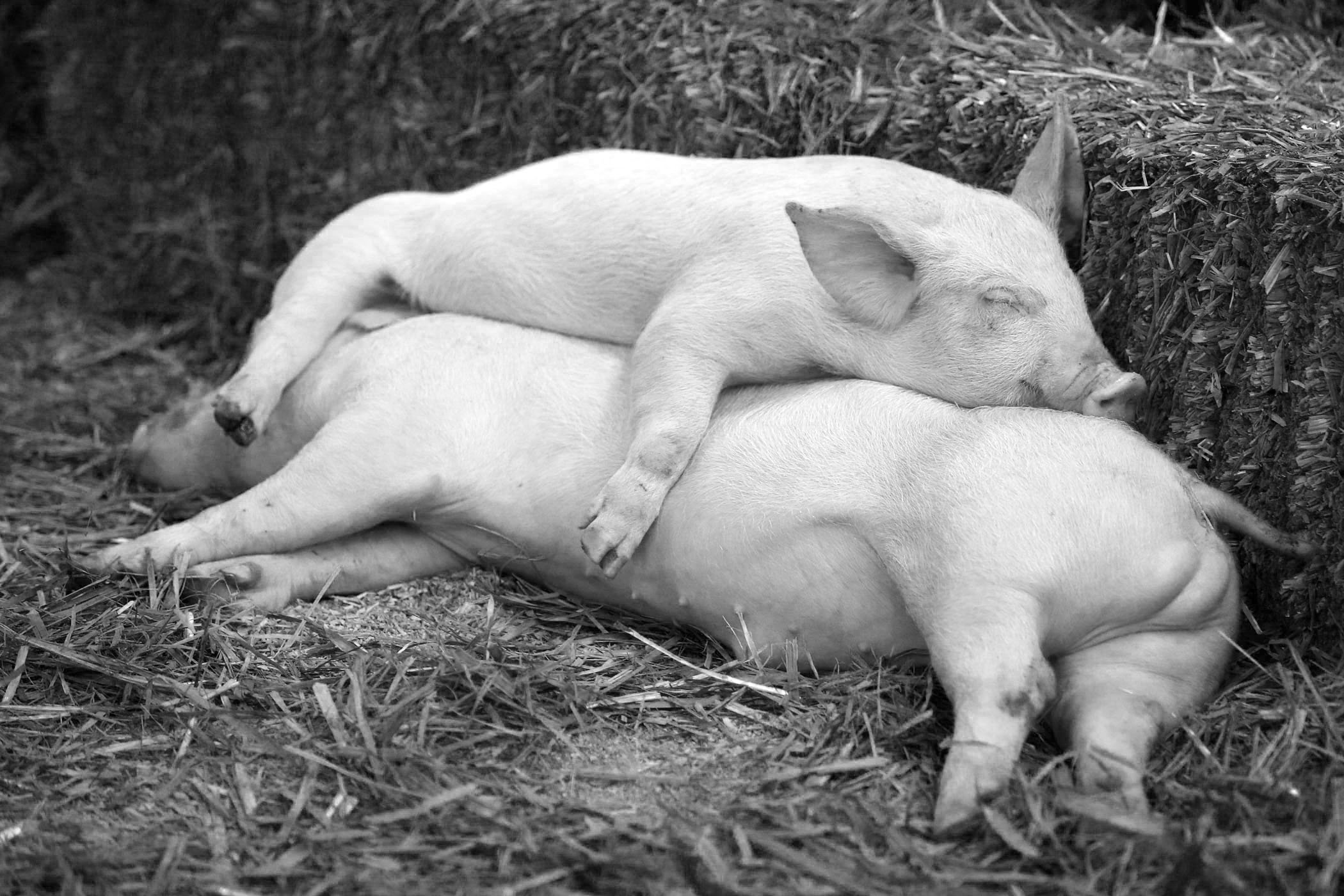
Next: Book Seven From Dandelion Series 1: The Reprimand.
Have any thoughts?
Share your reaction or leave a quick response — we’d love to hear what you think!
-
 3
3
-
 1
1
-
 0
0
-
 0
0
-
 0
0
-
 0
0
